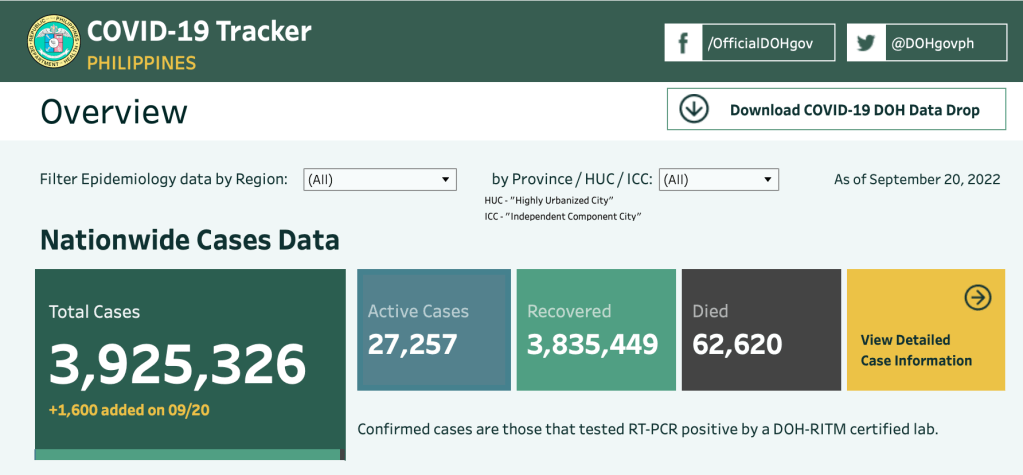
1600 new cases for the low Tuesday on 09.20.2022

The Health Agency announces 1600 new cases with 33 added deaths and 13.7% positivity rate. Of the cases on the low Tuesday, NCR owned 743 (46%) of the cases.

In NCR, two LGUs had triple digits – Quezon City 172 and Manila 109. Twelve LGUs reported double digits. These were: Caloocan 68, Pasig 50, Makati 48, Mandaluyong 42, Parañaque 35, Taguig and Valenzuela 33, Pasay City 32, Muntinlupa 31, Las Piñas 27, Marikina 25 and Malabon 20.

Outside NCR, only four provinces had more than 50 and less than 100 cases. They were: Cavite 97, Rizal 99, Laguna 52 and Bulacan 82.

Back to more than 3K cases with NCR owning 44% of the total on 09.19.2022 and the week in review

The week of September 12-18, 2022 saw only a slight decline in cases (-4%) compared to the week of September 5-11. The 14,707 cases from September 12-18 saw the Philippines draw a 7-day average of 2101 new daily cases (as severely under reported because testing was also down). Thee 248 new deaths during that week had 34 of them being recent or ‘fresh’ as these occurred between September 5-18.

Health care utilization was at 28.9% for non ICU beds and 24.1% for ICU beds. However, this data is a based on the over-all capacity of the hospitals in the country. Based on region, this will differ. For example, in the NCR, non-ICU bed utilization is at 42% (compared to the national utilization rate) and 28.34% for ICU beds (compared to the national utilization rate).

The Health Agency announces 3119 new cases with positivity of 13.1% and 38 added deaths. The NCR owned 1374 (44%) of the total cases.

Mega Manila saw 16 of 17 LGUs report double or triple digits. Five LGUs reported triple digits: Quezon City 314, Manila 170, Pasig 124, Taguig 114, Makati 106. Those with double digits were: Parañaque 88, Caloocan 72, Las Piñas 68, Mandaluyong 66, Marikina 59, Muntinlupa 47, Valenzuela 45, Pasay City 42, Malabon 23, Navotas 20 and San Juan 11.

Outside NCR, four provinces had triple digits. They were: Cavite 203, Rizal 161, Bulacan 121 and Tarlac 111.

Those with more than 50 but less than 100 cases were: Laguna 95, Batangas 87, Pampanga 55, Cebu 55, Davao del Sur 88 (with Davao City owning 29), and South Cotabato 62.

East Asia in review and the data for 09.18.2022

The Health Agency announces 2367 new cases with 13.2% positivity rate and 35 added deaths. NCR owned 1080 (46%) of the day’s cases.

All 17 LGUs in Mega Manila reported double or triple digits today. This was led by Quezon City with 221, Manila 135 and Taguig 122 cases. Double digits were reported by: Pasig 93, Makati 77, Caloocan 69, Parañaque 65, Mandaluyong 58, Las Piñas 56, Valenzuela 37, Pasay City and Muntinlupa with 30 each, Marikina 29, Malabon 16, San Juan 15, Navotas and Pateros with 12 each.

Provinces outside of NCR that had triple digits were: Cavite 146 and Rizal 114. Those with more than 50 but less than 100 cases were: Laguna 60, Bangs 50, Bulacan 78, and Davao del Sur 67 (Davao City owned 19).

THE WEEK IN REVIEW

The world in general is seeing less daily cases of COVID-19 (either unreported or under reported). Of those that remain reported, Asia accounts for 50-60% of the daily global cases with BA.5 and BA.4 triggering surges after surges as this part of the world remains the most conservative in the approach to mask mandates and reopening borders and economy. The global deaths from COVID-19, however, are at an all-time low since the pandemic began.

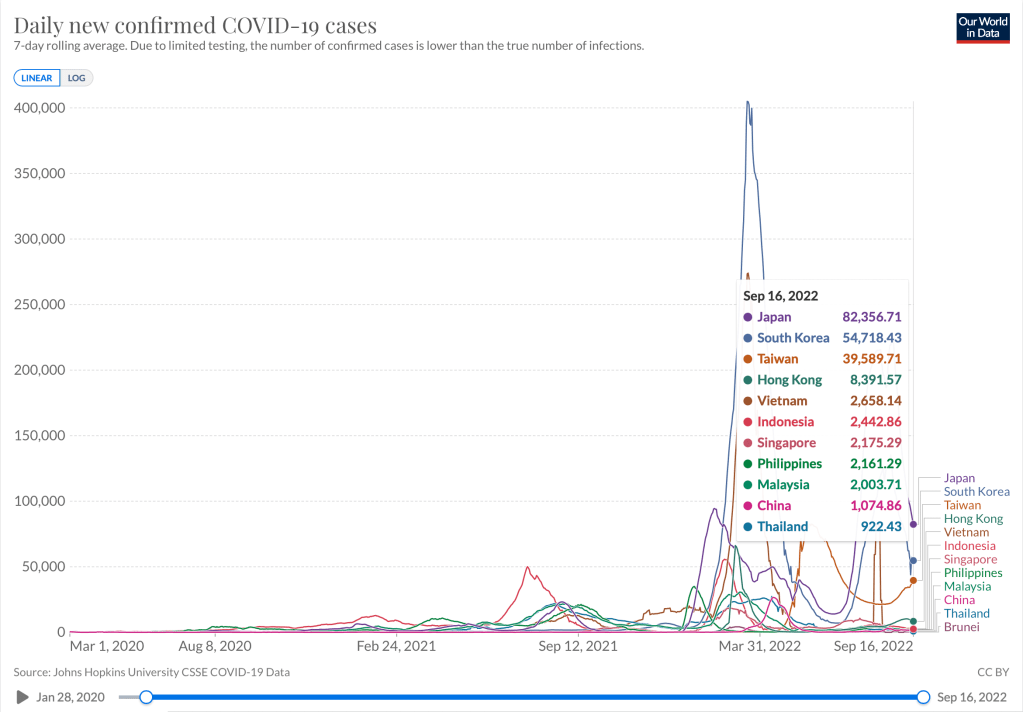
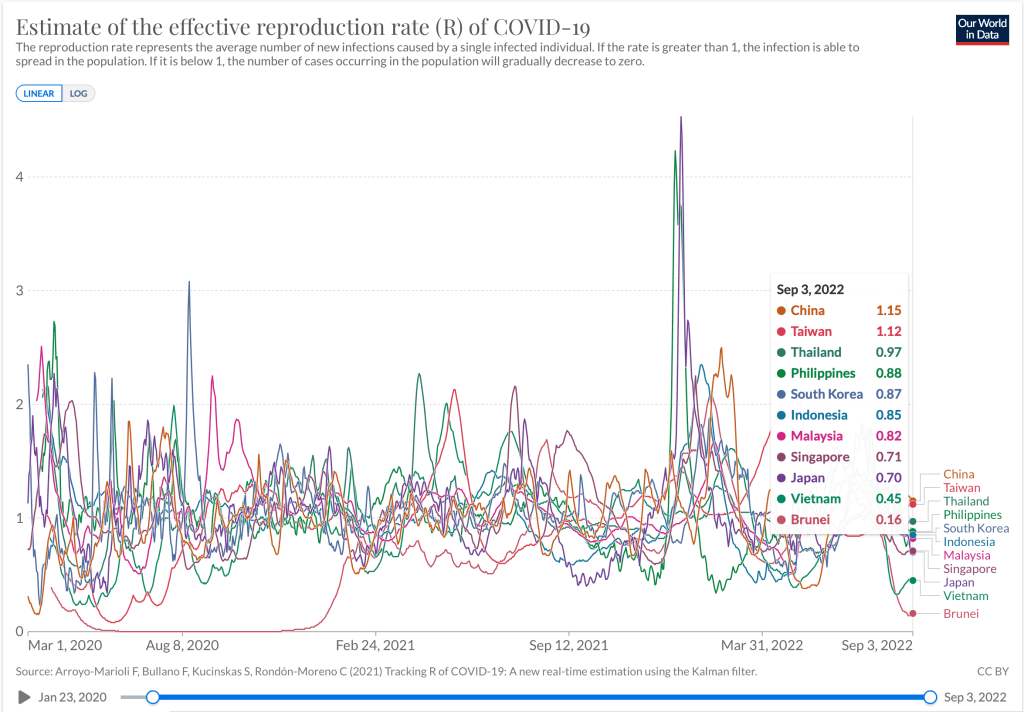
Which brings us to the data in East Asia this week, where most countries are seeing their numbers tumbling down. However, Taiwan and Hong Kong is on a re-uptick of cases as well as the Philippines and Vietnam, the latter two that are seeing a mild bump up in reproduction numbers and positivity rates.

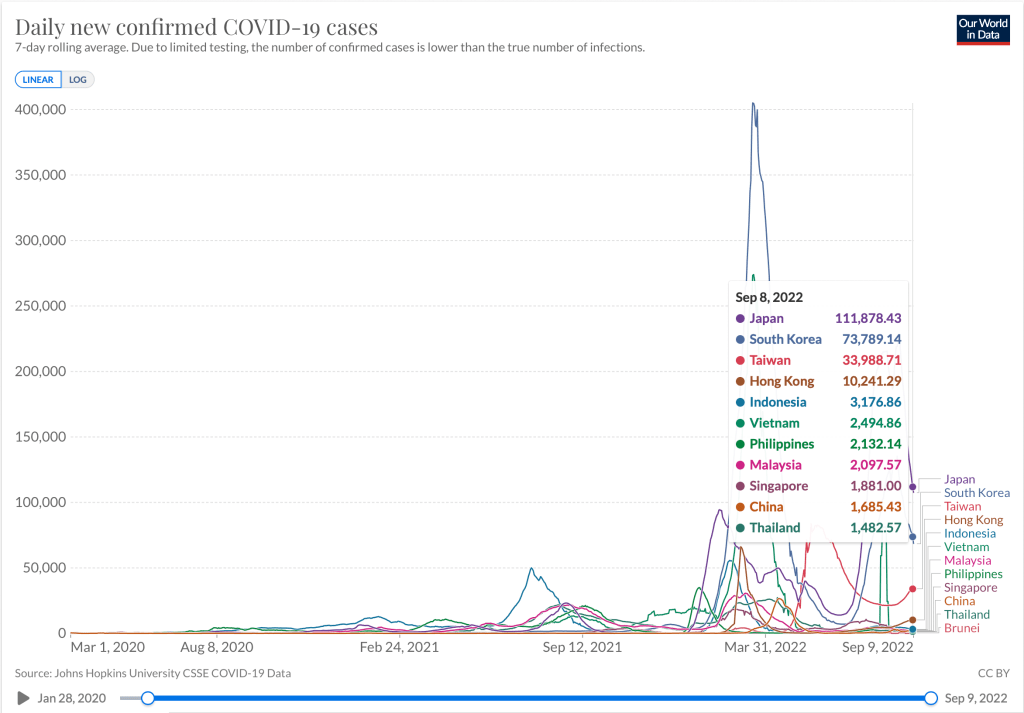
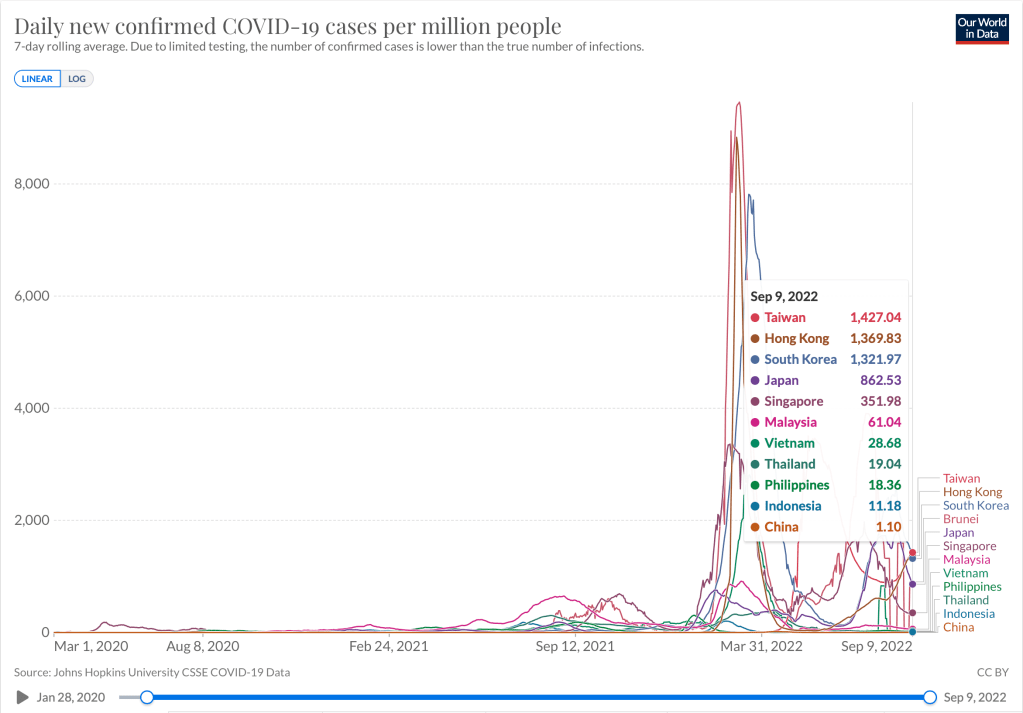
Japan, South Korea and Taiwan continued to lead the region with 5-digit numbers, but in terms of per capita (cases per million population), Taiwan, Hong Kong and South Korea lead with 4-digits per million population.

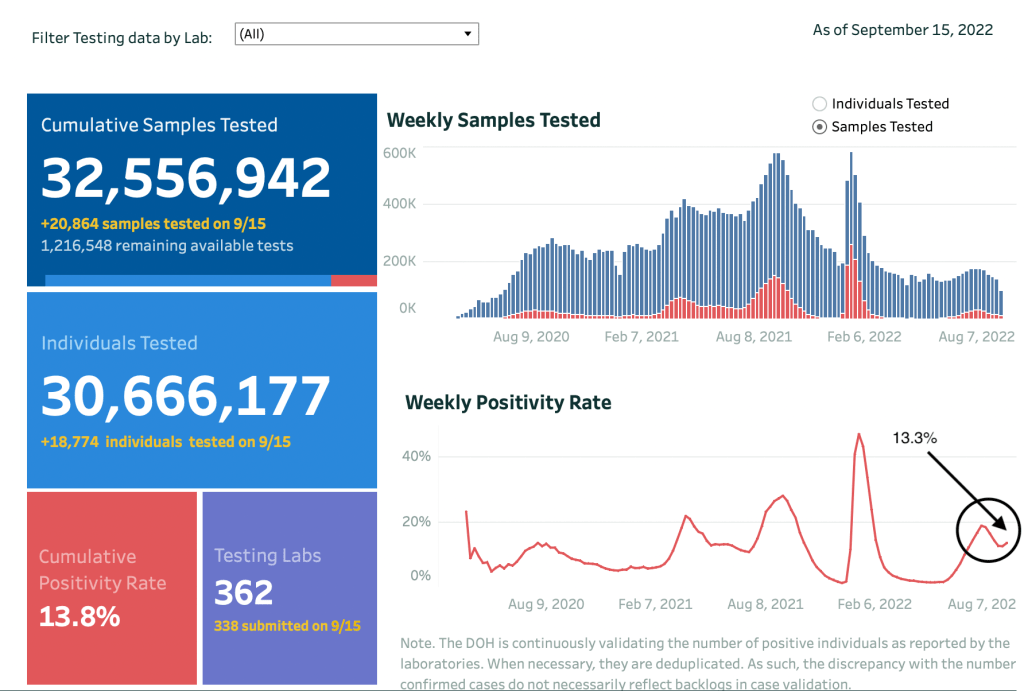
Reproduction rates in the region are slightly up this week in most of the countries in East Asia. The Philippines for example has a Rt of 0.95 (+/- 0.05), up from 0.85 the week previous. The Rt needs to remain low and continue to decline for 4 consecutive weeks for the cases to go down. Unfortunately, it has not stabilized consistently as the National Capital Region drives the uptick in cases in the country. Mega Manila alone has a reproduction number up at 1.23 (+/- 0.05) compared to other provinces in the archipelago, that are seeing a decline in cases. Testing is also at an all time low in the country as only those tested with PCR are counted.

Japan’s borders have now formally opened, but tourists should still be coursed through a Japan travel agency for now. In South Korea, while the border is open, all tourists are mandated to take a RT-PCR test 24 hours upon arrival. In Taiwan, a cap on the total number of arrivals remains in place and inbound passengers are still required to follow current CECC regulations of three days of home quarantine and four days of self-initiated pandemic prevention. In Hong Kong, all inbound arrivals are required to undergo 3 days quarantine in a quarantine designated place (home, hotel or other accommodation) and self-monitoring in the 4th and subsequent nights. A negative PCR is required on the day of arrival or within 3 days prior to arrival in Hong Kong. All visitors need to take a rapid antigen test on the second day upon arrival and if the result of the RAT is negative, must undergo RT-PCR for confirmatory (a reason I cannot understand, unless the patient was positive from the get go, then just have an RT-PCR without having to do a RAT anymore). Other countries in East Asia have eased their borders and require only proof of vaccination for entry to the country.

NCR owned more than 53% of the cases for 09.17.2022

The Health Agency announced 2275 new cases with 13.2% positivity and 35 added deaths, as the epicenter, Mega Manila now owned more than 53% of the day’s cases with 1199.

While the rest of the country is mostly seeing lower cases, NCR continued to haul in the largest contribution to the daily cases as highest mobility and density in the region continued to be the major factor for the re-uptick in cases.

Quezon City led with 289 cases followed by Manila 177 and Makati 117. Eleven other LGUs reported double digits: Pasig 89, Caloocan 73, Mandaluyong 70, Taguig 67, Valenzuela 61, Parañaque 59, Pasay City 50, Las Piñas 40, Marikina 34, Muntinlupa 33 and San Juan 19.

Non-ICU occupancy in NCR is at 40% while ICU utilization is at 30% as of today (however, hospitalization, like death, are lagging data).

Three provinces reported triple digits: Cavite 130, Rizal 114 and Bulacan 101.

Two provinces had more than 50 but less than 100 cases: Davao del Sur 92 (with 46 from Davao City) and Laguna 51.

2619 new cases with NCR owning ~50% of the cases for 09.16.2022

The Health Agency announces 2619 new cases, with NCR contributing to 48% of the cases for the day with 1251 cases (and under reported at that). The positivity rate in the country is up at 13.3%, mainly driven by the high cases from the epicenter – Mega Manila.. There are 32 added deaths today.

Because of the increasing cases in Mega Manila, several contingent provinces to NCR are seeing triple digits, including Cavite 125, Rizal 139 and Bulacan 135. Laguna reported 81 cases today. The travel to AND from the epicenter of the pandemic is disturbing because NCR is also the only region that has the highest vaccination rate, including boosters. Back to normal or business as usual is driving the upsurge in cases again, and this is unavoidable because people need to put food and their table as the peso plunges to its lowest value closing at P57.38 to the greenback for the weekend. The stock exchange also continued to slide.

In NCR, sixteen of 17 LGUs report double or triple digits. Four LGUs that reported triple digits were: Quezon City 268, Manila 198, Makati 113 and Taguig 111. Twelve LGUs with double digit cases were: Caloocan 81, Pasig 71, Parañaque 60, Mandaluyong 57, Las Piñas 56, Muntinlupa 50, Marikina 41, Pasay City 40, Valenzuela 30, Malabon 24, San Juan 23 and Navotas 18. Only Pateros had single digit of 8 cases.

Outside of NCR and the other provinces, only Davao del Sur had 50 cases (with 23 coming from Davao City).

This pattern is not unusual as classes have begun and face to face learning at the time of Omicron BA.5 will remain as challenge if the schools do not innovate and craft a more desirable hybrid learning and improve their ventilation in the learning facilities.

2141 new cases with NCR owning ~50% on 09.15.2022

The epicenter of the Philippines – Mega Manila – continued to report higher cases than other regions in the country, owning almost 50% of the cases today.

The Health Agency announces 2141 new cases with 12.7% positivity rate and 31 added deaths.

NCR owned 1002 of the cases, with 16 of 17 LGUs reporting triple or double digits.

Quezon City took the lead with 210 cases and Manila followed with 158. Fourteen LGUs reported double digits: Makati 99, Pasig and Taguig 74 each, Parañaque 61, Pasay City 48, Caloocan 47, Las Piñas 43, Muntinlupa 37, Mandaluyong 36, Valenzuela 34, Marikina 33, San Juan 16, Navotas 12, and Pateros 11. Only Malabon had single digit today (7 cases).

Outside of NCR, Cavite is back with triple digits at 102. Only four provinces had more than 50 but less than 100 cases. They were: Rizal 97, Davao del Sur 87 (with Davao City owning 30), Bulacan 76 and Laguna 67.

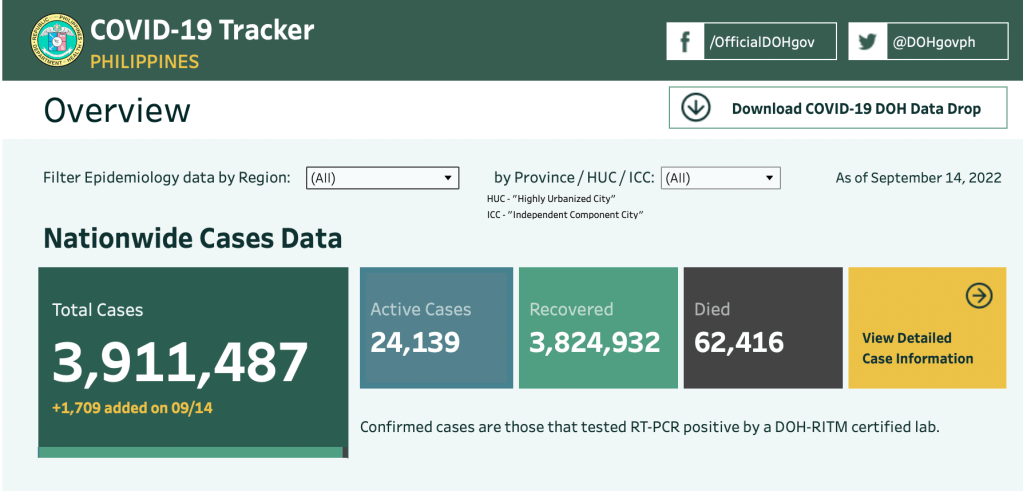
1709 new cases and 34 added deaths on 09.14.2022

The Health Agency announces 1709 new cases with 12.2% positivity rate and 34 deaths today. NCR led with 655 of the day’s cases.

Quezon City led the pack with 152 cases and the only LGU that carried triple digits. Twelve other LGUs in NCR had double digits: Manila 81, Pasig 59, Makati 52, Parañaque 43, Caloocan 40, Pasay City 37, Las Piñas and Marikina 34 each, Mandaluyong 32, Muntinlupa 30, Taguig 28 and San Juan 11.

Five provinces had more than 50 but less than 100 cases. They were: Cavite 79, Bulacan 77, Rizal 80, Laguna 50 and Davao del Sur 53 (with Davao City owning 18).

The low Tuesday with 1574 new cases and the data for 09.13.2022

The Health Agency announces 1574 new cases and 40 added deaths with 11.6% positivity. The NCR owned 665 of the cases for the day.

Two LGUs in NCR reported triple digits – Quezon City 158 and Manila 103. Twelve other LGUs had double digits: Makati 62, Pasig 50, Taguig 43, Caloocan 40, Parañaque 37, Pasay City 32, Mandaluyong 31, Las Piñas 26, Muntinlupa 18, Malabon 17, Marikina 16 and San Juan 10.

Only three provinces had more than 50 but less than 100 cases: Cavite 88, Bulacan 79 and Rizal 61.

The week in review and the data for 09.12.2022

The Health Agency announces 10% less cases the week of September 5-11, 2022 with 15,379 cases or an average of 2197 new daily cases compared to the week of August 29 to September 4 where were recorded 17,145 cases.

Severe and critical cases comprised 0.09% of the cases in the past week.

Number of deaths added was 300, but only 21 of them were ‘fresh’ (from August 29 – September 11, 2022).

Healthcare utilization is down to 28.2% this past week (vs. 29.3% the other week) for non-ICU beds while ICU bed utilization is slightly up at 23.9% (vs. 23.5% the other week).

There were 2038 new cases added today, with a positivity rate of 11.2% and 38 added deaths. NCR owned 810 (40%) of the cases for the day.

Two LGUs in NCR reported triple digits: QC 151 and Manila 109. Twelve LGUs had double figures: Makati 70, Pasig 66, Taguig 64, Caloocan 59, Parañaque 52, Mandaluyong 48, Pasay City 44, Las Piñas 31, Marikina 30, San Juan 25, Muntinlupa 24 and Valenzuela 22.

Outside NCR, the province of Cavite had 115 and Rizal 105 cases. Other provinces with more than 50 but less than 100 cases were: Laguna 59, Bulacan 80, Davao del Sur 63 (16 from Davao City) and Pangasinan 95 (12 from Dagupan City).

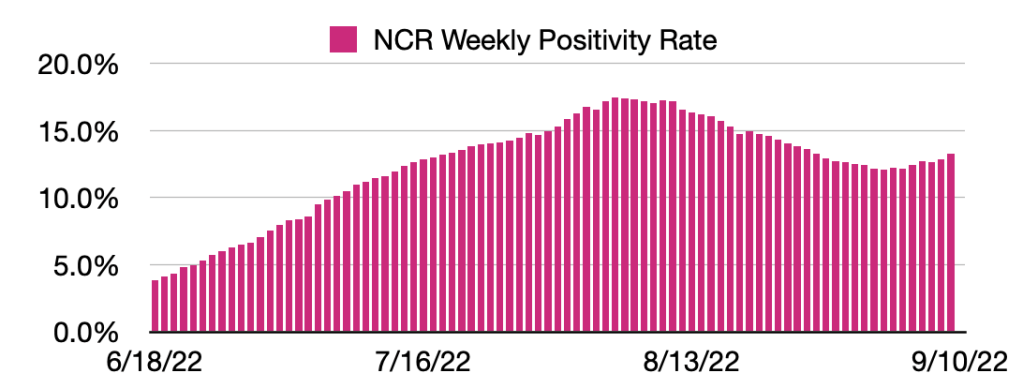
Notice that the positivity rate this week starts off at 11.2% compared to the positivity rate last Monday, September 5, which was at 9%. This means the cases are up, and so is the reproduction number.

East Asia in review and the data for 09.11.2022

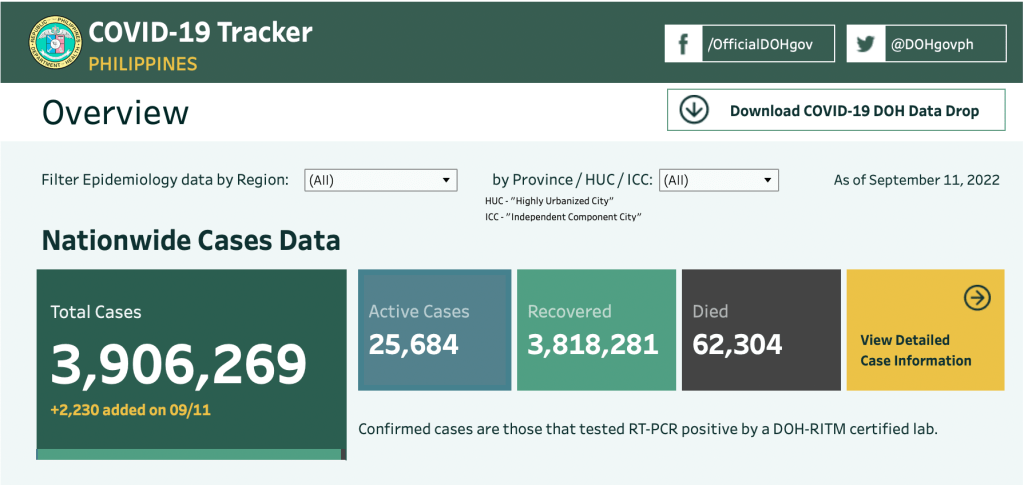
The Health Agency announces 2230 new cases with 12.3% positivity and 16 added deaths today. Almost half the cases today came from the National Capital Region (1056).

Two LGUs in NCR had double digits: Quezon City with 234 and Manila with 180. Thirteen other LGUs reported double digits: Pasig 91, Makati 70, Parañaque 66, Taguig 61, Las Piñas 57, Caloocan 55, Marikina 46, Mandaluyong 41, Valenzuela 41, Muntinlupa 33, Pasay City 31, Malabon and San Juan with 17 cases each.

Outside of NCR, Cavite and Rizal reported triple digits with 157 and 123, respectively.

Provinces with more than 50 but less than 100 cases were: Laguna 62, Batangas 62 and Bulacan 72.

The Situation in NCR

Prof. Guido David of OCTA Research provides a summary of the cases in the National Capital Region, the epicenter of the pandemic in the Philippines. Mega Manila will remain the epicenter because of its density and should be a reminder to government officials and those managing the pandemic in the country that this region is roughly only 620 km2 in land area but with a population of around 15 million people, has around 25,000 people per km2. Quezon City is the largest (161 km2) among the 17 Local Government Units (LGUs) in Mega Manila, with a population of more than 3 million. This translates close to 17,000 people per km2. Mega Manila is the 15th most dense city in the world [https://www.usatoday.com/story/news/world/2019/07/11/the-50-most-densely-populated-cities-in-the-world/39664259/].

As we saw cases continue to decline in the middle of August, the past week has seen a few days where the weekly positivity rate in NCR had begun to climb up and the cases move upward as well. This coincided with the resumption of face to face classes (coincidentally or not). The reproduction rate in the Philippines hovers around 0.9 (+/- 0.05), up from a Rt of 0.82 last week. But it is NCR that breaks the Rt of 1.0 to close at Rt of 1.15 (+/- 0.05) as of yesterday, September 10, 2022.

While the economy is pushing to open on all sectors, the masking mandate is also being rushed. With the current inflection of cases, it is advisable to keep the masking mandate at status quo, considering that only a small percentage of the population has taken advantage of even getting a single booster. On a more serious note, I don’t think the mask has any effect on the economy fully opening and serves as a reminder and caution, that the pandemic is not yet over.

THE WEEK IN REVIEW

East Asia continued to contribute to more than 55% of the global cases of COVID-19 this week, with countries like Japan and South Korea seeing falling numbers but Taiwan and Hong Kong seeing rising cases. The Philippines has seen a bit of decline compared to the previous week, but the data should be interpreted with caution because many do not have RT-PCR done anymore. As noted in the Philippines data, the number of deaths is unusually high as reported cases continue a downward trend (except for yesterday). This unusual trend only points to the fact that we are under testing and under reporting actual COVID-19 cases. Under testing and under reporting is not only providing false information of the true COVID-19 situation in the country, but also making people complacent on minimum public health standards, premature calling to remove face mask policies and not wanting to get booster vaccines against the virus.

Based on population size (per capita), Taiwan and Hong Kong now overtake Japan and South Korea with the highest cases per million people.

The reproduction rate remains above 1.0 for both China and Taiwan, with Singapore, Vietnam, Japan and Brunei seeing a massive improvement in their Rt. This means that China and Taiwan will continue to see increasing cases in the upcoming week, while countries like Singapore Vietnam, Japan and Brunei will continue to see a decline in their new COVID-19 cases.

The Philippines has an Rt up at 0.9 (+/- 0.05) from a previous of 0.82. Again, to reiterate, one will need to see a lowering of reproduction rate for 4-8 weeks in order to drive the numbers down. Seeing a Rt of 0.5 and below is the ideal situation. A Rt that is not sustainable in decline is dangerous, as this reflects under reported data, delayed data, under testing in the country or environmental and social conditions that will affect the actual cases in the country. Mega Manila, the epicenter of COVID-19 in the Philippines has a Rt at 1.15 (+/- 0.05). This means that even if the cases in the Philippines declines in the upcoming weeks, the NCR will now own even a greater majority of the share of cases and will contribute to the higher cases in the coming week.