Two words: ‘advance directives’

“You cannot prevent the birds of sorrow from flying over your head, but you can prevent them from building nests in your hair.”
Old Chinese proverb

One of the most difficult questions those in the medical profession ask during a continuously deteriorating clinical scenario is, “Does XXX have any advance directives?”

What is an advance directive?

“An advance directive is a legal document that outlines your preferences for medical care if you become unable to speak or make decisions for yourself due to a serious illness, injury, or coma.”

The following are usually a form of advance directive:

  1. Living will – a written document that specifies the treatment you want or don’t want when you are terminally ill or permanently unconscious
  2. Healthcare power of attorney – a document that designates a trusted person (proxy, surrogate) to make medical decisions when one becomes incapacitated
  3. Do not resuscitate order – a specific medical order from a physician based on the wishes of the patient or family, instructing other healthcare providers NOT to perform CPR when breathing or heart beat ceases
  4. Physician/Medical orders for life-sustaining treatment – an actionable medical order that translates your advance directives to standardized instructions for emergency and medical staff

Most of the information in these will contain:

  1. Life support preferences – ventilatory support, artificial nutrition and hydration tubes (including specific medications that may or may not be vital to sustaining life)
  2. Pain management – instructions on palliative care and acceptable pain-relief medicines
  3. Resuscitation – whether to do CPR or defibrillation
  4. Additional wishes – organ or tissue donation, and other religious or spiritual care when the time comes

I write about this as I see patients whose parents or friends and relatives who when I need to address their medical concerns, have difficulty in discussing the topic of advance directives.

I personally feel that this is something each and every one of us must make while many of us still have our mental faculties intact. While it is a topic that many Filipinos refuse to discuss, it is one whose time has come. Rather than discussing issues on Artificial Intelligence or the latest gadgets available or political turmoil or the economy, or even healthcare costs and benefits, I strongly feel that advance directive is an important conversation every physician must make with those they care for, especially those who are critically and chronically ill.

It protects personal autonomy by ensuring that our personal beliefs, values and wishes are honored even when you are unable to make decisions for yourself anymore.

It relieves family burden when having to make critical end-of-life decisions as this places a lot of stress, guilt and agonizing ‘what if’ moments to loved ones.

It reduces family conflicts who eventually disagree on the treatment of an incapacitated family member. Placing explicit instructions in writing to a proxy helps alleviate this confrontation.

It guides healthcare providers on the actionable boundaries on whether to aggressively intervene or focus on providing comfort and aligning with best care plan with patient goals.

It prevents unwanted or over-aggressive care. Prolonged, painful, or unwanted medical procedures in permanent or terminal conditions result in unnecessary emotional and financial costs to the family and to the healthcare system.

There is no easy way to discuss this with patients but it is a conversation that must be brought up with empathy, clarity and sensitivity.

Aside from these, it’s always good advice to colleagues to:

  • Choose calm settings – speak in private, quiet room, away from public and loud places
  • Validate the stress the family or loved ones are going through now. Acknowledge that the current setting is overwhelming and that there is some news or update that may not be good and that while it is difficult to impart, it needs to be said and everyone needs to be more prepared.
  • Frame it around the patient’s voice. It’s not about YOU. It’s about the patient. The goal is to honor what the patient would have wanted and not place the burden of choice on the family.
  • Involve other specialists when needed – a priest, social worker, or palliative care team to join the conversation especially if the family is struggling to process the medical updates.

I’ve done this playbook several times and it’s really never easy to talk about grief when the person is still physically here with you. The compassion and empathy must be there when you share the bad and sad news.

There is never a painless goodbye.
The decision makers

One of the most difficult jobs in my over 40 years of medical practice is giving a patient or their family the bad news.

It’s never easy to break it to someone that an untoward ending is inevitable. The problem in my field of practice (Pediatrics) is whom you disclose sensitive and delicate information to. The worst part, is who decides their ultimate fate?

I’ve had several teen patients who lost their battle with leukemia in the past few weeks. While it was the oncologist who was managing the primary disease, I was at the other end trying to control the infection. With the infection under control, it would be a continuous cycle of the disease fighting to gain an upper hand in the battle for life. With the vicious cycle, the patients eventually succumbed to the disease.

In one case, the patient insisted to the parents that he knew what his chances were after going through so much in the past years after relapsing. In the final family conference, he insisted on being involved in the decision-making. For some doctors, it would be best to confuse the patient with valuable information by just using medical jargon. At least that way, it would be less painful than having to tell the truth in words he would have understood.

I let the attending do the talking.

It wasn’t easy. But this is not the script.

Your leukemia is in relapse. Your labs are not good. They show a bone marrow that is generating a lot of white blood cells. The fact that you are in relapse and have super high white cells makes the situation very grim. Organ failure will set in, you will bleed, infection will be uncontrollable even before or after chemotherapy. In my mind, I wanted to say, you are dying.

How do you tell a 13-year-old that his time is up and that he was dying?

Good job for a battle well fought.

Spend time with your loved ones at home and provide palliative care.

Death with dignity, quality of life and comfort should be the goal. Emotional and spiritual support should be provided to everyone.

I was surprised that the patient actually wanted to go home. After hearing what needed to be said, he was quick to process this and the parents respected his decision. To die at home.

Then there was the other 13-year-old who had a similar disease and prognosis.

The parents and grandparents were aggressive even when we knew the outcome would be futile. One of the family members is a doctor and was hopeful that the boy would go through this bump in the road. They were all out and hoping that after this episode, they would opt for a bone marrow transplant.

This boy never asked questions.

He was never included in any decision-making process. He never asked as well.

He passed on in the hospital less than a week after being re-admitted.

I pose these two similar scenarios, one where the teen is part of being a decision-maker and the other, where the parents and grandparents are the ones.

Because this is a deeply complex intersection of law, medicine, and ethics, decision-making is collaborative and breaks down into specific roles. The 13-year-old is still considered a minor and while he cannot give consent, he can ASSENT, meaning he can actively agree to or cooperate with the medical plan. Pediatric ethics require clinicians to explain the diagnosis and treatment options in age-appropriate terms and seek the child’s agreement.

There is a difficult road in medicine, and when the time comes that you meet that fork on the road, compassion, care and considering who decides when it is time to let go, must be shared when it can and is appropriate.

As doctors, we can cure sometimes but comfort always.

We are not gods. There is no happy ending in death.

Grief will always stay on as a reminder of our mortality.

Silver years

A couple of decades back, I traveled to explore. Find new countries to learn the culture, enjoy the scenery, and take a break from all the work and stress of daily life.

The tick box on which countries I have traveled to were now filled up.

My favorite traveling companion was my mom. Of course, while we didn’t enjoy the same taste in lifestyle, to her, getting the chance to see the world was everything. To me, getting the chance to be with her was everything.

They say that as we age, many things begin to fail. Hearing, eyesight, health, and finances.

What once to be a flurry of birthday greetings are now an avalanche of sympathies and prayers.

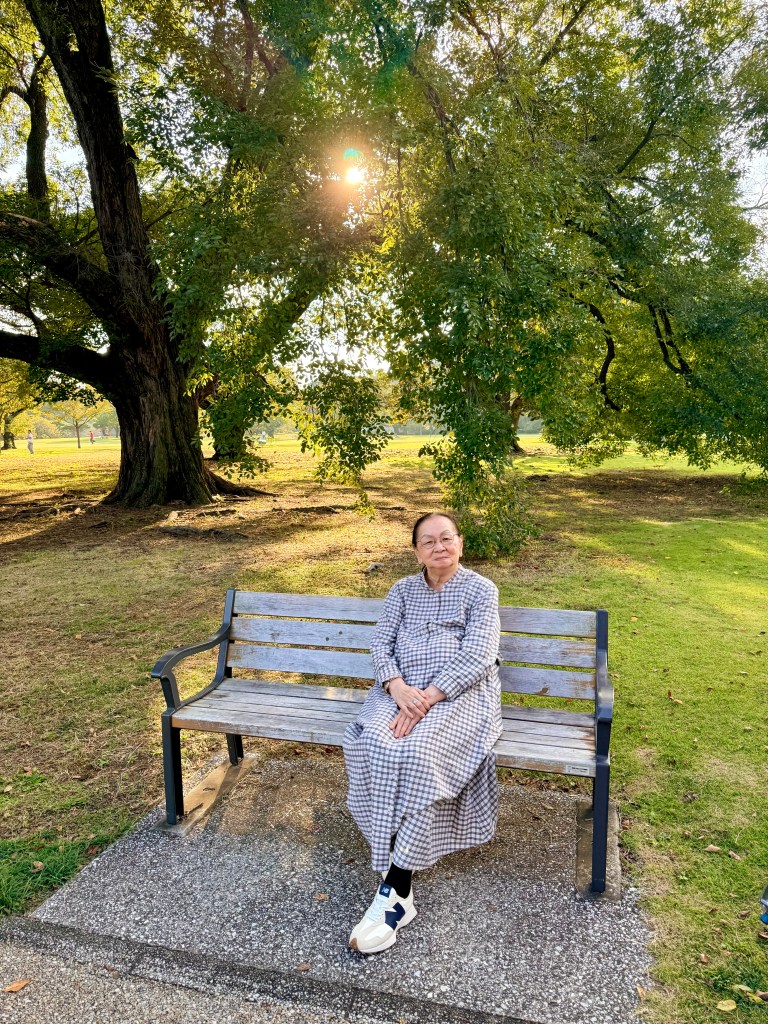
To say that traveling with a 90-year-old who is ambulatory challenged is not easy is an understatement. As I always tell my friends, if there’s a will, there’s a way. The most important part of the travel at this age (and mine) is not just getting from point A to point B but HOW to get from point A to point B. The experience for those of in the silver years is not just about itineraries. It’s just being laid back and enjoying the small luxuries that we have worked very hard for, and the company we keep. At the end of the day, we will not be able to look back at what we could have done but rather at what we did and smile back and say, mission accomplished.

We’ve been to Japan so many times that my mom calls it her “favorite place on Earth”.

And upon request, this autumn trip to Tokyo reminds me that in the silver years of our life, autumn will always depict those years of wisdom, comfort and peaceful reflection. It serves as the visual metaphor for the beauty of impermanence and embracing personal transformations.

Peace and tranquility during those silver years…

The year of the Earth Pig

If you’re born in the year of the pig, this is not going to be your year.

More often than not, the bad news is that it’s usually a “challenging” year for those born in the animal year of the lunar calendar.

A bit of history

According to mythology, the Jade Emperor had invited 12 animals to his feast. The pig overslept and was the last to arrive at the banquet. That is why he was (and is) the last among the zodiac animals in the Chinese calendar.

If there is one tradition that Filipinos observe, it is the Chinese Lunar New Year.

Here’s a bit of trivia

Unlike the Roman Calendar, the Chinese calendar is lunisolar – meaning, the years, months and days follow an astronomical observation based on the sun’s longitude and the moon’s phases. Days begin and end at midnight. Months begin on the day of the new moon (hence the term Lunar Calendar). Years begin on the second (or third) new moon after the winter solstice.

A common year has 12 months (353 to 355 days) while a leap year is 13 months (383 to 385 days) in the Chinese calendar.

There are two components to the Chinese Zodiac. Because the Chinese calendar does not count years in an infinite sequence, every year is assigned a name with two components that run over a 60-year cycle. The first component is called a celestial stem: Wood, Fire, Earth, Metal, Water. The second component is a terrestrial branch. Here is where the names of the animals in the zodiac cycle appear (in the following order): Rat, Ox, Tiger, Rabbit, Dragon, Snake, Horse, Sheep, Monkey, Rooster, Dog, Pig. Each of both components are used sequentially. For example, the first year of the 60 year cycle is Jia-Zi or the wood rat, the second is Yi-Chou or the timber/wood ox, etc. One starts from the beginning when the end of a component is reached. And the cycle begins once more. The 60th year in a cycle is always called Gui-Hai or the year of the water pig.

The pig is the Yin (the dark swirl) in the Yin-Yang balance. The Yin is the dark, negative and feminine side of that balance. In Chinese culture, obesity or being fat is a symbol of wealth. Hence, the pig being regarded as a symbol of prosperity and wealth. The big ears of the pig are a symbol of long life as well.

The good news and the bad

As a general rule 2019 will be an auspicious year, because the Pig attracts success in all spheres of life. It will be a year of friendship, love and joy for all the zodiac signs.

Those that are considered to have good fortune this year include: the rat, the rabbit, ox and a recovery for the dog from their tumultuous 2018. (I can’t wait for February 05!).

Those where the year of the Pig will be challenging include those born in the year of the Pig, Tiger, Dragon, and the Snake.

The other animals will have a year under the influence of chance.

We all want to have lady luck on our side. We look forward to predictions in the hope that our future turns around for the better. I always tell my friends that the various “predictions and horoscopes” provides a general overview on how you can manage the coming year with fortitude.

Life, after all, is how we make it.

You can ask the universe for all the signs you want, but ultimately, we see what we want to see when we’re ready to see it.

The winters of our life

The heady December air is double bladed. While it has a festive side, it also reminds us the onset of a bitter, dark, and cold season.

While tropical countries like the Philippines get to enjoy two seasons – wet and dry – whole year round, the four seasons in other parts of the world are symbolic of the cycle of life.

With winter comes longer nights and colder days. Nature has its way of teaching us that everything in life has a time to shut down. The end of each day alone is a winter phase in our life. A time to rest. To recover. To recharge.

Winter is the end of a cycle. Some will die, while some will survive into the coming spring. As we age, the cycle of the winter metaphors of our life seem to come more frequently. It’s a sad yet lonely reality.

As I hold my cup of warm coffee on a gloomy December dawn listening to the chirping birds amidst the lighted up Christmas tree, I cannot help but think of those whose christmases will not be merry and bright. Those who mourn the passing of a loved on, missing a family because they are thousands of miles away and working this long holiday, watching over a sick relative fighting for their lives, having to care for the frail loved ones who cannot even recognize them anymore…

From where I view the ornaments on the tree and the gifts beautifully wrapped underneath it, there is a feeling of loneliness, of missing a loved one, that this Christmas not everyone will be here to share that joy. The ambivalence is ironic, yet real.

We all have stories on the winters of our lives…

It is a reminder that the other seasons of our life should be harnessed and cherished. They are footprints that guide us through the winters of our life.

The stories of our life

Everyone has a story.

There will always be drama and comedy, poignancy and fairytales, love and fantasy in each of our stories. After all, only we write them.

In life’s twist and turns, the outcomes may be in our favor and considerably be rewarding. Other times, life is unfair.

We are all bad stories in other people’s life. Some people won’t own up to reality and issues that they create. No matter how laid back and cool one is, there will always be that one person who doesn’t like you for no reason.

I write this to remind everyone that we should also have understanding and empathy and sympathy with our fellow men. After all, we are all actors in this life. And each of us have a version of life’s story.

In the local mini series Maalaala Mo Kaya (Can you Remember), the stories of our lives are weaved, remembered and recreated. This mini series is a beautiful reminder that we make our own stories in our lives.

Appreciate where you are in your journey even if it’s not where you want to be. Every season serves a purpose.

In the end, only three things matter: how much you loved, how gently you lived, how gracefully you let go of things not meant for you.

Let’s make sure we write it well. Edit often. And celebrate it!

Living without regrets

Many of us live life with over a hundred regrets. As a child we’re filled with a million dreams. As we grow older, some of these become fulfilled…others are left as dreams, or fantasies.

Then comes a point in our lives where we make bucket lists. Hurrying up to make up for lost time with the “what if” moments.

The list above is not exhaustive. After all, what is said and done is forever gone. There are decisions made or deeds done that cannot be recovered.

We often wish we could have made amends while the person we care for is still alive. But time was not on their side. One day they are with us. Tomorrow, they’re not. How we wish that if we could just have had one more day to spend with them, we’d be willing to trade anything just to have that moment back.

As you’re reading this blog entry today, take 60 seconds and think of how you’d like to live a life without regrets.

Remember – in the end, we only regret the chances we didn’t take, relationships we were afraid to have, and the decisions we were too afraid to make.

Stay happy. Life is about moments. Don’t wait for them. Create them.

November 1

All roads lead to the cemetery. This year, it’s a very long weekend.

In the Philippines, I remember that during the growing up years, All Saints and All Souls Days are a mini reunion at the cemeteries. Family members would gather in droves, staying overnight, bringing food, mahjong tables, books, tents, and other recreational stuff. We would walk the whole cemetery reading epitaphs of other people, say a little prayer for our deceased relatives, and spend the day(s) binging on food and stories.

As we grew older, the number of family members going to the cemetery. A few were too busy with work and began chasing careers. The others had passed away and the cemetery eventually became their home. Others migrated and never came home again. I guess the changes in life has changed the way we celebrate the way we commemorate the day of the dead.

While people move on, there is a part of us that will never forget how important some memories are. Some day, we will all meet our maker. In the meantime, life goes on.

We’re all going to die

…but what you do before that happens is what matters most.

I am writing this for a friend whose mother was diagnosed to have cancer. The family wanted her to undergo surgery, chemotherapy and radiotherapy. After two cups of tea and a cup of tears, she asked my opinion.

I told her I had none.

I was sad. And wouldn’t want the same kind of situation where one would have to decide on matters where the heart and the mind collide.

As healers we want what is best for our patients. We offer the best treatment options, health care and assurance. Medicine, after all, is not a perfect science. We work with odds, weighing benefits over risk. We work against odds, with scarce resources and that will to survive.

I told my friend if she had asked her mother, what her wishes are. After all, her mother is educated and should be informed at the options available to her. Unlike many Filipinos, their family does not need to hurdle the financial obstacle. Cancer therapy today has made strides in not only minimizing side effects, but in improving survival rate as well. Cutting edge technology in medical science has altered the landscape on how we address diseases today.

She told me that her brothers and sisters wanted the best care and that the doctors had explained to them the outcome. In spite of the poor prognosis, her mother would probably have 6-12 months more. Or longer. The outcomes were unpredictable and based on various variables. She would have to contend with some side effects with treatment. Without treatment, the outcome was grim. But the children wanted their mother to receive the best treatment. And to be given that chance to battle her disease.

It would be another day before I saw the family. It was a somber meeting. Because I was the pediatrician of all her kids, her mother wanted to hear my opinion.

I told her I wasn’t sure of what to say except echo what the doctors already confirmed. Held her hand and asked her, what would you like to happen?

She smiled back and told me, she was ready.

The quality of life would be intolerable. She was tired. And she had seen other members of the family go through cancer treatment. She told me that she would just be procrastinating the inevitable. There would be time. To make amends. To enjoy life as life should be. To be able to finally fulfill her bucket list. To go with dignity and peace. Then she asked me, “if you were in my shoes, would you still pursue the treatment options”?

I smiled. Held her hands. Then hugged her. And she knew my answer.

That was a year ago. Without any treatment she lived another year. Battling pain and living life. They buried her a week ago. A celebration of life, love, and the choice to live …and die with dignity.

You see, we’re all going to die. But what you do before that, matters most.

Dear self

There are days that you have no one but yourself to depend on. Not even your parent(s) or relative(s) or better half will understand. Those days when opening your mouth or providing an opinion can hurt someone you love. There are just those days when you need to be alone. Go somewhere far. Escape the madness of life. Only to be whole again.

I’m sure you all know what I’m talking about. It’s one of those days when you really just want to sit at the window and look at the sunrise holding a cup of coffee in one hand and just watch the day go by. Or curl up with a bag of chips, a good book and stare at the sunset. Or listen to sad songs and cry.

There is nothing wrong with taking a break from everything and concentrating on yourself.

You are not responsible for fixing everything that’s broken.

You don’t always have to try making everyone else happy. Make your own happiness and peace of mind a priority.

And it’s not being selfish when you deprive someone your attention when you need to find some moments of sanity.

Sometimes, when you get too embroiled in other people’s lives or stressed at making ends meet…you get to miss yourself. Taking a personal day off from the humdrum of life is being kind to oneself. We can, after all, only heal when our weary body and soul rests from all the pain.

Dear self. It’s just you and I today. Let’s make this the best day of our life. Reset. Recharge. Rewind. Repeat.