The sins of Rodrigo and Ferdinand…

I rarely blog on politics.

This, is that rare occasion.

This is a personal opinion from my pulpit. After all, it is a fact that I had lived my life with both Ferdinand and Rodrigo as presidents of the Republic of the Philippines.

FERDINAND

Ferdinand Marcos was a brilliant man. Greed was the reason for his downfall.

Martial Law was declared in order to perpetuate him in power. He used the opposition and the rebels as an easy excuse to declare Martial Law. In the beginning, it may have served the purpose of quelling the ‘threat’ of the Communist Party of the Philippines. But the one-man rule lasted for fourteen years. Martial Law gave birth to shifting power from the people to the military. While Ferdinand was elected president in 1965 and presided over an economy that grew during the beginning of his term, his 20-year rule would end in the loss of livelihood, extreme poverty, and a crushing debt crisis. Even when the family was exiled to Hawaii, the loot they carried from the Philippines and documented upon entry in the US was enough to feed a whole country. Considering how much a president’s monthly salary was in those days, even staying on as president of the country for his lifetime would not have amounted to being able to buy a building in New York (which would eventually be bought by Donald Trump) or wifey Imelda owning jewels or going on shopping sprees just for the heck of it.

The Marcos years were turbulent ones. When you had become his (or his wife’s) enemy, you’d be tagged as an enemy of the state. And people were afraid. No one dared to say anything about Ferdinand or Imelda.

The bailiwick of the Marcos is the north of the Philippines. They call it the Solid North. The only compass in that area (and the story of Rodrigo later on), would point the reader to why parents in politics prepare their children for that same role. The dynasties created do not provide a change of the guards to keep the businesses growing. The conflicts of interest propagate a deep cultural behavior among clans and small kingdoms created by local government units that collide, connive and collude with one another.

While Ferdinand Marcos may have had stellar moments at the beginning of his political career, avarice became too enticing to resist. If there is a story that is unforgettable in the eyes of the Filipino people, it was the story of Martial Law. I recall my father reminding me that we should not even mention the names of Ferdinand or Imelda during any outdoor conversation because the ‘walls have ears’ and that the Philippine Constabulary had people that were listening in on everyone’s conversation. That was the kind of fear that was instilled among those who grew up in the generation of Ferdinand.

The EDSA revolution created a sense of ‘woke’ among the Filipino people. With unrest even in the military ranks, it became inevitable that the chapter on Marcos’ reign was coming to a close anytime soon.

The People Power Revolution in 1986 paved the way for a new successor, through a non-violent revolution, to succeed the ailing dictator. The family of Ferdinand fled the country, and true to their nature, with loot in tow as they left.

A new dawn came for the Filipino people.

ALL BEGINNINGS ARE HARD

With a new slate, Corazon Cojuangco Aquino, needed to put order back from chaos. She became the 11th president of the Republic of the Philippines.

A constitutional convention replaced an abolished government. It was during her term that the 1987 constitution was written.

A country in deep debt and political crisis had to rise from the rubbles. After two decades of political machinations and corruption, it would take the country the same amount of time to resurrect from the ashes. In the meantime, the political parties left by Ferdinand remained intact. The lords did not die. With the wealth amassed by the political allies of Marcos during his presidency, the political families went underground and used that wealth to regroup, establish business enterprises and resurrect in or as another political party.

They say that there is no accountability in politics. When the term of offices of politicians come to an end, one is punished while another one forgiven. That amnesic disease would be played over and over the next three decades after Cory became president.

The Marcoses would be allowed to return to the country in 1991 by Cory herself, to face charges of tax fraud and corruption. After all, the crimes committed could not be prosecuted in a different country, even from Big Brother Uncle Sam.

By the time they returned, the tumultuous term of Corazon was coming to an end. The popularity of the yellow brigade was at a low ebb. While Cory was cheered at the beginning of her term as an icon for a new democracy in the Philippines, her lackadaisical stance and distrust of people she felt threatened by, pushed her to the brink of several coup attempts that would jar her monumental rise to power. During the term of Aquino, a new TradPo (traditional politician) had risen. However, the class D and E remained at the bottom of the rung. Even at the property of Cory’s family – Hacienda Luisita – the issue of Land Reform Program among the poor remained unaddressed. At the end of her term, her anointed successor, Fidel Valdez Ramos would win by a hairline to Miriam Defensor-Santiago.

Over the years, the Marcoses returned to power, slowly but surely. First stop was in their own hometown where people would undoubtedly put them in political positions that would later on catapult their solid return to national posts. This calibrated patience is what politics is all about. They worked at the back end like the late Ferdinand. The Marcoses did not only have that patience, but the financial and political backing to return to power.

The blame goes to the inept judicial system of this country. The very slow roll of justice to Martial Law victims was akin to an ant on an expedition from Batanes to Jolo.

Several presidents and corruption laden governances later, the people slowly forgot the story behind EDSA. The millennials, GenX and GenZ mostly do not recall Marcos’ legacy and the painful beginnings of a new democracy. People Power Day, while a public holiday in the country would lose its meaning and be left as just another day of rest and recreation.

A forgiving, nah, forgetful people is how the Filipinos turned out after ousting Joseph Ejercito Estrada, the 13th president of the Philippines, whose corruption laden plunder triggered his short lived stint as the chief executive of the country. Gloria Macapagal-Arroyo, the Vice-President at the time of Estrada would abandon him and succeed him after a second People Power Revolution (albeit, a smaller one) would ‘overthrow’ Estrada. Estrada would be incarcerated because of plunder but would later be pardoned by Arroyo.

Gloria Macapagal-Arroyo became the 14th president of the Republic of the Philippines and the longest serving president in the post Marcos era. Three years of the remaining term of Estrada and winning the next national election would put her into power. A coup attempt before her term ended gave rise to the political careers of the mutineers after the term of Arroyo. An election scandal with leakage of the “Hello Garci” tapes would make Arroyo apologize on national TV for the controversial elections of 2004. But she would not step down.

It was Cory’s demise that won the election for her son NoyNoy or PNoy (Benigno Simeon Cojuangco Aquino III) as the 15th president of the country. With an outpouring of support for the late Corazon, NoyNoy would trump all other candidates. And while PNoy had the best and brightest in his cabinet, corruption allegations hounded his term as well. Like his mother, he only trusted a circle of friends. The opposition would be a minority and the upper and lower law making chambers down to the smallest local government unit would throw their political support to his party. The bungling of the Mamasapano massacre was the sterling highlight of his political career. A sad ending to good beginnings.

While PNoy made Arroyo accountable for the mess she left behind, her incarceration was more of a zarzuela. And the next president, like all previous presidents would end up pardoning the sinners.

In all those jump start years of every president, one sore thumb stood out at each closing. The class D and E were the crowd the candidates wooed each and every election year. After they are elected, it was still the class D and E that were forgotten. Accustomed to this fate, the poor knew how a single meal a day felt and that every politician vying for a vote would woo them back every three to six years. Unless they left this country, there was no rise from the slum areas they grew up.

And this is evident in the massive exodus of professional and non-professional Filipinos as Overseas Filipino Workers. The economy of the Philippines is strong because of the remittances of the OFWs. They served as the anchor for the Philippine economy to stay afloat. While some investments came through, it was the oligarchs and those close to the powers that be, that benefitted from the largesse and political channels.

Starting idealistically with the bravado of changing the lives of the poor, all politicians gradually ended their stint doing two things – perpetuating themselves and their families in office and/or earning enough during their government stint for a beneficial retirement.

Frustrated at the system, the 2016 election became the game changer.

The rise of technology and social media platforms would put to test the Philippine National Election.

RODRIGO

The swashbuckling mayor of Davao City became the 16th President of the Republic of the Philippines.

There was nothing unusual in the rise of a strongman into power. After all, Filipinos believe that only an iron fist can turn the story of this nation around. They saw that in Rodrigo Roa Duterte.

Duterte or Digong as people would call him is the oldest elected president of the country. Digong is not new to politics after running Davao City for over 22 years having won seven terms. It was the climate of change and discipline in Davao City that became the sterling symbol for the campaign of Duterte. Ironically, it was Corazon Aquino who had placed him in that position after the People Power Revolution.

They say there are no friends in politics.

The political position of Duterte would be a populist and nationalist one. His governance began with his war on drugs. And while it is an admirable advocacy, it was hounded with human rights issues and extrajudicial killings. This war would again hurt the class D and E, where majority of ‘small time’ drug users, pushers and abusers were killed on the spot. The real vendors and distributors were protected by those who punish the criminals. Duterte allowed the military and the police force latitude in addressing the drug problem of the country. His embrace for ‘independent foreign policy’ with China and Russia was troubling considering that he had put aside the winning International arbitration case against China on the row of the West Philippines Sea.

But the mortal sin of Duterte would be that of abetting and fueling fake information. His presidency was marred by fake posts on achievements and accountability of various public issues. His personal agenda and vendetta against big corporations and media would be the flip side of his governance. Appointments of the worst and the blatant disrespect for good governance was the icing on the cake. Like the little mayor of a city, he would find a way to favor awarding contracts to his inner circle.

With the rapid advances in technology and social media, Duterte’s minions took advantage of this progress. The rise of fake information in a country where mobile phones and other gadgets far outnumber the population would be the perfect experimental setting to demonstrate the depreciation of a nation through fake news and revisionism.

It is in his term that we credit the rise of the keyboard warriors. In 2016, BBC News had published a story with the title “Trolls and triumph: a digital battle in the Philippines”. Nobel Prize winner Maria Ressa of Rappler had investigated the machine built by the Duterte campaign. Former advertising executive Nic Gabunada had used this for Rodrigo’s campaign strategy. Trolls and troll farms became big business as part of a marketing machinery to garner popularity among the gullible.

Troll farms were created using ‘coordinators’.

How do coordinators work? Essentially, each are assigned a particular group, task and messaging. Each group is assigned to a particular region or working group, for example over overseas foreign workers. They each have targets, bespoke messages and other immediate experiences relevant to the crowd. [https://www.bbc.com/news/blogs-trending-38173842] is an interesting read as it shows how social media is able to achieve what it has done in three words – Arouse. Organize. Mobilize.

Yet the end does not justify the means.

In this case, Duterte winning the election did not translate to better governance. Rodrigo’s supporters continued to peddle fake news, owned fake accounts, bots and trolls – all meant to justify the weaponization of hatred, lies and deception. After all, trolls have no moral compass. To them, the monetary compensation far outweighed truth, justice and righteousness. The trolling business puts food on their tables and addresses their material needs. At the end of the day, we are back to the same story. The class D and E who are most vulnerable and gullible continue to be used rather than taught to rise from the rubbles of ignorance.

The pandemic was (or should I say is) a blessing in disguise for the president. With his penchant of staying away from almost all direct duties as chief executive of the country (due to ailing health and age), he assembled the IATF or the InterAgency Task Force, that decides and recommends to him what to actually do in managing the pandemic. It was chaotic in the beginning, particularly when the Health Agency was in panic mode. Two years into the pandemic and we are left with an economy in shambles, hardly struggling to survive, and again, the class D and E literally begging for scraps.

WHY DOES MAY 9, 2022 MATTER?

I started off this blog with the president I knew as I grew up. And end it with the current president of the Philippines.

I did not realize that I would write about the rise of the son from the north, and his alliance with the “punisher” from the south. The story I write here is factual. Those who doubt it should research a bit deeper instead of relying on social media or what is shared by your group. Fact checking is a mandatory exercise for our brain.

There is more I can write about, but I leave that to the reader to dissect on their own with whatever they would like to know more about. Revisionism of history must come to an end. Only then can the Filipinos people expect a real change in governance. Dynasties must come to an end. The business of politics should abruptly be halted. If there is one law that needs to be passed, it is one that will end all kingdoms from proliferating and propagating corruption.

There is no political will.

The gap between the different economic classes will grow wider and wider. The poor will remain poor. Gullible. Used. Abused. And those that supported this kind of political quagmire we face today and the future should be held accountable for the continued decline in the power of the people to astutely choose a leader that will lead us to the promised land.

It is sad that those left behind, eventually leave for better opportunities, not because they want to, but are forced to, because of the circumstances leaders create for them.

The politicians? They remain in my beloved country amassing wealth for themselves and their families, perpetuating themselves in office in connivance with those whose families and businesses are in collusion with evil. Those that belong to class D and E will perpetually remain pawns in their greed for power.

How does this story end? We will know on May 9, 2022.

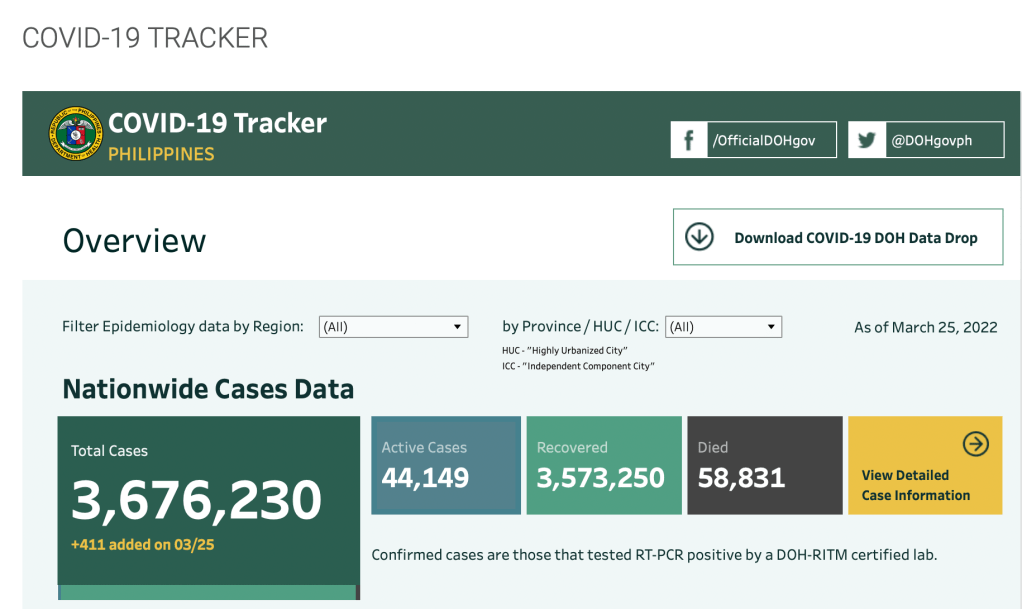
411 new cases and 60 deaths for 03.25.2022

It’s not a bad day to end the week.

The Health Agency announces 411 new cases today with 60 deaths added.

The NCR accounted for 34% of the total cases with 140 today. Six LGUs contributed double digits led by the City of Manila with 21 and Quezon City with 20. Makati and Parañaque had 16 cases apiece and Caloocan and Las Piñas 12 apiece as well. While the rest of the LGUs continued to report less than 10 cases, only one LGU had zero covid – Mandaluyong.

Outside of NCR, the following provinces reported double digits: Cavite province 28, Rizal 12, Iloilo province 32, Pangasinan 11, South Cotabato 12, and Zamboanga City 14.

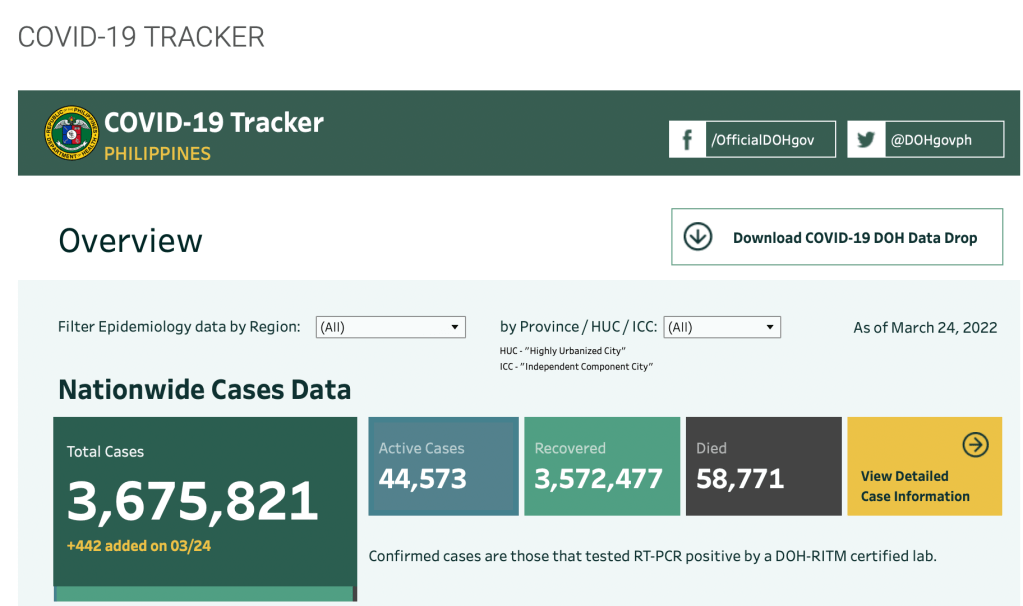
The deaths streak and the data for 03.24.2022

It’s the second straight day where the Health Agency reports more than 200 deaths (with 208 deaths added today). Most of these cases are most likely backlogs since the healthcare utilization is at a very low risk already.

There are 442 new cases added today as well. NCR accounts for 30% of today’s numbers and will most likely continue to account for >30% of the daily data due to density, testing capacity and requirement for work purposes in this region.

Six LGUs in NCR reported double digits, led by the City of Manila with 28 cases and Quezon City with 22. Parañaque had 16, Pasay City 15, Caloocan 13, and Makati 11. All other LGUs had single digit numbers with Pateros and Navotas reporting zero covid.

Outside of NCR, it was Cebu that reported 41 cases (Cebu City 21 and Cebu Province 20), while Cavite had 24 cases and Iloilo province had 23. Iloilo City reported zero covid today.

407 cases and 282 deaths for 03.23.2022

The Health Agency announces 407 new cases today, but it’s the deaths that’s startling as 282 deaths are added, bringing the total deaths to 58,563 (from yesterday’s 58,281).

The National Capital Region accounted for 30% of today’s cases with 123. Five LGUs in NCR reported double digits. They are: Quezon City 21, City of Manila 17, Caloocan 13, and Makati and Parañaque 11 apiece. The rest of the LGUs reported single digit numbers, with San Juan and Pateros logging ZERO COVID.

Outside of NCR, it was the province of Cavite that had the most cases with 47 cases today. Iloilo province and city had 21 cases (18 for the province and 3 for the city), Cebu province and Cebu City had 20 cases (13 for the city and 7 for the province), Laguna 15, and Rizal 11. The rest of the provinces and HUCs reported 10 and less cases today.

The 7-day average positivity rate is at 2.4%.

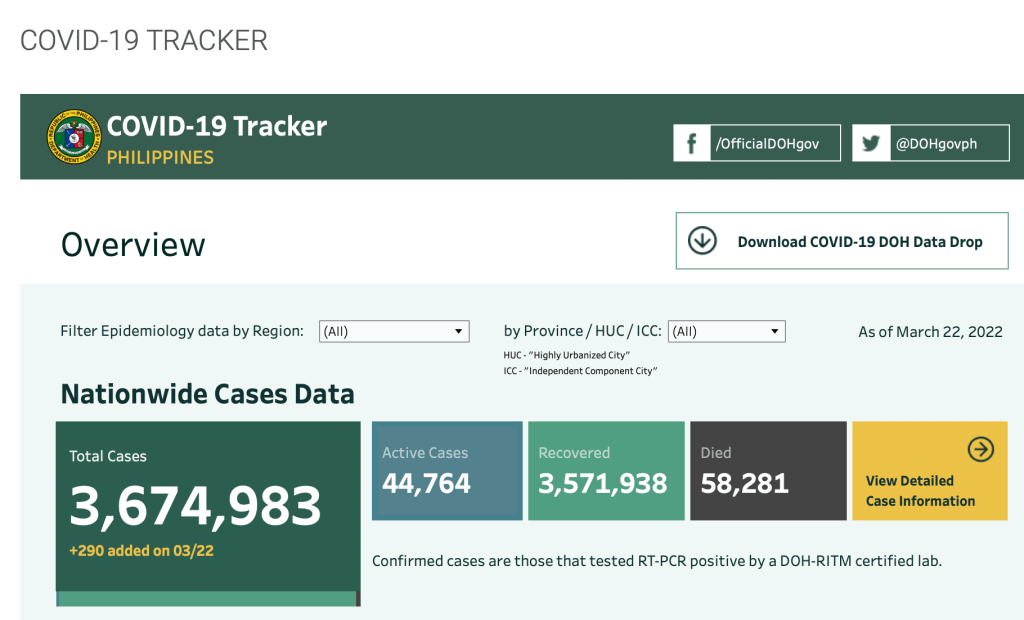
The low Tuesday and the data for 03.22.2022

The pattern for a low Tuesday is a good sign.

The Health Agency announces 290 new cases, and 5 added deaths today. The other good news is that that 7 day positivity rate is at 2.5%.

Now the downside. As other regions see lower cases, NCR accounted for more than 35% of the total cases for the day with 103 cases. The cases in NCR were led by the City of Parañaque that had 22 cases and the only LGU with more than 20 cases. City of Manila reported 16 and Quezon City had 11 cases today. All other LGUs had single digit numbers with three LGUs reporting only 1 case each. They are: Muntinlupa, San Juan, and Pateros.

Outside of NCR, the following provinces reported double digits: Cavite 20, Rizal 11, Iloilo Province and City 12, and Zamboanga City 17. Many provinces are now reporting ZERO COVID cases.

The Monday rundown and the data for 03.21.2022

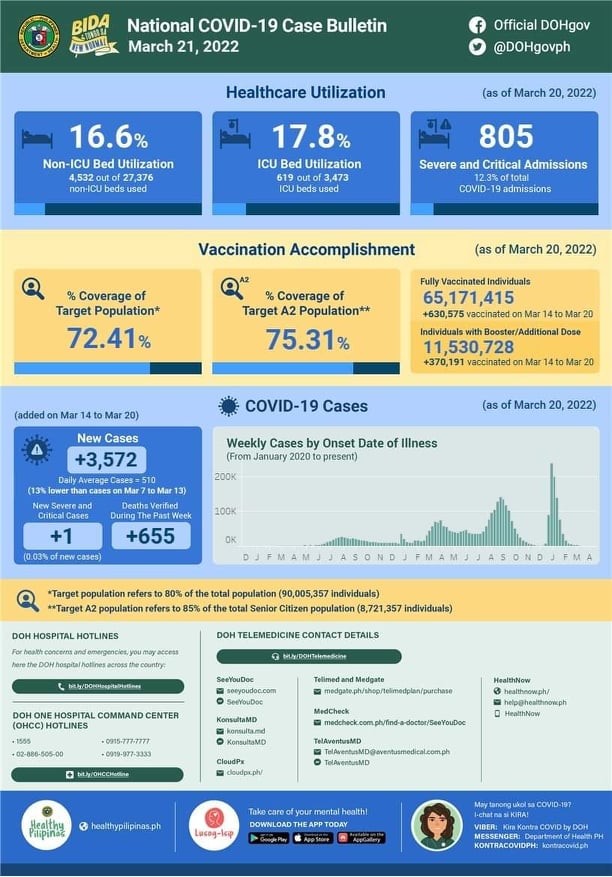
It’s a Monday. Which means, it’s the day when the Health Agency provides a summary for what transpired from the last 7 days (March 14-20, 2022).

And here’s the rundown:

  • Healthcare utilization is at very low risk with both ICU and non-ICU bed utilization at <20% for COVID cases. The number of severe and critically ill is now at triple digits from a previous week of four digits.
  • Vaccination is slightly higher but at a very slow increase with only a little more than 630K added to fully vaccinated individuals and >370K added for booster or additional dose. More than 75% of the target A2 (senior citizen) population is now vaccinated.
  • There were 3572 new case this week (no saying if they include backlogs or not) for a 7-day average of 510 cases/day. While there continues to have a decline in cases, the decrease has slowed down to -13%. Which means that we are likely reaching a trough.
  • There were 655 deaths added (for about 95 deaths a day). Most likely, this includes those who were declared recovered but eventually verified to have passed away due to COVID19. Of the 655 deaths, 97 occurred in March (14.8%), 122 in February (18.6%) and 81 in January (12.4%). That meant that 54.2% were from August 2020 to December 2021! The largest bulk were deaths in October (101) and September (100).

The DoH today report 415 new cases with 13 deaths. The positivity rate is a tad up at 2.8% (from 2.7%) but can be due to very few tests being done. On March 20, less than 15,000 individuals were tested. (412 of 14,645 individuals tested last March 20 tested positive.)

NCR owned 115 of the 415 (27.7%) of the total cases for the day. Only 4 LGUs in NCR had double digits: City of Manila 20, Quezon City 19, and Taguig and Caloocan 14 each. All the rest had single digit cases with Pateros, the lone LGU reporting zero covid.

East Asian nations in the omicron wave and the data for 03.20.2022

The Health Agency announces 577 new cases today, with 229 belonging to the NCR. That’s 40% of the total share of cases for the day. Which really is quite worrisome considering that we have no idea if they are backlog cases or up-to-date. There are 9 of 17 LGUs with double digit cases in the NCR led by the City of Makati and Pasay City with 30 apiece, Parañaque with 28, Manila 27, Quezon City 25, Caloocan 23, Taguig 18, Pasig 16, and Las Piñas 10. All other LGUs had single digit with 2 LGUs reporting zero covid – Pateros and Navotas.

Outside of NCR, the following provinces of HUCs lead the tally: Cavite province 30, Iloilo Province and Iloilo City 46, Zamboanga City 20.

There are 240 new deaths added today.

The positivity rate holds at 2.7%.

Health care utilization has not been updates since March 3, 2022. We most likely will get an update tomorrow, and hopefully, one that is truly up-to-date.

THE WEEK IN REVIEW

South Korea became the epicenter of the global COVID19 pandemic this week as it hit an all-time high of more than 620,000 cases in a single day last March 17 for COVID19. For the past week, S. Korea has been churning 1M cases every 2-3 days.

Vietnam wasn’t far behind with almost 180,000 daily cases (based on a 7 -day average.

As omicron lashes at the East Asian nations, the good news is that the vaccination rate of these countries are at more than 80%, diseases are mostly mild, and their pandemic management is different from that of the Philippines. They are, to put it in words, more disaster prepared in spite of the onslaught of the omicron wave.

Only those countries with lower vaccinations in the vulnerable population (read: senior citizens) like Hong Kong were at a lost when they began counting the dead, placing corpses beside those who had COVID19 because the funeral parlors could not keep up with the mounting deaths.

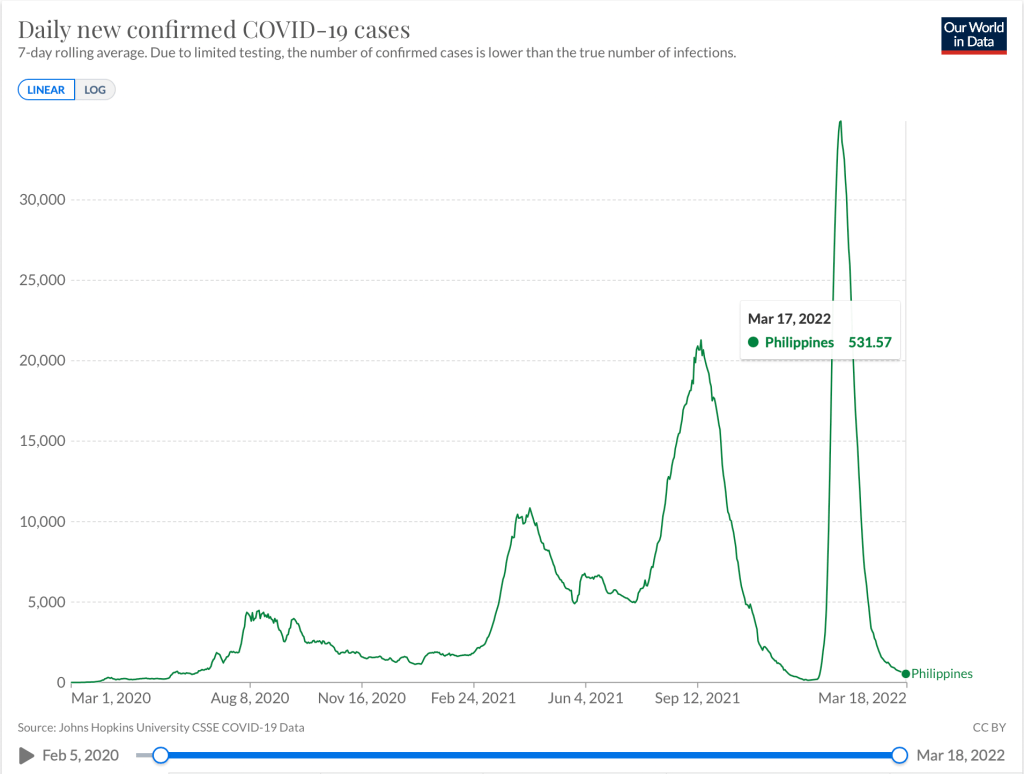
The Philippines continued its low cases streak but has most likely hit a trough in spite of the lower reproduction number (Rt = 0.53 +/- 0.05). We ended last week with a 7-day average of 590 daily cases and as of yesterday averaged 531 daily cases (which isn’t a significant decline compared to the lower cases we had in December 2021, after the delta surge and before the omicron wave. Majority of the daily cases remain concentrated in the National Capital Region, most likely because of the density of the region and that testing is more accessible and plentiful in Mega Manila.

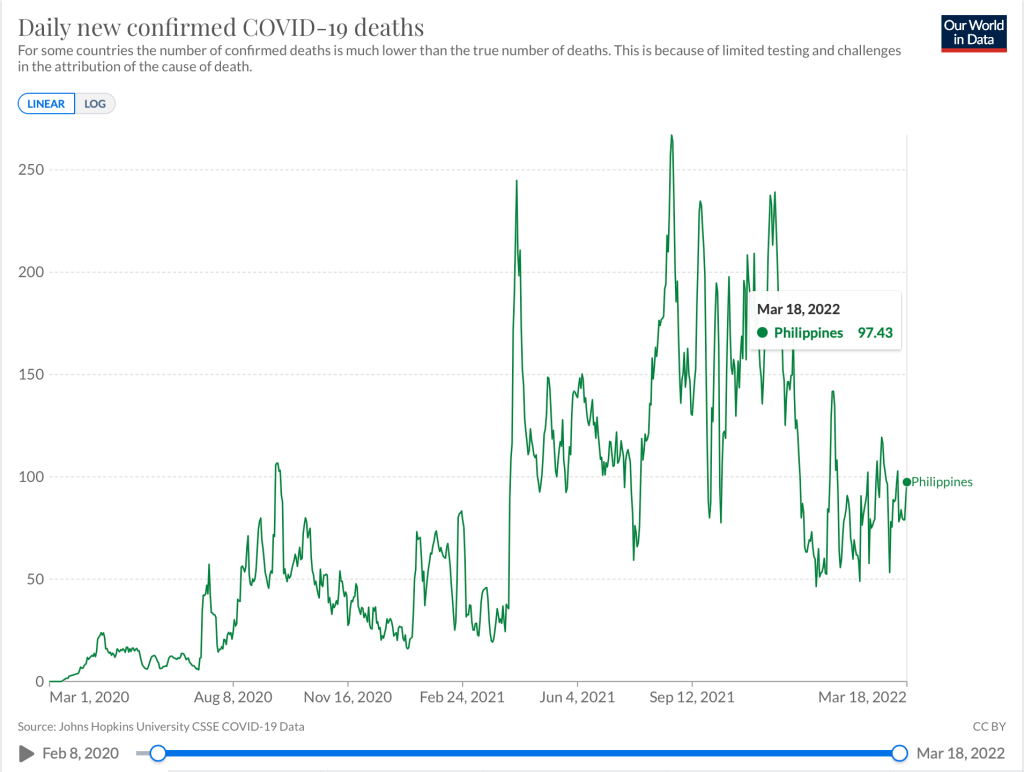
Deaths were erratic the whole week as the agency were reporting backlogs aside from the daily deaths. Daily deaths averaged 97 per day based on a 7-day moving average.

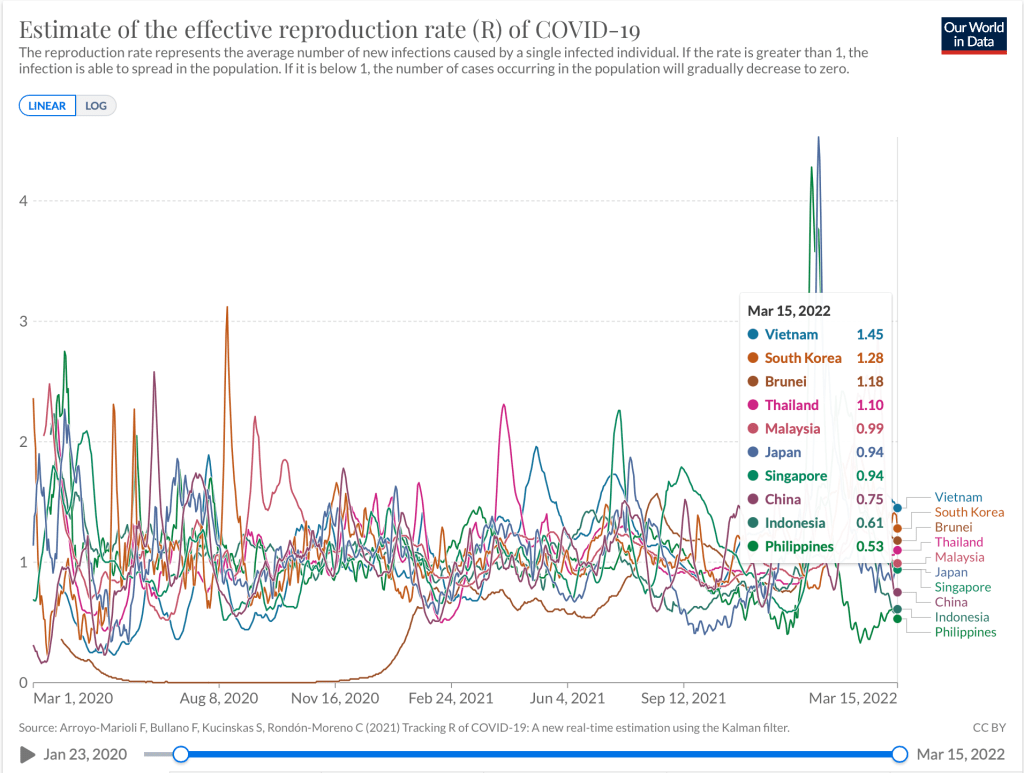
Comparing this to how the other countries performed, the graph below shows the 7-day average in the different countries (with China and Brunei added).

Based on a per capita (number of cases per million population), South Korea led the pack. And while Brunei may have around 2150 daily cases only, the small nation of half a million people was enough to push it into second spot with 4860 cases per million population. Hong Kong comes in third with 3500 per million, Vietnam fourth with 2800 per million and Singapore fifth with 2000 per million. The Philippines and China are the sole nations with single digit per million population. The data may not be a reflection of the actual situation as the stark contrast is that the Philippines has decreased its testing capacity by limiting it to A1, A2 and A3 and contact tracing is not routine anymore. On the other hand, China aggressively tests and does contract tracing in almost every province or city where there is an outbreak of cases noted.

With that data, the reproduction rates of the various countries show that Vietnam and Korea remain critical. The upcoming week will see Vietnam continue to report a slight uptick in numbers and should be peaking anytime soon. South Korea has lower Rt this week compared to last and is seeing a slight decline in numbers. Most likely, it has reached its peak. With aggressive testing in Korea, 1 in every 20 individuals are currently testing positive. Brunei has also peaked and are seeing a slight decline in numbers. Those with Rt < 1.0 are Malaysia, Japan, Singapore, China, Indonesia and the Philippines.

At the current trend, East Asia should see better days in the next four weeks. With the aggressive stand of China on the ZERO COVID policy, they should be able to handle omicron much better than other countries. Otherwise, a country with 1.4B people will create a global havoc with numbers soaring if omicron is allowed to breakthrough in each and every province and city.

Too many, too soon?

With a slight bump in cases due to BA.2, the question is – do we need a fourth dose?

Pfizer and Moderna, the two big mRNA vaccine developers have been pushing through media and various press releases their application with the US Food and Drug Administration for that ‘fourth dose’. The evidence they present is based on “data from the Center for Disease Control and Prevention that found the effectiveness of both company’s vaccines against hospitalization dropped from 91% two months after a booster shot to 78% after four months”. This sweeping statement is reckless and the evidence for a fourth shot is based on “how well the Moderna vaccine has protected against the omicron variant in the United States and Israel”.

Let’s dissect the statement provided as justification for another dose.

The United States and Israel are two different countries – and are not the only nations that implement mRNA as the sole vaccines for their citizens. Singapore, a country of 5M people uses mRNA vaccines in over 90% of its population. If you look at the number of COVID19 cases in these countries, the US, a country of 334M people has recorded more than 81M COVID19 cases since the start of the pandemic. In short, it has at least 250,000 cases per million population OR 1 in every 4 Americans have had COVID19. Israel, a country of less than 10M people and the first to roll out the mRNA vaccines and boosters and pediatric vaccination now has more than 3.75M total COVID19 cases. This gives them a per capita of 400,000 cases per million population or 2 in every 5 Israelis has had COVID19. Singapore will exceed the 1M number of COVID19 cases tomorrow. This puts the country at 170,000 cases per million population (or around 1 in every 5-6 people having had COVID19). The data clearly shows that the mRNA vaccine are NOT transmission blocking agents. It works at reducing the risk of more severe infections, but will definitely change how mild or asymptomatic infections develop among those who get sick from SARS-CoV-2.

Deaths are a different endpoint. The US has also the highest number of deaths in the world with close to 1M dying from COVID19 since the start of the pandemic. Deaths are a lagging indicator and therefore underreported everywhere. The US has almost 3000 deaths per million population or 1.3% case fatality rate. Israel on the other hand has had just more than 10,000 deaths or 1117 deaths per million population or 0.3% case fatality rate. Singapore has almost 11,000 deaths or 201 deaths per million or 0.18% case fatality rate. This shows that other factors are highly dependent on outcomes of this pandemic. Why some countries have lesser fatality rate compared to others are likely due to factors not due to vaccine protection alone.

The study of the CDC Prevention and Control was a very broad snapshot. Very broad is an understatement. It failed to factor in hospitalization by age, presence of underlying conditions and basically other intangible factors like mask wearing, distancing and other minimum health standard measures.

If a second booster after two full doses is short-lived, what assures the developers of the vaccine that additional doses will provide longer protection? Which begs the answer to the question – how many booster shots should one get? At the rate the recommendations are coming from the “pharmaceutical companies”, it looks like a quarterly jab. If this is true, then the bottomline is that the mRNA vaccines are short-lived and providing a homologous vaccine may not be the way to go in preventing COVID19 infections (even from mild infections). There are ‘mix and match’ studies (heterologous vaccination) that demonstrate a more sustained immunologic response against mild infections. The other observation is that while protection MAY be waning against mild infections, without more data and better randomized controlled trials, is protection waning against severe disease? If the answer to the latter question is NO, then why would you push people into getting more shots. Again.

The uptick in cases in the past week is driven by countries who are going through BA.2 wave. But governments and people are tired of lockdowns and this pandemic has affected global economies and the way people interact with others.

There are no long term studies for ALL the COVID19 vaccines. We know they work at preventing more severe disease. We know they do not block transmission. We know that there are adverse effects in a very minority of the population. We know that it doesn’t work at lower doses in a select age group for now.

The drug companies and regulators forget that the pillars of a drug being approved for human use and recommendation lies in three key words: quality, safety and efficacy. One cannot help but think that there are those that simply take advantage of the pandemic situation.

Before making further recommendations and giving the nod to Moderna on the fourth dose for all, the data presented must show definite advantage in the long run on those key issues. Do we really need another shot soon?

545 cases and 119 deaths and the data for 03.18.2022

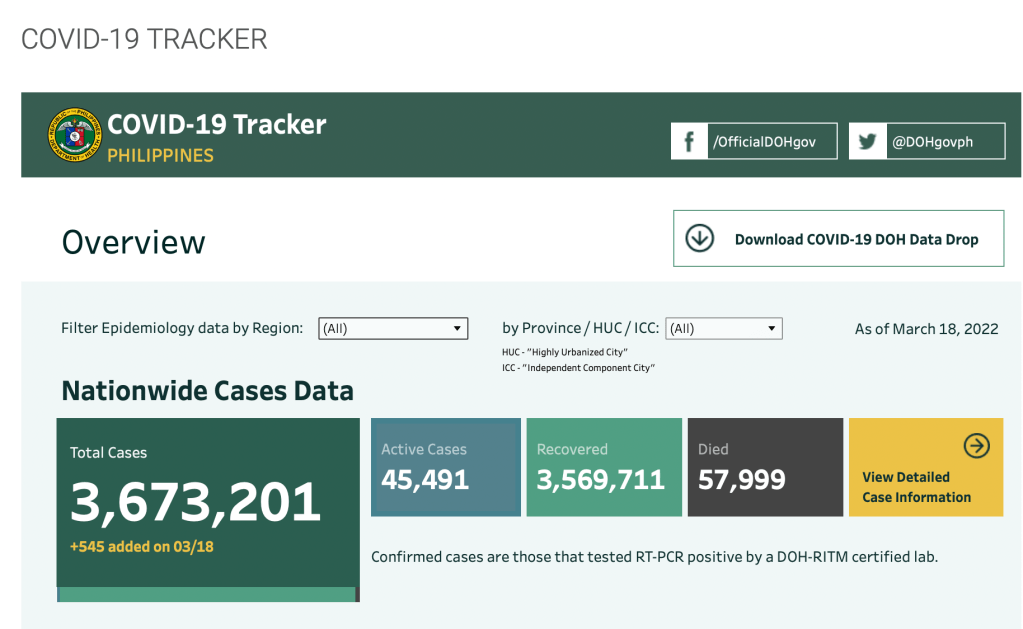
The Health Agency announces 545 new cases and adds 119 deaths today. The NCR accounted for 23% of the total cases in the country. The decline in cases has slowed down and at the rate of decline now, it looks like we will reach a trough of around 400-500 cases per week. Which shouldn’t be the objective. We need to bring the numbers significantly lower than 300 cases nationally and less than 100 in NCR alone. But because we’re really not testing enough anymore, our low numbers may not be an actual reflection of the current state in the country, in spite of the 2.7% positivity rate.

The NCR had 128 cases today, with 6 LGUS reporting double digits. They are: City of Manila 28, Quezon City 20, Caloocan, Makati and Pasay City with 11 cases apiece, and Parañaque with 10. The rest of the Mega Manila LGUs had single digit with Navotas reporting ZERO covid.

Outside of NCR, it was the province of Iloilo that reported the highest cases today with 56 followed by Cebu City and Cavite Province with 22 each.

NCR accounts for 38% of the cases on 03.17.2022

The good news is that the daily data is back. (Thank you DoH)

The bad news is that of the 598 new cases announced by the Health Agency today, 229 of them are from NCR alone.

There are 145 added deaths today as well.

It was Pasay City that had the most cases for the NCR with 48 cases. Other LGUs with double digits were: Parañaque 37, Manila 31, Quezon City 25, Makati 17, Caloocan 16, Pasig 13 and Las Piñas 11. Other LGUs had single digit with Pateros reporting zero covid.

There is also a slight uptick in cases in some provinces but without added information, hoping that it’s just some backlogs being reported.