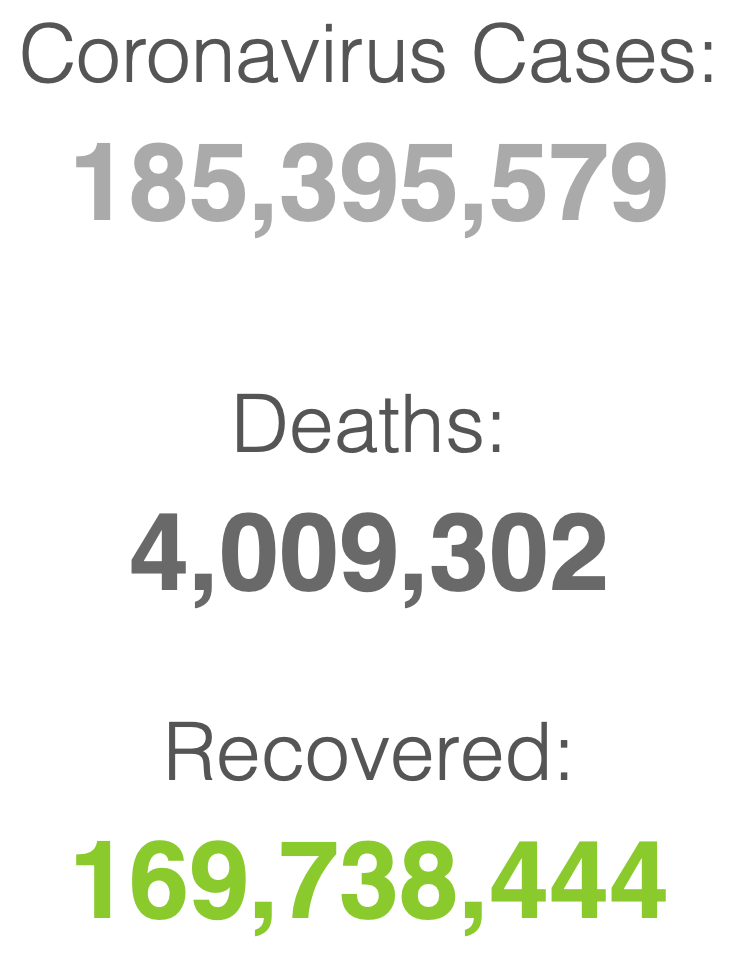
It’s been awhile since I’ve tracked the global numbers. As of July 7, 2021, the world has now passed the 4M mark for deaths attributed to COVID-19. And as the other countries begin to reopen their economies, the variants pose a threat to future surges, particularly in countries that do not have adequate vaccine supply.
The Health Agency reports 4,289 new cases for tests done last July 5 with 11.3% positivity rate. This pushes the total now to more than 1.45M COVID-19 cases. There were 4 laboratories that failed to submit results for this day.
While the low cases yesterday and today may be good news (hopefully it stays lower), the 164 new deaths reported today had pushed the case fatality ratio for outcomes (recoveries and deaths) a tad up from 1.81 to 1.82%. As repeatedly mentioned, death reports will always be late (anywhere in the world).
For the first time, since the beginning of the pandemic, NCR manages to slip to fourth rank as CALABARZON, Western Visayas and Davao Region each represent Luzon, Visayas and Mindanao as the top regions in each of the parts of the Philippines.
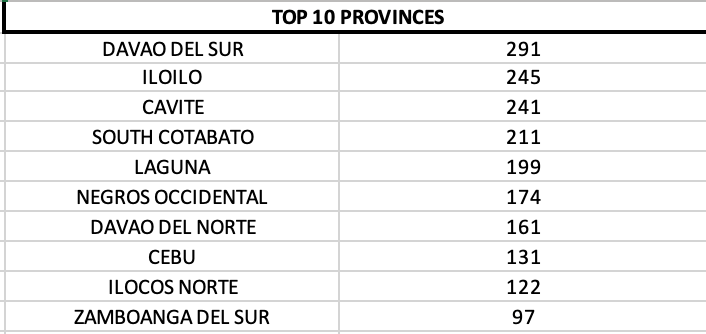
Davao del Sur, Iloilo province and Cavite are the top three provinces for the day.
On an LGU level, the top three does not even include a city in NCR. Davao City, Iloilo City and Bacolod City are the top three cities with most cases among the top 20 list. There are only 3 of 17 LGUs from NCR that even made it to the top twenty – which is very good news for the day. Laguna managed to include three cities in the top 20 ranking – Calamba, Santa Rosa and Cabuyao.
In the NCR, only Quezon City continued to report triple digits, while Navotas and Pateros continue their good job at maintaining single digit new cases.
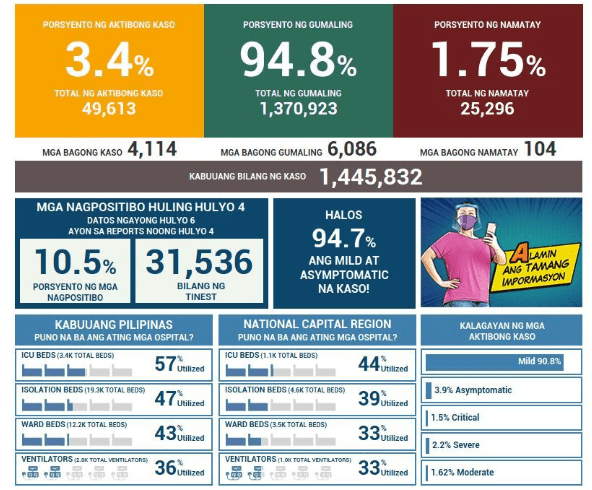
As typical of any Tuesday, there are 4,114 new cases announced by the Health Agency based on a little over 31,000 tests done on July 4, Sunday with a 10.5% positivity rate. While the active cases are slightly below 50,000, this data is erratic as the number of cases are still above 5,000 based on a 7 day average.
The total number of deaths reported today are 104. The case fatality ratio for outcomes is steady at 1.81%.
CALABARZON and Western Visayas led todays haul, with 12 ROF (returning overseas foreigners) added to the list of new cases. To date, 23,845 ROFs accounted for the over 1.44M total COVID-19 cases in the country. While they make up only 1.62% of the total cases in the country, the concern of their carrying variants of concern from their places of origin is significant.
In NCR, Quezon City continued to report triple digits while five LGUs stood out among the pack with single digit cases only – Valenzuela, Navotas, Marikina, Malabon and Pateros. Only 4 of 17 LGUs from Mega Manila were among the top 20 cities with most cases for the day.
Davao City continued to lead among LGUs, albeit with lower cases today than the previous days. Joining Davao City in the top five are: Quezon City, General Santos, Baguio City and Cebu City. Majority of the LGUs in the top 20 are from the Visayas and Mindanao.
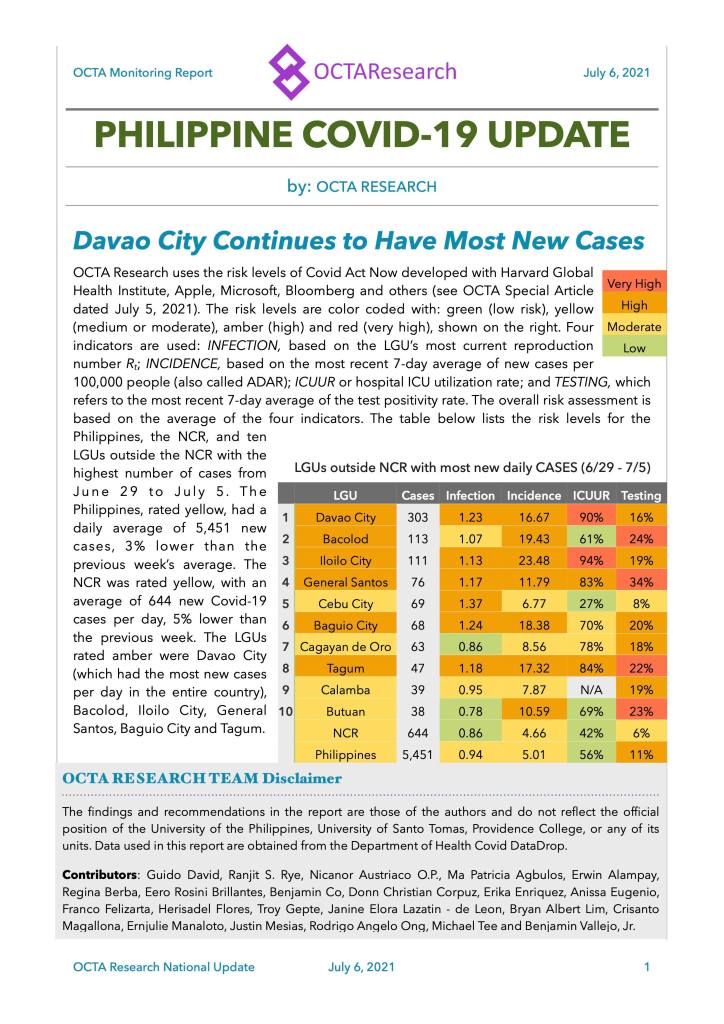
The OCTA Research Monitoring update for July 6, 2021 shows that Davao City continued to lead among cases.
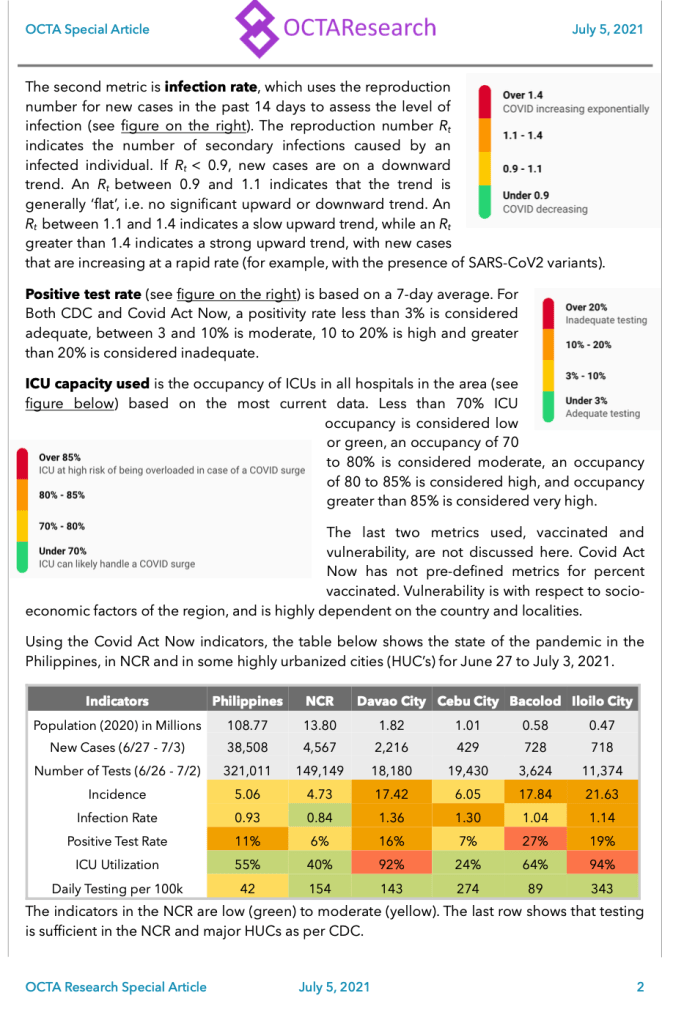
The research group now uses the risk levels of Covid Act Now, developed with Harvard Global Institute, Apple, Microsoft, Bloomberg and others.
The risk classification is color coded. Meaning if the code is green then it is classified as low risk, yellow as moderate, orange as high and red as very high risk for the indicator.
There are four indicators used: INFECTION, INCIDENCE, ICCUUR (hospital ICU utilization rate) and TESTING (7-day average of the test positivity rate).
This set of indicators was published on July 5 and is expounded below. Standardizing indicators is vital in measuring how we are doing as a nation. This translates also to regional, provincial or LGUs in the country. Standardizing with metrics that have endpoints and are measurable are subject to less bias as well. Utilization of standardized metrics also affords one to make sound decisions on creation of policies and exit plans for the government.
LGUs outside of the National Capital Region that are seeing higher cases are summarized below. Overall, the Philippines is at moderate risk considering these indicators. The table below is self-explanatory. For example, Davao City showed the highest infection rate (Rt = 1.23), positivity rate was highest for General Santos (34% or 1 of 3 tested would test positive), incidence highest in Iloilo City with a daily attack rate of 23.48 per 100,000 population, and Iloilo City also with the highest ICCUUR at 94%.
The LGUs outside of NCR that are considered overall high risk are: Davao City, Bacolod, Iloilo City, General Santos, Baguio City and Tagum.
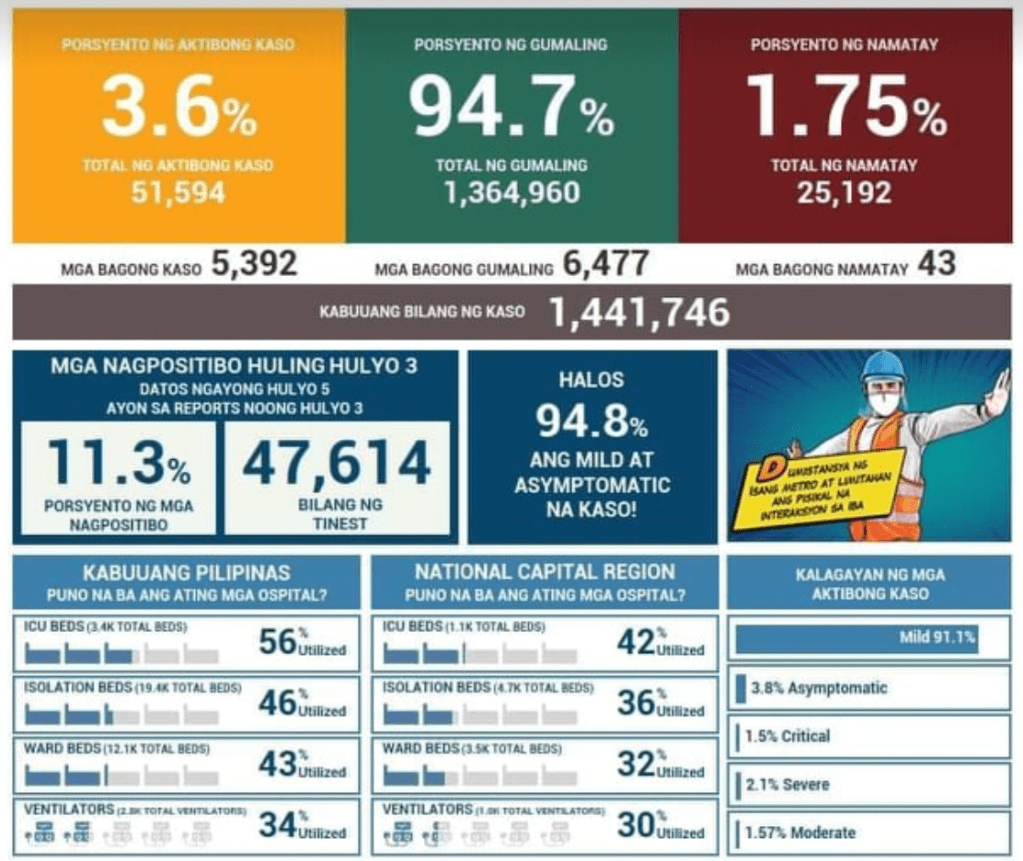
The Philippines recorded 5,392 new cases today for tests done last July 3 with a positivity of 11.3%. Hopefully, this translates to a continued downtrend in the NCR and CALABARZON, which contribute to the bulk of cases in the country. Any spike from these two regions will automatically send us spiraling back to square one. The cases in these two regions are the most critical as they are the most difficult to contain.
With 43 new deaths, the case fatality ratio for outcomes is steady at 1.81%.
CALABARZON and NCR are back in the lead with NCR generating 11.5% of the total cases for today. Davao Region, Western Visayas and Ilocos Region round up the top five.
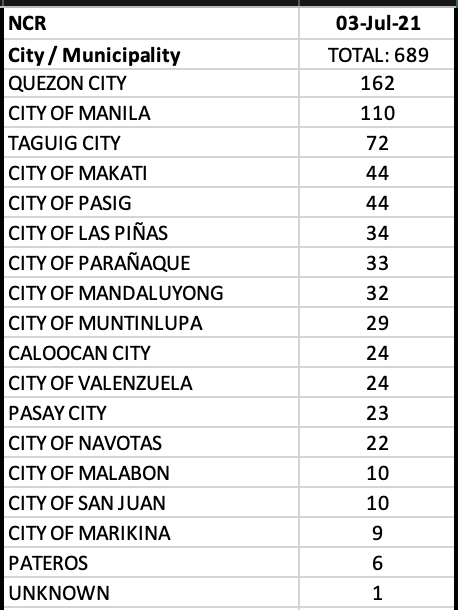
In NCR, Quezon City continued to lead with 123 new cases. Five of 17 LGUs in NCR are in the top 20 cities with most cases.
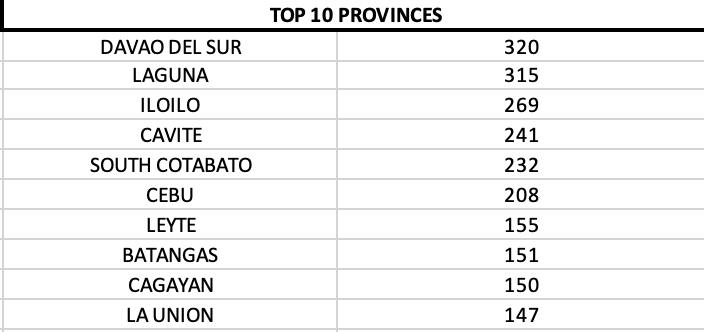
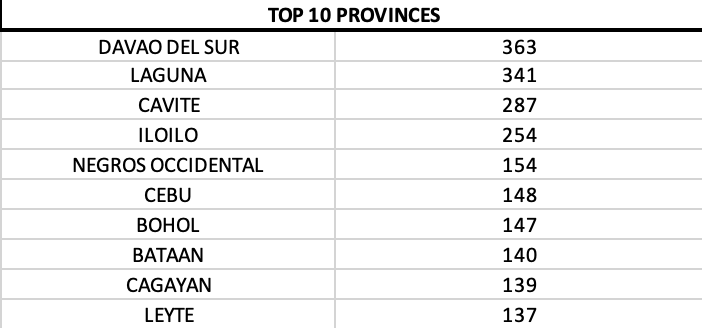
On a provincial level, Davao del Sur, Laguna and Iloilo dominate the top three provinces.
Davao City continues to lead among all LGUs in the country. Its total cases are more than the cases of second and third rank Quezon City and Iloilo City, respectively. Four cities in Laguna land in the top 20 – San Pedro, Santa Rosa, San Pablo and Biñan.
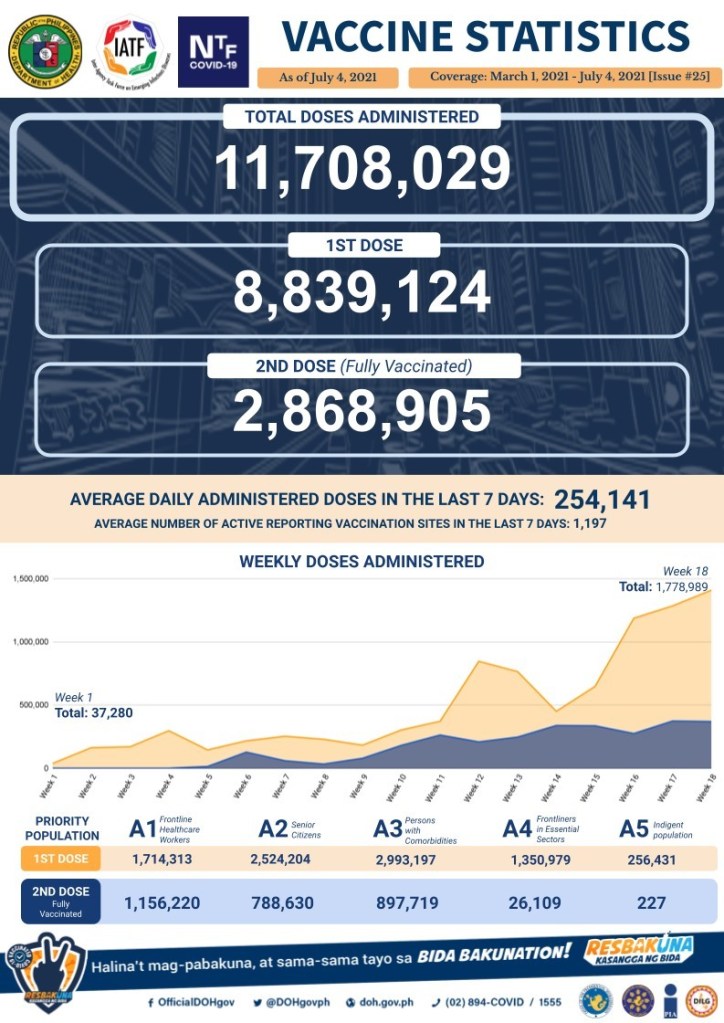
Based on data from the Health Agency, as of July 4, 2021, close to 12M doses have been administered with close to 2.6% being fully vaccinated. There’s still a challenging road ahead, and hopefully, we get to take a jab when any vaccine is made available to us.
One testing center failed to submit reports for July 2.
The Health Agency announces 5,966 new cases today based on 11.5% positivity of less than 44,000 tests done on a Friday – July 2. Active cases remain above 50,000 and ICU rate utilization is up in the NCR from 40% yesterday to 46% today. Nationwide, the ICU rate is also up from 55 to 57%, perhaps driven by the NCR’s increase in ICU utilization due to slight uptick in moderate and severe cases.
There are 86 new deaths reported, bringing the total to more than 25,000 (which we officially passed yesterday). The case fatality ratio is steady at 1.81%.
While Western Visayas and CALABARZON dominated the days numbers. Nevertheless, the NCR is seeing a higher share in cases, owning 13.5% of today’s 5,966 cases.
Quezon City and Manila continue to declare triple digit numbers while 7 of 17 LGUs in NCR land in the top twenty cities with most cases for the day.
Among provinces, Iloilo grabs the spotlight and leads all provinces in total new cases.
On a national level, while Davao City continued to lead, it had lower numbers compared to the past week and will hopefully see a downtrend in coming week. In the top five are Davao City, Bacolod City, Quezon City, City of Tagum and Iloilo City.
With a Rt = 0.95, the cases go down a tad. The national Rt is driven by increasing cases in the provinces mostly in the Visayas and Mindanao regions. With a 7-day moving average of around 5,600 new daily cases, the Philippines still has high numbers considering that these daily cases are more than 500% of the new daily cases before the second surge. The regions outside of the NCR have lesser health care capacities and will definitely struggle as the numbers continue to escalate. The balance between healthcare and economy is more difficult in these areas because the income per capita is lower than in NCR plus.
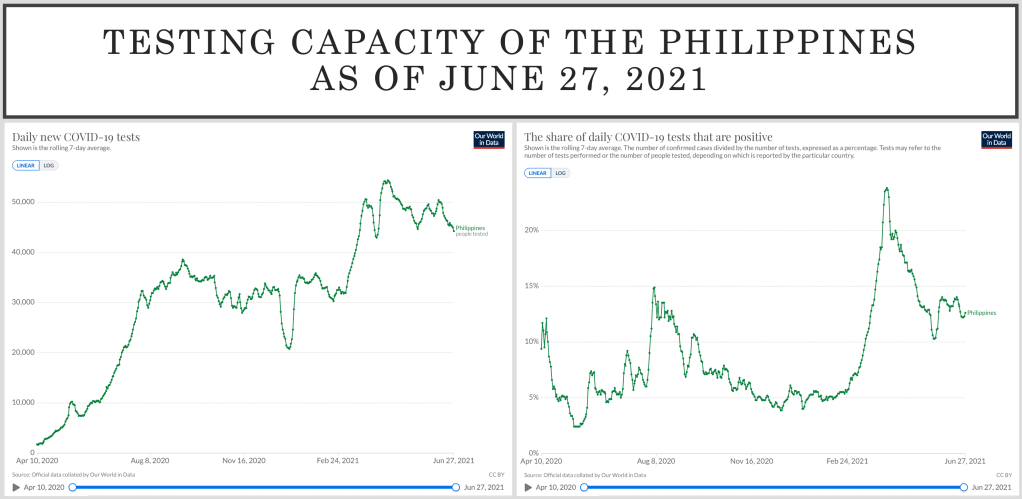
The testing capacity of the country is not stellar, as the reports of COVID-19 cases are dependent on the Health Agency insisting to count only those that are positive by RT-PCR. While it is not prohibited to use rapid antigen test kits that have been approved by the Philippines Food and Drug Administration, it is not encouraged as well. Only those tested with RT-PCR are counted, traced and subjected to isolation in facilities in the country. The Philippine Health Insurance agency (PhilHealth) also reimburses only those that get tested by RT-PCR and are positive. With the positivity rate still way above even 10% daily (which is a far cry fro the pre-surge levels where the positivity rated were 4-6% on the average), the Philippines is definitely NOT testing enough. This puts us in a precarious position because only through adequate testing (including patients who are not symptomatic but have significant exposure and considered close contacts or are immunized to some degree) can we do significant contact tracing. Containment of the outbreak will need extensive testing, tracing and isolation.
If we are plateauing at these numbers as the vaccines are rolling out tepidly (for now), we will not be able to stimulate economic growth, reopen borders anytime soon, or contain a future surge. The numbers are just too high to call these data as ‘good’ or classify us as ‘low risk’.
This is how we stand among other countries that are experiencing recent surges. Japan and Taiwan are significant control in cases. Thailand, Malaysia and Indonesia are seeing rapid rise in cases while the Philippines remains flat.
The good news is that we’re seeing a slight decline in new cases in the country this week. The Health Agency announces 5,908 new cases today based on more than 50,000 tests done last July 1 with a positivity rate of 10.6% (much lower than the previous weeks). Note the comparison of our data prior to the surge in late March 2021. The Philippines plateaued at 1,100-1,600 cases/day with positivity rates 4-6%. While we are seeing a slight decline in cases and positivity rates, this is still a far cry from the pre-surge numbers, which will take awhile to work on as we reopen the economy.
Healthcare utilization rate is low and manageable in the NCR, while it remains challenging in some parts of the country outside of Mega Manila.
With 90 new deaths today, the case fatality ratio for outcomes remains steady at 1.81 percent.
CALABARZON and NCR took back the lead from all regions today. Nevertheless, the rounding up the top five region, were Western Visayas, Davao Region and Central Luzon – all contributing to more than 500 cases apiece.
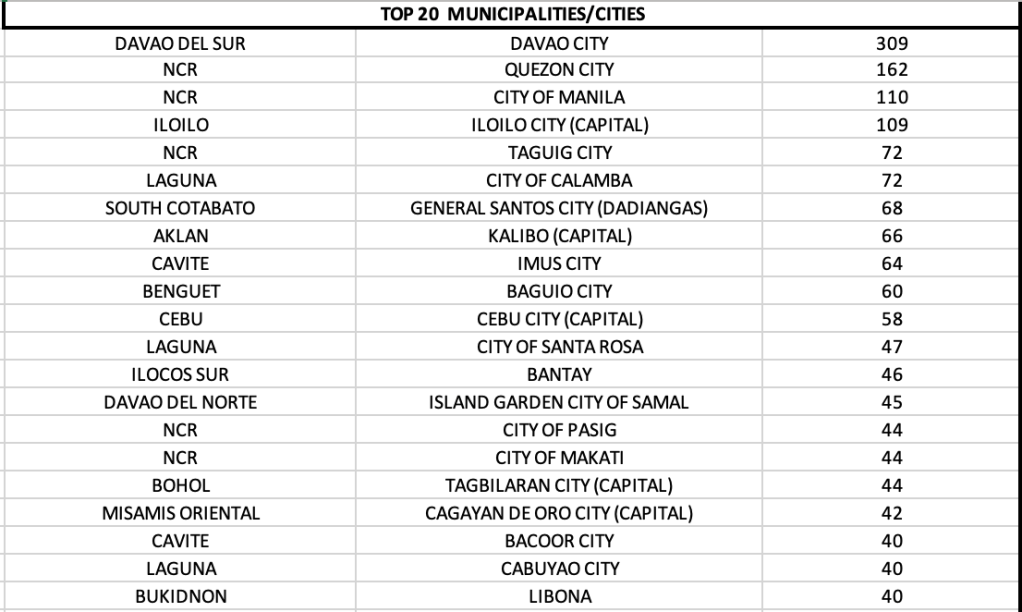
In the NCR, it was Quezon City and the City of Manila that reported triple digits. Mega Manila accounted for 12% of the total cases in the country today. Five of 17 LGUs were among the top 20 cities with most cases.
On a provincial level, Davao del Sur, Cavite and Laguna were the top three provinces.
And on a national level, three LGUs from NCR were in the top five: Davao City, Quezon City, Manila, Iloilo City and Taguig City.
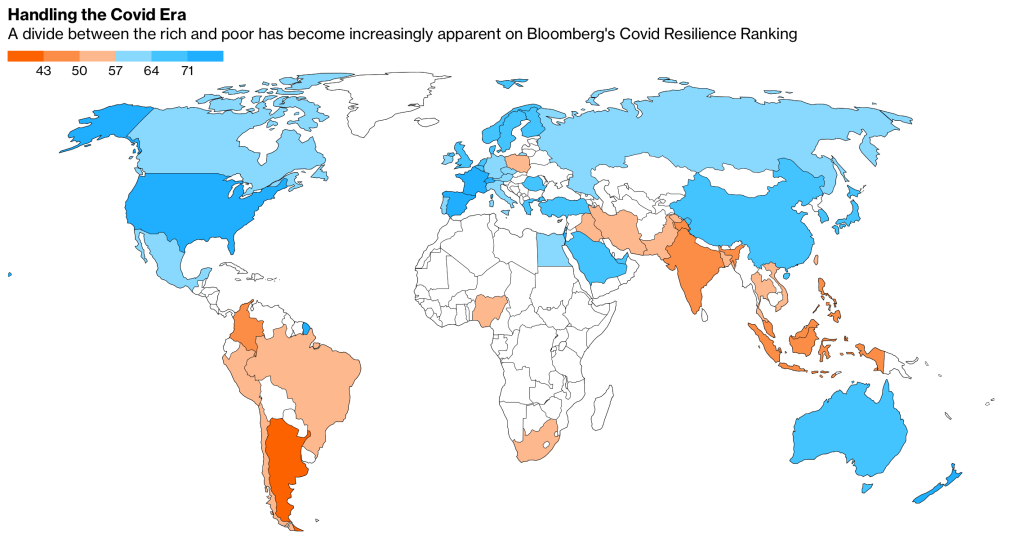
The Bloomberg Resiliency Index report https://www.bloomberg.com/graphics/covid-resilience-ranking/ released last June 28, 2021 was a wake up call at why countries who may have been doing well during the beginning of the pandemic may be sitting at the lower bottom of the rung eventually.
Resiliency, after all, is defined as “the capacity to recover quickly from difficulty; toughness”. It is the ability to return to normalcy after a period of instability due to external factors. And while some people or government agencies may feel that there is an element of bias in this, it is generally a good reminder that preparedness is vital in disaster management.
When the COVID-19 pandemic started, many Asian countries were doing much better than western counterparts. But as the situation evolved, the once spectators are now being carefully watched. How a nation addresses resiliency during a time of uncertainty apparently comes down to the last cent and priorities.
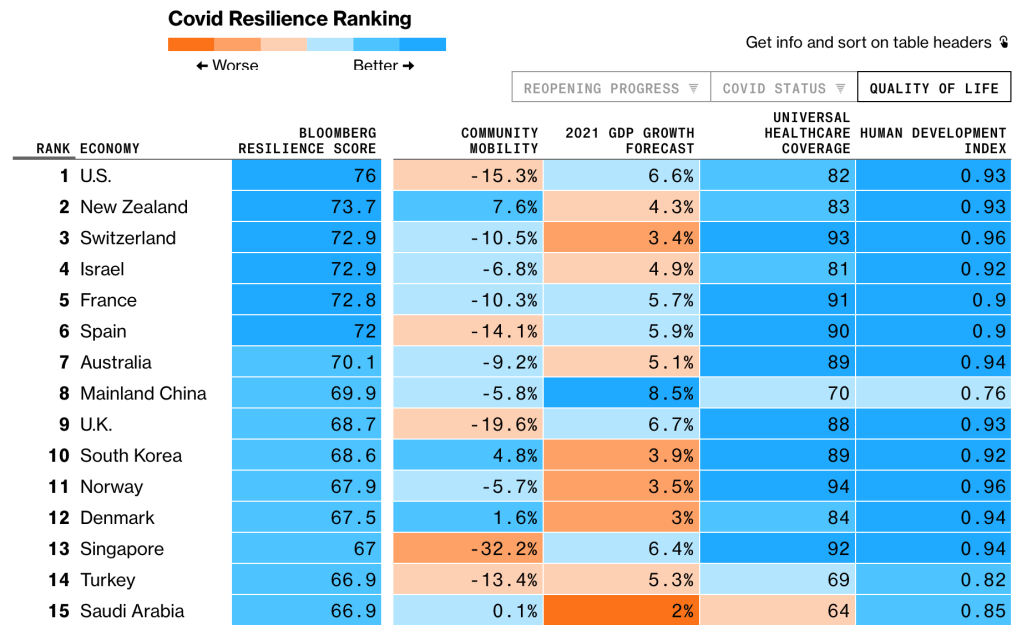
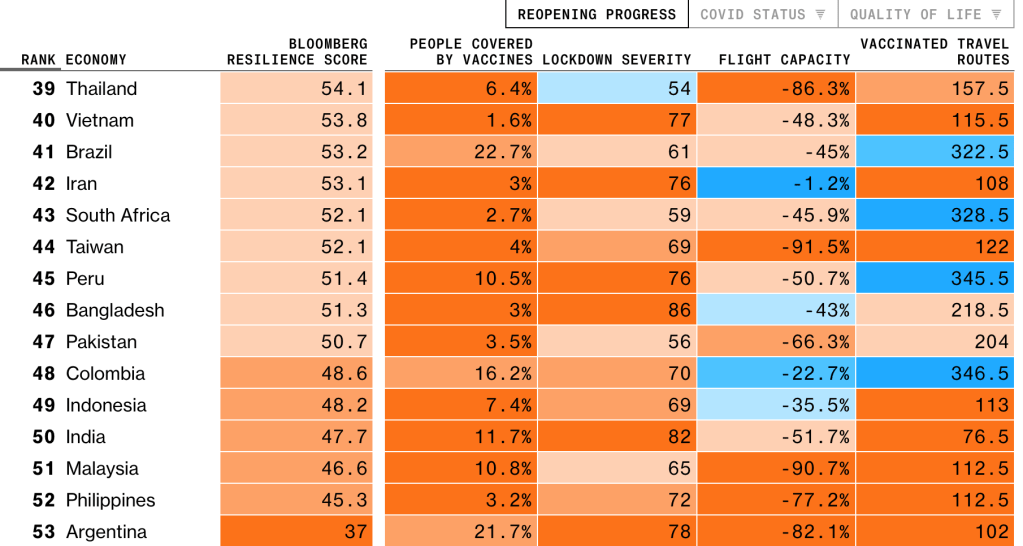
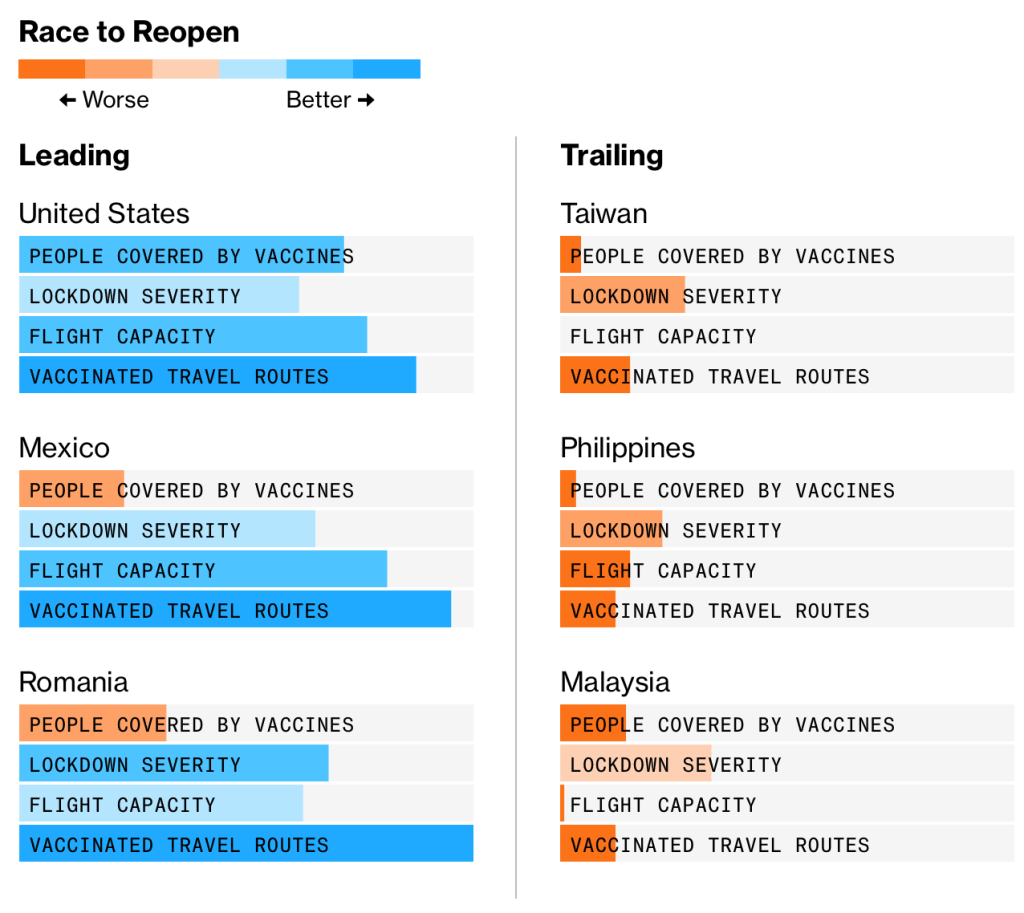
The Bloomberg COVID resiliency index is divided into 3 major categories: reopening progress, COVID status, and quality of life. In turn, these major categories have 4 variables measured per category. For example, under reopening progress, the authors took into account: vaccine coverage, lockdown severity, flight capacity and vaccinated travel routes. A higher score for the particular variable would be displayed in a darker shade of blue, while a worse resiliency score for that variable is in a darker shade of orange, as exemplified in the chart below.
There were 53 countries ranked. Notice that the United States was the most resilient in the June 28 report while New Zealand, with a vaccines coverage of only 10% came in second. In short, no nation excelled in all variables. They had their own gaps, which they need to work on.
The second category was on COVID status. The four variables that were looked into were: 1-month cases per 100,000 population, 1-month case fatality rate, total deaths per million population, and testing (positive test rate). The latter is important because the only way one can know the actual number of cases, and who to contact trace, isolate and/or quarantine is through testing. The higher the positive test rate, the most likely the lesser number of tests being done. And this is reflective in the number of cases, and deaths. You cannot have a country having thousands of cases and deaths daily if testing is not being done. The question is – are they testing enough?
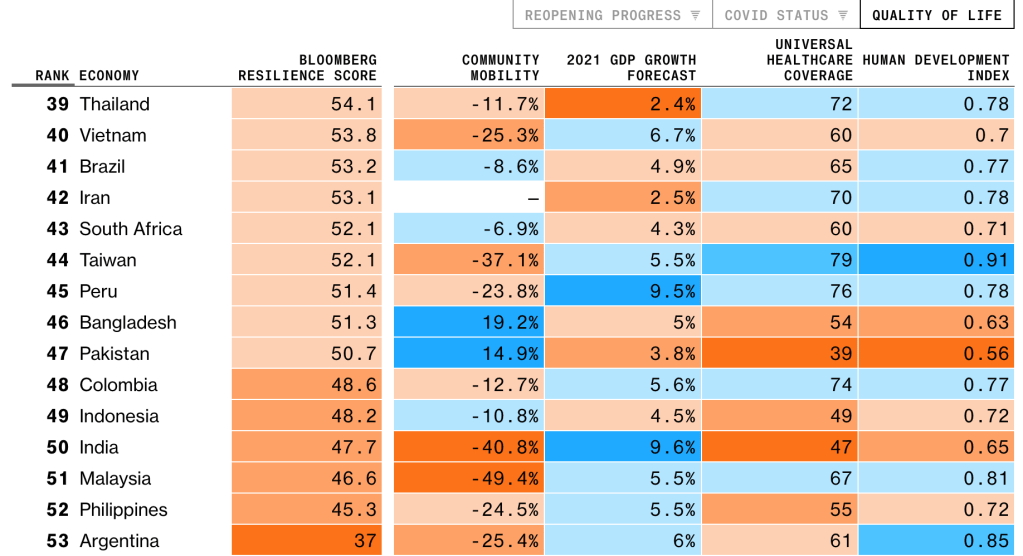
The last category, and one of the most important is the quality of life. This is divided into 4 variables which looked at community mobility, 2021 GDP growth forecast, universal healthcare coverage, and human development index. Human development index has four indicators – life expectancy for health, expected years of schooling, mean of years of schooling for education, and gross national income per capita for standard of living.
With the jury back, the Philippines had slipped notches below to rank second to the last in the resiliency rating for the month of June. The countries from rank 39-53 showed how reopening the economy was the most challenging among the resiliency parameters. In particular is the vaccine coverage and the lockdown as the only measure used to address containing the pandemic in the country.
While we do excellently at improving the COVID status in the country, our resiliency score is dragged down by variables under quality of life and the respective indicators for these variable. Restricted mobility due to lockdowns (we are, after all the country with the longest lockdown of some form in the world), poor healthcare coverage, and subpar human development index (with education suffering the most) dragged the Philippines to number 52, with a resiliency score of 45.
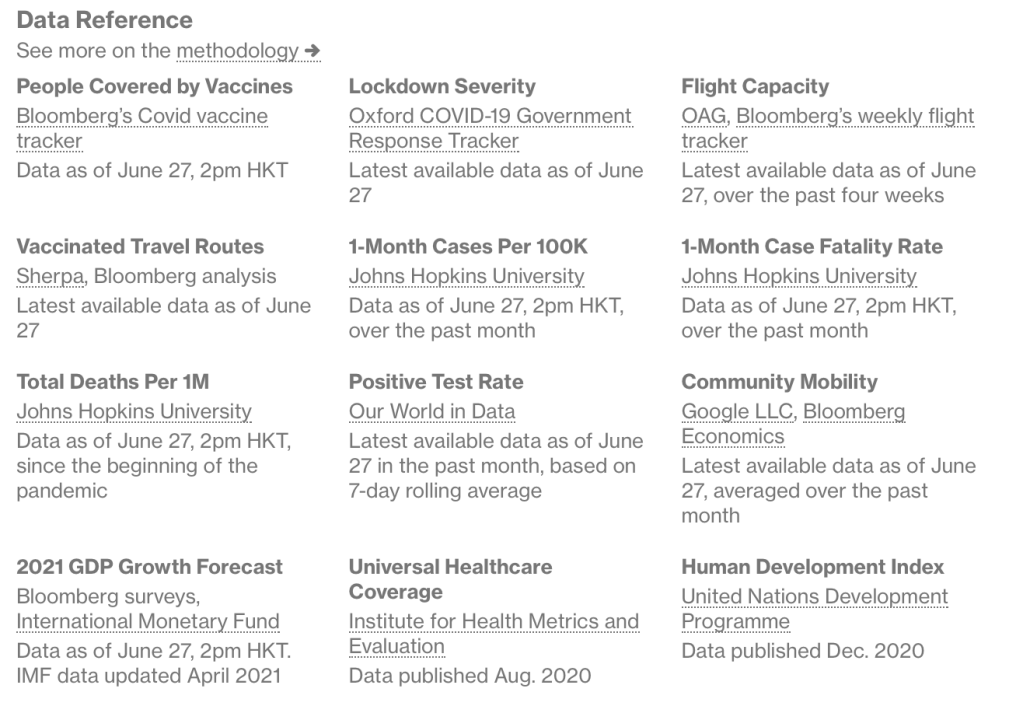
There are those who sour grape at how we were ranked. But we need to take the information with a grain of salt. One of the interesting points of the resiliency index was how they scored the various categories. Without reading the methodology, some government officials reacted defensively. The data references on methodology is indicated below:
Agreeably though are indices on vaccines and flight capacity as well as vaccinated travel routes. It is, without doubt that with the roll out of vaccines late last year, the great divide between rich countries vs. poor ones had the line drawn. Failing on all these metrics would not be fair to countries that continue to struggle to get hold of scarce supplies for vaccines. In the race to reopen, even Taiwan saw a dramatic decline in their resiliency. Thailand even outranked Taiwan, even if the latter had fewer cases. Asian nations that saw how they handled the pandemic well in the beginning are now relegated to the bottom. One cannot just close borders and expect the virus to disappear. We know that’s never going to happen. SARS-CoV-2 has earned its place in the textbooks on infectious diseases and microbiology.
It’s important to look back at where the 53 countries were 8 months back. There was, after all, a time when our resiliency was better than the US or the UK. In the months starting mid December 2020 to March 2021, we outranked our western counterparts. Unfortunately, several factors including late and poor access to vaccines, evolving variants of concern, poor mitigation of border control, and inadequate testing resulted in why we are where we are today.
There was no exit plan. It was a series of lockdowns one after the other. Every two weeks, we would see the same people prompting the same information day in and day out on the quarantine classification. Every day, we got accustomed to simply waiting for the 4 o’clock habit and announcement on the number of cases and deaths.
Let’s not twist what is a fact.
We did well in the beginning. We fumbled in between.
We are where we are because we have really no exit plan.
We are bickering at the use of face shields, and the government is at an all out campaign at preserving the implementation of a useless piece of plastic on our faces. Did that change the curve to an upward direction?
Even politicians got into the fray of recommending anti-parasitic drugs for prophylaxis and the treatment of COVID-19. The push coming from no less than the president commanding a research be done (with public funds) to see if it does or does not work at all.
School remained closed, even in areas where there are few to no cases of the virus in the 7,641 islands of this archipelago.
While testing facilities escalated to 265 as of this writing, more than 50% were concentrated in two regions – NCR and Region IVA. NCR or Mega Manila actually accounted for 112 testing sites in the whole country.
It was undeniable that the government needed to create so much background noise because it refused to call out the accountability of those who were tasked to steer us out of this pandemic.
The challenge to the government is not to transition us to a new normal.
The challenge to it is to get us back to what is normal.
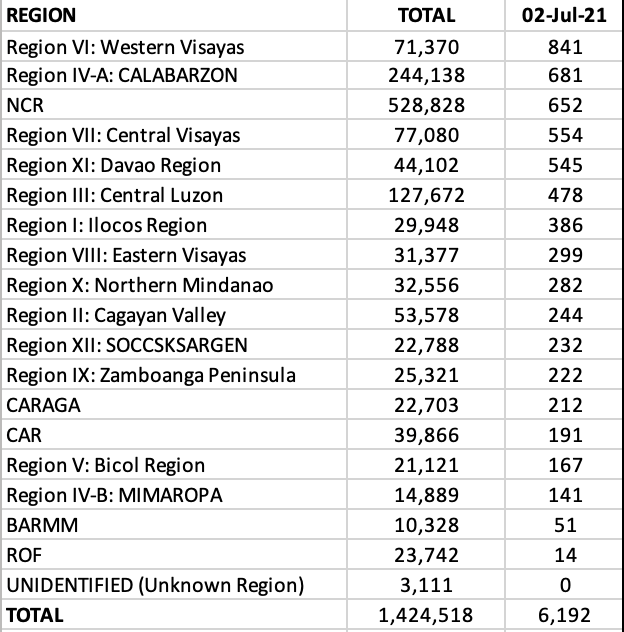
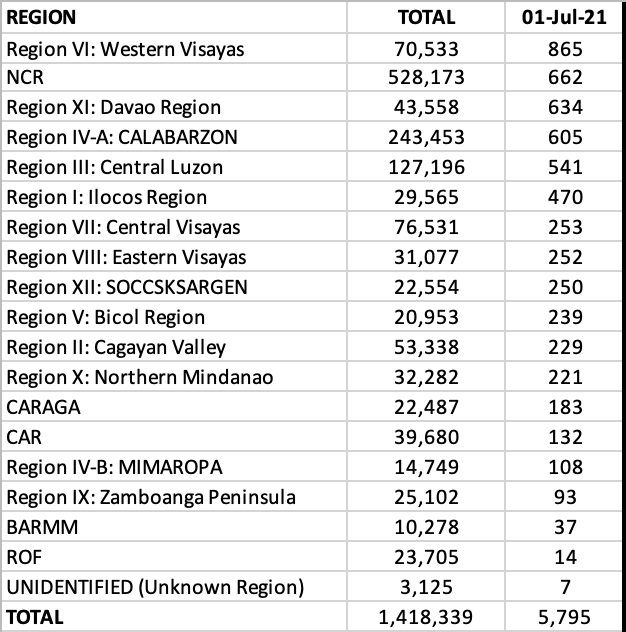
As the virus continues to spread in the provinces and regions outside of NCR the Health Agency reports 6,192 new cases today based on more than 51,000 tests done last June 30, with a positivity rate still above 10% (11.4%). The active cases are up at more than 55,000 as there are fewer recoveries reported.
With 177 new deaths announced today, the case fatality ratio for outcomes is at 1.82%.
Western Visayas continued to lead among regions with most cases, followed by CALABARZON and NCR. Central Visayas and Davao Region round up the top five for the day.
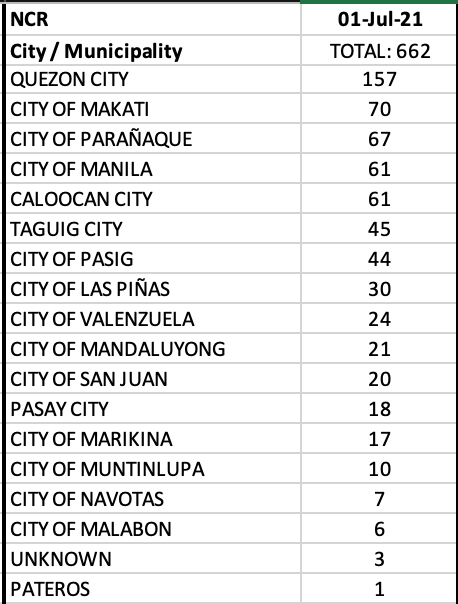
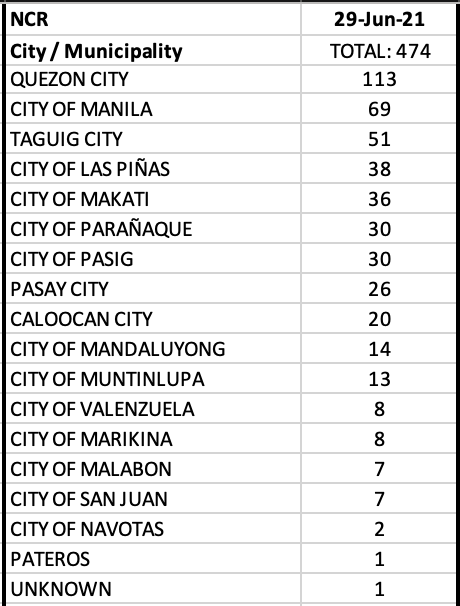
Among LGUs in NCR, Quezon City keeps the lead with triple digits, while 3 cities have single digits – Malabon, San Juan and Navotas. Six of 17 LGUs in NCR were among the top twenty cities/municipalities with most cases for the day.
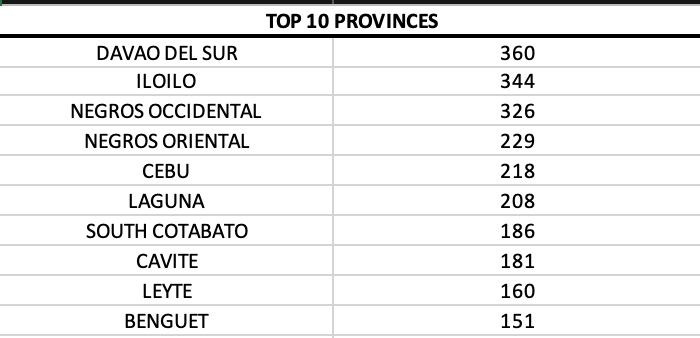
The provinces that dominated the haul today were Davao del Sur, Iloilo Province and Negros Occidental. Which is also why their respective capitals were among the top five cities in the country with the most cases.
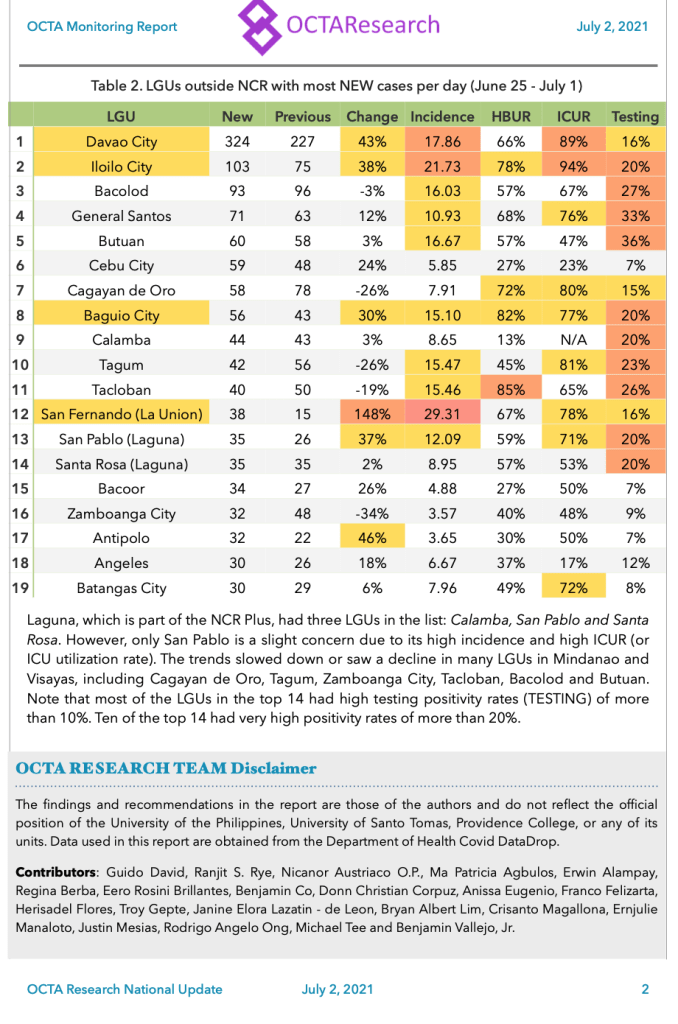
The OCTA Research Monitoring Report for July 2 shows that the National Capital Region (Mega Manila) saw an uptick of 5% in cases from the previous week. This, as the Rt jumps from 0.72 to 0.82 over the same period. The Rt in the country is also up from 0.92 to 0.97. The incidence rate in NCR is around 5 cases per day per 100,000 population. While the positivity rate is lower at 6% over the last week and healthcare utilization is also lower. In the NCR, three LGUs that are doing well are Navotas, Pateros and Malabon. Seven of 17 LGUs in NCR had incidence less than 5/100,000.
LGUs outside of NCR had a different story. Davao City and Iloilo City continued to dominate the cities with increasing cases and HCURs. Laguna which is part of the NCR plus bubble saw three cities haul in the numbers – Calamba, Santa Rosa, and San Pablo. It is important to focus on the testing capacities of LGUs outside of the NCR. Fourteen of the 19 LGUs had positive rates more than 10%. Of these 14 LGUs, 10 of them had positivities 20% and up (where 1 of 5 will test positive).
The close to 6,000 new cases today was more than enough to move up one rung – from 24th to 23rd – in global ranking, as the Philippines now has a total of 1,418,377 COVID-19 cases. Today’s data are based on close to 48,000 tests done last June 29, with a positivity rate of 11.9%. With fewer recoveries than new cases, the active cases are up at more than 50,000 once more.
There are 135 new deaths reported today. The case fatality ratio for outcomes is steady at 1.81%.
For the first time since the start of the pandemic last year, Western Visayas took the lead today, and by a mile. NCR is in second and Davao Region in third. CALABARZON and Central Luzon round up the rest of the top five regions. Notice that all these regions in the top five have more than 500 cases apiece.
Cases are slightly up in the NCR, with Quezon City maintaining the lead. Seven of 17 LGUs in Mega Manila were among the top twenty cities with most cases.
On a national level, Davao City remains to lead among all LGUs in the country, followed by Quezon City. Bacolod City, Iloilo City and General Santos City ranked third to fifth, respectively.
Davao del Sur, Negros Occidental and Iloilo province were the top three provinces today.
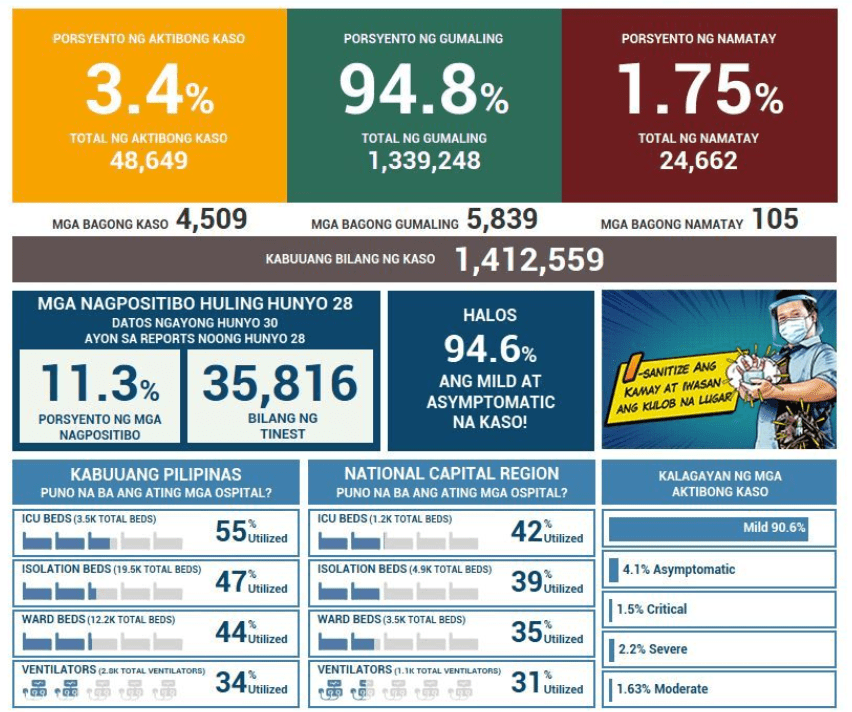
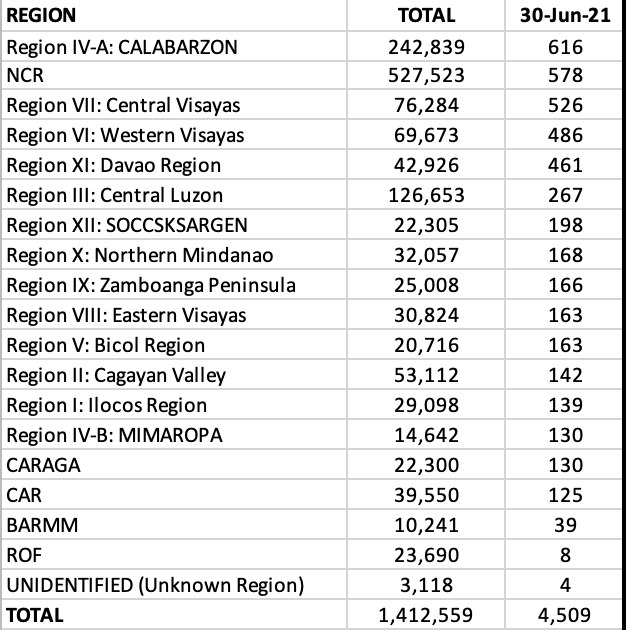
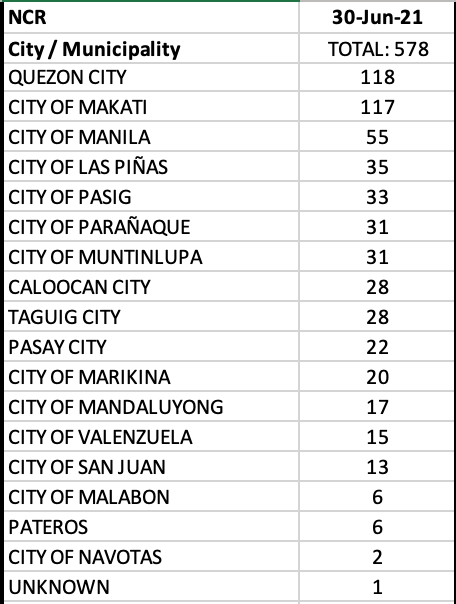
While the numbers continue to stay lower with the 4,509 new cases reported today (6 laboratories failing to submit reports for June 28), the number of tests done is insufficient as a little more than 35,000 tests were done with an 11.8% positivity rate. This brings the total of COVID-19 cases to 1,412,559 – a few thousand cases shy of Canada that is in currently in 23rd spot.
With 105 new deaths today, the case fatality ratio for outcomes is steady at 1.81%.
CALABARZON and NCR are back in the top spots for the day. Except for BARMM, even on a day with fewer cases, all other regions report triple digit cases. Central Visayas, Western Visayas and Davao Region round up the top five regions with most cases.
Davao wCity continued to lead among all LGUs with Iloilo City, Quezon City, the City of Manila and Baguio City making up the top five LGUs with most new cases. Only 4 of 17 LGUs in NCR were in the top twenty cities.
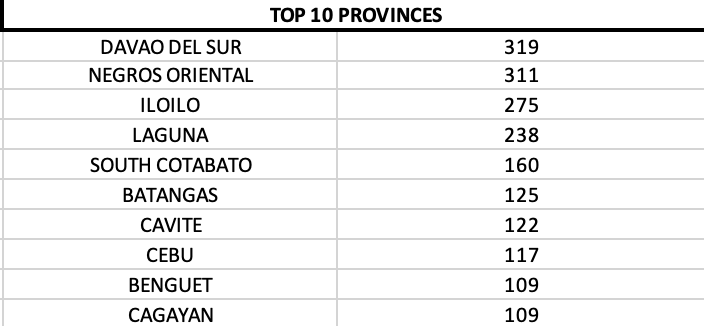
On a provincial level, Davao del Sur, Negros Oriental and Iloilo province are the top three contributors to the pool of cases for the day.
The Philippines is seeing a drop of 52% from the peak cases from the highest daily average reported on April 15, 2021 during the second surge.
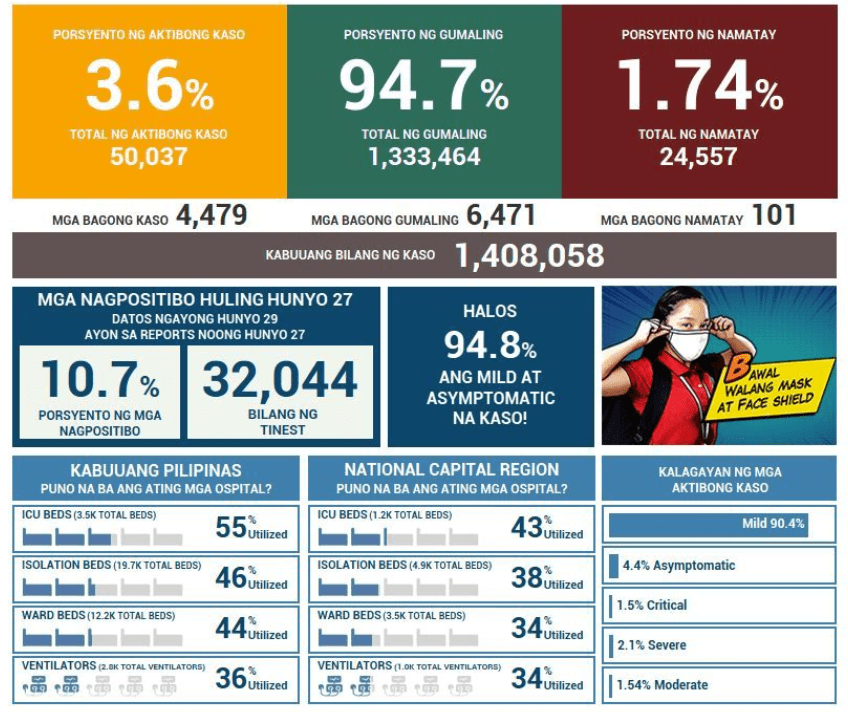
To date, we now have 1.408M infections and close to 25,000 coronavirus-related deaths reported as the Health Agency announces 4,479 new cases from reports last June 27, on a little more than 32,000 tests with a positivity of 10.7%. But then again, there’s the factor of a Tuesday report where the new cases reported are the lowest during the whole week. You can see that in the number of tests done and the quantity of laboratories that failed to submit a report on a Sunday – 14 laboratories (accounting for 5.4% of all samples tested or 6.5% of positive individuals for that day).
With 101 new deaths today, the case fatality ratio for outcomes remains steady at 1.81%.
Davao led -by region, province (Davao del Sur) and city (Davao City) on a day that had fewer cases to report. For the first time, NCR moved down to fourth in rank.
Quezon City still led in the NCR with triple digit cases, while 6 LGUs in NCR had single digit cases. Nevertheless, 7 of 17 LGUs in NCR were among the top twenty cities with most cases for the day in the country.
While the province Davao del Sur was on top, Cavite and Negros Occidental were in second and third for the day.
Davao City had more cases than the cities of Bacolod, Quezon City and Iloilo City combined.





























 Relative Joy