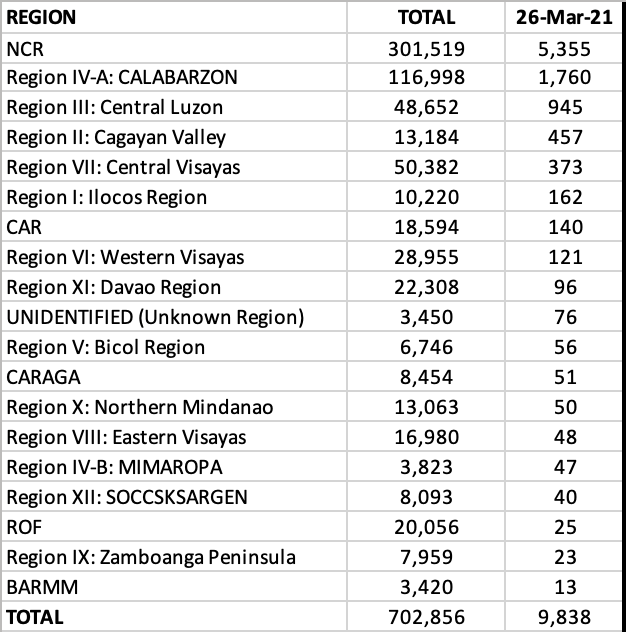
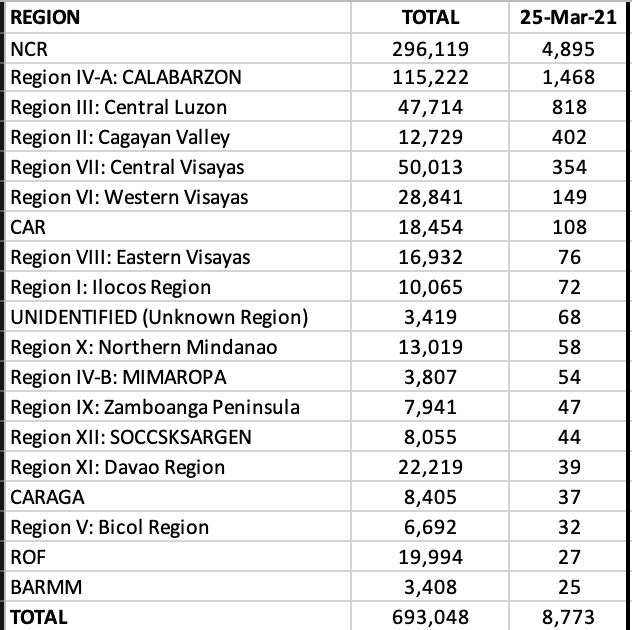
The holiday is over and we’re back to the real count with 8,773 new cases for 03.25.21

The Tuesday and Wednesday trough is over.

The Health Agency reports 8,773 new cases and 56 new deaths today. With a new high in both new cases and positivity rate of 16.1 percent, we are projected to head towards the 9,000-10,000 level this weekend. The large haul today brings the total active cases in the Philippines, a few cases short of 100,000 (14.4 percent).
Apart from the startling high numbers is the hospital occupancy rate in the National Capital Region where the ICU beds are now more than the critical levels, rising an additional 3 percent from yesterday’s 71 percent. The isolation beds are also up at 62 percent (from 59 percent yesterday) with the rising cases in the capital.
The National Capital Region reported close to 5000 cases today as the pandemic rages on (56 percent of the total). CALABARZON owned 16.7 percent of the total and Central Luzon 9.3 percent. These three regions alone accounted for 82 percent of todays cases or 7,181 new cases. Other regions with triple digits were: Cagayan Valley, Central Visayas, Western Visayas and CAR. There were 68 cases with no known location on a regional level.

In the NCR, Quezon City continued to have the most total number of cases with 856 new cases (17.5 percent). Manila was in second with 818, Caloocan with 460, and Pasig with 354. The cities of Pasay, Makati, Parañaque, Malabon, Mandaluyong and Taguig had more than 200 but less than 300 cases. The cities of Marikina, Valenzuela, San Juan, Muntinlupa and Las Piñas had more than 100 but less than 200 cases. Navotas and Pateros that usually see single digits had 65 and 76 cases, respectively.

Fifteen of 17 LGUs in the NCR were in the top twenty cities with most cases.

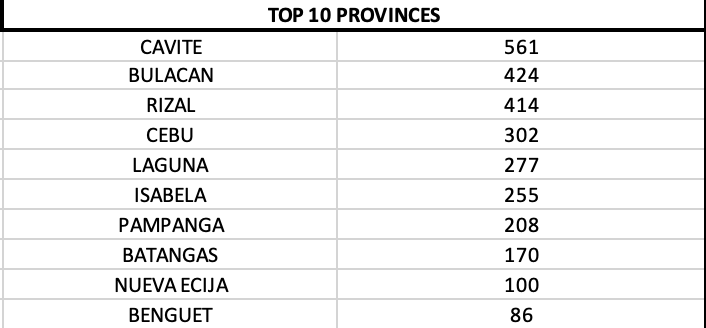
On a provincial level, Cavite has overtaken Bulacan for the top spot. Nine of the top ten provinces were triple digits. Today, only 3 of the 81 provinces in the country had no reported case. They were: Marinduque, Dinagat Islands, and Davao Occidental. Batanes had one new Covid19 case.


Update from the OCTA Research Monitoring for March 25, 2021 shows a slight decline in Rt for the NCR at 1.91. But this is not a cause for celebration, and it is unknown if this can be attributable to the recent stricter regulations of the IATF on mobility outside of the so-called “NCR plus bubble”. Note that the positivity rate in the National Capital Region was 18 percent (higher than the national average of 15 percent) over the past week.

Philippine COVID-19 Update, OCTA Research Monitoring, March 25, 2021

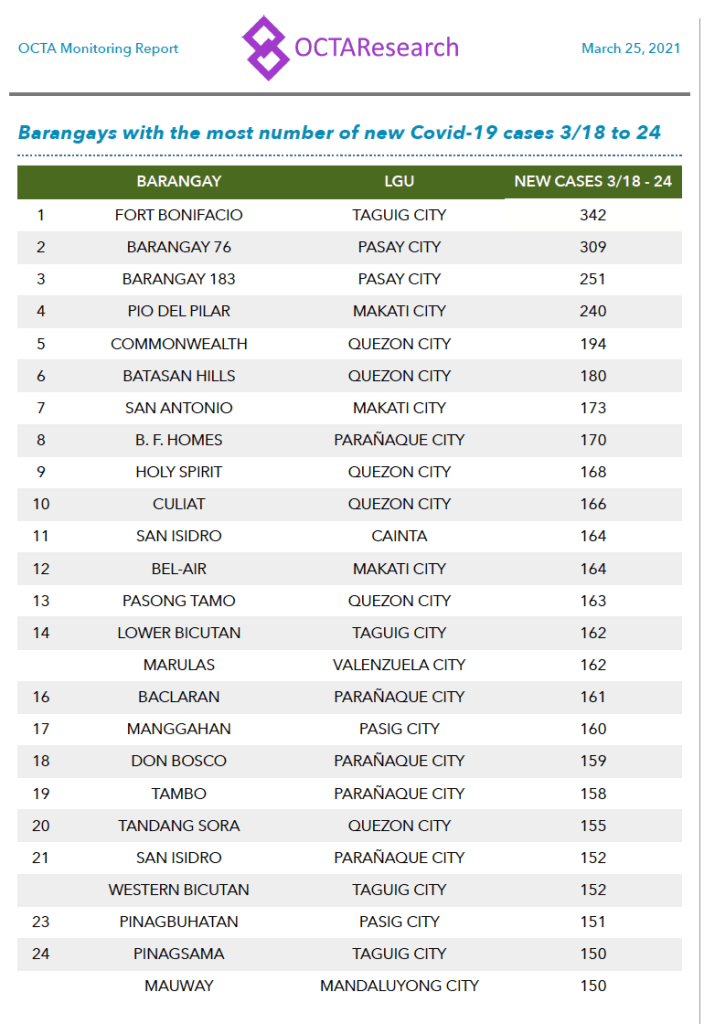
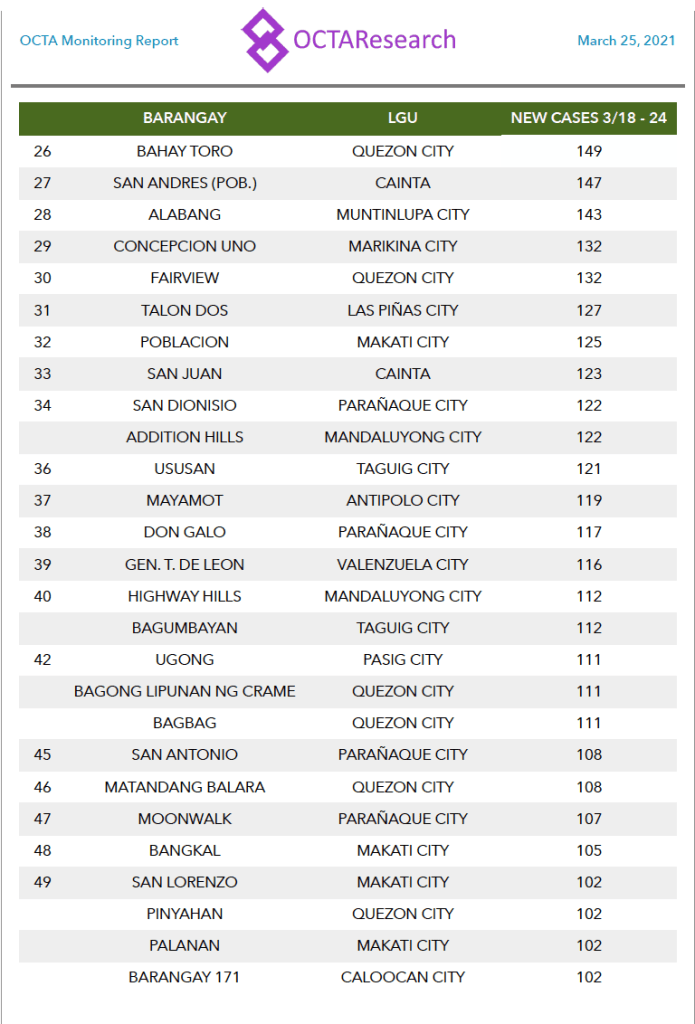
In the same report for today, the following are the top barangays in the country with the most number of COVID-19 cases covering the period March 18-24. Only 4 barangays are located in Rizal. The rest in the top 50 are from the National Capital Region with Fort Bonifacio in the lead. Note here that several of the Barangay are from middle to higher income class areas.

The current most common sources of infection based on history of exposure are: travel outside of the NCR, in-dining, festivities (weddings, baptisms, birthdays, parties and celebrations of more than 10 pax), visitors outside of the family bubble and gyms.

The mark of the devil 6666…The data drop: 03.24.21

As in previous trends, Wednesday will be slightly higher than Tuesdays numbers.

With 6,666 new cases today, 47 new deaths and 1,072 recent recoveries announced by the Health Agency, we move closer to the 700,000 mark most likely before the weekend.

Active cases are now more than 91,000 (13.4 percent) and climbing with a daily positivity of 15.3 percent.

Notice the comparison of healthcare capacity (ICU beds, Isolation beds, ward beds and ventilators) between the country and the National Capital Region. ICU beds for COVID have now breached 70 percent capacity (critical level) in Mega Manila.

The NCR continued the daily haul with 3,758 new cases or 56.4 percent of todays total. CALABARZON is in second with 16.3 percent (1,085), and Central Luzon in third with 11 percent (712). These three regions together accounted for almost 85 percent of the total cases in the country in the midweek data drop.

The larger unknown of 47 cases on a regional level is disturbing in data collection. There were 22 new cases from ROFs.

In the National Capital Region, 13 of the 17 LGUs continue to report triple digit cases, with Quezon City accounting for 23 percent of the cases in Mega Manila. Manila followed with 570. Parañaque, Makati, Taguig and Caloocan had more than 200 cases, while Pasig, Marikina, Pasay, Mandaluyong, Las Piñas, Navotas and Valenzuela saw more than 100 but less than 200 cases.

Fourteen of 17 LGUs from NCR ranked 1st to 14th in todays haul. Muntinlupa was 14th among the 20 top cities with most cases for the day.

On a provincial level, Bulacan continued the haul with 439 new cases, followed by Cavite and Rizal. Cebu moved down to fourth rank with 208 new cases only.

The OCTA Research Group provides an update on the situation in the Philippines in general, and the National Capital Region in particular, with close to 55-60 percent of the cases coming from Mega Manila.

As of March 23, 2021, the reproduction number in NCR was 1.99 and the number of new cases averaged more than 3,600 daily in Mega Manila. An increase of 62 percent compared to the past week. The daily attack rate in NCR has jumped to 25.9 per 100,000 population which is much higher than the attack rate of 12.8 per 100,000 on July 28 – August 3, 2020, prior to shifting the capital from GCQ back to MECQ.

Philippine COVID-19 Update, OCTA Research, March 24, 2021

The ten top regions/provinces are provided in the graph below, with their corresponding percentage change per region. Notice that the province of Cebu is the only one that saw a significant decrease, Benguet a slight uptick, and the remaining provinces in the top 10 soared significantly.

Based on the projections for the National Capital Region (plug GCQ Bubble), the report indicates that

…several provinces in CALBARZON and Central Luzon are also having an increase in cases, including Cavite, Bulacan, Rizal, Laguna, Batangas and Pampanga. These are the provinces included in the bubble, but we need to monitor closely the trends in Batangas and Pampanga, considering these provinces are outside the bubble but the week to week average increase in new cases was actually higher in these provinces compared to the bubble.

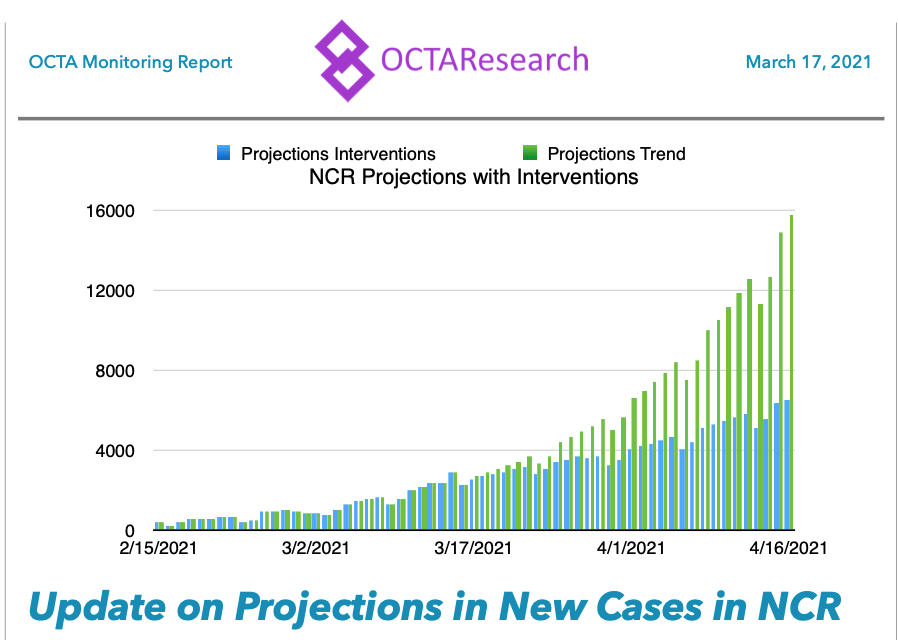
The figure below shows simulations based on two possible scenarios in the NCR. Using a current reproduction number of Rt=2.0, a scenario based on a decreasing trend (blue line) illustrates the effect on the number of cases IF the reproduction number decreases to Rt = 1.5 after two weeks. There will be a downward (trend) in four weeks, and the number of new cases per day will reach 6,200.

In a more optimistic scenario (green bars), the reproduction number will decrease to less than 1.0 after two weeks and the trend will reverse. The number of new cases under the more optimistic scenario could reach 5,000 per day in the NCR. While the optimistic scenario is NOT IMPOSSIBLE, it is mathematically unlikely, considering the nation’s pandemic history.

Philippine COVID-19 update, OCTA Monitoring Report, March 24, 2021

Tuesdays trend…The data drop: 03.23.21

The data that come in on Tuesdays (and Wednesdays) are usually the lowest numbers for the week. Hence, it was expected that the Health Agency announced fewer cases today compared to the past days. I will caution everyone to be careful in interpreting data on Tuesdays because they usually represent tests done 2-3 days back (most likely Sunday) where some testing facilities may not be operational OR that people do not see a physician on the weekend to get checked when they have signs and symptoms and usually wait it out until the first day of the week – Monday.

With a national positivity rate of more than 15 percent today, this implies that for every 10,000 individuals tested, 1,500 will likely test positive. But certain areas have higher positivity rates. The NCR for example has a positivity rate of 20 percent. If the NCR runs 25,000 tests daily, then that would mean 5,000 new cases in this region alone.

The Health Agency announces 5,867 new cases for March 23, 2021. Note the encircled numbers. The number of active cases is up at 86,200 (12.7 percent) and the percent positivity for COVID testing is now 15.4 percent. There were 620 recoveries and 20 deaths reported by the DOH, a far cry from the new cases. Recoveries are just 10 percent of the total cases. As more cases than recoveries incur this week, it will be worrisome to see more than 100,000 active cases before the end of the week.

Today’s granular data showed NCR contributing to a glaring 61 percent (3,579 new cases) of the total cases in the country. CALABARZON accounted for 18 percent of the haul for the day. Other regions with triple digit reports were: Central Luzon, Central Visayas, and Cagayan Valley. Notice that the “unidentified” are back with 51 new cases from no known region.

In the NCR, Quezon City continue to harvest the most number of cases with 731 (20.4 percent) of the total cases in Mega Manila. Manila had 489. Caloocan with 336. Pasay City 294, Taguig 271, Parañaque 252, and Makati 213. Malabon, Pasig, Mandaluyong, and Las Piñas had more than 100 cases. There were 11 cases with unknown LGUs.

Sixteen of 17 LGUs in the National Capital Region were among the top 20 cities with most cases today. The remaining four cities were: 3 from Cavite and 1 from Rizal. The whole NCR + bubble (as the government describes it) has become the epicenter of the nation.

On a provincial level, the provinces of Cavite, Bulacan and Rizal had more than 300 cases. Batangas, Cebu and Laguna posted more than 150 cases.

8,019 a new high…The data drop: 03.22.21

A record breaking day for the start of the week as the Philippines passes its new record high and into the 8,000 realm with 8,019 new cases today.

No country has ever had a second surge that ended well. Particularly those from developing nations. This will be a long drawn battle for the nation as the national Ro approaches 2.0. That’s national and not NCR alone. NCR hits an all time high of Ro of more than 2.0. Which is alarming and scary.

This new record high continues to push the active cases as there are now more than 80,000 active cases (12.1 percent). I would like to remind readers that these numbers are based only on those that are tested, recorded and monitored. It does not include those who have signs and symptoms or asymptomatic who have not been tested at all.

The speed of the trajectory now pushes the total cases to more than 671,000 and if we continue this trend in the next few days, we will definitely see more than 700,000 before the week comes to a close.

This is not far from impossible considering the positivity rate has stayed at 15 percent for the past days.

The National Capital Region continued to rake in more than 50 percent of the total cases with 4,103 (51.2 percent) of the cases today. In second was CALABARZON with 1,327 new cases (17 percent). The other provinces with triple digits were: Central Luzon (542), Central Visayas (487), CAR (424), Cagayan Valley (272), Western Visayas (225), and Ilocos Region (120).

In the NCR, Quezon City continued to account for the highest cases with almost 1,000 cases today. This was followed by Manila with 587, Taguig with 375, Makati with 341, Caloocan with 264, Paranaque with 209, and Pasay City with 208 cases. The cities of Malabon, Las Piñas, Pasig, Valenzuela, and Marikina registered more than 100 new cases each. Fifteen of the 17 cities in NCR were in the top twenty cities and municipalities today.

On a provincial level, all provinces in the top ten had triple digits with Cavite leading the pack. Three provinces registered more than 400 new cases each. They were Cavite, Cebu and Rizal.

Of the 81 provinces in the Philippines, only 8 (or less than 10 percent) reported no cases of COVID19 for the day. They were: Surigao del Sur, Eastern Samar, Basilan, Camiguin, Siquijor, Tawi-Tawi, Batanes, Dinagat Islands and Davao Occidental. Batanes has the least COVID-19 cases in the country with just 4 cases since the pandemic began.

PH is worst performing in Asia with – The data drop: 03.21.21

For the week of March 14-20, 2021, the Philippines added 39,438 new cases in those 7 days.

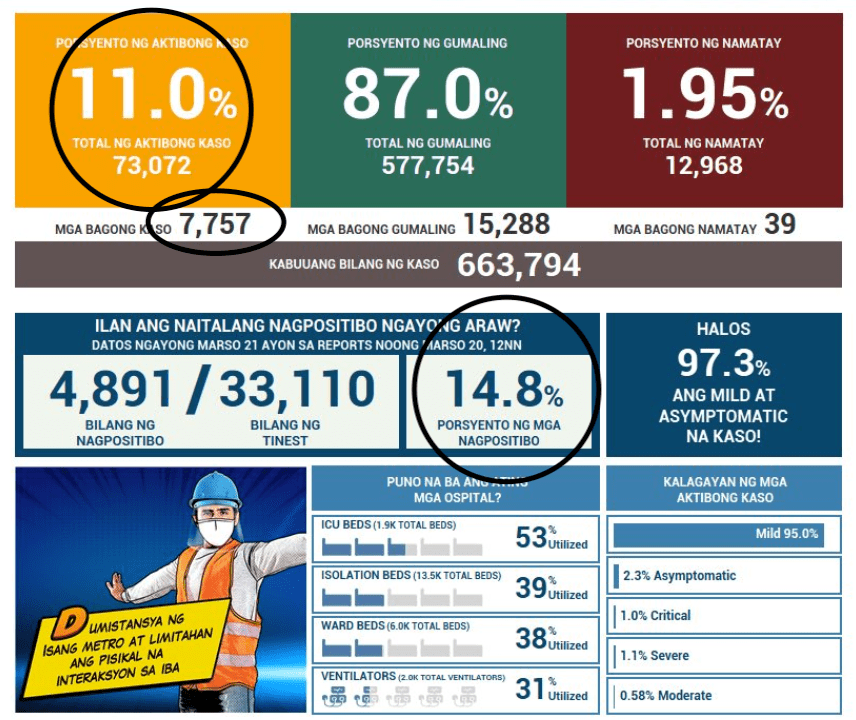
Today the Health Agency reports 7,757 new cases and 39 new deaths. In spite of the weekend recovery haul of more than 15,000 cases, it wasn’t enough to bring down the active cases which now hovers at 11 percent with more than 73,000 active patients. Remember, as the number of cases continue to increase, the number of active cases will take time to decline. Putting the population at higher risk for transmission of the virus.

The daily positivity rate remains unchanged at 14.8 percent (close to 15 percent), implying that for every 1,000 individuals that get tested, around 150 will turn up positive.

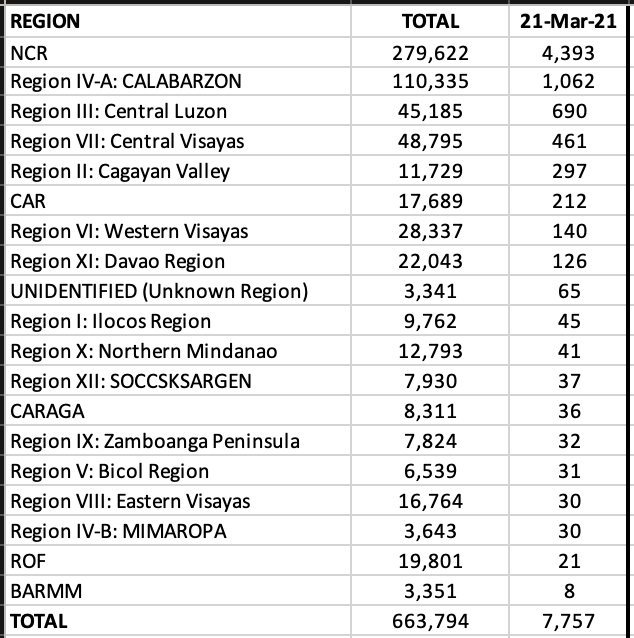
The National Capital Region continued to lead the haul with 4,393 new cases or 57 percent of the total cases for today. CALABARZON is in second with 14 percent contribution and Central Luzon with 9 percent. These three regions continue to account for 80 percent of the total cases in the country. The other regions with triple digits today were: Central Visayas, Cagayan Valley, CAR, Western Visayas and Davao Region. Twenty-one ROFs were included in todays tally.

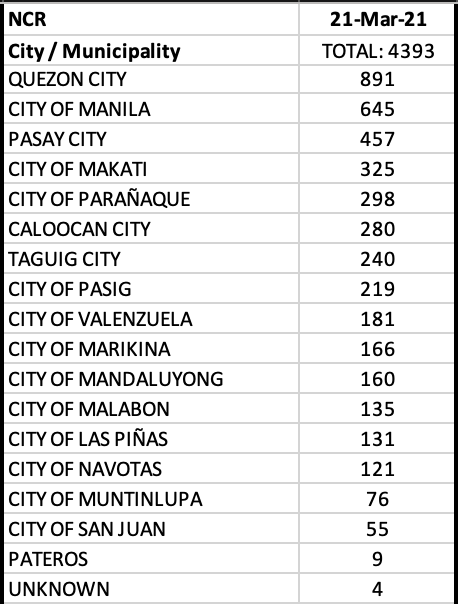
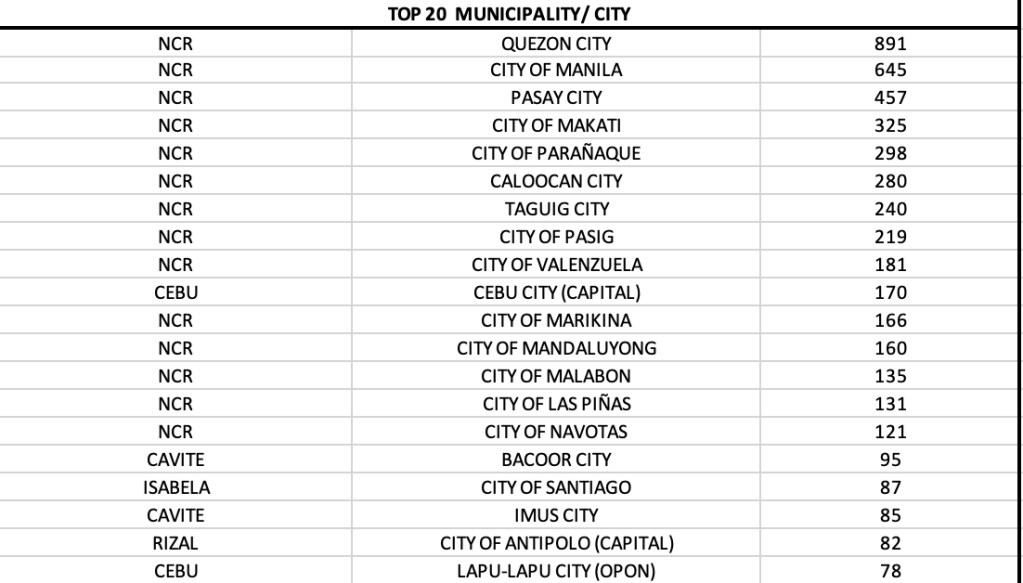
In Mega Manila alone, 14 of 17 LGUs reported triple digits! Making this one of the worst days in the NCR. Quezon City continued the haul with 20.3 percent of the total cases, followed by City of Manila with 645, Pasay City 457, Makati 325, Parañaque 298, Caloocan 280, Taguig 240, and Pasig 219. The cities of Valenzuela, Marikina, Mandaluyong, Malabon, Las Piñas and Navotas all reported more than 100 cases. All 14 of the 17 LGUs that reported triple digits landed in the top twenty cities with most cases.

On a provincial level, Cebu was back on top. But the provinces of Bulacan, Cavite, Rizal, and Isabela are seeing higher numbers today. Nueva Ecija, for the first time, lands in the top ten.

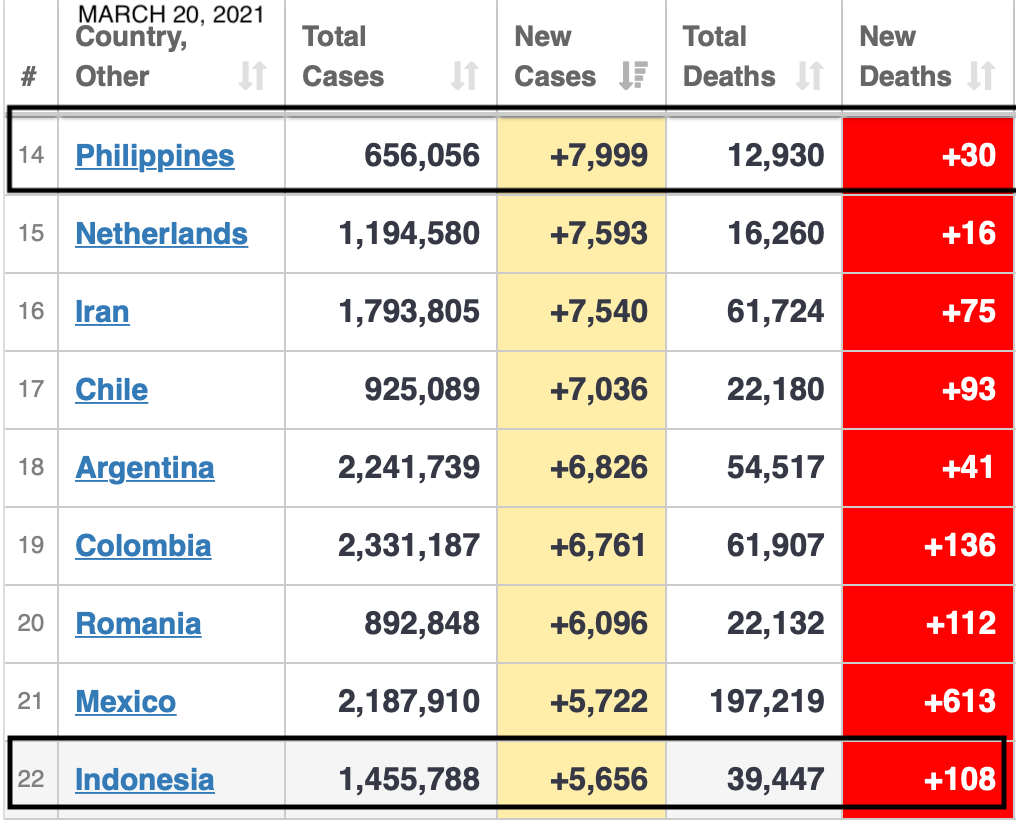
Yesterday, March 20, 2021 was a game changer with the 7,999 cases reported in a single day. The Philippines ranked 14th in total number of new cases, overtaking several European and South American nations, including our Asian neighbor Indonesia.

Based on the European CDC tracking, only the Philippines is seeing a significant surge of cases in the region. This is the highest surge the country is experiencing since our initial surge between July – August of 2020. The surge in the Philippines is mainly driven by the National Capital Region, which contributes to more than 50 percent of the daily numbers, CALABARZON (Region IVA) with more than 16 percent, and Central Luzon (Region III) with more than 10 percent.

7,999 and climbing…the data drop: 03.20.21

The OCTA Research group had predicted that the mathematical probability of being in the 8,000 range is highly likely to occur considering that the positivity rate averages 15 percent daily for the past few days. The Philippines is now tracking a higher positivity rate as a nation at 8 percent on the average. In short, it was inevitable that the 8,000 mark would be reached or breached. With rising daily positivity rates and a large active cases pool, today marks the highest number of new cases reported in the Philippines. And the numbers are expected to rise in the upcoming days and weeks.

In todays report, the Health Agency announced 7,999 new cases, 30 new deaths, and 597 new recoveries (which will really not matter considering that the active cases are now more than 80,000 and will continue to swell disproportionately).

With a 14.6 percent positivity rate, we will continue to report cases in the range of 7,500-8,500 the next few days, depending on the extent of tests done.

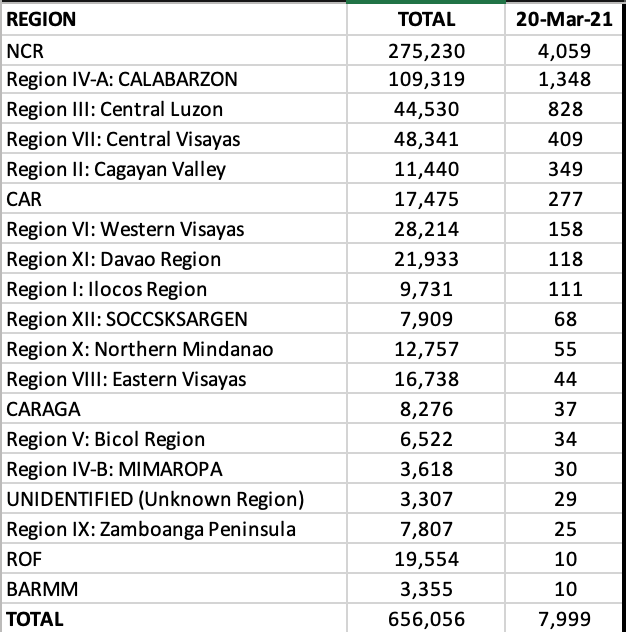
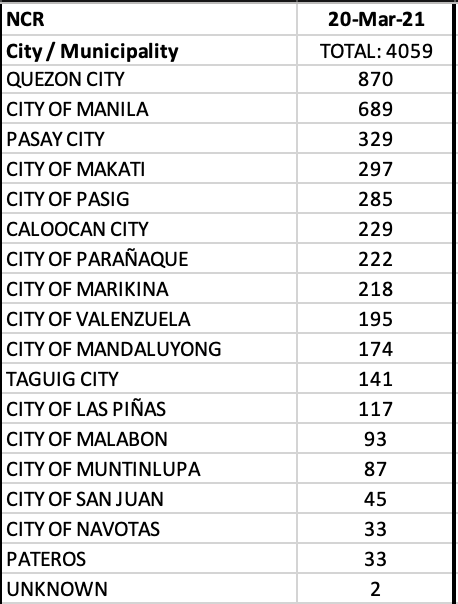
Of the 7,999 new cases today (which should really be more than 8,000 because 6 laboratories did not submit data), the granular data continued to show the NCR being the epicenter of the pandemic in the country with more than half the cases today (4.059) coming from Mega Manila alone.

Notice the difference in the graph of the Health Agency below (as of March 18, 2021). The first surge last year took us an average of 7 weeks to climb. The highest peak was during the week of August 6-12, 2020. And it took us more than 10 weeks to stabilize the weekly new cases. CALABARZON’s share is now up at 17 percent with 1,348 new cases followed by Central Luzon with 828 (10.4 percent). These three regions that are contiguous with one another account for more than three-fourths of the total cases in the country.

In the NCR alone, all LGUs showed a significant rise in daily cases with Quezon City contributing to almost 900 cases or 21.4 percent of the cases in Mega Manila. The City of Manila had 689 and Pasay City had 329 new cases. The cities of Makati, Pasig, Caloocan, Parañaque, Marikina had more than 200 cases, while the cities of Valenzuela, Mandaluyong, Taguig and Las Piñas reported more than 100 cases. Fourteen of the 17 LGUs in NCR were in the top twenty cities with most cases in the country today.

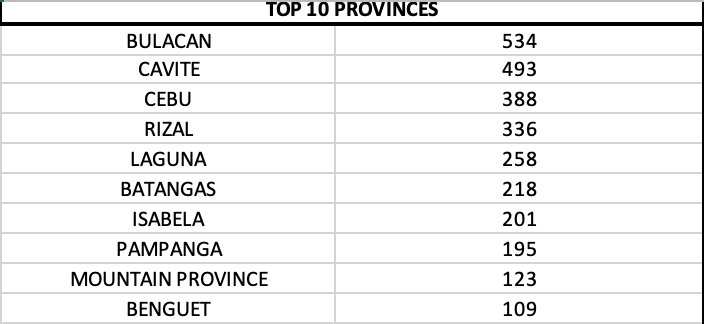
A new record for the top 10 provinces was marked today when all ten provinces reported triple digits or more than 100 cases each. Bulacan led with 534, followed by Cavite with 493 new cases.

The second surge is markedly different inthat it took us only 2 weeks to reach numbers this high. The incline is steep. And a steep incline is indicative that we have not even peaked yet. With the current trend, we will need to exercise more restraint when deciding to go out for nonessential matters.

7,103 on 03.19.21 and the OCTA update

Let’s start with today’s data release from the Health Agency.

The most number of cases since the pandemic began in the Philippines marks a milestone with 7,103 new cases announced today. This puts the total number of cases close to 650,000 as the second surge dramatically changes the landscape of the pandemic at a time when the economy is tattered and vaccines are still in the waiting list.

Here’s what the reader needs to focus on:

  • The number of active cases has ballooned to 11.3 percent (more than 73,000 active). Remember, it takes two weeks to even consider these cases as “recovered” using a time-based endpoint. As more cases accumulate, the number of active cases will continue to balloon. Meaning more potentially infectious people circulating.
  • The percent of positive patients being tested are at an all time high – 15 percent! This is based on more than 35,000 being tested. On the premise that it is the same positivity at 50,000 people tested, that would mean around 7,500 new cases tomorrow.
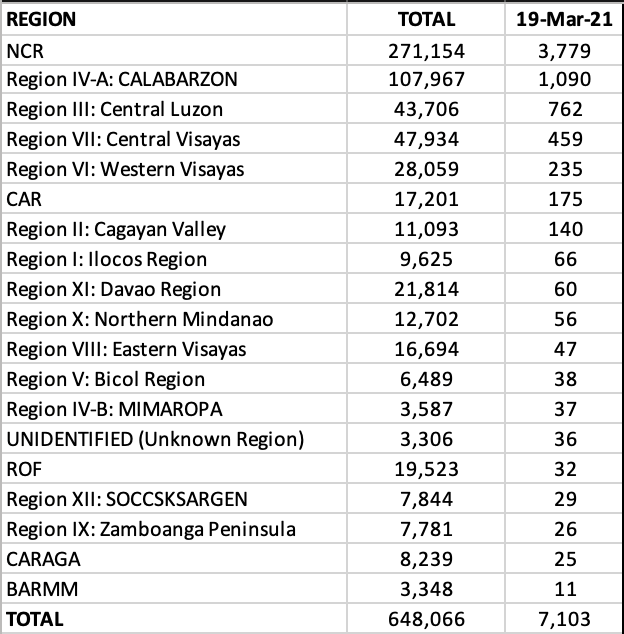
  • On a granular level, NCR accounted for more than 53 percent of the total cases with 3,779 new cases. CALABARZON reported 1,090 (15.3 percent) followed by Central Luzon, Central Visayas, Western Visayas, CAR and Cagayan Valley.
  • Among the 17 LGUs in NCR, Quezon City led with 752 new cases or 20 percent of the total cases in Mega Manila. Manila, Makati, Caloocan, Pasig, Pasay, Taguig, Parañaque had more than 200 cases. Marikina, Mandaluyong, and Valenzuela had less than 200 but more than 100 new cases. 14 of 17 LGUs in NCR were among the top ten cities with most cases today.
  • On a provincial level, Bulacan led with 439 new cases. Eight of the top ten provinces reported triple digits.

The post for the last few days had one take home message – this surge is real.

The indirect message is that, if we don’t this surge seriously, it will end up ugly.

In the March 17, 2021 Philippine COVID-19 Update of the OCTA Research Group, NCR alone continued the upward trend in numbers and accounted for more than 50 percent of the total daily cases in the country. The reproduction number is up at Rt = 1.96, its highest since May 2020. With a daily attack rate of 15.9 per 100,000 population over the past 7 days, the region is now classified as high risk. The positivity rate for tests is at an all time high at 12 percent, with testing in the NCR up by 18 percent to almost 25,000 tests daily. The hospital bed occupancy for COVID19 patients in the NCR is at 49 percent, with ICU occupancy for COVID19 patients at 64 percent based on data from the Health Agency.

The top 25 LGUs in the country with the most number of new COVID19 cases over the past week (March 10-16) showed very high attack rates (>20/day/100,000) in Pasay City, Makati, Navotas and Santiago, Isabela. As a matter of fact, Santiago, Isabela had a 24,300 percent (twenty four thousand three hundred percent) change in new cases over that period.

While the province of Cebu still has relatively high numbers, it has significantly slowed down and its major LGUs like Cebu City, Mandaue, and Lapu Lapu have seen a drop in new cases and attack rate as well.

Those that are shaded in yellow are seeing significant increases and are alarming, while those in orange hue have very significant numbers depending on the parameter (e.g., change in new cases or daily attack rate or hospital occupancy).

“…by simulating the combined effects of localized lockdowns, curfews and stricter implementation of health protocols…the projection compares Rt=2.0 (trends currently observed in NCR continue or if city ordinances and interventions have zero effect on the trend). The result is that more optimistic scenario can reduce the number of new COVID19 cases by the end of March to less than 4,000, compared with 7,500 if there are no changes (i.e., if the current trends of Rt=2.0 persist).

By mid-April the model that takes into consideration the city ordinances could lead to 6,000 new cases, compared to 16,000 if current trends continue.

Localized lockdowns may work against variant-driven surges but they are more effective in tandem with expanded testing, contact tracing and supported isolation. Localized lockdowns are also more effective when communities support them. Hence, LGUs organizing lockdowns must ensure that they are humane and protective of individual rights, and that the communities affected must be provided food, water and other minimum basic needs.

OCTA Research National Update March 17, 2021

The data drop: 3.18.21

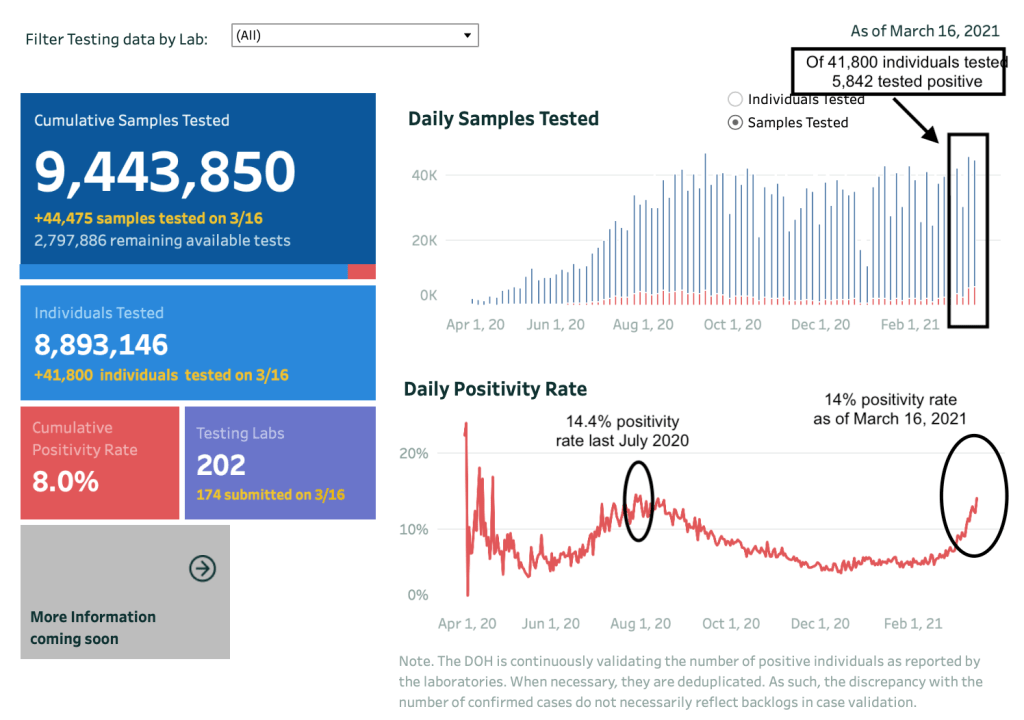
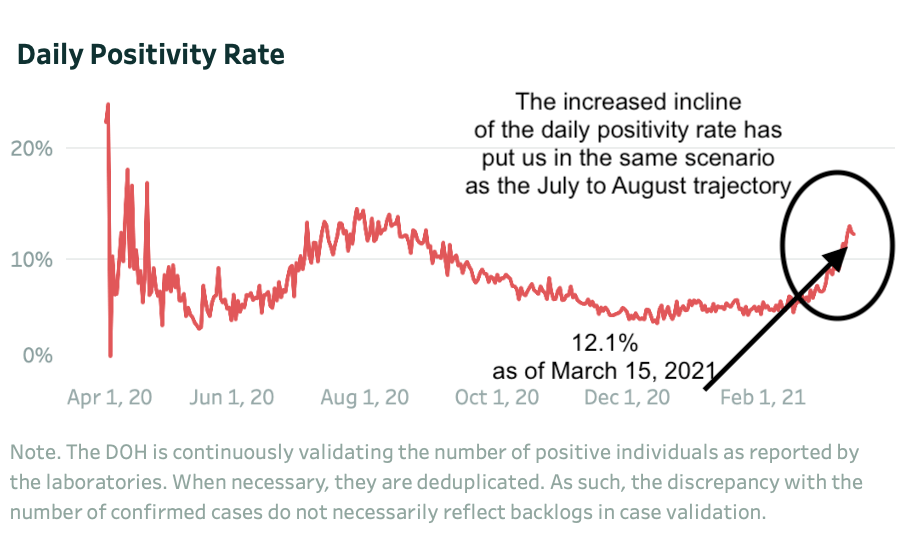
The daily positivity rate for March 16, 2021 was almost similar to the July 30, 2020 trend. The difference? We’re running 10,000-15,000 more samples for testing in this surge compared to the last surge. Which implies that we need to be testing more. And with more than 220 testing centers now compared to the 150 testing centers last July 2020, there is no reason that we shouldn’t be testing more and doing more aggressive contact tracing.

That is why we are where we are today with the numbers.

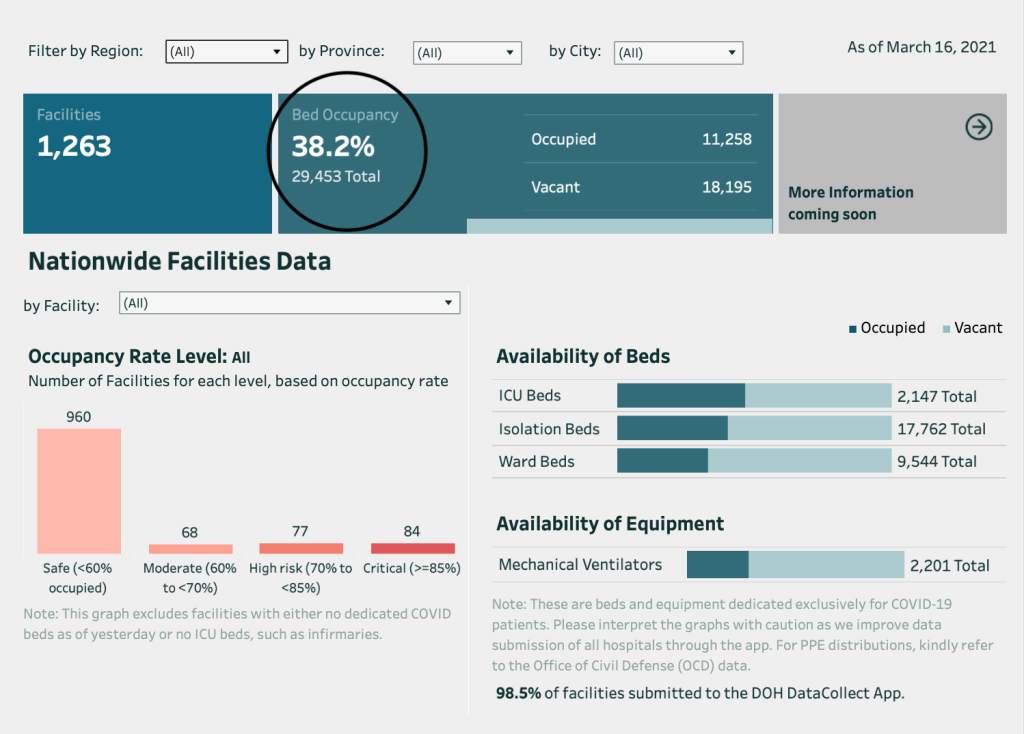
The Health Agency notes in the website (and in their press release) that the hospital capacity of the country is still way below the critical level. This, however, is not an accurate picture of how the pandemic playbook is affecting health systems in areas with higher cases. There are over 1,260 facilities spread throughout the 7,640 islands of the country. Only five regions are currently inundated with cases, with NCR seeing quadruple digits daily.

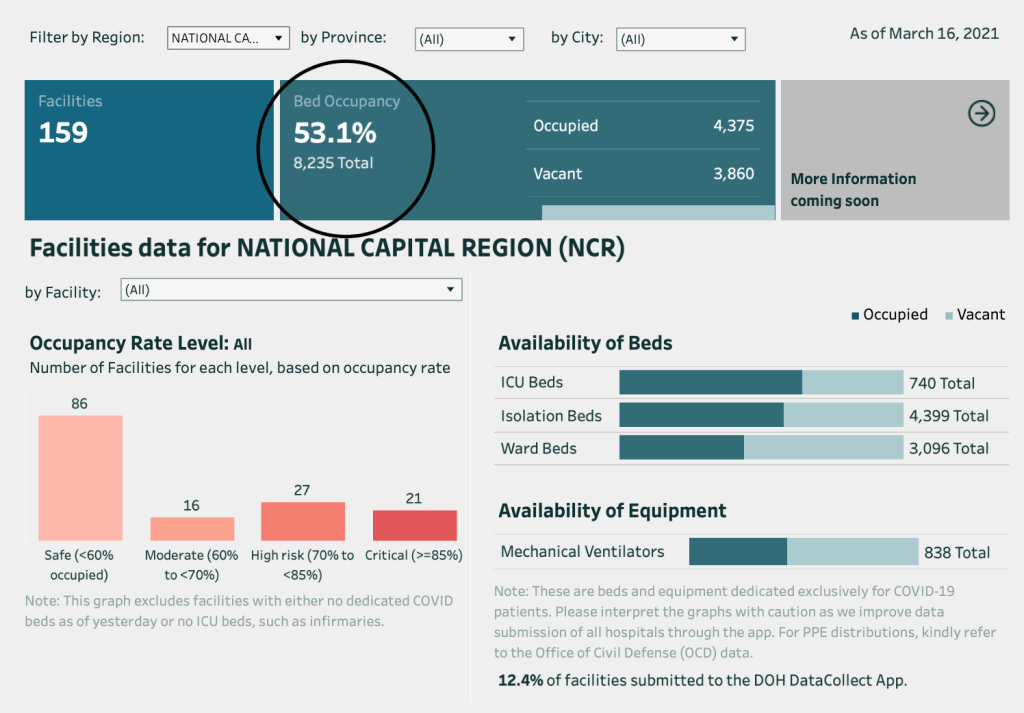
Health capacity dramatically changes when you drill down to the specific regions. In the National Capital Region where the daily cases far exceed the daily cases of other countries, the occupancy rate is past 53%.

This National Capital Region, or Mega Manila, is divided into four districts.

District 1 is the city of Manila only, where around 1.8 million reside in a land area of 42.88 sq. km.

District 2 covers the Eastern Manila District, where the LGUs of Mandaluyong, Marikina, Pasig, Quezon City and San Juan are found. District 2 has the highest population with 4.7 million people over a 236.4 sq. km. area.

District 3, otherwise known as CAMANAVA, cover the cities of Caloocan, Malabon, Navotas and Valenzuela. They have a population of close to 3 million on a land area of 126.42 sq. km.

District 4 or the Southern District comprise the cities of Las Piñas, Makati, Muntinlupa, Parañaque, Pasay, Pateros and Taguig. The population for this district is around 3.7 million occupying a land area of 208.28 sq. km.

The Health Capacity of the various districts also vary. The 1st district has a hospital occupancy of 47.3 percent, the 2nd district at 51.2 percent, the 3rd district at 48.1 percent and the 4th district is the most overwhelmed at 68.6 percent.

Today, the Health Agency reports 5,290 new cases bringing the total cases past 640,000. Thee were 21 new deaths reported today.

The highlights of the day are encircled:

(1) The active cases have surpassed 10 percent with more than 66,000 active.

(2) The positivity rate is at 14.1 percent with 5,635 positives from close to 40,000 individuals tested.

Of the 5,290 cases today, 2,767 (52.3%) were from NCR alone.

CALABARZON reported 917, Region VII, 473, Central Luzon 413, Cagayan Valley 159, Western Visayas 107.

In NCR, Quezon City reported 539 new cases (19.5%) of the total. The others? Manila 490, Pasay City 227, Makati 223, Marikina 211, Pasig 192, Parañaque 172, Caloocan 152, Taguig 132, Mandaluyong 113, Valenzuela 101. The remaining 6 LGUs in NCR had double digits but still increasing numbers.

The data drop: 3.17.21

The Health Agency’s website today shows the steep incline in cases for the week March 4-10, 2021. This, in spite of the fact that the data is based on Date of Onset of Illness. Definitely, this storm is far from over and as the vaccine program of the government is being rolled out to the frontliners, the government needs to seriously consider placing containment policies on mobility in the next few weeks in order to avert this surge.

  • Testing showed the proportional increase in daily positive rate with the increase in cases. Not testing enough and not doing enough contact tracing as more patients are being seen much later on when the clinical symptoms are already present.
  • The Health Agency reports 4,387 new cases today. A bit lower than yesterday but expected for a Tuesday and Wednesday announcement.
  • Encircled below are the important numbers and parameters.
    • Number of active cases will exceed 10 percent tomorrow. It is now at 9.7 percent with more than 61,000 active cases.
    • The positivity rate for March 16 (as of 12 NN) is up at 14.1 percent, our highest since July of last year. Will we breach the 6,000 mark tomorrow? Not a far possibility.

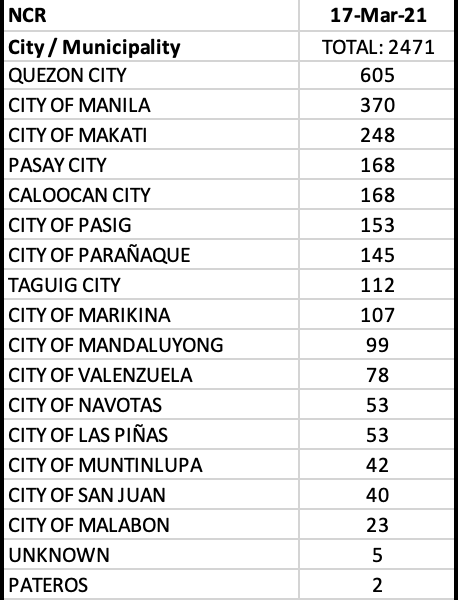
NCR continued to account for the majority of cases with 2,471 or 56.3 percent for the day. Five other regions reported triple digits – CALABARZON, Central Luzon, Central Visayas, Cagayan Valley and CAR. Note the significant decline of cases in Central Visayas on a regional, provincial and city level. There were 28 cases with unknown residences from a regional level.

In the NCR, Quezon City continued to lead with 605 or almost 1/4 of the total cases in Mega Manila. The city of Manila, Makati, Pasay City, Caloocan, Pasig, Parañaque, Taguig, and Marikina reported triple digits today.

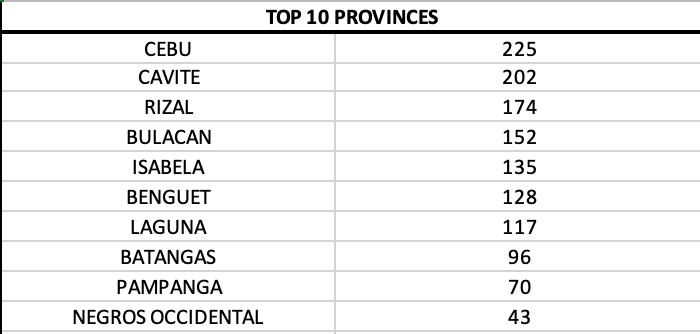
On a provincial level, Cebu was back on top but with significantly lower cases. Cavite, Rizal, Bulacan, Isabela, Benguet, and Laguna reported triple digits.

Fifteen of 17 LGUs (88 percent) in the NCR filled the top 20 cities and municipalities with most cases. An indication that the surge is highly concentrated in Mega Manila. Top 11 cities with most cases today were all from NCR.

With the increase in positivity rate and the high number of positives as of 12NN today, we will definitely see a significant rise in cases tomorrow. This means that if 50,000 tests were done at 14% positivity rate, we may be testing the 7,000 level within the week.

The COVID19 pandemic: Season 2

If this were a TV series, the first season of the pandemic could be described aptly as one helluva rollercoaster ride. And in the same vein as many season endings, yesterday’s 5,404 new cases left us in a climax where the data clearly showed how formidable the virus is.

While many countries had to deal with similar, if not more tragic outcomes in spite of better resources, other nations showed that they were able to step up to the challenge in conquering the pandemic against all odds. For some countries, a change in leadership was necessary to pave the way for addressing correctly in managing the ongoing pandemic in their own territories. The inevitable changes led to better outcomes as worthier leaders took the helm.

If there was one lesson that resonated from the season 1 of the pandemic, it was clear that science played a crucial role at driving the right direction on how a pandemic is managed. How each nation grappled with the pandemic depended heavily on the extent to which its leaders acknowledged the gaps and failures. Without a doubt, every disaster requires a risk management system. But systems are not cast in stone. And disaster preparedness is one that should be ‘forward looking’, using the lessons of the past in order to capacitate itself in order to avert another disaster or if and when it is inevitable, we now have more leg room to manage it because we had foresight.

So we give Caesar what is due Caesar.

We thank the many “czars” for the job done. The tasks given to each was herculean in itself. At the end of the day, there is no playbook on how to survive a pandemic. Some of them, however, could have done a better job had they been better qualified for the task. The defense mechanism(s) of people who are there to defend the faux pas of the government’s less sterling moments is terribly wanting. If there is something we learn in disaster management, it is realizing that gaps exist, gaps are acknowledged and that solutions at addressing them should be provided. Humility, is, after all a virtue lacking in many.

In much the same way as there is no instructional manual on how to manage pandemics, there is nothing written about how economies of various scale can pull through a pandemic without significant losses. Some industries may end up more profitable than others because of the nature of their business. Resilience and innovation tested the various businesses as the world saw the economy grovel to its knees. And the small and medium enterprises were the first to be buried.

The pandemic started at various timelines depending on the country. While some escaped it unscathed, others were left with having to replay the horror, sometimes more than once. We are at that precipice.

The star of 2020 was without a doubt, science.

The speed with how drugs, vaccines, diagnostic modalities and other medical devices were discovered was the silver lining that kept the candle of hope burning through the darkest days last year.

The second season begins on a brighter and more expectant note with these discoveries in science and medicine.

It is what will pull us through the next season of the pandemic.

Let us hope that this will be a short season, and this season finale should have a happy ending.

Like all stories, only we, as a people can write how this story ends.


On Tuesdays and Wednesdays, the Health Agency usually reports slightly lower numbers than the previous days. That’s because the data that is reported is actually two days late. As in other parts of the world, where we get lower numbers on weekends, the Philippines reports its lowest number of cases on Tuesdays (and a tad higher the day after). The actual numbers come in on Wednesdays to Mondays, reflective of that two days lag.

It is also interesting that only the Philippines uses the “date of onset of illness” in capturing cases. Which is odd because majority of the cases do not and cannot pinpoint the date of onset of illness.

Today, the Health Agency reports 4,437 new cases, 11 new deaths and 166 new recoveries.

The stark revelation here is the number of active cases which has climbed to over 57,000 (and continues to climb). In addition the positivity rate for tests remains over 10 percent (11.2 %). With the Ro in the NCR now at 2.03, unless drastic measures are implemented we may actually defy the high numbers we saw last July-August 2020.

With today’s case load, the NCR continued to lead with 2,231 new cases (more than 50%) in spite of the lower total cases for the day. Five other regions recorded triple digits: CALABARZON, Central Luzon, Central Visayas, CAR and Cagayan Valley. Remarkably, Central Visayas moves down to fourth spot after almost two months in second rank.

Eight LGUs in the NCR had triple digits with Quezon City reporting more than 20 percent of the total cases. Manila, Makati, Pasay City, Taguig, Parañaque, Caloocan and Pasig had more than 100 cases each. Fourteen of the 17 LGUs were in the top twenty cities for the country. Of the top ten cities with most cases in the country today, ALL were from Mega Manila.

The province of Cebu for the first time moves down to fourth place in rank on a provincial level. The provinces of Rizal, Bulacan and Cavite now outrank Cebu.

Every country that experienced a surge had one common story. It was worse and more difficult to manage.