Going up? The elevator #PetPeeveStories

We all take the elevator on most days. And my patience is ultimately tested in this cramped space, where the ride can be your most patient or angry moments.

My take on elevator etiquette. If you feel alluded to, sorry. The following are NOT appropriate when taking the lift. The general rule of thumb is BEING CONSIDERATE with the people inside. If you don’t want people staring or glaring at you when your highness steps in OR out the tiny cramped space, here are the rules:

1. Remove your backpack when you’re inside the lift

The space is cramped already. Boarding an elevator with your backpack at your back is occupying extra space. What’s worse than an indignant person with a backpack on his/her back is when he/she keeps moving around and the backpack is swinging at the other people. If someone smacks you, you deserve the smacking. Oh yes. That includes those carrying those large bags (and we don’t care if it’s an Hermès) that are bigger than a luggage. Please make sure that it’s not on your arm but held down in front of your legs with your hands stretched downwards.

RULE IS – when boarding the lift, remove your backpack and keep it between your feet. Being considerate of other people is mandatory.

2. Fold those baby carriages

When a disabled has to occupy the space because he/she is in a wheelchair or crutch, they have the priority. Not the babies! If you need to take the baby, fold the carriage and carry the infant. If he’s already a toddler, wake him up, make him walk or carry him and if there’s an escalator, take the escalator. The carriage is meant to carry a person and not your shopping stuff. The carriages are space occupying lesions.

RULE IS – fold the carriage before stepping into the lift. If you’re in a building that has an escalator, fold the carriage, carry the baby, take the escalator. The disabled have priorities in using the lift.

3. Face the front

It’s weird that you’re facing people in the elevator. It’s never right to stare at each other’s face. When in a lift, everyone should face the door. It allows you to step out of the lift at once when you get to your designated floor.

Don’t board the elevator when you’re going the opposite direction. Like when you’re going down, you take the elevator on the 7th floor when it still has 15 floors to go. It’s rude. You’re wasting space that can allow others to take them to their designated floor.

Looking at the door allows you to assess when it is time for you to step out of the lift.

RULE IS – after entering the lift, turn around, face the door and look straight. No groping or touching body parts unless you’re a pervert.

4. Last floor in, first floor out

If you’re heading to the uppermost floors, stay at the back of the lift. If you’re getting off at the lower floors, stay in the front area. When it’s already full, take the next lift. Don’t make everyone feel like sardines in a can. Move to the side when the doors open for other people to get in. Statues are not allowed inside the elevator.

RULE IS – last floor inside, lower floors near the door. Move for other people when the door opens or closes. If it’s not your floor and you’re at the door, step out of the lift when the door opens and let the people out. Be considerate. No statues inside the lift please.

5. No cellphones and keep your voice down

We don’t need to hear your conversation. Just today, as I was going down from work, three people were simultaneously chatting on their mobile phones. It wasn’t only irritating. I didn’t want to overhear each of their one way conversations. But they were outdoing each other’s volume. And I had 8 floors to go.

The Japanese are great examples of courtesy and decency when it comes to elevator etiquette. When they board a lift or train or bus, they don’t talk on their mobile phones.

Incidentally, it holds true for music and headsets. You’re supposed to hear YOUR music. If I wanted to appreciate a concert, I’d go to one. We’re not as tone deaf as you.

RULE IS – turn off your phone or place in silent mode when you board the lift. When you’re already in a conversation before you board the elevator, tell the other person you’re talking to that you’re getting into a lift and that you’ll call back. If you can’t cut the conversation, don’t take this lift. Wait till you’ve finished that conversation before riding the elevator. The lift is not your mini conference room.

For those appreciating the music at top volume, tone it down. Your sounds may be noise to me.

Silence is the key!

6. Eating is disturbing

We’re all starving to some degree. We probably dashed out of the office to grab a bite to eat. Eat it in your desk over a sad lunch or at the cafeteria or restaurant instead. Don’t bring out the food and munch while you’re inside the lift. You can enjoy every morsel of that bite in your space without having to irritate the others inside the lift. That is, of course, a different story if you want to offer everyone in that 30 seconds ride, a cheeseburger.

RULE IS – it is rude and gross to be snacking inside the elevator. Enjoy your meal without having to slobber all over the lift. If you spill food on someone who accidentally bumps into that ice cream cone, it’s your fault.

7. Stairs or stars

A bit of exercise is worth our health. It’s ironic that there are people who will run a 50km marathon but would want to take the elevator two or three flights up. If you’re in good health, you may want to be kind to those who need to use the lift more than you.

RULE IS – if you’re going one or two floors up or down, take the stairs. It is being considerate to those who need to use it. Think of it as your contribution to the good of mankind and your health.

8. Sorry I’m closing the door

This is a tough topic. You ever encountered that situation where someone or you are running towards the lift yelling “pssst pssst pssst” or “hoy hoy hoy” to hold the door? Then it closes. If you were the guy outside, some would probably be cursing at the inconsiderate bastard who didn’t hold the door and you’d have to wait another few minutes for the next lift to arrive.

RULE IS – he who is inside the door and has control of the door has the prerogative to allow you to join him in the lift or not. No one needs to wait for you when you when they’re inside the elevator already. It is always the prerogative of those inside the lift to allow to wait or leave you behind. If the people inside the elevator decide to wait for you, be grateful. You’re not the only one in a hurry.

If this article hits home, feel free to share away especially to those concerned. It would be good to have educated someone today on proper elevator etiquette. God knows this country needs this.

“The doctor is out” #PetPeeveStories

[PARENTAL GUIDANCE IS RECOMMENDED.  THE LANGUAGE USED MAY BE INAPPROPRIATE FOR CHILDREN]

It’s never appropriate to give away your personal mobile number to patients. Unless the number you give is an office phone, or you have a personal secretary whom patients can get in touch with, then yes, it’s never appropriate to give away your personal phone numbers.

Patients will ALWAYS want to know how to get in touch with the doctor. I get that. Many, usually ask for your mobile number – just in case – they need to get in touch with you when they or their kids get sick.

Ever since I started my practice, asking for my personal number has been my number one pet peeve. “No you may not have it. On my card is the number of my clinic where you can contact me during office hours.”

During the earlier days when the pager was still in vogue, I didn’t mind that my pager number was emblazoned on my calling card. After all, it was one anonymous number and the patient had to get through another anonymous person who would filter the information that would be sent to me. It’s like having a private secretary that you needed to go through before I got the “emergency” message. My pager would vibrate. The message would appear. And I could call from my landline or phone (there were no Smartphones then), wherever I was. Or I would just save it for later if it wasn’t urgent.

But technology would change the landscape of clinical practice. Gone were the days when you were the CEO of your own private practice. Smartphones and tablets changed the way you dealt with patients. There are medical professionals who have “professionalised” their medical services providing online “consultations and opinions”.  Some take it a level higher by being able to “Viber” or  FaceTime with patients as well! And here’s where it gets really tricky and icky.

I have no quarrel with technology. Just where and how it’s used.

1. Personal space and professionalism is important

Doctors have a personal life. When the patient has an emergency, I am not 911. Take them to the nearest hospital. They should know what to do there. For the younger ones who’re trying to give away their personal numbers so that they can create a following (or a patient base) – DON’T! You’re making yourself open to liabilities and law suits by acquiescing to the patients desires. Keep a professional distance.  If they can pay to go to the hairdresser and queue to watch a movie, I think they can pay for a professional medical/surgical consultation. NEVER EVER GIVE A DIAGNOSIS TO A PATIENT YOU HAVE NOT PHYSICALLY EXAMINED OR SEEN.

I will tackle a general pet peeve on mobile phone use etiquette another day. Remember, you don’t have a right to call anytime you like. Because there is a text messaging service, kindly text first if the party you are calling can take your call. If they don’t reply in the next 5-10 minutes, it means they’re busy. Don’t call just because they don’t respond. If it needs attention, resend the message after 5-10 minutes. We may be seeing other patients or watching a movie or having fun with our family or cooking dinner or sleeping. We have a life, too.

The rule of thumb is – if it’s urgent or an emergency, take the patient to the hospital.

2. The email has landed… together with shit

So the Smartphones have made it “business is open” 24/7 for everyone.  It’s like a “pager” all over your precious space.  It’s all over my business card anyway, so I allowed it to be part of how to “contact” me.  And with “data” being cheaper than SMS services, it was fine, until the day I received a lot of shit in my email. I meant, literally, SHIT.  Pictures of their baby’s SHIT! SHIT! SHIT! and more SHIT!

Some moms thought that sending me those gross looking shit enveloped by a diaper would make me clinch the diagnosis.  It’s like an online revalida! I had questions to ask – did he have a fever, were there precipitating situations that made your boy poop green turd, is there any form of pain, are there rashes, what was his last meal? Of course, I wanted to ask if there was a stethoscope lying around in the house and could she listen to his tummy and tell me if the boy had hyperactive or normoactive or hypoactive bowel sounds.  Feel his tummy and tell me, is the liver big, can you feel the spleen, is there a mass, is there direct or indirect tenderness? Oh by chance do you guys have an ultrasound machine lying around in your house as well? Coz if you do, can you get to do an abdominal ultrasound while you’re at it?

The email just threw my whole textbook of physical examination and history taking out the window! All because the mother was worried about the turd!

The rule of thumb is – if it’s urgent or an emergency, take the patient to the hospital.

The second rule of thumb is – for God’s sake, take him to the nearest doctor in your area. I won’t mind!

You don’t have to flash all that turd or take naked pictures of the body and send it by email for me to give you a “provisionary” diagnosis. And hopefully get a prescription.  Some of these people will even exchange emails with you when you tell them that they need to bring the child to the clinic.  The favourite excuse? CODING!!!!!

I’m like, come on, if you feel that the kid is really sick and you need to go to see a doctor, I don’t think the traffic officer will try to stop you.  If he does – SHOW HIM THE F*CKING TURD YOU SENT ME BY EMAIL AND THROW IT IN HIS FACE!

3. Time is precious

A few years after I started my practice, I tried implementing a “by appointment” system.  That meant that patients who wanted to be seen without having to wait could do so by setting up an appointment (instead of the first come, first serve basis).   That’s because patients were complaining that the queue was too long. There was no cut-off.  They had other appointments to go to. And so on and so forth.

Did it work? NO!

Sadly, I think I was either ahead of my time or that this kind of system is unfit for Filipino patients.  Why did I say it did not work? It’s like this – they liked to make appointments, BUT 99% DID NOT BOTHER TO CALL IF THEY WANTED TO CANCEL!!! It’s soooo Filipino.  It’s like sending out an invite with the letters RSVP in bold.  You think they’d even bother calling to say they’re not coming? NO!!

The rule of thumb is – make sure that you respect each other’s time (both doctors and patients). 

I hate it as well that when a colleague says that his clinic hours are 10AM-12NN, he arrives tadaahhhh – 1PM!  We need to be conscious of other people’s time. Professionalism dictates that we observe the time of our patients as well.  After all, they have a life as well.  We all need to be somewhere, somehow, doing something that is important to us. If you’re running late, let the secretary know so that the secretary can inform the patients the time of your arrival. Let’s all respect each other’s time and space.

Of course, that means there’s the patient who’s also running late. Very very late. So when I say that clinic hours are 10am-12nn, it means that the last patient must come before 12nn because I need to leave at 12nn. But no!! Some of them pile up at 12nn so that they think they’re the last patient and won’t have to queue. (A separate blog on queuing is on the menu.) And the patients get irritated that they’re not the last to be seen. Five of them arrive at exactly 12nn. And there are still 2 more on the way. Each hoping to be the “last” patient for the morning. And that my friends is why the doctor is late for his next clinic at 2pm at another hospital.

4. Dear Google 

The internet has made everyone a keyboard warrior.  We’re only a few taps away from asking what the diagnosis of Burkitt’s Lymphoma or Kawasaki Disease is.  Press search and your friendly reference Google will help you find 1,000,000 hits in less than 1 second.  What do you do with all these references? Without appropriate training on how to critically appraise the published literature, the typical patient will scan through the easiest to understand (read – written in layman’s terms) or get discombobulated with the complex terms.  The next day, they’re at your clinic, all anxious and worried that their lives or of their children are about to end. On one hand is a whole envelope of print outs from what was downloaded last night! And they have a million questions…

They are, after all, within their right to ask.  That’s why there is a consultation.  How you face Google as their defence attorney is another matter altogether.

The rule of thumb is – Google is not a doctor.  Wikipedia is not a good reference material (READ: ATTENTION MEDICAL STUDENTS).

Which goes to the point of keeping up with the changing paradigms in the practice of your specialty or subspecialty. It’s called CONTINUING MEDICAL EDUCATION. Medicine is not an exact science.  There are hits and misses.  Mostly hits.  But we need to make sure that we are updated in our practice.  Because the patient sure is! And it would be shameful that when you’re caught with your pants down where the patient knows more than you, they’re probably not going to go back to you or recommend you.  It would be doubly shameful that you try to get around the fact that you didn’t know the reply to the great question your patient posted, by LYING through your teeth.

Remember, we’re all entitled to second, third, and even more opinions of our clinical condition.

The second rule of thumb is – Brush up on your practice. Take your Continuing Medical Education seriously.  Patients deserve nothing less when it comes to treating them.

Technology may assist us at organizing our office files and databases and create better efficiency in the hospitals and clinics. It is NEVER, however, the best way to assess the health of your patient. And not seeing the patient and fully examining, yet providing a prescription treatment through text messages or emails that later results in an adverse reaction is a recipe for disaster and a law suit.

State-of-the-art gadgets, equipments and medical devices are useless if what is between those ears are empty.

A gentle reminder. If your doctor gives you his/her personal mobile number – don’t abuse it. It doesn’t mean you’re besties already and that you need to send a text even at an ungodly hour or when he/she is out of the country (yes – we pay the roaming charges not you), if and when you need to. Proper decorum dictates that you treat each other in a professional manner or find someone who’s willing to live up with your expectations.

Being considerate is highly appreciated.

p.s. Don’t use the messenger on FB or other social media apps to get in touch with your doctor. It’s rude.

My pet peeve stories

We all have pet peeves. And I’m sharing mine with you. I’m quite sure that some of you can relate to these.

We all have our little pet peeves. It’s that tiny corner of our lives that annoy us completely. But it’s not wrong to be annoyed when there is reason for annoyance.

For example, when basic etiquette isn’t observed or when someone abuses your kindness or simply watching someone from the sideline make an ass of himself/herself. Yup! Sometimes, there are just situations where you see people who are full of themselves.

Like have you ever been in a queue and someone suddenly cuts the line? Come on! We’ve been in line for the past 45 minutes as well! Or you’re in a elevator and the guy beside you has his headset pumped up to maximum volume and is gyrating his head to the “noise”! Or you’re in a hurry going up an escalator and the couple front of you are standing side by side chit chatting nonchalantly and when you say “excuse me”, one of them gives a dagger eyed look at you. Or the keyboard warrior whose grammatically wrong all the time yet bangs away when writing or commenting in a public forum.

So I’m sharing with you with my little annoying peeves. Because they are disturbingly rude or wrong! Etiquette and common sense play an important role in daily human interaction and we need to lead by example. Color, race, sex or status in society do not matter. Courtesy and discipline differentiate us as a people in society.

Hopefully, you will enjoy (or hate) and share the other side of my writing this month on #PetPeeveStories.

Trolls and the right of reply

The last of my April entry puts closure on the recent topic of vengeance, rudeness and my fave (or pet peeve) of them all – the troll.

Thanks to Danny Wallace, I have my stories to share about trying to understand a new culture of rudeness.

Received wisdom tells us that the greatest ally of trolling on the internet is anonymity. The person whom you’re saying is a travesty of a human being does not know who you are, and therein lies both your power and your clever escape.

Notice the posts of these trolls. No pictures of their own faces. All pseudonyms. Fake addresses. Fake jobs. Everything about them is unreal. If you scroll down their page, ALL posts are inconsequential and have no bearing on their existence in the real world. They are a cowardly angry bunch of lowlife reprobates who have no meaningful contribution to the world.

We often write off the people who post abusive messages online.

This is especially true when you try to provide a personal opinion with what is an accurate constructive analysis of the posted point of view…and then a troll comes along and puts senseless rude remarks. Most trolls are probably stinking reprobates who are possibly uneducated and have nothing better to do in life except stalk the internet, having a bad day because they’re probably waiting to get a “drug” high but can’t access any so they’re taking it out on just anyone in their line of firing sight.

Bullying is an overused word these days…but it’s what the internet nevertheless allows to have a fresh new-world attempt at.

But not all the trolls are lackeys in life. Some happen to be highly educated, are highly professional people, but “troll” for either a political conviction or personal crusade. They have a real profile and a fake one. The latter is one where they hide behind in a mask of anonimity so they can dish out their rudeness because they’re pure cowards. They are simply afraid of accountability, responsibility and the consequences of being rude.

The new generation of keyboard warriors who troll, has placed both politics and media at the lowest totem pole of truth and accountability at the highest risk of disruption, transparency and fake news because because of the phenomenon called trolls.

The right to reply, while within the right of every human being, is something that we need to understand and comprehend before we hit the send key. After all, when everything is said and done, the repercussions may outweigh the act. And that’s when shit hits the roof.

Revenge, just because…

It’s interesting that many of today’s online sites provide a “feedback mechanism”. A prominent example is TripAdvisor. It has both the mobile App and desktop version. Anyone (literally anyone) can be a member for free, and be a keyboard warrior. Imagine, an ordinary citizen given the power to “review” his/her most recent visit to a destination!

Imagine, a site that provides you the power to “rank and recommend” these places you’ve been to (from airlines to restaurants to hotels to tourist destinations), provide feedback to other visitors and earn imaginary “badges” and “ranks” as reviewers! Excellent idea and review reference when this site began, and while it still is a good reference, let me tell you why it may have been more biased in spite of the fact that they have a review process before your review is “published”.

The avengers (no pun intended here) appeared. Yes. You read it right.

How many times have we felt the urge and motivated to write a review NOT to help people but instead write about how terrible our experiences were just because…

We wanted revenge.

Vengeance is an interesting side of rudeness. Danny Wallace (in his book “F you very much…”), points out bluntly that

Ordinarily, what civilised human beings desire is justice. If someone kills your dog, we want justice. We don’t want to kill that person’s dog…But if someone is rude to us, it’s not justice we immediately think of. We want to shove their rudeness straight back in their stupid rude face. We want to show strength. Fight. We want them to feel the way they made us feel.

I mean, yeah, I get it! If you scroll down among, say, the top hotels and read the reviews, many are authentic to a large degree. Then there are the outliers. Those who’ve posted “warning” signs and disappointing reviews just because…

It was their anniversary and they didn’t get upgraded…(duh?!? Since when was announcing your anniversary a right for a room upgrade?)

The room was tiny and they were 3 people who occupied the room…(uhmmm yeah, didn’t you read the room size specs when you were booking? It said 12sqm!)

There was a lot of noise because of the repairs in the hotel…(well oftentimes if you go through the hotel website, you’d see an announcement on repairs being made at the date of your stay, but NO…you needed to go through some cheap site to cut back on costs and didn’t do a thorough research by cross referencing the actual website of your hotel!)

And I can go on and on…with these “just because” scenarios. What I’m trying to get at is that revenge is only a keyboard away. With downloadable free mobile Apps, it’s something you can manage at your finger tips even while you’re sipping your margarita on a beach where the lifeguard looks awfully fat and the kebab is awfully bland!

Social media is today’s snake pit. A world where good and evil co-exist. Facebook, Twitter and Instagram are receiving the top rants and vengeance posts.

Revenge is everywhere. And it is natural. As Wallace points out,

…to not want it is weird and it has ever been thus…but this is a deep pot of unattractive emotion we’re stirring. Most of these acts of rudeness-revenge are done from the shadows, the results of which aren’t seen or witnessed, but just imagined and enjoyed. Within each of them is a deep, sad feeling of powerlessness.

If you’re rude to two people, chances are one of them is now plotting to get you.

The scary thing is that we really do believe that revenge is a dish best served cold. We wait. We plan. We relish. And afterward, we are secretly proud. We also have the ultimate excuse: they were rude to me.

And I get it when my friends and colleagues want to “plot” back against those that have caused hurt. It is never easy to walk away from a place of pain. The more painful the event, the more difficult to forgive and forget. The degree of revenge is proportional to the pain, if even in our imagination. That’s why the hurt is not only physically but mentally and emotionally draining.

Yet revenge is never the answer. Karma will take its course.

…and it will be sweeter watching from the sidelines how the enemy has crumbled.

The power of YET

Yes. You read it right. Three letters, one word. And yet it changes a whole paradigm.

“I don’t get it”

“I can’t do this”

“This doesn’t work”

I’m sure we’re all familiar with those moments of uncertainty and feel that life’s such an epic failure. If you’ve ever been there or are in this situation now, take a deep breath. Take your headset, go someplace where you can find tranquility or even just go for a walk…think about the three statements above but add YET at the end of each sentence.

It may not be easy, but it doesn’t mean you’re not going to be able to beat the challenge.

Two of my fave people (who sadly have passed away), to me are the best examples of resilience and strength.

Steve Jobs founder of Apple, tells us why we should never cut down trees in the winter time when he says

Never make negative decisions in the low time.

Never make your most important decisions when you are in your worst moods. Wait. Be patient. The storm will pass. The spring will come.

And Stephen Hawking, former professor of Mathematics at the University of Cambridge and author of A Brief History of Time paints resilience through,

One, remember to look at the stars and not down at your feet.

Two, never give up work. Work gives you purpose and life is empty without it.

Three, if you’re ever lucky to find love, remember it is there and don’t throw it away.

And when we’re at the lowest point in our lives, don’t forget the three letter word that can change everything and the power of YET.
The onlookers and the thing called rude

There’s a Filipino habit that’s really both irritating and entertaining at the same time. We call these people “miron” (onlookers).

They’re people who like minding other people’s business. (I guess it’s a cultural thing). They have so much time in their lives minding how others live even if they’re epic failures at their own.

A typical example is when a minor accident on the already heavily crowded roads of Metro Manila occurs. As the drivers approach the scene of the accident, they slow down (I mean really slooooooowww down). And of course, add to the already building traffic. The people on the sidewalk are not much help. They’re just there. Looking. Staring. (No one will bother to call the police or assist). They’re like statues stationed at the site, listening to the exchange in arguments, and in a few minutes, the gathering swells large enough to obstruct the road.

A more recent example is the latest spat between erstwhile local media “queen” Kris A., her ex husband James Y., and TV host Korina S. R.

It has the netizens eyes glued on Bimby, the love child of Kris and James, being the center of the “fight”. While the pathetic online drama is being paraded by media as a “national issue”, the entertainment piece has incorporated a mix of political under toning by the tactless sister of ex-president PNoy. Washing dirty laundry is, after all, her forte. And what juicier news than being an “onlooker” at what’s happening to lives of the rich and famous.

Nothing wrong in “appreciating” some salacious facts there. If this happened two decades back, it wouldn’t be given much attention except in some sleazy tabloid where it would be categorized as a WTF news. We’d have our own opinions and we’d probably gossip about it for gossip sake, but whatever opinion the public has over the matter is kept unrecorded. And the number of people “viewing” this, wouldn’t matter.

In the digital age, the internet has played a role at fomenting rudeness online. Danny Wallace, in his book “F you very much: understanding the culture or rudeness – and what we can do about it” points out that “the rage the internet stirs up and allows us to vent threatens to derail the thing that once made it beautiful. Newspapers, once so proud to welcome in the community and get a discussion going, are now wary of their own below-the-line commenters. Those who stick their necks out sigh as they press “PUBLISH,” knowing that whatever they say and no matter how clearly they say it will be accused of racism, sexism, homophobia, stupidity, thoughtlessness. And as you already know, they have their favorite targets.”

And he’s right. Whatever you “post”, people will either love you or hate you. A closed loop of friends may be the best alternative but that’s not going to happen for media.

Social media has practically made us all “onlookers”. We scroll through posts and look at those that are interesting enough to “share”, “like”, or feel over. Then of course, we can take it a notch higher by commenting as well.

But it’s easy to tweak a mob and they’re always just there waiting for it. A hungry, angry mob that can get angry about anything!

The challenge is in dealing with the “onlookers” who, in so few words – need to get a life! Healthy scholarly discussions have become a thing of the past. Even among the supposedly more educated tribe, some of the commentary exchanges have become pathetically trivial, rude, and sadly, stupid.

It’s like arguing with someone who has an IQ of 30 for a topic that requires at least a minimum IQ of 100.

And then there are the fake onlookers. They’re not real people. Fake accounts. Trolls. It’s bad enough we have to deal with “real stupid” people. But dealing with trolls that are employed or just innately rude, is so not worth testing your patience with.

Remember: no one wins an argument with stupid.

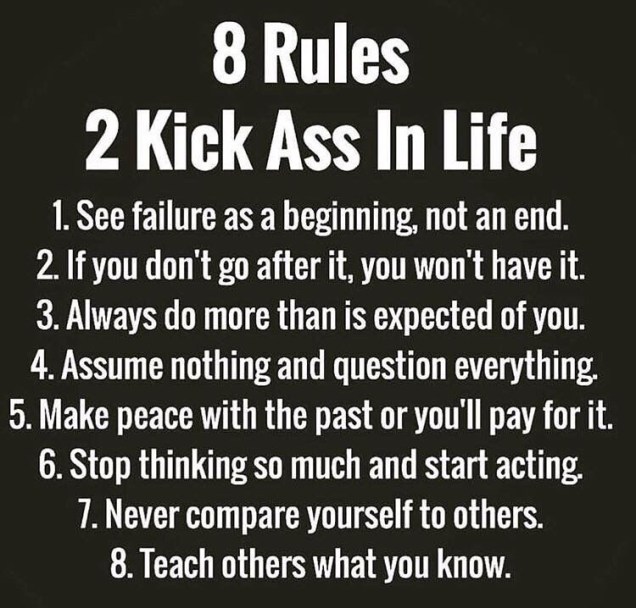
Kick ass 2

It’s the first time I’m giving a second “kick” at random thoughts on this topic as I attempt to wind up my posts of Relative Joys on resilience and strength.

1. See failure as a beginning, not an end.

Some things are just not meant to be. Deal with it. No use crying over spilled milk. If at first it does not succeed then try, try again. We’ve heard these lines before and they remain relevant till today.

2. If you don’t go after it, you won’t have it.

Chase your dreams, no matter how tough it is. Having a goal (but let’s stick to being realistic) is better than none. You don’t want to be called a deadbeat or a leech, so stop acting like one.

3. Always do more than what is expected of you.

Sometimes we just give what we want. Well, hell yeah – that’s all we get paid for! We’ve always hated the class “show-off” or the kid that raised his hand after each teacher’s question or the guy at the office that the boss could rely on during crunch time. Guess what? That’s your fault. Stepping up to the plate means doing much more than what’s in your job description. The boss always prefers a team player.

4. Assume nothing and question everything.

Never believe in everything you hear. Yep! People always promise everything. They’d even tell you that they’re Moses and you’re off to the Promise Land. They just say that to F with your head. And I’ve been redundant saying “no greater fool than the fool that was fooled by a fool”.

5. Make peace with the past or you’ll pay for it.

It’s never good to cling on to what was and can never be again. Let it go for God’s sake. Dwelling on the past is detrimental to both physical and mental health. Forgiving and forgetting is not as easy as it seems but letting go of what was is forgiving yourself.

6. Stop thinking so much and start acting.

I know people who just keep thinking about the WHYs in life. Questioning on why their plans have been stone walled, why things aren’t working their way, why life is not fair. They’re called signs. There are signs that are written all over the wall! If you can’t see it, you’re still in a stage of denial. Slap yourself and move on. You cannot do if you do not move.

7. Never compare yourself to others

Envy is the harbinger of greed, graft, corruption and evil. You know why people get involved in shenanigans? It stems from envy. These low life appreciate only how green the grass on the other side is. The Americans call it “keeping up with the Joneses” syndrome. I call it pure envy. Appreciating what you have and living with what you have, is called contentment. Doing good should make us sleep better at night.

8. Teach others what you know

The greatest leader will always be the one that creates a greater leader. Teaching has always been my cup of tea. Sharing your time and knowledge is irreplaceable and unmatched. As they say, you reap what you sow.

Kicking ass

Mark Twain, one of my favorite authors, places it positively when he says “let us live so that when we come to die even the undertaker will be sorry.”

Sarcastic, witty, and point-blank right, here are some of his quotes on, yes, having an attitude of “kicking ass”!

1. Approve of yourself

A man cannot be comfortable without his own approval.

2. Let go of anger

Anger is an acid that can do more harm than to the vessel in which it is stored than anything in which it is poured.

3. Release yourself from entitlement

Don’t go around saying the world owes you a living. The world owes you nothing. It was here first.

4. Never procrastinate the inevitable

Don’t wait. The time will never be just right.

5. Learn to appreciate life

The two most important days in your life are the day you were born and the day you find out why.

6. Stand your ground with the right attitude

Never argue with a fool, onlookers may not be able to tell the difference.

7. Always remember to appreciate what you have

Comparison is the death of joy.

8. Lighten up and have some fun

Humor is mankind’s greatest blessing.

9. Don’t let politics get into your life

Politicians and diapers must be changed often, and for the same reason.

10. Don’t put down others by forcing them to be who and what they’re not.

Everybody is a genius. But if you judge a fish by its ability to climb a tree, it will believe its whole life believing that it is stupid.

Life truths

Lifehack has a short list on hard truths which we wish we knew early on in life.

When we were young, we all wished we were adults sooner than we thought. Responsibilities. Freedom. Making money. Financially stable. Professionally made.

As adults, at times we wish we were kids again. Carefree. Dependent. Cared for. Few life stressors.

I’m sharing with you Lifehack’s 8 hard truths about life (and my personal take on these) which we wish we knew earlier:

1. Everyone you love is going to die

Sadly, no one lives forever. And while death leaves a heartache no one can heal, love leaves a memory no one can steal. So here’s to living and loving one day at a time.

2. We give our lives meaning. If you feel that your life is meaningless, that’s your fault.

Only we have the power to chart our directions in life. Only we can allow people to hurt us or violate our rights. If you allow this, you deserve what you dish out. Stop blaming others.

3. The perfect partner doesn’t exist.

We’re all idealistic. Who doesn’t want a whirlwind romantic relationship? But searching in the wrong ocean may be what you’re doing. Ideal relations are wonderful goals. Be realistic. Building a fantastic relationship takes two to tango.

4. Life is a game. Find the games you want to play, learn the rules, and find a way to be successful at the game you selected.

Or tap out if you can’t hack it.

Sorry kids. The truth is out. Life is a game. A game of chance. Sadly, the fact is, some of us don’t realise that we either sink or swim in the game called life. Like any game, there will always be cheaters. And the latter may win a game. It’s up to you if you allow it, the next round.

5. Everything ends. Youth, love, life. All will end. That’s what makes them valuable.

Cherish them while you can. Make the most out of them while you still can. Look for happiness. Martyrdom is a thing of the past. Live to love and love to be happy. We only live once. And die once as well.

6. Be romantic about the little things.

It’s more memorable that way. Attachment may be something we try to shun away from so that we don’t hurt when it’s time to say goodbyes. But memories of good times put a smile on our faces. It’s not about the hurt that we need to focus on. It’s about why fairytale “aha” moments that are remembered most.

7. Be a realist about the big things. Life isn’t a movie. You need to have a plan. Have an artist’s ambition but an engineer’s mindset.

Have you ever tried to walk away from what doesn’t fit you or doesn’t feel right and feel good after walking away? Sure you’ll be poor for awhile but hey, that’s reality. Life will never give you rainbows everyday. There will be rollercoaster rides. That’s why you need to have a plan. And if you keep getting stuck at Plan A, well tough luck. That’s probably where you’ll still be 10 years from today. Reality bites. But it is what it is.

8. Figure out a way or don’t complain

Starting all over again is not bad. It’s actually what successful people do. “Your last mistake will be your best teacher.” And that’s a fact. Life will always offer you a million chances to make you happier and a better person. Don’t regret the opportunities for change. Walk away if you must but don’t complain at where you get stuck.