Lies

A lie will always be a lie.

Anything done after a lie will never be the same again. You look at the other person differently.

When someone lies to you, it’s because they don’t respect you enough to be honest. They think you’re stupid. And I find it insulting when the lie is justified as “truth”.

It’s sad how some people believe their own lies and the stories they make up in their heads.

If you don’t correct the people who lie to you, when they upset you, they will never treat you right. What we allow is what will continue.

Whether the lie is from a relationship or work in nature, a lie is a form of deception. Of betrayal.

They say that time discovers truth.

I say, “never try to f*ck up someone’s life with a lie when yours can be destroyed with the truth”.

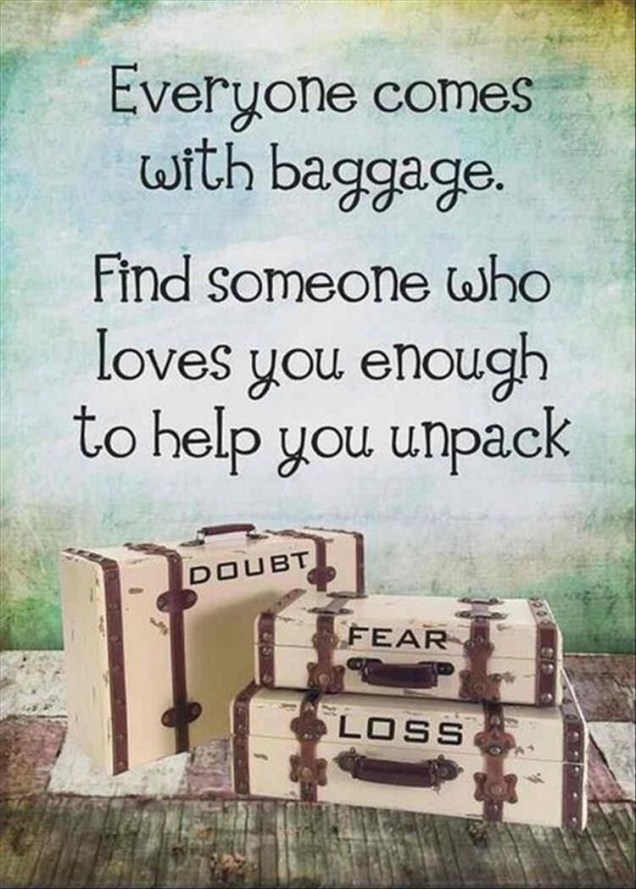
Unpacking

Doubt. Fear. Loss.

They’re part of the baggages we carry in life. Oftentimes we pack too much in one suitcase that they become heavy burdens in our journey.

That’s why we need to depend on people who can make the travel much lighter. Friends and family who are true to you and who will help you – they matter.

Some of us go through situations so traumatic that the human mind is so scarred from recovering from it. We’re left incapacitated mentally, physically, and emotionally. While the human mind isn’t built to handle all these, we fight and persevere every single day. We literally survive life’s challenges.

But the greatest gift is having people who truly care for you, not because when you’re up there and they’re taking advantage of you, but because when you’re down for the count, they’re willing to help unpack your burden with you because of love.

Basil Valdez’s song entitled “Lift Up Your Hands”, has a chorus that resonates these “unpacking” moments.

Cast your burden upon me those who are heavily laden

Come to me all of you who are tired of carrying heavy loads

For the yoke I will give you easy and my burden is light

Come to me, and I will give you rest.

The last day

If you want a happy ending, that depends, of course, on where you stop your story.

– Orson Welles

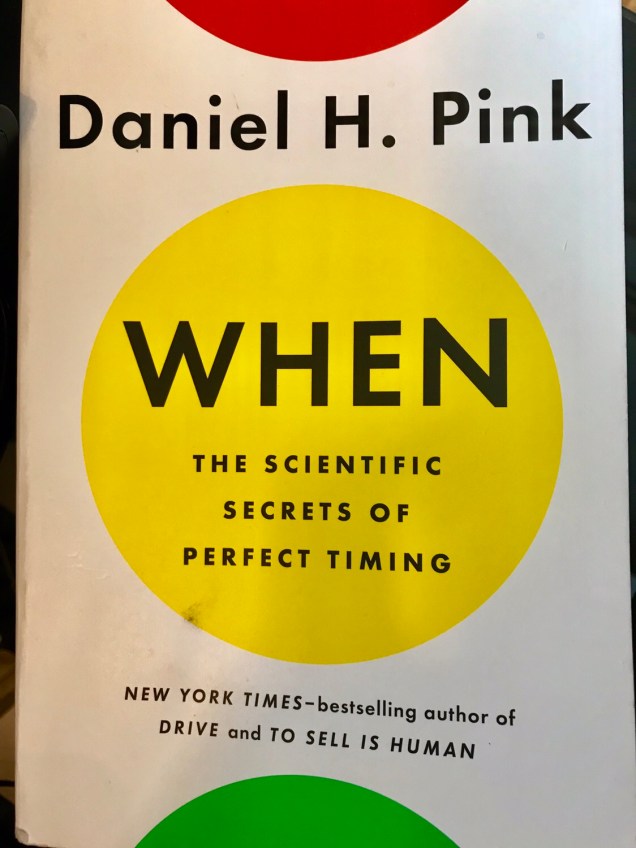
In the book by Daniel Pink entitled “When: The Scientific Secrets of Perfect Timing”, chapter 5 talks about ENDINGS.

It’s one of the most interesting discussions of the book particularly when it talks about the core of meaningful endings, poignancy. Poignancy is a mix of happiness and sadness. For many, “the most powerful endings deliver poignancy because poignancy delivers significance…adding a small component of sadness to an otherwise happy moment elevates that moment rather than diminishes it.”

I’m not very good at goodbyes. Or endings, for that matter. After all, the best endings don’t leave us happy. “Instead, they produce something richer – a rush of unexpected insight. A fleeting moment of transcendence, the possibility that by discarding what we wanted we’ve gotten what we need.”

I’d like to believe that decisions have both good and bad news. The bad news is that the I feel sad leaving a new found “family” behind. But closings, conclusions, and culminations reveal something essential about the human condition: in the end, we seek meaning.

When I was writing this blog entry, I did not know how to end the story. Pink points out the “when’s” of our lives in such scientific relevance that I understood better why I decided what I decided.

(The following is lifted from his book entitled “When”, and is available currently at Fully Booked).
Many “when” decisions involve endings. There are five questions to help us decide. If your answer to two or more of these is no, it might be time to craft an end.

1. Do you want to be in this job on your next work anniversary?

People are most likely to leave a job on their one-year work anniversary. The second most likely time? Their two-year anniversary. The third? Their three-year anniversary. You get the idea. If you dream the thought of being at your job on your next work anniversary; start looking now. You’ll be better prepared when the time comes.

2. Is your current job both demanding and in your control?

The most fulfilling jobs share a common trait: They prod us to work at our highest level but in a way that we, not someone else, control. Jobs that are demanding but don’t offer autonomy burn us out. Jobs that offer autonomy but little challenge bore us. (And jobs that are neither demanding nor in our control are the worst of all.) If your job doesn’t provide both challenge and autonomy, and there’s nothing you can do to make things better, consider a move.

3. Does your boss allow you to do your best work?

In his excellent book Good Boss, Bad Boss: How to be the best…and learn from the worst, Stanford Graduate School of Business professor Robert Sutton explains the qualities that make someone worth working for. If your boss has your back, takes responsibility instead of blaming others, encourages your efforts but also gets out of your way, and displays a sense of humor rather than a raging temper, you’re probably in a good place. If your boss is the opposite, watch out – and maybe get out.

4. Are you outside the three- to five-year salary bump window?

One of the best ways to boost your pay is to switch organizations. And the best time to do that is often three to five years after you’ve started. This period represents the sweet spot for pay increases. Less than three years might be too little time to develop the most marketable skills. More than five years is when employees start becoming tied to their company and moving up its leadership ranks, which makes it more difficult to start somewhere else.

(While this was lifted straight from Pink’s book, my work experience has proven that this is the average time frame for “making it” or not, at the work force. If, after three years you’re not in a better place at work, it’s time to either re-examine yourself or leave the company.)

5. Does your daily work align with your long-term goals?

Ample research from many countries shows that when your individual goals align with those of your organization, you’re happier and more productive. So take a moment and list your top two goals for the next five years and ten years. If your current employer can help you reach them, great! If not, think about an ending.

The Phoenix Zones

Suffering is real. Recovery is hard.

There’s no such thing as a free meal in life.

But resilience is real as well.

In Greek mythology, the Phoenix is a long-lived bird that cyclically regenerates and lives again.

Dr. Hope Ferdowsian writes about the Phoenix Effect and building Phoenix Zones to overcome the challenges of our time. By combining studies on survival and resilience, Ferdowsian takes us to the places where the “injured can heal and thrive if we attend to key principles:

– respect for liberty and sovereignty

– commitment to love and tolerance

– promotion of justice

– fundamental belief that each individual possesses dignity”

Associated with the sun, a Phoenix obtains new life by rising from the ashes of its predecessors.

Like resilience, we rise from our ashes. We die with the decisions we make in our lives based on these key principles pointed out by Ferdowsian. We die a little each time we fight for our rights and other people’s justice that is rightfully theirs.

Remember: the ones who said you couldn’t do it are watching.

We either fail miserably, or rise like the Phoenix.

The story of the blind boy

On a busy street, a blind boy was waiting for someone to drop a coin in his can. He had a board beside him with a note written: “I am blind, please feel pity on me.”

A man came and dropped a coin and erased what was on the board. Soon, the boy heard a lot of coins being dropped in his can. The boy wondered and asked someone to read what was on the board.

“Today is a beautiful day, too bad I can’t see it”.

I shared this story 5 years ago and up to today, I find it most relevant for stories on relative joy.

The story here reminds us on various ways to see life’s challenges – wallowing in self-pity or celebrating our Calvary.

We always have choices. But the decision is always left to us to make. Comfort zones are so easy to settle in. And like the blind boy in the story, it’s what we’re used to – self-pity. Like many of us, we feel it’s a safe place to be, afraid of change, waiting for the miracles that would change the situation – instead of taking on how happiness can be achieved if we only changed our paradigm.

Stories on Resilience and Strength

Falling and failing will always be life’s greatest teacher. It is from these failures we learn to rise up to the challenges. It makes us stronger and hopefully, better in a good way.

The older we get, the more challenges come our way. Even when you’ve supposedly “retired” from the humdrum of life, life has a way of finding a lemon to throw your way. In reality, life doesn’t get easier. We just get stronger.

This month, I write a few more stories on resilience and strength and the relative joy of people who have gone through hell and found heaven at the end of their journey.

To my followers, thank for for having over 5,500 views and almost 3,500 visitors since I started this blog 3 months ago in a little room in Tokyo while finding my relative joy with my family. I am grateful for the “likes” and the “shares”.

Some people asked if I could venture into a more political slant and rant. I told them that this blogsite is not themed for that purpose and because there’s really so much negativity already out there, I’d like to share a more positive mindset. Besides, politics is not my cup of tea. Staying focused on the central theme of this blog site would also help me achieve inner peace and settle my mind into achieving life’s relative joy.

I draw my strength from the lessons and decisions on the road less traveled. And I am always excited at starting all over again.

The positive life

When it rains, it pours. And a negative attitude at our problems is never helpful. It’s funny because a lot of us (including me) believe that life, in order to be happy, should all be peachy. The reality is, we were never promised a rose garden in our life journey.

Sadly, we let stress dominate our world because we take the negative aura as stress factors. Maureen Killoran points out that

stress is not what happens to us. It’s our response to what happens. And response is something we can choose.

It’s like looking at a glass of water as half empty, or half full.

Practicing positive self-talk can serve as a different paradigm in our lives. We don’t need to react to everything that bothers us. And here are five pointers on having a positive mindset.

1. Awareness

Reframing our thoughts is the first step. Listen and be aware of them so that we can understand it better. One doesn’t have to make it complicated.

2. Challenge beliefs

Not all our thoughts are true. Don’t just accept what you think just because your mind wanders off there. Our thoughts don’t define us. We need to challenge ourselves by rising to the occasion of looking for truth and validating it first.

3. Choose your thoughts

By being aware of our negative thoughts we can choose to change our perspective on it and shift to a more positive one.

4. Check the environment

The environment creates a big impact on how we think and feel. For example, the workplace may suck tremendously or the home isn’t a healthy ground for understanding and love. Is your environment bringing you more negative feelings than positive ones?

5. Practice it daily

As the saying goes, when we practice it daily it becomes a habit. And positivity is a habit that is learned. When we repeat positive thoughts, we develop a gentler and kinder way of talking to ourselves more often.

(Adapted and modified from http://www.aserenepursuit.com)

Pride and humility

There are people who we associate or work with that need those spotlight moments. Even if they are menial successes or something that’s really part of their job description, they want it noticed as front page headlines, announcing to the world their tasks and accomplishments.

They say that “people who shine from within don’t need the spotlight”. But humility is wanting in many of us nowadays. There will always be someone, somewhere who somehow wants to be a star.

Pride will always want to get in the way because pride will always be concerned on who is right while humility with what is right. There’s a thin line that delineates between being confidence and arrogance. That line is called humility. Remember that confidence smiles while arrogance smirks.

The test of a great person is one’s humility. When one is humble, one has a modest opinion of one’s self importance and a lack of pretention, superiority and arrogance.

Mother Teresa of Calcutta writes about a “humility list”.

– speak as little as possible about yourself

– keep busy with your own affairs and not those of others

– avoid curiosity

– accept contempt, being forgotten and disregarded

– accept small irritations with good humor

– do not dwell on the fruits of others

– accept censures even if unmerited

– give in to the will of others

– accept insults and injuries

– do not interfere in the affairs of others

– be courteous and delicate even when provoked by someone

And yes, the list isn’t an easy one to follow especially when we need to fight for what is right and what is just. It is not asking us to give up what is fair and correct. It is asking us to be selfless. After all, to forgive takes love. To forget takes humility.

The Sacrifice

The greatest suffering one has to endure is the suffering resulting out of betrayals by those whom we deeply love, care for, and respect. How painful had God felt when he sacrificed his only Son to save humanity from sins.

The short summary of the New Testament reminds us the life of Jesus – healed the sick, showed that miracles do happen, showed us the way, the truth and the light. And we crucified Him, in spite of all He did! What is striking (and not emphasized by the Church), is that Jesus was tried, condemned and put to death out of political reasons. Even in Christ’s time, politics and its accomplices, put Him to death.

Mother Teresa of Calcutta describes sacrifice best.

A sacrifice to be real must cost, must hurt, and must empty ourselves. Give yourself fully to God. He will use you to accomplish great things on the condition that you believe much more in His love than in your weakness.

Sacrifice, after all, is a self-less act. An act of giving up something valued for the sake of something else regarded as more important or worthy.

This Lenten post should help remind us of the travails and trials of people. Yes. People matter. Some people are given up as collateral damage for personal or political ambitions. Dignities are trampled upon and values are exchanged for a few pieces of silver. We are reminded centuries later, year in and year out, that His death on the cross should not be one in vain.

Reflect and meditate, were you part of the crowd that chanted “crucify Him”?

Meditation

There are two ways to face life’s challenges – one way is resolution by meditation, the other is by drowning ourselves in more work. The latter is what most of us consciously, or unconsciously do. I’ve seen people who cover one struggle by creating more struggles or immersing themselves in more work. In the end, we become so engrossed in so much work, that we actually forget the problem.

Some people say that in order to “forget” the problem, burying yourself in a lot of work is a good alternative. While there may be some wisdom in this idea, it’s an escapist’s thought. You see, while burying yourself in work in order to forget may seem a good idea from the get go, it’s like slowly killing yourself. We bury ourselves in a mound of problems as well.

Then there is meditation. Meditation is not for relaxation alone. As a matter of fact, “it’s primary purpose is to develop the capacity to respond skillfully and gracefully to life’s difficulties as well as its joys.”

Buddha was asked, “what have you gained from from meditation”? He replied, “Nothing! However, let me tell you what I have lost: anger, anxiety, depression, insecurity, fear of old age, and death”.

In the humdrum of today’s world, finding peace and tranquility through meditation is a wonderful option we should learn to embrace. And there’s a difference when we pray and when we meditate. Often times my mom would always remind me (when I’m deep in thoughts when I’m faced with problems), to pray. I always tell her that she doesn’t get it – praying is when you talk to God. Meditating is when you listen to God. And there’s the big difference.

We often pray because we need to tell someone something. Talk to someone or some being. And blab away we go. You notice that even during confession it’s a one way street? We pray. For forgiveness. Question is, do we listen to God speak to us?

Like many routines in our daily lives, our way of dealing with problems and issues are through rote roles. We like talking. Not a lot love to listen.

Meditation is settling the mind to listen to what the universe has in store for us. It’s a deliberate effort at mastering calm during the storms of our lives.

Yoda in Star Wars says it succinctly,

Train yourself to let go of everything you fear to lose.

With God on your side, we are all winners.