It’s easy to create a profile on social media. And with the many platforms available, there will always be another one to move to when your account gets canceled when you violate any terms and conditions in the social media community you’re currently registered with. There are two major reasons why people create a social media account and why they choose that platform.
The first (and usually most common) is because their friends and relatives have one. It is the greatest influencer of which platform one chooses
Second (and most disruptive) is for business purposes – whether it is a legitimate business of engaging people in knowing your business and creating more clients OR one that involves getting paid for disrupting the normal social milieu.
And it’s pretty easy to create a new account.
Facebook for example requires only a few details: Name (we never see the real names of many people), email or mobile number (so here’s the tickler. Because the operative word is OR it’s easy to create an email account AND buy a cheap disposable prepaid card in the Philippines. The law regarding requiring to register ALL prepaid mobile numbers has never been passed. That’s because politicians use social media platforms to benefit from engaging in the business of trolling.), password, date of birth (yeah right, so even a 7 year old can create an account because there’s really no way to verify this (no documents to upload or send for verification and is based on what numbers you place), and gender (which is the least useful of the security information in this platform).
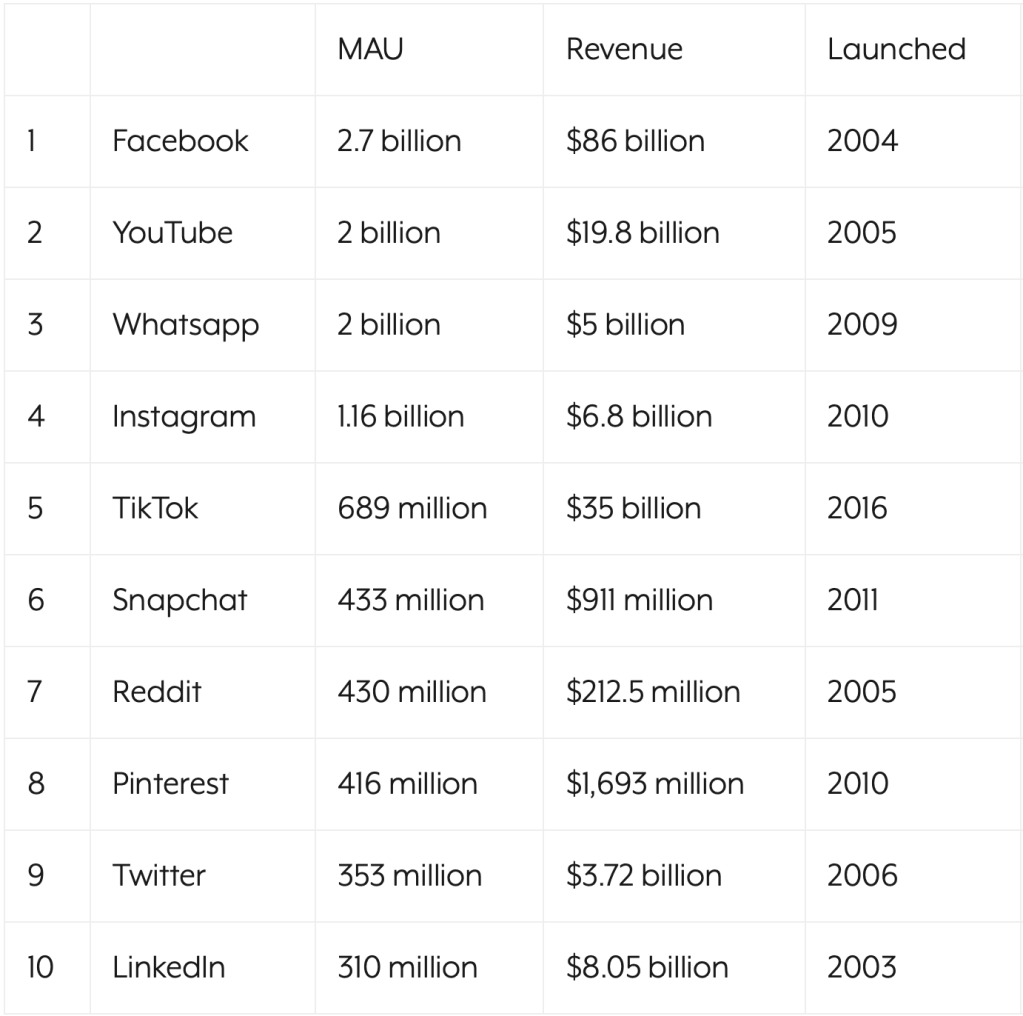
Based on MAU (most active users), the social media platform once dominated by Facebook (now known as Meta) has been spread out depending on the age group of the user.
Of course based on the year launched, FB definitely had a head start. Most of the ‘oldies’ who are used to FB refuse to leave this social platform because there are too many memories to ‘erase’ or vacate.
Choosing a platform will depend on your peer group. The senior citizens and the class D and E are more inclined to be on FB, the Gen X and Z on TikTok and Instagram, the more middle class on Twitter (including the pornstars), the executives and professional working class on LinkedIn, while YouTube encompasses all generations.
Legitimate social platforms like LinkedIn are mostly made up of executives and those with high paying jobs as they navigate the world of business and connecting with elite professionals. It is THE place to be when you want to brag about credentials, achievements, and establish social connections with the other professionals in the world. And while it sits in last place among the ten most popular apps and was one of the first social media apps to be launched, its revenue for 2020 was 4th among the top ten.
TikTok is the revelation. Launched in 2016 by ByteDanceLtd, Zhang Yiming and Toutiao, it has its headquarters in Culver, California. Mr Yiming is the founder of ByteDanceLtd and the news aggregator Toutiao. Barely 6 years old, this company which bills itself as the “leading destination for short-form mobile video” with a company vision to create joy and creativity is the fastest growing app worldwide. Despite the attempt to ban this app in India and the US, this app has been downloaded more than 2 billion times globally. This app belongs to the Gen Z, where more than 1/4 of the users are teenagers and their level and degree of engagement are high. Based on January 2021 data, time per user spent on TikTok exceeded that of Facebook. It’s revenue for a social media platform ranked second in 2020 in spite having only 25% of the user share of Facebook. ByteDanceLtd surpassed Uber in 2018 to become the most valuable start up in the world.
YouTube is the indisputable original video social media platform. It is estimated that more than 80-90% of adults and children use this platform. It has a strong base across all ages and while it covers all genres – gaming, education, DIY instructions, beauty, self-help and improvements, masses and other daily activities – it is the platform to invest in and will remain so as video remains the major driver for content marketing. Founded in 2005 by Jawed Karim, Steve Chen, and Chad Hurley, this social media company earned close to $30B in 2021 alone and has over 2.2B MAUs.
Instagram is a social network where product-based influencers, businesses and coaches thrive. With the social influence base endorsement on this social media platform, people under 35 years old share what are “Instagrammable” moments. Data shows that almost 75% of people 18-24 years old, 67% Gen Z and 57% millennial, use this app daily. With more than 1 billion MAU, its revenue stood at $6.8B, or 5th among the top ten social media apps.
Twitter came into the news with Tesla CEO Elon Musk planning to purchase for $44B this social media company. Note, however, that Twitter in 2021 made only $5B in revenues. Is Twitter worth it all? Tweets require short notes and this became popular during the time of Donald Trump. Twitter is not popular in the Philippines as this is mostly used by entertainers, politicians, tech or marketers. In Twitter, you need to be clever and personable in addition to being informative and helpful. Unlike the other apps available, nudity and pornography is allowed on Twitter. Those who offer ‘personal’ intimate services and online adult shows can provide added value to their services through their “Only Fans” page, which provides full blown sex and live cam shows. Most of the adult services on Twitter extend to the app of Telegram (a Viber-like community).
Finally, is the old reliable Facebook. The younger generation should actually shun from being affiliated with FB as the demographic shift to this 18 year old app has many of the millennial and Gen Z screaming ‘ewww’ to this platform. While it still sits pat on top of the list in terms of MAU for social media apps, it only does so because it has expanded engagement with financial services, eCommerce, retail, gaming, entertainment, media, telecom (messenger app), technology, and consumer products. However, one should be cautious in dealing with these businesses over FB because many of them are either illegitimate or have outrageous claims not commensurate to the product advertised. Services offered are not checked by FB if they are allowed by the government (example is selling and advertising prescription medicines through social media is not allowed by law). There is a small price to pay to bolster your business through their ads (which they will offer to you to boost engagements).
The Facebook company is now known as Meta Platforms Inc. They are the same owners of Instagram.
In recent years, Facebook has been the target of complaints and law suits by creating the political divide and being a disruptor for data privacy. From legitimate personal posts to bullying and shaming on social media, it has become the antithesis for disruption in the global community. Instead of fulfilling its mission on “giving the people power to community and bring the world closer together” (https://about.facebook.com/company-info/) and their “commitment to keeping people safe and making a positive impact”, it has been weaponized by trolling activities (read in part 2 of this two part blog) in recent elections both in the US and in other countries.
It recently announced that it will soon be providing more details how advertisers target people with political advertisements. (https://learningenglish.voanews.com/a/facebook-to-provide-more-details-about-political-advertising/6590490.html)
Meta said it will start releasing details in July about the demographics and interests of people targeted with ads running on its Facebook and Instagram networks.
The announcement said Meta will provide researchers with new details about the interest groups advertisers chose to target.
The new details could provide information about how politicians might choose to spread misleading or controversial political messages among different groups.
The information will be available in Meta’s ad library. The library is a public record that already shows how much companies, politicians and campaigns spend on each ad run on Meta’s social media services. Currently, anyone can see how much ad money has been spent. The library also shows the ages, gender and states or countries an ad is shown in.
The new, detailed information will be available across 242 countries when a social issue, political or election ad is run, Meta said.
As social media continues to evolve and the universe…or meta verse…continues to become part of our technology and mobile devices, catching up with disinformation will be a challenge not only to adults but to the younger generation as well, whose use of social media has been the source and bane of disruptive behavior in the past decade.
Disinformation is something not even the AI bots of all social media platforms can catch up with.
[Next week, will be part 2 of this two part blog.]




 Relative Joy