No approved therapeutic claim

For the record, let me start with a disclaimer.

I am not against complementary alternative medicine (CAM).  They may have their roles in various health and illness.  But just because they are “natural” or “alternative” does not give them the territory of absolutely safety. While there may be a role for many CAMs, the need to prove that the benefits outweigh the risks is important. And coming out with well controlled studies are essential to demonstrate that it can actually cure and is treatment to a disease. Otherwise, their claims will always be supplementary at best.

The Food and Drug Administration evaluates medicines based on quality, efficacy and safety standards.  If they meet these criteria, then they are given marketing authorisation.

On the clinical aspect, a drug (or supplement or complementary medicine) to be useful must at best fulfill the following: suitability (need), efficacy, safety, and affordability. For those that are off patent, interchangeability standards are required.

Let’s use dry cough as an example.

Most herbal medicines apply their products as food during the registration process. The reason for this may be multiple in nature.

Doing robust clinical trials are costly. It’s important that they follow Good Clinical Practice and approved by an accredited Ethics Review Board or Institutional Review Board to ensure that no harm is unwarrantedly done in the proposed studies or that the benefit of conducting the trial outweighs other risks. They should, at the very least be able to demonstrate beyond reasonable doubt (statistically significant difference) that between the experimental agent and placebo and/or standard accepted therapy, the experimental agent works.

Even something as minor as dry cough, to claim that it works better than water or     drugs in the symptomatic relief can cost an arm and a leg to execute properly.

Most herbal manufacturers don’t have that kind of money OR refuse to part with that amount of money.  Because pharmacognostically, the herbal agent may have mucolytic property, they can claim that the preparation may exhibit the same therapeutic properties as conventional drugs. All they will need to do is to (a) claim it is food and/or (b) use an endorser or testimonials to market the product. As to whether it is ethical to use these avenues for registering a product for a specific claim – the rule of thumb they follow is – THE ROAD TO NO APPROVED THERAPEUTIC CLAIMS.

It is not a medicine.  It is not for the treatment of a disease.  It simply helps.  It is natural.  It is an adjunct or supplement.

The second reason is proprietary ownership. CAM is a multibillion billion dollar business.  Grand View Research Inc. reported on April 2017 that the CAM industry would be worth around $196.87 BILLION USD by 2025.  That’s about 6 years down the road for us.  CAM finds its path into chronic diseases – hypertension, diabetes, kidney problems, liver ailments, cancer, etc.  The push here is driven by the increasing cost of conventional medicines and the marketing drive to overall wellness using vitamins, supplements, minerals and naturopathy.  But since the ingredients used in many CAM products are plant and nature derived, the proprietary rights to sources that are natural from the get go make it easy to replicate many of these success stories on botanicals. In short, nature has no patent.

Natural agents will need to, however, demonstrate its purity and safety.  The consistency in the manufacture of these products from batch to batch, their stability, interactions between ingredients that can cause potentiating or harmful effects when mixed with other herbal products are some considerations when evaluating these products.

After all, not all roses will be the same, even if they come from the same root or stem. Even the leaves of one bush of rose will vary among themselves.

It is easy to see, how skeptical the CAM industry is in sharing their “trade secrets”.  After all, even with vitamin C alone, the sources are vast and evidently wide if you were looking at a basket of fruits alone.

Third is the business aspect of CAM.  With rules and ethical norms guiding the principles of marketing in the pharmaceutical industry becoming more important, the business of CAM is unregulated to this degree.  Food, after all, is something that one can easily concoct and sell, even on an underground basis.  Drugs require that all products are under the radar of every National Regulatory Authority.  But CAM usually escapes both the mind of the consumer and the distributor through their no approved therapeutic claim pitch.  Actors and actresses, media men, personalities and every Tom, Dick, and Harry are easily paid to claim that taking herbal agents have made them look more radiant, younger, become smarter, or even have a better boner during sex.

In addition, unlike drugs which are given 20% senior citizen and PWD discounts (and less 12% Value Added Tax), supplements are not covered with this entitlement.

Then there’s the extravagant extended claim that it’s a do it all “medicine”. By golly, it will attempt to address allergies even if it’s nothing but a purported immunomodulator. Allergic disorders are NOT an immunologic problem per se. And there are more of this kind of marketing. Grow taller, be brighter, achieve more are dreams we all chase.

Do they really work?

The problem with CAM is that they’re also easily adulterated.  Under the guise of a supplement, many products have been noted to have active ingredients of conventional drugs but are sold as supplements and natural products and claim to work “as good as the conventional drug and are safer because they are ‘natural’.”

There was news back in September 2016 where a local supplement for erectile dysfunction was noted to be adulterated with tadalafil, a conventional drug that is used for treating this disorder.  Some Chinese ointments and creams contain a mixture of steroids and other antibacterial or anti fungals and claim that it is a do it all topical agent for the treatment for skin problems. They find their way into the shelves of dubious unlicensed outlets but are sold through pyramidal schemes or online. Hence the need for even herbal products being regulated to some degree.

The gullible consumer is often convinced of the efficacy of a product from testimonials of friends and family. Their marketing push will always be “natural” is safe.

I often get the question from patients on which multivitamin preparation is best or what cough remedy is suitable for their child.  I answer always – food for the former, and water for the latter. Nothing comes more natural than that!

While some (if not many) of these herbal products actually benefit the patients who use it for a specific disease, the consumer is warned about the purity of the products that make a claim, especially those whose claims are superfluous.  In addition, it is always good to discuss treatment strategies with your doctor when you are taking CAM.  The physician should likewise read up on the field of CAM so that he/she can guide his/her patients toward total body wellness.
To first do no harm is not the purview of only one specialty.  It is, everyone’s business to make sure that it is not abused for financial remuneration alone.

Because profiting from something that doesn’t work – whether conventional or CAM – is harm on patients who buy a bottle or a pill of hope.

Survey says!

There’s a TV show entitled Family Feud that we’re all familiar with.  The contestants try to guess the top answers to a topic or question on the board with the host revealing the answers by shouting – Survey says!

My lectures in Research Methodologies includes Surveys and Questionnaires.

I will not make this blog complicated.  It is not a discourse in mathematics and statistics.  While there are people that will pretend to know about this topic, I am writing this for you.  Sharing it among the misinformed can help guide them in the interpretation and utilisation of surveys, as well as educate them on the the advantages and disadvantages of relying on surveys as a mathematical basis for outcome analysis.

If you’re ready to get educated, read on.

What is a survey?

It’s a research method used to collect information about a population of interest.

It is a reflection of information of a single point in time. TODAY. In short, it means that a survey today cannot be extrapolated with absolute certainty to something that has not happened yet.  Many circumstances that change will with certainty affect outcomes.

Let us use the last presidential election as a classic example on how fickle minded surveys are.  The Presidential race was a shoo-in for Vice President Jejomar Binay.  When Grace Poe threw the gauntlet, there was a shift of tide. The dark horse Rodrigo Duterte won that election. You could tell that when the people marched to the polls, Poe was going to slip further down the road.  Roxas landed a far second from Duterte. But the Liberal Party knew that from the get go.  Unless Poe gave up her candidacy, there would be no way Roxas would win over Duterte. And Poe should have known that a neophyte would never win this election.

The Vice-Presidential race saw independent candidate Chiz Escudero at the forefront at the start of the surveys.  Subsequently BongBong Marcos began to climb slowly to eventually lead the pack.  A month before the Vice-Presidential debate, the young Marcos was ahead. During the debates, Allan Peter Cayetano practically delivered the Vice-Presidency to Robredo on a silver platter. His maligning the young Marcos and resurrecting the Martial Law regime and the billions that they stole provided the setback needed to push Robredo to the forefront.  That one and only debate was the final nail on the coffin.  The aftermath of that debate was a winning moment for a dark horse like Robredo.  Even the surveys agreed. A week before the elections, Robredo and Marcos were statistically tied. Marcos should have learned from the last presidential election where Roxas lost to Binay.

It is important to know that there are various types of surveys. There are also various ways of conducting a survey. And finally, there are many ways a sampling method is done.

Because of the complexities in making sure that a reliable survey is well designed, a poorly done survey, is a biased one. It is important to remember that bias sampling is the best way to skew data to favour desired outcome.  Appropriate randomisation in order to clearly reflect the true population being surveyed is vital to the reliability and accuracy of any survey.

Remember – a survey is made up of a sample from the population.  Unlike a census, where each and every person inclusible is included, a survey utilises only a sample.  That sample SHOULD be highly representative of the population the survey intends to address.

Self-administered vs. enablers

Surveys (and questionnaires) can be self-administered. That means that I give you a piece of paper or ask you a question online and you just provide the answer.  It’s usually answerable by multiple choice(s).

Then there are those that use enablers or enumerators.  In short, there are people that are sent to the field and these people conduct the interviews by asking questions to the respondent.  Using enablers is an additional layer of bias.  How the interviewee replies to the question and how the respondent is approached by the enabler can affect the response.  How the enabler chooses the respondent when the actual respondent targeted is not there is the largest bias called convenience sampling.

http://www.gmanetwork.com/news/news/specialreports/522054/sws-and-pulse-asia-s-methods-or-why-you-ve-yet-to-answer-election-surveys/story/

Leo Laroza, senior survey research and communications specialist from the Social Weather Station provided the methodology the SWS uses in undertaking their surveys.  From choosing 1,200 (because it’s an internationally accepted number sample size?!? is a lame answer) as the number of respondents of voting age. From the way the stratified random sampling is conducted, the likelihood of the survey results being accurate and reliable should be considered.  And they peg their errors at +/- a certain percentage.  The basis for the percentage error should be disclosed, particularly with how many hits and misses they had for an enabler assisted survey.

Their constraints on areas that are not readily reachable compared to the more accessible ones introduces bias already.  Another bias is on dividing the 1,200 into 4 areas – Metro Manila, Luzon, Visayas, and Mindanao.  Then appropriating 300 subjects for each of these four areas, and further subdividing these 300 into 60 barangays (which means 5 people per barangay for Metro Manila, the rest of Luzon, the whole of the Visayas, and the whole of Mindanao).

Interpreting surveys

Surveys are information guide. Taken now. A snapshot of time.

Reflective of data from a sample that may be representative of the sentiment of the population depending on whether the sampling process was appropriately conducted or not.

The results can be interpreted to fit what what one wants to sell.

Let’s not rely too much on surveys to check how the landscape of the political climate in the country is evolving. The better indicator is our moral compass.

It is barely 7 months into the midterm election.  We need to focus on the ball.  Those numbers, remain unreliable until the final candidates are announced.  Remember, it is not the opinion alone that matters.  It is going to the polls and showing that there is strength in your vote that will change the landscape of politics.

Our votes are the only opinions that count.

Survival

When you start seeing your worth, you’ll find it harder stay around the people who don’t.

It’s unfortunate that there are those who undermine freedom of expression so casually by posting fake stories or simply just thoughtlessly lying. Oftentimes, it’s like tiptoeing on eggshells when you’re reading the comments section. Sadly, it’s obvious that there are simply “paid” trolls who provide no opinion at all except some hard core, brainless bashing.

More often than not, it’s hard to look the other way at what’s happening in social media today. The politicking at a level unheard of in the past decade has escalated to the point of having to deal with inutiles.

When you see posts that get advertised for the wrong purpose, one cannot help but be incensed at how callous these lowlife people get.

It’s not about being with one side of the political spectrum that’s disillusioning. It’s the fact that whoever even owns these troll farms should be held accountable for sowing disinformation, particularly to the gullible.

Political survival is a difficult conflict to manage. The interest of the nation should always be at the forefront of every government personnel and official. Especially those that hold critical positions in government. When vested interests supervenes for the sake of surviving a political conflict, these officials should be prosecuted for being traitors to the nation.

What is most disappointing are the silent ones. They refuse to be caught in the fray or make a stand because of a variety of reasons, including personal ones. As Desmond Tutu points out

If you are neutral in situations of injustice, you have chosen the side of the oppressor.

Silence in the midst of impunity is tantamount to being complicit with injustice.

You cannot fight the battle only when the war is in your backyard. Because you were silent and just watching when the war was being fought in my backyard, now that your house is burning, would you expect me to sympathize with you and fight the same battle you so unwittingly didn’t care to lift a finger to help me fight?

When democracy is demonized and truth replaced with lies, we have no one to blame but ourselves. Because all we wanted to do was to silently survive with evil when we wined and danced with the devil.

Lies & the liars

People don’t want to hear the truth because they don’t want their illusions destroyed.

And that’s the problem today. There’s so much lies being peddled around.

They say that senile dementia has set in with the 95 year old politician who lied about the peachy years during the Marcos Martial Law. I beg to disagree. While mental deterioration in the elderly is a normal phenomenon, there is a clear difference between lying and dementia. His pronouncement is not only disgusting but outrageous as well.

The only people who are mad at you for speaking the truth are those who are living a lie.

He benefitted from the ouster of a dictator. He slept with the political foes and friends. He and his family has amassed wealth out of his existence in politics. It is a shame that there are fools who even believe his pronouncements that no one was ever killed during the Martial Law years.

Denying the truth does not change the facts. And history can never be rewritten to benefit a few.

As a people, the actions of politicians who twist the truth is tantamount to betraying a nation.

We will never change what we tolerate.

There is a need to recalibrate our moral compass if we are to survive as a nation.

And this old man is not the only liar in our midst.

Almost

In the poetry of Nikita Gill, she writes in Tiny Stories part I…

Many things in our lives very nearly happen.  We almost made it in the last licensure exam.  We almost reached a million pesos in sales.  We almost hit the lotto. When we come very close to almost achieving our dream, and don’t make it, we end up being disappointed.

Because what was almost, did not happen.

There was the planning, the audition or preparation, the test, the anxiety and day dreaming, and then when it feels like it is within our grasp…we lose grip. And almost becomes a difficult word to swallow.

It is human to want. And human to feel despair, particularly when what you longed for never happened. Because almost felt palpably close to achievement.

And when everything ends abruptly, almost feels like an empty shell.

She doesn’t live here anymore

Ever since he passed away, I took care of her.

I think that is my purpose in life.

I saw the signs.

At first she couldn’t remember things. Or the medications she’s on.  It was mixed with difficulty in trying to say what needed to be said.  She rarely forgot those simple words.  One day, it just escaped her.  The little lapses – it’s 9PM and she thought it was morning, or she needed to go to the toilet but didn’t know where it was when it’s right near her bed, or she had problems in handling money.  There were days when I’d tell her than she can’t be spending things left and right.  She’d look at me and ask, “what things”? And then there were those changes in mood and behaviour.  Cranky all the time.  Or simply staring into space.

Everyone else thought that ageing had just caught up with her.

I had taken her to the doctor. When the doctor gave the diagnosis, I knew my world would be different. I pored through all the information I could get hold on to.

Until some things dramatically changed.  She began to forget more often and now had more difficulty orienting to time and place. There would be days that she would stare at me and ask who I am. Her hygiene began to take a downhill course and when I would home from work, the household help would complain on her mood and behaviour.  Late one night, someone knocked on our front door.  She was found wandering at the neighbourhood convenience store in her nightgown barefoot buying a pack of cigarettes.  On the car ride home, she looked at me and said, “your father was left in the store”.

Like a jilted lover who had grown tired and weary of the relationship, we just drifted apart.

I knew then that she didn’t live here anymore.

And it would be a long goodbye.

Many of us have come across similar stories of family and friends whose loved ones have dementia.  Alzheimer’s is one form of dementia.

A person with dementia has difficulty with two of the following:

  • memory
  • communication and speech
  • focus and concentration
  • reasoning and judgement
  • visual perception (unable to tell the difference in colours or detect movement or sees things that are not there)

Various conditions can give rise to dementia – as part of the ageing process OR medications like narcotics, anti-anxiety pills, anti-epileptics, antipsychotics, to name a few.

Alzheimer’s Disease (AD)

Is the most common type of dementia.

While it is more commonly seen in the elderly, early onset Alzheimer’s is not uncommon. Early onset AD is usually familial and accounts for half of the early onset patients.

It is progressive.  Meaning it gets worse over time. Memory loss may initially be mild, but symptoms worsen over time. It gets more difficult to carry on conversations or daily activities. Then there is the confusion.  Even they become bewildered at where they are and in the confusion, become angry and the mood changes escalate.

Let’s be clear about this.  Alzheimer’s Disease is not a normal part of ageing. 

AD worsens over time. Those with Alzheimer’s live an average of eight years from the time of diagnosis (survival range is 4 – 20 years depending on age and other health conditions).

There is currently no cure but treatment for symptoms are available and extensive research in the past years has made some progress.  While treatment options CANNOT stop Alzheimer’s from progressing, it can temporarily slow down the the worsening of symptoms of dementia and improve the quality of life for those with Alzheimer’s and their caregivers.

“There is much pain to endure when watching a loved one suffer with Alzheimer’s Disease.  There is the pain of perpetual grief.  There is the raw wound of continual loss.  There is the struggle to preserve dignity and the desire to respect the present but cling to the past.  In the midst of the heartache there is a small glimmer of light that exists to remind us of the things that Alzheimer’s cannot take away – the warmth of a touch, the importance of smiles and laughter, and the knowledge of what it truly means to experience unconditional love and acceptance.”

For more information on what AD is, http://www.alz.org is a good reference site.

(The story above is a fictional one.  But it can happen to anyone of us.)

The gospel according to Thomas Sowell

My post on “Credit Where Credit is Due”, drew inspiration from Thomas Sowell.  I know most (if not all) of my readers are unfamiliar with him.  I stumbled upon him at Pinterest and began reading up on many of his publications.  His biography entitled “A Personal Odyssey” published in 2002 is a recommended read.

Who is Thomas Sowell?

It is hard to imagine a more stupid or more dangerous way of making decisions than by putting those decisions in the hands of people who pay no price for being wrong.

Influential American economist and social theorist Thomas Sowell was born in 1930 in Gastonia, North Carolina but grew up in Harlem, New York.  Although Thomas showed signs of academic promise, his father who was a construction worker did not encourage him to pursue higher education. Thomas dropped out of high school, worked odd jobs, but his penchant for pursuing academic achievement saw him obtain a high school degree in an evening program.  After serving the marines, he entered Howard University and later moved to Harvard graduating Magna Cum Laude. He later earned his master’s from Columbia University and PhD from the University of Chicago. His mentor at the University of Chicago was the Nobel Prize winning conservative economist Milton Friedman.

His teaching career would take him to Rutgers, Howard, Cornell, Brandeis, and UCLA. Today, at 88 years old, he is currently a Rose and Milton Friedman Senior Fellow at the Hoover Institution at Stanford University in California.

A prolific scholar (he has written over 25 books), his earliest work Economics: Issues and Analysis was published in 1971. His latest work was published in 2007, entitled A Conflict of Visions. 

His position with government and the private sector included the US Department of Labor, the Urban Institute, and the Hoover Institution.  In 1990, Sowell won the Francis Boyer Award from the American Enterprise Institute.  In 2002, he was awarded the National Humanities Medal for innovative scholarship and incorporated history, economics and political science.

Sowell tells things the way it is and the way it should be told.  Often times too real and painful for the onion-skinned, his opinions speak volumes of experience.

His political rants are spot on:

No one will really understand politics until they understand that politicians are not trying to solve our problems.  They are trying to solve their own – of which getting elected and re-elected are number one and number two.  Whatever is number three is far behind.

He has this to say when politics takes on a personal agenda:

Politics is the art of making your selfish desires seem like the national interest.

His thoughts on entitlement are point blank:

  • When people get used to preferential treatment, equal treatment seems like discrimination.
  • It is usually futile to try to talk facts and analysis to people who are enjoying a sense of moral superiority in their ignorance.

His views on education:

The problem is not people being uneducated.  The problem is that they are educated just enough to believe what they’ve been taught.  And not educated enough to question what they’ve been taught.

His thoughts on the current social situation:

  • One of the sad signs of our times is that we have demonised those who produce, subsidised those who refuse to produce, and canonised those who complain.
  • The real danger to us all is when government not only exercises the powers that we have voted to give it, but exercises additional powers that we have never voted to give it.  That is when “public servants” become public masters.  That is when government itself has stepped over the line.
  • What is ominous is the case with which some people go from saying that they don’t like something, to saying that the government should forbid it.  When you go down that road, don’t expect freedom to survive very long.

On the relation of economy, taxes and the government:

I have never understood why it is “greed” to want to keep the money you’ve earned, but not greed to want to take somebody else’s money.

Or simply placing real life scenarios in perspective:

People who enjoy meetings should not be in charge of anything.

And harping at media bias:

If people in the media cannot decide whether they are in the business of reporting news or manufacturing propaganda, it is all the more important that the public understand that difference, and choose their news sources accordingly.

‘he sleeps in a storm’

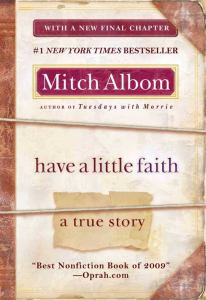
Eight years ago, I wrote a book review for “Have a Little Faith” by Mitch Albom.

Albom is renowned author to “Tuesdays With Morrie”, “Five People You Meet in Heaven”,  “For One More Day”, “The Magic Strings of Frankie Presto”, “The Time Keeper”, “The First Phone Call From Heaven”.  On October 9, his new book entitled “The Next Person You Meet in Heaven” will hit the bookstands.

So far, “Have a Little Faith” was his best.

While the book was published in 2010, its message is as timely as when I wrote it’s review eight years ago.

Perhaps, it has come at no better time when we come to grips with our faith.  The conversation between Albom and the dying rabbi is an awakening  to what inner faith many of us lack or what many of us lost.

Timely and moving are the two words that best describe the 254 pages that drove me to a deeper understanding of my humanity.

The book begins with a task.  The 82 year old rabbi has asked Mitch to deliver an eulogy for him when he passes on. Here, Albom seeks out to find not only the story of the life of the rabbi, but his life and many of those whose lives he crossed path with in his search for the “right words” to say to fittingly describe one of the greatest eulogies.

The story spans eight years between two men – Rabbi Albert Lewis and Pastor Henry Covington. In Alboms’ search for the right words to put together, their stories would cross paths in the search for the meaning to life and happiness.

On page 93 is a short excerpt of how beautifully written the sermon of Rabbi Lewis (Reb) is:

From a sermon by the Reb, 1975:

“A man seeks employment on a farm.  He hands his letter of recommendation to his new employer. It reads simply – ‘he sleeps in a storm’.

The owner is desperate for help, so he hires the man.  

Several weeks pass, and suddenly in the middle of the night, a powerful storm rips through the valley.

Awakened by the swirling rain and howling wind, the owner leaps out of bed. He calls for the new hired hand, but the man is sleeping soundly.

So he dashes off to the barn. He sees to his amazement, that animals are secure with plenty of feed. 

He runs out to the field.  He sees the bales of wheat have been bound and wrapped in tarpaulins.

He races to the silo.  The doors are latched, and the grain is dry.

And then he understands, “HE SLEEPS IN A STORM”.

“My friends, if we tend to the things that are important in our life, if we are right with those we love and behave in line with our faith, our lives will not be cursed with the aching throb of unfulfilled business. Our words will always be sincere, our embraces will be tight.  We will never wallow in the agony of  ‘I could have, I should have’. We can sleep in a storm.”

And when it’s time, our goodbyes will be complete”.

There will always be stories of despair. Or of inspiration. Albom puts reality into perspective by engaging us in a story of finding meaning in our faith.

As the story draws to a close, Album finds that the lives of two men from two different religions profoundly find something bigger than oneself.

images

Have a Little Faith is a book about life’s purpose. About losing belief.  And finding it again. About the divine spark inside each of us.

You will smile.

Shed a tear or cry.

Because this one man’s journey, is everyone’s story.

Credit where credit is due

I have no political inclinations. Like many Filipinos, when it comes to political affiliations, I have no conflict of interest.

I do not like it when people call each other “dilawan” or “ka-DDS”.  We are Filipinos.  One nation.  Whether you are an oligarch or a pauper, whether you are a drug lord or a communist rebel, whether you are an OFW or a farmer in Benguet – the Philippines is our motherland. Patriotism should never be territorial.  Just because the president or other government officials hail from a province or region does not mean you have to die for them. No other agenda should be put on the forefront of politics except the greater good of the people.

When you want to help people, you tell them the truth.

When you want to help yourself, you tell them what they want to hear.

I am writing this for everyone, regardless of political stand, who use social media in the dissemination of information, to think and do a bit of research before they share. To share the full story and not pick up bits and pieces to fit an agenda. If there is nothing good to share or when you doubt on the information that you are sharing, DO NOT PRESS CLICK AND SHARE. Sharing wrong information is perpetuating evil.  It is wrong to think that it does no harm passing around twisted lies.  Peddling lies is being in connivance with the devil. The last I recall was that we are citizens of this nation and not a cult for some government officials.

I have friends and colleagues who have lost all critical thinking because of political affiliation.  And that makes me sad.  They were intelligent people who got washed away with the tide.  We need to respect each other’s political beliefs.  But a spade must be called a spade when it is.  Credit should be given where credit is due.

Of all ignorance, the ignorance of the educated is the most dangerous.  Not only are educated people more likely to have more influence, they are the last people to suspect that they don’t know what they are talking about when they go outside their narrow fields.

We all know that it takes more than the six (6) years of an administration to see the fruits of its labor.  There are projects of every administration that has either a sordid history laden with graft and corruption or one where we all look back and recognise the visionary in them.  Most of that, however, can only be appreciated after the term of the administration is over. It takes years to build infrastructure – skyways, road, airports, subways, etc.  The layers of governmental approval – from bidding to construction – is a logistic nightmare in itself.  By the time any sitting president will see his or her flagship projects, MANY OF THEM will be seen in the next administration.

I am writing to the people who share posts about infrastructure projects being credited to the current administration, when the projects were started by the previous administration and completed only in this administration OR were completed in the final year of the previous administration and were not given due credit.

I am writing to the people who use fake pictures to promote success when that success story never happened in our country.

I am not a fan of PNoy. He had his own lapses in governance.  And I can name many. But whatever credit is due him, let’s not subvert the incontrovertible truth of the achievements of the previous administration, particularly when it comes to infrastructure or disaster preparedness.  Every administration could have used the lessons the previous administrations had in building and rebuilding a country. There is no perfect leader.  There has been no one that has endeared the people. Using these lessons will chart us in more concrete directions.

Social media is being misused for the gullible plenty.  What the current administration can do is focus on short term goals – the economy.  That, my friends, is tangible success.

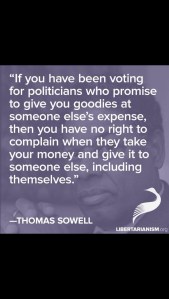
Since this is an era when many people are concerned about “fairness” and “social justice”, what is your ‘fair share’ of what someone else worked for?

Let the real infrastructure progress of the current administration be reflected when the projects have been completed.  When Boracay is finally open and cleared of all that stench and filth, then kudos to those responsible for the clean up drive.

The pressing issue is the economy hitting the shitty ceiling.  The major bravado of the current administration should be to work at what are tangible solutions to the economic woes of the country now.  When corruption and incompetence are in collusion with governance, we are all headed for a collision course with an economic meltdown because we were all focused on issues that were personal and formed background noise.

Let’s face it, you cannot turn your head away from issues hounding appointees who have been accused of corruption and stay silent about it.

You cannot look the other way with appointees who disappoint and drag the president down because of their feeling of entitlement and expect the public to love them. The president was elected to govern for the greater good of its people – friend or foe, rich or poor.  The allegiance of every Filipino is to its country.

One of the consequences of such notions as “entitlements” is that people who have contributed nothing to society feel that society owes them something, apparently just for being nice enough to grace us with their presence.

Let’s put some sensibility and civility back on the table.  There is no shame in recognising our faults and short comings.  Our disillusions and misplaced sense of allegiance.  Let us give credit to where credit is due.  And respect where respect should be.

Enough with peddling these lies, make believe stories and half-truths. Accountability is mandatory for all actions – no exceptions to the rule. If you have nothing better to say, or share, don’t.

Remember: Right is right even when no one is doing it.  Wrong is wrong even if everyone is doing it.

(All quotations are from the Politics of Thomas Sowell).

The story of truth and lie

In 1896, French artist, Jean-Léon Gérôme painted La Vérité sorta time du puits armée de son martinet pour châtier l’humanité.

(Truth coming from the well armed with her whip to chastise mankind).

The painting was suggested to be an expression of Gérôme’s hostility to impressionist movement, to which he was violently opposed. The expression is a translation of the aphorism of the philosopher Democritus, “of truth we know nothing, for truth is in an abyss”. The nude model refers to the naked truth.

In the 19th century, there was a legend created based on the painting.

Truth and Lie meet one day. Lie tells truth that “it’s a beautiful day today”. Truth looks up to the skies and sighs. For truly, it was a beautiful day.

Truth and Lie spent the whole day together, exchanging stories and having fun. During their stroll, they reach a well. Lie tells Truth, “the water looks very nice. Let’s take a dip together.” Truth, once again suspicious, tests the water and discovers that indeed, it was very nice. They undress and start bathing.

Suddenly, Lie jumps out of the well and puts on the clothes of Truth and runs away. The furious Truth comes out of the well and runs everywhere to find Lie so she could get her clothes back.

The World, seeing Truth all naked, turns it’s gaze away, with contempt and rage.

The poor Truth returns to the well and disappears forever, hiding therein, it’s shame.

Since then, Lie has traveled the world dressed as Truth, satisfying the needs of society, because the World, in any case, harbors no wish at all to meet the Naked Truth.

According to Gérôme’s biographer, Charles Moreau-Vauthier, Gérôme slept with this painting above his bed and was found after his death with his arm stretched towards it, in a gesture of farewell.

Since 1978, it has been part of a permanent exhibition at the Museé Anne de Beaujeu in Moulins, France.

(Thank you to my classmate Noel Tanglao for posting this story in our Viber group. This is a modified version.)