It was a day late, but nevertheless, there is data. I personally think that the DoH should just continue with the COVID-19 tracker daily upload. After all, they will need to count the daily cases and because they will, in the spirit of transparency, all they need to do is to provide the daily report.
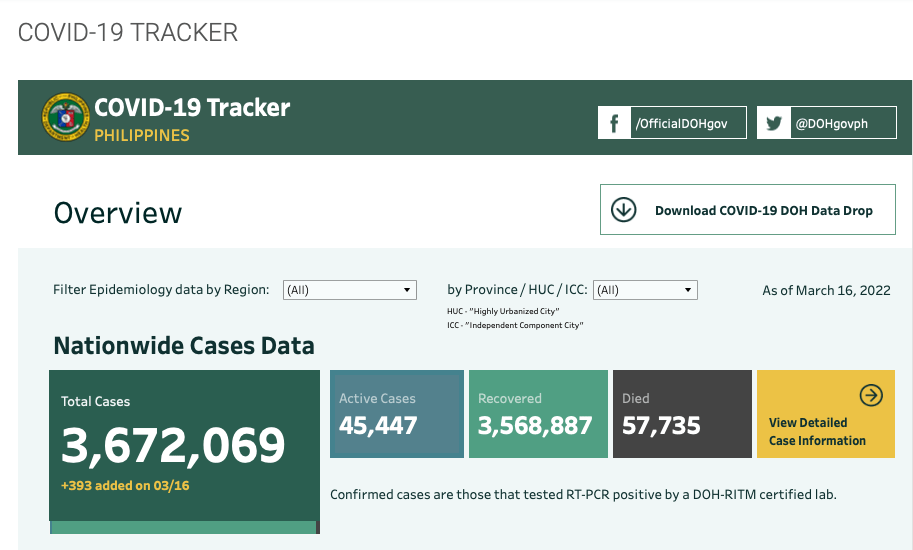
With that, the Philippines continues its low Tuesday as 393 new cases were added yesterday. There were 55 deaths added as well. Positivity rate for the 7-day average is down to 2.7% (and this should be taken with a grain of salt as testing and contact tracing is at an all time low in the country).
The NCR accounted for 29% of the cases for the day with all LGUs reporting less than 20 cases. Only 4 LGUs reported double digits – Quezon City 19, City of Manila 18, Pasay City 11 and Parañaque 10. All other LGUs had single digit with Pateros the lone LGU with ZERO COVID.
There’s a pattern one sees with the COVID-19 cases in Asia and Australia. Countries which did not experience massive surges are feeling the brunt of the omicron wave in these two regions of the world. Perhaps one of the strongest explanation for this is the lack of natural immunity due to the ZERO COVID policies. After all, while many countries cheered on the success of their ZERO COVID program, SARS-CoV-2 found a way to mutate into other variants of concern.
The last two years saw an evolution of alpha, beta, gamma, delta and omicron as the major variants of concerns that would play a role in how the pandemic evolved.
It began in 2019 in Wuhan, China as the epicenter of what would be a global pandemic of the 21st century. More than four months later, China would contain the outbreak in Wuhan and institute a ZERO COVID policy. The most draconian of lockdowns was implemented in China.
It took the World Health Organization almost three months, and upon pressure of other nations, to declare the outbreak in Wuhan as a pandemic on March 11, 2020. There was no turning back after that announcement. The global knee jerk reaction was to shut down borders. And the rest was history.
More than two years and several variants of concerns later, the world continues to turn and life goes on. The pandemic is still very much around, in spite of the vaccines that have probably been instrumental in averting more deaths. Economies continue to sputter. At the end of the day, the challenge remains on how different governments address the balancing act of health and economy. After all, the political platform of a nation is the very root cause of where we are today.
Omicron – whether as BA.1 or BA.2 – has become a global nightmare. Do we learn to live with this or not? From a peak of almost 4M daily cases in the month of January alone (due to omicron), the world now sees an average of 1.6M daily cases.
worldometers.info/coronavirus
While South Korea broke its own record high today with more than 400,000 cases, all eyes are actually on China where it saw numbers jump to more than quintuple numbers due to its ZERO COVID policy.
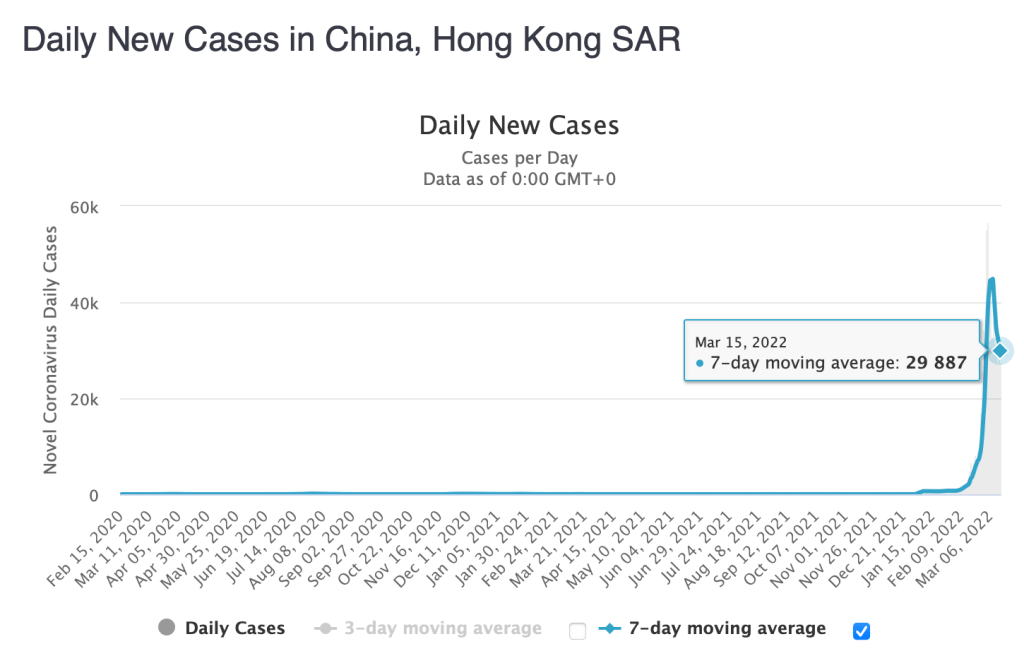
Hong Kong, a special administrative region of China is in the midst of the omicron wave, with news of hospitals full to the brim and now owning the highest death rate due to COVID-19 in the world. With a population of 7.6M, this puts deaths at 601 per million population (mostly the elderly) in this tiny nation south of China.
For now, Europe is seeing a slight uptick in number of cases as more than 771,000 cases were from this region alone. Asia saw more than 734,000 cases of the close to 1.69 M cases on March 15, 2022, with more than half coming from South Korea alone. The Philippines has stopped its daily reporting (for reasons that are not explained well) and readers (and I) will need to make heads or tails of the ‘weekly report’ moving forward.
As the country is now at very low risk from data in the past week (590 daily cases on the average), let’s try to keep this in check by continuing to observe minimum health standards and jump starting the economy without compromising the gains made in the past weeks. After all, 2021 wasn’t the best year for us because we went through all the variants of concern from alpha, beta, delta and omicron. It was the worst year. As we reopen the country for business, we should not let the political noise of the upcoming national election distract us from the pandemic.
The next leader should remain focused on how to help the Filipino during a crisis. Performance rather than promises should count when choosing the next president of our nation for the next 6 years. We will still be in for a ride because the pandemic is NOT YET OVER.
The Health Agency announces 554 new cases and 15 deaths today, March 14, 2022 with a 2.8% weekly positive rate (398 positives from 14164 who were tested). The National Capital Region led the haul with 25% of the national cases with 141 positives.
The City of Manila led the haul with 33 cases followed by Quezon City with 21. LGUs in NCR with double digits were: Caloocan and Parañaque with 15 cases each, and Makati and Pasay City with 13 cases each. All other LGUs had single digit number with three LGUs with ZERO COVID – Pasig, Navotas and Pateros.
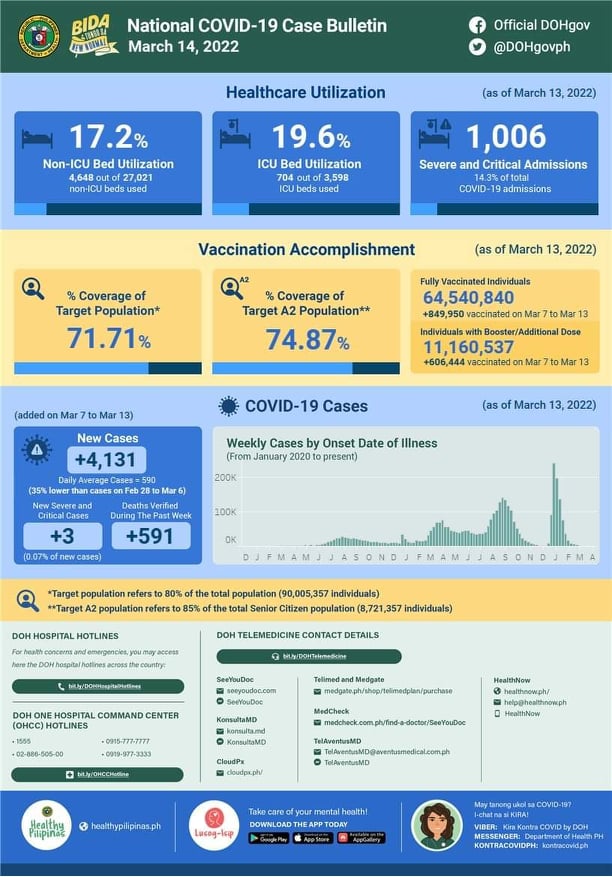
The summary for the week March 7-13 since was 4131 new cases or a 7-day average of 790 cases. The added deaths for the same week was 591 or 84 deaths a day.
Both non-ICU and ICU bed utilization is at less than 20% (very low risk), while there are 1006 patients admitted as severe and critical.
On vaccination status, close to 72% of the target population (80% of total population) has been vaccinated, while close to 75% of the target A2 population have also received their vaccines. Unfortunately, for the whole week of March 7-13, only 849,950 individuals were added to the fully vaccinated list, while a little more than 600,000 got an additional dose or booster. With the millions of vaccines that the government has received, everyone is enjoined to get their booster or added doses before another variant of concern circulates.
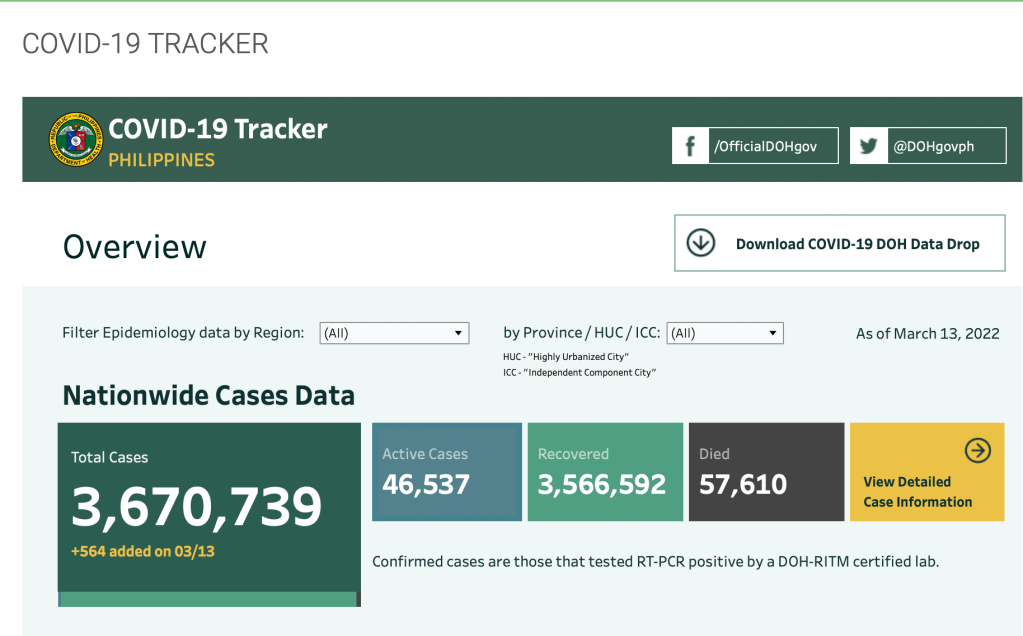
The Health Agency reports 564 new cases with 197 or 35% of the total cases coming from the NCR alone. There are 169 added deaths today.
The City of Makati had the highest cases today with 42, followed by the City of Manila with 28, Pasay City 24, Quezon City 21, Caloocan 19, Parañaque 14, Taguig 13, and Pasig 12. All other LGUs had single digit cases while Malabon and Pateros had ZERO Covid today.
THE WEEK IN REVIEW
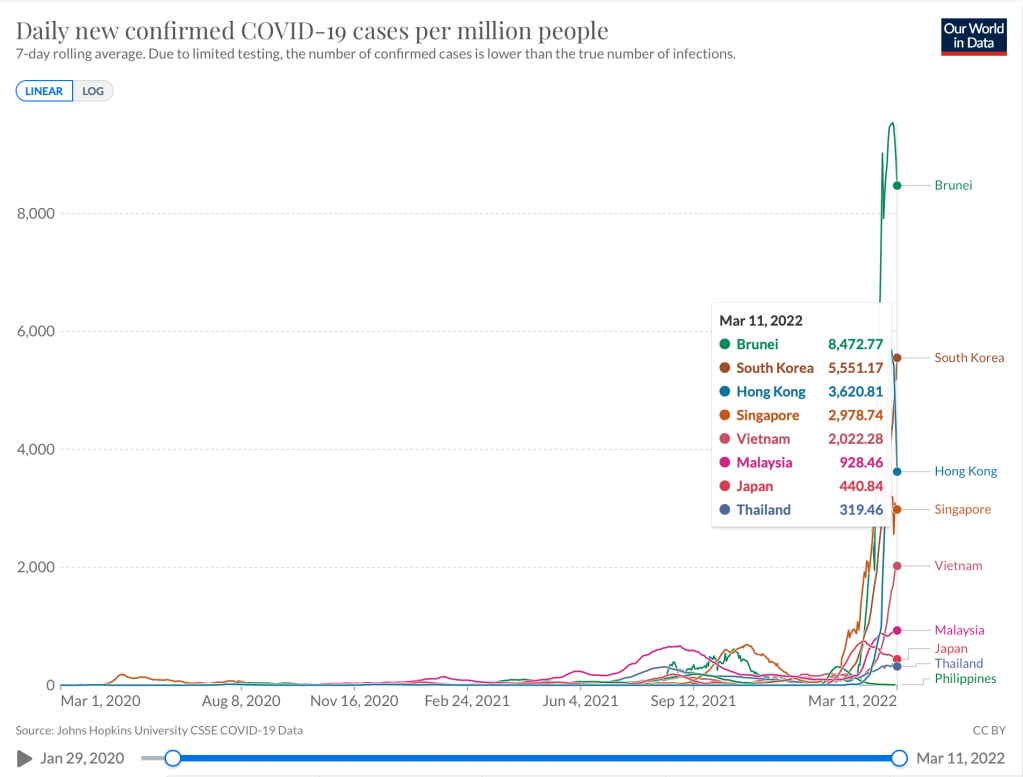
South Korea is seeing more than 1M cases every 3 days. Vietnam is recording the same increment every 4-5 days. As the omicron surge continues to grapple many Asian nations, here’s a summary of how we and our neighbors did the last 7 days.
While South Korea reports a y-day average of close to 300K daily cases, it is Brunei that leads the group with 8472 seven-days average based on population size (per capita). The Philippines is at the bottom with 6.9 cases per million population.
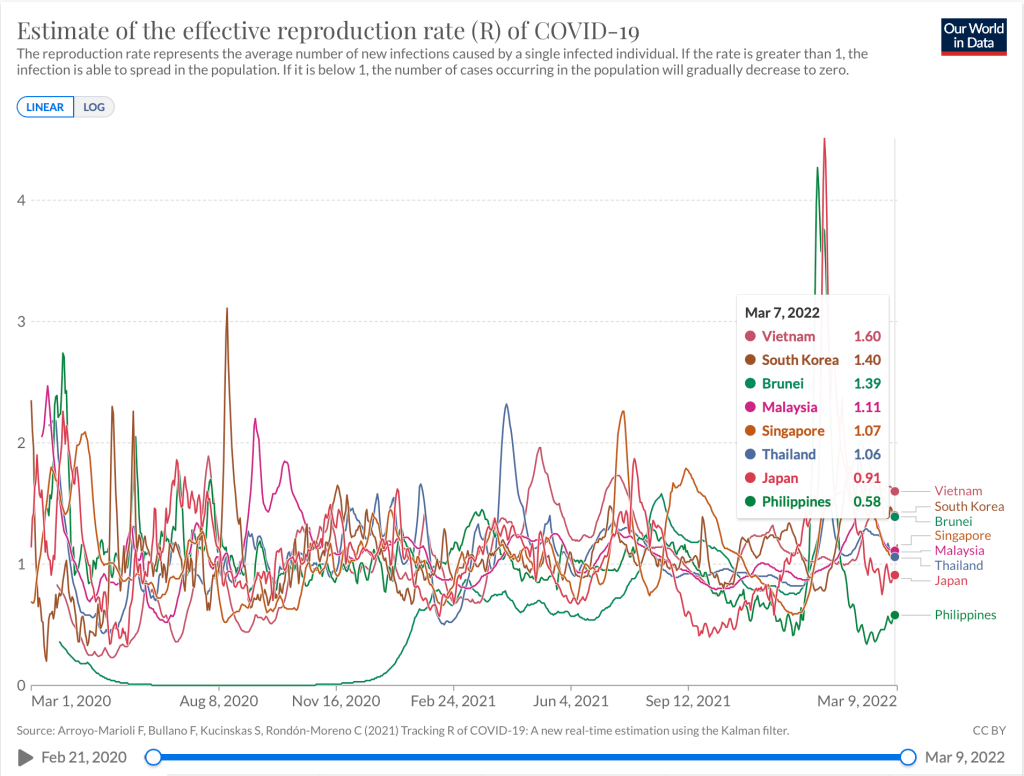
Vietnam, S. Korea and Brunei will continue to see higher cases in the upcoming week as its Rt, although effectively slightly lower this week, is still at critical levels >1.2. The Philippines maintains its effective reproduction rate at 0.58, which essentially is a good sign. Meaning, we will still see continued declining numbers in the upcoming week. We close the week also with a 7-day average of 500 new daily cases in the PH.
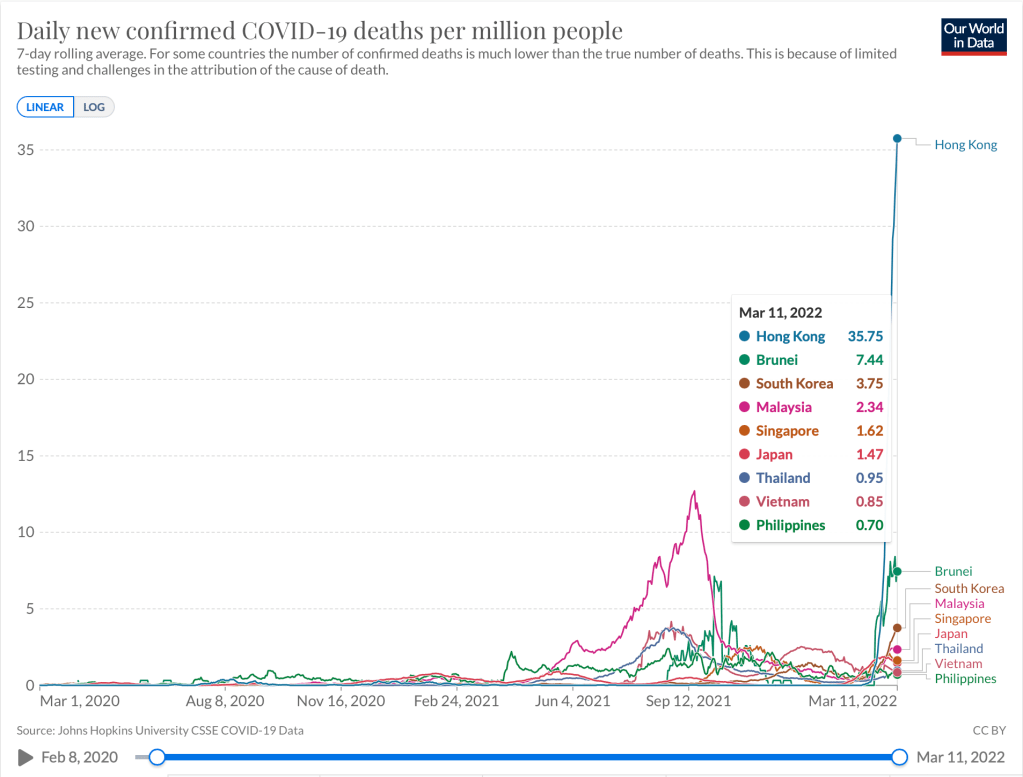
The most bothersome indicator is death and Hong Kong is at the brunt of this problem. It has the highest deaths per million people at 35.75, while Thailand, Vietnam and the Philippines are at <1 per million population.
With the shift in data, the Philippines moves quickly to 26th rank globally from a previous 21st spot, which it held onto since the start of the year 2022. South Korea climbs to 14th, Vietnam to 16th, Indonesia is in 17th, Japan in 19th, and Malaysia in 22nd spot. Thailand is at 33rd, Singapore in 60th and Hong Kong in 73rd rank.
While China is 124th in rank globally, and seems to have contained the pandemic there with its ZERO covid policy, the past week has been a challenge as it sees outbreaks in certain provinces. For the first time, China reported a daily high with 3,393 new cases on 03.12.2022. The previous day it had more than 1900 cases. All eyes should be focused in this country with a population of 1.4B as we watch and learn how they will and how they can overcome an omicron wave.
The Health Agency reports 655 new cases and 124 new deaths today, with the National Capital Region owning 31.3% (205) of the total cases in the country.
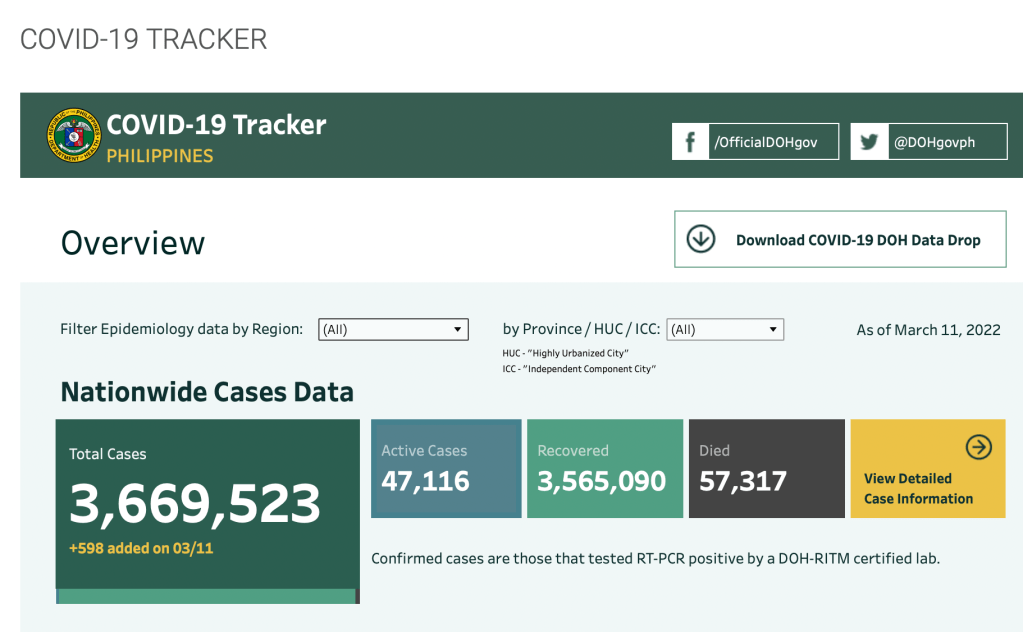
The information provided by the DoH is based on their COVID-19 tracker.
In the NCR, 7 LGUs had double digits with the City of Manila reporting 48 cases followed by Quezon City with 34. The others were: Parañaque 20, Caloocan and Makati with 18 cases each, Pasay City 13 and Taguig 10. All the other LGUs had single digit, with Pateros reporting ZERO COVID.
There were 23,523 individual tested with 3.2% positivity on March 10, 2022.
The Health Agency announces 598 new cases today, with 22178 individuals tested last March 10, 2022. With the targeted testing (only those A1, A2 and A3 are routinely tested) and no contact tracing done anymore, the testing have decreased as well. The World Health Organization provides guidance on interpreting lower cases as it may not reflect the real situation in the country. The numbers are likely underestimated especially if a milder form of the virus is circulating. The disease course is short and those who are fully vaccinated (and received a booster) may even be infected but asymptomatic (hence, not testing).
NCR led the haul with 149 (25%) of the today’s total cases.
Among the LGUs in the NCR, it was Quezon City that had the most cases (30), followed by the City of Manila (26), Makati (20), Taguig (15), Parañaque (12) and Pasay City (10). All other LGUs had single digit cases with Navotas and Pateros having ZERO COVID cases.
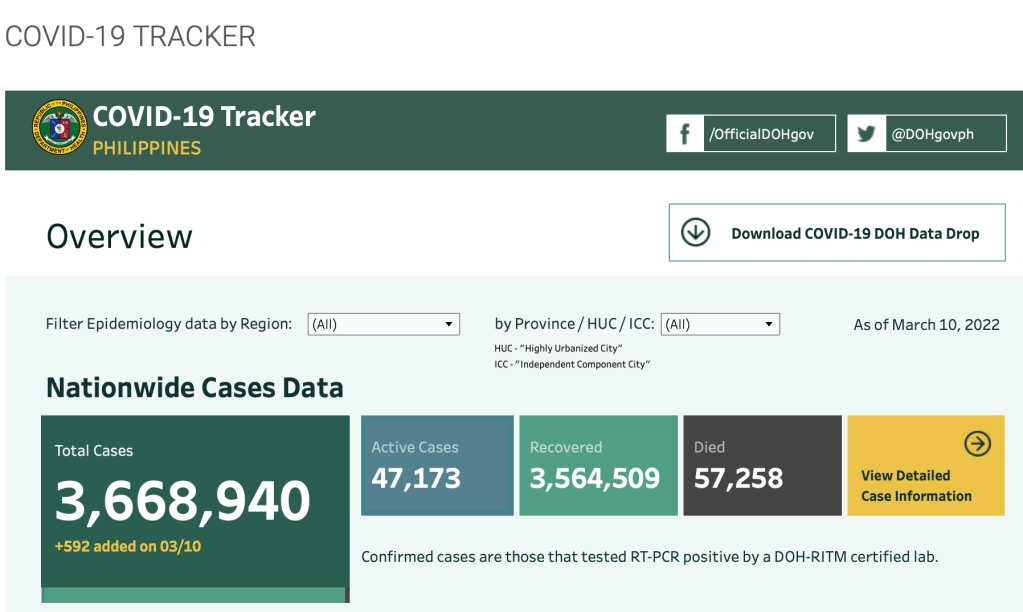
The Health Agency announces 592 new cases, 76 deaths and a 3.2% positivity rate today. The positivity rate should be taken with a grain of salt as the country moves into targeted testing. Which means that only A1, A2, and A3 are prioritized and that contact tracing is not routinely performed anymore. This is not only seen in the Philippines but in almost all our Asian neighbors as well.
NCR accounted for 25.7% of the total cases (152) in the country today.
The City of Manila led todays cases in the NCR with 25 cases followed by Quezon City with 23. All other LGUs had less than 20 cases, with 11 LGUs announcing only single digit. The LGUs with single digit were: Makati 7, Parañaque 9, Las Piñas 5, Valenzuela 6, Mandaluyong 5, Muntinlupa 2, Marikina 6, Malabon 1, Navotas 4, San Juan 2, and Pateros 1.
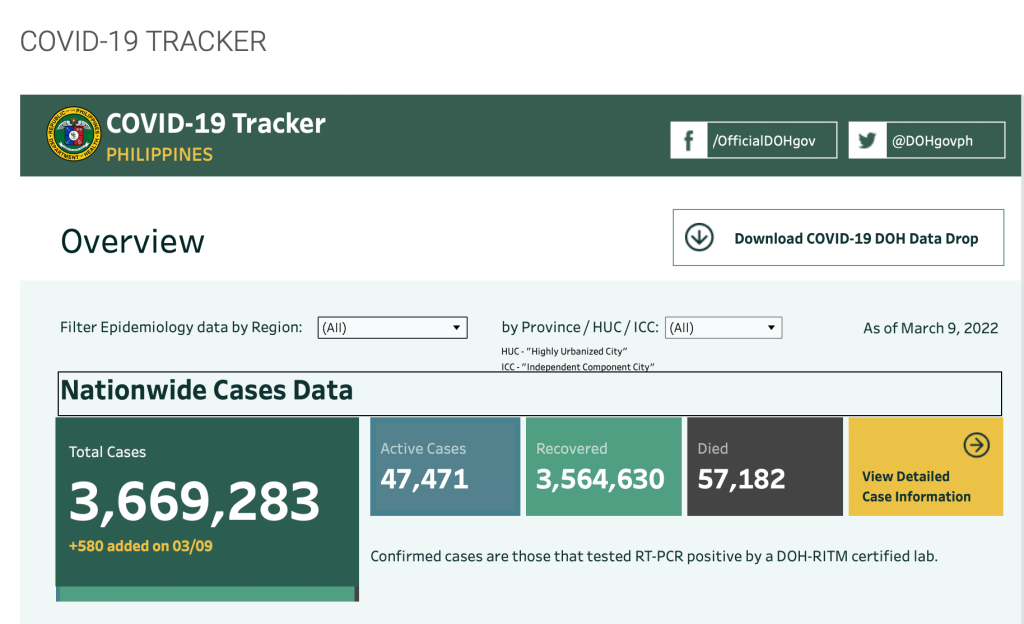
The Health Agency announces 580 new cases today with 110 deaths recorded today and a 3.3% positivity rate.
The data at doh.gov.ph and click on COVID-19 tracker for more information.
NCR accounted for 137 or 24% of the total cases for the day.
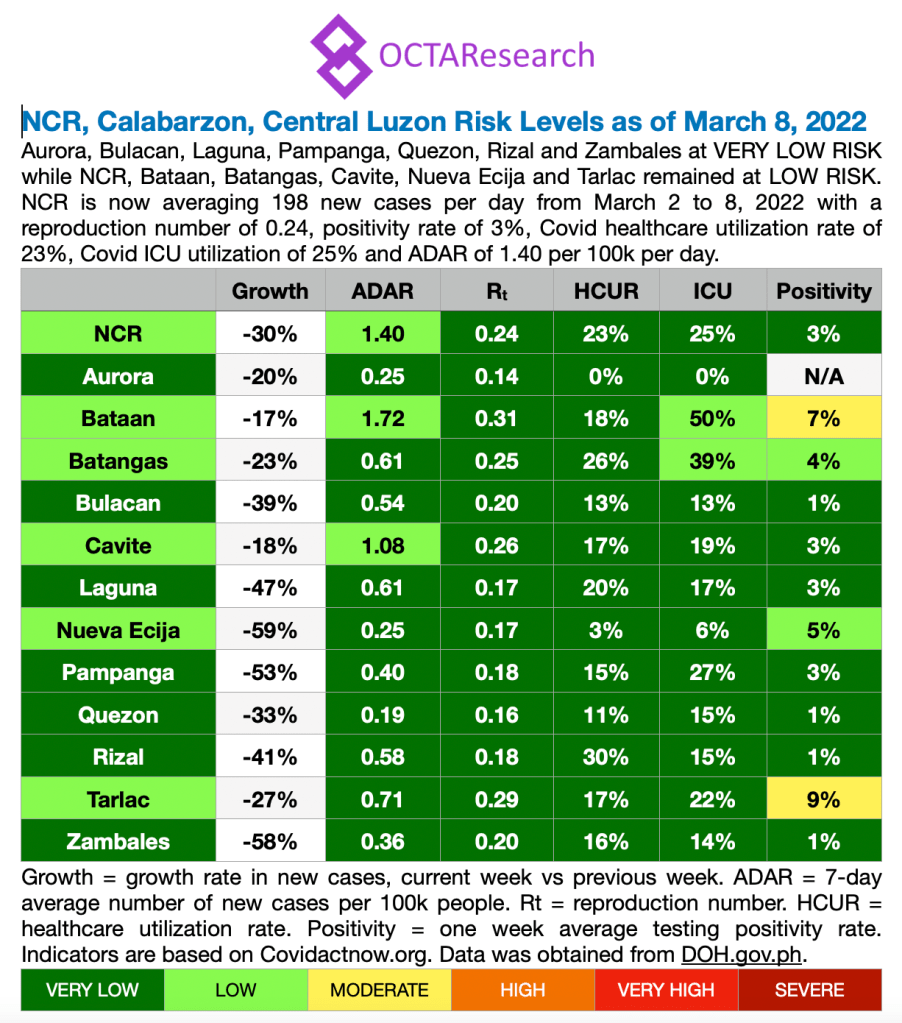
Prof. Guido David continues to drill down the data gathered from the COVID19 tracker of the Department of Health and on behalf of OCTA Research shows that the overall risk in the country is generally low.
Several areas in NCR, CALABARZON, Central Luzon, and Central and Western Visayas have continued to see declining numbers with several provinces seeing ADAR of <1.0 per 100,000. Reproduction rates remain very low, with health care utilization rate at very low risk as well. Only some areas remain to have higher ICU rates (but still considered low risk) like Bataan, Batangas, and Iloilo. Positivity rate is generally at an all time low in most regions including the National Capital Region whose positivity rate is at 3%.
If you’re wondering where the data is coming from, you can just go to the doh.gov.ph website and click on COVID19 tracker and you won’t miss the data on the screen. I have shown you how to access the site and where to get more information on COVID-19 cases in the country.
In the red notes is where you click to gather detailed case information. As you scroll down their page, you will also see testing and health care utilization capacity of the country.
NCR accounted for 37% of the total cases in the country today with 164 cases, with the City of Manila leading the LGUs with 40 cases. Other LGUs in NCR with double digits were Quezon City 26, Pasay City 20, Parañaque and Caloocan 13 each, Makati 11 and Pasig 10. All other LGUs reported single digit with Navotas and Pateros reporting ZERO COVID.
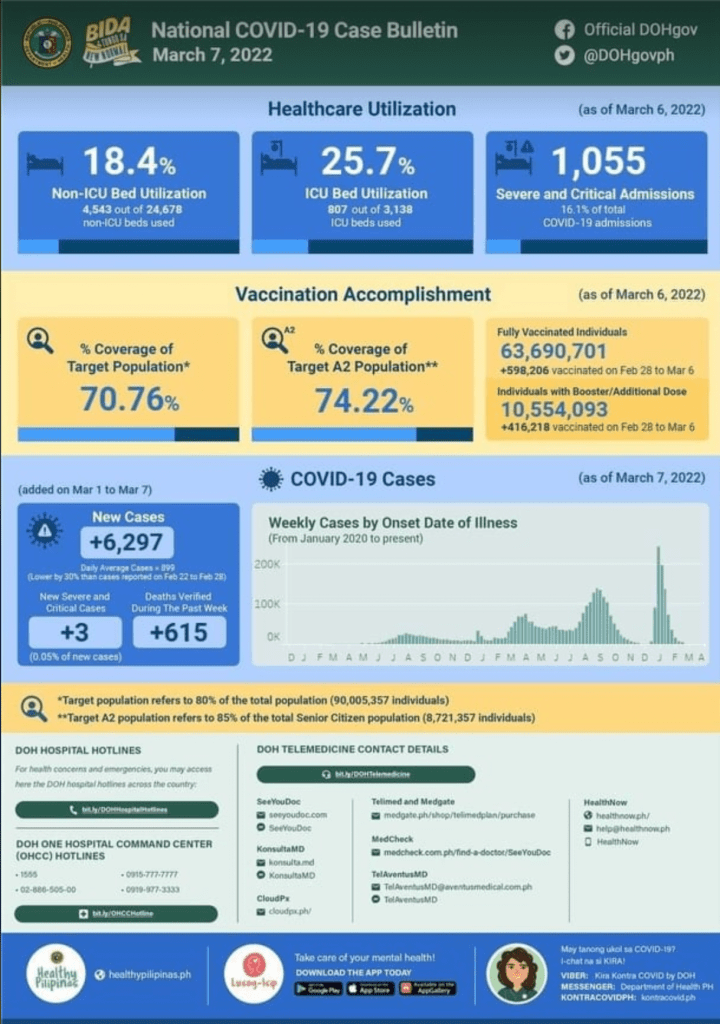
With the lower cases in the Philippines (reporting triple digits), the Health Agency has now revised its case bulletin. The infographic below shows three parameters: Healthcare Utilization, Vaccination Accomplishment and the COVID-19 cases.
The data for healthcare utilization and vaccination status is delayed by one day. Which means, as of March 6, 2022, HCUR is at low risk in the country, considering that only 18.4% of the non-ICU bed is used for COVID-19 and 25.7% ICU beds are used for COVID-19. Of the COVID-19 admissions in the country, 16.1% are severe and critical.
Vaccination accomplishment is also displayed. As of March 6, the PH has covered almost 71% of the target population vaccinated, with almost 75% of the senior citizens also vaccinated. On the extreme right, information is provided on the actual number of fully vaccinated individuals (how many were vaccinated within that week) and the number of individuals who have received an additional or booster dose (with the number of those also who received additional doses within that week).
Then of course, is the coup de grace. That’s the COVID-19 cases in the country. As of March 7, there were 6297 cases from March 1-7 (or added on March 1-7). The 7-day average is at 899. Only 3 new cases were severe and critical (0.05% of new cases).
Based on the website of the DoH, the PH officially had 733 cases today (but since 22 are duplicates and they were removed from the total) then 711 is the final total cases for March 7, 2022.
The NCR owned 183 or 26% of the total cases for the day with the City of Manila owning 33 and Quezon City owning 30 cases. In third was Parañaque with 22 cases. All other LGUs reported less than 20 cases while 7 LGUs reported single digit. The single digit LGU were: Caloocan 8, Malabon 3, Mandaluyong 5, Muntinlupa 8, Pasig 9, Valenzuela 3, and Pateros 1. Two LGUs had ZERO COVID-19 – Navotas and San Juan.
Out side of the NCR, NO OTHER REGION had triple digit cases.
Other regions that trailed NCR were: CALABARZON 93, Central Luzon 78, Central Visayas 76 Western Visayas 55 and Davao Region 52. All other regions had less than 50 cases with 5 regions reporting single digit. These single digit regions were: BARMM 3, CARAGA 6, MIMAROPA 2, Bicol 9, and Eastern Visayas 7.
There were 3 ROFs that were positive today.
Today’s positivity rate is 3.3% based on 15873 tested individuals last March 6, 2022.






 Relative Joy