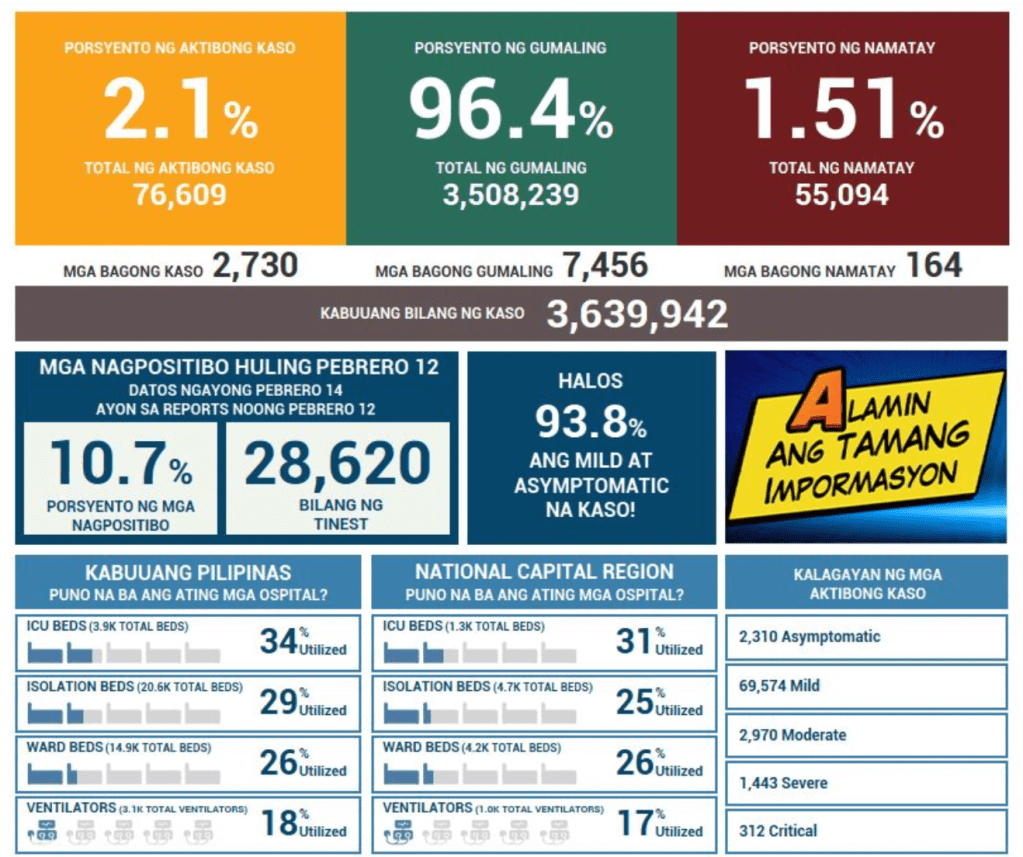
The Health Agency reports 2730 new cases based on 28620 tests and 10.7% positivity rate last February 12. Of the cases today, 2627 or 96% of the cases today were within the last 2 weeks. Top regions with most cases were NCR, CALABARZON and Central Visayas in this interval.
Active cases drop to a little more than 76,000 as the cases continue to decline, with almost 94% of the active being asymptomatic or mild at the time of testing.
The shocker on Valentine’s Day 2022 are the 164 deaths. Note that of the 164 – 52% or 86 occurred in February while 52 (32%) in January. The remaining 16% were from July to December 2021.
There were 68 duplicates removed from the total case count. Of these, 52 are recoveries. There were 121 cases previously tagged as recoveries were reclassified as deaths after final validation.
As the third week of February opens, it is NCR that continued to haul in 18% of the total cases or 485 of the 2730 for the day. The positivity rate in the NCR is at 8%, slightly lower than the national positivity rate of 10.7%. Other regions with more than 200 cases are: CALABARZON (345), Western Visayas (266), Central Visayas (294), and Davao Region (285). All other regions reported either less than 200 cases per region or double digits. Those with double digits were: BARMM (32), CARAGA (49), Cagayan Valley (94), MIMAROPA (20), Bicol (30), Eastern Visayas (41), Zamboanga Peninsula (69), and Northern Mindanao (98).
In the NCR, only Quezon City continued to haul in triple digits with 108 cases today. The City of Manila reported 69 cases, while the rest of the LGUs in NCR had less than 50 cases with four LGUs reporting single digit – Malabon (6), Navotas (7), San Juan (5) and Pateros (2).
HUCs (highly urbanized cities) with more than 50 cases today were: Davao City (97), Cebu City (78) and Baguio City (74).
There were 30 ROFs (returning overseas Filipinos) who tested positive.
Tomorrow is a Tuesday…let’s hope the Tuesdays remain a good run for low days…
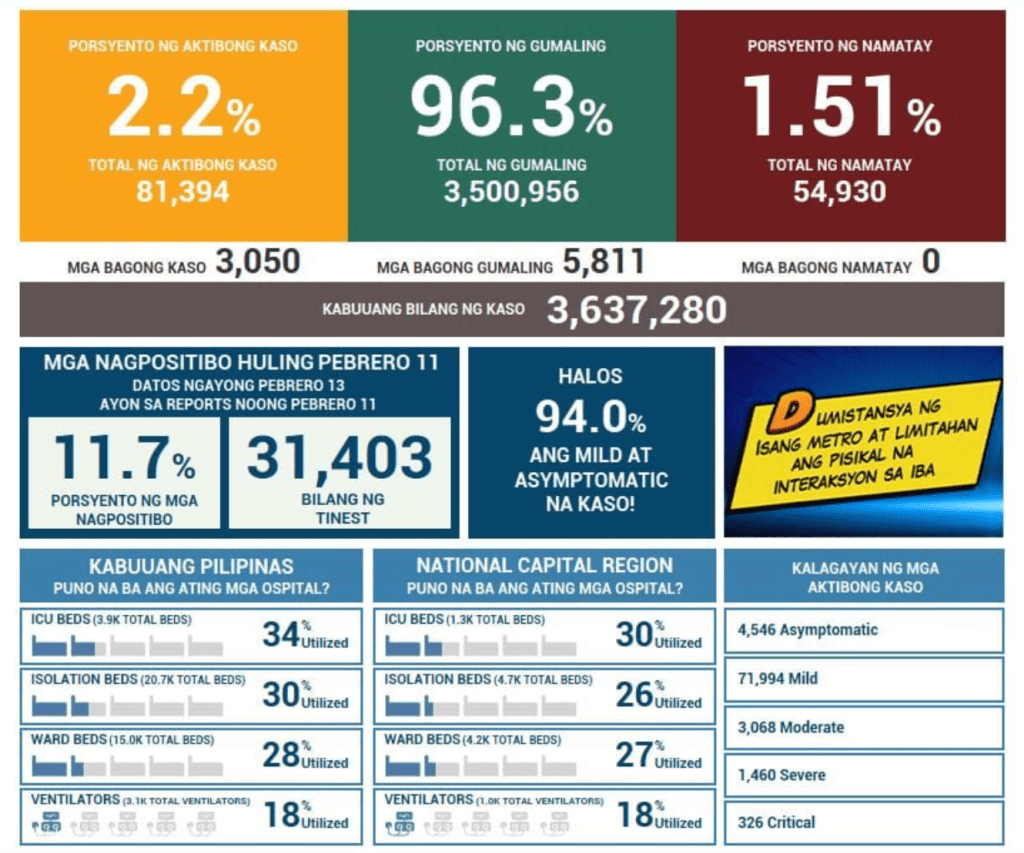
The Health Agency reports 3050 new cases based on 31,402 tests with 11.7% positivity last February 11. Of the reported cases today 99% occurred within the last 2 weeks with NCR, Western Visayas and CALABARZON leading the top 3.
There were 138 duplicates removed from the total case count – 64 of who were recoveries.
While there is ZERO death reported today, this is due to technical glitches in extracting data from COVIDKaya and is NOT the a reflection on deaths at all today.
NCR owned 18% of the total cases today with 558 new cases. Other regions with 300 or more cases were: CALABARZON (313), Western Visayas (367) and Central Visayas (300). Other regions reported 100-299 cases, while 5 regions had double digits. These latter regions were: BARMM (45), MIMAROPA (38), Bicol Region (42), Eastern Visayas (48), and Zamboanga Peninsula (90).
In the NCR, the City of Manila led among all LGUs with 107 cases and was the only LGU in Mega Manila to report triple digits. Quezon City had 98, followed by Makati with 81. All the rest either had less than 50 cases or single digit. The cities with single digit in NCR were: Malabon (9), Marikina (8), Navotas (4), San Juan (8) and Pateros (1).
Outside of NCR, only Davao City was the HCU (highly urbanized city) that had triple digits – 110.
—————-
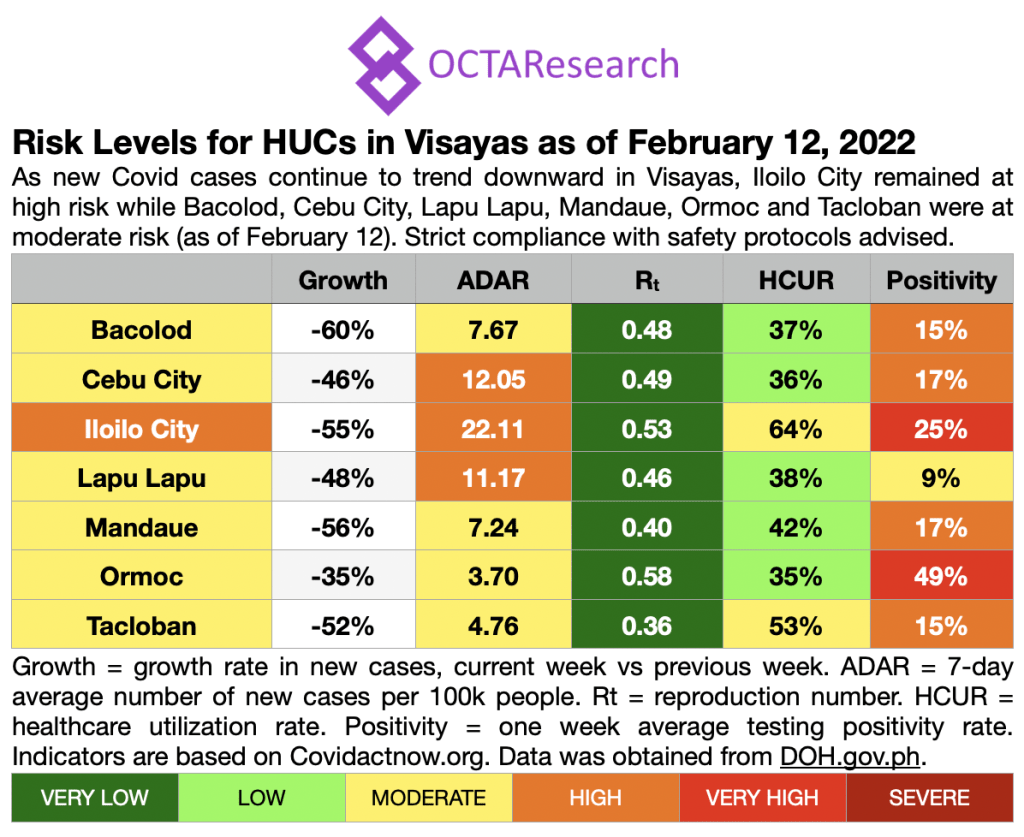
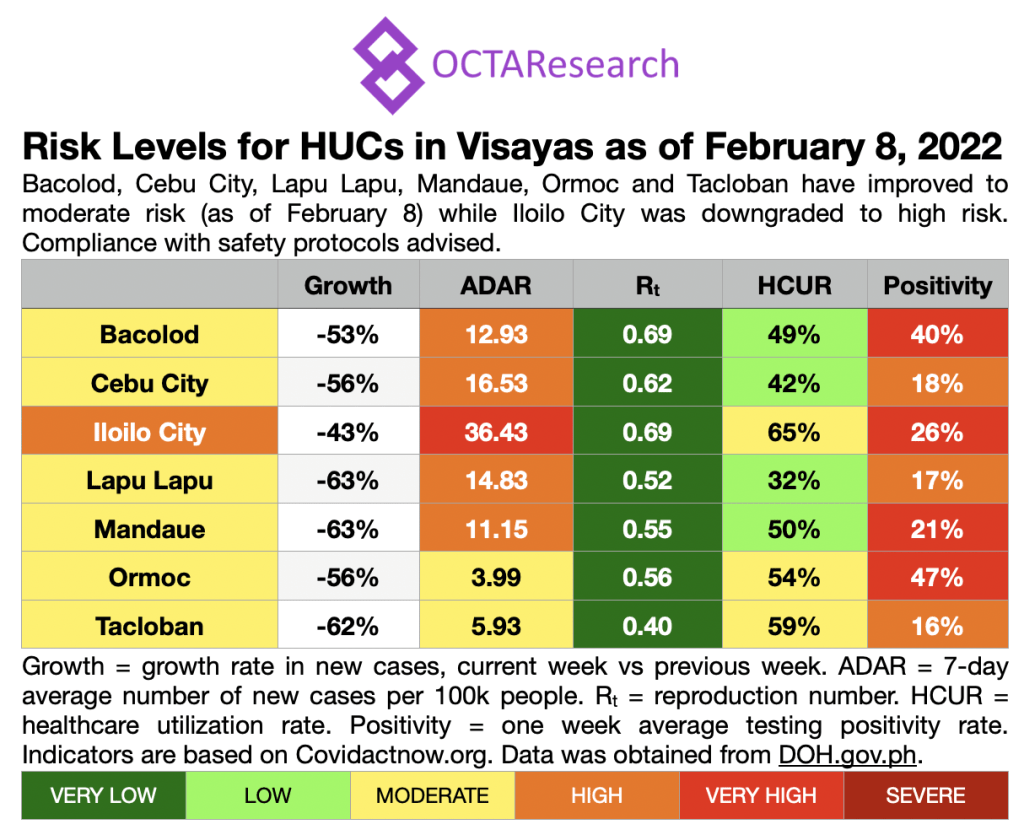
From OCTA RESEARCH [Prof. Guido David shares] the rundown of risk levels for highly urbanized cities in the Visayas as of February 12. While there is a decline in the weekly growth, the positivity rate in Iloilo City (1 in 4 testing positive) and Ormoc (1 in 2 testing positive) are at severe risk. Health care utilization is a moderate risk for Iloilo City and Tacloban (>50%), while ADAR (average daily attack rate) remains high in Cebu City, Iloilo City and Lapu Lapu (>10 per 100,000 population). While the reproduction number remains less than 0.5 in many areas, the decline may be due to the limited testing that is being done (many doing rapid antigen tests and not captured by the government) and testing only when patients need to be hospitalized for either COVID or nonCOVID cases (eventually ending up as + for SARS-CoV-2).
THE WEEK IN REVIEW
The Philippines continued its downward trend in cases, but unlike the delta wave, this downward trend did not coincide with a concomitant drop in positivity rate. As a matter of fact, the positivity rate in the country remains around 15% (considered high) with an average of 35K tests done daily. This trend of a high positivity rate in spite of a quick, sharp decline in cases is seen in almost all countries affected by the omicron wave. This translates to two things: (1) There will continue to have community transmission but until we meet a threshold that allows ‘comfortably’ stable at the positivity rate AND number of daily cases. (2) Eventually, that number will allow us to ‘live’ with the virus AND that we will eventually stop tabulating the numbers and return to ‘business as usual’ gradually.
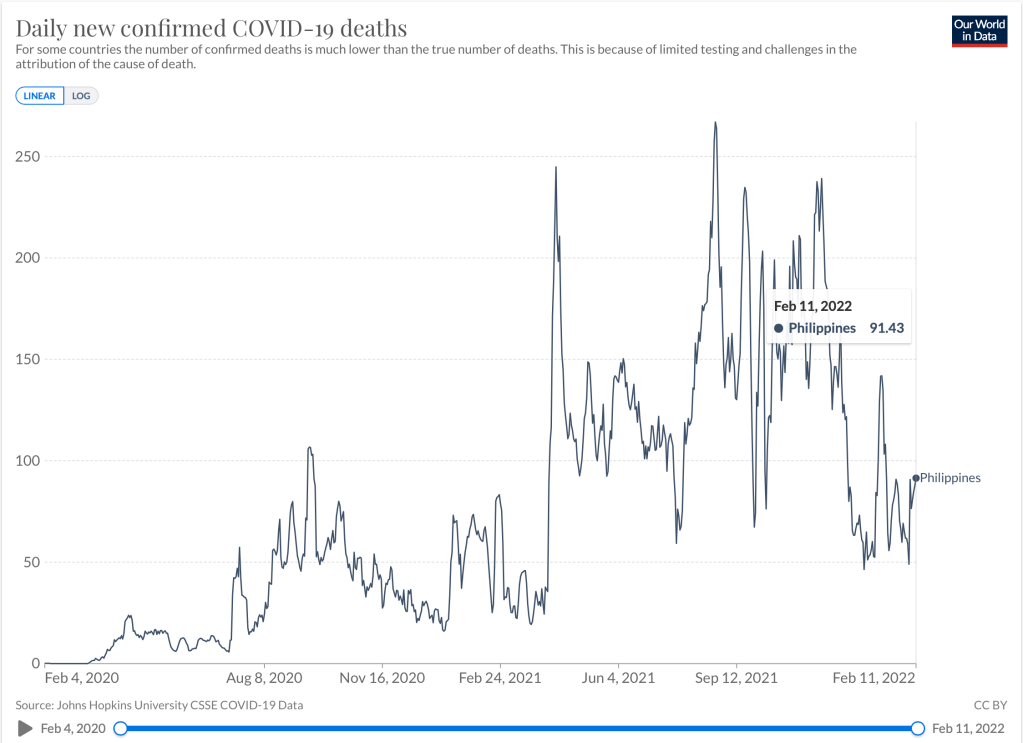
The deaths remain high for this lower number of daily cases, as only 60% are recent (occurred in the month of February) while a large chunk are still being reconciled from 2021 to January 2022.
The reproduction rate is generally lower in the Philippines at 0.53 (+/- 0.05) as of February 9. Which means that the decline will most likely continue till the end of the month, but due to the positivity rate, this will reach a threshold or baseline for the omicron wave. This pattern in decline of cases and reproduction rate is very similar to South Africa and UK and in many parts of the world who are settling from the omicron wave.
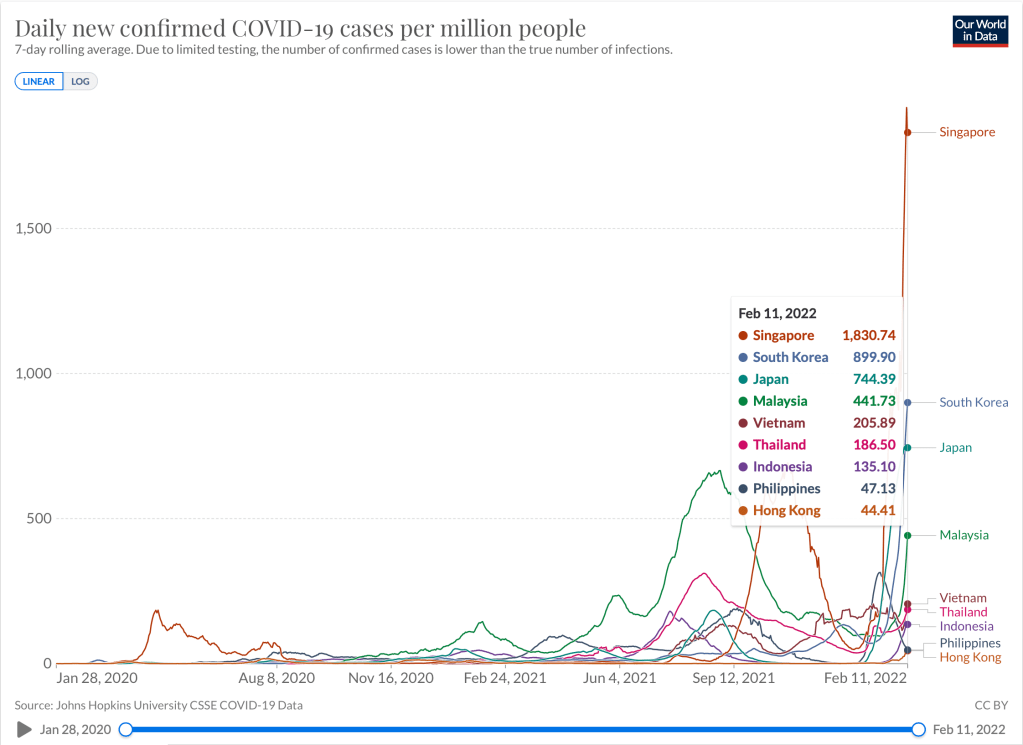
In the meantime, many countries in Southeast Asia, including northern Asia are seeing the start of their omicron surge. Japan leads in the surge with an average of 95K daily cases, followed by South Korea and Indonesia. Vietnam and Malaysia that saw a slight decline in the past month are seeing an upward trend in cases. The surprise in the group is Hong Kong, which recorded more than 1000 new cases yesterday. The small nation that is under receivership from China is battling its worst surge as it struggles to align with China’s ZERO COVID policy.
In terms of number of cases per capita, however, note that it is Singapore and South Korea that lead among all countries in the region. Only the Philippines and Hong Kong are seeing double digits at 47 per million and 44 per million, respectively.
The effective reproduction number is highest for South Korea and Singapore, and all nations except for the Philippines with Rt >1.0. Japan, while owning the highest cases in the region has a positivity rate of 44% as of February 10. South Korea has a positivity rate of 18%. Vietnam owns the highest positivity rate in the region at 50% (meaning 1 in 2 test positivity). As omicron rages on, the effective reproduction rate may not translate to the actual situation in the respective countries as testing takes a back seat in how the pandemic is addressed.
Seriously, wherever Bloomberg Resiliency Index or Nikkei COVID19 Recovery Index put the Philippines (in the lower bottom of the rung), the country is in a much better place and is handling the pandemic much better than the rest. And while no country can be similar to another in how it manages the pandemic, with the current data, we need to strengthen vaccination in the provinces and other regions where vaccine hesitancy is still high. The economic struggle is real and needs to be addressed, now that we most likely have this under control.
The data next week will should tell us many stories – and that includes the strategy on how to welcome Filipinos to the ‘new normal’.
The Health Agency announces 3792 new cases today based on 32,067 tests with a positivity rate of 14.3% on February 10. This brings down the active cases to a little over 84K as there are more than 10K recoveries today. Notice, however, that the cases buzz around the 3-5K mark due to the high positivity rate. Theoretically, if the positivity rate remains more than 10% and we average 30K tests daily, then the daily new cases will always be above 3K. The only way we will see triple digits is if the positivity rate drops to <5%.
Of the 3792 cases today, 96% occurred in the last two week, with NCR, Western Visayas and Davao Region leading the haul.
There are 76 deaths announced today – 66% occurring in February (50), 7% last January (5) and the remaining were from April to December last 2021.
The NCR led with 562 (15%) of the total cases today. This was followed by Western Visayas 408, CALABARZON 337, Davao Region 335, and Central Visayas 328. Other regions reporting more than 100 but less than 300 cases were: CAR (250), Cagayan Valley (214), Central Luzon (286), Ilocos Region (150), Zamboanga Peninsula (153), Northern Mindanao (176) and SOCCSKARGEN (194). Only BARMM, CARAGA, MIMAROPA, Bicol and Eastern Visayas reported double digits.
In the NCR, only Quezon City reported triple digits today with 123 cases followed by the City of Manila with 82. All other LGUs in NCR had double or single digits but less than 50 cases. Those with single digit cases were: Malabon (4), Navotas (2), San Juan (5), and Pateros (2).
Outside of NCR, Davao City took the lead among HUCs (highly urbanized cities) with 114 cases today. This was followed by Cebu City with 92 and Zamboanga City with 87.
With Valentine’s Day around the corner, I hope the public understands that it single day celebration in crowded indoor dining isn’t worth the risk of getting infected with COVID19. It is a fair reminder that while vaccines work at preventing severe disease, they do not work as well at preventing infections particularly for Omicron. Let’s make it austere, safe, yet meaningful.
The Health Agency reports 3788 new cases today, based on 32795 tests with a positivity rate of 14.7% last February 9. Note that this percentage is still considerably high as testing shifts to hospital settings, those with symptoms and high risk groups (A1, A2 and A3). Unlike the delta surge last year, where the positivity rate dropped significantly concomitantly with the positivity rate, this one is going down quite slowly. The positivity rate is keeping these numbers between 3-4K and may continue until the positivity rate drops to <10%.
Of the new cases reported today, 97% occurred within the last two weeks. NCR, Western Visayas and Davao Region led the haul.
Active cases hover above 90,000, with almost 95% of them being mild or asymptomatic at the time of testing.
While health care utilization rate is at low risk in both the NCR and most of the areas around the country, there are 72 deaths announced today.
Of the 72 deaths, 76% occurred in January and February 2022. The rest were from June to December 2021.
Top regions with most cases were NCR with 486, Western Visayas 463, and Davao Region 459. CALABARZON reported 371 cases and Central Visayas had 370. All other regions had less than 200 cases with four regions seeing double digits today. They are: BARMM (31), MIMAROPA (44), Bicol (43) and Eastern Visayas (75).
In the NCR, ALL LGUs reported double or single digit cases. This was led by the City of Manila with 91, Quezon City with 90 and the City of Makati with 49 cases. All other LGUs had less than 40 cases or single digit. Those with single digit are: Malabon (4), Marikina (9), Navotas (4), San Juan (9), and Pateros (1).
Outside of NCR’s LGUs, Davao City took the national haul with 193 cases today.
Among ROFs (returning overseas Filipinos), 28 were reported positive today.
Let’s keep a little restraint on Monday, Valentine’s Day. We’ve been through the worst in the pandemic. Let’s celebrate it with caution and safety. Stay home. Cook for the wifey. Enjoy the day. Love does not have to be expressed in a restaurant.
After the low 3000 or so cases recorded the past days, the Health Agency reports 4575 new cases today based on 36,407 tests done with 15.1% positivity last February 8. Of the reported cases today, 3461 occurred within the last 2 weeks with the top regions being Region 6, 7 and NCR.
With more recoveries today, the active cases go down to 93,307, with almost 95% of them being asymptomatic or mild.
There are 94 additional deaths today. Of these, 70% occurred in February (66) and 12% (11) last January. The remaining deaths were from June to December 2021.
One hundred seventy six duplicates were removed from the total case count. Of these, 132 are recoveries and 1 is a death. In addition, 47 cases that were previously tagged as recoveries were reclassified as deaths after final validation.
NCR led again in today’s tally with 600 (13%) of the cases today. This was followed by Western Visayas with 568, CALABARZON 508, Central Visayas 498, Davao Region 378, and Northern Mindanao 362. All other regions had less than 300 cases with three regions reporting double digits – CARAGA (90), MIMAROPA (72) and Bicol Region (91).
In the NCR, only Quezon City had triple digits with 122 cases today. The City of Manila continued it second spot with 82 cases followed by Pasig and Makati City owning 50 cases apiece. All other LGUs reported less than 50 cases with 4 LGUs reporting single digits – Malabon (9), Navotas (7), San Juan (5) and Pateros (1).
LGUs/HUCs (highly urbanized cities) with most cases for the day, OUTSIDE of NCR, were Davao City 185 (highest number of cases among all LGUs in the country), Cebu City (129), Negros Oriental (123), Baguio City and Iloilo City with 110 cases apiece.
The Health Agency continued to report lower numbers, today at 3651 new cases based on 29970 tests (very low) with 16.5% positivity rate (high) last February 7. This is disturbing data because the positivity rate remains high – which means that with omicron being mild or mostly asymptomatic (as seen in the status of over 96000 active cases) – many are NOT testing anymore.
This scenario is mostly seen in community settings and I am willing to bet that 1 in 5 patients who need to get hospitalized and are swabbed at the point of care, will most likely turn up positive. Remember, all these cases which the DoH announce are based only on RT-PCR positive results.
There are 69 additional deaths – 25 occurring in February, 36 in January and the remaining were May to October 2021.
It’s always a good thing to see the lower numbers. Unlike previous surges, many patients are not testing anymore. Which makes this a more challenging surge because we’re relying on data of the Health Agency – those that had RT-PCR done.
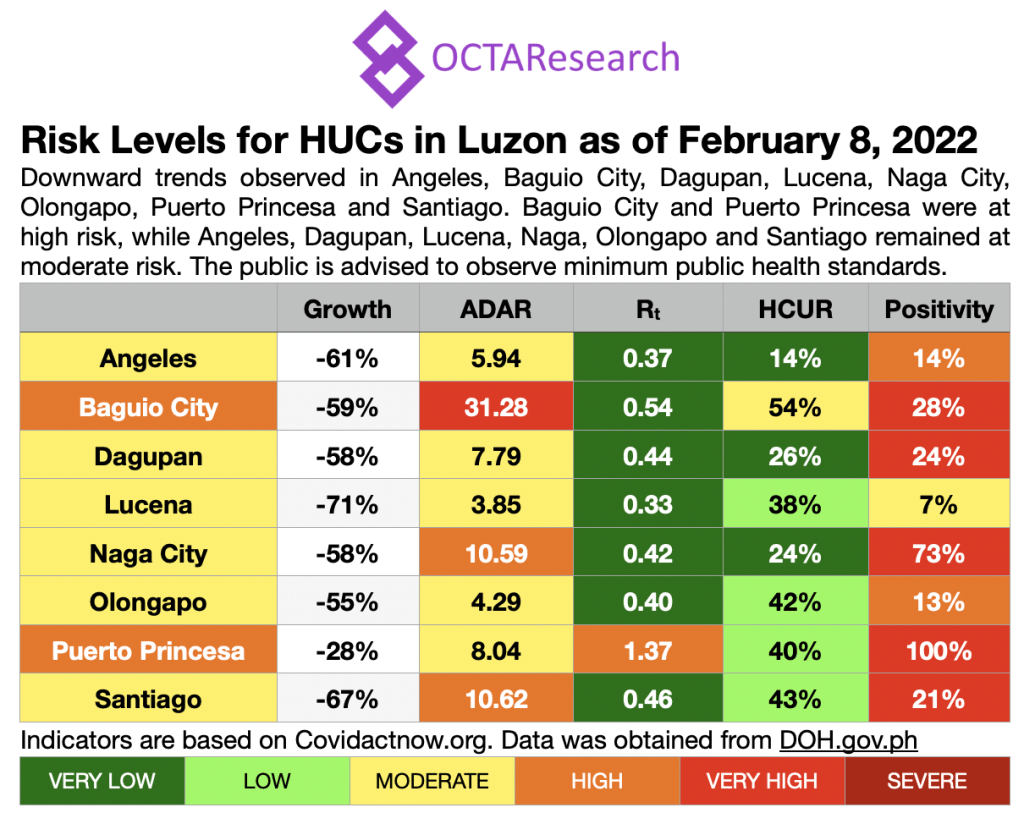
This statement comes based on the OCTA Research Monitoring data [through the effort of Prof. Guido David] on the risk levels for Highly Urbanized Cities (HUCs) as of February 8. While there is an overall downtrend of cases, this decline may not be accurately reflecting the exact number of people with COVID19. Baguio City still has a very high ADAR (average daily attack rate) and a positivity higher than the national average. Notice that ALL these HUCs, except for Lucena City has a positivity at high, very high or severe. For example, Puerto Princesa’s growth, while on a decline has a Rt of 1.37. This is being greatly affected by the positivity rate of 100%. Everyone who tests there is positive.
The same growth (or decline) trend is seen in the Visayas region. Compared to the HUCs in Luzon, more testing is done in the Visayas as noted in their positivity. Iloilo City remains at high risk with the highest ADAR in the HUC in the region, a HCUR that is at 65% and a positivity of 26%. Bacolod City and Ormoc’s positivity is more than 40% (or 2 in 5 that get tested are positive).
Because the data does not provide us with enough comfort zone as to the real condition of the omicron surge, it is best that we gauge moving to Alert Level 1 with caution, and use the positivity and HCUR as a benchmark for deciding on whether we should move from Alert Level 2 to 1. It is a given that ADAR and Rt will depend on the daily report of the health agency.
In areas where the positivity is <10% AND HCUR that is at low risk, then moving to Alert Level 1 may be made with caution.
It’s expected that the numbers would be low today. But it’s almost half the numbers yesterday as the Health Agency announces 3574 new cases from 23754 tests with a positivity of 16.3% done last February 6. With more recoveries than deaths, the active cases ease to just a little more than 105K with more than 95% of them being mild or asymptomatic when tested.
Health care utilization is low risk, most particularly in the NCR compared to the general population.
There are 83 additional deaths reported today. [Of these, 53 occurred in February while 24 in January this year. The rest or 7% of the announced deaths today were from June to December 2021].
Today’s granular breakdown of data shows the NCR owning 20% of the total cases in the country with 689 cases. Remember – a lot of people are not doing RT-PCR anymore, just self-test with antigen tests at home and do not report these positive results. The estimate of the cases are between 8-10x the actual number based on the current data with 20% positivity rate. This is also the estimate if we use the positivity results of the recent bar exams.
ALL regions had a decline in the number of cases. None reported quadruple digits and only three regions reported more than 300 cases – CALABARZON 368, Western Visayas 380, and Central Visayas 367. Six regions reported double digits while the rest reported 100 to less than 300 cases today.
In the NCR, all LGUs reported lower cases today than yesterday except for Malabon that reported 16 cases today compared to yesterday’s 14. Quezon City and the City of Manila had triple digits at 140 and 123, respectively.
Outside of NCR, the LGUs with most cases were Cebu City with 120 cases and Davao City with 116 cases.
—————–
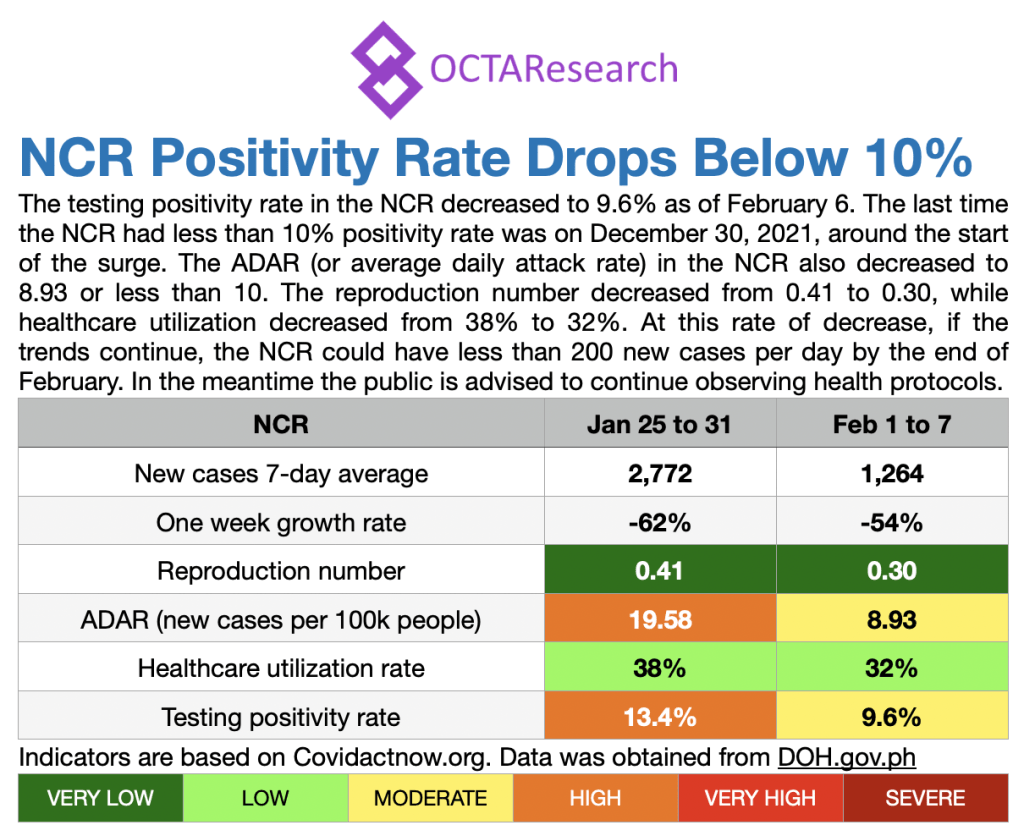
From OCTA Research (through the efforts of Prof. Guido David) is the current state of Mega Manila. As of February 6, the positivity rate has appreciably dropped below 10%. Cases are less than half the previous week average and the reproduction number continues to decline (which means that we will be able to sustain a lowering of cases in the coming week). ADAR is below 10 per 100K population and healthcare utilization rate is also at low risk.
Let’s just try to make Valentine’s Day an austere and healthy one and not risk the gains made. Omicron now dominates the genotype of SARS-CoV-2 in the country and there’s still a sprinkling of delta around. Fair reminder that celebrating a commercial occasion is not worth putting to risk your health and that of our loved ones for now.
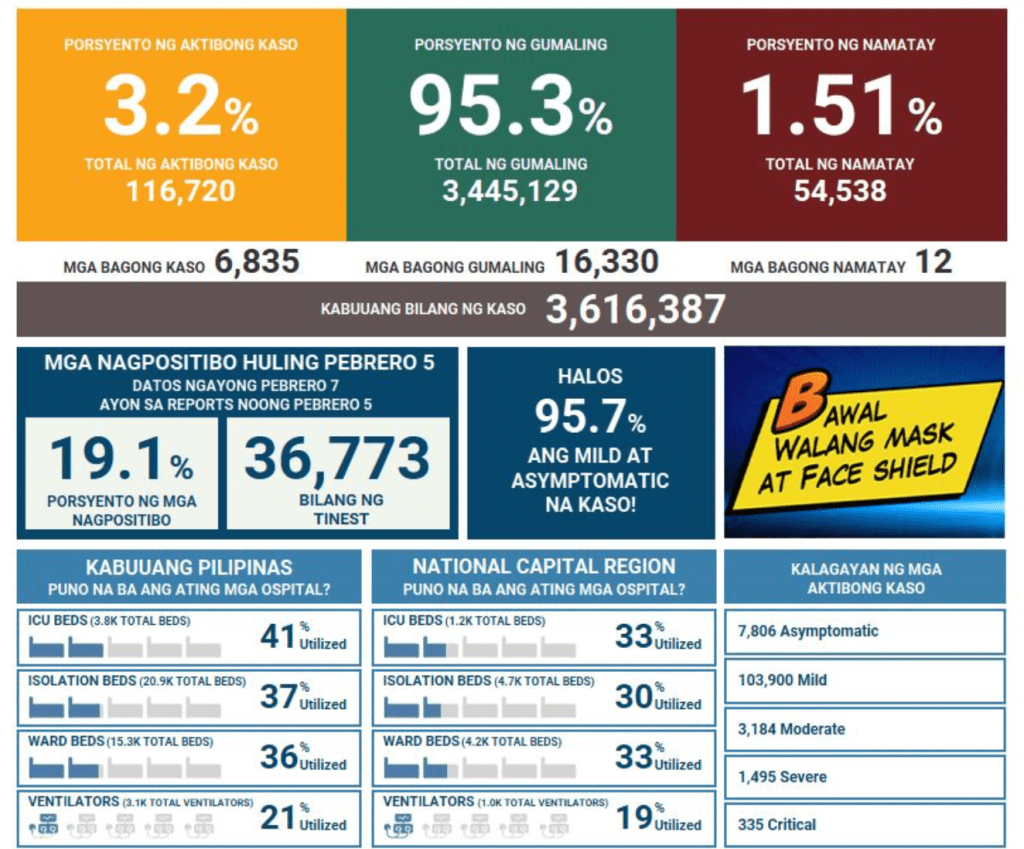
The Health Agency reports 6835 new cases based on 36773 tests with a positivity rate of 19.1% done last February 5. This is most welcome news considering that this is also the first time since this last surge that the positivity rate dropped to less than 20%.
With more recoveries, the active cases are now at a little more than 116,000
Healthcare utilization rate is at low risk both nationally and in the NCR.
There are 12 deaths added today.
Let’s start off with the regions today.
NCR had the most cases with 968 (14.1%) of the 6835 cases for the day. This was followed by Western Visayas (829), Central Visayas (649), CALABARZON (611), Davao Region (602) and Central Luzon (536). All other regions reported triple digit cases and less than 500. Two regions reported double digits: BARMM (85) and Bicol Region (90).
Among LGUs in NCR, only three LGUs had triple digits: Quezon City with 190 cases, City of Manila 132, and Makati 113. All other LGUs report double digits with the following reporting more than 50 cases but less than 100: Parañaque (79), Pasig (77), Pasay (59) and Taguig City (57). Two LGUs report single digits – San Juan with 8 and Pateros with 5.
Outside of the LGUs in the NCR, Davao City kept the lead with 263 cases followed by Cebu City 179, Iloilo City 154 and Baguio City 139.
Among ROFs (returning overseas Filipinos), only ONE tested positive today.
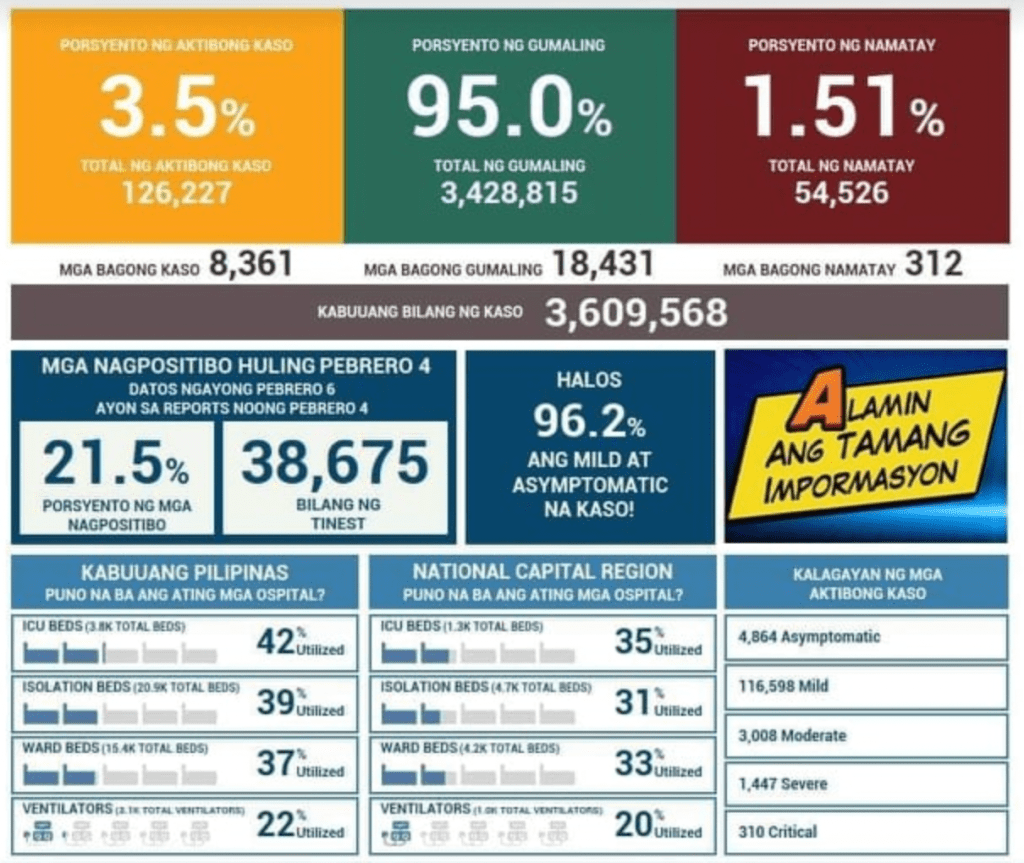
The Health Agency announces 8361 new cases today based on 38675 tests with 21.5% positivity rate (very high) done last February 4. Around 96% of these active cases were asymptomatic to mild at the time of testing. Total cases are now past the 3.6M mark.
Health care utilization rate remains at low risk in general.
The sad news – 312 additional deaths announced today.
NCR took the bulk of cases today with 1271 (15%) cases. This was led by Quezon City with 222 cases and the City of Manila with 201. Makati City was in their with 102. All other LGUs reported double digits except for Pateros that had 8 cases.
Outside of NCR, all other regions reported triple digits, led by Davao Region 792, Central Luzon with 782, CALABARZON 775, Western Visayas 764, and Central Visayas with 757 cases.
Davao City remained the LGU in the country with most cases owning 334 of the 792 cases in the region.
Among Returning Overseas Filipinos, 31 were reported positive today.
THE WEEK IN REVIEW
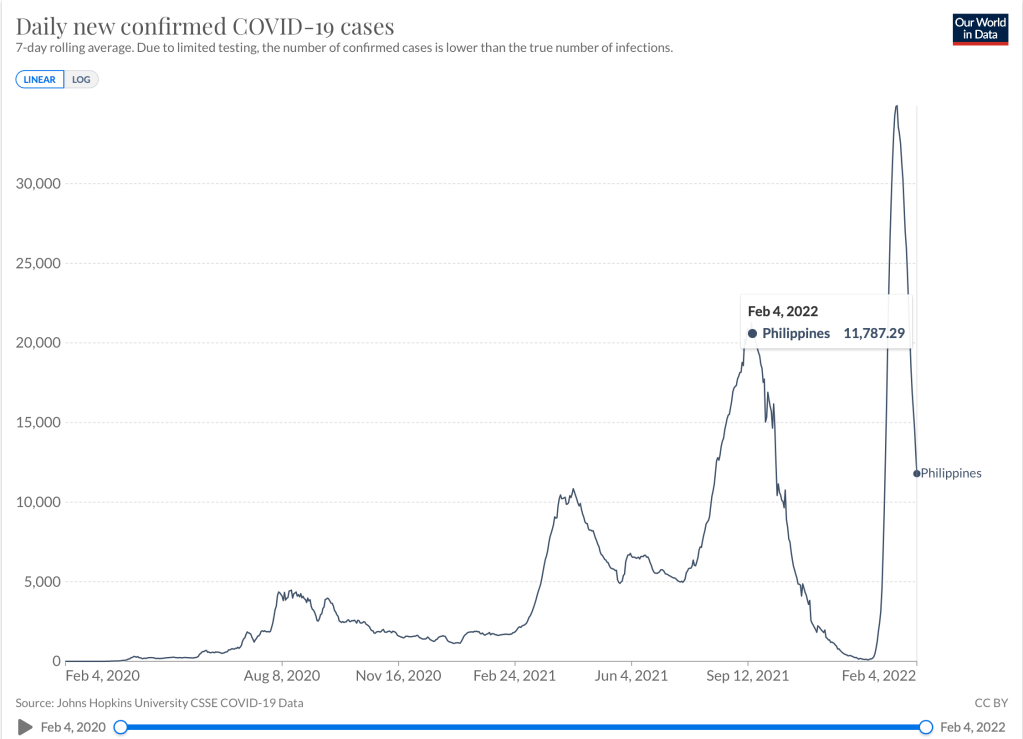
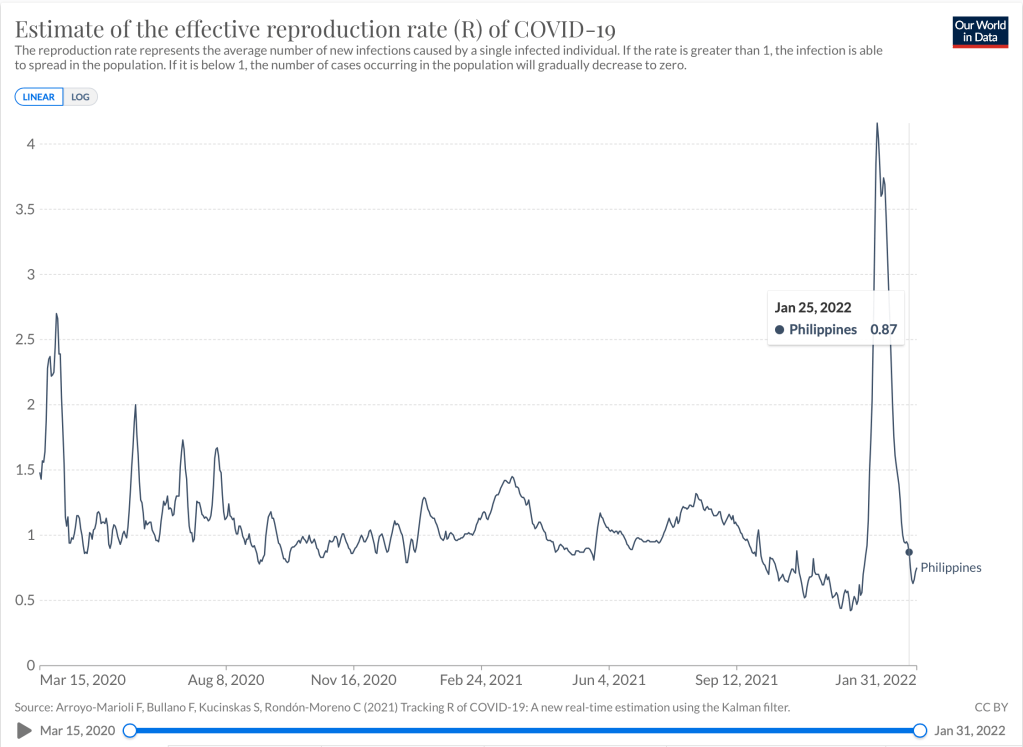
The cases in the Philippines continue the declining trajectory with a reproduction rate around 0.75 (+/- 0.05). Staying below 1.0 is a good indicator that the cases will continue to decrease this upcoming week in spite of the high positivity rate in the country. Note that many countries including Japan, Bangladesh, and Vietnam have positivity rates more than 20%. Thailand has a positivity rate at 15%. With the omicron surge, it is difficult to keep track on contract tracing and testing the general population.
As of February 4, the 7-day average of the Philippines is at 11,787 new daily cases and is expected to report quadruple digits the upcoming week. Deaths average 59 per day due to reconciliation of late reports as well.
Compared to ASEAN nations and select Asian nations (Japan, South Korea, and Bangaladesh), the Philippines is the only country with a Rt at <1.0. Indonesia is seeing the beginning of their omicron surge as their Rt is up at 2.36. The country currently has a 7-day average of 18,000 per day and has reported more than 33000 new cases in a single day on February 5, 2022. South Korea has an Rt at 1.71 as the country sees a daily average case at more than 22000. As a matter of fact, with the more than 36,000 cases in S. Korea yesterday, the country has passed the 1 million mark for COVID19 cases.
Japan, with an Rt of 1.15 is seeing seeing a 7-day average of 86,000 daily cases. It broke its record of hitting the 100,000 daily cases in the past days as it rapidly crosses the 3 million mark yesterday for COVID19 cases.
While Japan may be seeing the most number of cases in this part of Asia, it is Singapore that actually has the most cases per capita (based on population size). This tiny country with less than 6 million people, has a Rt of 1.55 and is seeing an average of 6000 new daily cases (1075 per million population). The past days, Singapore has been reporting more than 10,000 new daily cases.
The first week of February ends with a high note – the cases are noticeably going down. The 7-day average drops to 11,000 based on yesterday’s data. With the cases today, we should be seeing four digit averages for the upcoming week.
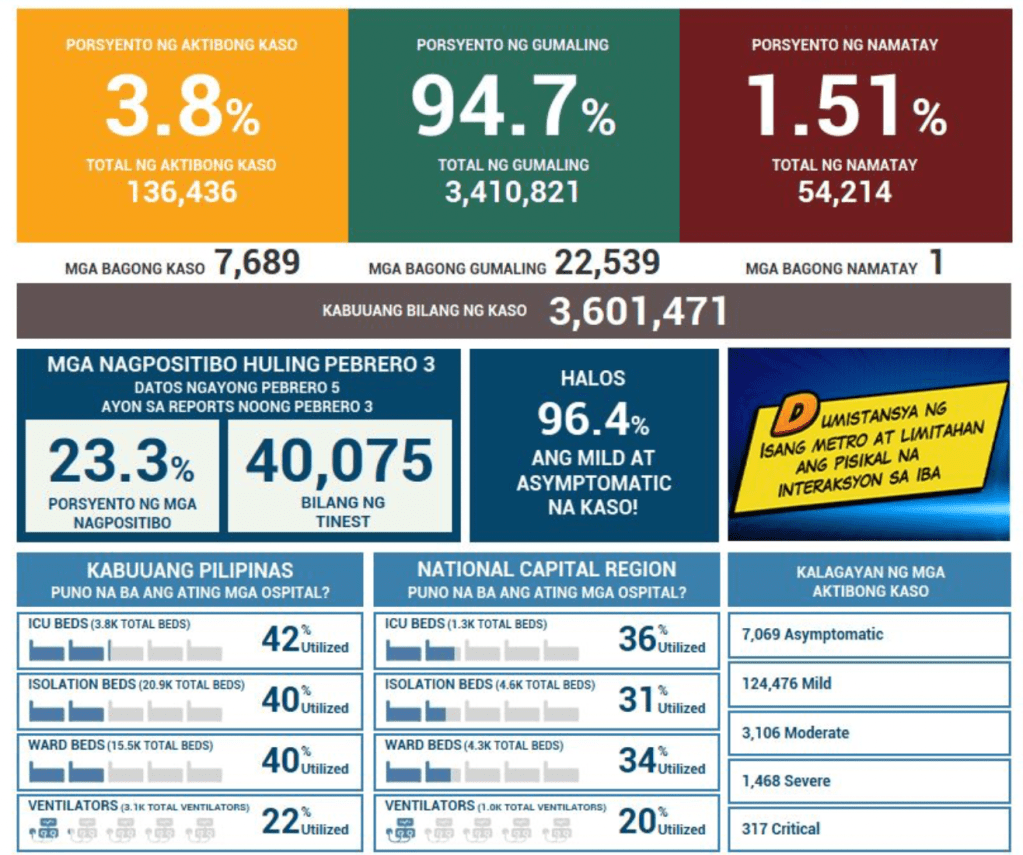
The Health Agency reports 7689 new cases based on 40K plus tests with a positivity rate of 23.3% (still very high) last February 3. And with more than 22,500 recoveries, the active cases slip to 136,436 today.
Hospital utilization rate is also lower (considered low risk) both nationally and in Mega Manila.
There is one additional death today.
Today, Central Visayas topped all region with 1115 cases (489 from Negros Oriental and 230 from Cebu City).
Davao Region came in second with 883 cases (350 for Davao City).
NCR was in third with 877 cases, with Quezon City (171 cases) and City of Manila (136 cases) as the only LGUs in NCR with triple digits. Pateros had only 1 case.
Other regions that saw more than 700 cases were: Central Visayas with 754 and CALABARZON with 729.
Among returning overseas Filipinos there was NO REPORT of a positive case today.









 Relative Joy