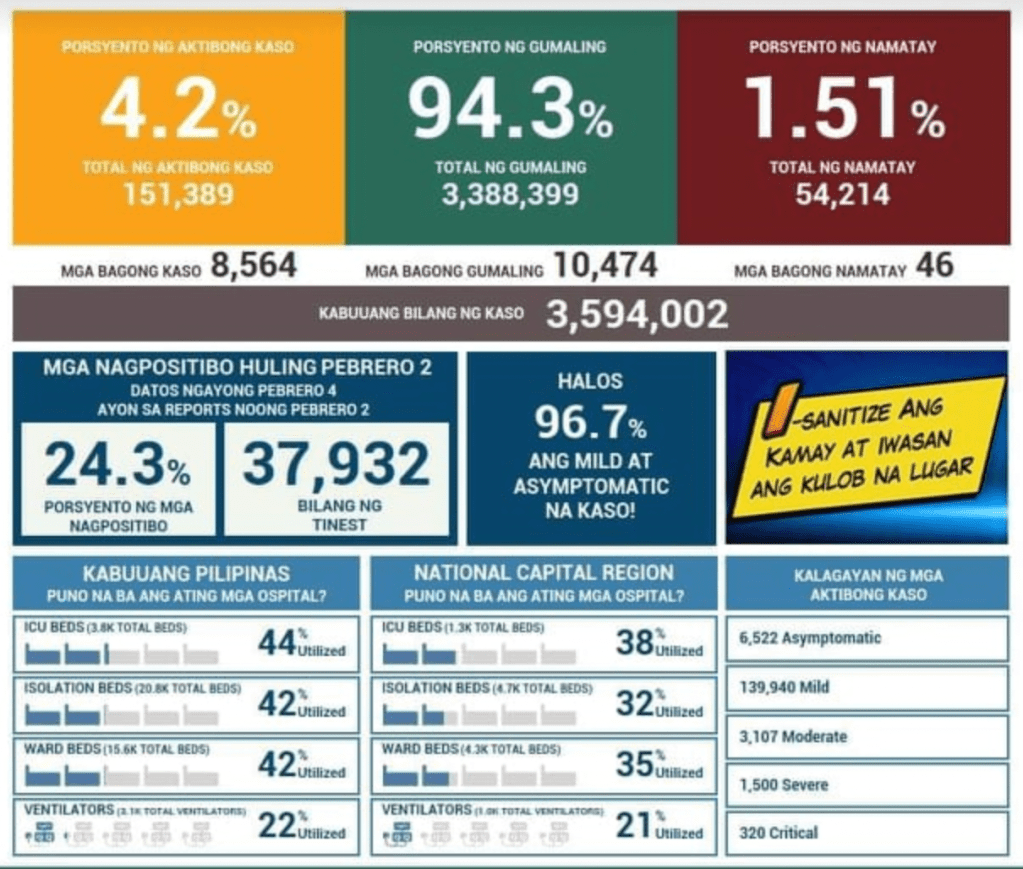
The Health Agency announces 8564 new cases today based on a measly 37,932 tests with a positivity rate of 24.3% done last February 2. Note that this is the positivity rate for the country and not for each region or LGU. The positivity rate in NCR is lower (~18%) compared to the national. Still will more recoveries than cases, this brings down the active cases to a little more than 150K. Of these active cases, almost 97% were asymptomatic or mild at the time of testing.
Health care utilization rate is generally at low risk in both the NCR and nationally.
There are 46 additional deaths announced.
NCR is back on top with 1535 (18%) of the total cases in the country. This was led by Quezon City (325) and the City of Manila (229). Other LGUs in NCR that reported triple digits were: Makati (126) and Pasig (117). The rest reported double digits, with Pateros as the lone LGU that had 5 cases.
Outside of NCR, CALABARZON was in second with 1166 cases and the only one with four digits aside from NCR, today. All other regions reported triple digits. Central Visayas followed with 869, Central Luzon with 839 and Davao Region with 803 cases. All other regions report less than 500 cases. Among LGUs in the country, Davao City had the most cases at 384.
—————–
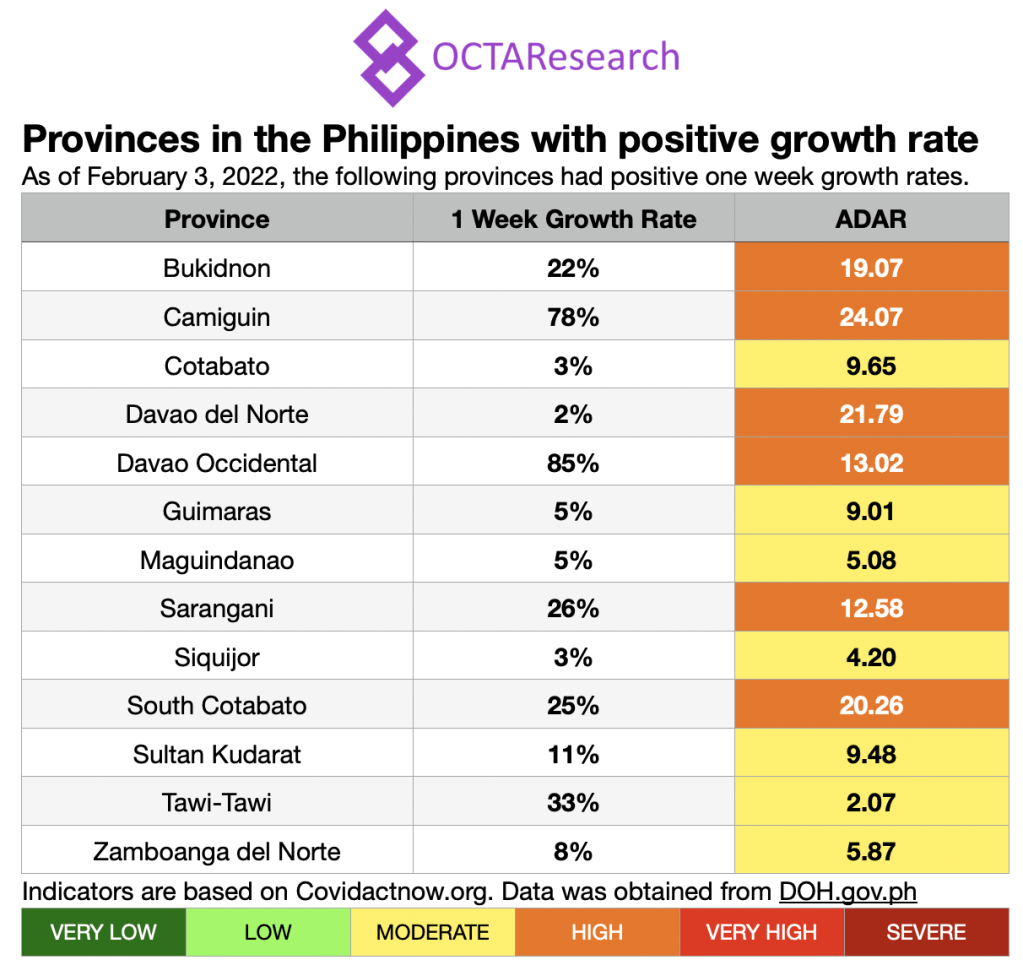
Prof. Guido David continues to track the omicron surge, this time looking at the provinces with a wine week positive growth rates. Highest growth rate goes to Davao Occidental (78%) and Camiguin (78%). Highest ADAR (average daily attack rate per 100,000 population) goes to Camiguin, Davao del Norte and South Cotabato. While the cases are on a decline in major HUCs (highly urbanized cities), the numbers in certain provinces continue to increase. These are also the same areas that have lower vaccination rates.
First of all, let’s rant about the Data Drop that is sorely missing from the Department of Health.
While it is understandable that perhaps a few of their personnel were sick with COVID-19 during the beginning of the omicron surge, I doubt that these same players are continuing a long haul of illness. If they are, they should be replaced because the Data Drop is important – not only to the data chasers like us, but also in the spirit of transparency on what is happening in the country.
While the COVID19 tracker of the DoH, that is available on its website, is accessible, the Data Drop is more comprehensive that it provides age, date of swabbing or onset of disease, date of death and when the deaths were reported, etc. These valuable information are important in how to model and project where this pandemic is leading to. After all, this kind of information should be shared by the government agency unless there is a different agenda in the last few months of the term of the president.
If there is noise that the media must make, it is this one. After all, they benefit from the projections provided by independent groups on how the country is doing in the pandemic and the various responses of the government.
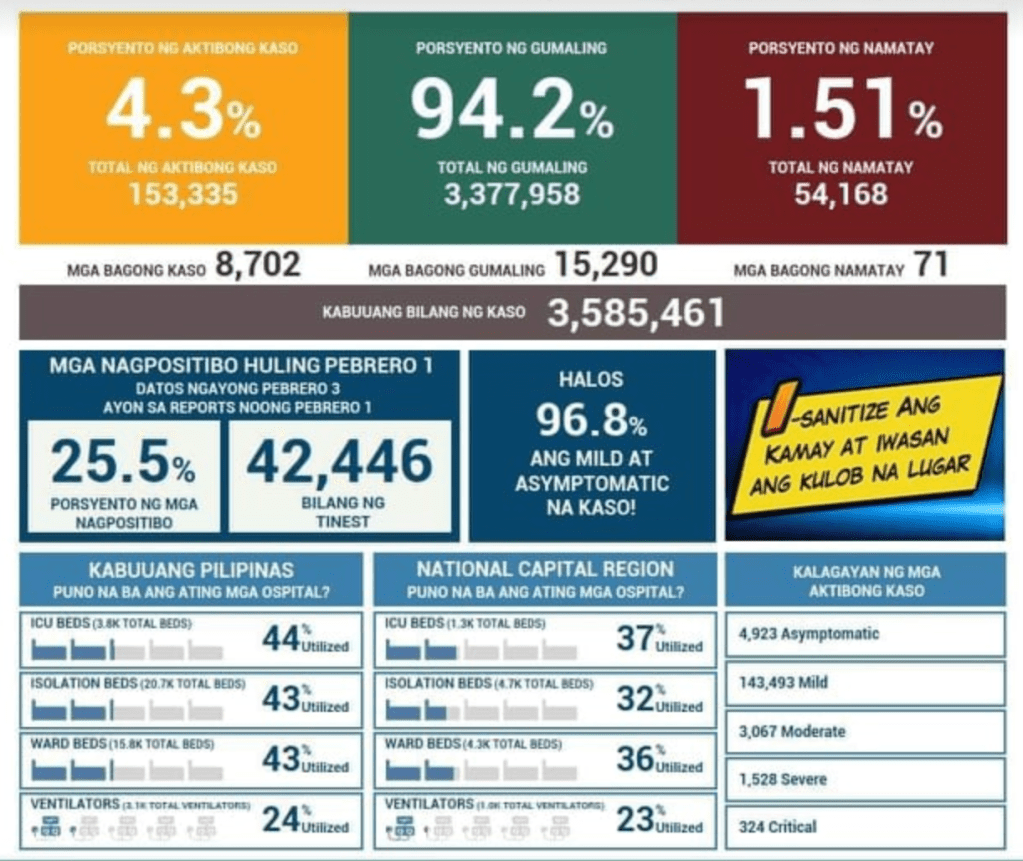
There are 8702 new cases today based on 42,446 tests with 25.5% positivity last February 1 (Chinese Lunar New Year) which was a holiday. More recoveries than active cases bring down the active cases to 153,335 with almost 97% asymptomatic or mild at the time of testing.
Health care utilization in general is at low risk.
There are 71 deaths added today.
Western Visayas led among regions today with 1044 cases followed by Central Visayas 833, CALABARZON 794, Davao Region 789, NCR 724 and SOCCKSARGEN 714. All other region reported less than 600 cases.
In the NCR (which is seeing much fewer cases today compared to other regions), only two LGUs reported triple digits – Quezon City 129 and Manila with 120 cases. LGUs with 50-99 cases were: Makati (61), Parañaque (58), and Taguig (61). The rest had less than 50 cases, with 2 LGUs reporting single digit – San Juan 8 and Pateros 3.
Nationally, the LGU that had the most cases was Davao City that reported 298 cases followed by Cebu City with 218 cases.
There were 36 positive ROFs (returning overseas Filipinos) today.
—————-
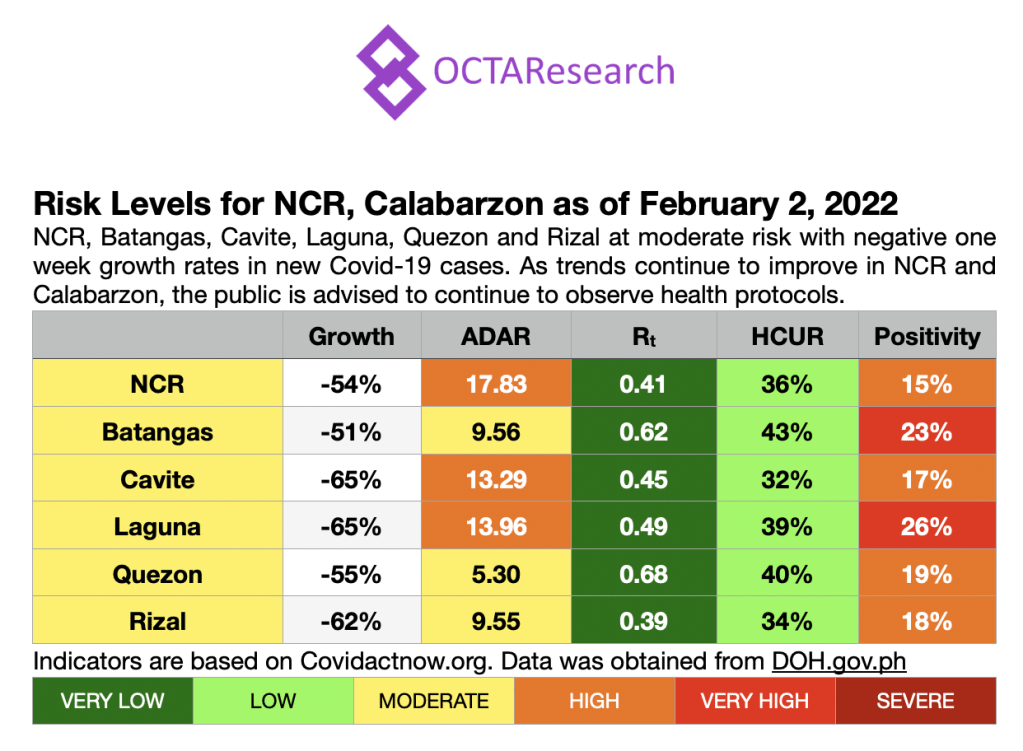
OCTA Research data (manually painstakingly done by Prof. Guido David) shows how the NCR and CALBARZON provinces and certain areas in Luzon are doing in the current omicron surge. Notice that the positivity rate drops below 20% but remains high in NCR, Cavite, Quezon and Rizal. Reproduction rate is very low in all these areas as the growth rate continues its decline. ADAR is moderate in Batangas, Quezon and Rizal provinces.
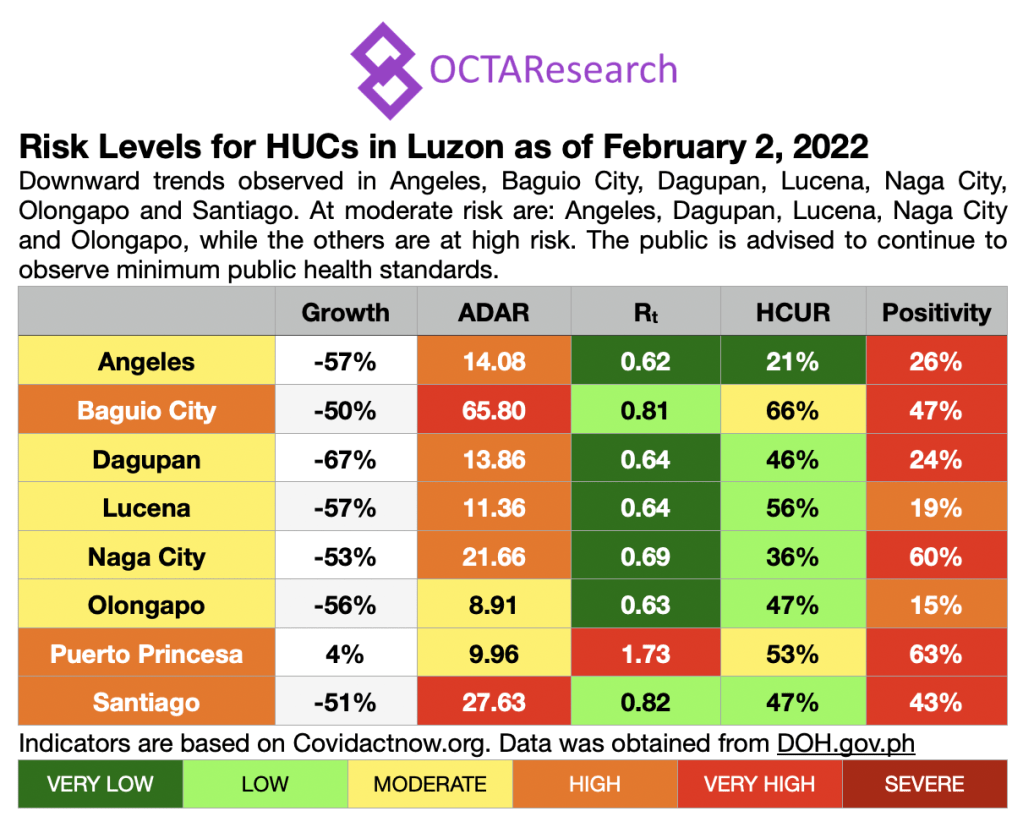
In other HUCs (highly urbanized cities) in Luzon, notice also the decline in cases. However, the very scant testing is noticeable as the positivity rate is very high to severe in many of these HUCs. Puerto Princesa for example, has a positivity rate of 67% (or 2 in every 3 people tested are positive) and has a Rt that is at 1.73 in contrast to other HUCs in the country.
The Health Agency reports 7661 new cases based on 40,453 tests done with a positivity rate of 24.6% (very high) on the last day of January 2022. With more recoveries (again) today, the active cases drop to 160,297 and almost 97% of these were asymptomatic or mild at the time they were tested.
Healthcare utilization rate is now low risk in general (both nationally and in the NCR).
There are 43 additional deaths today.
The NCR continued the haul today with 1999 or 26% of the total cases in country based on Jan 31 data. This can either be backlogs adding up or because this is data on a Sunday, only NCR will have more laboratories testing. Quezon City led with 450 cases followed by Manila with 309. All other LGUs in NCR had less than 200 cases with Makati 161, Pasig 158, Caloocan 108, Parañaque 105, Las Piñas 103, and Pasay City 103. The cities of Malabon, Marikina, Muntinlupa, Navotas, San Juan, Valenzuela and Taguig had two digits numbers while Pateros reported 7 cases.
Outside of NCR, only CALABARZON had four digits as well with 1079 cases. All other regions saw triple digits including Western Visayas with 909 cases and Davao Region with 507. Central Luzon had 747 reported cases today.
Tomorrow will most likely be a four digits day (unless there are a lot of backlogs that get reported) and because the data tomorrow will be from February 1, most likely the bulk will come from NCR again, where close to 50% of the laboratories in the country are found.
—————-
While the NCR is actually seeing lower cases (again let me emphasize that the positivity rate is still high, which is reflected in the daily high positivity rate because the DoH only records those with positive RT-PCR tests), the situation in the Visayas is also looking better.
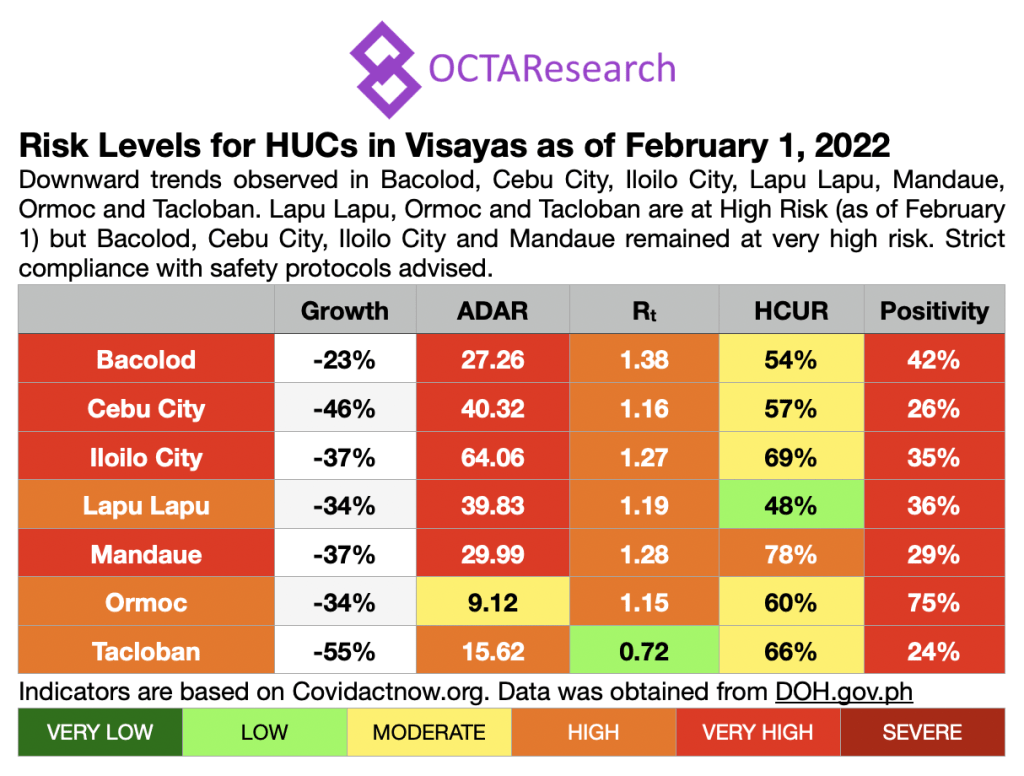
Prof. Guido David of the OCTA RESEARCH GROUP breaks down the numbers and the data in the Visayas. Note the declining growth rate in these HUCs (highly urbanized cities), with certain areas seeing better parameters of decline such as Ormoc where the ADAR is now moderate, Tacloban where the reproduction rate is at 0.72, Lapu Lapu City where the healthcare utilization rate is low (<50%). The flip side is that the positivity rate in these areas is very high (>20%).
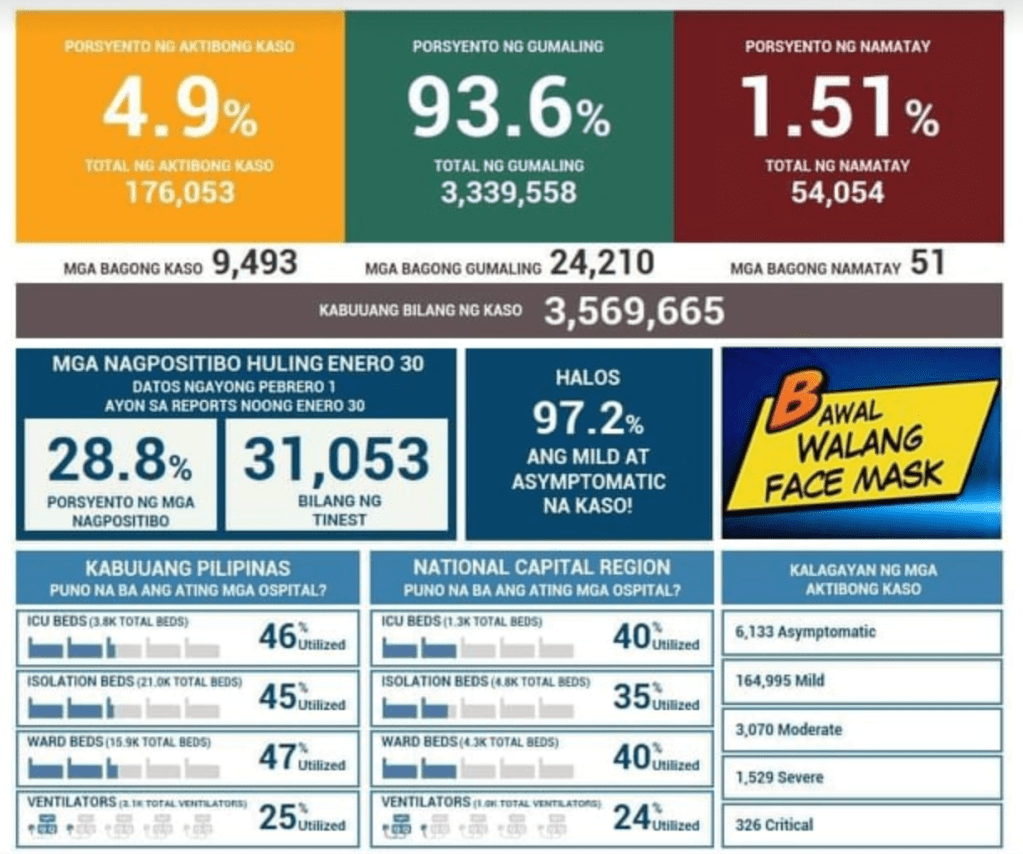
With a little more than 31,000 tests done last January 30 and a positivity of 28.8%, the Health Agency announces 9,493 new cases today. The last time the country reported more than 10,000 cases was January 5 (10,727 cases). With more recoveries today, the active cases drop to around 176,000 with 97.2% being mild or asymptomatic at the time of testing.
Healthcare utilization both nationally and in Mega Manila are at low risk (<50%).
There are 51 additional deaths today.
The NCR reported 1477 cases today (15.5%) led by Quezon City with 300 and the City of Manila with 209. The rest of the LGUs in Mega Manila had less than 200 cases.
Only one other region outside of NCR reported four digits – CALABARZON with 1165 cases. All other regions had triple or double digits. Even ROFs had only 29 positives today.
Nevertheless, more than 62% of the national cases are outside of NCR plus.
Tomorrow, NCR and 7 other areas in the Philippines shift to Alert Level 2.
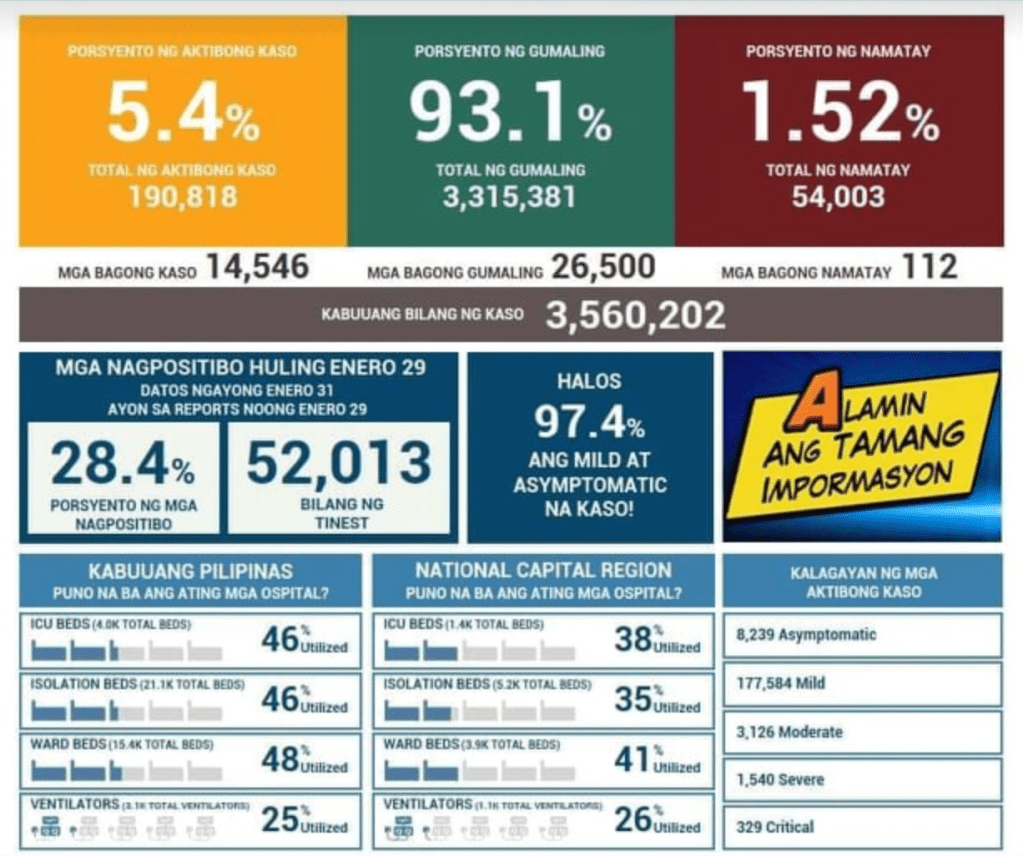
The Health Agency reports 14,546 new cases based on 52,013 tests with a positivity rate of 28.4% done last January 29. With more recoveries than active cases, the active cases drop to around 190,000 – 97.4% of who are asymptomatic or mild.
Healthcare utilization is now at low risk nationally and in the NCR (however, caution should be provided in interpreting this as applicable to every LGU as there may be some areas seeing high HCUR particularly in places that have lower vaccination coverage).
There are 112 deaths added today.
In a dramatic twist of numbers (with many backlogs from different areas), the NCR bounces back to lead with 4040 cases or 27% of the total numbers for the day. This is led by the City of Manila that has 861 cases and is the highest among all LGUs in the country. A close second is Quezon City with 838 new cases followed by Makati 334, Parañaque 263, Caloocan 240, Taguig 219 and Pasig 218. All other LGUs report less than 200 cases with a sprinkling reporting double digits. None had single digit numbers today.
Outside of NCR, only 4 regions had four digit numbers: CALABARZON 1644, Davao Region 1401 (with Davao City having 722 cases and is third highest among LGUs in the country for today), Central Luzon 1152, and Central Visayas 1029.
The shift in tide back to NCR the past days is bothersome as Mega Manila’s negative trend has flattened and there is no continuing sustained downtrend. Will shifting to Alert Level 2 in the midst of these high numbers be worth it so that we can celebrate the Chinese New Year and Valentine’s Day?
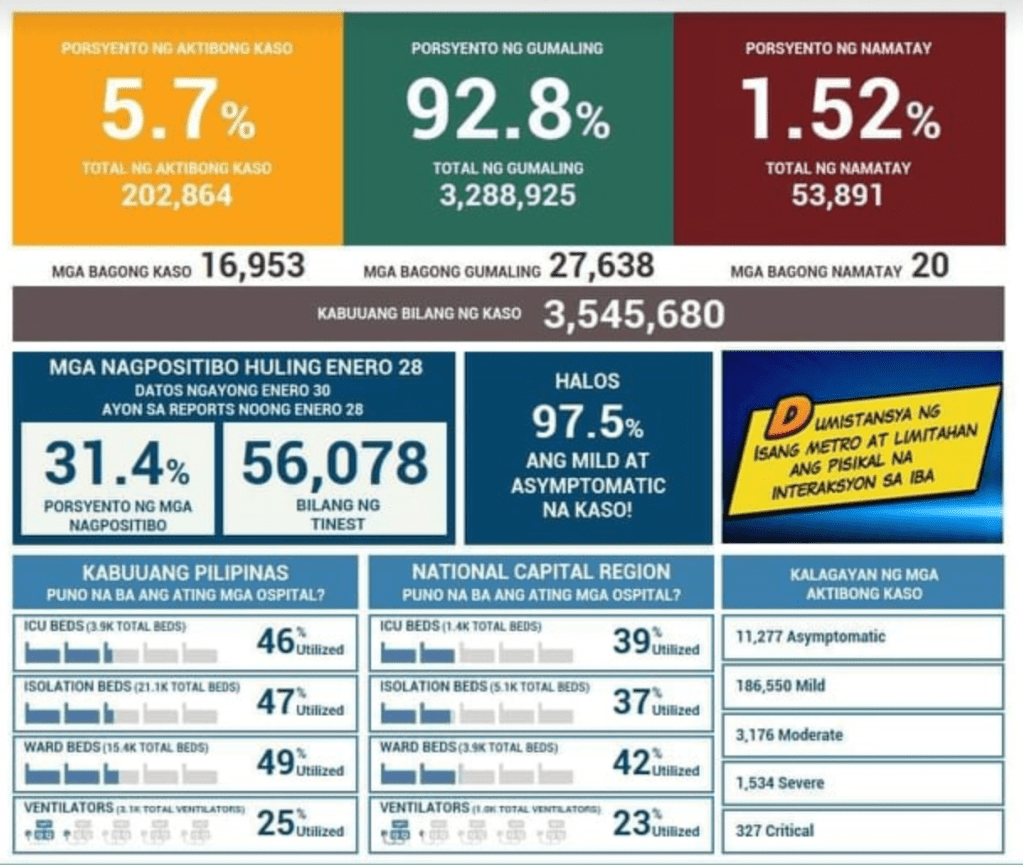
The weekend closes with late data coming in from the Health Agency with 16,953 new cases. Back in the previous surges, these numbers would have been catastrophic equivalent to ECQ or MECQ category. I recall back in March 2020, when we had only a handful of COVID-19 cases, the NCR was in total lockdown for 3 months. Now, with even 3000 cases in NCR, the government has declared Alert Level 2 just in time for the Chinese New Year and Valentine’s Day.
Today’s cases are based on more than 56,000 tests with a positivity rate of 31.4%, the latter being dragged due to the lower testing in the provinces outside of NCR. With more recoveries than cases, the active cases now drop to a little above 202,000.
Health care utilization in general is at low risk (but that is not true in many provinces because vaccination rate in other areas is still way below the target).
There are 20 added deaths today.
NCR led todays count with 2008 cases or 12% of the total shares in the country. Quezon City had 391 cases while the City of Manila came in second with 298. All other LGUs had less than 200 cases with 8 LGUs reporting double digits and Pateros reporting only 4 cases.
Outside of NCR, Region 6 led with most cases at 2003 followed by CALABARZON 1913, Davao Region 1466, Northern Mindanao 1224, Central Visayas 1202, Central Luzon 1056, and Ilocos Region 1040.
Among all LGUs in the country, Davao City had the most cases with 650.
——————-
From Prof. Guido David (OCTA Research), the risk levels for NCR and CALABARZON shows the rapid decline in the weekly cases as the ADAR dips as well. Notice that the positivity rate is much lever than the national average of 33.3% in NCR, Batangas, Cavite and Rizal. The drivers of testing include: number of testing facilities and the financial capacity of the people in the area. In addition, because of the mild presentation of majority of patients with Omicron, many forego testing and simply wait out the clinical symptoms. The positivity rate in Laguna is highest in these regions.
Reproduction rate is also lowest in NCR, while Healthcare utilization rate is low in all these areas.
THE WEEK IN REVIEW
We continue to track the pandemic in the Asian region and the one week interval has dramatically changed the landscape of an omicron surge.
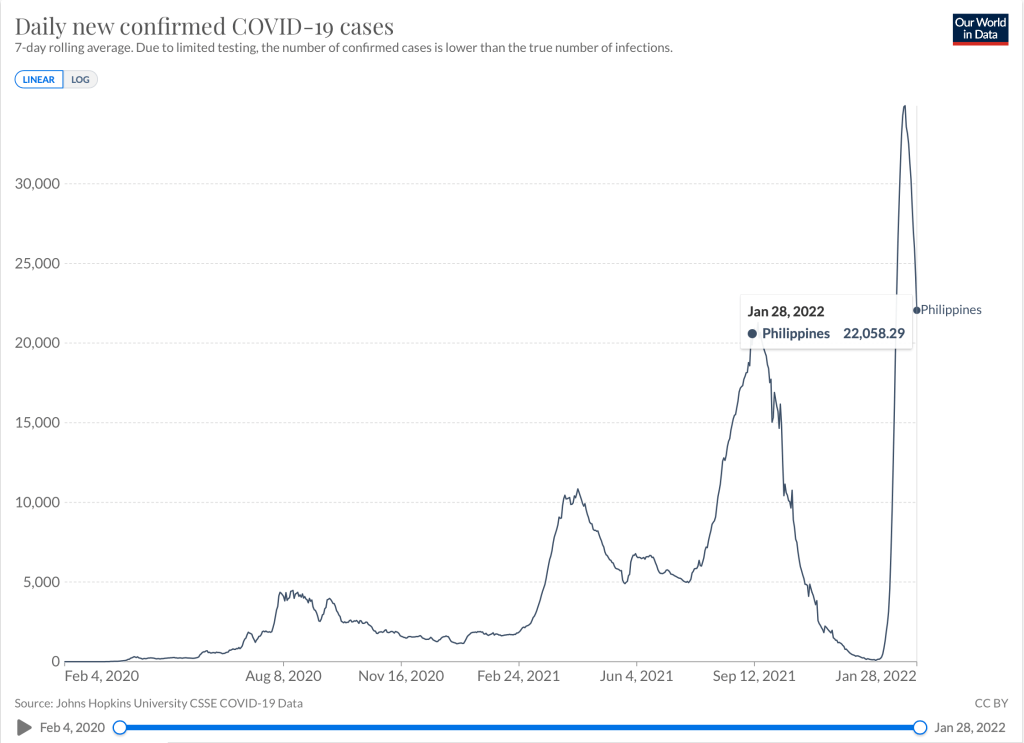
In the Philippines, as the needle rise of cases, the 7-day average of cases drop to 22000. While this is an under report (the country only counts cases with RT-PCR results from accredited laboratories, while Rapid Antigen Tests both self tested and laboratory or healthcare performed are not included), it represents a good sampling size of the graph of the surge.
The Department of Health has also confirmed that the National Capital Region plus (CALABARZON and Central Luzon) is seeing a marked decline in cases and the cases have now shifted to the provinces and other regions outside of these regions. More than 50% of testing facilities are located in these three regions alone. Which means that we may not be seeing the actual numbers of COVID-19 outside of NCR plus because of much lower testing (see infographic of OCTA Summary above).
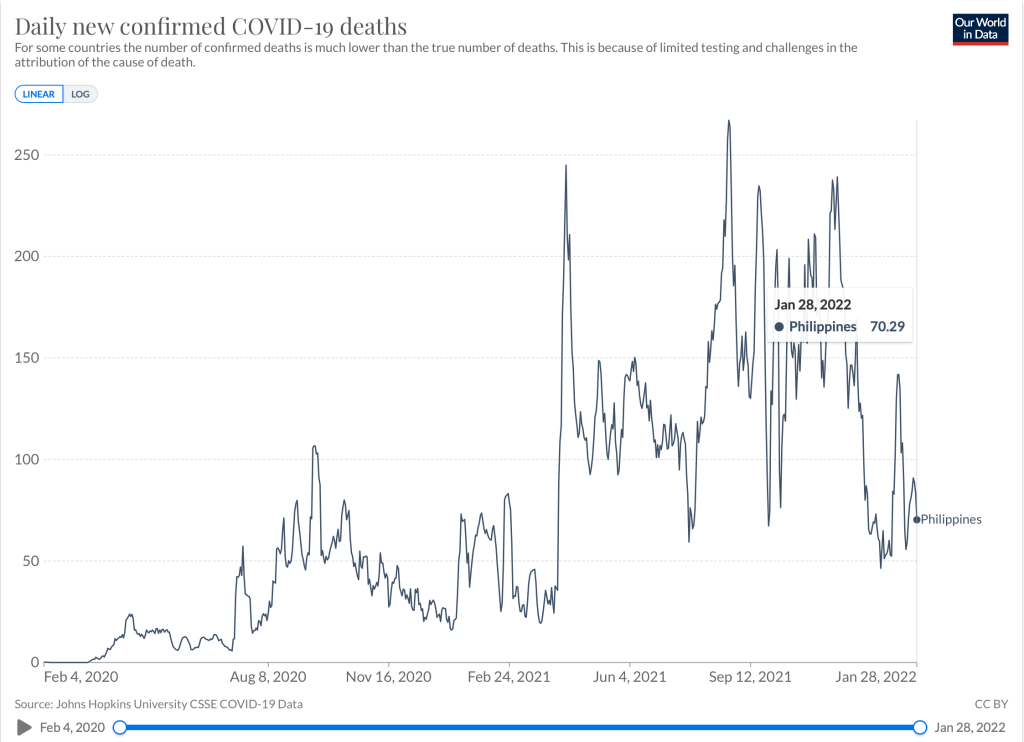
Deaths are late reports and while backlogs come in, the Philippines reports a 7-day average of 70 deaths, lower than the delta surge, but nevertheless still high because of the low vaccination in regions outside of NCR and Highly Urbanized Cities (HCUs) where the vaccine roll out is more organized and where vaccine acceptance is higher.
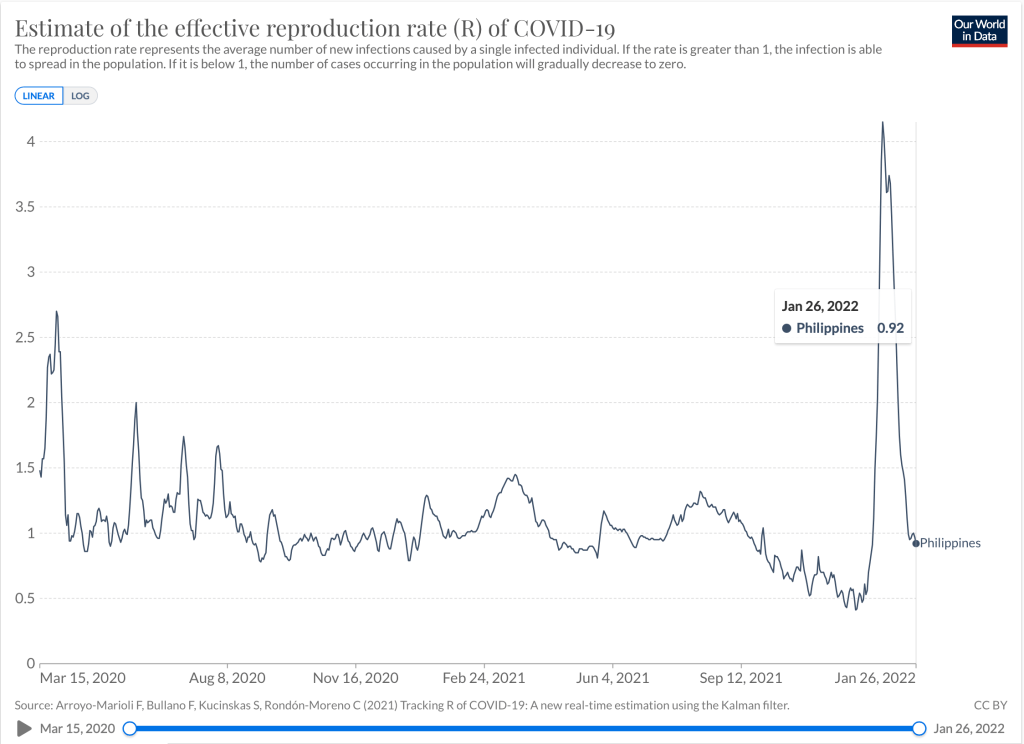
The reproduction rate of the Philippines is down to 0.92 (+/- 0.05). This means that the numbers have plateaued and we will continue to see a declining trend in the week to come. Hopefully, the government did not make a rash decision in transitioning to Alert Level 2 very quickly in NCR plus. Remember, the cases reported still have a very high positivity rate (>20%) because people are not testing anymore (or even if they are are not being counted because only RT-PCR results are counted by the government). This free-for-all concept may not capture the real number of cases in the epicenter of the Philippines, and is estimated to be even 8-10x the actual numbers reported by the government.
Of course, the argument there can be that with the shortened mild course of omicron, the decline in cases is also as rapid as its increase and before the PCR results are out, majority the cases would have recovered.
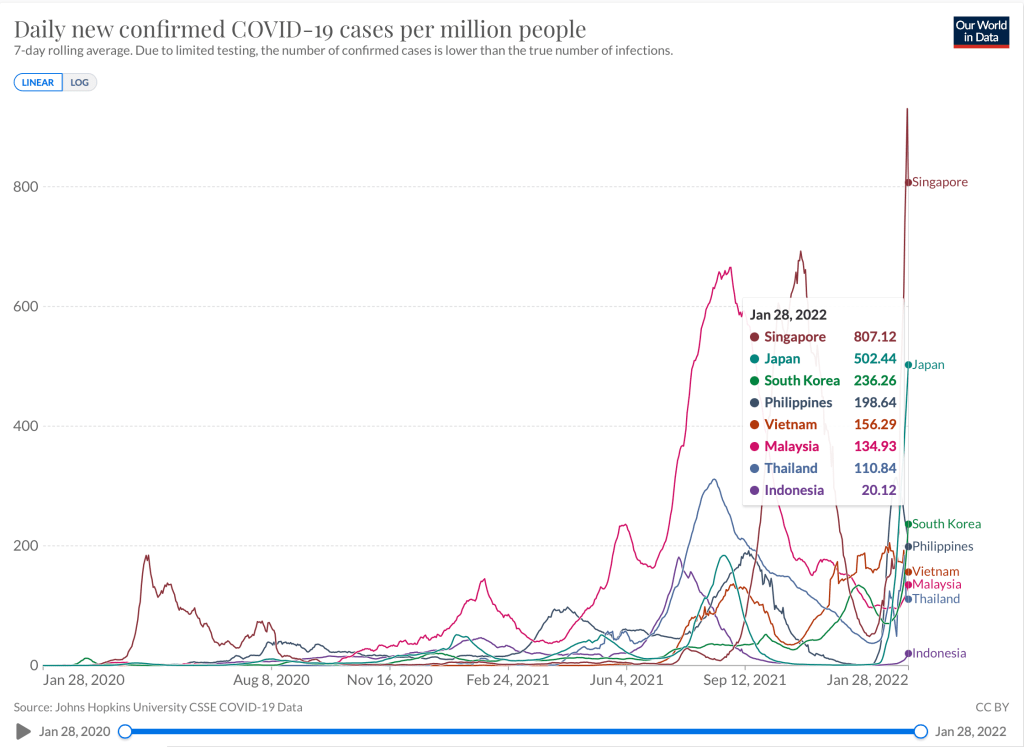
Compared to the other countries in Southeast Asia and select Asian nations (Japan and South Korea), the Reproduction rate is highest in Indonesia, followed by Singapore, South Korea and Japan for this week. These countries are seeing the nth wave (for example Japan is in its 5th wave) and, except for Indonesia, are seeing the highest numbers in the pandemic. With the Rt of Indonesia now at 2.33, the country prepares for an estimated 100,000 daily cases in the next week or two.
As reference, based on population size (per capita), it is Singapore that has an overwhelming number of cases at 807 followed by Japan, South Korea and the Philippines. Indonesia is at 20 per million population (>11,000 new daily cases) and at the bottom of the list, mainly due the sheer size of the people in the 4th most populous nation in the world.
How the upcoming week eventually evolves with the Chinese New Year on February 1 will be an interesting development particularly in Asia, where this is a major celebration .
While the world continues to average more than 3M daily cases, the Philippine numbers continue to plateau between 16,000-19,000 cases with the Health Agency announcing 17,382 new cases today from 56447 tests done and a positivity rate of 33.3% (or exactly 1 in every 3 being tested as testing positive).
Remember, these are still high case numbers considering that majority of them are coming from the provinces. A word of advice, if you are in NCR, avoid traveling to the provinces for now as testing in the provinces is extremely low (very high positivity rate in provincial areas due to lack of testing laboratories and many people do not even test because the symptoms are mostly mild).
Active cases are lower at 213,587 with close to 98% of them being mild or asymptomatic.
Health care utilization is at less than 50% in both the NCR and nationally.
There are 70 additional deaths today.
NCR grabs top spot and an increase in the total shares for the day with 3625 cases (20% of national total). Several LGUs had spike in cases with Quezon City leading with 688. City of Manila had 479, Parañaque 371, Makati with 328, Pasig 255, Las Piñas 247, Taguig 243, and Pasay City 218. All other LGUs in NCR report less than 200 cases, while Pateros is the lone LGU with single digit – 6 cases.
Outside of NCR, CALABARZON came in second with 2265 followed by Central Luzon with 1455 cases. Central Visayas had 1392, Davao Region 1362 (with Davao City recording 793 of the cases and the highest among all LGUs in the country for the day), and Ilocos Region with 1293. Other provinces saw less than 1000 cases but many continue to record more than 500 cases in spite of the very low testing and the high positivity rate (>50%) in these regions. This emphasizes that many individuals, especially in the provinces, are not testing anymore. It would be prudent if those from NCR avoided going to the provinces for awhile.
As the positivity rate remains relatively flat at 34.6% today from 62,671 tests done last January 26, the Health Agency announces 18,638 new cases. The past days has seen a declining trend of cases for the National Capital Region and the contiguous areas of CALABARZON and Central Luzon. However, this is being offset by increasing cases in the provinces. Unfortunately, because the bulk of testing facilities are in NCR plus, the positivity rate remains high nationally because we are under testing and it is highly likely that people in the provinces are not alarmed at the clinical presentation of Omicron.
With fewer recoveries than cases, the active cases are at a little more than 231,000 with close to 98% of them being asymptomatic. ICU utilization rate is at low risk both nationally and in Mega Manila.
There are 68 deaths added today.
CALABARZON led once more the numbers for the day with 2439 cases followed by the NCR with 2256. In NCR, Quezon City had 421 cases while Manila has 265. All the rest of the LGUs reported less than 200 cases with some reporting double digit numbers.
Other regions outside of NCR and CALABARZON that saw four digits were: Western Visayas 1981, Central Visayas 1959 (Cebu City owned 529 of the cases), Davao Region 1933 (Davao City owned 1114 of the cases and had the highest number of cases in any LGU in the country), Central Luzon 1446, and Northern Mindanao 1214.
The past 7 days, the NCR accounted for 15-17% of the total daily cases in the Philippines. That’s a large decline from what began as a 70-75% share of the national cases.
As the NCR (plus) see declining cases, the national cases ease a bit as well, since majority of tests and cases are from the NCR plus.
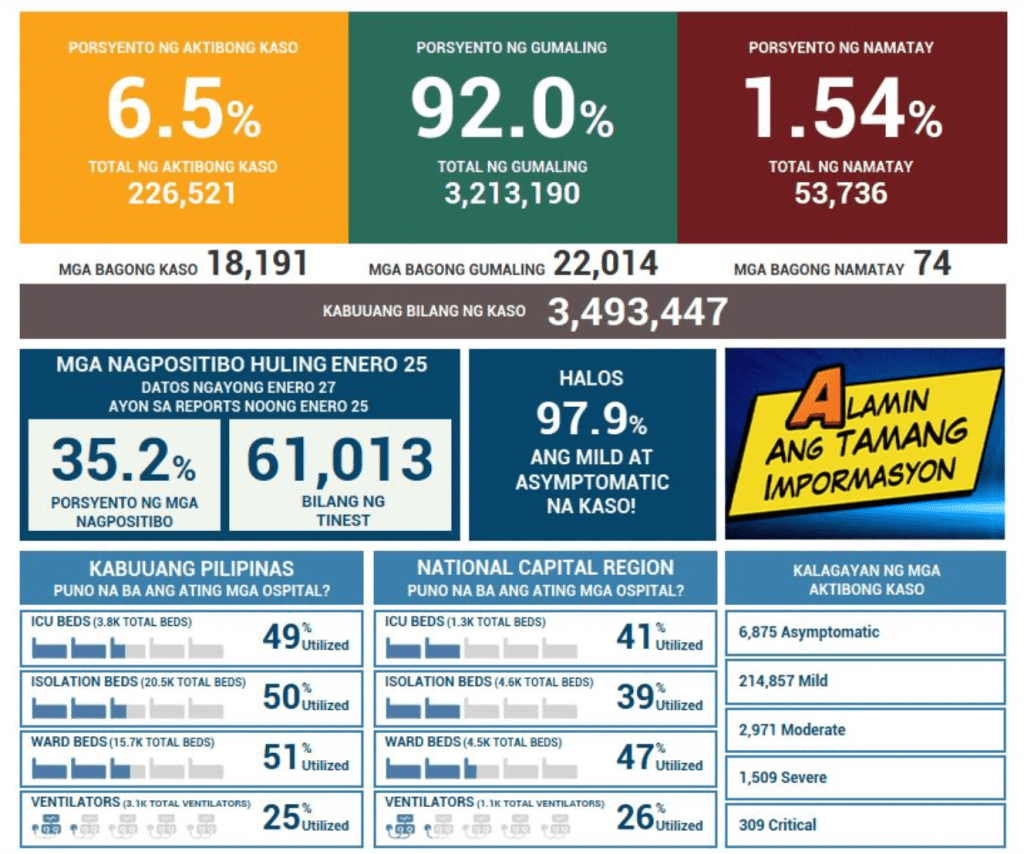
Today, the Health Agency announces 18,191 new cases based on more than 61,000 tests done with a positivity rate of 35.2% last January 25. As more recoveries are noted, the active cases are down to 226,521 with close to 98% being asymptomatic or mild.
Health care utilization in the NCR is at low risk, while it is at very low moderate risk nationally.
There are 74 deaths added today.
The good news is that the cases in NCR continue to decline with 2270 (12.5%) today. Quezon City led with 467 cases, but only 3 other LGUs in Mega Manila had more than 200 cases: City of Manila 255, Parañaque 225, and Makati 212. The rest has either less than that while several LGUs report double digit numbers.
Outside of NCR, even CALABARZON and Central Luzon are seeing a quick decline in cases, with Region IVA reporting 2162 and Region III 1477 cases today.
Elsewhere in the Philippines, the regions with four digit cases are now led by Davao Region 2022 (1054 in Davao City alone), Western Visayas 1634, Central Visayas 1541 (455 in Cebu City), CAR 1095, and Ilocos Region with 1136 cases. The data shows that the positivity rate is still high, not because of the NCR, but because there is lack of testing laboratories outside of the NCR plus and the fact that many of the presentation of the patients are mild (or even asymptomatic), there are quite a chunk that are most likely not being tested in the provinces.
With the NCR and Regions IVA and III seeing lower cases, the Health Agency announces 15,789 new cases based on 48,725 tests with 35.8% positivity last January 24. As more recoveries are announced, the number of active cases drop to 230,000. Close to 98% of the active cases are mild or asymptomatic.
Healthcare utilization in NCR is now at low risk as the numbers continue to slide, while it remains at over-all moderate risk in the country.
There are 66 deaths announced today.
CALABARZON continued its second day streak with most number of cases today with 2461. This was followed by NCR with 2455 (15.5%) cases. In Mega Manila, Quezon City kept the lead with 452 cases followed by Parañaque 294, Manila 271, Makati 244 and Pasig 201. All other LGUs had less than 200 cases.
Among all LGUs in the country, Davao City led with 570 cases or >50% of the 1031 cases in Davao Region.
Regions outside NCR and CALABARZON with four digits are: Central Luzon 1335, Western Visayas 1366, Central Visayas 1557, and Davao Region.
Among the ROFs (returning overseas Filipinos), 62 were reported to have COVID19.






 Relative Joy