How NCR plus affects the surge and the data for 01.24.2022

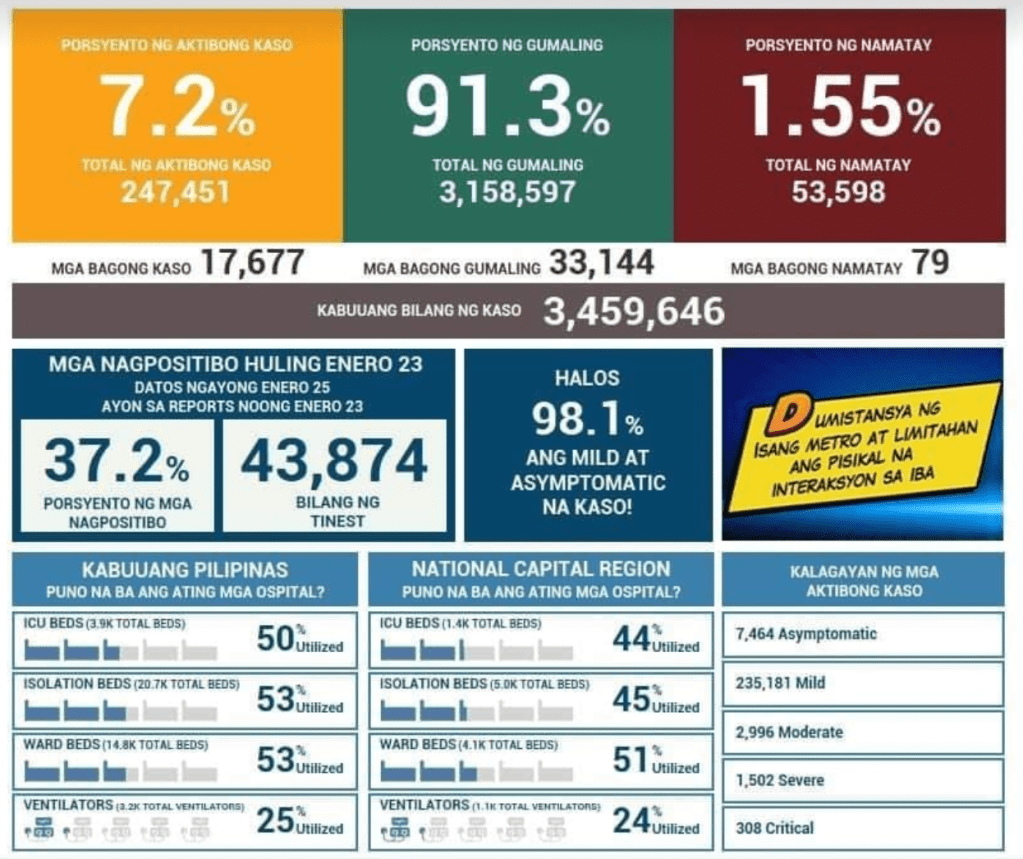
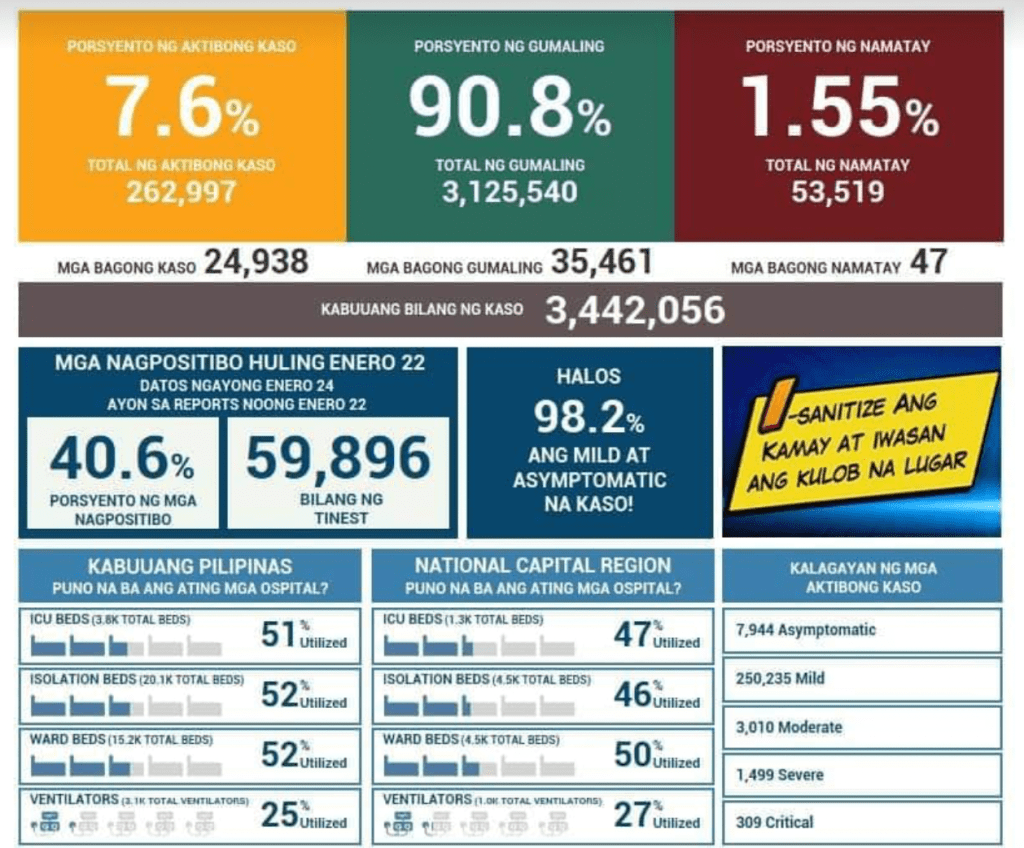
The Health Agency announces 24,938 new cases today based on a little less than 60,000 cases with a positivity rate of 40.6% on January 22. With more recoveries, the active cases drop to around 262,000 with more than 98% of them being asymptomatic or mild at the time of diagnosis.

Health care utilization remains moderate risk but at much lower levels than the last two weeks.

The lower positivity rate and lower health care utilization is due to the lower cases now in the National Capital Region (including CALABARZON and Central Luzon). This also accounts for the drop in positivity rate as the cases begin to recede in the epicenter. However, the rise of cases in the provinces continue and with less testing capacity and financial capability, there may be some disconnection in the testing and positivity rate in these areas. For now, we remain blind to the situation as the Department of Health has not had a regular daily data drop since January 15, 2022. Hopefully, as more people recover from quarantine or isolation status in the Health Agency, we will soon see more realistic numbers to make better projections.

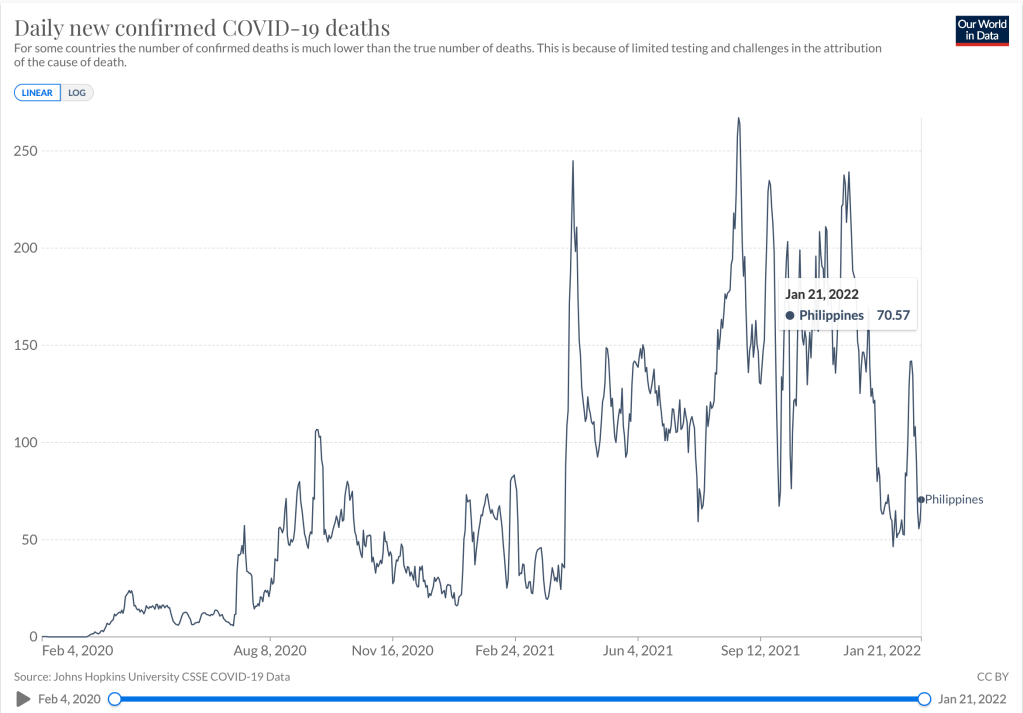
There are 47 added deaths today.

The NCR reports 4018 of the close to 25000 cases – or 16% of the cases in the country. Quezon City continued to lead the haul with 1030 cases but it was the cities of Las Piñas 353 and Muntinlupa 352 cases that came in second and third. Manila continued to see a dramatic decline in cases with 333 only reported today.

Outside of NCR, CALABARZON had 3469 and Central Luzon 2265 cases. NCR plus own less than 38% of the cases in the country.

Those seeing four digit numbers outside of NCR plus for the day are: CAR 1312, Ilocos Region 1938, Cagayan Valley 1632, Western Visayas 1501, Central Visayas 2588, Northern Mindanao 1012 and Davao Region 2292.

There are 104 ROFs that had positive results today.

———–

Outside of NCR, the following provinces have the highest levels of risk based on ADAR. Note that NCR, Cavite, Rizal and Bulacan are seeing negative one-week growth rates, but other provinces are seeing tremendous increases. Highest ADAR is Benguet with >101 per 100,000 population.

NCR and some contiguous provinces annexed to it saw the rise in their cases towards the end of December and spiked disproportionately at the start of the year. As the numbers gradually ease, the other provinces are now experiencing the same phenomenon.

Past 3.4M, the week in review and the data for 01.23.2022

The Health Agency reports 29,929 new cases based on 69,014 tests with a positivity rate of 41.8% last January 21. With more recoveries than active cases reported today, the active cases slide a little lower to 273,580 with more than 98% of them being mild.

Overall health care utilization is at moderate risk, noticeably lower in the National Capital Region than the national data.

There are 67 deaths added today.

NCR reported 5433 new cases today or 18.2% of the total cases in the country as the other provinces are seeing rapid increases in cases. Quezon City owned 1015 of the case and was the only LGU in NCR reporting quadruple numbers. The City of Manila had the most dramatic drop in this surge and reported only 483 cases today. Of 17 LGUs, Muntinlupa City owned 8.4% of the total share with 444 cases and is one of the LGUs with high ADAR and Rt when compared to other LGUs in NCR.

CALABARZON had 4317 and Central Luzon 2820 cases. Their cases, while in the 4-digits are slowing down like NCR.

Everywhere else, the numbers are up with Western Visayas 2573, Davao Region 2572, Central Visayas 2501, CAR 1911, Northern Mindanao 1144, and Ilocos Region 1021.

Davao City led among all LGUs with most cases in the Philippines for the day with 1831 cases or 71.2% of the total cases in Davao Region alone.

143 ROFs (returning Overseas Filipinos) were reported positive today.

————–

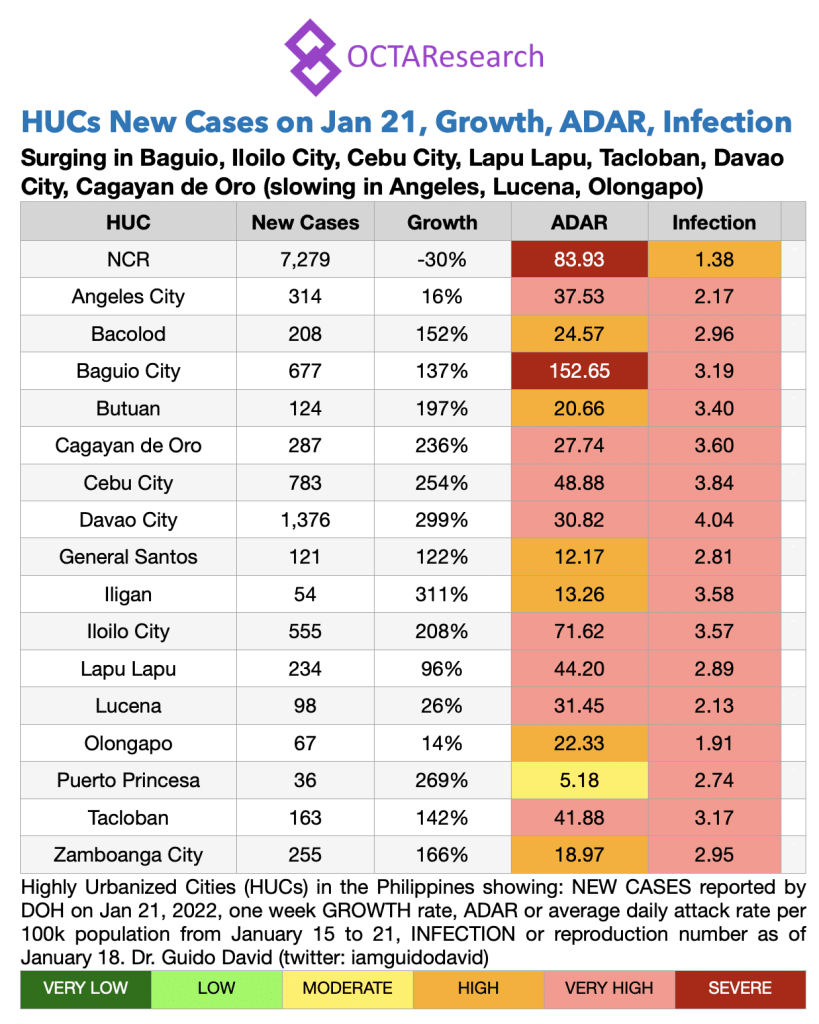
From Prof. Guido David, the highly urbanized cities in the Philippines with the highest cases are in the infographic provided below. Notice that all have positive growth over the past week, except for NCR which is seeing a negative decline in cases. (However, there are some LGUs in the NCR that remain at higher risk than others.) The Rt for NCR is now at high risk of 1.20 from a previous severe, while all other HUCs are at very high. The ADAR in Baguio City and Iloilo City is classified as severe risk. The ADAR in Mega Manila is now downgraded to very high risk from a previous severe the day before.

THE WEEK IN REVIEW

The numbers in the Philippines continue to pass the 30,000 mark. While the total cases in the epicenter, the National Capital Region slow down significantly, this nation of more than 7,600 islands is seeing higher cases outside of NCR and is offsetting the gains in Mega Manila.

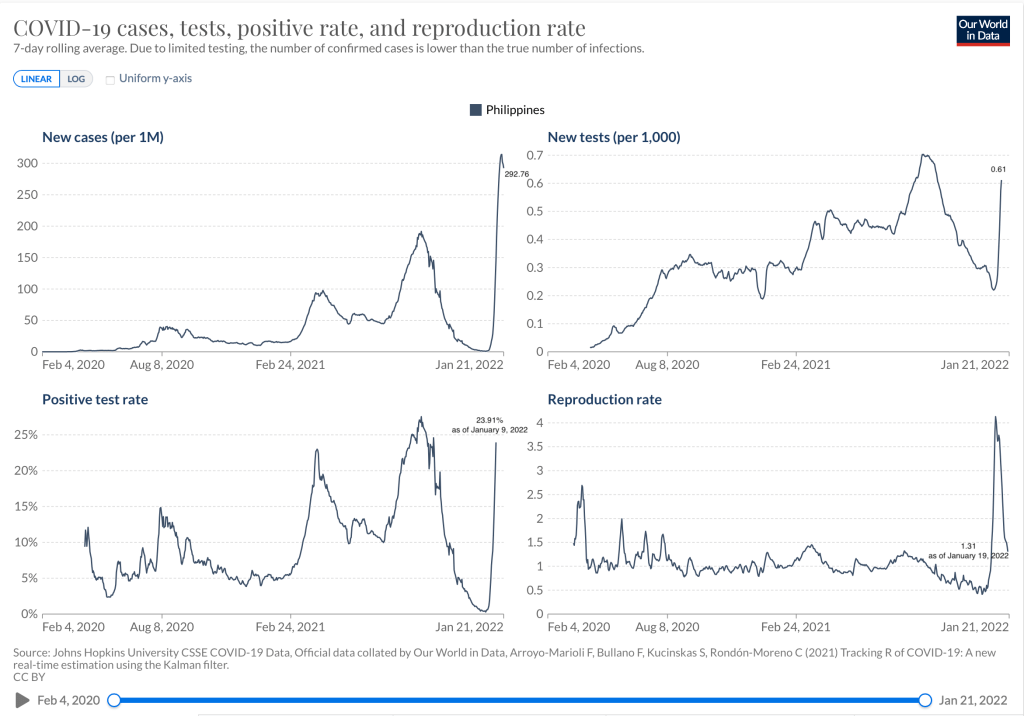
Notice that there is a slight downward trend, but not enough to say that the whole country has peaked. Local data above from OCTA Research shows that only the National Capital Region has slowed down in the Omicron surge, while the other provinces are seeing rising cases. Tests and positivity remain very high. As a matter of fact, positivity rate yesterday was at past 45% in the Philippines. This is disturbing because this can only mean that there are more cases, people may be testing (with rapid antigen) but the data is not being recorded by the Health Agency as the latter only records RT-PCR results.

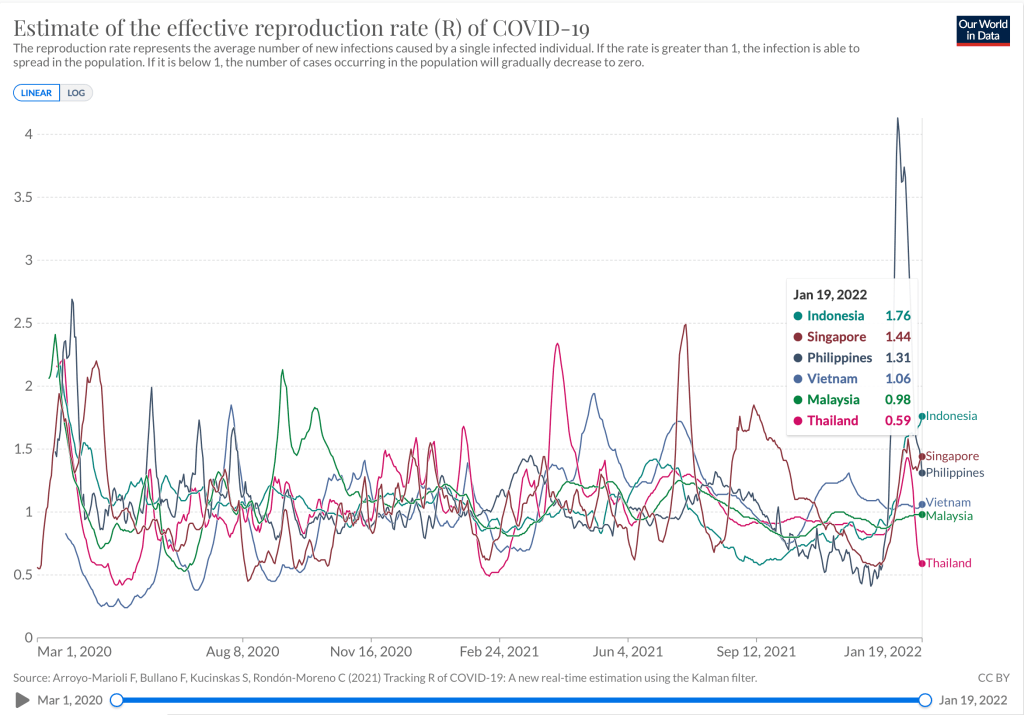
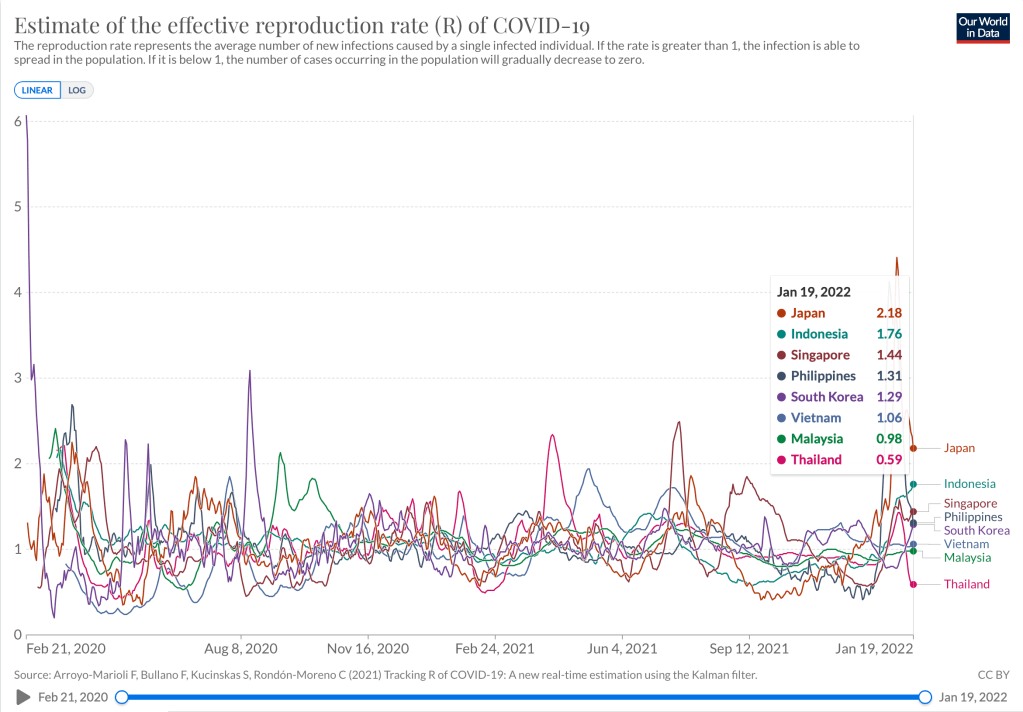
However, the Rt is down to 1.31 from a previous high of >4.0 at the first week of the year.

Elsewhere in Southeast Asia, the Rt of Indonesia is up at 1.76, and while it still is seeing relatively lower cases than other countries in the region, the data shows a trend towards an uptick in cases as it continued to report four digits over the past week, with 3,205 new cases yesterday. With the R continuing in an upward trajectory, as it braces for an Omicron surge. We need to monitor for this ongoing development in the fourth most populous nation in the world.

Singapore has the most cases per capita in the region, followed by the Philippines and Vietnam.

Around other Asian countries, it is Japan that is seeing a huge rise in cases as the R jumps past 2 and the number of cases came close to a record high of almost 50,000 cases yesterday. The prefecture of Tokyo, the most populous city in Japan reported a record of more than 11,000 cases in a single day yesterday, as the country of the rising sun struggles with the Omicron surge as well.
The war against Facebook

For those, who like me, share vetted information prior to posting, I find it biased on the side of Facebook bots and AI (well so much for artificial intelligence) to just provide punitive action on those that share valid and truthful information on their social media platform.

My recent tiff with Facebook was irritating. While it is a platform that allows a wider range of audience, many of the audiences, I have difficulty in filtering out those who are trolls and want to be ‘friends’ when they are not anywhere in my circle of ‘friends’.

The latest information dissed that was deleted by FB was related to the published article from https://www.science.org. The article, entitled ‘In rare cases coronavirus vaccines may cause Long Covid-like symptoms’ was flagged as FALSE INFORMATION. https://www.science.org/content/article/rare-cases-coronavirus-vaccines-may-cause-long-covid-symptoms?campaign_id=154&emc=edit_cb_20220121&instance_id=51008&nl=coronavirus-briefing&regi_id=93550402&segment_id=80443&te=1&user_id=b3e6cc78c87b77f94dea36964a9aa6a9

It’s actually an excellent read as I have had some people who have been vaccinated with mRNA vaccines and have had symptoms similar to Long-Covid. This article is careful in saying that it DOES NOT imply that vaccines are harmful, but advice regulators and manufacturers to make sure that these new vaccines, which have seen short and early clinical trials with no long term information, be judiciously monitored.

While advocates may think that this kind of information will throw off people into getting vaccinated, the intent of the article is to shed light into the other side of the spectrum. The unknown world of adverse events. After all, everyone in the scientific world knows that there is no such thing as a drug without a side effect.

The benefit risk of a vaccine, biological agent or even antiviral should be weighed with its purported risks because in the realm of medicine (and not the world of social media) – we must first DO NO HARM.

It is ironic for FB to call out this post as FALSE INFORMATION but refuses to flag in its own marketplace or posts of online sellers on fake and counterfeit medicines. It does not take a lot of AI to flag sales of prescription medicines. The law does not allow the sale of any prescription drug online. What more medicines or vaccines that have only Emergency Use Authorization (EUA) approval! FB administrators do not have to go far in looking for what can and what cannot be vetted by bots or whatever intelligence they have left.

They also cannot say that the reviews are taking time because they have less people doing the review at a time of a pandemic. It is important to remember that when you take out relevant information and tag it as false wrongly and quickly, you must also be able to defend from your end why it was false. The onus does not lie in the one who posted the vetted information, but on the social media platform that claimed and tagged it as a false one.

While it is true that all social media platforms are free – and you are free to join or leave – there is a level of accountability by both the ones who post and those who provide this platform.

That accountability applies to Facebook as well.

The owner is just as liable as the user.

The hot zones, a positivity rate of 45%and the data for 01.22.2022

The cases remain above the 30000 mark as the numbers in NCR decline but are being offset by the rise in cases outside of Mega Manila.

The Health Agency announces 30,552 new cases based on more than 68,000 individuals tests with a positivity rate of 45.1% last January 20. With more recoveries than new cases, the active cases slow down a tad to a little above 280,000. More than 98% of the active cases were mild or asymptomatic at the time of testing.

Health care utilization is still at moderate levels in the NCR but is declining, while in the general trend is slightly up nationally, as the surge moves outside of the epicenter.

Total deaths added today are 97.

The NCR accounted for 21.8% of today’s cases with 6646. The major contributors to Mega Manila are: Quezon City 1217, Taguig 736, Parañaque 596, Manila 576, and Muntinlupa City 544. All other LGUs reported less than 500 cases with several now reported double digits. All are reporting lower cases, except for Muntinlupa City which seems to be having problems in controlling the surge in a locality of around 500,000 people.

In regions outside of NCR, Region 4a reports 6373 cases while Central Luzon had 2876. Other regions with more than 1000 cases include: CAR 1134, Ilocos 1653, Cagayan Valley 1140, Western Visayas 2003, Central Visayas 2269, Davao Region 1552, and Northern Mindanao 1052.

Returning Overseas Filipinos reported 138 positive COVID19 cases.

——————

Prof. Guido David drills down the Highly Urbanized Cities in the Philippines in the midst of the Omicron surge. While NCR continues to have very high cases, its growth rate has considerably slowed down and is now on a negative trajectory. The Rt is down to 1.38, which means that, in spite of the RT-PCR only reports being churned by the Health Agency, there is an actual decline in cases with ADAR at 84 per 100,000 population. On the other hand, other cities are seeing a significant rise in numbers, especially Baguio City with an ADAR of 153 per 100,000 population and Davao City which saw 1,376 new cases yesterday, to lead among all LGUs in the country with an Rt or 4.04.

Provinces in the Philippines at very high risk based on ADAR are in the infographic below.

The see saw in regions and the data for 01.21.2022

The Health Agency reports 32,744 new cases today based on more than 75,000 tests done with a 44% positivity rate (still staggeringly high) on January 19. With only a little more than 16000 recoveries, this brings the active cases up to past 291,000 as more than 98% of them are mild or asymptomatic. The total cases will exceed 3.4M by Sunday as the provinces pour in with more cases now.

Hospital utilization rate is moderate risk but has shifted in burden to the provinces as the national HCUR exceeds or approaches that of the NCR.

Additional 156 deaths are reported today.

The NCR continued the declining streak as it recorded 7279 new cases (22% of the total cases) led by Quezon City with 1260 cases. The LGU with most cases for the day? Davao City which had 1376 cases while Davao Region reported 1726 cases.

CALABARZON is seeing a slight decline in cases as well with 6749 cases, while Central Luzon is still on a upward trajectory for cases at 4402. Other regions with high cases include: CAR 1376, Ilocos 1667, Central Visayas 1911, Western Visayas 1782. The remaining regions are seeing increasing cases which are off-setting the lowering of cases in the NCR, accounting for the high numbers seen in the country.

Returning Overseas Filipinos reported 145 positives.

——————-

From Prof. Guido David (with permission to share) are three infographics that provide a summary or snapshot on the current status of the pandemic.

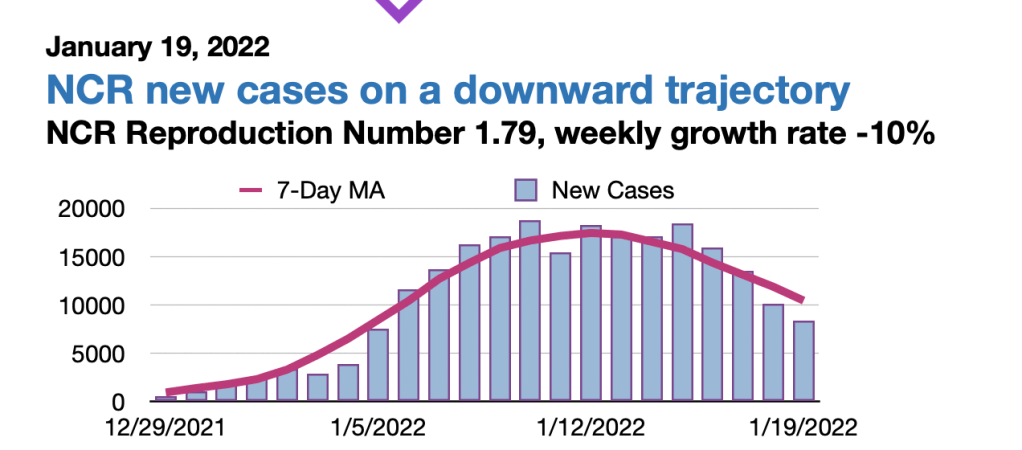
  1. The NCR weekly growth rate has a steady decline (although some LGUs are performing worse than the rest). The data should be treated with some caution as these DO NOT include lateral flow assays (Rapid Antigen Tests) and have limited data in children because many parents refuse to have their children tests.
  2. The projected trend using the current data for the NCR, which is the epicenter of this difficult surge.
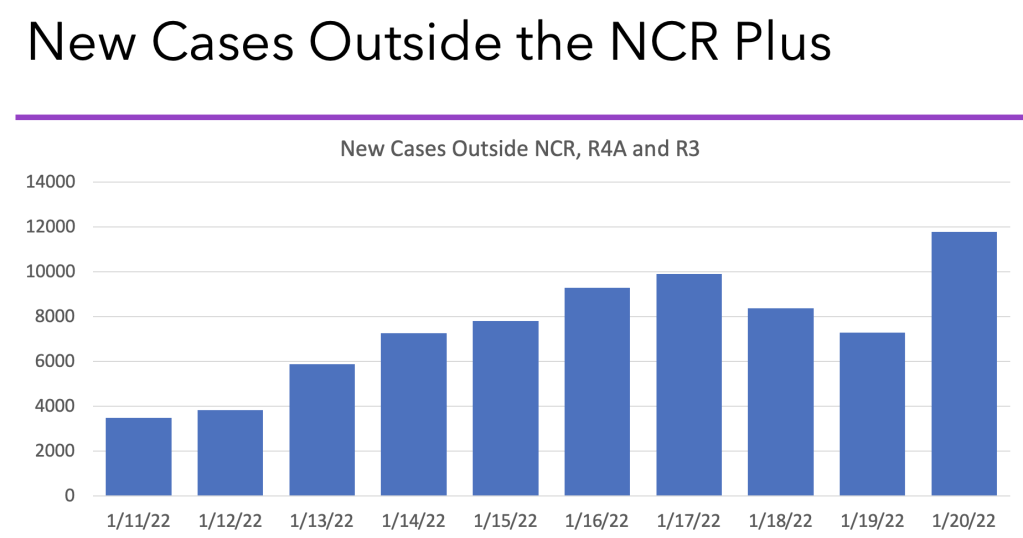
  3. The rise in cases outside of NCR, CALABARZON, and Central Luzon as the shift in cases is now in these regions. The problem with regions outside of NCR (plus) is that the vaccination rate is also lower and the healthcare systems in these areas may be less capacitated than within Mega Manila.

Past 3.3M COVID19 cases and the data for 01.20.2022

After two days of less than 30,000 cases, we are back at 31,139 new cases as announced by the Health Agency today. This is based on close to 74000 tests done with a positivity rate of 43.3% last January 18. Today’s numbers was enough to push the Philippines past the 3.3M mark and the active cases jump to more than 275,000 as there are more cases than recoveries reported.

The healthcare utilization is also up nationally compared to the National Capital Region, where the epicenter of the surge is.

There are 110 deaths added today.

The NCR owned for a lower percentage of the total cases with 9455 cases. This was led by Quezon City with 1639 cases and Taguig with 1126. The other cities with more than 500 cases include: Makati 811, City of Manila 772, Parañaque 692, Muntinlupa 583, Las Piñas 531, and Mandaluyong 511.

Regions outside of the NCR are seeing a higher share of the national cases now. CALABARZON leads with 7073 followed by Central Luzon with 2856 cases. Other regions with quadruple digits today are: Ilocos Region 1158, Cagayan 1014, Western Visayas 1772, Central Visayas 1704, and Davao Region 1066.

There are 127 ROFs (returning overseas foreigners) reported positive today.

From the plot provided by Prof. Guido David, the numbers in the NCR continue the gradual downward trajectory and while it is a slow one, one should not be complacent on the situation because Omicron still has room to infect others who have not been infected. YET.

The lower Wednesday (with backlog) and the data for 01.19.2022

Lower cases today than the previous day as the Health Agency reports 22,958 new cases and a large amount of recoveries to bring down the active cases to a little more than 270,000. More than 98% of the actives are asymptomatic or mild infections. With the additional cases, the PH will breach the 3.3M mark tomorrow.

Today’s report is based on 62,531 tests with a positivity rate of 43.5%.

Hospital utilization is still at moderate risk.

There are 82 additional deaths reported today.

The NCR had 8376 new cases today (or roughly 37% of the total cases in the country). This was led by Quezon City with 1835 cases and the only city with four digits. Makati came in second with 881, Parañaque in third with 673, Las Piñas in fourth with 666 and the city of Manila with a dramatic decline of 662 cases. Pasig had 505 cases today while the rest of the LGUs in NCR report less than 500 cases. Only Malabon had double digits with 82 cases.

Outside NCR, CALABARZON continued to lead with 5204 cases (Cavite 1813, Rizal 1266, Laguna 1135, Batangas 719, while the remaining are the other provinces). Central Luzon is in second with 2087 cases. In the Visayas, Western Visayas takes the lead with 1129 cases (dominated by Iloilo province) followed by Central Visayas with 1026 (dominated by Cebu City with 506 or almost half the cases today).

In Mindanao, Davao Region led with most cases by region with 468 cases (dominated by Davao City with 278 or more than half of the total).

There were 79 Returning Overseas Filipinos that were positive in today’s report.

Data from Prof. Guido David (you gotta give it to the guy who’s manually counting these with numbers because of the absence of the Data Drop upload) is shown in the infographic below.

Notice that the growth in NCR (while still increasing) has eased. The ADAR remains high at 111.47 per 100,000 population and the R has slowed down to a little more than 2.0.

The data, however, isn’t as rosy in the provinces and regions outside of the NCR where while the number of new cases may be small (compared to Mega Manila), their growth rates are disproportional and are seeing the same growth rate that NCR saw 3 weeks ago. They have only just begun.

The highest ADAR now belongs to Baguio City which also is seeing an R of 4.28.

Thank God for low Tuesdays and the data for 01.18.2022

It’s the low Tuesday with 28,471 new cases reported from the agency based on 51,738 tests with a positivity rate of 43.4% on January 16. There are more than 6000 backlog cases added to today’s numbers. With more recoveries than cases, the active cases dip a tad to 284,458 with more than 98% mild or asymptomatic.

Health care utilization remains at moderate risk.

There are 34 additional deaths today.

The National Capital Region accounted for 35.6% of the total cases today with 10,147 of the 28,471 total. While Quezon City continued to lead with 2008 cases, Taguig City came in second with 1120 cases and the City of Manila in third with 974. The dark horse that may likely displace these cities and is seeing a dramatic rise in cases is the city of Muntinlupa the recorded a high of 838 cases – mostly coming from the plush villages in the city.

Elsewhere outside of NCR, region IVA (CALABARZON) remained in second with 6914 cases followed by Central Luzon with 3028. Cagayan Valley reported 1206 cases, Central Visayas with 1121, and CAR with 1118. There are 114 ROFs with positive tests today.

37,070 to start the week and the data for 01.17.2022

This week begins with the Health Agency announcing 37,070 new cases based on 77,410 individuals tests with a positivity rate of 46% last January 15. In reality, there’s just about 35,000 cases today, but the testing backlogs had to get reported as well. And with the numbers today, the active case jump to almost 300,000 cases with around 98% of them as mild or asymptomatic at the time of swabbing.

Hospital utilization in terms of ward beds and ICU beds is at moderate risk both nationally and in the National Capital Region.

There are 23 additional deaths today.

The NCR seems to be accounting for a lower percentage of the cases from a previous staggering 70% of the total share to just 37% of the country’s share with 13,543 new cases today led by Quezon City with 2,842 cases, Pasig with 1400, and the City of Manila with 1,210.

Elsewhere, it is CALABARZON that is catching up to the share of the country’s total cases as it reports 9362 new cases today followed by Central Luzon with 4261. Other regions seeing new highs are: CAR (1438), Ilocos (1401), Central Visayas (1297) and Western Visayas (1225).

Worst in Southeast Asia and the data for 01.16.2022

It wasn’t really a very bad day as the Health Agency reports 37,154 new cases based on 81,381 tests with a positivity rate of 47.4%. As the recoveries comes in, the active cases are held slightly in check with more than 287,000 of them. Close to 98% are asymptomatic or mild.

With today’s additional cases, the Philippines now passes the 3.2M mark for total number of COVID-19 cases documented by RT-PCR as officially reported by the Department of Health.

In spite of the large number of daily cases, the hospital utilization rate is kept at moderate risk both nationally and in Mega Manila.

There are 50 added deaths today.

THE WEEK IN REVIEW

From hero to zero.

That’s the story of the COVID-19 pandemic in the Philippines. While some would say that it may not be fair to call out the government response as to how we got from a few hundred cases to innumerable cases and a positivity rate that has skyrocketed beyond the country’s testing capacity, let’s just call a spade a spade.

Were we unprepared? Most likely, complacency got the best of us. As December approached and we saw a dramatic decline in cases, we were all prepared to embrace a sense of normalcy once more. After all, it has been quite some time that we’ve been moving from plan A to plan B to plan C to plan D.

Of course, we can always shift the blame to Omicron, the inevitable variant of concern that is highly transmissible in more ways than one. But as a people, we were partly responsible for getting to where we are today. And that, is water under the bridge.

The Philippines landed 13th rank among nations in the world with most cases yesterday, January 15, 2022. In Southeast Asia, the first spot officially goes to our country. The needle-rise pattern of cases which began in the National Capital Region in the Philippines has been responsible for the fourth and dramatic surge in the country. With cases averaging close to 20,000 a day in Mega Manila (not counting those who do not undergo PCR, because the Department of Health only reports PCR confirmed cases), the testing facilities have backlogs of 2-3 days now.

During the first week of the month, NCR accounted for more than 70% of the cases in the country. Over the past days, it has declined to a little less than 50% of the total share. While that may be some good news, the bad news is that with rising numbers, the shift in cases is now in the regions outside of Mega Manila.

Like fire that burns in the center, the rampage now moves to the periphery.

The sad part is that, while the NCR has (according the the government) vaccine coverage of around 90% with at least one dose, this is not the same situation in the provinces and regions outside of imperial Manila. Vaccinating these more vulnerable sectors in the areas that have recently been hit by natural calamity will be extremely challenging as the virus rapidly expands to these areas much faster than the vaccination program of the government.