Honesty is such a lonely word

Singer and songwriter Billy Joel in the song entitled Honesty, writes the lyrics beautifully of a highly principled, ethical and moral dilemma.  While the whole song speaks about honesty in relationships related to love, the chorus talks about the quality of being honest and how lonely the word is.

Honesty is such a lonely word

Everyone is so untrue

Honesty is hardly ever heard

And mostly what I need from you

Some people purport “white lies” or “little lies” for fear of hurting others with the truth.  When a spade is called a spade, when the cruel reality is revealed in spite its consequences, honesty may sometimes hurt but will be appreciated much.

People often confuse honesty for truthfulness.

Honesty is about expressing your opinions and feelings accurately.  Truth is an accurate representation of reality. Both words don’t have to balance each other always. One can completely be honest yet be untruthful.

A schizophrenic can be honest about their fear of the ghost they see in the corner of their room every night.  The truth is, there’s nothing there.

When you are called by the principal of your child’s school because he beat up another child, and your kid says the other child “started the fight”, he’s being totally honest about his opinion.  The other child had called him out for being an ass, your kid got angry and hit his classmate with the algebra book on the face. But in reality, in truth, your child started the fist fight.  We usually will protect our offsprings and we won’t believe that our kid started the fight.  You can always say that your child was being honest. In truth, he started the fight.

Dr. Jeremy Sherman, writes in Psychology Today (Aug 1, 2018), about the difference between honesty and truth.  He emphasizes that the failure to recognise the difference leaves one exposed and gullible.

Gullibility is largely a product of failing to notice the difference between honest opinion and truth.  You may recognise the difference, but we’re all gullible in the company of people who share our honest opinions.

We’re much more likely to spot a fraud who disagrees with us than one who’s on the same page.  We’re much more likely to notice that honesty and truth are different when someone’s honest opinion conflicts with ours; but when someone’s feelings and opinions are just like ours, we’re both in touch with the truth. How could we not be? We both agree? That’s a consensus!

Why do we mistake honesty for truth when we’re on the same page? Because all tend to see ourselves as the standard for the truth about reality.  We assume we’re unbiased.  When we’re with like-minded people, they must be unbiased, too – in direct contact with the truth.

Thinking that we’re the unbiased measure of all truth is why more exes are diagnosed as narcissists by their former partners than there are true narcissists.  Their former partners assume that being loving and attentive to them is the true standard.  If someone fails by that “unbiased” standard, they must, in truth, be narcissists.

What Sherman writes about is the complicated truth.  Sadly, many see themselves as the measure of all things.  Everyone is suddenly a genius or a the gold standard of knowledge.  Anything that veers away from the standard of your opinion is biased.  Because you feel you’re the gold standard.

At any point in our lives, whether it is in the political arena or a battle of relationships and love or getting ahead in the business circle or academic honesty, it’s a fair reminder that you cannot expect loyalty from people who cannot even give you honesty.

It’s a paradigm shift that not many can handle. Ask the politician whose family is running for various positions in politics.  It’s like the story of the schizophrenic. He tells you to believe in his fantasies and fairy tales and empty promises, when in truth there is none.

If you want to be trusted, just be honest.

The teacher

Once upon a time, there was a teacher. She taught with passion. She made sure that the kids in the class would know the objectives of the lecture of the day. Would get to participate in the recitation. Would be able to submit assignments correctly and as scheduled. They all passed the exams with flying colors. Today, all her students are professionals from all walks of life. Doctors. Businessmen. Engineers. Lawyers. Architects. Actors. They all have one common root – the teacher.

I remember fondly some of my teachers who taught me many things. From learning to read and write, to being kind and upright. Even when they were tough on us, they also pointed us in the right direction. To who and what we are today.

They are, after all, our second parents who mold us when we’re students. Their passion is infectious. It’s not easy to be a teacher. Patience. Integrity. Honesty. They’re all virtues that make the student admire these unsung heroes. Their pay isn’t as much as the CEO. Their hours are not confined to class. They lug all those test papers back home and burn the midnight oil. The hours of preparing for classes are not paid by the school. Schools only pay them for physical presence in classrooms.

Then there’s the teacher that’s a cut above the rest. Not because of the selfies. Or their being friends on Facebook or Twitter. But because he or she is just a damn good teacher. These are the ones that are born to teach. To be mentors. To dedicate their lives to educating. And they don’t complain about the long hours or the bad pay.

But teaching isn’t confined to the four walls of a classroom. Even in the workplace, you will find a teacher who will inspire you to be the best.

They do it because they’re teachers.

The best teacher, after all, is making students who are better than them.

The master has come full circle when his pupil is now ready to become a master.

Messiah complex

Stephen Diamond, writes in Psychology Today (Sept. 29, 2014), about Messiah Syndrome and the psychology of terrorists.

We all have a “messiah complex” dwelling deep within.  But not everyone becomes completely possessed and grandiosely inflated by it.  The desire to redeem and “save the world”, when kept in check, can be a very positive force in life, motivating us to do good deeds and to leave the world a better place – if only infinitesimally – than when we came into it.

But when one has been chronically frustrated in realising this positive, creative potentiality, it remains stillborn in the unconscious, dissociated from the personality, rendering them highly susceptible to possession by the messiah complex.  This is especially true when the sense of self has been underdeveloped or weakened due to trauma and other early narcissistic wounding.

What is the messiah complex?

It’s a complex psychological state when a person believes that he or she is a saviour today or will be in the near future.  It is a state of mind in which an individual holds a belief that they are destined to be the saviour (otherwise called Christ or saviour complex).  

While the term ‘messiah complex’ is not addressed in the DSM (Diagnostic and Statistical Manual of Mental Disorders), the symptoms of people with a ‘messiah complex’ resemble those found in individuals who have grandiose delusions or delusions of grandeur.  This form of delusional belief is more commonly seen in patients with bipolar disorder and schizophrenia.

What is true is that we all have some form or degree of messianic complexes.  Because idealism should be a path normal people would take.

Vincent van Gogh even in his “abnormal state of mind” puts it well

Normality is a paved road: It’s comfortable to walk, but no flowers grow.

We live at a time where in spite (or despite) using advances in digital technology to propagate truth, our world is more confused.  Nonsense is being elevated on a pedestal. Personal gains and agenda are without a conscience any more.  And there will be those who with delusions of grandeur will promise the gullible a better world.  Not that it’s bad, but it can be wrong when it is impossible to give the sun and stars.

What better way to create a following than the make a situation as dire and as unsustainable as possible, and have some looney bin lead you all to hell?

Remember, all the people with messianic complexes are delusional. And there is no greater fool than the fool that is fooled by a fool.

A cup of hope

The other week when I was making rounds with my residents, we were discussing a patient who was the victim of a vehicular accident.

Prognosis was poor. Complications post surgery were multiple. Financial resources were scarce. What do patients or their relatives expect from their doctors? When faced with this dilemma, how do we arrive at a holistic approach at addressing this matter?

In medical school, we are taught the essentials of diagnosis and treatment. While bioethics is part of the theoretical considerations taught to us, placing this into practice is often forgotten. Until we are faced in real life with the dilemma in patient care.

As healers, we need to remember that it’s not only providing treatment to patients that are important. I tell my residents:

1. The patients expenses should always be taken into consideration. After all, it is not your money. And you have no right to spend it any way you want. Make sure that you approach the work-up based on the working diagnosis. Do a good history taking. Be sensitive to the needs of the patient and their family.

2. As medical students or those in training, don’t treat patients as training materials. Empathy, sympathy and genuine concern are the cornerstones of the good doctor. Remember: we are not god. Learn to touch their hearts more than their hands.

3. Sit down with them and discuss their illness. Everyone – whether they pay or are charity patients – deserve equal care and attention. Before prescribing, make sure that the patients need the medicine. If natural treatment is available (bed rest, water, fresh air, change in lifestyle), don’t prescribe medicines that are not superior to these.

4. Break it to them gently. Especially for those where the bad news will need comprehension and a bit more time to process, make sure you use terms that are understandable. Pause in between explanations and ask them if they understood and if they have additional questions.

5. Reassure them that you are with them in their road to recovery. Constantly update them on day-to-day changes. If you need to add tests, tell them why. Don’t be trigger happy requesting for unnecessary tests. Think before requesting. It’s not your money to spend. Imagine yourself as the patient. Always. How would you want your doctor to approach your illness?

6. During end of life issues, gather the family and explain in a language and words that they will understand. Provide them with clear options on both BENEFITS and RISKS on outcome. Place yourselves in their shoes and ask yourself, how will I want to hear the bad news?

7. And in our daily prayers, don’t forget the people we care for. Pray with them and for them. Adding a layer of faith by asking for spiritual guidance and enlightenment during these difficult times lighten the burden, and buys a cup of hope.

I get the point when patients or their relatives are taken aback when an unlikely diagnosis is heard. After all, no one is ready to look at death straight in the eyes.

Medicine after all provides every day with the possibility of a miracle.

Hippocrates said that

Wherever the art of medicine is loved, there is also a love of humanity.

Incidentally, the patient from the vehicular accident passed away. The family who was poor from the get go now has a mounting debt to settle. The party responsible for the “reckless imprudence” stopped providing funds to the victim.

We need to learn to let go…

because even at the throngs of death, there is dignity…

Even sad birds sing

Everyone’s life has a story.

It begins the day we’re born. More often than not, it’s the most joyous occasion to our parents.

Childhood are usually the best years of ones life. Carefree. Dependent. Wanting. Until we’re ready for school. And that’s when the first chapter begins.

School isn’t what it used to be. These days, you see the kids taking on so much assignments that you’d think your 4th grade son is taking a Master’s degree. You can hardly talk to them anymore. Maybe because we’re also too busy chasing our future or providing a roof over everyone’s head. Whatever the circumstances are, it’s not difficult to observe that a dysfunctional family has become a norm rather than an exception to the rule.

It’s because “life’s like that”.

But it isn’t.

Because there are pitstops in every journey of our life. Time to reflect o how we have lived, loved, laughed, cried. Being there for one another, not only during celebrations and victories, but during disappointments and sorrows will always be part of our stories.

Notice how quickly time has passed us by. How our children have quickly grown. How it’s impossible to turn back the hands of time. How many “what if’s” we’ve regretted.

Like autumn’s colors, our days take on a different hue. We wilt. We prepare for the cold of winter. Alone. Dreary.

For many of us, autumn is the second to our final pit stop in life. Nothing is too late. To live. To love. To laugh. To cry. To change. Because as long as we live, no dream is too late to change. No reconciliations too late to amend.

Only we can write the final chapter on how this story ends.

For even sad birds sing…

The beauty in kindness

One word that is so wanting nowadays.

Kindness is more than deeds. It is an attitude. An expression. A look. A touch. It is anything that lifts another person.

I’m writing this as an observation at the random posts we’ve shared in the last 30 days. There’s too much gore and hate and dislikes being pushed around. It’s like a doomsday prophecy. Sad. Dark. Bitter.

While I agree that social media has bordered to the point of irritation because people use it as a tool to peddle lies and fake news, we only worsen it by sharing it. It stirs the inner anger among us. It confuses our priorities and misdirects what we need to focus on. While it is true that we need to educate the misguided lot, sometimes not minding them at all is all it takes to put out the fire.

The beauty in kindness is found in each of us. No matter how dark our past or how difficult life is. There are stories of small, yet significant, victories in the world. The laughter and joy of life. The way life should be lived seeing rainbows after the worst storm.

We need to teach one another that sharing stories of love and kindness inspires us to be better human beings in an unkind world.

We can only conquer evil by doing good. And kindness repaid for the wrong that has been done melts even the hardened of hearts.

For beauty, after all is in the eyes of the beholder.

Background noise

Often times in our lives we’re too busy doing multiple things. Juggling from one chore to another becomes a handful. I guess the words “spread too thin” is an understatement for being too busy to even appreciate life.

The thing with being busy enough is that it makes us forget about depression and anxiety. Being too busy to even mind the daily worries. Oftentimes, we’re envious with people who don’t even care about anxiety.

In reality, all these “busy” events are but what I call background noises. We all understand the vicious cycle of working for the money. The career. The fame. But we all forget that the purpose for all these is to live a fulfilled life.

It’s ironic that there are many that see material things as the measure of success. Or popularity and going albeit, viral, as the measure of success. They’re background noise to true contentment.

Think about it. How much background noise is there in your life?

Almost

In the poetry of Nikita Gill, she writes in Tiny Stories part I…

Many things in our lives very nearly happen.  We almost made it in the last licensure exam.  We almost reached a million pesos in sales.  We almost hit the lotto. When we come very close to almost achieving our dream, and don’t make it, we end up being disappointed.

Because what was almost, did not happen.

There was the planning, the audition or preparation, the test, the anxiety and day dreaming, and then when it feels like it is within our grasp…we lose grip. And almost becomes a difficult word to swallow.

It is human to want. And human to feel despair, particularly when what you longed for never happened. Because almost felt palpably close to achievement.

And when everything ends abruptly, almost feels like an empty shell.

The story of truth and lie

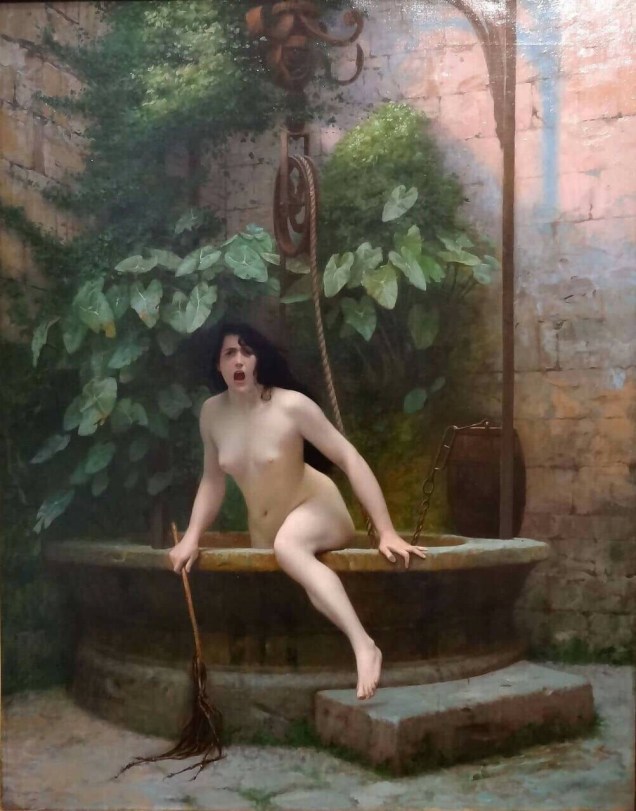
In 1896, French artist, Jean-Léon Gérôme painted La Vérité sorta time du puits armée de son martinet pour châtier l’humanité.

(Truth coming from the well armed with her whip to chastise mankind).

The painting was suggested to be an expression of Gérôme’s hostility to impressionist movement, to which he was violently opposed. The expression is a translation of the aphorism of the philosopher Democritus, “of truth we know nothing, for truth is in an abyss”. The nude model refers to the naked truth.

In the 19th century, there was a legend created based on the painting.

Truth and Lie meet one day. Lie tells truth that “it’s a beautiful day today”. Truth looks up to the skies and sighs. For truly, it was a beautiful day.

Truth and Lie spent the whole day together, exchanging stories and having fun. During their stroll, they reach a well. Lie tells Truth, “the water looks very nice. Let’s take a dip together.” Truth, once again suspicious, tests the water and discovers that indeed, it was very nice. They undress and start bathing.

Suddenly, Lie jumps out of the well and puts on the clothes of Truth and runs away. The furious Truth comes out of the well and runs everywhere to find Lie so she could get her clothes back.

The World, seeing Truth all naked, turns it’s gaze away, with contempt and rage.

The poor Truth returns to the well and disappears forever, hiding therein, it’s shame.

Since then, Lie has traveled the world dressed as Truth, satisfying the needs of society, because the World, in any case, harbors no wish at all to meet the Naked Truth.

According to Gérôme’s biographer, Charles Moreau-Vauthier, Gérôme slept with this painting above his bed and was found after his death with his arm stretched towards it, in a gesture of farewell.

Since 1978, it has been part of a permanent exhibition at the Museé Anne de Beaujeu in Moulins, France.

(Thank you to my classmate Noel Tanglao for posting this story in our Viber group. This is a modified version.)

The attitude

Dr Shirard Adiviso and the Development Team of Asian Hospital recently gave me a book entitled “How High Will You Climb?” by John C. Maxwell.

I had a little time to read this 160pp book during my short travel for a speaking engagement. It’s a highly engaging read and one of the highlights of the book is on attitude.

That inward feeling expressed by behavior. It can be seen without even having to utter a word. As Maxwell put it well, “of all the things we wear, our expressions are the most important.”

The next few blogs will center on a few good points about attitude that I’m sharing with you.  One of the important axioms of attitude lies in what Maxwell points out as: Our attitude can turn our problems into blessings.

In Awake, My Heart, my friend J. Sidlow Baxter writes, “What is the difference between an obstacle and an opportunity?  Our attitude toward it.  Every opportunity has a difficulty, and every difficulty has an opportunity.”

When confronted with a difficult situation, a person with an outstanding attitude makes the best of it while he gets the worse of it.  Life can be likened to a grindstone.  Whether it grinds you down or polishes you depends on what you are made of.

Few people knew Abraham Lincoln until the great weight of the Civil War showed his character.  Robinson Crusoe was written in prison.  John Bunyan wrote Pilgrim’s Progress in the Bedford jail.  Sir Walter Raleigh wrote The History of the World during a thirteen-year imprisonment.  Luther translated the Bible while confined in the castle of Wartburg.  Beethoven was almost totally deaf and burdened with sorrow when he produced his greatest works.

When God wants to educate a man, He does not send him to the school of graces but to the school of necessities.  Through the pit and the dungeon, Joseph came to the throne.  Moses tended sheep in the desert before God called him for service.  Peter, humbled and broken by his denial of Christ, heeded the command to “Feed My sheep”.

Great leaders emerge when crises occur.  In the lives of people who achieve, terrible troubles force them to rise above the commonplace.  Not only do they find the answers, but they discover a tremendous power within themselves.  Like a groundswell far out in the ocean, this force within explodes into a mighty wave when circumstances seem to overcome.  Then out steps the athlete, the author, the statesman, the scientist, or the businessman. David Sarnoff said, “There is plenty of security in the cemetery.  I long for opportunity.”

Today, at the crossroads of the economy and politics in the Philippines, we need to make sure that we keep our integrity and principles in serving the people.

The lost. The least. The last.

We need to make sure that our attitude is one where it is not self-serving.  Like the plane that takes off against the wind, where the turbulence is part of the climb, the noise we hear and feel are just part of the political climate.

We cannot (and should not) mix politics with personal gains.  In the end, a nation of hungry people creates masses that are discontented with governance and will pay a price dearly. At what cost is human life worth?

It’s all in the attitude.