Mobile phone etiquette #PetPeeveStories

We all have one (or two or more) mobile phones. Most have the latest models. And in spite of the billions of mobile phones in the world, mobile phone etiquette is understated. It’s irritating to see how people (including me) have pet peeves on others who don’t seem to observe respectful behavior when using a mobile phone. In an age where smartphones are the rule than the exception, here are a few reminders on cellphone etiquette.
1. Texting and sharing

Avoid sending too many messages without getting a reply from the initial message you sent. And try to make sure that you read back what you text and check who you’re sending your message to before pressing send. Texting several messages in a row makes you seem needy.

K, LOL, GTG…and other acronyms should be avoided. There’s auto correct. Avoid using acronyms especially if only you can understand. Besides, it’s not cool. It makes you look ignorant at spelling.

When you’re in a group thread, be mindful of the sentiments of the group. You cannot just point what you wish. Jokes, prayers, daily rants, food posts, personal events – should be in a separate thread. There are group threads that are “official” and serve for announcement of work, information or group related activities. Being sensitive to other people is basic etiquette.

When texting, don’t text or email with ALL CAPS ON. Nobody likes being shouted at.

Don’t send “round robin” chain messages. It’s irritating and seriously, if chain messages were true, the devil would have died long time ago.

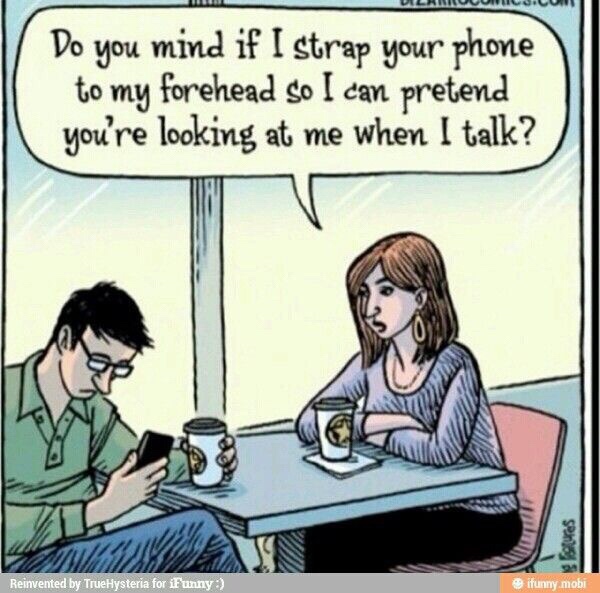
2. Look at the face not the phone

When we are with people, it’s important that we look at their face when talking to them and NOT the phone. It’s highly inappropriate that you’re staring at the phone during a conversation, a conference or meeting.

3. Silence should be observed

Keep your phone in silent mode during times that will require silence – at church, in meetings, during a conference, in the movie house, concerts, libraries, funerals. For your information, they’re universal quiet zones. It’s irritating to hear blaring Voltes V or Mission Impossible ring tones at these places.

4. Inappropriate

Don’t leave phones on dinner or dining tables. It’s a sign of expecting a call and hurrying up the party you’re dining with. It’s rude.

Don’t make a waiting or service staff wait for you to finish your conversation. When you’re in a group meeting or party and receive a call, be excused, step out of the meeting, and take the call outside. Not everyone has to hear how you closed a billion pero deal.

Watch the volume of your speaking voice. You don’t have to scream when talking. If you can’t hear the other party, it must be the connection is choppy, the volume of your phone is low, or you’re tone deaf. If you’re fighting with the other party, go out of the room and scream at the top of your voice in private. We don’t have to listen to your sh*t.

And if your kids are playing games, turn the volume down. Everyone doesn’t have to hear those irritating repetitive sounds. When you’re in a restaurant, it’s irritating to have a child watching in full volume, her fave movie. Get her a headset.

Remember, being considerate of others particularly in public mandates us to learn phone etiquette.


@the restaurant #PetPeeveStories

If there’s anything any of us love to do, it’s to eat. While you can eat in your underwear or slippers or with your feet up on the chair at your home, you can’t do the same in a restaurant. Whether it is a fast food joint, casual or formal dining, there are rules on proper behaviour in a restaurant.

1. Psssttt…waiter

Nowadays, most restaurants have nameplates for their crew. That’s so that you can call them by their nicknames. It makes it less degrading than hollering waiter or waitress. That’s what the nameplate is there for!

And I cannot stand this Filipino habit of grabbing someone’s attention by pouting his lips and making the sound “psssttt” to call a waiter (or anyone for that matter). It is humiliating and rude.

Wait for the server to approach you. They usually introduce themselves and REMEMBER their name!! It is good practice to make sure that when you need anything again, you don’t just drag any other waiter or say “psssttt”. That’s the reason why in the restaurant they start off with: “Hi! I’m (name of server) and how are you guys doing today? I’ll be your server. Here’s the menu. Can I start you off with some drinks? If there’s anything you’ll need, just let me know. Again, my name is (—) and I’ll be your server today”.

2. Who pays the tab?

When friends decide to go out for a meal and some drinks, it’s usually “dutch”. Which means, you pay what your order.

When someone INVITES you to a meal, the HOST always pays the bill (regardless of gender). Don’t invite people to a meal and expect them to pay for it. After all, it is good etiquette that whoever invites you, foots the tab. Hence, if you say, “you guys want to go grab a bite to eat?”, then expect to pay for that meal! If you want to make it clear that each one pays his own meal, say it so from the get go. If you don’t say anything, remember the rule – HE WHO INVITES, PAYS FOR THE MEAL!

3. BMW rule

When you’re at a formal dining event and you encounter all those cutleries and glassware on the table, a lot of us are flabbergasted because we don’t know how to go about this setting.

Rule of thumb is BMW – Bread, Meal and Water.

The left side of the table is the bread and butter plate. In the middle is the meal. At the right side is the water glass.

When there are multiple cutleries, use the utensils on the farthest end and work going towards the middle plate as the meals are served.

4. Bags and groceries off the table

Even if your bag is a Hérmes or Prada, no bags on the table please. Social climbers with no etiquette do this to show off. It’s a distraction and you shouldn’t actually be mixing books, cellphones, keys, gadgets and groceries on the dining table. If food or water gets spilled on it, your throwing a fit won’t help because in reality, only food and drinks served should be on the table.

In finer restaurants, they offer seats for your delicate LVs or other branded handbags and smaller items. Others have hooks under the table for your carry on bags.

5. Pass the salt PLEASE

When you need something that’s not within your reach, ask your companion to kindly pass the food or utensil or container or whatever! Don’t reach out for it by stretching out your arm in front of other people especially when they’re all trying to stuff food into their mouth already.

6. Chew with your mouth closed

Proper decorum dictates that we don’t make a lot of noise when we eat. Unless of course the restaurant is themed for that purpose. Many Chinese, Japanese and Korean restaurants have food (usually broth) that’s best eaten with a slurping and chomping sound so that it’s authentically “appreciated”.

As a general rule, however, don’t chew with your mouth open. You are not a monkey.

7. Food from plate to face NOT face to plate

Bring your food to your mouth. That’s correct. When eating, the direction should be from plate to face. Lean back and enjoy the meal by picking up the food with the utensils (or hands) and bringing it to your mouth. Never put your face into the plate. Only four-legged animals do that.

8. When to bring the kids

Unless your children have mastered good manners and proper conduct and can behave in a restaurant, you may want to keep them in a leash at a fast food joint or a family-themed casual restaurant. Fine dining is not appropriate for children who cannot observe the rules. Why people go to a more upscale restaurants is not only the ambience and the food, but the privacy and quietness of the environment. It doesn’t matter if you can buy the restaurant. If your children are uncouth, have no table manners and misbehave – you’re not welcome in these establishments. And when people being to stare at you and your children while they’re horsing around, you deserve the dressing down with the gazes from the crowd.

9. The napkin is not a tissue paper

Table napkins serve the purpose of cleaning your mouth when food comes in contact with the surrounding area. When you have snot, or a bad cold or allergy, and need to blow out all that mucus, for God’s sake, excuse yourself from the table, stand up, and go to the bathroom and use the tissue paper there. And don’t forget to wash your hands before returning to the table.

10. Breaking bread

Use your hands when breaking any form of bread. Even if you have to knead it slowly, use your hands. Don’t pick up the butter knife and attempt to slice open the bread using the butter knife or any other knives on the table.

I’ve left a nice poster reminder here for additional etiquette and manners when you’re dining alone or with your friends. Remember, while you pay to enjoy the meal, so do others. If you want to eat like a slob, do it within the confines of your home. Order a take out.

The five senses #PetPeeveStories

There are five senses – sight, sound, smell, touch, and taste. Not everyone though may have all these senses intact either because of an underlying medical condition or selective loss of faculties.

For example, newborns are unable to see the human face well. At birth the normal term infant has a vision of 20/200 to 20/400. That’s why the best distance for gazing into your bundle of joy is around 8-12 inches away. Because they are nearsighted, anything further than that is a blur.

Unless you’re a newborn or literally blind, please use your eyes to look for things and not your mouth.

I’m sure you’re familiar with this conversation:

Boy: Mom where is my pen? (Talking while he’s busy on the iPad)

Mom: On your table

Boy: Which table mom? (Still busy on the iPad)

Mom: If your pen can walk to you, it would. Use your eyes and not your mouth. You’ll never find it using your mouth!

The sense of smell is the most sensitive. Anosmia is the loss (total or partial) of the sense of smell. It can be temporary or permanent. The most common cause is nasal congestion from allergies, a cold or infection. But nasal polyps, cancerous growths, head injuries or neurological problems are diseases that can cause anosmia.

You notice how people have bad hygiene and they still can’t tell they smell awful? Unless you’re into pungent odour or have anosmia, be mindful that the greater majority have a healthy sense of smell.

Those who get off with stinky smell (and I mean literally in an erotic way) should know that it is a manifestation of benign masochism.

Halitosis (bad breath) is my ultimate pet peeve. I cannot, for the very heart of me, stand having to breath or eat at the same time talk to someone who’s breath smells bad. Really bad.

How do you tell someone that he/she has body odour or bad breath without necessarily offending him/her?

Tough question? These tips may help:

1. Drop some hints (I think my breath smells terrible. I’ll have some water. Or offer some breath aids – here have a gum. If he turns it down, say, I insist!)

2. Be direct (Filipinos aren’t good at this. We’re usually onion skinned and think it will offend people.). In general, the closer you are to the person, the more direct you should be. Don’t broadcast it all over the dining table. You can whisper it to him/her or discuss the issue in private. Even people with odorous problems have feelings.

3. Say it anonymously (like leaving a kind note or email or ask someone else to do it for you).

For the good of the environment, people with hygiene problems must be told they have. After all, we’re breathing the same air and are entitled to a “healthy” environment as well.

When you’re hard of hearing it can only mean that you’re probably deaf (partially or totally) or just don’t want to listen. Big difference there. Appreciating sounds is appreciating life.

When the sense of sound is obstructed at an early age (say the child had meningitis at birth which affected the sense of hearing because of complications), their neurodevelopmental milestones particularly adaptive and language skills are the most impaired. Then there is, of course, having renal diseases. Toxins that damage the kidneys affect blood vessels and the inner ear. That is why people who have chronic renal problems have audiologic problems as well. The elderly is another group who are hard of hearing.

Aging and loss of hearing is a phenomenon called presbycusis (or age-related hearing loss).

Hearing disorders are not uncommon. Rustling leaves are heard at 20 db. Bird calls and library whispers are at 40 db. Normal speech is 60 db. A lawn mower sound is around 90 db. A concert is about 120 db. Painful damage to the ear occurs at 140 db. As a general rule, sounds above 85 db are harmful. Imagine someone with a headset and those of us in a crowded noisy train can hear your music. You must be deaf!

And those people who pretend to not hear?

I don’t even understand why there are people who have a headset at work. No offense meant here but you don’t stick two plugs into your ear and say “excuse me” and point to the earplugs when someone at work calls your attention or asks you a question.

Tactile sensations are due to the nerve supplies in our body. Somatosensory senses are scattered all over the body on our skin. With this intact, we can feel cold, heat, pain and pressure.

The pathways for processing touch are separate. Because of this, the physical sensation of pain can be separated from its emotional impact. And the pleasurable aspect of touch can be removed from the actual sensation. Losing the sense of touch is called anaphia. In daily parlance, we call it numbness.

Figuratively (or even literally) there are those who are thick skinned. They are numbed and callous to other people’s feelings. To say they have no feelings is an insult to someone who suffers from anaphia because of a true medical condition. But they exist. And the sense of touch (physically and emotionally) is sorely lacking because of apathy and personal issues.

Gustatory sense is the most delicious sense in our body. It makes us appreciate the wonders of cooking and the different foods of the world. Without the sense of taste, there will be no school for Culinary Arts, no job for chefs and bakers, no work for waiters, no business for restaurants. There are five senses to taste: salty, sweet, sour, bitter and umami. Dysgeusia is a condition where a foul, rancid, salty or metallic taste persists in the mouth. Ageusia is the inability to detect any tastes at all.

The sense of taste can be affected by factors such as age, disease, or medications you’re taking.

When people say that what you do is immoral or wrong and “leaves a bad taste in the mouth”, they’re literally and figuratively an idiom that refers to an act or deed that leaves an unpleasant memory.

Someone who lies through and through about something he professes to do but does not practice what he preaches will always “leave a bad taste in the mouth”.

@the supermarket #PetPeeveStories

You know that those little kiosks that are right outside the area of a supermarket? Yes. Those food stalls outside the perimeter of the cashier in all the supermarkets? There’s one at a Robinson’s Supermarket near our home. After buying my grocery, I noticed that there were some food at the kiosk that I wanted to try – fried vegetable lumpia and turon! I asked the attendant for 3 pieces each. He turned to me and nonchalantly looked at me and asked for the receipt. I was baffled and he said, pay first at the cashier and come back. I turned my head to the cashiers, the queues were already long (there were only 3 registers open) and when I turned back to him, he was busy texting on his phone with his back to me. Really?!? There’s no sign that said that you needed to pay first before you could order. Besides the food stall is AFTER the cashier! It didn’t make sense that I’d enter the food stalls, then go inside the supermarket later and then pay for what I want to order! What if after my grocery, what I wanted to buy at the food stall had ran out and I’d already paid for it?!? I’d queue again to get a refund? It didn’t make any sense at all. So the food stall is owned by Robinson’s Supermarket but that wasn’t the point. The point was that it was not a very bright idea to make people have to queue back to the cashier AFTER they have already left the area. Other people in line will not appreciate it. Second, the logic didn’t make sense. Why will I even pay for something I’ve not even seen, more specifically food? While I understand that this supermarket branch may not have resources for adding another “cashier” just for the food stall (which I doubt), it’s a really dumb idea to make the customer go back to the queue once they’re out of the grocery perimeter already. I guess the reason for doing this was that not a lot of people buy from the food stalls for them to place additional manpower. When I was attempting to purchase food, I and one old lady were the only customers. What the attendant should have done was get our money, go to the cashier, paid for what we wanted to buy and come back with our receipt and change. Or, if that wasn’t his “role” (some employees are just not really proactive. They want to get paid but don’t like to exert more effort at work.), then he should inform the customer way ahead or even proposed to management to make a sign for those who don’t know Robinson Supermarket’s rules “PAY FIRST BEFORE ORDERING”!

I went up to the customer service, ask for the manager and told her that it was not a good idea to make customer queue again AFTER leaving the counters. Her reaction? She started berating all the cashiers and attendant. Like, duh?!?, it’s now their fault?!? I just walked away.

And after that quite long introduction to a scene the other day at Robinson’s Supermarket, here are other pet peeves I have in a supermarket.

1. Children shouldn’t be inside the pushcarts.

There’s a part near the handle of the pushcart that allows you to place your bag or a small child (1-3 years old, well maybe even up to 10 if your child is a dwarf) when you need to go to the supermarket with your (smaller) kid(s). That’s where the child should be. The idea is to keep watch over the child and restrain the child. The pushcart trolley IS NOT a baby stroller. Children who can walk should not be inside the stroller. You don’t know the last place where their feet landed on and you place them inside the pushcart and they’re there prancing and dancing! Then you pass by the fresh meat and fish and you’ve just mixed the turd your kid stepped on with all the food. It’s not hygienic to mix the child inside the pushcart. No supermarket cleans its trolleys! Be considerate of other people who still need to use that trolley. If your child is able to walk (and run) without supervision, make him/walk the whole time or bring a separate trolley for the purpose of lugging him/her around. Don’t use the supermarket pushcart.

2. The list and paying attention

There are distractions everywhere. Which means that it’s always a good idea before you go to the supermarket, to list down what you need to buy! That way, you can figure more or less which alley to begin and where to end. And you’ll end up spending less than what you should.

Many of those who go to supermarket don’t have a check list. What they do is make the trip to the supermarket like a trip to the mall. They go from alley to alley checking out what’s new and take a stroll like the supermarket is a park. And that’s a very bad practice.

Unsupervised children running and screaming around, people who park their pushcarts to chitchat (or text while pushing their pushcarts) and not mindful of other people around them, rowdy people who tag too close to you and run you over with their pushcarts – are common examples of why paying attention to a single task at hand is important.

3. Don’t block the aisles

It’s not the the aisles in a supermarket are the size of your streets. Which means that you shouldn’t leave your carts lying around while you’re off dashing to another alley. Bring the cart with you or park it in a designated area where carts can be left unattended unobstructing to others.

4. Place the merchandise back where it belongs

So you’ve decided not to buy the item. Thank you for leaving it where you picked it up. It’s a bad practice that we just leave a box of cereals jammed in between soap bars. It’s not just about, “that’s the supermarket employees job to put it back where it belongs” attitude. Sometimes this attitude ends up ruining the produce! Some of the items we put in the grocery cart actually get spoiled like when you grab a bag of fresh vegetables and leave them in the canned-goods section. If you decide you don’t want to buy that product, it is good etiquette to put it back where you originally found it.

5. Be considerate at the register

You’ve finally finished shopping. Hurray for you! As you plan to queue at the check out counter, please don’t forget to read the signs.

There’s an express lane for cash payment, less than 10 items only, senior citizens and PWD, and so on and so forth. Please be mindful of the signs! And queue properly. There’s no need to be angry when the place is packed to the brim. After all, you’re not the only customer there.

Speaking of which, if you have a full cart and the person behind you has just an item or two, you may want to make him go ahead of you and help make someone’s day.

6. Don’t park the cart anywhere

As you push your trolley out the supermarket, make sure that you bring back the cart after you’ve loaded what you purchased into your car. Never leave those empty carts in the middle of the parking lot. I see a lot of people who leave the carts behind. This practice predisposes untoward accidents to cars that are parked or are just plain road hazards.

Repetitively I will remind everyone that etiquette is being mindful of other people’s needs. It is being considerate. We can only be a better society if even in the smallest ways we care for others. Otherwise, we deserve where we are today.

Walk on the left, stand on the right #PetPeeveStories

There’s a video of SM Supermalls about escalator etiquette. One of my fave pet peeves.

It’s easy to remember

WALK ON THE LEFT, STAND ON THE RIGHT

https://youtu.be/UFDSAC5d5G8

This video shows a painful reminder of everyone (especially Filipinos) who DO NOT know how to use escalators.

Whenever I travel to other countries whose airports have a walkalator, the signs are the same – walk on the left, stand on the right. You’ll also notice that it’s the Filipino who more often than not, disobey this basic rule.

Etiquette is what civilised people learn. I’m sorry if you feel offended with this insinuation because you feel alluded to. Etiquette is vital in our daily relations with people in society. It speaks volumes on our education and breeding. Strangely, while many Filipinos are actually aware of appropriate etiquette, they only practice this when they are in foreign lands.

They say you can tell the nationality of a person by his action. In a crowd crossing the street, you can spot the Filipino because he’s most likely the one attempting to cross the street NOT at the pedestrian lane. He’s most likely the person that, in spite of a queue, will go in front and pretend to wonder if there is a queue or not. And you will read this a lot in this month’s blog – about how no etiquette is tantamount to being rude.

And the escalator is a perfect example of basic etiquette. Repeat after me. WALK ON THE RIGHT, STAND ON THE LEFT! No further explanation is required. Yet when you go to a mall, you see people who don’t follow rules. Either because they don’t know or they are inconsiderate.

When parents bring their children to the mall or a place that has access to an escalator and are taking the escalator, place the child in front of you so that you can actually watch your child. Do not make the child stand on the elevator BESIDE you, with both (or more) of you hogging the escalator. That’s how accidents happen. It is never the fault of the escalator or the mall owner (unless the escalator blows up). It is always the parents (or guardians) fault when their children’s fingers (or God forbid, other body parts) get caught in the escalator.

Do not converse on thr escalator. For God’s sake, it’s a 10-15 seconds ride. Pay attention. Do not suddenly stop when you reach the end of the escalator because there may be people behind you that are actually still in motion! Do not text while on an escalator. Be mindful of the gap. Be mindful of the very short ride. When the escalator comes to a halt in the middle of the ride, PLEASE MOVE your feet (up or down). Do not wait for the escalator to move (which may take forever) because there are other people behind you who need to get somewhere rather than wait for you to move just because you’re waiting for escalator to actually move! Do not ride on the railings. Don’t tie your shoes when you’re on the escalator and the escalator is in motion. Don’t hog the escalator with your shopping bags and don’t leave them on the escalator stairs. Always carry the merchandise!

More often than not, etiquette is common sense. And we see a lot of that lacking, even among the educated. The illustration above should serve as a helpful guide to the do’s and don’ts when taking the escalator.

Remember, STAND ON THE RIGHT, WALK ON THE LEFT.

The customer is (never) always right #PetPeeveStories

I don’t know who invented those lines. But I’m pretty sure that it must have been either a customer or a really stupid businessman who probably had personal interests when this “principle” was conceived.

While the customer is allowed to complain about almost everything under the sun – from coffee that’s not served piping hot to a service that didn’t “seem” fit – the customer is NEVER ALWAYS right.

I’ve frequently wrote about disappointments emanating from the anatomy of expectations. When we set rules, limitations and promotions in ANY business or professional or personal endeavour, we make it outrightly clear to the customer (or relationship/partner) what to expect.

For example, when a business is in its start-up mode, there are promotions given to entice potential clients. Usually companies will provide free delivery services or “buy one and get another one free or a percentage off” until the company has regular customers. The promotions are part of capital expenditure for marketing. Eventually, the economics of business survival will mean that these promotions will need to be reviewed, redone, and rescinded. It makes business sense that in order for a company to survive, it should be profitable in the long term. And it also makes business sense that you don’t give away the house or lose going into bankruptcy. After all, every business has an overhead cost to maintain.

Even “newly licensed” professionals have less expensive professional fees than those with more experience or specialty and subspecialty training. After school and training, professionals network with colleagues and friends during start up. Over the years, professional experience together with additional academic achievement improves the value and cost of services.

Why am I explaining this?

Rudeness among customers emanate from unsatisfactory service based on expectations. Basic economics dictates that

Services rendered = Services paid for (and vice versa).

We are all customers in this commercialised environment. From talking to call center agents or getting a haircut to seeing a doctor for an illness or being served by someone 35,000 feet in the air…we are all customers.

Over lunch in a restaurant a few days ago, there was an exchange of words between the waiter and the customer. The customer was very angry over his coffee not being the right mix as he expected. Because the place was relatively packed, and he wasn’t being attended to immediately regarding his coffee concern, there were words that were said that were mean. What did the waiter do? He was just the server! The manager was called. The manager had apologized and they were not charging the customer for the coffee (which he had already almost drank the whole mug).

When the crew had gone back to their work areas, (and because I was sitting next to the rude man who were with his friends), he boisterously announced, “see, that’s how you get free coffee”! And the idiots smirked with him.

Really?!?! Sheesh. He didn’t have to make a scene out of it. But he did. And many do. They figure if they’re rude and totally vocal about it, and rant and trash (and maybe even post online) the establishment that didn’t accede to their petty desires, they’d be getting freebies! Those entitled pricks should be crucified!

There’s a lot of crap that goes around these days. And it’s infuriating that people find rudeness the new way rule rather than an exception to more appropriate behavior and values.

Demanding for what is rightfully ours should be within the context of what is just and of course, common sense!

Children and their gadgets #PetPeeveStories

On October 2016, the American Academy of Pediatrics announced its new recommendations for children’s media use. This was prompted by the increasing concern of today’s children immersed in digital media. While technological advancements may have its pros, it also has its cons. A fair assessment of these positive and negative points was divided into two policy statements – the first for infants, toddlers and pre-school children, and the second “Media use in school-aged children and adolescents” for children 5 – 18 years of age.

A common question asked every pediatrician is – how old is my child allowed to have a cellphone? Or a gadget?

It’s a difficult one to answer directly and one where parents who already have read several bloggers (who by the way may not be experts at the topic) have an opinion on this matter.

This poster is a reminder on why digital media is popular today. The approval ratings of peers and strangers has become the source of affirmation to those of us who have lived through and are beholden to the digital age.

The “likes” and “shares” of even the most pathetic lame performance on YouTube or a Tweet from a “fake” troll or a bashing on Facebook by haters and trolls has placed our children as high valued targets. With minds that are susceptible to indoctrination with information that are oddly not for them to appropriately discern for their age, adult mentoring under direct, close and observed supervision is the key to answering – “what age can my child have a gadget?” – question.

It is a fact that the pediatric mind is highly susceptible to behavior modification because their mind is like a sponge. They absorb everything and anything immediately. That’s why we don’t appreciate curses flying around the dinner table. Or we close the eyes of our children when you and your husband/wife are having sex. Our children are, literally what we are – practice what we preach.

There’s a Filipino saying that goes

Kung ano ang puno, siya ang bunga. (The tree bears it’s designated fruit).

How different members of the family engage in the use of digital tools should be thoroughly discussed and disclosed with their children. A family media plan that takes into account the health, education and entertainment needs of each child and the family, must be laid out and observed. Changes in the plan should be discussed openly and can be revised after a consensus is arrived.

Rule of thumb is – NEVER LEAVE YOUR CHILD TO THE CARE OF AN ELECTRONIC BABY SITTER.

Let me be blunt. Digital media has totally changed the landscape of child rearing.

I am sure many of you share the observation (or even within your family gatherings) see that a lot of us are disconnected during mealtime. Instead of enjoying a meal with exchanges in conversation, the kids around the table (including the elders) are busy pounding away at their phones or iPads. The distraction is evident in waiting lounges where, I can vouch for that fact, digital media has lessened the boredom time while waiting for our turn at a queue. But is it applicable also to children whose attention span is much shorter than that of adults (hopefully more often than not)?

Mindful use of media within the family is the key to making a positive experience for children.

The following are some key points provided by the AAP on digital media guidance for children and can be referenced for free at their website aap.org:

1. For children <18 months and below, avoid use of screen media other than video-chatting. Parents of children 18-24 months of age who want to introduce digital media should choose high quality programming, and WATCH IT WITH THEIR CHILDREN TO HELP THEM UNDERSTAND WHAT THEY’RE SEEING.

2. For children between 2-5 years of age, limit screen use to 1 hour per day of high-quality programs. Parents should co-view media with children to help them understand what they are seeing and apply it to the world around them.

3. For children 6 years and older, place consistent limits on the time spent using media, and the types of media, and make sure media does not take the place of adequate sleep, physical activity and other behaviors essential to health.

4. Designate media-free times together, such as dinner or driving, as well as media-free locations at home, such as bedrooms.

5. Have ongoing communication about online citizenship and safety, including treating others with respect online and offline.

While these may seem “strong” recommendations for the Filipino community in the Philippines (and I’m sure there will be heavy, if not violent reactions from the public), these guidances can serve as platforms at working for better digital media use among our children.

It is, after all, difficult to dissuade a child from copying what his/her parents do in public. And if parents have no time to supervise children on the appropriate use of digital media, no child should be using any gadget unsupervised at any time. Even if it is for distraction purposes or me-time reasons of the adults.

Good manners and right conduct #PetPeeveStories

They teach that to us when we’re kids. In school, at home, in family gatherings…good manners and right conduct are the platforms that spell the difference on how well bred we are.

Rudeness is a sign of bad breeding. How you treat your fellow men, colleagues, family and friends is a reflection of how well bred you are. Of course, we can always casually throw that concept to the wind. For some, it would be pointless to talk about morals when power is at their disposal.

Then there are also those who are plain and simple – bullies! They will never accept responsibility and accountability. At all! You see them in school, at home, at work, and yes, even in social media. The latter have identities hidden as “trolls”. These are “fake” people in the true sense of the word. They will bash others and think only of themselves when the going gets rough. They will put down other people when they are caught in a corner when they cannot escape their web of lies. Their survival depends not on what is right and just, but on what their needs are. Just look at how some “people” rudely respond to comments on social media posts in general. Bash and trash has never been this popular. Long has the concept of, “if you have nothing better to say, just keep quiet“, been forgotten.

Breeding is an important backbone of the worth of an individual. You may have finished from a reputable school, but your true colors show when and how you deal with people. As the saying goes,

You can take the boy out of the county but you can’t take the county out of the boy.

Psychology Today published a report giving several indicators of those suffering from narcissistic rage.

– inability to apologize, or to do it sincerely

– showing or feeling no remorse for their actions

– quick to rage when you humiliate them

– rarely saying “thank you”

– quick to becoming aggressively defensive if you call them on any deficiency, fault, or responsibility.

I’m quite sure we all have personal experiences with this kind of people. The insecurity a narcissist feels means they have to show strength and power to make themselves feel stable. As Danny Wallace puts it briefly and correctly, people who are rude by nature are not only because they are insecure, but brittle.

The rage, the anger, the rudeness is all unleashed when – the way a wounded animal becomes more vicious as it realizes it needs to survive – the narcissist feels under attack and that the next insult may be the one to finish them off.

So they get in there first. They react in the moment. They attack.

Assholes are not born, but made.

Good manners and proper conduct, after all are learned behavior.

What is the appropriate way to behave? And how far should it go before we say enough of the rudeness? And the excuses for being rude?

Wallace goes on to rationalize that

The terrifying truth is that however damaging we can say it, however much we can warn people against it, however much it goes against basic decency and logic, the allure of rudeness can be almost uncontrollably powerful.

Good manners and right conduct, after all, when not learned early on in life, will never be learned when we’re old. Just like the senior citizen I talked about in the drug store post the other day.

And all these intertwined values – manners, right conduct, and integrity – make the difference in today’s society. And only we, can change this new changed attitude.

Remember:

1. Never do anything you don’t want others do unto you.

2. And never do anything at the expense of others.

Mother’s Day story

I will skip one day of #PetPeeveStories to dedicate today to all mothers in the world. They deserve this wall. I’m sure we all have personal stories of our moms. From heart tugging ones to heart breaking. But here’s my story and I’m sharing this with you because I’m proud of who my mom is.

A few years ago, I wrote a short piece called “Tuesdays With Inang”, in my other blog site, HeavenPurgatoryandHell.blogspot.com.

Before my mom became debilitated and had become more ambulatory challenged, Tuesdays would be dedicated to hanging out with her. After the sudden passing of my father in 1994, her world was never the same again. Five years ago, her spine began to deteriorate and being mobile became more challenging…and depressing.

Nowadays, when we’d sit down and have quiet conversations over her youth, family, marriage and life with my father, her mind would wander off to a beautiful place in her heart. I miss those “Tuesdays with Inang” mainly because of committed work and her physical therapy. So now my evenings after a hectic work schedule would be relegated to preparing dinner for her (when I most possibly can). It’s the least I could do. After all, she’d been the one preparing our dinners during all the years we were growing up.

Mother’s Day isn’t just about celebrating once a year the woman who has given you life in this world. It’s remembering the very person who has sacrificed a lot for you and thanking her for a job well done. After all, I can proudly say, I and my sister didn’t turn out so bad after all. And every day is a work in progress. As INANG begins to age, and so do we, the toll that health takes upon her let’s us know that time isn’t on our side.

We were never rich. And our humble beginnings taught us the important lessons in integrity, honesty, responsibility, and accountability. Because we never had much, both my parents toiled hard. It was my mom who stood by us through the best and worst times of our lives. Even when she got sick and needed several operations, her frail body would fight all odds just to make sure that she would be there to take care of us.

As we grew older, became more independent, and had lives of our own, I thought that one day both my mom and dad would have their happily-ever-after story. But that was cut short almost 25 years ago.

Today, my mom lives with me (or I with her?) after the passing of my dad. I continue to take care of her. With age, her companionship isn’t the same anymore. But her love is unequivocally the same. I will not be able to replace my father as the love of her life. But she will always remain the love of mine. Because in her, I see the face of hope, love, perseverance, sacrifice and strength. Even at my worst days, I look to her and smile at this woman who has been my inspiration, and my relative joys in life.

Happy Mother’s Day INANG!

I owe everything I am today because of you. I take pride that you’re my mom. Because you’re everything to me. Thank you INANG.

p.s. I love you

Abusive senior citizens #PetPeeveStories

I know most of us will (hopefully) all get to that age where we will get to enjoy the perks of being a senior citizen – free movies, first in line to almost anything, preferential boarding on flights, 20% discount on meals, medicines, travel, accommodations and more! Being a senior citizen has never been this good.

After all, those 60 years you’ve given to the world is worth the celebration and this reward is a fitting gesture to those who have “arrived”.

With technology and science at the forefront of advances in improving living and health conditions, this is the best time to be alive. That’s why they say that 60 is the new 40! Those that have made it to this stretch in their lives have earned it.

The senior citizen, however, should be gently reminded that whatever privilege is extended to them is not a reason to feeling entitled. I apologize if I will strike a nerve with this post. But let me say my piece.

I usually stay defensive about “senior citizenhood” because of my mom who turns 81 this year. Wherever we go, it’s wonderful to see the guards assist us or the passport queue is more convenient for her, or that her meals are discounted, among the many perks fitting her.

But there are quite a few senior citizens who have abused their privileges. With bodies more able than some of those in their forties, some abuse their entitlement at various establishments.

At the drug store the other day, I took a number and quietly queued with the crowd. I stood between two lovely senior citizens who offered wonderful smiles. When out of nowhere we heard a loud voice – a senior citizen (probably Fil-Am because she had this American twang but Filipino attitude) who was with another equally rude elderly (definitely Filipino) male. The tandem were rude. They berated the pharmacy assistant because the signs pointing to where the senior citizen lane was confusing, they demanded that there should be a better system (there is but these idiots were bickering that “in the States” they have a more efficient service for senior citizens), the woman wanted to know why the regular lane was moving faster than the senior citizen lane (because they don’t have to compute for the discounts if you don’t have all those discounts you dork), and she was hammering away with so much rudeness and the guy who came with her was echoing her rants. One rude person cheering on another.

After awhile, in the midst of her rant and demanding that there should be more Pharmacy assistants for the senior citizens (in an overcrowded drug store), I broke my silence and firmly told her “you’re not the only one queuing. The other senior citizens beside me have been here way ahead of you and they’re patiently waiting. Please wait for your turn or go buy a crown and place it on your head.” She and her companion looked at me leeringly but quieted down. The other two seniors beside me smiled and made the side comment – “buti nga” (good for them)!

I didn’t feel good telling them off. But someone had to put them in their place.

My number one general pet peeve is people who feel entitled. It is being rude. Of an ego that is bloated. Of abuse. Whatever age we are, entitlement is a form of insecurity. And the public display of rudeness should never be tolerated. It is a reflection of the kind of home environment you grow up in or the kind of friends that encourage entitlement.

When I got home, I told my mom the story of the day. The senior citizen, who came with plus one, and their attitude at the drug store. My mom retorted that there are a lot of senior citizens that are abusive of their privileges. Even if they are able bodied or they are still gainfully employed, they are, sadly – assholes.

Whoever it is, and wherever you are, it is our social and moral responsibility to put rude people in place.