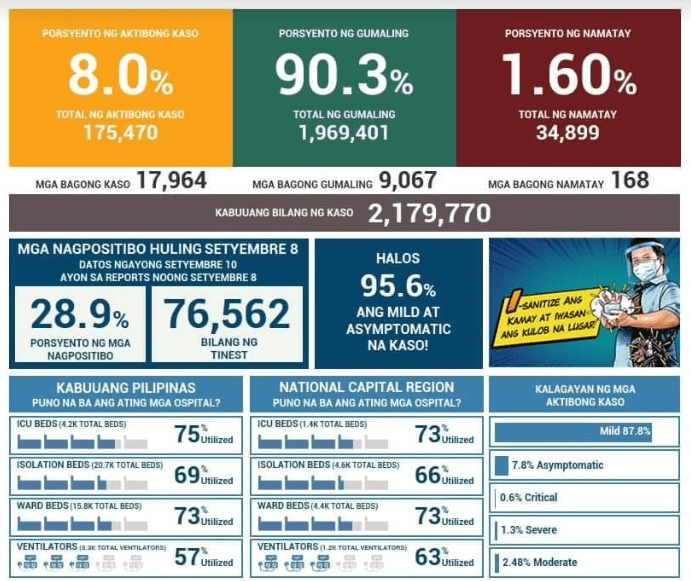
On a day when we expected higher numbers, the Health Agency reports close to 18,000 new cases today.
With over 76,000 tests done and a positive rate of 28.9%, it is without doubt that this surge is out of control as more and more patients who are symptomatic are getting tested. The active cases are now past 175,000 (8%) and we will cross 2.2 M mark within the weekend.
An additional 168 deaths were announced today, bringing the case fatality ratio to 1.73%.
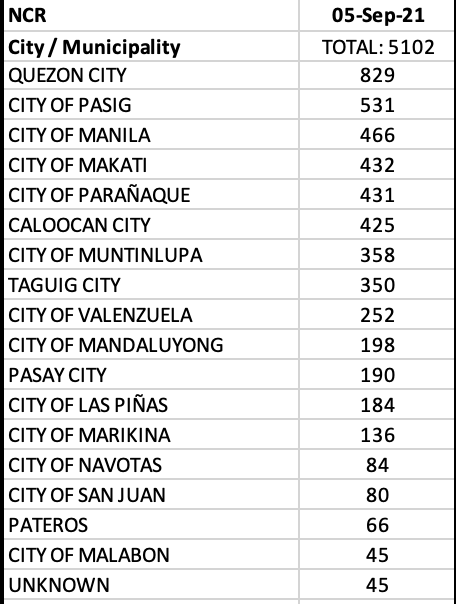
The National Capital Region had 4,359 cases or 24.2% of the national total. Three other regions reported quadruple numbers – CALABARZON, Central Luzon and Davao Region. Note that while these are today’s reported numbers, the backlog of the Health Agency is relatively large and when the unreported and unvalidated numbers come in, one should not be surprised at new record highs.
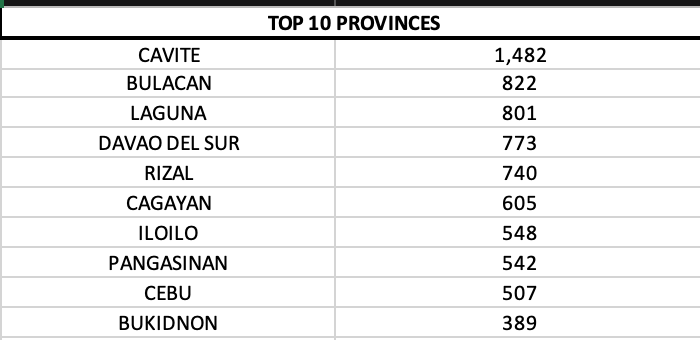
On a provincial level, Cavite maintains its lead with 1,482 cases reported today. The surprise of the day is the province of Bukidnon that joined the 10 provinces with most cases in the country.
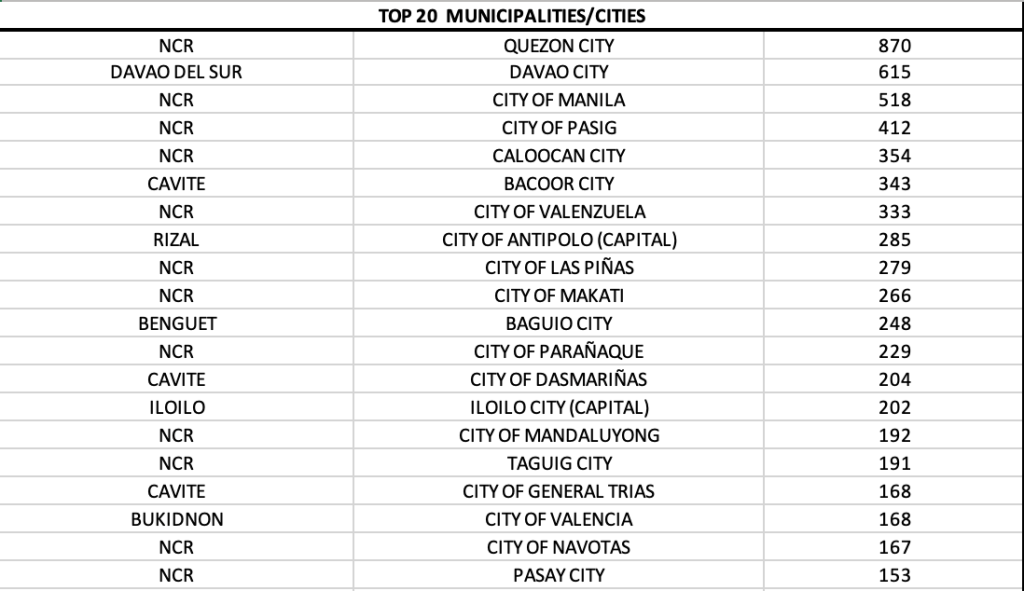
Among the top LGUs, 12 of 17 LGUs in NCR were in the top 20. Davao City came in second rank with 615 cases. Four LGUs from CALABARZON joined the list, while Baguio City, Iloilo City and the city of Valencia (in Bukidnon) rounded up the rest.
Let’s start with the data yesterday that was updated today. Aside from the 12,751 new cases yesterday, the health agency reports that there was an additional 5,132 new cases (making the real total at 17,883 cases for 09.08.2021). An additional 41 recoveries were recorded, but apparently no new deaths added.
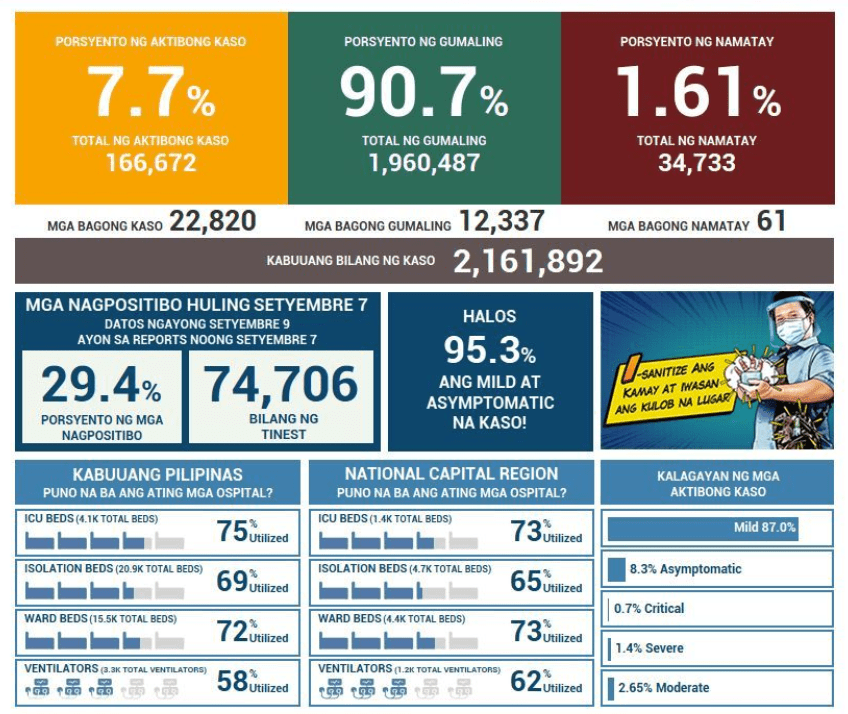
With the glitch fixed, the Health Agency waited till 830PM to upload the bad news. We have a new record high of 22,820 cases. And the 12,000 or so recoveries was not enough to avert the higher cases. This now pushes the active cases past 166,000 and will surely place the country within the top ten countries with highest new cases in the world tomorrow.
Today’s cases push the Philippines one notch higher, passing Peru for the 19th rank in the world with most COVID19 cases.
With close to 75,000 cases, the positive rate is also at a record high – 29.4% or 1 in every 3 people tested on September 7, tested positive.
The silver lining was the low new deaths of 61. This puts the case fatality ratio for outcomes at 1.74%.
While NCR reported more than 6,615 new case, we were peppered with the unknowns, where 1,696 of these were tagged an unknown LGU. It is either another “glitch” in data entry or really sloppy collection of data where 26% of the total cases in NCR had unknown locations. Five other regions reported quadruple digits as well – CALABARZON, Central Luzon, Ilocos, Central Visayas and Cagayan Valley. Ironically, there were no unknowns on a regional level.
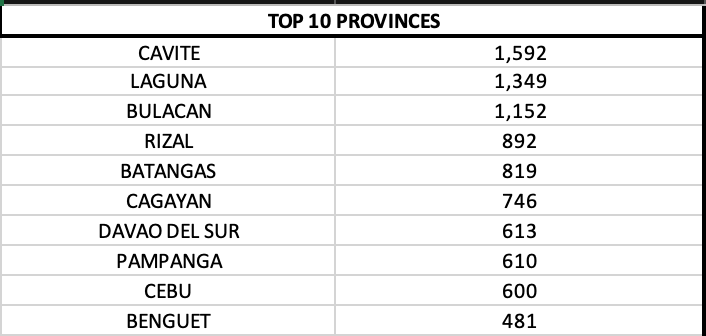
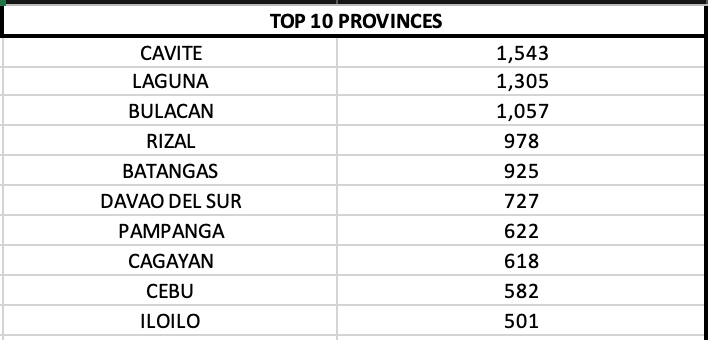
Cavite, Laguna and Bulacan reported quadruple digits on a provincial level, to top the provinces for the day.
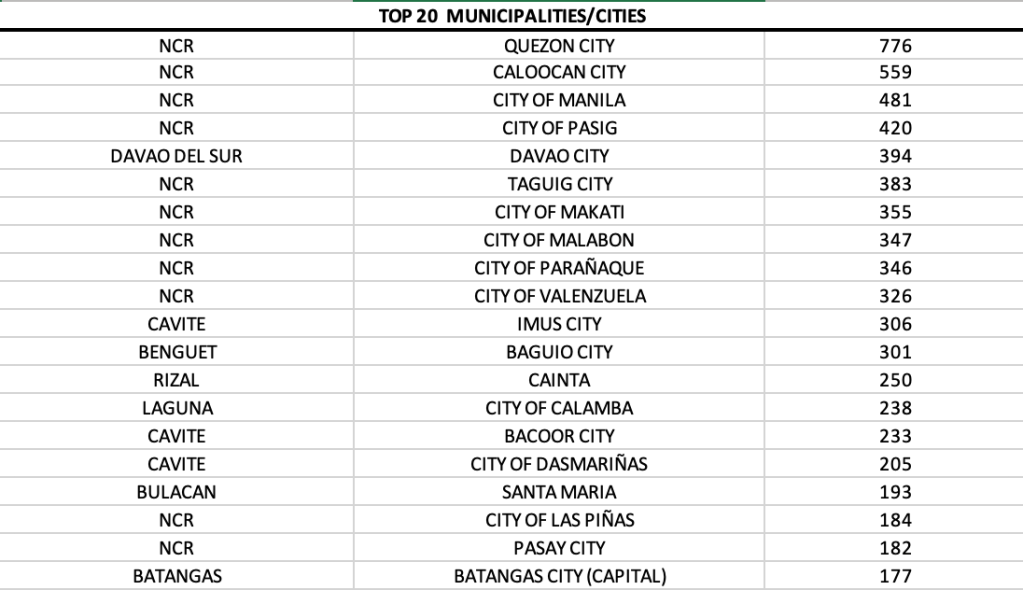
In spite of the more than 1,600 unknown localities of the NCR cases, 11 of 16 LGUs were in the top 20 LGUs with most cases for the day. If there were more accurate data, most likely more LGUs in the NCR would have been in the top 20. Six LGUs from CALABARZON were also in the top 20 list.
OCTA MONITORING REPORT
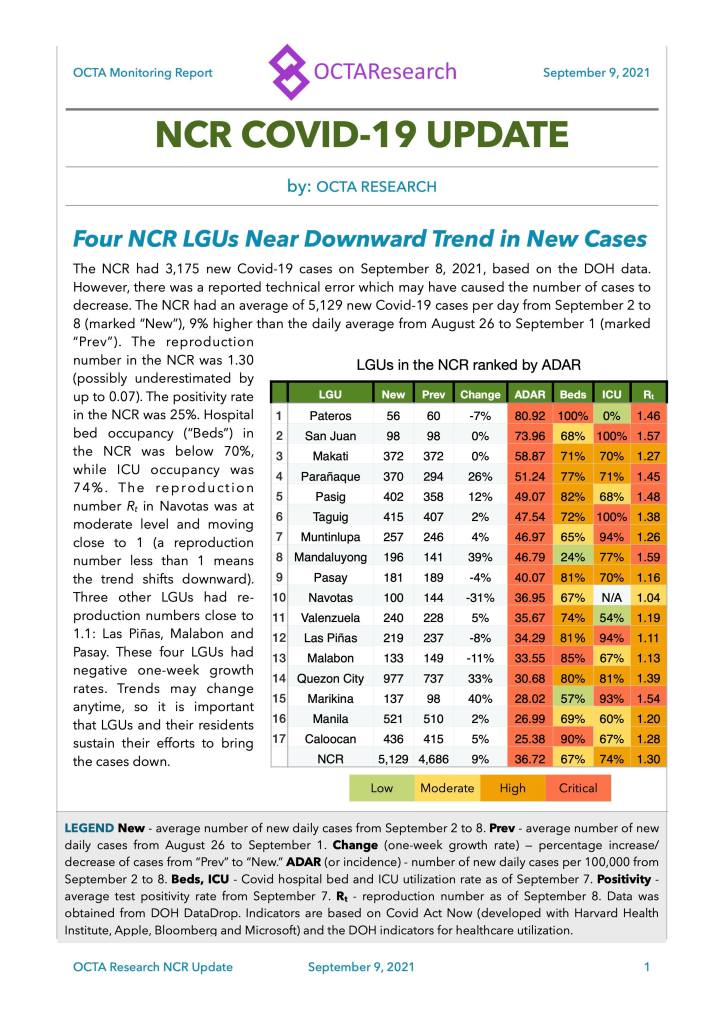
While there seems to be a minot downward trend in new cases in some LGUs in NCR, it is volatile at the moment. Given the fact that there is some resistance to continued lockdowns and not enough vaccines have been rolled out (remember the target is not 70% but should be 90% of the eligible population) in Mega Manila. There is also paucity of data among breakthrough infections, but this is understandable as this is under reported.
Nevertheless, the ADAR (incidence rate) remains critical in ALL the 17 LGUs in NCR, with Pateros, San Juan, Makati, Parañaque and Pasig having the highest. Bed utilization is critical in Pateros, Malabon and Caloocan. And the reproduction rate is highest in Mandaluyong at 1.59. Those included in the critical level are: San Juan, Marikina, Pasig, Pateros and Parañaque.
Navotas saw a significant drop in rate of cases (-31%) and had the lowest reproduction at 1.04.
No, it is real. Well, that’s the formal announcement of the Health Agency for the data today.
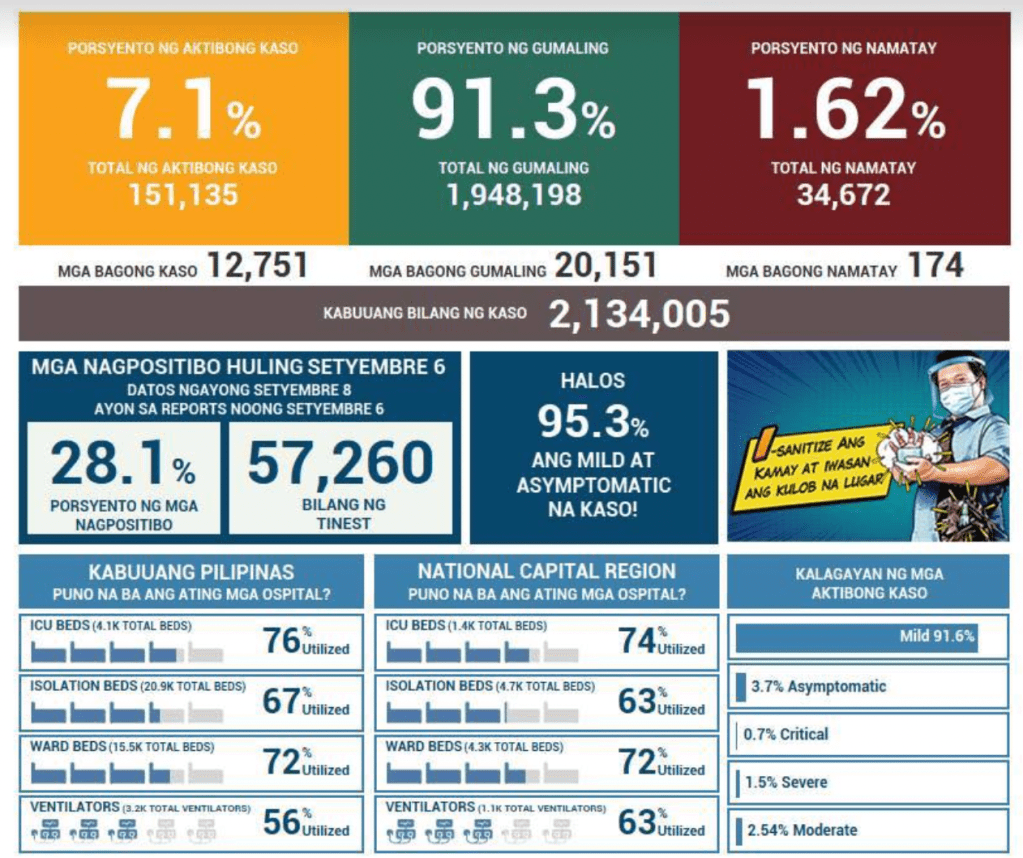
The Department of Health, in their late announcement today, reports, 12,751 new cases. With more recoveries today than cases, the active cases dip to a little more than 150,000.
Total tests done on September 6 (with 5 laboratories not reporting) was a little more than 57,000 for another high positive rate of 28.1%.
Total deaths reported today is at 174 placing the case fatality ratio for outcomes to 1.76%.
So it was a ‘technical glitch day’, hence accounting for the lower total cases today. Expect the ‘other unreported new cases’ to pour in within the week. The cases today are reported here as reported by the Department of Health in the data drop, and may not actually reflect the cases in the various levels (regions, provincial, LGU) because the the glitch in the DICT.
In spite of the glitch, it was still NCR, CALABARZON and Central Luzon that led the haul among regions, accounting for 55% of the day’s cases.
Cavite maintained its over-all provincial lead, while Davao del Sur came in second.
Among LGUs, NCR had 10 of its 17 LGUs in the top 20 list, while 6 LGUs came from CALABARZON. The city of Bacoor in Cavite was in fourth rank today.
It’s not too bad, but it’s the highest Tuesday we’ve ever had, as the Health Agency reports 18,012 new cases. Which is still bad. With an almost equal number of recoveries (as the recoveries play catch up to the new cases), the active cases hover at almost 160,000.
With more than 57,000 tests done on September 5 – the highest number of tests done on a Sunday – the positive rate is high at 28.1%.
Total number of deaths reported today is 161. The case fatality ratio is at 1.77% as of today.
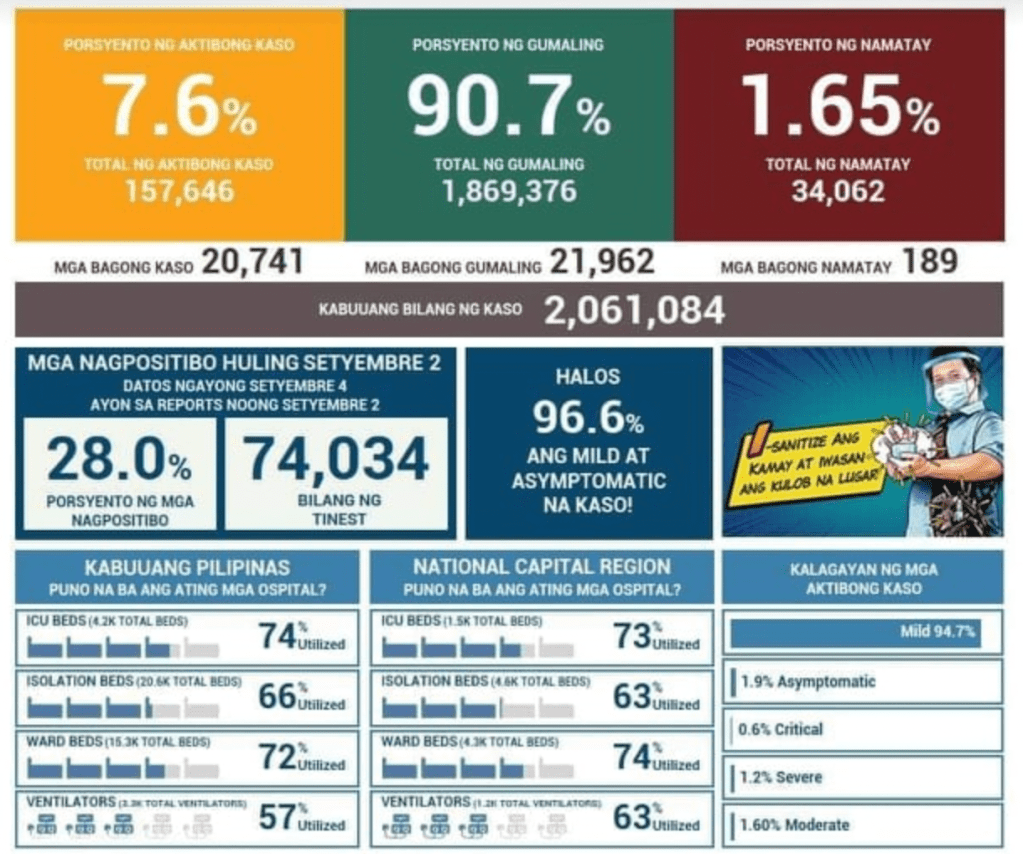
ICU utilization is 75% at the NCR, and 76% on the national level.
On the ‘low Tuesday’, four regions reported quadruple digits – NCR, CALABARZON, Central Luzon and Ilocos Region. All remaining 14 regions reported triple digits.,
Cavite remained the trailblazer among provinces, but the provinces of Laguna, Rizal and Batangas, all from Region IVA were second to fourth rank today.
Eleven of 17 LGUs in NCR were in the top twenty. Six LGUs from CALABARZON joined the top 20 list.
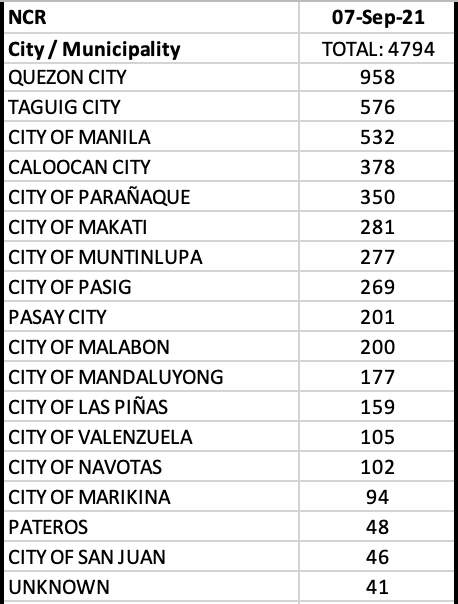
The unknowns are back in NCR as 41 of the 4,794 cases have no known location but are supposedly cases in Mega Manila.
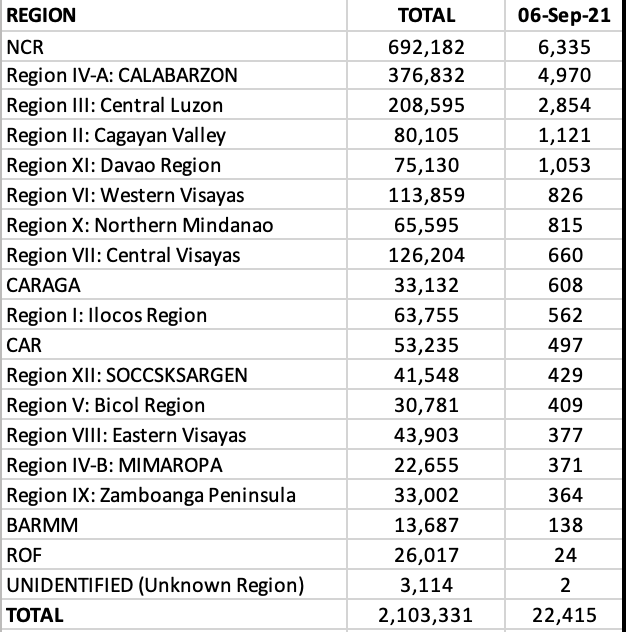
The Philippines records a new record high with 22,415 cases today. In spite the over 20,000 recoveries, the active cases are up at almost 160,000. We now have a total of more than 2.1M cases and most likely will overtake Peru in 19th rank, any time this week.
With more than 73,000 tests done last September 4, 2021, we also record a new high in positivity rate at 28.8% or almost 1 in 3 to 4 patients tested, tested positive.
New deaths today were at 103, putting the case fatality ratio for outcomes is lower at 1.77%.
The NCR records also a record high of 6,335 new cases, with four other regions reporting quadruple digits. In fourth and fifth are Cagayan Valley and Davao Region. Again, it is important to emphasize that the erratic numbers and ranking in the different regions outside of NCR plus is secondary to the fact that the test results do not arrive at the same time. That lag, is something the Health Agency needs to fix. This lag is also due to the fewer laboratories outside of NCR plus. Results of patients from the other regions take a little longer to obtain.
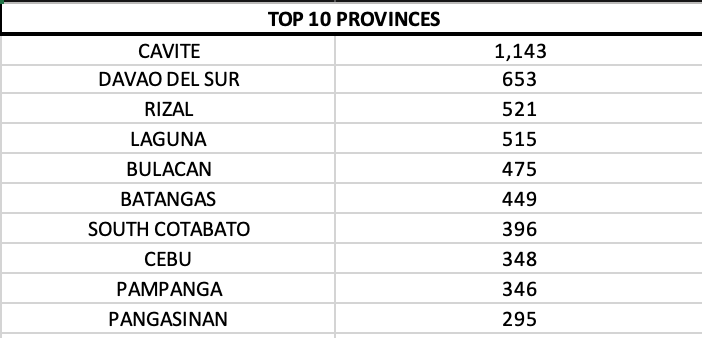
On a provincial level – Cavite, Laguna and Bulacan continue to rank 1-3 for the 3rd consecutive day.
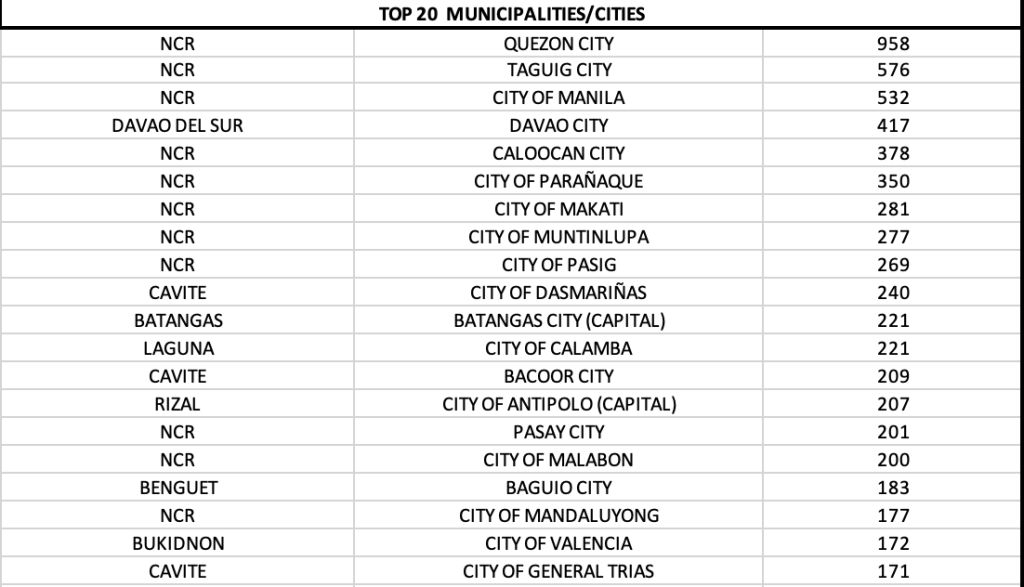
Twelve of 17 LGUs in NCR are in the top 20 cities with most cases with five cities from NCR in the top 5. Six LGUs from CALABARZON also make it to the top 20, with 3 from Cavite, 1 from Laguna, 1 from Batangas and 1 from Rizal.
PGC BIOSURVEILLANCE REPORT
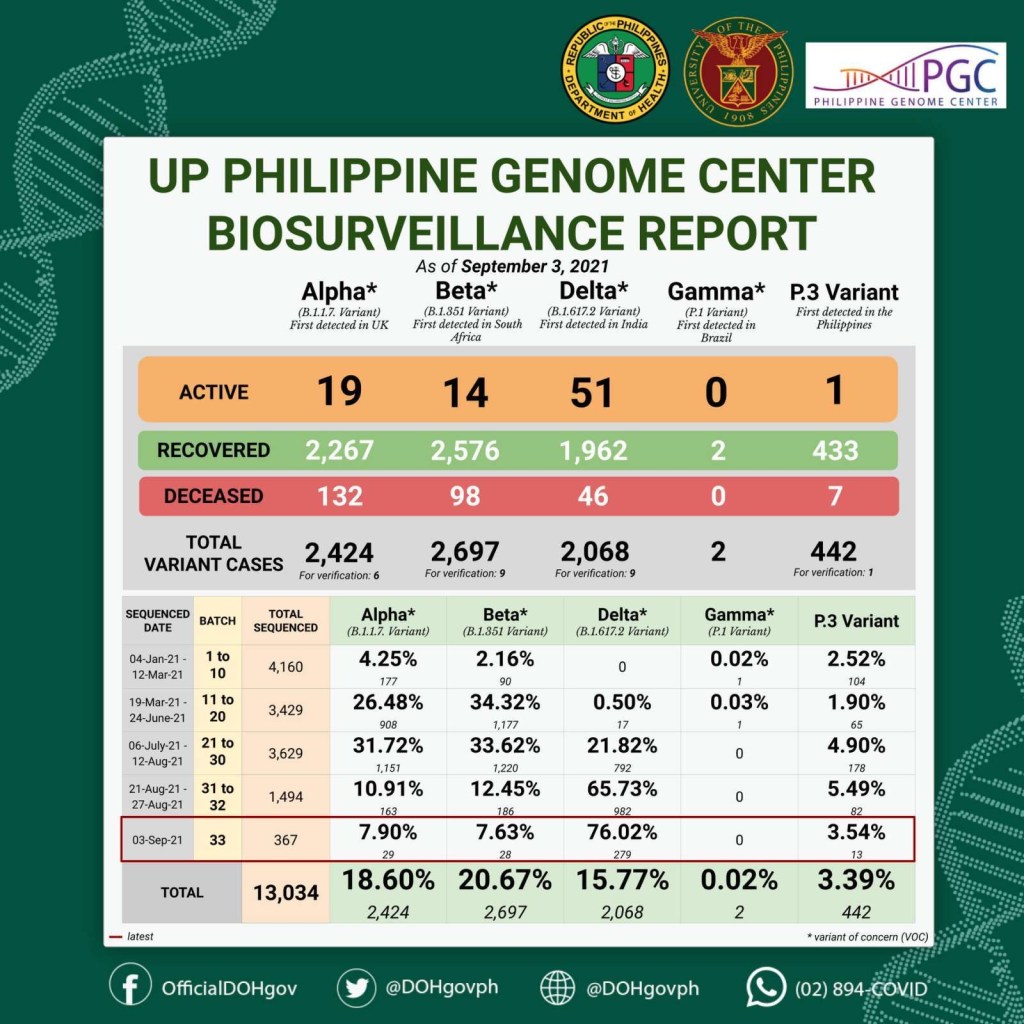
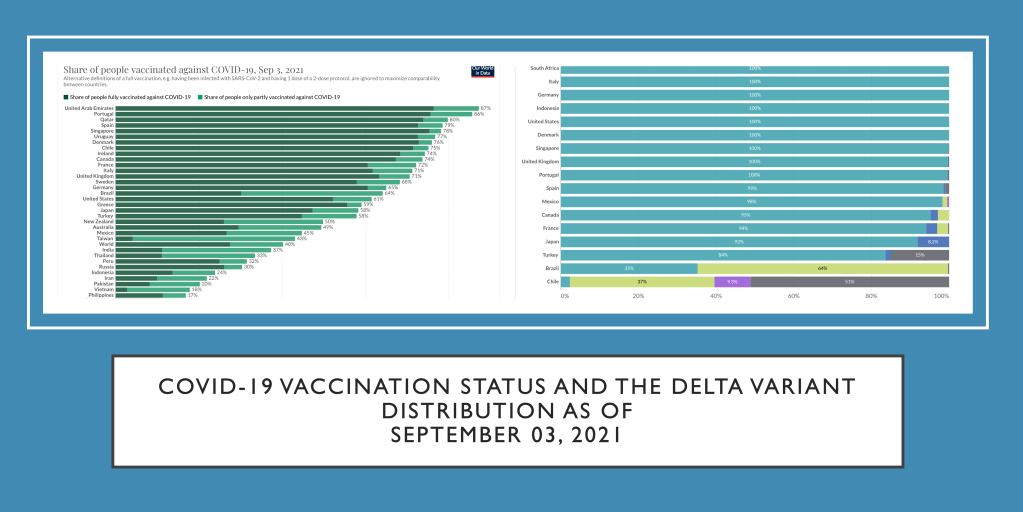
Without a doubt, the Philippine Genome Center Biosurveillance report shows that the shift in the major variant of concern in the country. Based on 367 sequenced samples on September 3, 2021, 76% of the batch were delta variants.
The Delta Variant, first detected in October 2020 in India show mutations at L452R and T478K. Its major concern is in the higher transmissibility, but to date has no evidence of effect on causing a more severe presentation.
Because it has the ability to partially but significantly escape neutralizing antibodies targeting the NTD and RBD, and polyclonal antibodies elicited by previous SARS-CoV-2 infection or vaccination, this may affect the number of cases we are seeing in spite of the vaccine roll-out.
The Health Agency reports another 20K day with 20,019 new cases today. With almost the same amount of recoveries, the active cases remain the same.
There were more than 73,000 tests done last September 3, with a very high positive rate of 27.5%.
New deaths announced today was 173, bringing the total deaths past the 34,000 mark and the case fatality ratio to 1.78%
Five regions posted quadruple digits today – NCR, CALABARZON, Central Luzon, Ilocos Region and Central Visayas. The erratic numbers see in regions outside of NCR plus is most likely from late reports from these regions.
Cavite, Laguna and Rizal retain the top three provinces for the second consecutive day.
Twelve of 17 LGUs in NCR and 6 LGUs in the CALABARZON region are in the top twenty cities with most cases. Only two LGUs in the top twenty – Davao City and Cebu City – are not from NCR plus.
THE WEEK IN REVIEW
While the reproduction rate has slowed down this week, this only means that the rise in cases has slowed down. Of course, it is unsettling that we are settling at getting used to the 20,000+ mark, as the Philippines records a 7-day moving average high of almost 18,000 new daily cases. There was a marked decline in death rate, and this may be attributable to two things – that the cases being recorded include breakthrough infections and are mostly mild (with a sprinkling of asymptomatic) and the fact that deaths are reported very late, we are not seeing more accurate reports for now.
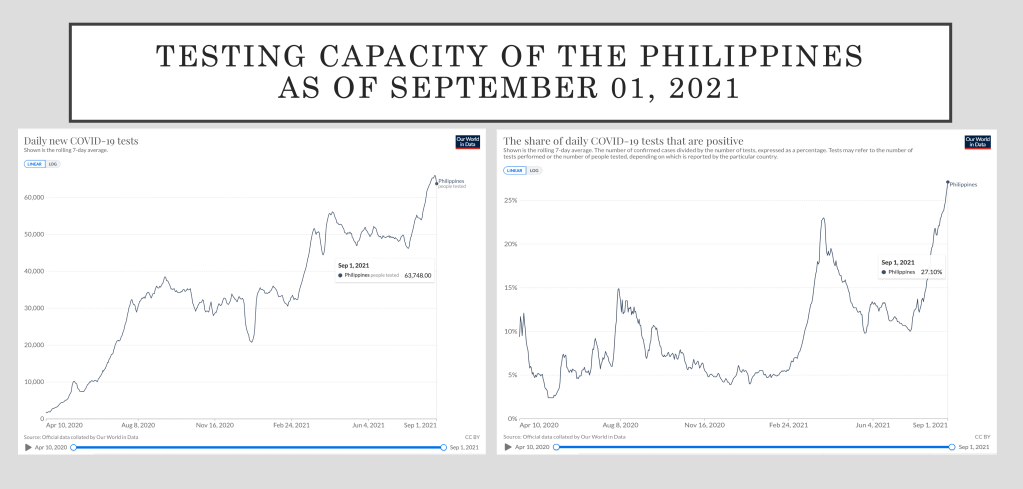
While there are more tests done compared to the past weeks, they are mostly done among symptomatic patients. This accounts for the very high positivity rate, which is creating a daily record for positives. A high positive rate implies that we are not testing enough. Even with the increasing tests, the additional 15,000-30,000 tests is not enough. To bring the positivity rate to 10%, we would need to do at least 200,000 – 250,000 tests daily. Without adequate testing, contact tracing will fail.
On a regional level, we are one of the countries with highest cases, and has overtaken Thailand and Vietnam. Notice how well Indonesia has done in bringing down their cases. The data below is correlated well with the data on reproduction rates.
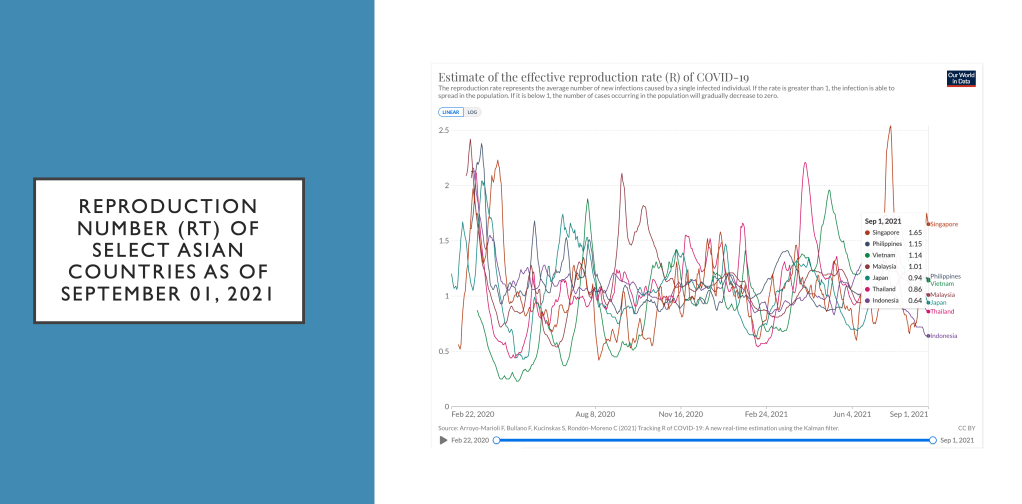
The reproduction rate of Singapore is still the highest in the region. This, however, takes into consideration the number of new cases and the population size of the country. While it is good news that the R in the Philippines has slowed down a bit, the number of cases is still increasing because the reproduction rate is still >1.0. And if you have a R >1.0 with a daily average of 18,000 cases, then that will only mean that we are not anywhere near to seeing a decreasing trend in cases. In short, we have not peaked yet.
Based on reproduction rate, the Philippines was bound to play catch up to Vietnam and Malaysia. Three countries are seeing an R that is less than 1.0 – Japan, Thailand and Indonesia.
To address the pandemic is to roll out the only preventive strategy currently approved globally – vaccination. While the Philippines has quite a chunk more of the 17% that have been vaccinated as fully vaccinated, the glut in vaccine availability becomes a challenge. The graph below simply indicates that the supply of vaccines is low, the roll out is slow and the distribution cannot therefore be a balanced one. If the supply was adequate then those that would have received at least a first dose would be way larger.
Because of the lack of vaccines for now, there is a need to stay on course to the original target of the much needed vaccines – the adult population. When the target for the adults have been reached, and there are available vaccines for the pediatric age group and booster shots, then these segments can be considered. The Philippines can also accelerate that full authorization for the Pfizer-BioNTech vaccine, which has recently been given the nod in the US. Doing so can make this vaccine available in the private sector, without the need for restrictions as provided in an EUA.
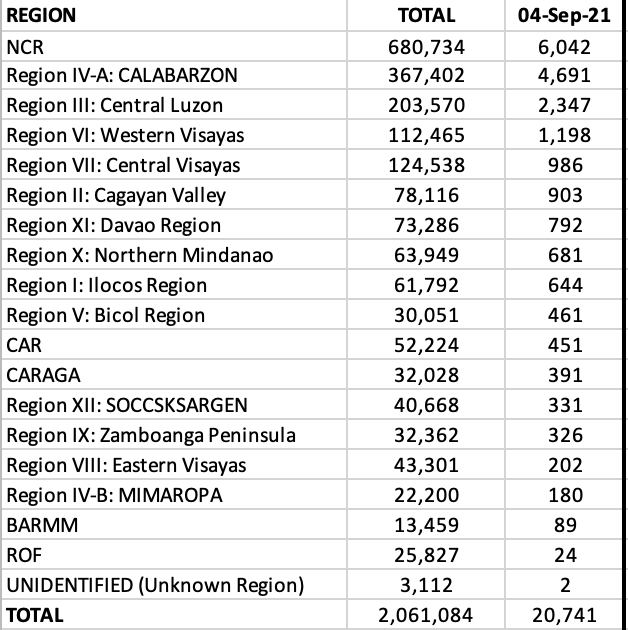
Averaging at almost 18,000 new cases/day (7-day moving average), the Health Agency announces 20,741 new cases today. A few hundred more than yesterday, making today, the second highest daily cases reported. The active cases are still more than 150,000 in spite the more than 21,000 new recoveries.
On September 2, more than 74,000 tests were done. The highest number of daily tests. But the positivity rate is also at a all time high of 28%!
With 189 new deaths, the case fatality ratio for outcomes stands at 1.80%.
Four regions report quadruple digits today, with NCR a far lead from any of the regions with 6,042 new cases (29.1%). Together with CALABARZON and Central Luzon, the NCR plus accounted for more than 63% of the total for the day.
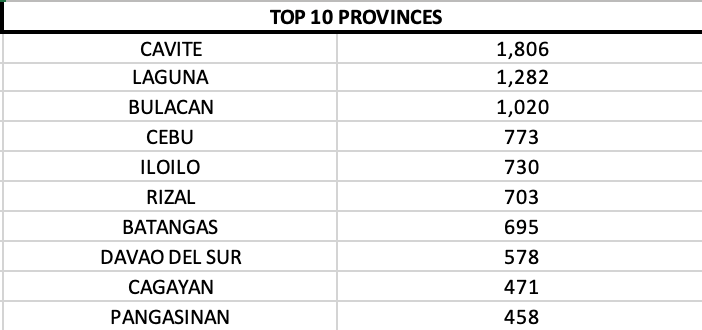
The provinces of Cavite, Laguna and Bulacan report quadruple digits as well. Eight of the top 10 provinces report more than 500 cases apiece.
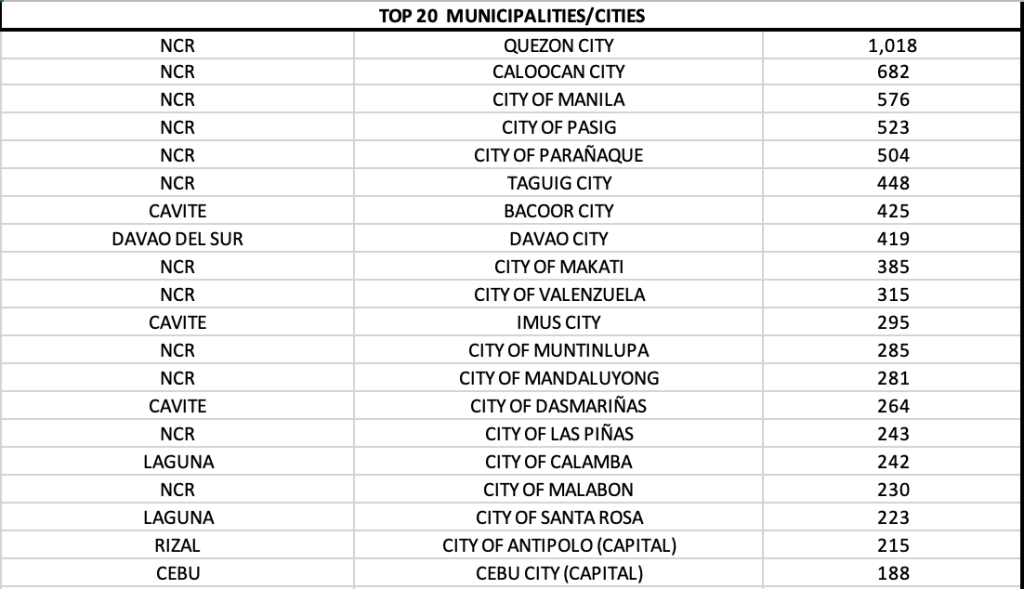
Twelve of 17 LGUs in NCR were in the top 20 list, with Quezon City back at quadruple digits. In CALABARZON, 3 LGUs in Cavite, 2 in Laguna and 1 in Rizal were among the top twenty.
It was expected. You should not be surprised anymore. It will be quite awhile before we see quadruple digits. In the meantime, we need to get used to the more than five digit numbers in cases in the Philippines.
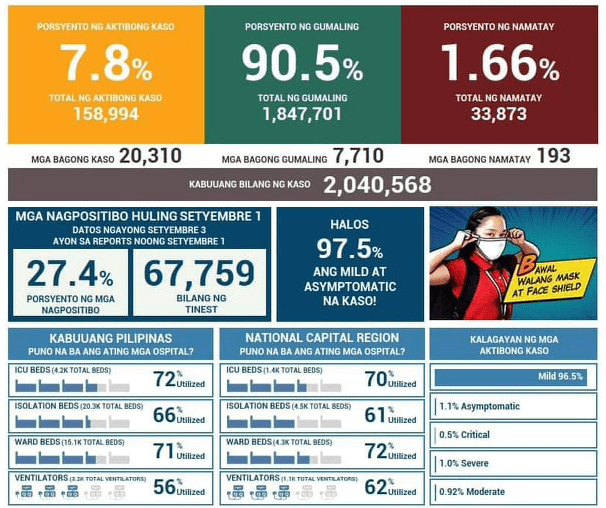
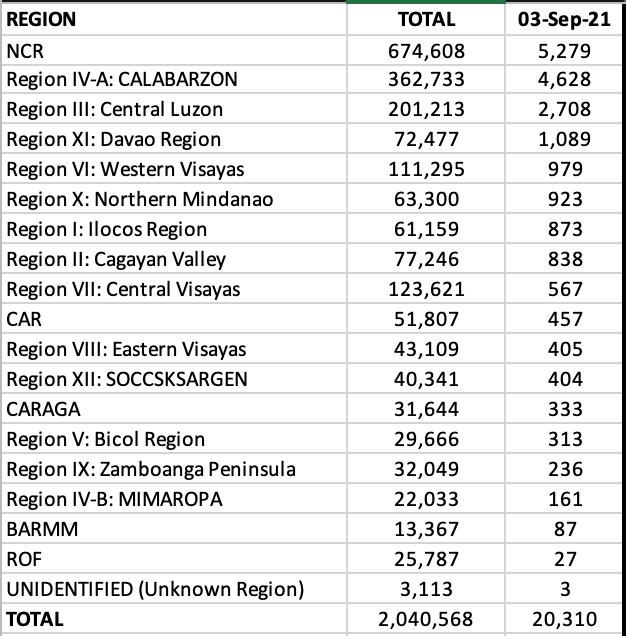
The Health Agency reports 20,310 new cases, our second highest in the pandemic, pushing the active cases close to 160,000.
On September 1, more than 67,000 tests were done with another all time high in positivity rate at 27.4%.
With 193 deaths reported today, the case fatality ratio for outcomes is at 1.80%.
Four regions reported quadruple digits – NCR, CALABARZON, Central Luzon and Davao Region. NCR plus accounted for 62% of the cases in the country for the day.
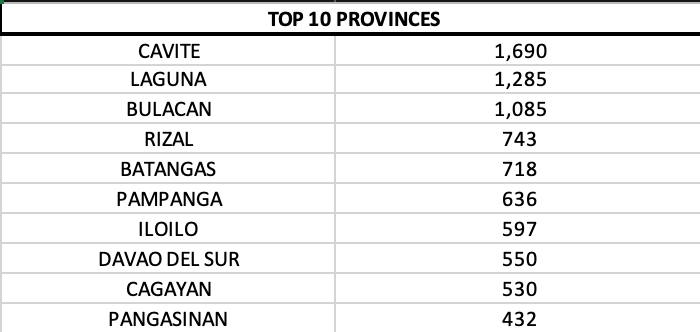
Cavite, Laguna and Bulacan had quadruple digits on a provincial level.
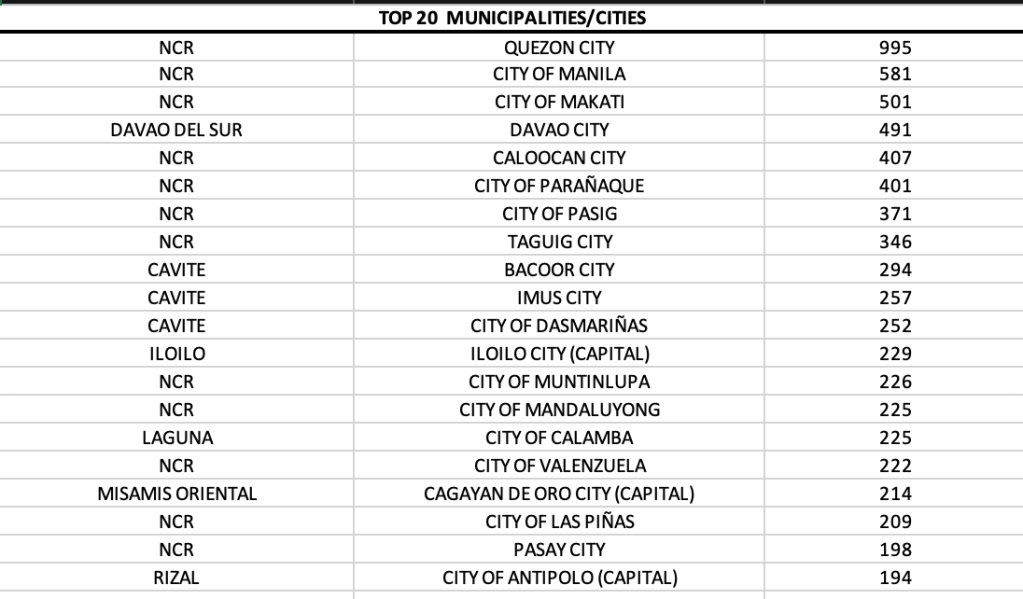
Twelve of 17 LGUs in NCR were in the top twenty LGUs with most cases today. Three cities in Cavite, 1 from Laguna and 1 from Rizal were among the LGUs in the CALABARZON region in the top 20 list. Iloilo City is back in the top twenty today as Western Visayas reported a rise in cases,
It was the usual Thursday. As expected, the day after low Tuesdays and Wednesdays would be a more realistic Thursday before going into the reality check weekend.
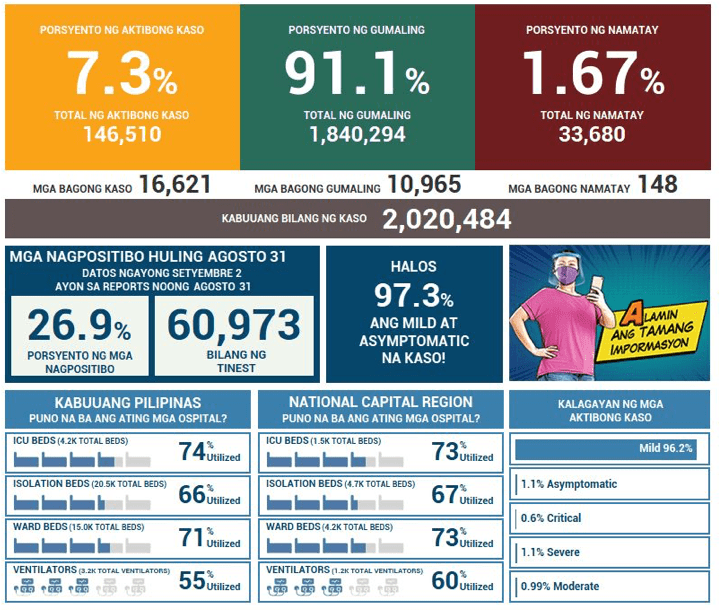
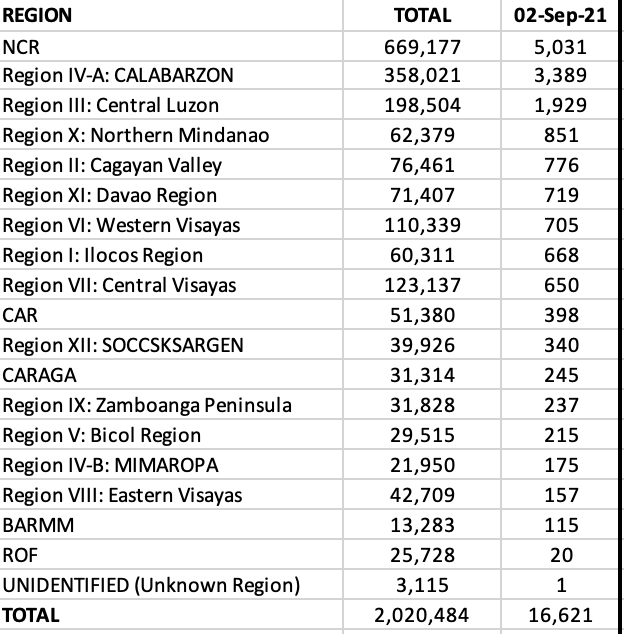
The Health Agency announces 16,621 new cases, bringing the active cases back to more than 146,000.
On August 31, 2021, more than 60,000 tests done showed a positivity of 27%. This means that there are still more cases out there, and that we will continue to see a climb of cases (even if it has slowed down).
There were 148 new deaths reported, bringing the case fatality ratio for outcomes to 1.81%.
Is NCR on the rise? Of the over 16,000 cases today, NCR accounted for more than 30% of the share – the highest in this latest surge. CALABARZON and Central Luzon are second and third, as usual.
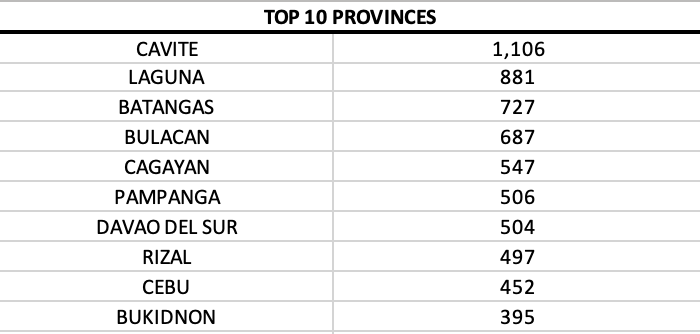
Cavite, Laguna, and Batangas – all provinces in Region IVA – are the top three provinces for the day.
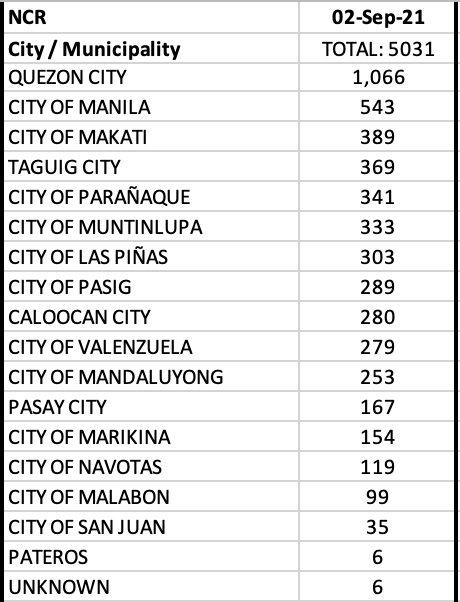
Thirteen of 17 LGUs in NCR are in the top 20 cities/municipalities with most cases. This, as the Department of Health announces, that all 18 regions in the Philippines now report delta variant present in each and every region. Other cities in the top 20 include 3 in Cavite, 2 in Laguna, Davao City, and Cebu City.
OCTA MONITORING REPORT
While we are still in shock and awe with the rising cases in the country, it is a bit of good news to know that the reproduction number is slightly declining. However, that does not mean that our cases are going down. Slowing down is not the same as going down. Notice that the percentage of new cases actually went up in the NCR (12% higher than the previous week).
The incidence rate for NCR is at 33.2 per 100,000 population with a positivity rate of 24% (not very far from the national positivity rate of 25%). Notice in the report provided below, that 14 of 17 LGUs have ADAR at more than 25/100,000 (critical level), with Pateros, San Juan and Makati at more than 50/100,000.
The LGU with the highest reproduction number is San Juan at 1.69 followed by Taguig (1.65). Eleven of 17 LGUs in NCR had reproduction numbers more than 1.4, with Quezon City and Manila having the lowest R (despite the higher number of cases).
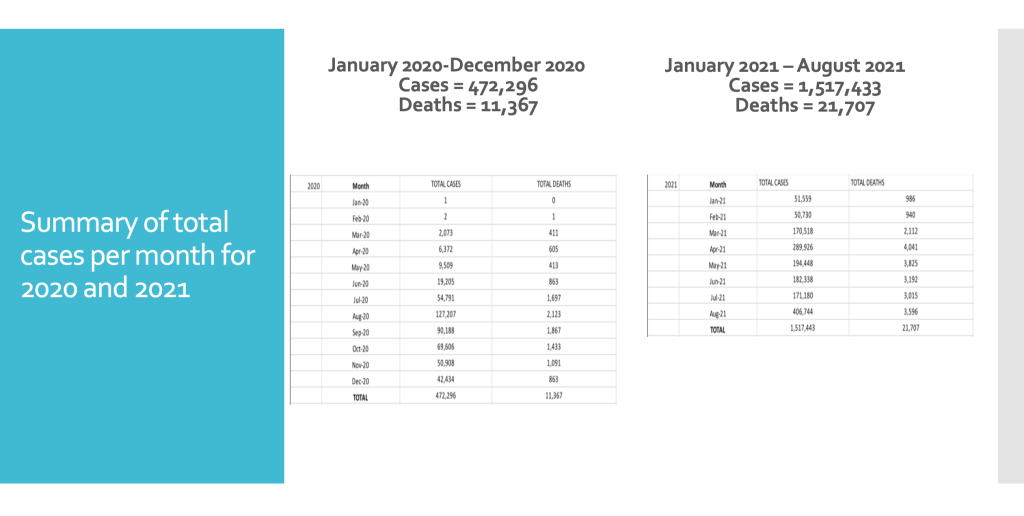
As additional information to the reader, is the summary of total cases per month since the pandemic began from January 2020-August 2021.
Notice that August and September 2020 were the worst months for the year 2020. The most cases in 2020 was seen in the month of August with 127,207 cases. It was also the same month that saw the most number of deaths in a month for year 2020.
Year 2021 isn’t over yet. But March saw a significant rise in cases, peaking in April and slowing down from May to July. August 2021 was a month to reckon with as the PH saw 406,744 cases or more than 3 times the cases of the August 2020. In the first 8 months of 2021 alone, we had almost 4x the total cases of the whole year 2020. Even the total number of deaths were twice that of 2020, and 2021 is not over yet.
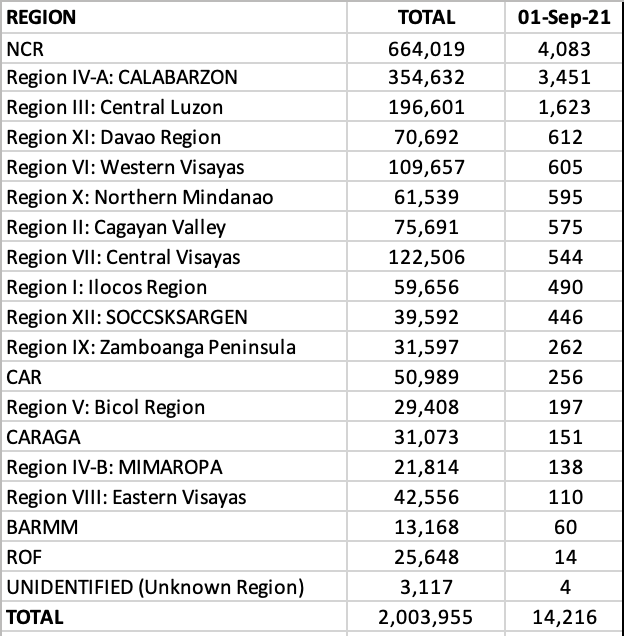
With the Health Agency announcing 14,216 new cases today, the country officially crosses the 2M mark. The active cases are down to a little more than 140,000. However, with more than 50,000 tests done on August 30 showing a positivity rate of 26.4%, this may mean that we may still see more than 20,000 cases any day this week.
New deaths announced today was 86. The case fatality rate for outcomes is at 1.81%.
While the ICU utilization rate is lower, this not translate to the actual condition on the ground because hospitals have declared full capacity because many of the healthcare workers are also down with COVID-19 or under quarantine. While beds may not be physically full, there is no way that patients can be accommodated in a hospital that is understaffed.
NCR accounted for close to 29% of the cases today. Together with CALABARZON and Central Luzon, the NCR plus now contributes to almost 2/3 of the cases in the country.
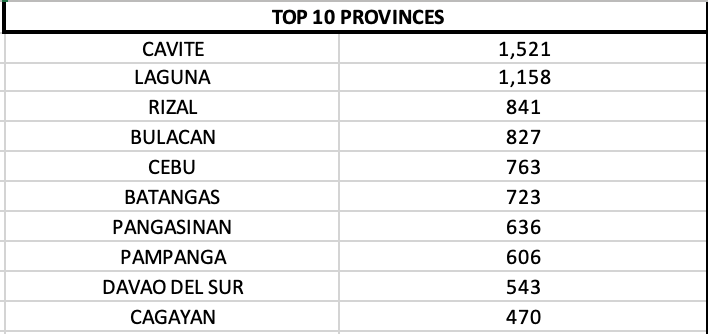
Cavite continued to lead among provinces, this time with Laguna and Rizal in second and third rank.
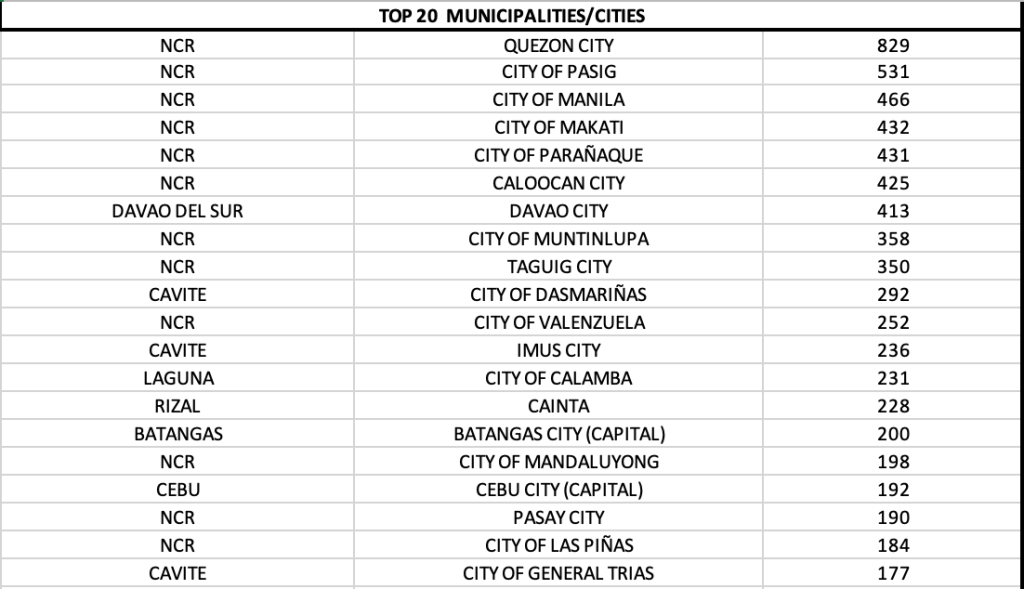
Of the 17 LGUs in NCR, 12 made it to the top twenty today. Four cities in Cavite, 1 in Laguna and 1 in Rizal were also in the top twenty. Davao City is in 4th.






















 Relative Joy