The usual Tuesday is 25-30% lesser than the 7-day average of cases. Since the 7-day average is now at 20,500, the usually ‘low’ Tuesdays would be around 15,000 new cases.
Not this Tuesday.
The Health Agency reports 18,056 new cases, as tests done last Sunday, September 12 pass the 50,000 mark (the highest number of tests on a Sunday). The positivity rate is also up at 29.7%. ICU rate in NCR is up at 79% (which I think is even higher considering that some hospitals may have beds but direly lack manpower at this point).
The total deaths reported today is 222, bringing the case fatality rate for outcomes to 1.70%.
Based on the 7 day average the past week, we add 100,000 new cases every 5 days. If the cases continue in this trajectory, we will be seeing a new record high this week.
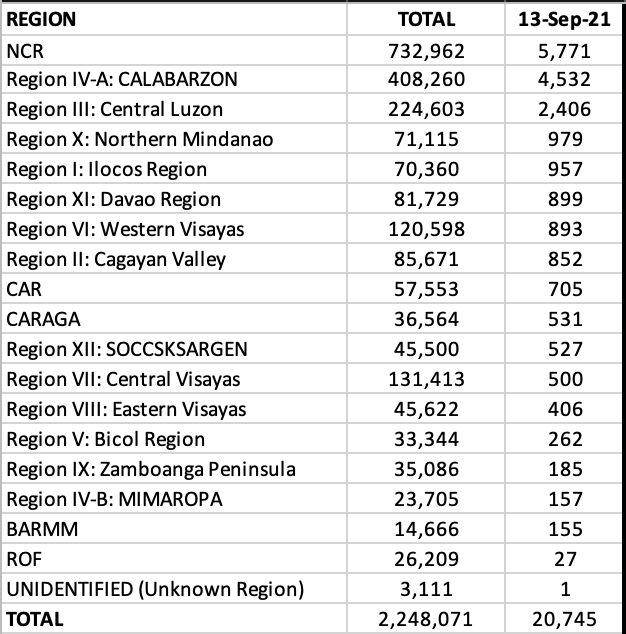
The NCR had a more than higher median average cases today (27.5%). Four other regions reported four digits – CALABARZON, Central Luzon, Ilocos Region, and Cagayan Valley. NCR plus accounted for 55% of the total shares of cases today.
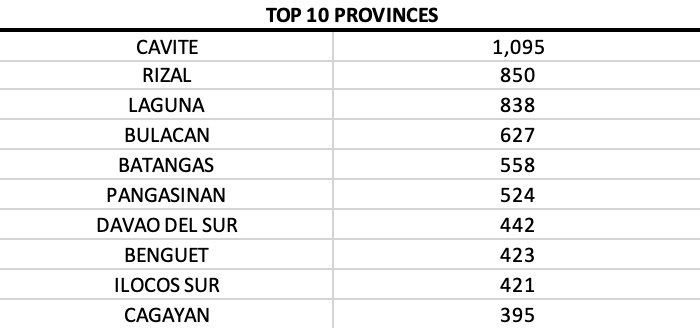
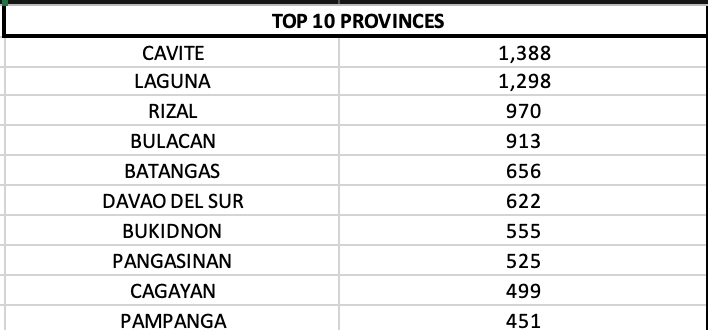
Cavite, Rizal and Laguna topped provinces with most cases today.
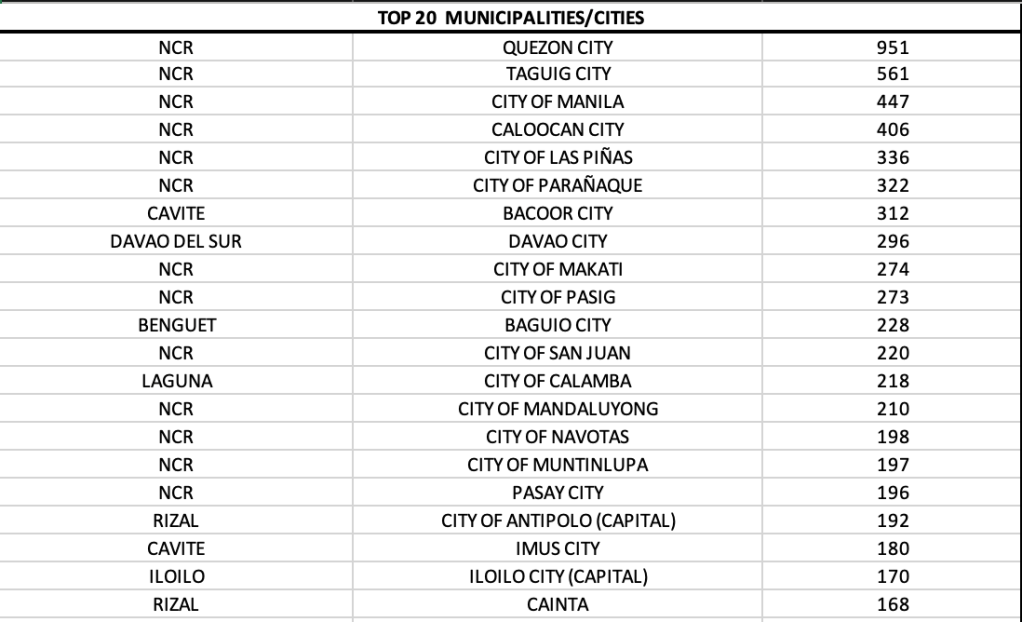
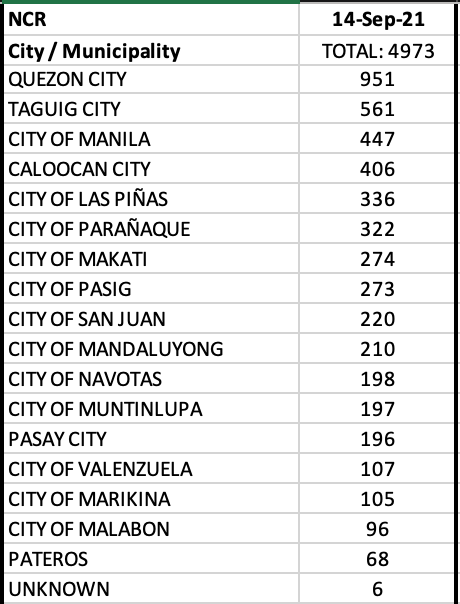
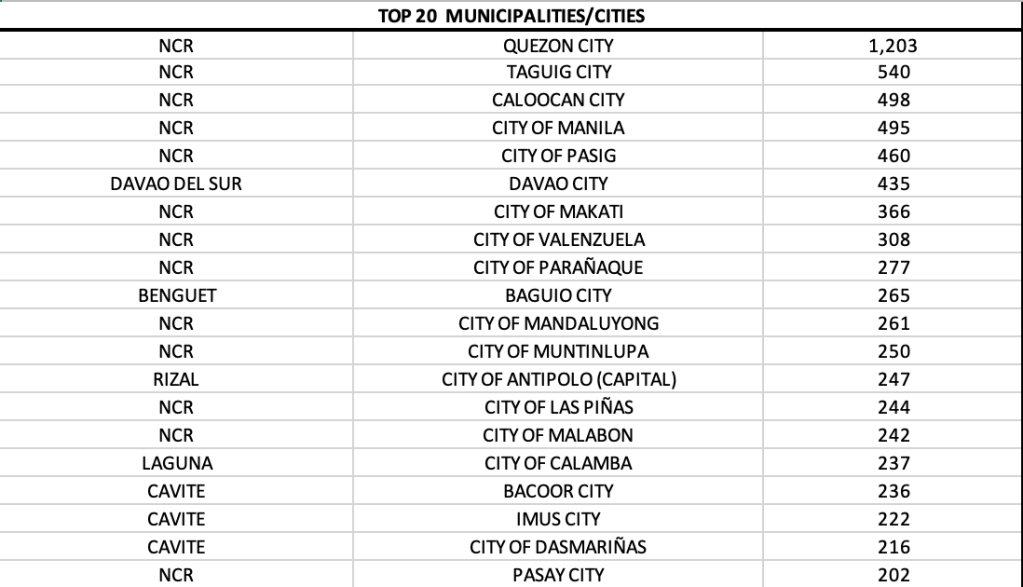
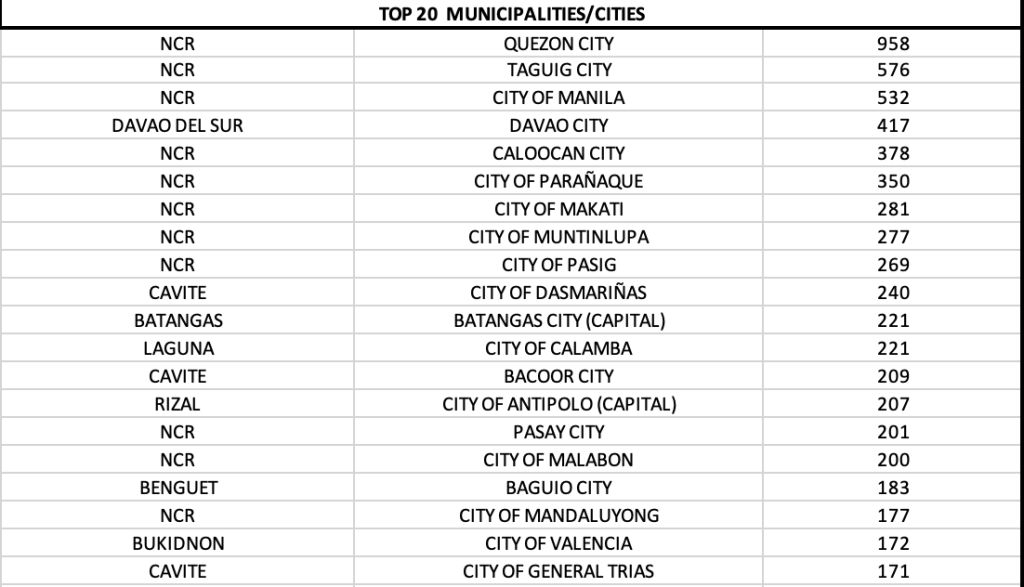
Thirteen of 17 LGUs in NCR were among the top 20 cities/municipalities with most cases for the day. Five LGUs in CALABARZON were in the top 20 list as well. There we six unknowns in the NCR reported today.
With 20,745 new cases announced today, the 7-day average cases for the country is around 20,500 new daily cases. The active cases remain high at over 180,000.
Tests done on September 11 was close to 72,000 with a slightly lower positivity rate of 26.7% (nevertheless still critically high).
New deaths today are 163, with the case fatality ratio for outcomes steady at 1.71%.
With the upcoming new classification for lockdowns to be implemented in the NCR, Mega Manila continued to account for more than one-fourth (28%) of the cases in the country. NCR plus owned 62% of the total share. Again, all regions outside of NCR plus had triple digit cases.
The provinces of Cavite, Laguna, Rizal, Bulacan and Batangas continued to lead on a provincial level.
On a LGU level, 13 of 17 LGUs in NCR now are in the top twenty cities/municipalities with most cases. Five LGUs in CALABARZON also make it to the list.
Hopefully, the glitches have been fixed, as the backlogs have somehow are being addressed.
The Health Agency reports 21,411 new cases today and with more than 25,000 recoveries, the active cases are down to around 182,000.
More than 78,000 tests (the highest number of daily tests) were done last September 10 still showed 27% positive rate. Way above the acceptable positive rate.
ICU utilization rate is now close to 80% in the NCR and at 77% nationally.
There are 168 new deaths reported today. The case fatality ratio for outcomes is at 1.72%.
With the technical glitches addressed (that is my presumption), the NCR average trend is back to 26-27% with the 5,619 cases today. Other regions with quadruple digits are CALABARZON, Central Luzon and Ilocos Region. All other regions reported triple digits.
The provinces of Cavite and Laguna led with four digits on a provincial level.
Among LGUs, 12 of 17 LGUs in NCR were in the top twenty with Quezon City leading with quadruple numbers. 3 LGUs in Cavite were also in the top 20 list.
THE WEEK IN REVIEW
The Philippines finished the week with a day in the top 4 countries in the world with most COVID-19 cases. In a nation where the face shield is the symbol of managing this pandemic, the daily numbers do not reflect the actual cases we are seeing daily. And here is why.
TESTING
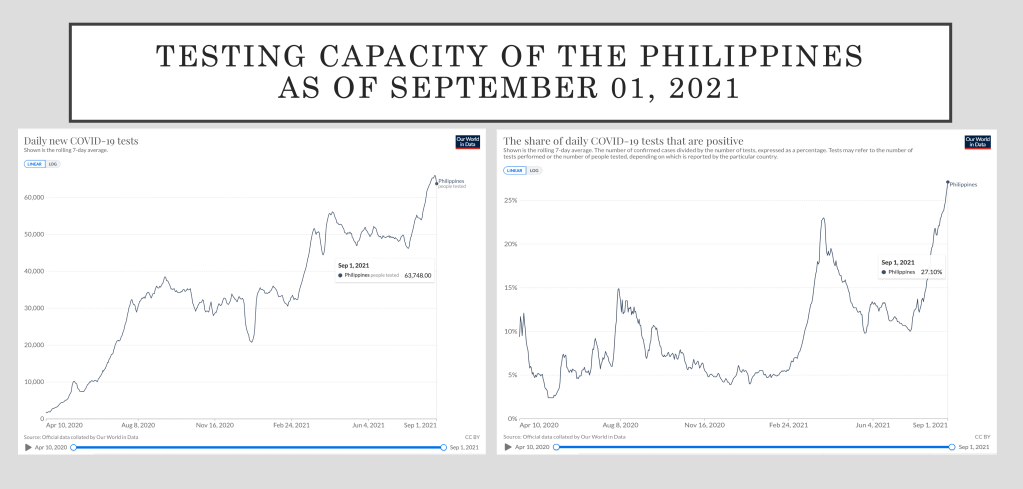
The World Health Organization pegs 5% as the acceptable positivity rate. Between 5-10%, is still manageable. But notice that we have never looked back to even <10% positivity rate since March 2021. Today, we have eclipsed all records and the 7-day average for positive stands at more than 25% or 1 in every 4 people tested, testing positive. Although we have had more tests done in this surge compared to the last one in March/April, it isn’t enough. Which means that most likely only those with symptoms or hospitalized end up being tested. With cases this high, the only way we can bring down the positive rate is to do good contact tracing. The total number to test to bring the positive rate to ~10%? At least 250,000 – 300,000 per day. An impossible feat considering that more than half of all testing facilities are in NCR plus.
CASES AND DEATHS
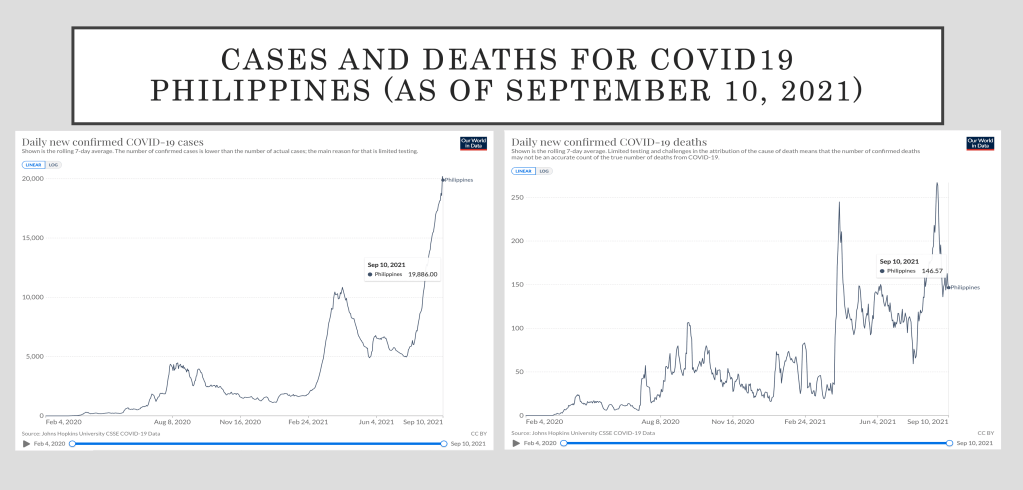
We have not peaked yet. As of September 11, 2021, the 7-day average is 20,722 new cases daily. With a national R still >1.0, there will be a continued rise in daily cases, but managing to slow down, based on the data being churned by the Health Agency. Remember, all these data do not come from thin air. They come from the Data Drop of the the COVID19 tracker of the Department of Health. We are still in an upward trajectory. And the densest regions and provinces are taking the brunt of the outbreak.
The new cases include breakthrough infections. While the Food and Drug Authority reports that only a small percentage are attributable to breakthrough infections, the data on the ground do not seem to point to that. That is because many of have been vaccinated, develop symptoms and get tested, are either asymptomatic or mild. Breakthrough infections, like other countries are under reported.
The deaths are lower, which may be a good sign because of having many of those living in the more dense areas of the country vaccinated. It may, however, also mean that because deaths are late reports, we are not seeing the actual picture for now. The course of illness of those that are severe and critical may take a longer course. When the cases begin to decline, the true picture of deaths will be revealed.
HOW ARE WE FARING WITH OTHER SELECT ASIAN COUNTRIES
Compared to other countries, the Philippines now ranks number 1 among other ASEAN nations and is second to India in the whole of Asia in terms of daily new cases. All other countries that are in the midst of the delta crisis are seeing a decline in cases. Singapore, a country with less than 6M people is seeing an increase in cases but is at the lower end because of their population size.
THE REPRODUCTION NUMBER
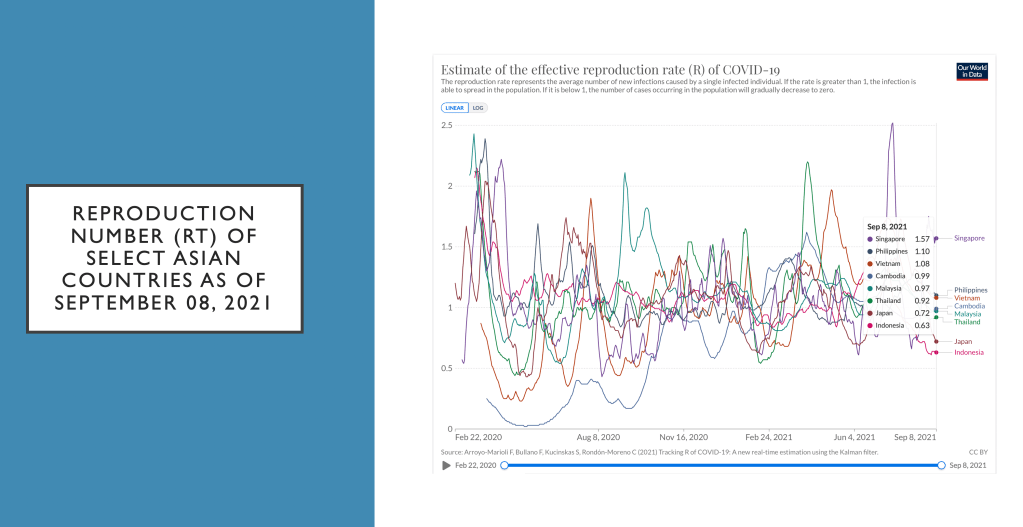
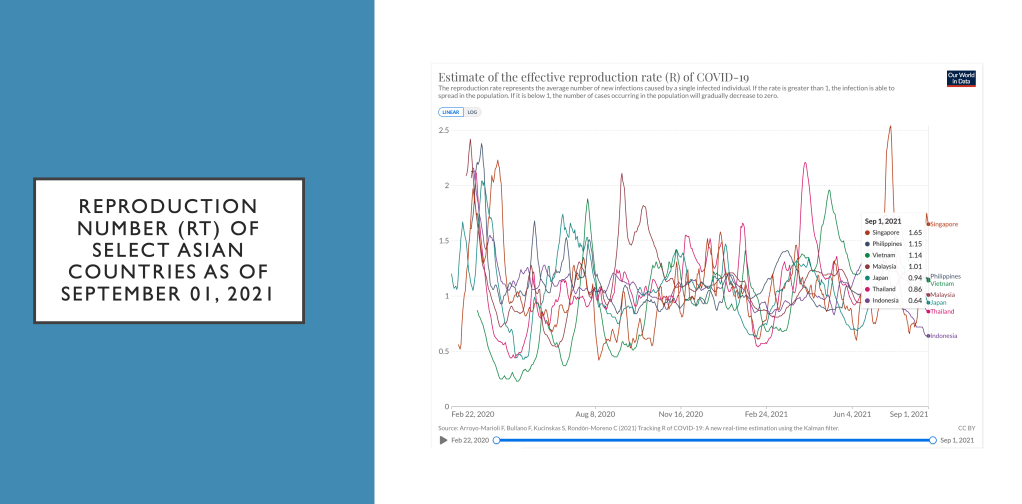
While the Philippines may have the highest daily cases, it is Singapore that leads among countries with the highest reproduction number. The R of the PH is lower this week at 1.10 compared to last week at 1.2. This does not mean that there is a decline in cases. It only means that we have plateaued at a certain average and have not peaked yet. The daily numbers are slowing down and not significantly increasing. The data, however, should be taken with the perspective of the high positive rate. This means that whatever numbers we are seeing, are most likely higher if more testing and tracing were done.
VACCINATION AND DELTA
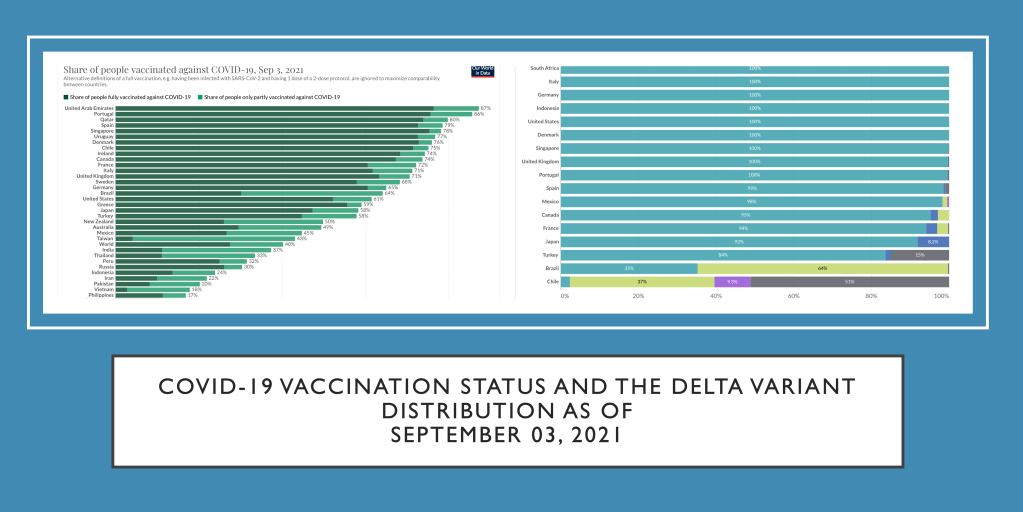
The IATF reports that almost 50% of the eligible adults in the National Capital Region have been vaccinated (either with one or two doses). With the variability of vaccine efficacy on which vaccine was rolled out and when they were vaccinated (many frontliners receiving Sinovac over 6 months ago), the question on boosters is now up in the air. Many of the neighboring countries where the Delta variant is the predominant serotype, have started providing “boosters” to frontliners who are at highest risk of breakthrough infections due to the natural hazard of their work. While the total number of vaccinated (whether fully or partially) is at over 17% in the country (as of this report), the government should work quicker in order to allow access of more vaccines sans red tape so that they can rationalize reopening the economy. After all, the virus is not specific to Mega Manila alone. The whole country especially the workforce should be the priority. For those that can afford to purchase the vaccines, this should be allowed particularly with vaccines like Pfizer-BioNTech which already has full authorization in the country of origin (USA). This will solve the inequity issue in the country, where those who can afford to buy the vaccine can purchase it on their own.
I guess the numbers 9/11 is symbolic. Twenty years ago, it stood for the worst terror attack in the United States.
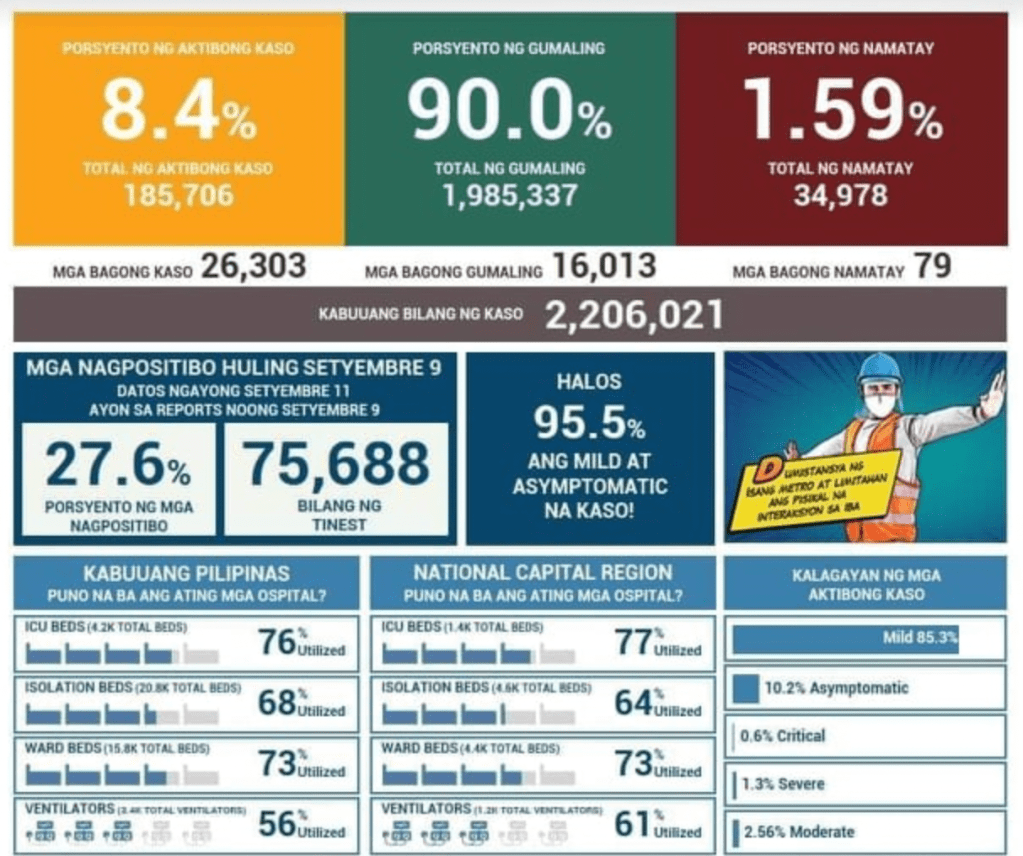
As the world stood to remember that day, the Philippines breaks an all time high in COVID19 cases with the Health Agency announcing 26,303 new cases. It took a day to surpass the 2.2 Million mark. This pushes the active cases past 185,000 and climbing.
Note that of todays cases, 1,608 were supposed to have been included yesterday but were not. The total number of cases for September 11 is actually 24,695.
Tests done September 9 were past 75,000 but the positivity rate was still unmanageable at 27.6%.
The health care capacity is definitely at past critical levels, with the NCR’s ICU rate past 77% (which is an under report). Note that this does not count the beds for “closed” ICUs because of lack of personnel to man these units.
Total deaths reported was 79 as the total deaths near 35,000. The case fatality ratio for outcomes is at 1.73%.
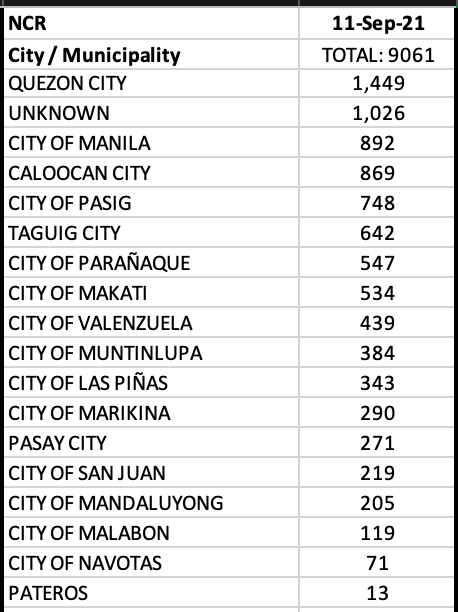
The NCR had a record high of more than 9,000 cases or close to one-third of the total cases in the country today. Three other regions were reporting quadruply digits – CALABARZON, Central Luzon, and Western Visayas. But it was NCR that stood out among the rest with numbers too numerous to validate that more than 11% of the NCR cases were from unknown LGUs.
On a provincial level, six provinces reported quadruple digits, making this the highest number of provinces recording 4-digits in a single day. They were: Cavite, Laguna, Rizal, Bulacan, Iloilo and Batangas.
Twelve of 17 LGUs in NCR were in the top 20 cities/municipalities with most cases. This, notwithstanding the fact that 1,026 were unknowns from NCR. Six LGUs in CALABARZON were also in the 20 twenty list.
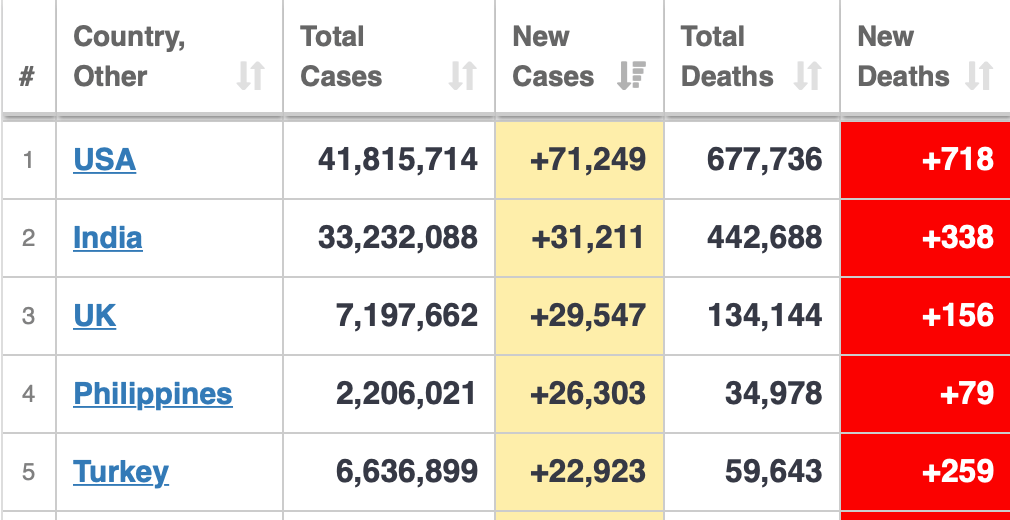
As the day closed, the Philippines, for the first time, ranked 4th (it’s highest ever) among the global cases of COVID-19 on 09.11.2021.
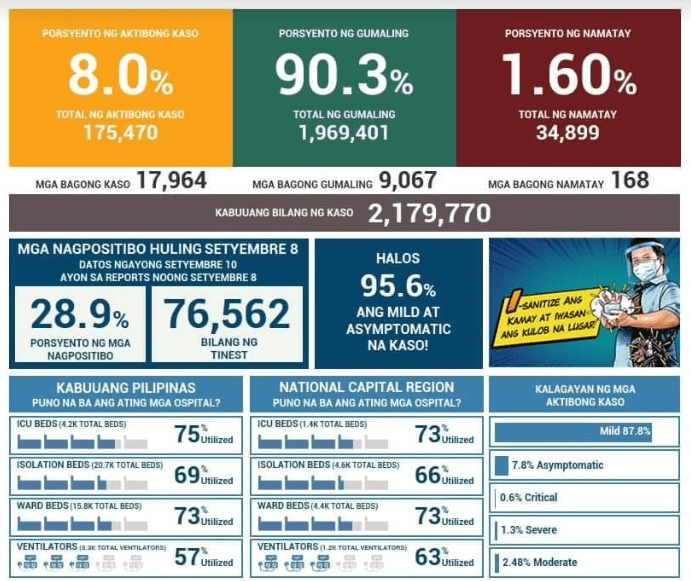
On a day when we expected higher numbers, the Health Agency reports close to 18,000 new cases today.
With over 76,000 tests done and a positive rate of 28.9%, it is without doubt that this surge is out of control as more and more patients who are symptomatic are getting tested. The active cases are now past 175,000 (8%) and we will cross 2.2 M mark within the weekend.
An additional 168 deaths were announced today, bringing the case fatality ratio to 1.73%.
The National Capital Region had 4,359 cases or 24.2% of the national total. Three other regions reported quadruple numbers – CALABARZON, Central Luzon and Davao Region. Note that while these are today’s reported numbers, the backlog of the Health Agency is relatively large and when the unreported and unvalidated numbers come in, one should not be surprised at new record highs.
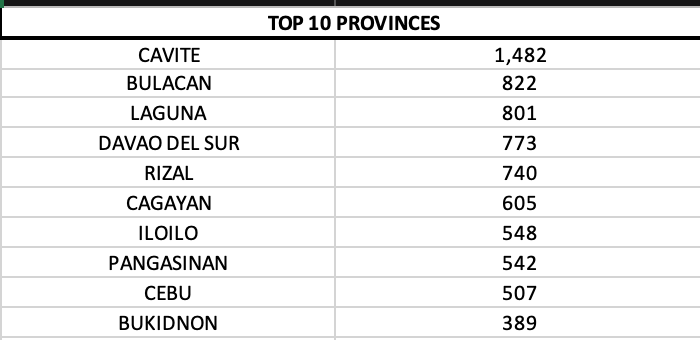
On a provincial level, Cavite maintains its lead with 1,482 cases reported today. The surprise of the day is the province of Bukidnon that joined the 10 provinces with most cases in the country.
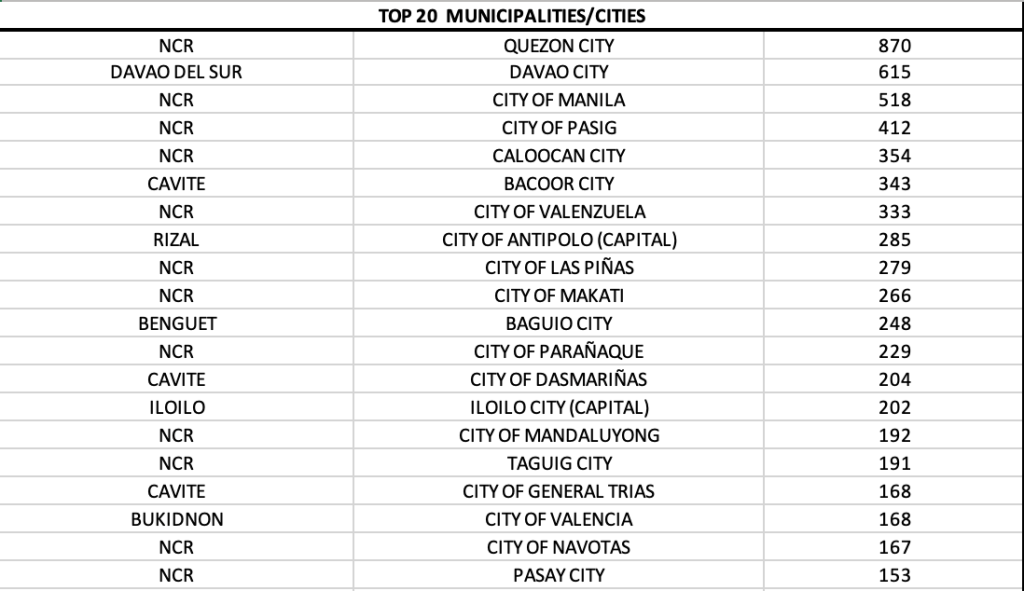
Among the top LGUs, 12 of 17 LGUs in NCR were in the top 20. Davao City came in second rank with 615 cases. Four LGUs from CALABARZON joined the list, while Baguio City, Iloilo City and the city of Valencia (in Bukidnon) rounded up the rest.
Let’s start with the data yesterday that was updated today. Aside from the 12,751 new cases yesterday, the health agency reports that there was an additional 5,132 new cases (making the real total at 17,883 cases for 09.08.2021). An additional 41 recoveries were recorded, but apparently no new deaths added.
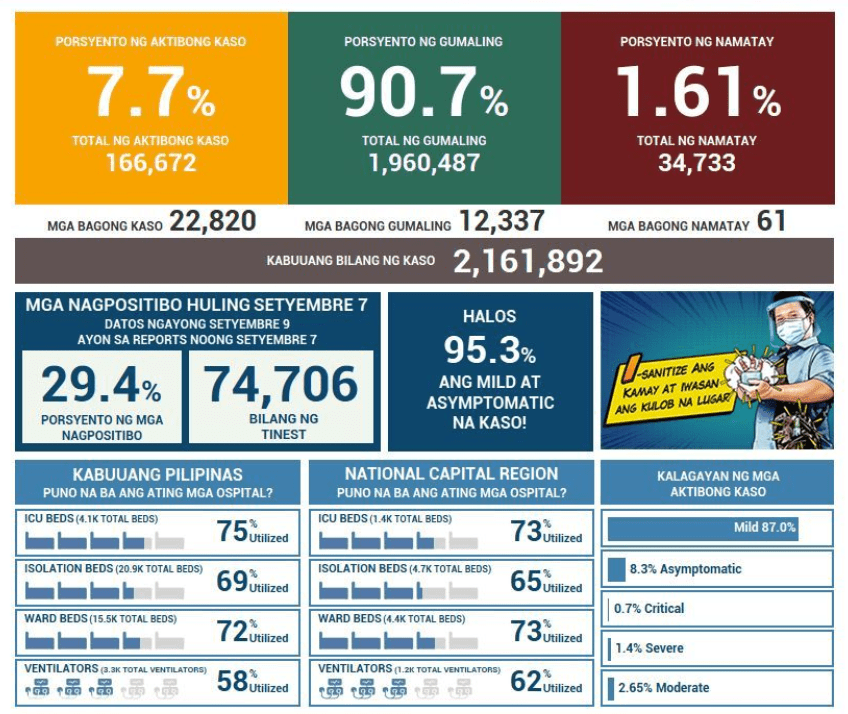
With the glitch fixed, the Health Agency waited till 830PM to upload the bad news. We have a new record high of 22,820 cases. And the 12,000 or so recoveries was not enough to avert the higher cases. This now pushes the active cases past 166,000 and will surely place the country within the top ten countries with highest new cases in the world tomorrow.
Today’s cases push the Philippines one notch higher, passing Peru for the 19th rank in the world with most COVID19 cases.
With close to 75,000 cases, the positive rate is also at a record high – 29.4% or 1 in every 3 people tested on September 7, tested positive.
The silver lining was the low new deaths of 61. This puts the case fatality ratio for outcomes at 1.74%.
While NCR reported more than 6,615 new case, we were peppered with the unknowns, where 1,696 of these were tagged an unknown LGU. It is either another “glitch” in data entry or really sloppy collection of data where 26% of the total cases in NCR had unknown locations. Five other regions reported quadruple digits as well – CALABARZON, Central Luzon, Ilocos, Central Visayas and Cagayan Valley. Ironically, there were no unknowns on a regional level.
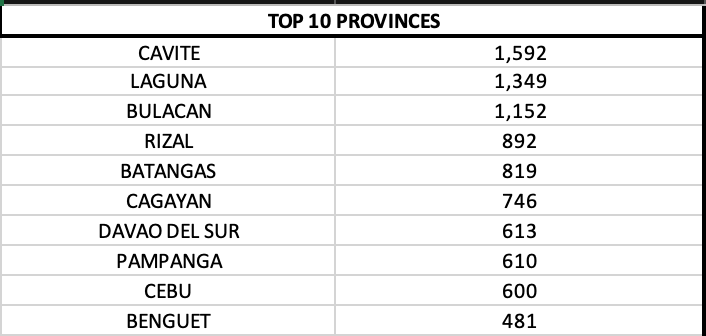
Cavite, Laguna and Bulacan reported quadruple digits on a provincial level, to top the provinces for the day.
In spite of the more than 1,600 unknown localities of the NCR cases, 11 of 16 LGUs were in the top 20 LGUs with most cases for the day. If there were more accurate data, most likely more LGUs in the NCR would have been in the top 20. Six LGUs from CALABARZON were also in the top 20 list.
OCTA MONITORING REPORT
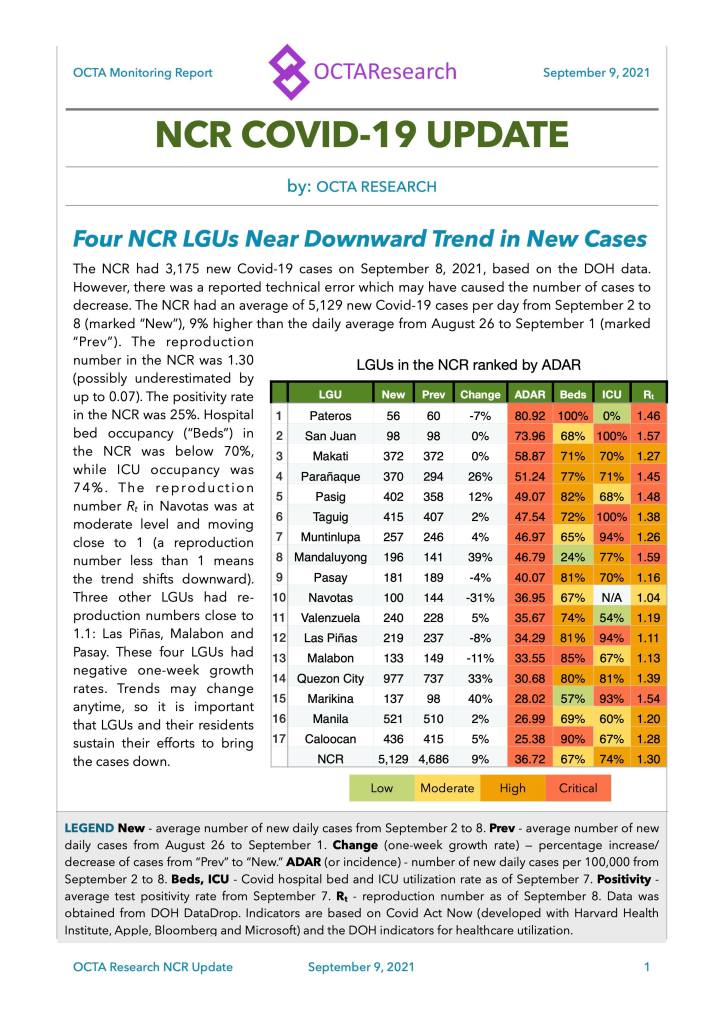
While there seems to be a minot downward trend in new cases in some LGUs in NCR, it is volatile at the moment. Given the fact that there is some resistance to continued lockdowns and not enough vaccines have been rolled out (remember the target is not 70% but should be 90% of the eligible population) in Mega Manila. There is also paucity of data among breakthrough infections, but this is understandable as this is under reported.
Nevertheless, the ADAR (incidence rate) remains critical in ALL the 17 LGUs in NCR, with Pateros, San Juan, Makati, Parañaque and Pasig having the highest. Bed utilization is critical in Pateros, Malabon and Caloocan. And the reproduction rate is highest in Mandaluyong at 1.59. Those included in the critical level are: San Juan, Marikina, Pasig, Pateros and Parañaque.
Navotas saw a significant drop in rate of cases (-31%) and had the lowest reproduction at 1.04.
No, it is real. Well, that’s the formal announcement of the Health Agency for the data today.
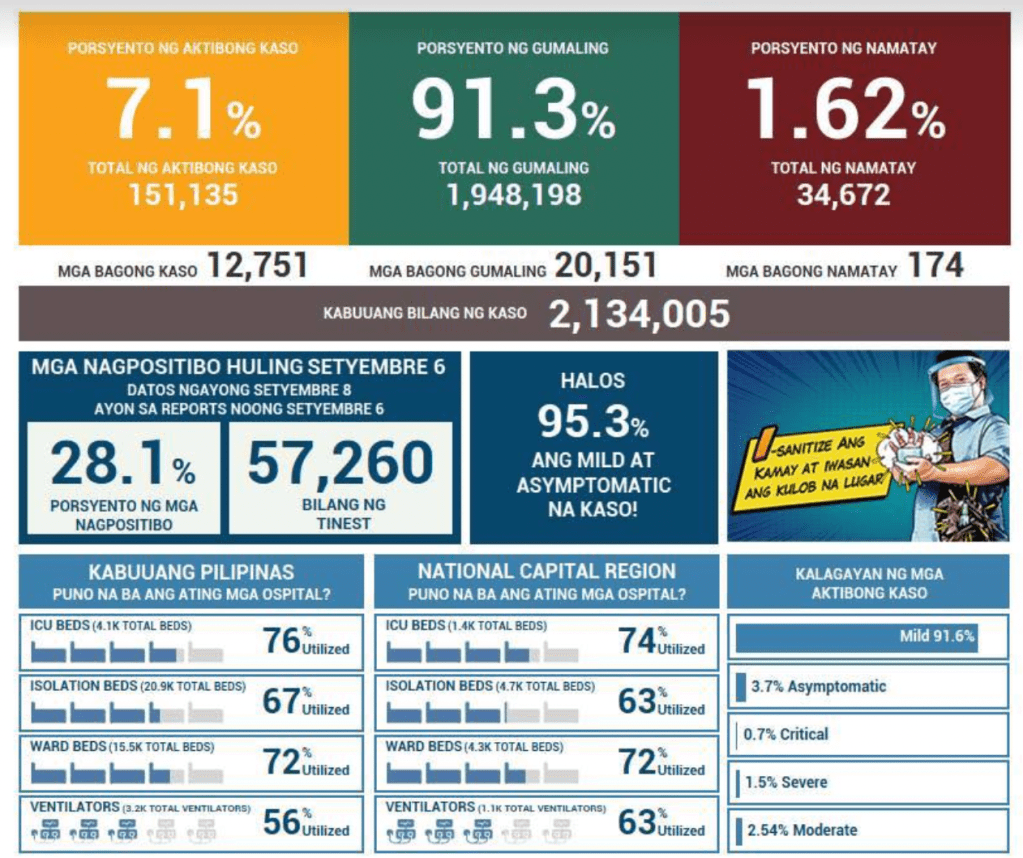
The Department of Health, in their late announcement today, reports, 12,751 new cases. With more recoveries today than cases, the active cases dip to a little more than 150,000.
Total tests done on September 6 (with 5 laboratories not reporting) was a little more than 57,000 for another high positive rate of 28.1%.
Total deaths reported today is at 174 placing the case fatality ratio for outcomes to 1.76%.
So it was a ‘technical glitch day’, hence accounting for the lower total cases today. Expect the ‘other unreported new cases’ to pour in within the week. The cases today are reported here as reported by the Department of Health in the data drop, and may not actually reflect the cases in the various levels (regions, provincial, LGU) because the the glitch in the DICT.
In spite of the glitch, it was still NCR, CALABARZON and Central Luzon that led the haul among regions, accounting for 55% of the day’s cases.
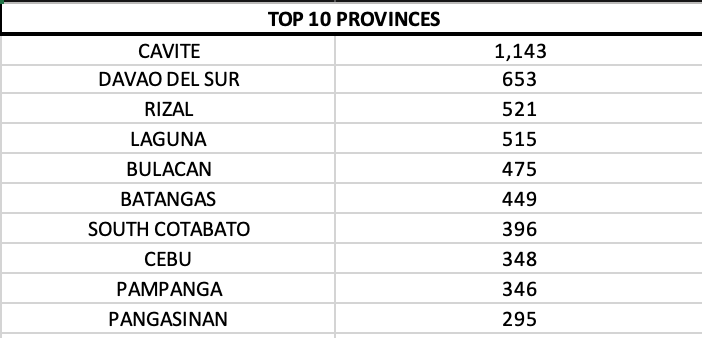
Cavite maintained its over-all provincial lead, while Davao del Sur came in second.
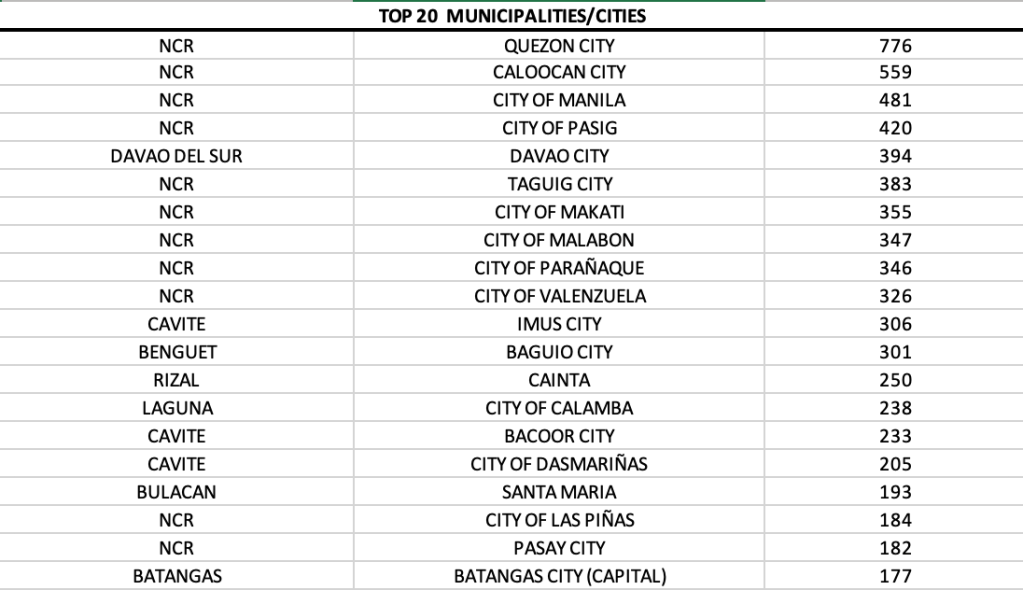
Among LGUs, NCR had 10 of its 17 LGUs in the top 20 list, while 6 LGUs came from CALABARZON. The city of Bacoor in Cavite was in fourth rank today.
It’s not too bad, but it’s the highest Tuesday we’ve ever had, as the Health Agency reports 18,012 new cases. Which is still bad. With an almost equal number of recoveries (as the recoveries play catch up to the new cases), the active cases hover at almost 160,000.
With more than 57,000 tests done on September 5 – the highest number of tests done on a Sunday – the positive rate is high at 28.1%.
Total number of deaths reported today is 161. The case fatality ratio is at 1.77% as of today.
ICU utilization is 75% at the NCR, and 76% on the national level.
On the ‘low Tuesday’, four regions reported quadruple digits – NCR, CALABARZON, Central Luzon and Ilocos Region. All remaining 14 regions reported triple digits.,
Cavite remained the trailblazer among provinces, but the provinces of Laguna, Rizal and Batangas, all from Region IVA were second to fourth rank today.
Eleven of 17 LGUs in NCR were in the top twenty. Six LGUs from CALABARZON joined the top 20 list.
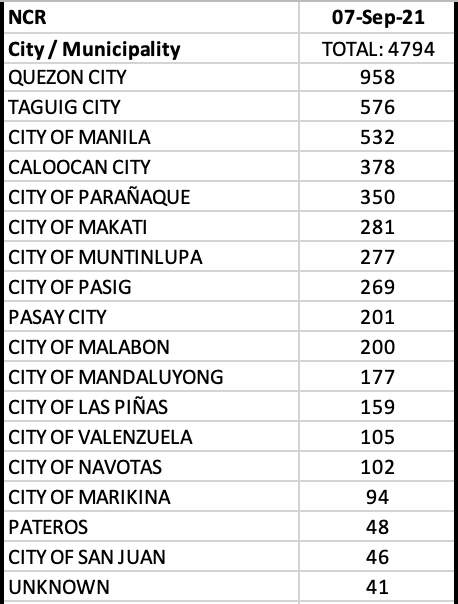
The unknowns are back in NCR as 41 of the 4,794 cases have no known location but are supposedly cases in Mega Manila.
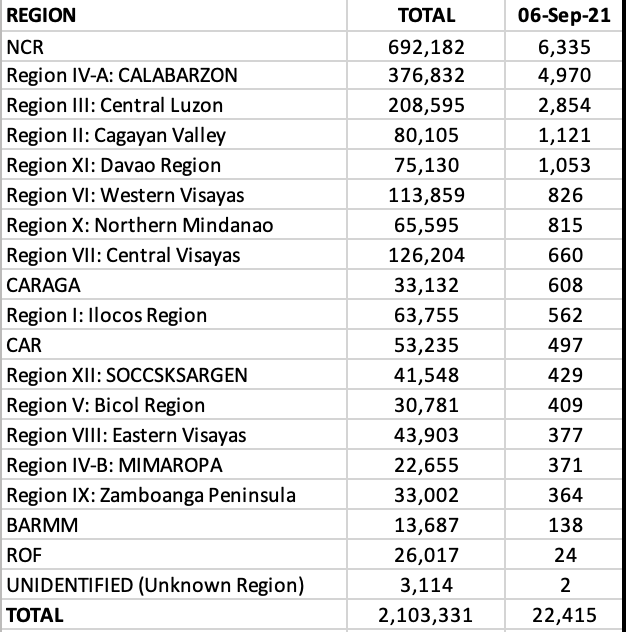
The Philippines records a new record high with 22,415 cases today. In spite the over 20,000 recoveries, the active cases are up at almost 160,000. We now have a total of more than 2.1M cases and most likely will overtake Peru in 19th rank, any time this week.
With more than 73,000 tests done last September 4, 2021, we also record a new high in positivity rate at 28.8% or almost 1 in 3 to 4 patients tested, tested positive.
New deaths today were at 103, putting the case fatality ratio for outcomes is lower at 1.77%.
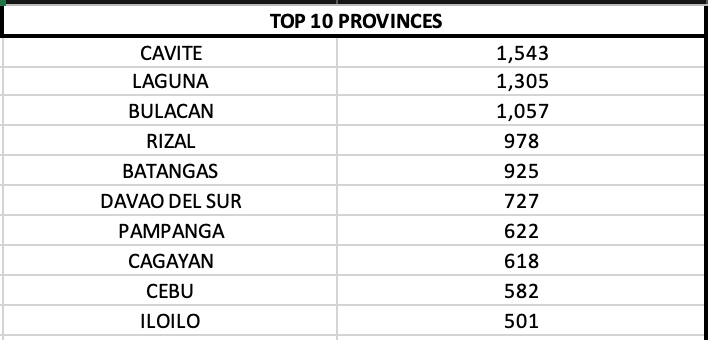
The NCR records also a record high of 6,335 new cases, with four other regions reporting quadruple digits. In fourth and fifth are Cagayan Valley and Davao Region. Again, it is important to emphasize that the erratic numbers and ranking in the different regions outside of NCR plus is secondary to the fact that the test results do not arrive at the same time. That lag, is something the Health Agency needs to fix. This lag is also due to the fewer laboratories outside of NCR plus. Results of patients from the other regions take a little longer to obtain.
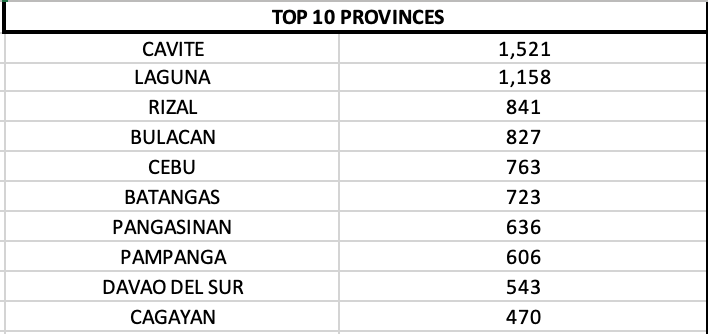
On a provincial level – Cavite, Laguna and Bulacan continue to rank 1-3 for the 3rd consecutive day.
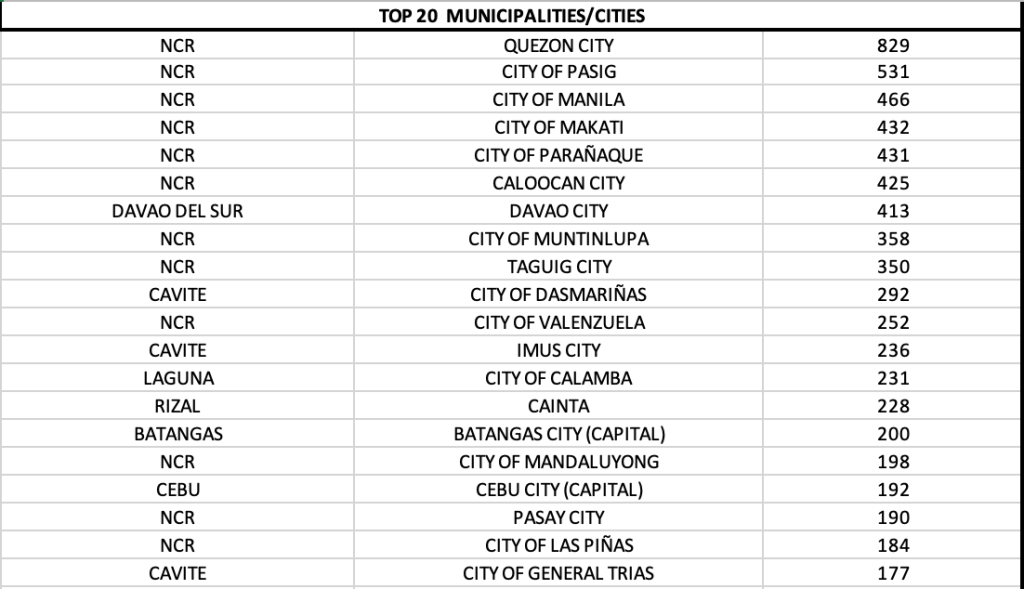
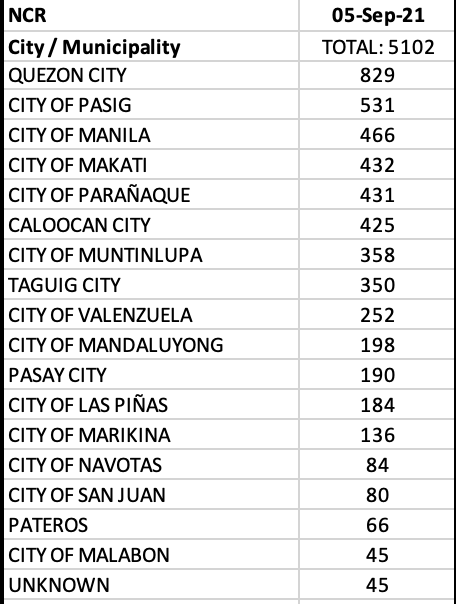
Twelve of 17 LGUs in NCR are in the top 20 cities with most cases with five cities from NCR in the top 5. Six LGUs from CALABARZON also make it to the top 20, with 3 from Cavite, 1 from Laguna, 1 from Batangas and 1 from Rizal.
PGC BIOSURVEILLANCE REPORT
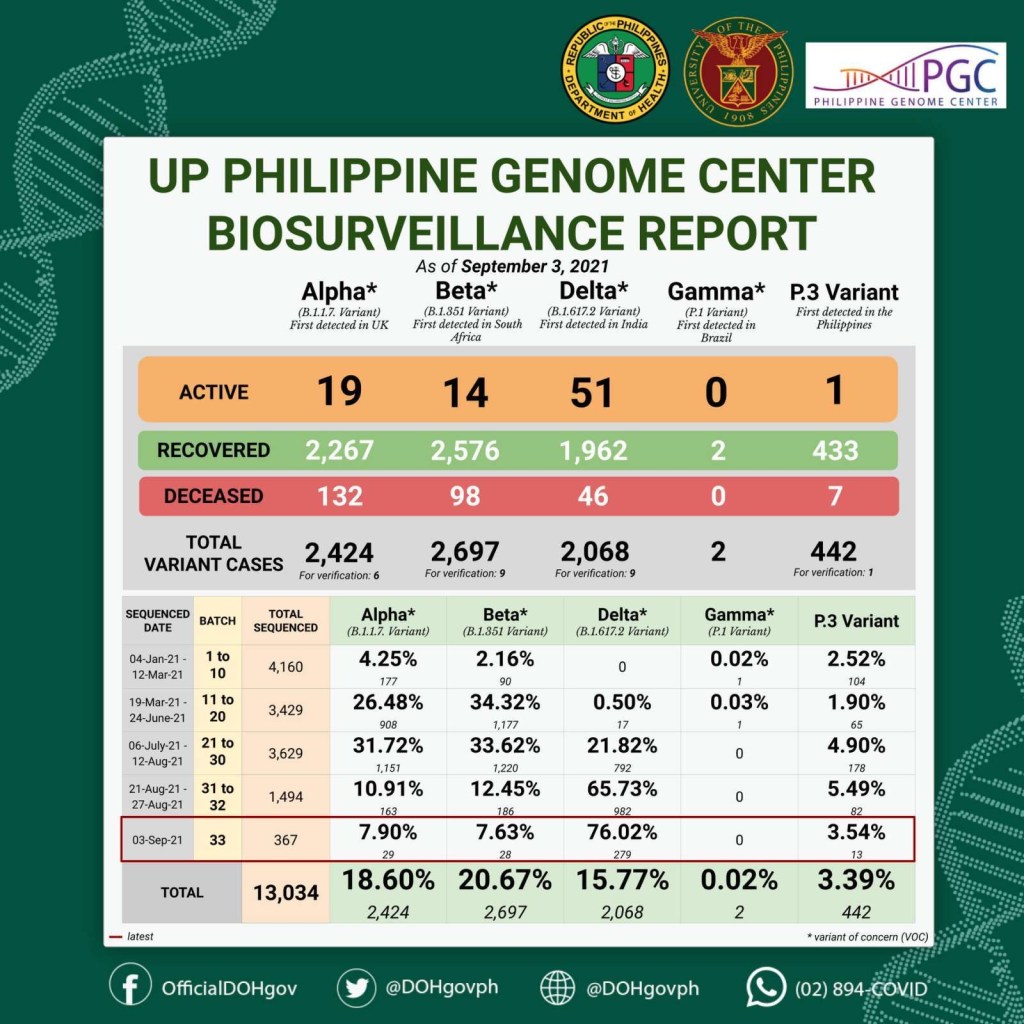
Without a doubt, the Philippine Genome Center Biosurveillance report shows that the shift in the major variant of concern in the country. Based on 367 sequenced samples on September 3, 2021, 76% of the batch were delta variants.
The Delta Variant, first detected in October 2020 in India show mutations at L452R and T478K. Its major concern is in the higher transmissibility, but to date has no evidence of effect on causing a more severe presentation.
Because it has the ability to partially but significantly escape neutralizing antibodies targeting the NTD and RBD, and polyclonal antibodies elicited by previous SARS-CoV-2 infection or vaccination, this may affect the number of cases we are seeing in spite of the vaccine roll-out.
The Health Agency reports another 20K day with 20,019 new cases today. With almost the same amount of recoveries, the active cases remain the same.
There were more than 73,000 tests done last September 3, with a very high positive rate of 27.5%.
New deaths announced today was 173, bringing the total deaths past the 34,000 mark and the case fatality ratio to 1.78%
Five regions posted quadruple digits today – NCR, CALABARZON, Central Luzon, Ilocos Region and Central Visayas. The erratic numbers see in regions outside of NCR plus is most likely from late reports from these regions.
Cavite, Laguna and Rizal retain the top three provinces for the second consecutive day.
Twelve of 17 LGUs in NCR and 6 LGUs in the CALABARZON region are in the top twenty cities with most cases. Only two LGUs in the top twenty – Davao City and Cebu City – are not from NCR plus.
THE WEEK IN REVIEW
While the reproduction rate has slowed down this week, this only means that the rise in cases has slowed down. Of course, it is unsettling that we are settling at getting used to the 20,000+ mark, as the Philippines records a 7-day moving average high of almost 18,000 new daily cases. There was a marked decline in death rate, and this may be attributable to two things – that the cases being recorded include breakthrough infections and are mostly mild (with a sprinkling of asymptomatic) and the fact that deaths are reported very late, we are not seeing more accurate reports for now.
While there are more tests done compared to the past weeks, they are mostly done among symptomatic patients. This accounts for the very high positivity rate, which is creating a daily record for positives. A high positive rate implies that we are not testing enough. Even with the increasing tests, the additional 15,000-30,000 tests is not enough. To bring the positivity rate to 10%, we would need to do at least 200,000 – 250,000 tests daily. Without adequate testing, contact tracing will fail.
On a regional level, we are one of the countries with highest cases, and has overtaken Thailand and Vietnam. Notice how well Indonesia has done in bringing down their cases. The data below is correlated well with the data on reproduction rates.
The reproduction rate of Singapore is still the highest in the region. This, however, takes into consideration the number of new cases and the population size of the country. While it is good news that the R in the Philippines has slowed down a bit, the number of cases is still increasing because the reproduction rate is still >1.0. And if you have a R >1.0 with a daily average of 18,000 cases, then that will only mean that we are not anywhere near to seeing a decreasing trend in cases. In short, we have not peaked yet.
Based on reproduction rate, the Philippines was bound to play catch up to Vietnam and Malaysia. Three countries are seeing an R that is less than 1.0 – Japan, Thailand and Indonesia.
To address the pandemic is to roll out the only preventive strategy currently approved globally – vaccination. While the Philippines has quite a chunk more of the 17% that have been vaccinated as fully vaccinated, the glut in vaccine availability becomes a challenge. The graph below simply indicates that the supply of vaccines is low, the roll out is slow and the distribution cannot therefore be a balanced one. If the supply was adequate then those that would have received at least a first dose would be way larger.
Because of the lack of vaccines for now, there is a need to stay on course to the original target of the much needed vaccines – the adult population. When the target for the adults have been reached, and there are available vaccines for the pediatric age group and booster shots, then these segments can be considered. The Philippines can also accelerate that full authorization for the Pfizer-BioNTech vaccine, which has recently been given the nod in the US. Doing so can make this vaccine available in the private sector, without the need for restrictions as provided in an EUA.
























 Relative Joy