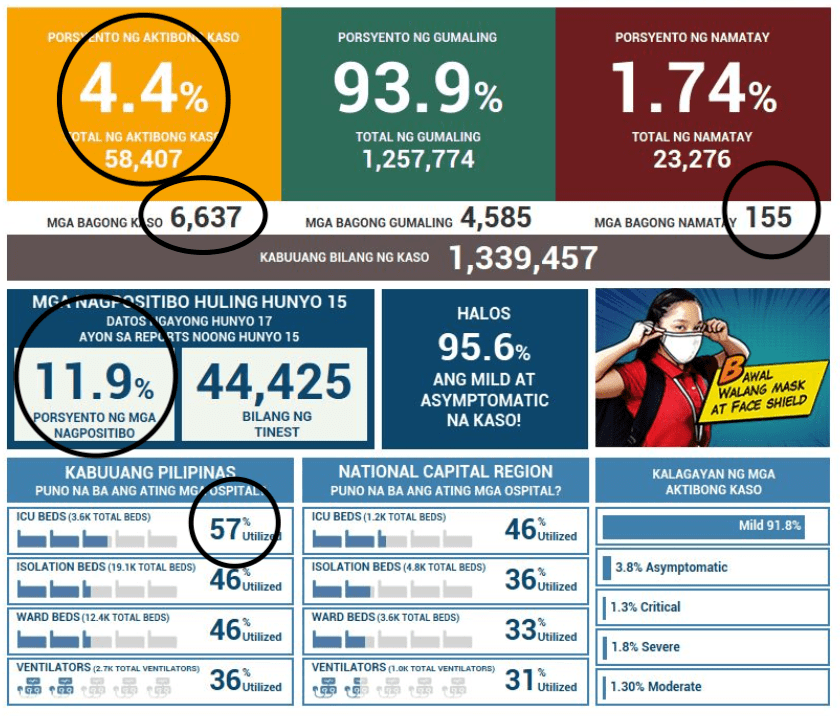
With a little more than 6.6K, and 11.9% positivity on 06.17.2021

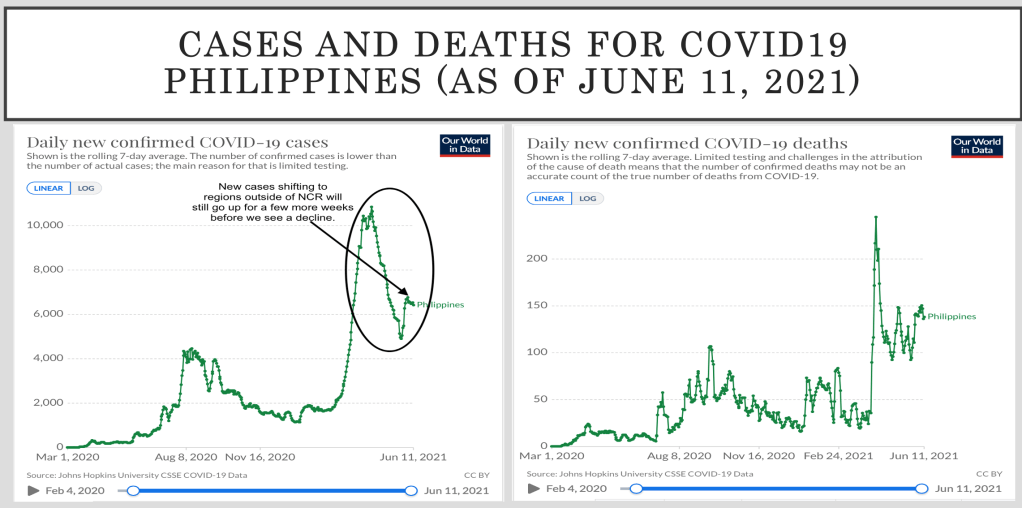
For the past weeks, the Philippines has averaged 6500 new daily cases. This 7-day moving average includes the low Tuesdays and Wednesdays and the high Fridays to Sundays. That’s because the report is based on tests done 2 days behind.

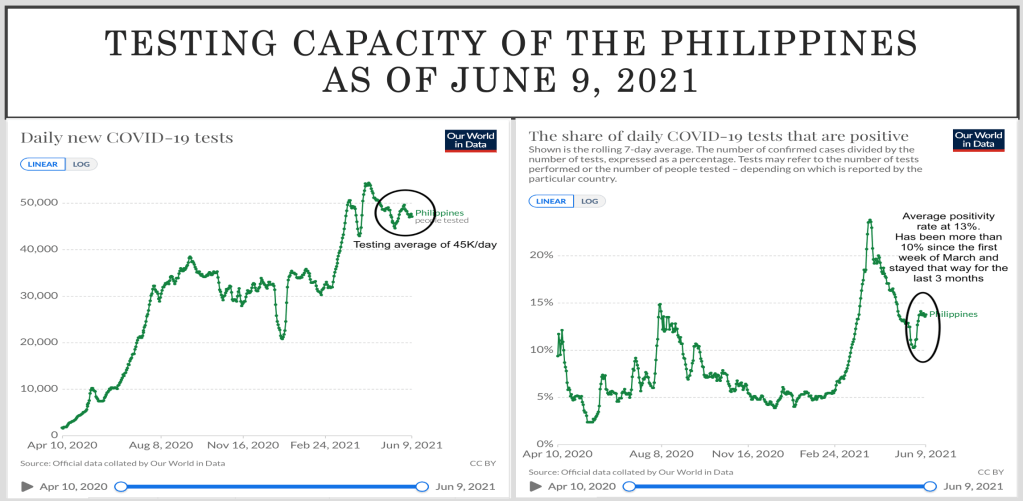
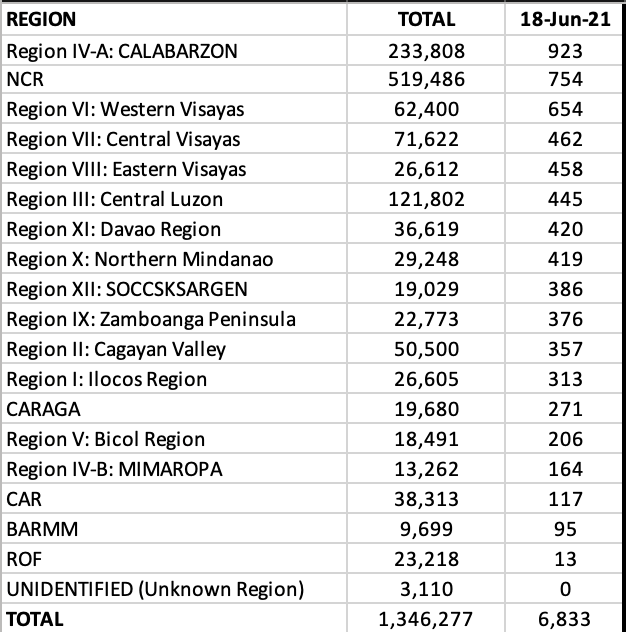
Today, the Health Agency announces 6,637 new cases as the active cases still hover around the 60K average. Todays cases are based on close to 45,000 tests done on 06.15.2021 with an 11.9% positivity rate. The positivity rate is being dragged up with the higher cases in the various regions outside of NCR, where testing sites are fewer and where it takes more than 7 days to release results because of the surge in cases. The health agency should allow the use of rapid antigen tests, particularly in symptomatic patients in these areas current experiencing insurmountable outbreaks so that they are able to complement the lack of testing in order to properly trace, isolate and quarantine early and appropriately.

With 155 new deaths today, the case fatality ratio for outcomes is now up at 1.82%.

After more than week trailing behind CALABARZON, NCR is back on top as the region with most cases with close to 1,000 or 16% (that sudden jump) new cases for the day. Western Visayas took the second rank, with Central Luzon and Davao Region overtaking CALABARZON, which landed in fifth. These five regions raked in more than 700 new cases each and accounted for 63% or almost 2/3 of the cases in the country today.

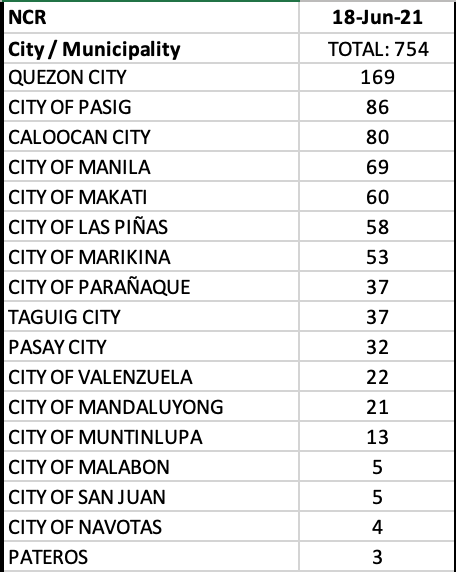
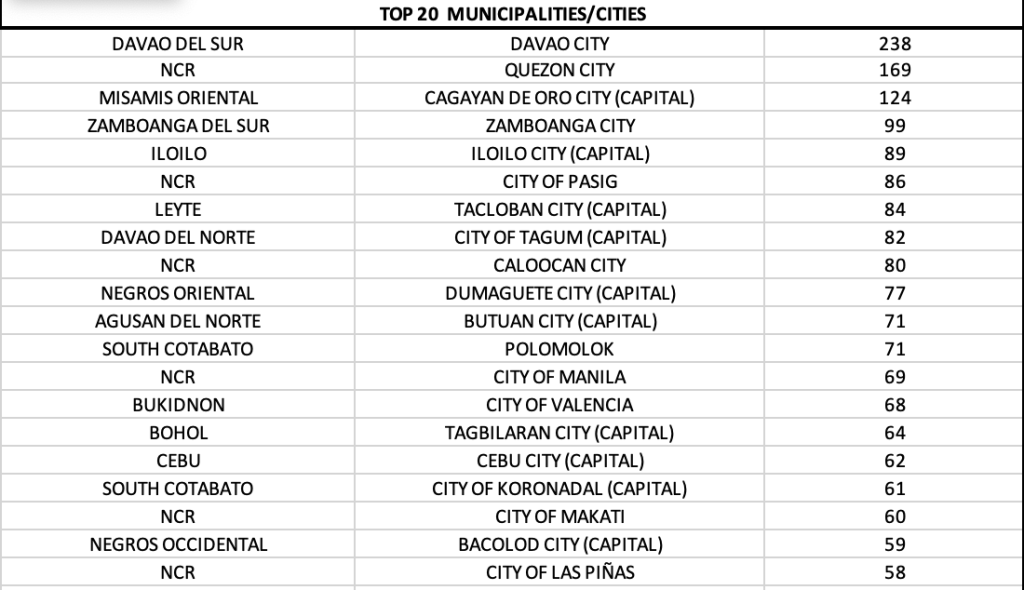
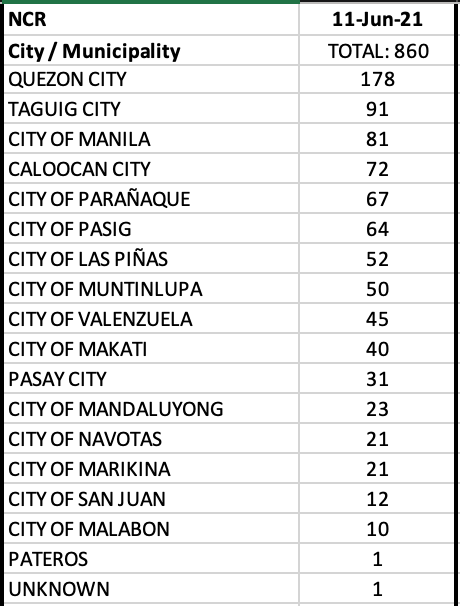
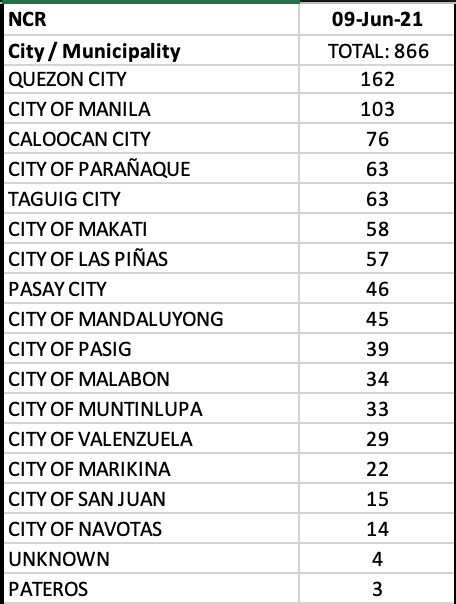
In NCR, Quezon City and Caloocan City reported triple digits for the day with 8 of 17 LGUs in NCR back in the top twenty cities with most cases.

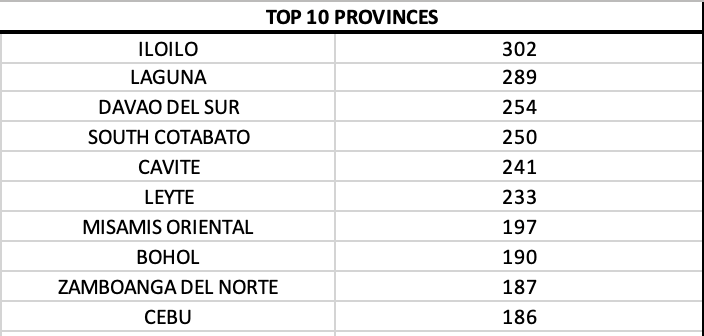
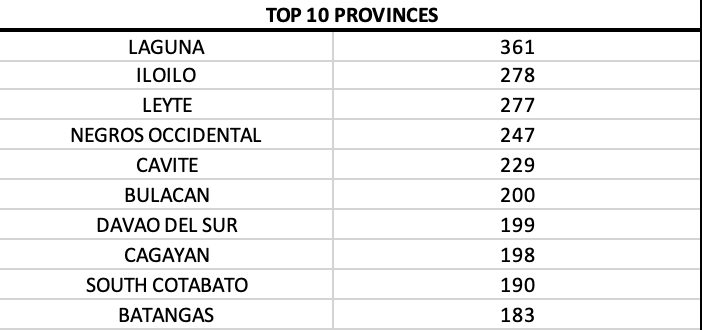
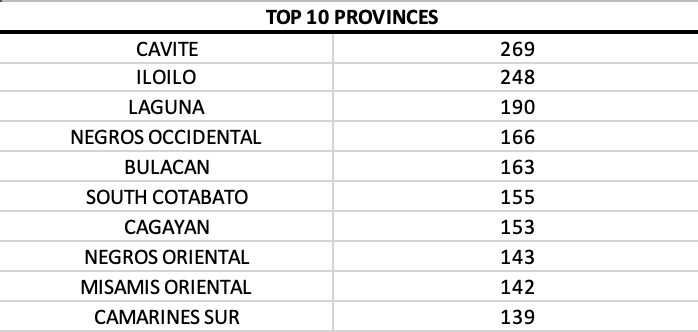
On a provincial level, it was Davao del Sur that led the pack, by a mile with 504 new cases and Davao City accounting for 482 of these cases – 96% in the province or 67% in the region. Negros Occidental and Iloilo province jumped into the top ten at second and third rank today.

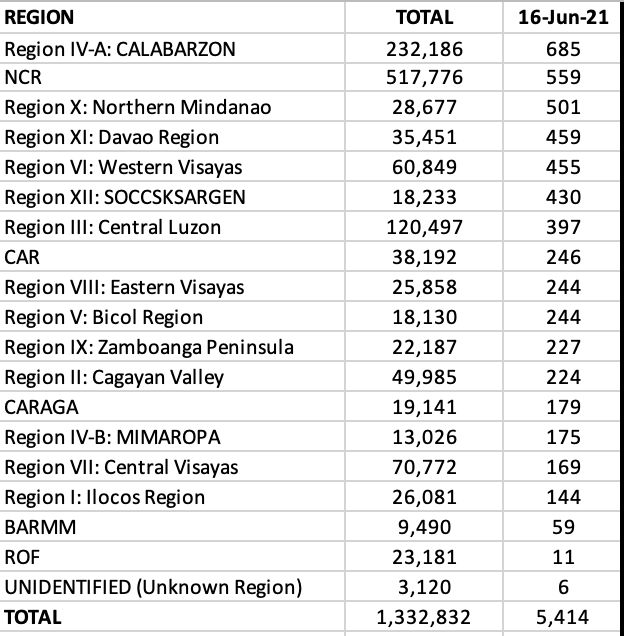
As NCR continued to decline in new cases, which region owns the bulk of the 5,414 new cases on 06.16.2021?

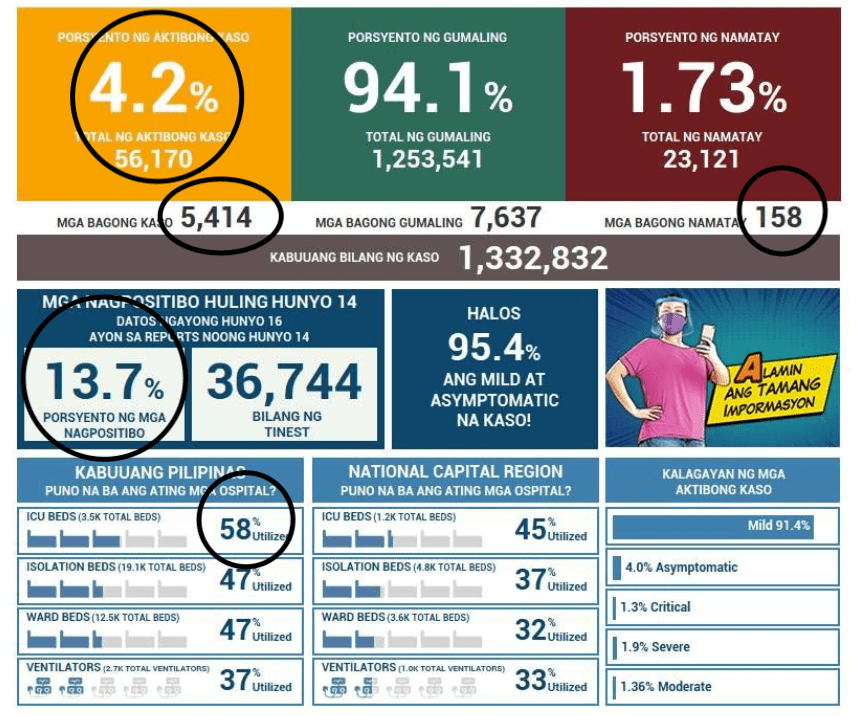
The Health Agency announced more than 5,000 new cases today (as it is a Wednesday) for tests done on June 14, 2021 in slightly more than 36,000 individuals resulting in 13.7% positivity rate. Many of the reported cases from the provinces, which have less PCR facilities are submitting delayed reports. Some of the tests done in May were reported only in June. This means that we will expect more cases in the subsequent weeks. It is also disturbing why the government refuses to utilize antigen swab testing in areas where the outbreak and the positivity rate is exceedingly high. A delay in releasing results for PCR tests make tracing and isolation/quarantine difficult and allows the disease to continue to spread.

With 158 new deaths today, the case fatality ratio for outcomes is steady at 1.81 percent as the total deaths now exceed the 23,000 mark. And rising.

CALABARZON led with most cases on a regional level. Except for BARMM, all regions continued to report triple digit cases.

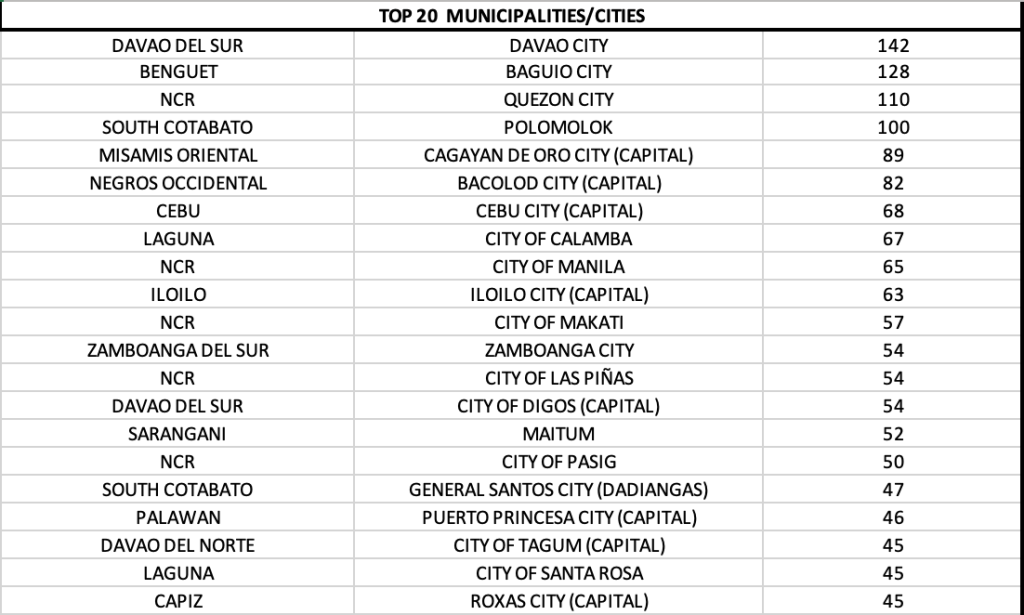
Among LGUs in NCR, Quezon City continued to lead with 110 cases, one of their lowest numbers to date. Two LGUs reported single digits – Malabon and Navotas. Pateros had zero cases. Five of the 17 LGUs in NCR were among the top 20 cities with most cases for the day.

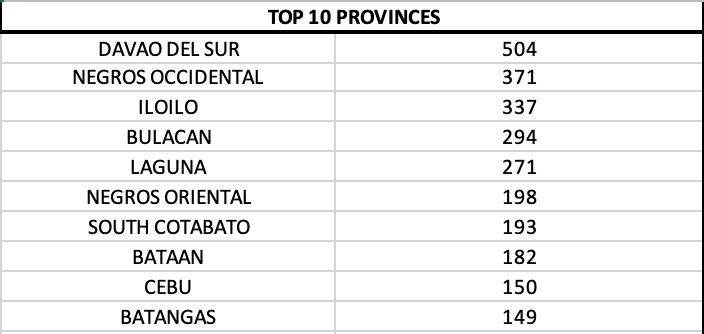
On a provincial level, it was Laguna that led for the day. Majority of the provinces in the top ten were from the Mindanao region. But this may not be a true reflection of the cases in the country, as many provinces do not have adequate testing facilities and results may take days or weeks to get accounted for.

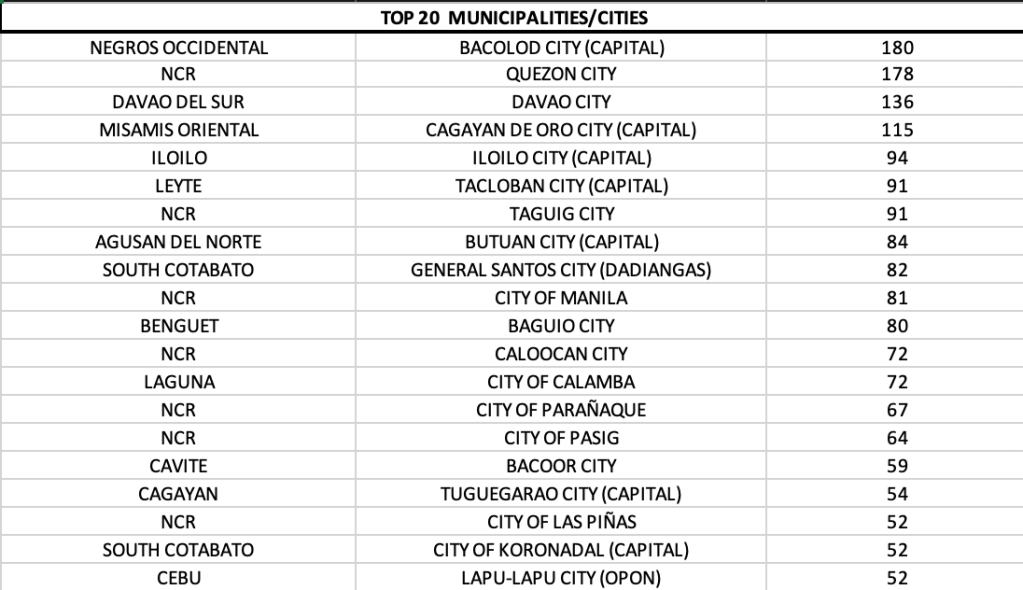
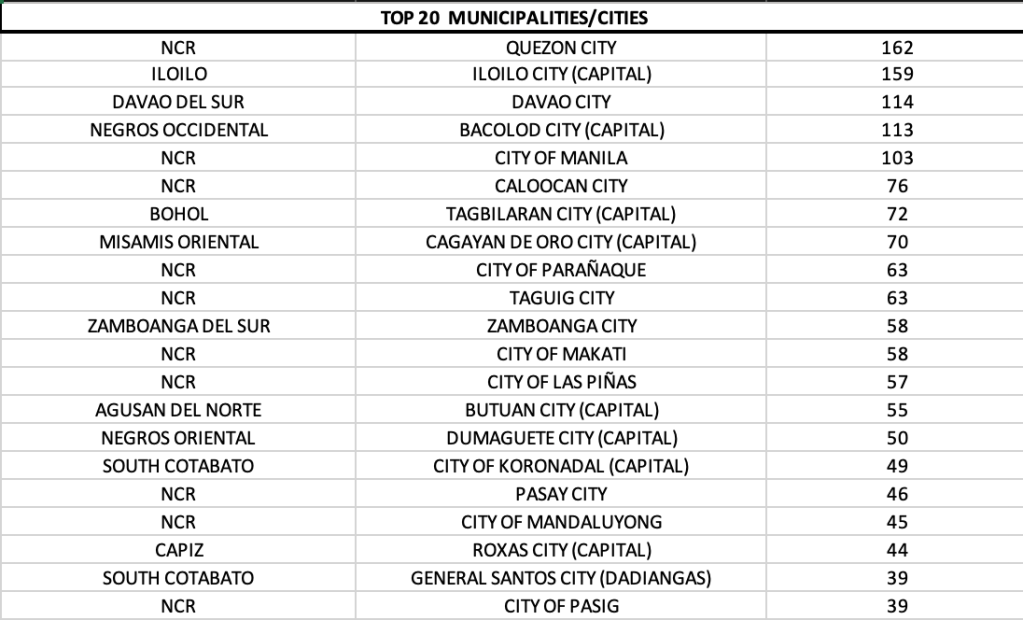
The top 5 cities with most cases were dominated by cities outside NCR. Only Quezon City was included and landed in third rank. Number one continued to be Davao City and Baguio City came in second.

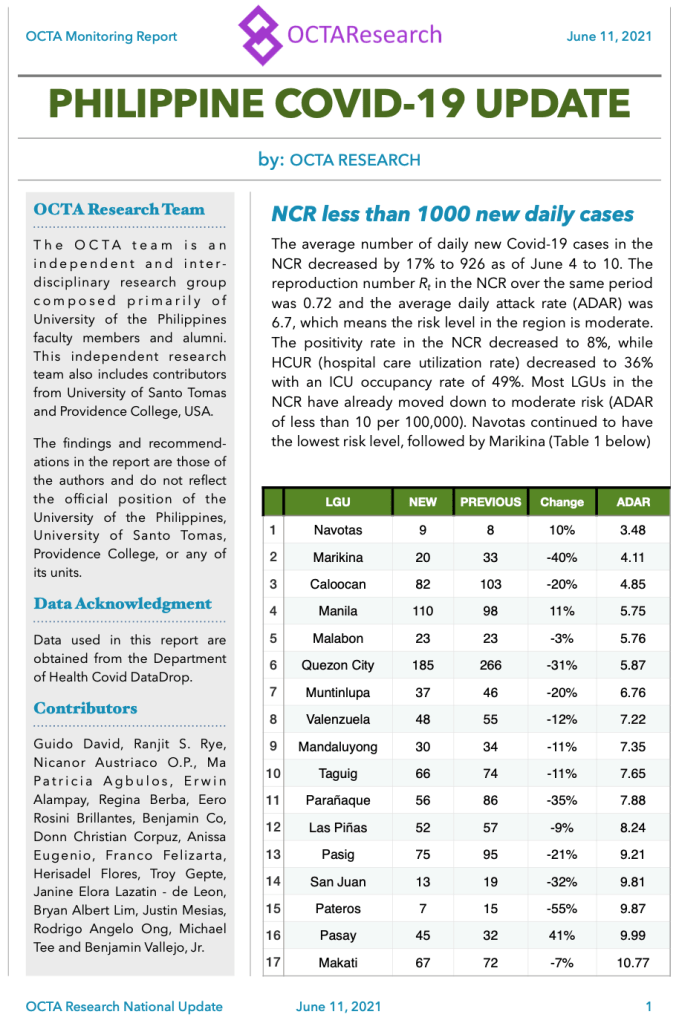
The OCTA Research Monitoring update for June 16, 2021, shows that new cases in the NCR continue to decline with an average of 829 daily cases over the week June 9-15 (13% drop from the previous week). The ADAR was lowest in Navotas and highest in Pateros. Health care utilization rate is also lowest in Navotas and highest in Pateros, while the intensive care unit use was at >70% in the cities of San Juan, Las Piñas, and Parañaque. The over-all positivity rate is at 8%, much lower than the national positivity rate of >13%.

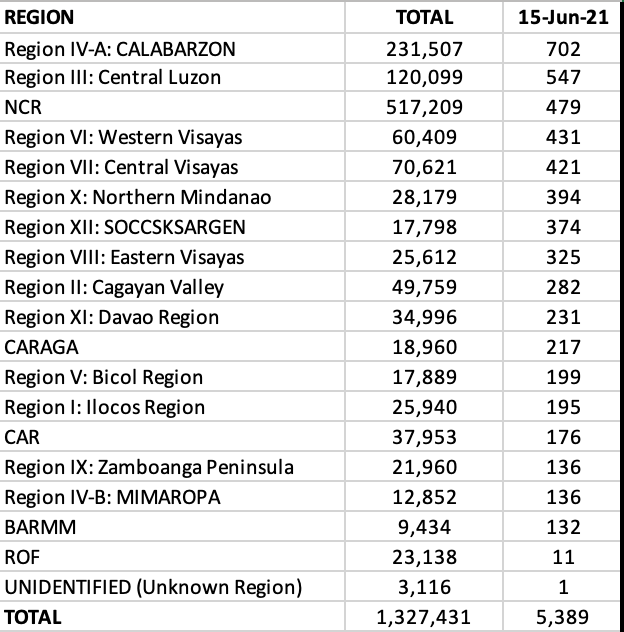
Because it is a Tuesday, 5,389 new cases on 06.15.2021

The Tuesday will always bring in 20-30% lower cases than the daily average.

The Health Agency today announces 5,389 new cases for a little more than 30,000 tests only, done last June 13. The national positivity rate is higher at 13.9% as most of the cases we are seeing now are outside of NCR, where testing facilities and healthcare resources are direly lacking. As the fire rages in the periphery, it is inevitable that provinces seeing higher cases go into stricter lockdown measures, improve border controls, and use the concept of travel and business bubble in the areas to contain the spread of the pandemic.

With 118 new deaths, the case fatality ratio for outcomes is steady at 1.81 percent.

While there were relatively lower cases today than the past days of the week, all regions continued to report triple digits. CALABARZON remained on top with the NCR down to third rank. Most of the regions with higher cases are still from the VisMin area.

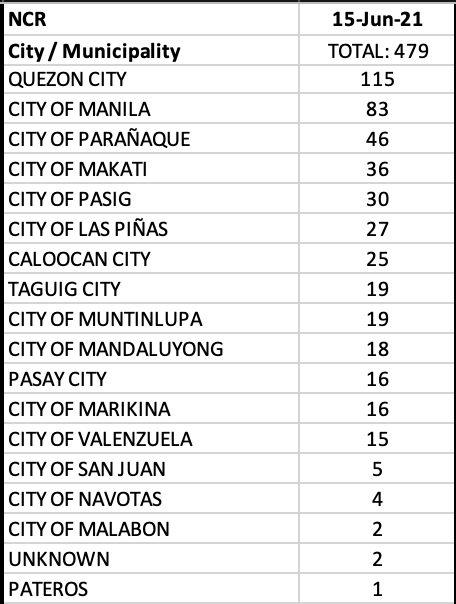
LGUs in NCR continued to report less cases, including Quezon City. But that is because there were 16 testing centers that failed to submit reports. Most of the cases reported outside of NCR plus are late reports. We should expect a rise in cases in the coming days, particularly from the regional areas outside of NCR plus. Only three of 17 LGUs in the NCR made it to the top twenty cities with most cases.

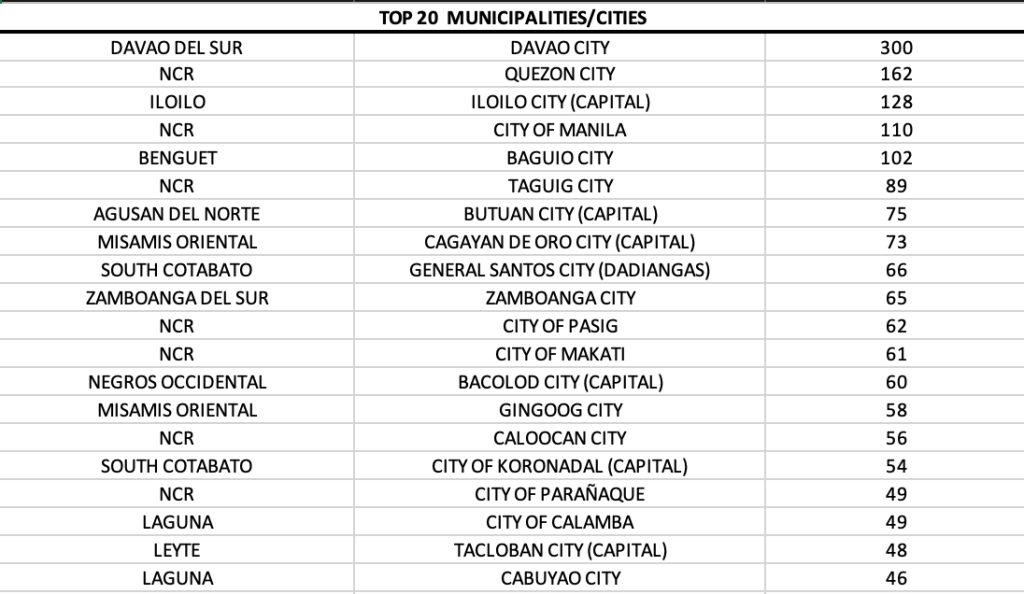
On a provincial level, Cavite is back in the leader board. While Davao Region reported only 231 cases, and Davao del Sur was not even among the top ten provinces, Davao City (together with Bacolod City) shared the limelight as the city with most cases at 126, out sprinting Quezon City.

With 6K plus, the difficulty of the provinces is palpably felt on 06.14.2021

Today’s Health Agency reported 6,426 new cases with active cases still hovering around 60K. Note that todays cases are based on June 12 with more than 40K cases and a difficult positivity rate at 13.7%.

There were 57 new deaths announced today, which puts the case fatality ratio at 1.81%.

The good news is that no region reported quadruple digits today. Not even CALABARZON.

The bad news? All the regions in the Philippines reported triple digits.

CALABARZON continued to lead the pack, but the NCR is back in second slot and Western Visayas in third. Note that the erratic figures coming in from the regions outside of NCR plus, Davao Region and Central Visayas, are due to the fact that there are fewer testing facilities in other areas. When results are released, there are occasional bursts of cases in these areas. Using a 7-day average report (as provided by OCTA) is a better indicator of the testing capacity and cases in these areas.

In the NCR, Quezon City and Manila managed to report triple digits for the day. Six of 17 LGUs in Mega Manila remained among the top twenty cities with most cases.

On a provincial level, it was Davao del Sur that topped the provinces, followed by Laguna and Iloilo Province.

Davao City contributed to the majority of cases in the province of Davao del Sur, and being responsible for why Davao City had the most number of new cases of COVID-19 on a city level, today. Two other cities outside of NCR were among the top five for the day – Iloilo City and Baguio City.

As the cases in the provinces see an upward trajectory, one can see how the frail healthcare systems outside of more urbanized areas can easily be overwhelmed even with simply triple digit cases. No province has experienced the same quantity of cases as Mega Manila. With limited resources, even the most urbanized city outside of NCR will definitely feel the pressure on its healthcare system, and can result in higher death rates because of the deluge of cases.

Western Visayas, for example, has been in MECQ for quite some time and even this level of lockdown has continued to inundate the region with more cases in the past week.

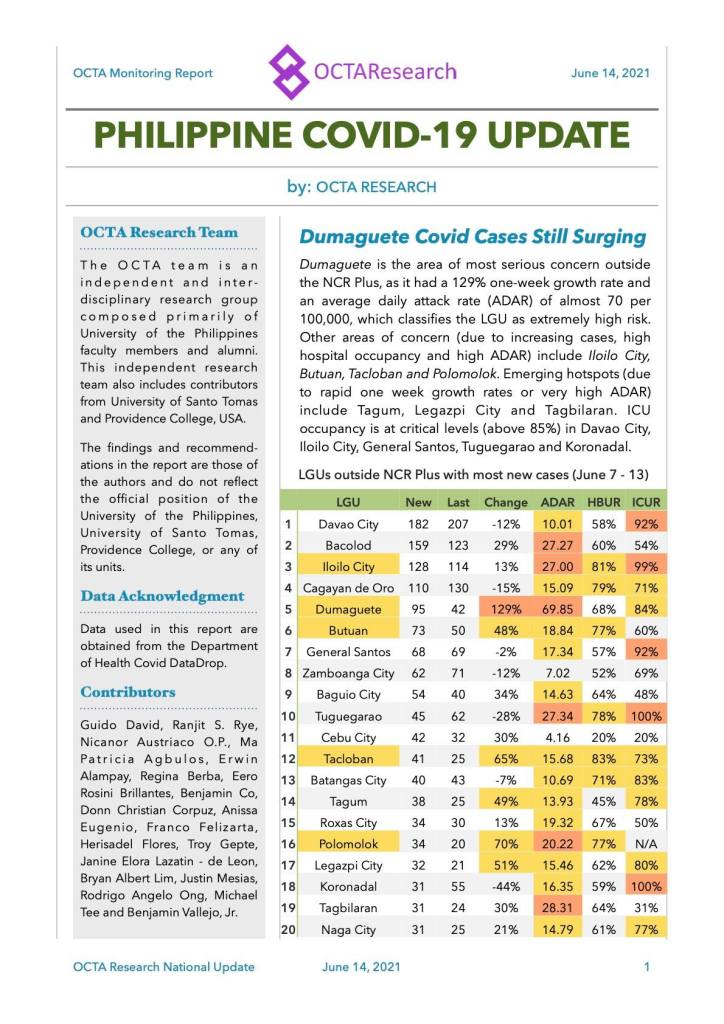
In the latest OCTA Monitoring Report, Dumaguete is the area of most serious concern as its one-week growth rate continues to escalate, its average daily attack rate is almost 70 per 100,000 population and the intensive care unit utilization is at critical levels.

The list below provides a look into LGUs outside the NCR plus, that has the most number of new cases from June 7-13, 2021. While Davao City remained in the lead, it has managed to bring down the number of new cases and its ADAR as well. However, ICU rate is unsettling at 92%.

The IATF may want to rethink on the quarantine status of some of these LGUs and move them to one where mobility is more restricted in order to stem the continued transmission of spread of the virus in select regions.

With more than 7K on 06.13. 2021 and 8th in global rank yesterday, cases outside of NCR bring the haul

With 7,302 new cases today, from more than 50,000 tests done on June 11, with a positivity rate of 12.4%, the active cases remain close to 60,000. The over 8,000 cases yesterday was more than enough to take the Philippines back among the top ten countries with most cases in the world.

Cases in regions outside of the NCR are accounting for the higher number of daily cases and the healthcare and intensive care units in these areas significantly burdened.

With 137 new deaths reported today, the case fatality ratio for outcomes is at 1.81%.

The National Capital Region moves a notch up to third, but remains behind CALABARZON and Western Visayas, and accounts for 11% of the daily total. Regions in Visayas and Mindanao continue to haul in cases for the day.

There were 7 of 17 LGUs in NCR that were in the top twenty cities/municipalities with most cases, with Quezon City and Manila leading the pack with triple digits.

On a provincial level, Negros Oriental was in first spot for the first time. This was followed by provinces in Region VI – Negros Occidental and Iloilo.

Quezon City was displaced to fifth over-all among cities with most cases in the country for the first time. The four cities that overtook it were from outside NCR – Bacolod, Davao City, Iloilo City and Dumaguete City. Surprisingly, Cebu City and Muntinlupa City are back in the top twenty cities with most cases today.

The week in review provides us an quick look at how the Philippines is faring compared to some of our Asian neighbors that also went through new surges and limited mobility measures. Unlike the Philippines, however, the mobility measures in other countries did not drastically affect their economies as there was no one size fits all rule. TTIQ (testing, tracing, isolation and quarantine) measures are standardized by the national government, and consistently implemented across all areas in their nation.

First is the hardy positivity rate. Based on the PH-DOH website, as of June 08, 2021, there are 260 accredited testing centers using rRT-PCR or cartridge-based PCR in the country https://doh.gov.ph/licensed-covid-19-testing-laboratories. However, 109 (42%) of these are all located in the National Capital Region. While NCR has the largest population per density (23,500 people per sq km), the imbalance in distribution of operational testing sites are more for economic rather than health policy reasons. For example, region III (Central Luzon) has 22, region IVA (CALABARZON) 21, region VII (Central Visayas) 20, and region XI (Davao Region) with 11 testing facilities.

The remaining regions have a sprinkling of testing facilities. Region IVB (MIMAROPA) has only 5 accredited testing sites – with 2 only for Palawan. The recent outbreak and rise in cases and positivity rate in Palawan is attributed to lack of testing. Region VIII (Eastern Visayas) that is seeing a dramatic increase in cases is also beset by lack of testing facilities with only 3 accredited sites – 2 located in Tacloban City and 1 in Ormoc City. The maldistribution of testing facilities in the regions outside of NCR leads to under testing and eventually, a high positivity rate.

Why does testing matter?

When people are not tested, we do not know who has COVID-19 infection. When people are not tested, it would be difficult to do contact tracing, and the infection just continues to spread. When people are not tested, isolation and quarantine cannot be done, and the disease sadly proliferates.

Second is the sudden shift in cases to the regions outside of NCR. As cases began to decline in mid-May, this decline did not last. As in the first surge, when the NCR had gone into stricter quarantine measures, many people in classes D and E needed to survive. The exodus back to their home provinces most likely accounted for the rise in cases in the regions. The second surge became more difficult because the hospitals not only filled up, overflowed, and resulted in a near catastrophic collapse of the health care in Mega Manila. As the second surge was deadlier, with cases tripling the cases of the first surge, another exodus, was inevitable.

With variants of concerns spreading in various regions, the porosity of our borders together with a drive to stimulate tourism became a triggering factor for the sudden upward shift of cases before it could even drop to levels less than 2,000 cases. Mobility was inevitable as the economy took a beating. Economy needed to be revved up because 2022 is election year.

How do you rev up an economy based on the science of lockdown measures?

While lockdowns help bring down cases significantly, it should be used cautiously and judiciously. It is a measure of last resort. If a government has a good TTIQ pillar in place, it will not need to resort to lockdown measures to address every surge. It is why data analysts do what they do. Following the data provides eyes for the government to see what is going on on the ground. When, why and how measures should be instituted and what economic activities should be allowed. Only a science driven policy should be used for deciding the level of lockdown measures.

Finally, there is the vaccination roll out.

In the figure below is a summary of the status of COVID-19 vaccinations in select Asian nations. The Philippines isn’t doing too bad, but it isn’t doing too good as well. That is because most of the vaccines we current receive are donations. The donations came in trickles, and the full purchases of the national government are coming in aliquots as well. Because of this, the vaccination drive could not be put into full gear and had to be appropriated to the more vulnerable population first, and the hardest hit region – the NCR – ahead.

To date, less than 1.5% of the total population in the Philippines has been fully immunized.

The target of herd protection, however, is a challenging one because of the diversity of vaccines the country received, is receiving, or has bought. As various COVID-19 vaccines vary in efficacy, so will the number of people that will need to get immunized to achieve herd protection. A vaccine with 50-60% over-all efficacy will most likely need 100% of the population immunized as against a vaccine with 95% efficacy, which may render herd protection when 70% of the population are vaccinated.

We need to remember that getting a single shot of the vaccine (for 2 dose vaccines) will not provide adequate protection. Yet. It will take two to four weeks after the second dose before any immunologic response can even be guaranteed. With the tepid vaccine rollout and the rollout in limited locations because of inadequate supplies for now, caution and appropriate science based strategies should be taken when reopening the economy.

Finally, here is where we stand together with our next door Asian neighbors.

With today’s numbers, will the Philippines land again among the top ten nations with most cases in the world in tomorrow’s daily tally?
Over 8K cases and 145 new deaths, regions outside of NCR have healthcare facilities that are failing on 06.12.2021

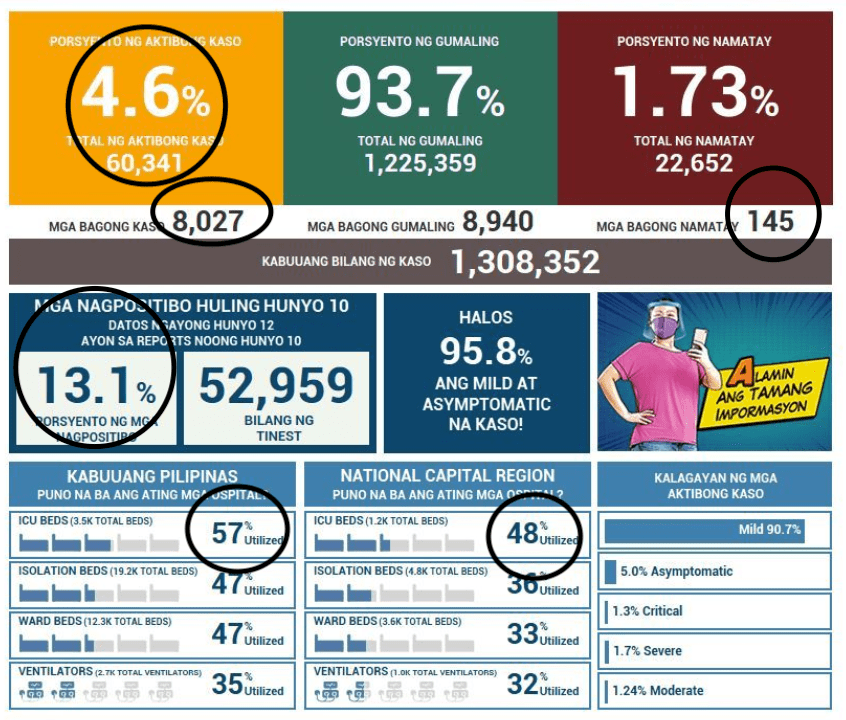
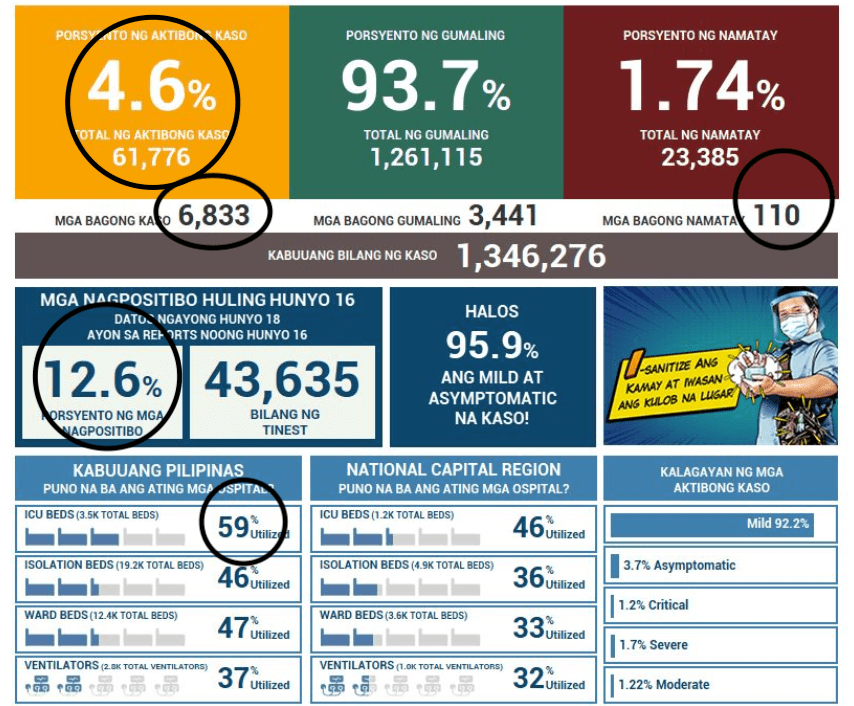
The last time the PH breached the 8,000 mark was two weeks ago. Today the Health Agency reports 8,027 new cases, for over 52,000 tests done last June 10. In spite of having slightly more tests, the positivity rate remained over 13%. Without a doubt, we are not testing enough.

Troubling are the consistently higher new deaths reported, with 145 for today. This brings the case fatality ratio for outcomes steady at 1.82%. This is underestimated considering that the outcomes of more than 60,000 current active cases have not been resolved. Even if the Health Agency reports that almost 95.8% are mild or asymptomatic, this data is obtained AT THE TIME OF THE TEST. It does not reflect the ultimate outcome of patients and how many of them eventually progressed to moderate, severe, or critical. Deaths will always be reported much later, usually 4-8 weeks after the patients have died. As we tread higher numbers, expect more deaths to be announced in later dates.

The shocker of the day is the ranking for NCR, that has slipped significantly to fourth rank and accounted for only 10% of the new cases on Independence Day! On top is CALABARZON, followed by Western Visayas and Central Luzon. The continuing rise in cases in the regions is worrisome considering that this is the first time a region outside of NCR has registered quadruple cases.

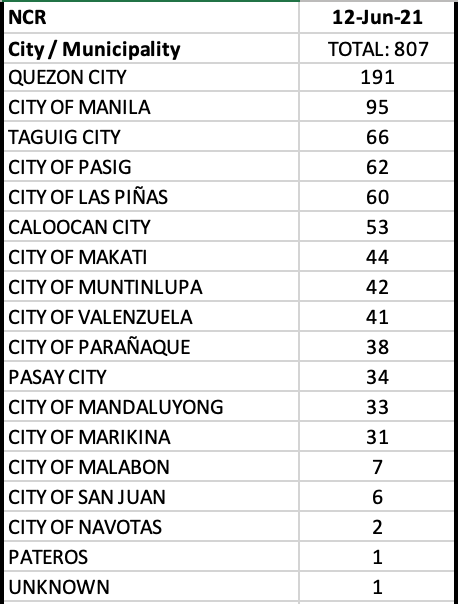
While NCR has registered lower cases now, it is still Quezon City that continued to lead with close to 200 cases. Four cities/municipalities reported single digit numbers. Six of 17 LGUs in NCR were among the top twenty cities and municipalities with most cases.

With the high numbers in Western Visayas, the provinces of Negros Occidental, Iloilo and Negros Oriental ranked first to third today. Batangas and Laguna accounted for the bulk of cases in CALABARZON.

The city of Bacolod topped the cities with most cases in the Philippines, followed by Davao City. Quezon City for the first time, came in third. On a day with more than 8000 cases, the top five cities with most cases aside from Bacolod and Davao were Iloilo City and Dumaguete City. (Eight of 10 cities in the top ten were outside of NCR).

The OCTA Research Monitoring report for June 12, 2021 is divided into provinces and LGUs with most case cases.

In general, there was a minuscule decline in cases from June 5-11, the reproduction number for the country is >1.0. This is not good because it implies that we are plateauing at a very high daily average. This would mean that at an average of 6500 daily new cases, total new cases in a month would approximate to around 200,000. This is on the presumption that the reproduction rate stays at 1.0. There will be more than 1.4M cases on or before June 30 and while NCR now owns <15% of the total daily cases, 85% of the daily cases are scattered in regions that have lesser capacity for extensive health care and resources at managing COVID-19 cases – from quarantine to confinement to intensive care utilization.

Notice that during the beginning of the second surge, NCR plus accounted for 94% of the new cases from March 29 – April 4. Today, NCR plus (NCR, Cavite, Laguna, Bulacan and Rizal) account for around 27% of the new COVID-19 cases. The total population of the National Capital Region alone is around 14% of the population of the country. While the new cases now are more ‘controlled’ in Mega Manila, the return of people from the regions back into the NCR together with the increasing laxity in quarantine restrictions in NCR may pose a challenge to the gains made in Mega Manila, in spite of the vaccine roll out. Vaccines do not work immediately. There should be pacing when reopening the economy in the NCR as getting vaccinated and reopening economies simultaneously may prove to be a false sense of security and end up with an eventual rise in cases in NCR.

While it is NCR that led in the total average daily cases, several provinces in Visayas and Mindanao were seeing increasing rates and burdensome Healthcare Utilization Rates. Iloilo, Cagayan, Misamis Oriental, Negros Oriental and Agusan del Norte had HCURs >70%.

For the second week in a row, Davao City had more daily average cases than Quezon City. The growth in new cases in Davao City, however, has quickly slowed down. On a LGU level, Cagayan de Oro, Iloilo City, General Santos, Taguig, Tuguegarao, Bacoor (Cavite), and Cotabato City are seeing Intensive Care Utilization Rates (ICURs) of more than 90%. Zamboanga City, Las Piñas, Koronadal, and Calamba (Laguna) are at more than 70%.

NCR vs LGUs outside of NCR: Are the cases slowing down on 06.11.2021?

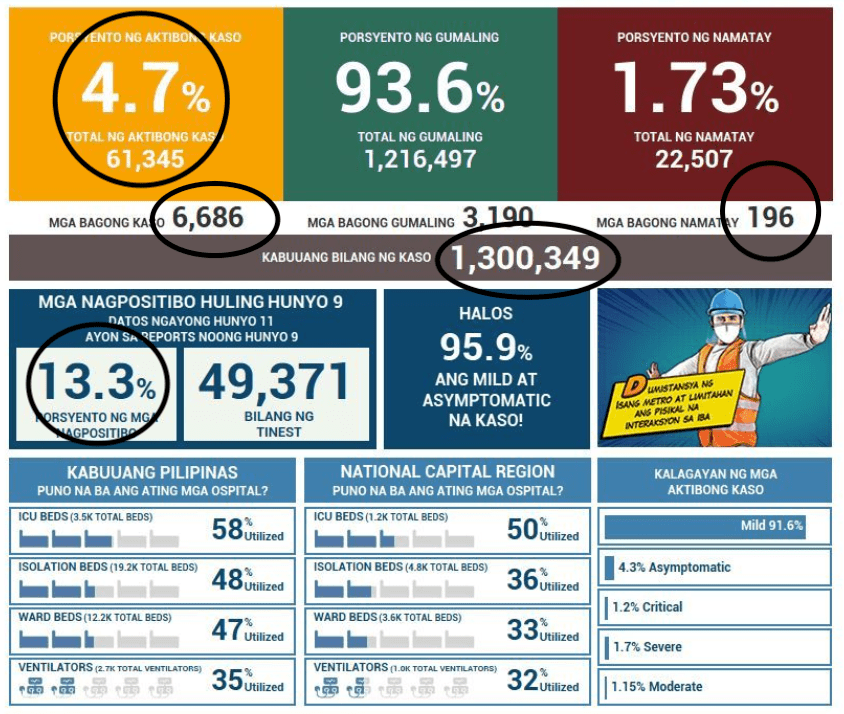
As the Health Agency announces 6,686 new cases today, the Philippines officially crosses the 1.3M mark for COVID-19 cases. The cases today are from reports last June 9, with close to 50,000 tests done. However, this was not enough to bring the positivity down as it increased to 13.3% for the day. As more active cases are reported, the number of active cases exceed 60,000 (4.7%).

With 196 new deaths, the case fatality ratio for outcomes is up at 1.82%.

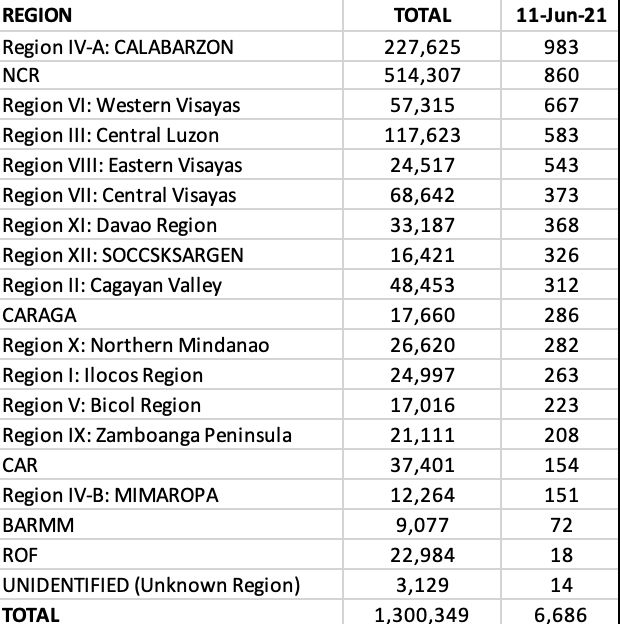
NCR slipped to second spot today with less than 13% of the total cases in the country. CALABARZON is back in first place. The Visayas regions are troublesome as they continue to report rising cases with Western Visayas leading, even overtaking Central Luzon. Eastern and Central Visayas follow Region III.

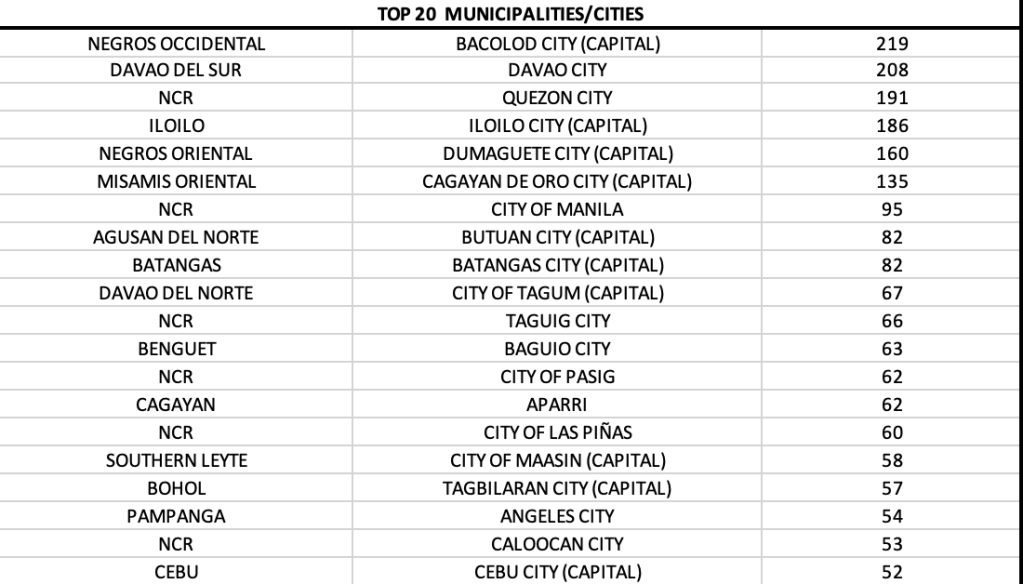
Among the 17 LGUs in NCR, only Quezon City continues to report triple digits. Seven of the 17 cities in Mega Manila are in the top 20 cities/municipalities with most cases in the country.

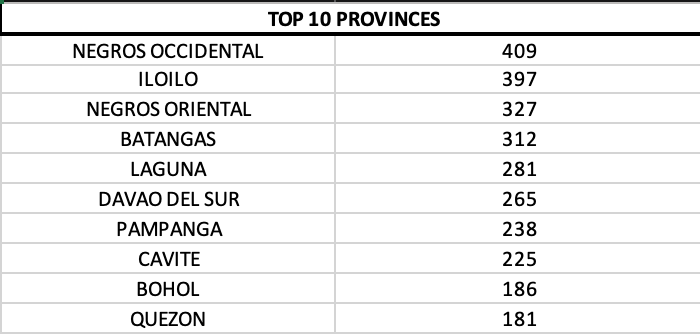
On a provincial level, it is Laguna that takes the lead today, followed by Iloilo, Leyte and Negros Occidental.

But it is Bacolod City that has the highest number of cases among cities in the country, overtaking erstwhile perennial leader Quezon City. Four of five LGUs outside of NCR are in the top five now. Aside from Bacolod City, the rest are – Davao City, Cagayan de Oro, and Iloilo, ranking third to fifth.

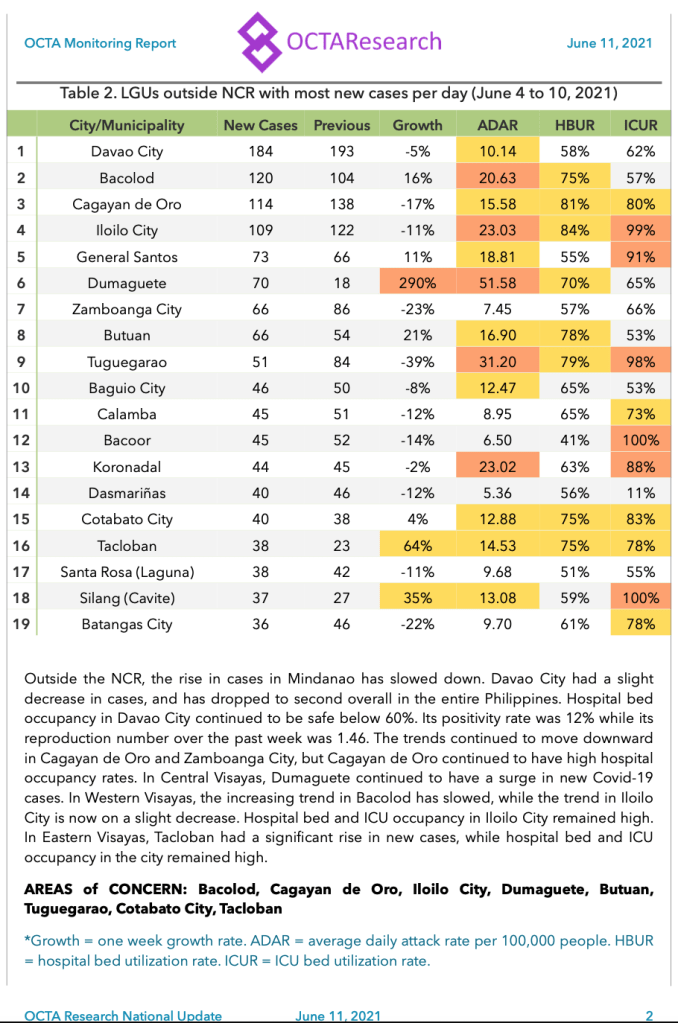
The OCTA Research Monitoring Update for June 11, 2021 separates the data from the 17 LGUs in the National Capital Region from LGUs outside of Mega Manila with most cases.

Mega Manila’s reproduction remains below 1.0 at 0.72 with an average daily attack rate (ADAR) of 6.7 per 100,000 and a decline of 17% in cases for the week of June 4-10, 2021. Based on ADAR, most the LGUs in the NCR are now at moderate risk, with the lowest risk level belonging to Navotas and Marikina. Only Makati City remains at highest risk with an ADAR of 10.77 per 100,000 population.

Outside of NCR, many of the LGUs that were seeing significant increase in cases have slowed down, and most of them posing declines rather than growth. Nevertheless, the ADAR in many cities remain at high risk (>10/100,000). Dumaguete continued to see a significant increase in cases by 290% and an ADAR of 51.58. Tacloban City and Silang (Cavite) are also seeing significant increases in their cases.

The major areas of concern in terms of ICU occupancy rate are: Iloilo City, General Santos, Tugeugarao, Bacoor (Cavite), Koronadal and Silang (Cavite).

Are we plateauing at 7K+ with regions outside NCR reporting higher cases on 06.10.2021?

Tomorrow we will pass 1.3M total cases.

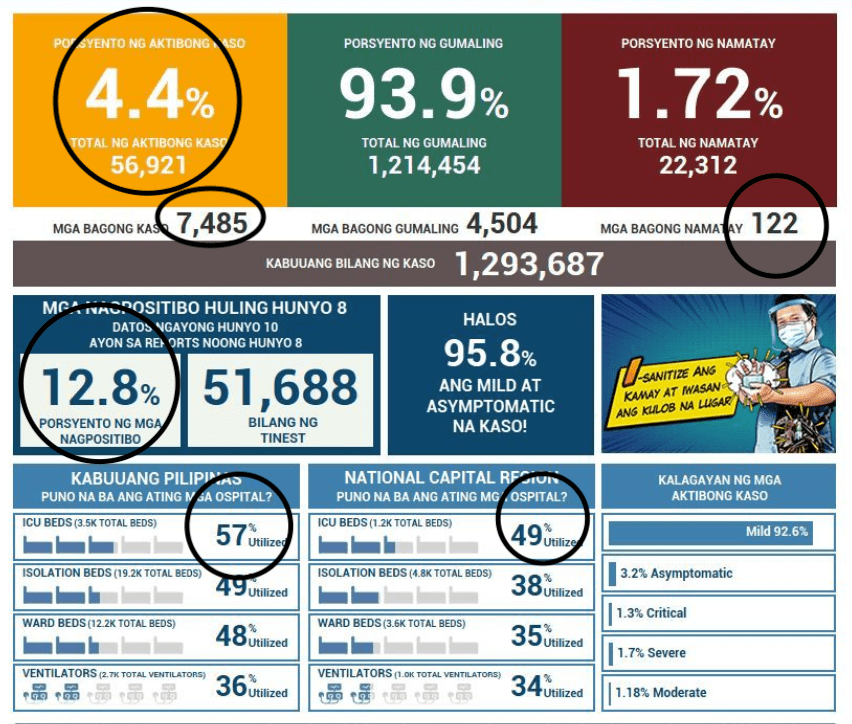
The Health Agency reports close to 7,500 new cases (with 4 laboratories not submitting reports) for June 8, 2021. The positivity rate is still a high 12.8% in spite of the close to 52,000 tests done. To bring down the positivity rate, more testing should be done. Approximately 100,000 tests a day will help bring the national positivity rate to less than 10%. With more cases than recoveries, the active cases are up again at 4.4%.

There were 122 new deaths reported today. The case fatality ratio for outcomes remains steady at 1.80%.

Hospital utilization on a national level is higher than NCR alone, but it is still NCR that remains to be the largest contributor to the number of daily cases on a regional level.

The NCR sees a jump in cases as it sees a 2.5% increase in cases from the previous week owning close to 16% of the total cases in the country today. It is back in number 1 among regions, followed by CALABARZON and Central Luzon, the original triumvirate. These three regions remain to contribute to more than 40% of the total cases in the country daily.

Western, Central and Eastern Visayas are now in 4th, 6th and 7th rank as the Visayas region sees a sudden increase in cases.

Among LGUs in NCR, Quezon City, Manila and Caloocan City reported triple digits and 8 of 17 LGUs from NCR were among the top twenty cities/municipalities with most cases.

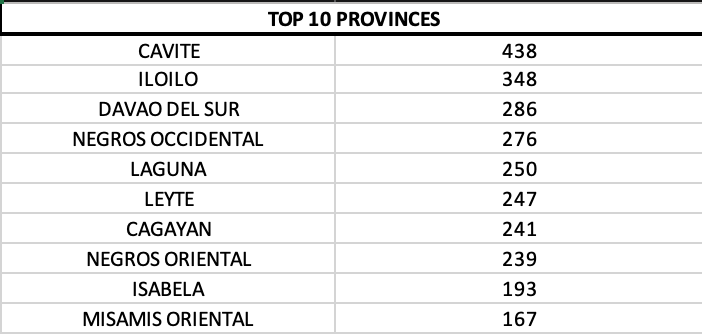
On a provincial level, Cavite continued to lead followed by Iloilo and Davao del Sur.

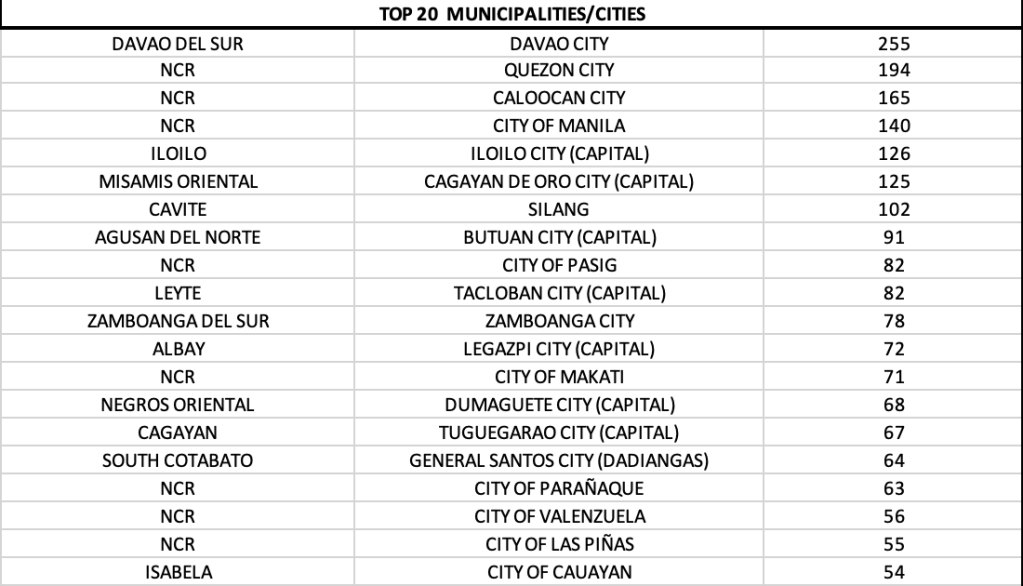
Davao City was once again the top city with most cases for the day. Iloilo City was number 5. Silang (Cavite), home to Tagaytay City was in seventh spot.

5,462 new cases with 12.6% positivity on 06.09.2021

The granular data for yesterday came out very late. They released it one hour before the daily 4PM data drop announcement. The Health Agency reported a little less than 5,500 new cases today (as expected because Wednesday will always see a bit higher cases than the low Tuesdays). Today’s numbers are based on close to 40,000 tests run last June 7 with 12.6% positivity rate. The active cases are slightly down to 4.2%, but tomorrow will provide us with a clearer picture of our numbers in the pandemic.

With 126 new deaths reported today, the case fatality ratio for outcomes is steady at 1.80%.

The NCR is back on the leader board among regions with most cases (I have doubts it will ever have numbers below 500), with close to 900 new cases. In second is CALABARZON. Western Visayas is the region to watch out for as it makes a dash for the third spot in the regional tally.

On a provincial level, Cavite leads the pack, followed by Iloilo and Laguna.

And on a city/municipality level, Quezon City takes back the lead among all cities. There are 10 of 17 cities from NCR that are among the top twenty cities with most cases for the day. Iloilo City, Davao City and Bacolod City are the three cities outside of NCR in the top 5 cities with most cases.

Infection vs. injection: The light at the end of whose tunnel?

The world changed overnight with the COVID-19 pandemic.

So did our lives.

Masks became part of the new normal. Travel – whether by land, air or sea – unless essential for work was parked. Borders both locally and internationally were closed. The economy broke its back as mobility became compromised. What stood out was how the pandemic served as the great divide between rich and poor countries, rich and poor people. Inequity became more glaring during the past one and half years.

The world needed to live differently. At an age of technological, digital and economic advances, the new normal was mentally and emotionally challenging.

In the Philippines, schools never reopened face-to-face. The irony here is that while many other municipalities and cities in the 7,641 islands in the archipelago had very few COVID-19 cases, the whole education system had a one strike policy – shut it down. And for a country whose internet speed and regular stream of energy supply is wanting, this was a misguided decision of government. The disruption in our normal daily lives was more apparent among the frontline healthcare workers and the daily wage earners in society. Lockdowns became the primary measures at curtailing the spread of the virus.

The year 2020 was traumatic to everyone. When the first surge came, the health workers were overwhelmed. It was a time when we scrambled searching for a cure while some friends, families and colleagues who got infected died. Several drugs were repurposed as we waited on the sidelines for vaccines. Using new and old platforms, science was on a mad dash to developing vaccines to stem the pandemic’s growth.

Towards the end of 2020, some manufacturers were ready to roll out vaccines. The COVID-19 vaccines were approved for Emergency Use Authorization (EUA) in less than a year. The quickest ever. The entry of a new platform using mRNA technology provided the first ray of light at the end of the deep dark tunnel. Other vaccine platforms – non-replicating viral vector (Astra-Zeneca Oxford, Sputnik V, Janssen), inactivated virus (Sinovac, Sinopharm), and subunit protein (Novavax) – rolled out their clinical trial results one after the other. To date, there are more than 80 vaccines in development at various phases of clinical trials. A testimony of humanity working together towards that light.

While vaccines are now available, the glaring prejudice for countries or continents that have more resources compared to poor nations has become more apparent than ever. Israel, the UK, the US are examples of model and wealthy nations that have managed to address the pandemic with the abundance of vaccines available to them. The saying “beggars can’t be choosers” is strikingly more vivid now, with developing and third world countries like ours having to literally beg for that shot of hope.

With vaccines coming in dribbles for now, how the available COVID-19 vaccines at our disposal are being rolled out, is even a challenging one.

The first challenge is the war against vaccine hesitancy.

Vaccine acceptance was never a problem in the Philippines. Until the political story behind Dengvaxia came along. After the Dengvaxia fiasco – with theatrics and drama at the level of congress and the senate – rebuilding vaccine confidence became an uphill battle. Social media and reckless sensational journalism heightened the misinformation and false information campaign. While it is true that Dengvaxia was prematurely rolled out as a public health program by the past administration, the vaccine was vilified and stripped of its potential use among those who may benefit from a vaccine against dengue. During the deliberations in congress and the senate, science was thrown under the bus. At the end of the Dengvaxia debacle, science and research were lost in translation. The wrong people were crucified. And public trust in vaccines were lost overnight.

The Dengvaxia story would be one that would be the first straw to severely affect preventive healthcare in the country. Parents refused to have their children immunized. An outbreak of measles ensued. Followed by polio. Then dengue. Sadly, the more vulnerable sectors of society – classes C, D and E – were the most affected.

Then came the COVID-19 pandemic. And while the world was not prepared for a pandemic of this magnitude, the ghost of Dengvaxia past was still fresh in the minds of the Filipino people. Deeply ingrained even as vaccines against COVID-19 started to arrive and roll out, that ghost would haunt our vaccination efforts.

In several early surveys done by independent organizations (SWS, OCTA RESEARCH, Pulse Asia), vaccine acceptance against COVID-19 was initially very low. The brand also mattered. There was distrust from those made in China and Russia. The tragedy created by the Dengvaxia story created a wedge so deep with fear that many people were more than willing to risk infections rather than getting injections.

As the title in a Nature article would say, “six months and 1.7 billion doses later“, where are we in the effort to address the pandemic?

That leads us to second challenge – restoring vaccine confidence.

On December 8, 2020, at 630AM, Margaret Keenan, a 90 year old British woman became the first person in the world to receive a COVID-19 vaccine (Pfizer-BioNTech) as a mass vaccination effort at University Hospital in Coventry. On April 22, 2021, Maggie was interviewed once more, and called the global mass vaccination rollout as “incredible”. She has turned 91 since, and continues to be the poster woman who took the first jab during the pandemic.

Without a doubt, the vaccines work. Their efficacies vary from clinical trial settings and since their roll out in the real world, much of the news continues to be positive on how well the vaccines perform in general settings.

As a general rule, the ideal time to roll out a vaccine program is when the cases are low. If you wait to do this when the cases are running through the roof then one will need to combine this with extensive limitation of mobility (e.g., lockdowns) to give time for the vaccines to provide immunologic responses to those that get the shot. Starving the virus entails stemming the transmission from person to person either by limiting movement of individuals in society or having them vaccinated.

Restoring vaccine confidence will entail a lot more work than just providing lip service. The communication strategy should be one that appeals to the concerns (safety and suitability) of the masses. The major question that is asked – IS IT SAFE?

We will need more than just one Keenan out there to show the world that the vaccines work and are safe. With an unparalleled speed in the roll out of a vaccine, surveillance systems must be put in place to watch out for adverse events, record them, and identify if there is a link between the vaccine and that reported side effect. So far, the concerns include clotting syndrome with vaccines from an adenovirus platform, anaphylactic reactions after immunization, and lately, the possible link of myocarditis (heart inflammation) among those 16-19 years old who received Pfizer-BioNTech vaccine. The debate on the safety of these vaccines was enough to dampen public confidence in them.

What level of safety is acceptable?

Even the food we eat, or the air we breath or the water we drink have potential risks. Over the counter multivitamins or supplements have different manufacturing standards and can pose harm even to those who perceive that they are absolutely safe.

There is no answer that will guarantee with absolute certainty that the vaccines are 100% safe. Some side effects will occur. Whether it is local or systemic, majority will be mild, tolerable, and inconsequential. To date, the number of people who have developed adverse events to the COVID-19 vaccines available as EUA are far fewer than the 1.7 billion doses that have been administered. Definitely, a case where the benefits far outweigh the risks.

The final challenge is equity at a time of scarcity.

When the COVID-19 vaccines began its initial roll out in the Philippines, the healthcare workers were the priority. Not many wanted to get the first jab. It was a disappointment that instead of an mRNA that arrived, a vaccine made in China came. But we rolled up our sleeves and took the jab anyway.

A study published in the American Journal of Preventive Medicine on “The Benefits of Vaccinating With the First Available COVID-19 Coronavirus Vaccine” by Bartsch et al. last January 18, 2021 argues why “during a pandemic, there are many situations in which the first available vaccines that may not have as high effectiveness as vaccines that are still under development or vaccines that are not yet ready for distribution” raise the question of whether it is better to go with what is available now or wait. After all, it is a valid concern by all.

The authors of that study developed a computational model representing the spread of COVID-19 and vaccines with different efficacies (either to prevent infection or reduce severity of disease), vaccination timing and the clinical and economic value of vaccination.

That study showed that, using the United States of America population as computational model, “if a vaccine with 50% efficacy in preventing infection becomes available when 10% of the population has already been infected, waiting until 40% of the population are infected for a vaccine with 80% efficacy in preventing infection results in 15.6 million additional cases and 1.5 million additional infections, costing $20.6 billion more in direct medical costs and $12.4 billion more in productivity loses.”

Clearly, there are few situations where it is even worth foregoing the first available COVID-19 vaccine in favor of one that becomes available later on during an ongoing pandemic, even if the one we are waiting for has a substantially higher efficacy.

At at time when the vaccines that are arriving are coming in trickles, let us remember that the ultimate aim of vaccination is creating herd protection. This can only be achieved when majority of us are immunized, regardless of the vaccine platform. There are many factors that affect response to a vaccine. We need to keep in mind that the best one is the one in our arm. And when we get more arms getting the shot, then it becomes more difficult for the virus to transfer from a person who is protected to an unprotected individual.

But there is a need to equitably distribute the available vaccines across all classes of society.

The systems that allow people to get vaccinated should not rely on technology alone because people in classes C, D and E will most likely not have the same means and resources as those in class A and B. Being able to register for vaccination using technology is unjust and inequitable. It is prejudicial to the poor who will always be left behind. As a consequence, the effect of being noninclusive in a society that treats them differently, pandemic or not, is a challenge for every local government.

In spite of the vaccine roll out, every nation cannot fully depend on lockdown measures and vaccines as the only strategy at addressing the pandemic. Economies will suffer and those who have the least will have a longer journey through the tunnel. Unless a feasible exit plan is laid out.

At the end of the day, the impact of the pandemic will continue to be felt until every eligible person from high-, middle- or low-income countries can be immunized.