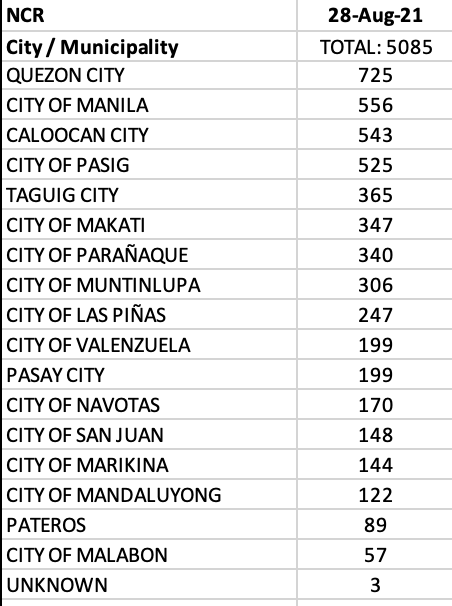
Breaking new records on 08.28.2021

With high positivity in spite of more tests conducted, it was eventually going to come down to this.

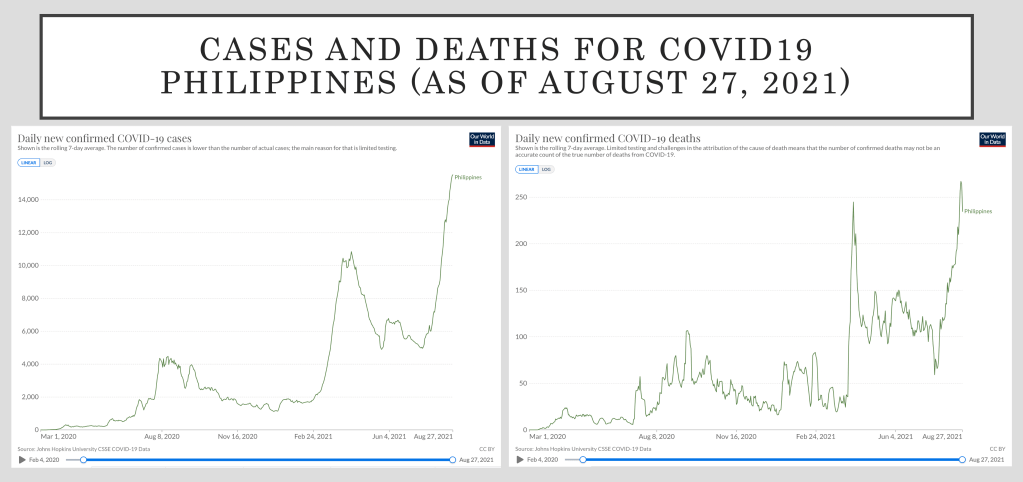
The country records a record high of close to 20,000 new cases today. In spite of the more than 19,000 recoveries, the 19,441 new cases is a testament to a variant out of control and an outbreak that is surging and will last for quite sometime, as businesses become unsettled with lockdown extension to September 7.

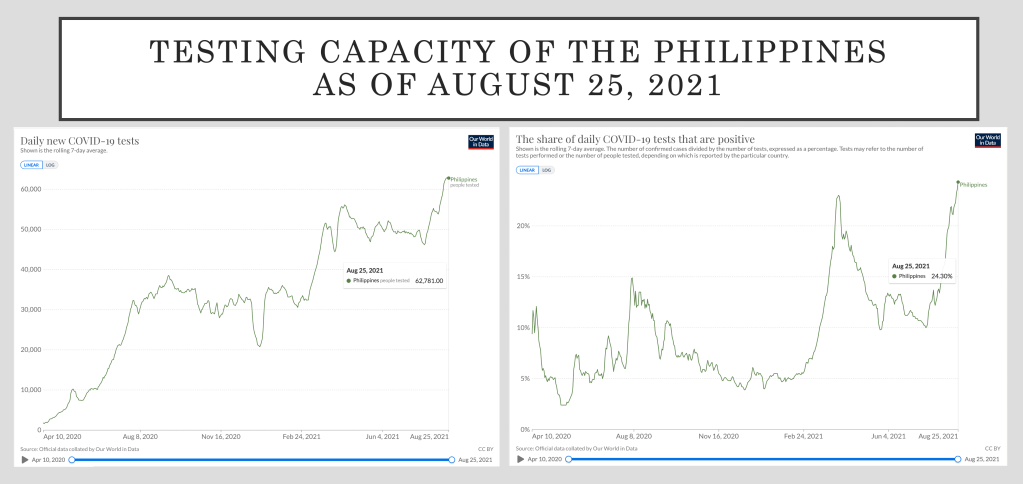
The highest number of tests ever done was August 26 with close to 72,000 tests yielding a positivity rate of 27.5%! This positivity rate is also a record high. Hypothetically if we did 100,000 tests daily, this would likely bring down the positivity rate to 24%. Meaning more than 24,000 would test positive. To bring down the positivity rate to at least 10%, we most likely would need to test 230,000-250,000 per day, a feat that would be impossible at this point.

Additional 167 deaths reported, brings us to deaths passing the 33,000 mark. The case fatality ratio for outcomes is at 1.84%.

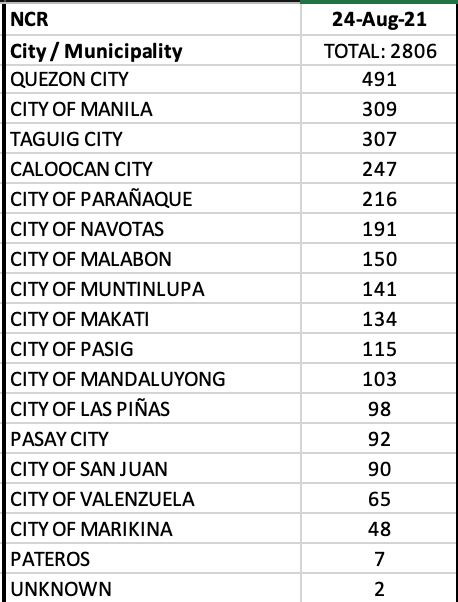
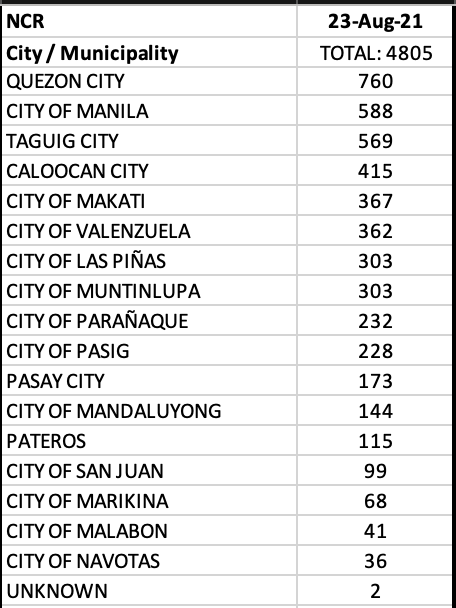
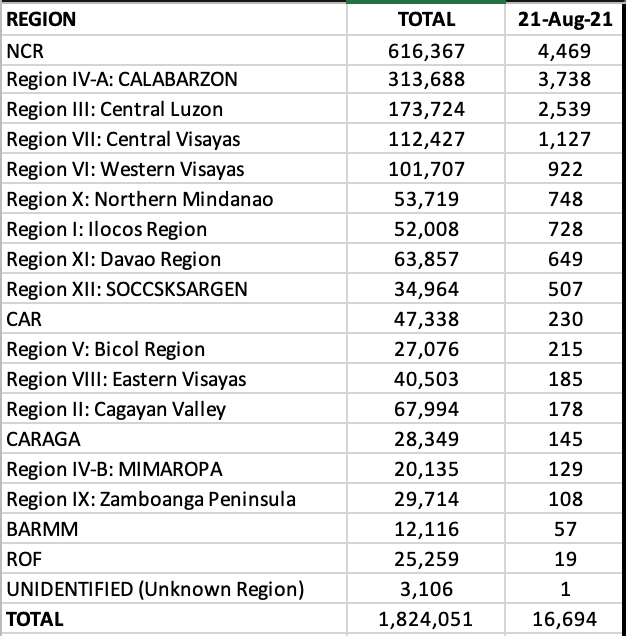
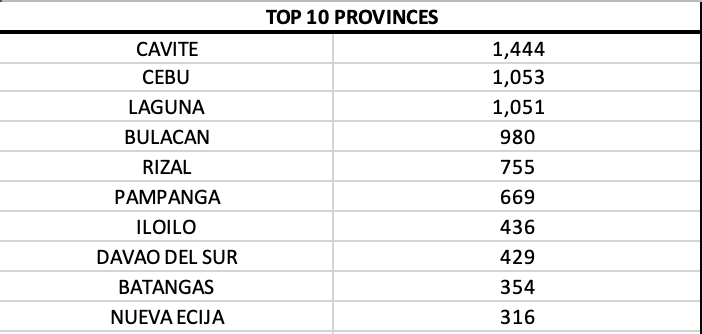
Today’s record breaking total also broke records in regions, provinces and LGUs.

While NCR was steady with 26% of the total cases, that amounted to more than 5,000 cases more to Mega Manila. Today, however, FIVE regions now report quadruple digits, with Ilocos Region overtaking Central Visayas in the count. More than 63% of the cases are from NCR plus bubble.

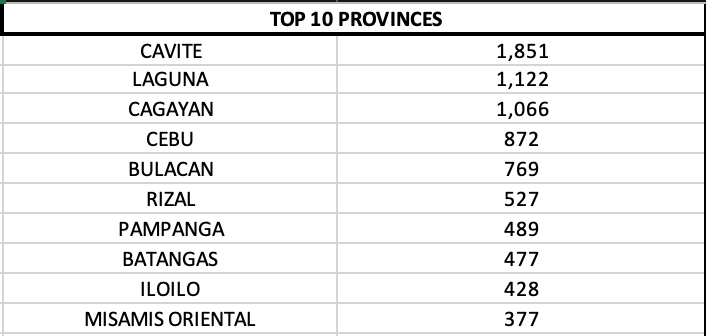
The rise in cases is also being seen on a provincial scale, with Cavite, Laguna and Bulacan reporting more than 1,000 cases apiece.

On the LGU level, 11 of 17 LGUs in NCR were in the top twenty cities with most cases. Four cities in Cavite and two in Laguna joined the top 20. Davao City is seeing an increase in cases as it continued to debut in the top five list.

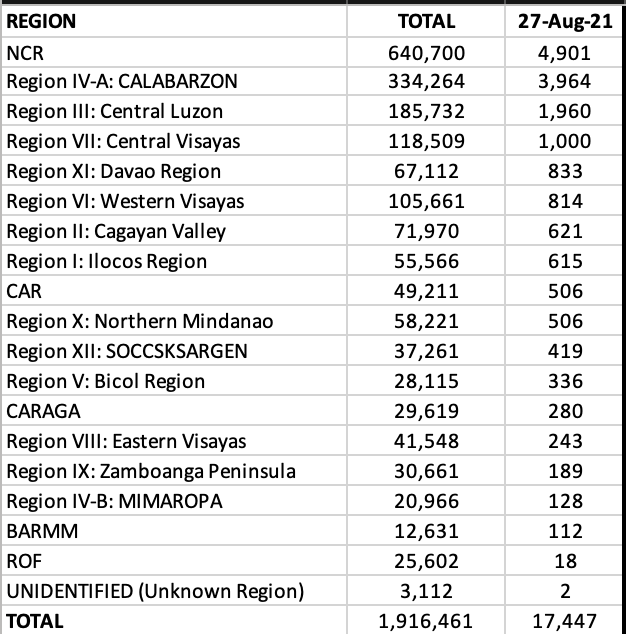
17,447 for the last Friday of August and the data of 08.27.2021

The second highest cases reported since the pandemic began, the Health Agency reports, 17,447 new cases today. But with only 6,772 recoveries, the active cases jumps to more than 140,000.

The highest number of tests done was reported last August 25, but the positivity rate was 26.1% in more than 70,000 tests.

Total new deaths added was 113, and the case fatality ratio is at 1.85%.

Hospital utilization and ICU rate is at 75% both nationally and in the NCR.

The NCR reports close to 5,000 new cases today, as CALABARAZON, Central Luzon and Central Visayas declare quadruple digits for the day. For the second day, all the rest of the regions report triple digits. The NCR plus bubble is seeing an increase in the share of cases for the country with NCR accounting for 28% today.

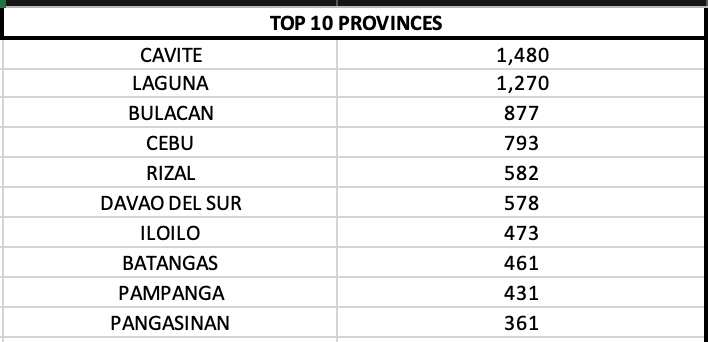
Cavite and Laguna now have quadruple digits on a provincial level.

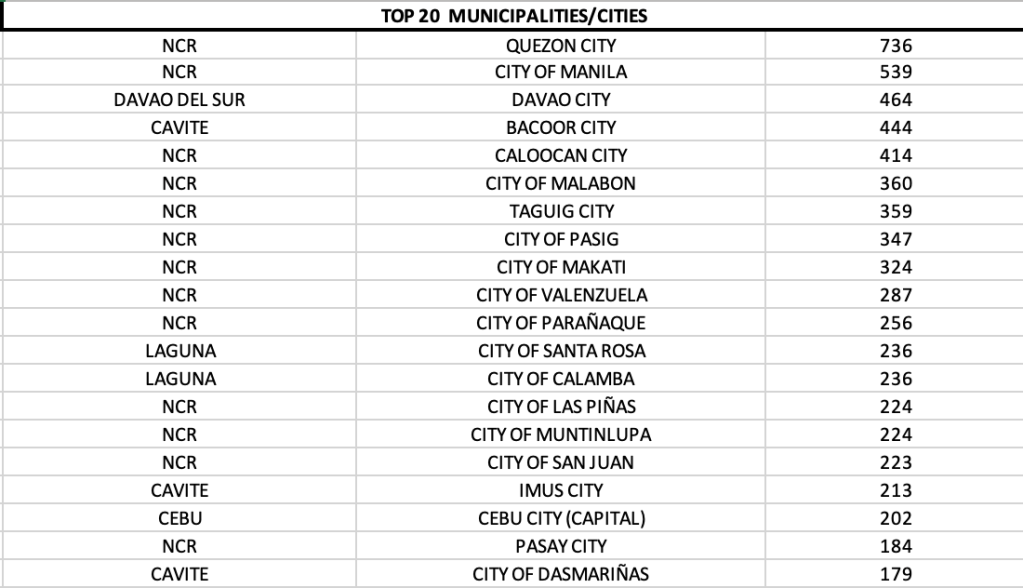
Thirteen of 17 LGUs in NCR are in the top 20 cities/municipalities with most cases today. The surprise LGUs are Davao City which saw a jump in cases overnight, landing in third and Bacoor (in Cavite) that landed in fourth. Three Cavite cities and two Laguna cities are in the top twenty as well.

40% of the Tuesday is the Thursday and the data of 08.26.2021

With 16,313 new cases today, we are 800 cases shy of 1.9 Million COVID-19 cases. Will we end August breaching the 2M mark?

With todays new cases, the total active breaches 130,000.

There were more than 65,000 tests done on August 24 or around 25% positivity. This meant that one in every 4 tested that day were positive.

New deaths announced totaled 236, with a case fatality ratio for outcomes steady at 1.85%.

Healthcare utilization is up both nationally and in the NCR. ICU utilization rate in the NCR is reported at 77% today.

NCR accounts for 26% of the total cases today. Other regions with quadruple digit reports were CALABARZON (22%), Central Luzon (15%), and Central Visayas (6.7%). All regions reported more than 100 new cases today.

Among provinces, while Cavite raked in quadruple digits, the provinces of Laguna, Rizal and Batangas made it to the top ten.

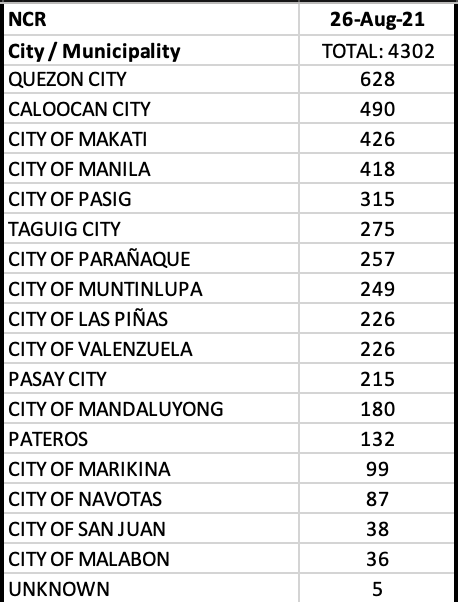
Twelve of 17 LGUs in NCR were among the top 20 cities/municipalities in the country for the day. Three LGUs in Cavite also were in the top 20 list.

OCTA MONITORING REPORT

Today’s report highlights Central Luzon or Region III, that is consistently third among regions with most cases in the country.

Lower reproduction numbers amidst rising cases and the data of 08.25.2021

It’s a typical Wednesday. Around 10% more than the low Tuesdays. But it’s the highest recorded new cases for a Wednesday so far.

The Health Agency reports 13,573 new cases today. And with more than 15,000 recoveries, the active cases are slightly lower but still more than 125,000 in number. The total COVID-19 cases is now past 1.88M and the Philippines will most likely breach the 2M mark tomorrow at the earliest and Friday at the latest.

Of the over 46,000 tests done last August 23, 25.5% were positive. This means that over the past weeks, from every 4 patients that get tested, 1 will most likely test positive.

There are 228 new deaths reported. This brings the case fatality ratio for outcomes is steady at 1.85%.

Healthcare utilization and ICU rates are still past 70% for both the NCR and national level.

NCR continued to own between 25-27% of the total cases for COVID-19 in the country today. Notice the variability in the cases in the other regions, except for CALABARZON and Central Luzon. The top three regions – Mega Manila, Region IVA and Region III – account for 60% of the daily cases.

Cavite and Laguna, two provinces in CALABARZON, and are contiguous to NCR, remain the top contributors to cases in the country and in that region.

Twelve of 17 LGUs in NCR make it to the top twenty cities with most cases for the day. Surprisingly in fifth spot is Davao City. Four LGUs in Cavite also are in the top 20 list.

OCTA MONITORING REPORT

The NCR averages 25% the total daily COVID cases in this surge. Together with CALABARZON and Central Luzon, these three regions account for half the daily new cases in the country.

While the number of cases continued to increase, with NCR averaging more than 4,000 cases daily from August 18-24 (13% up than the previous week), the reproduction number has slowly declined to 1.53 (on an average). The table below shows the cities with critical ADAR (incidence rate) as highlighted in red, and the high risk in darker orange highlight. Notice that while Caloocan, Marikina, Manila and Quezon City show higher cases this week compared to last, their ADAR is lower because of the population size (based on per capita and not number of cases).

Only Navotas and Malabon saw a decrease in rate of cases, while Las Piñas was flat (no change). On an individual LGU level, the reproduction number was still above 1.4 in all NCR LGUs except for Navotas whose Rt dropped to 1.37.

Meanwhile, in the Mindanao area, the cases seem to ease up (better than the NCR) as the reproduction number in Cagayan de Oro eases up to 1.15 from a previous 1.38. This is positive development and if the trend continues the next two weeks, there will be a significant decline in cases in CDO soon. Malaybalay and Valencia in Bukidnon are still seeing critical ADARs, but the hospital utilization is down in most provinces except for Cagayan de Oro, whose healthcare status is still at critical levels.

While Davao City still sees a rise in cases week on week, that change is minimal and the ICU utilization is down from critical to high risk level.

Good news Tuesday is still bad news and the data on 08.24.2021

After landing 7th most cases reported in the world in a single day, the Health Agency reports 12,067 new cases today with more than 127,000 remaining active. The new cases do not necessarily mean they are yesterday. They are NEWLY ANNOUNCED cases. While there may be less cases today, today happens to be the highest Tuesday on record. The past Tuesday for the month of August were: Aug 3 – 6,879, Aug 10 – 8560, Aug 17 – 10,035 cases.

There were just a little more than 45,000 tests done on Sunday, August 22. And with around 25% positivity rate, this just means that 1 in every 4 tested that day, tested positive.

It’s the deaths that’s worrisome as the Philippines passes the 32,000 mark with 303 new deaths announced. The case fatality ratio based on outcomes is 1.85%. If we use the 7-day average deaths and divide it by the 7-day average of the number of cases 10 days earlier (moving average case fatality rate), the rate would be at 2.13%.

NCR accounted for 23% of today’s more than 12,000 cases. CALABARZON, Central Luzon, and Central Visayas accounted for more than 44%.

Among provinces, it is Cavite that continued to report quadruple digits, with Bulacan and Cebu coming in second and third.

Nine of 17 LGUs in NCR were in the top twenty cities with most cases, while Cavite had 4 LGUs in the list.

OCTA MONITORING REPORT

Today’s special coverage is the province of Cagayan. Cagayan region had more than 1,500 cases yesterday and the DoH announced 1,066 new cases in the province of Cagayan. The capital, Tuguegarao had a new high yesterday with 323 reported cases. The incidence rate is up at more than 73/100,000 population in Tuguegarao and Bothe province of Cagayan is at critical levels in terms of ICU utilization. Among all the provinces in the region, Batanes remained the lowest ADAR at 0.79 and zero cases.

Manic Monday and the data of 08.23.2021

We were primed already for higher numbers so we shouldn’t be surprised at today’s announcement of more than 18,000 cases.

With 18,332 new cases, this brings the active cases past 130,000 in spite of the close to 14,000 recoveries. And the highest single day count of new cases since the pandemic began.

Of the close to 65,000 tests done last August 21, the positivity was still at 25%. Meaning 1 in 4 would be positive.

There are 151 new deaths announced today, which brings the total deaths close to 32,000 and the case fatality ratio for outcomes at 1.86%.

NCR had close to 5,000 new cases but keeps its 26% share in the total cases for the day. CALABARZON and Central Luzon have increasing cases in their regions, but it is Cagayan Valley that saw a dramatic rise in cases overnight. Whether the cases in Cagayan Valley are actually delayed or recent reports, they are still new announced numbers.

Cavite, Laguna and Cagayan are the provinces with quadruple digits, with Cavite reporting almost 2,000 new cases for the day.

All first six spots among the top 20 LGUs for the day go to LGUs in NCR. In seventh, however, is the city of Tuguegarao in Cagayan. Eleven of 17 LGUs in NCR are in the top twenty. Other LGUs outside of NCR in the top twenty include 4 from Cavite and 2 from Laguna.

Why two-week lockdowns may not be effective and the data of 08.22.2021

While we had lesser cases today than the two previous days, it was still the third highest number of new cases announced since the pandemic began. The active cases are now past 125,000.

With 16,044 new cases today, the Philippines officially passes Iraq and sits in the 21st rank among countries with COVID-19 cases.

There were more than 65,000 tests done last August 20, but in spite of the slightly higher testing done, the positive cases are still past 25%. One in four tested that day tested positive.

The Health Agency adds 215 new deaths today, putting the case fatality ratio for outcomes at 1.86%. It is important to remember that of the 1,839,635 officially reported COVID-19 cases, only 1,713,735 patients had outcomes. Among the latter, 98.14% have fully recovered. The active cases should be left as active cases with no outcomes. Yet.

NCR recorded a decent 3,973 or 24.7% of the total cases in the country. CALABARZON + Central Luzon + Central Visayas accounted for an additional 44.5% of the cases.

On a provincial level, Cavite, Laguna and Cebu reported quadruple digits.

Eleven of 17 LGUs in NCR were in the top 20 cities with most cases, led by Quezon City. Four LGUs in Cavite were in the top twenty as well.

OCTA MONITORING REPORT

As the government began to lift a tighter lockdown in our rollercoaster ride of lockdowns, the growth rate in new cases declined a tad. While the growth rate continues to increase, it has slowed down. Which is like saying, yes the cases are still rising but not as much as the week before. The NCR now averages 3,819 cases daily (August 15-21 week) compared to the 3,088 daily cases for the week before (August 8-14).

The Rt is down at 1.67 in NCR (versus 1.9 last week), but it is still high. Very high, as a matter of fact.

The average positive rate in the NCR is at 22% at critical levels. That’s because mostly the symptomatic get tested.

The data shows you one thing. Two-week lockdowns don’t work.

Here’s a typical household scenario.

There are 7 people in the home. Two senior citizens, the parents, two children and a maid. The grandfather comes down with COVID-19. The family gets swabbed. They are all negative. They isolate the grandfather. After five days, the grandmother has fever. She gets swabbed again. She is now positive. The remaining 5 in the household get swabbed again. They are negative. After five days, the parents are now coughing and have low grade fever. They both turn up positive after getting swabbed. The kids and the maid who were swabbed remain negative. But they continue to be exposed to the parents because the children are 1 and 3 years old, respectively. After 3 days, the kids now have a runny nose and some diarrhea. The maid also falls ill. They all get swabbed. Again. This time they are all positive. More than two weeks has passed before the whole household is not fully infected.

Depending on the size of the household, transmission will continue to occur between 2-4 weeks. It is best to always presume that it takes 4 weeks for a typical household to recover. Extrapolating that to a community, depending on the size of the community, it would normally take 1-2 months for the whole community to stop circulation of SARS-CoV-2. Locking down a street or a Barangay for two weeks will most likely fail.

The two weeks ECQ did not really bring down the cases. It slowed it down, based on the numbers of the Health Agency. As to the accuracy of the data, that is another challenge during the pandemic of perpetual lockdowns.

There is a need to place more science into the anatomy of a lockdown. While it is challenging to the business community, it is, sad to say, a bullet we need to bite. Resources from the national and local governments must be used properly to assist people survive for health, personal needs and livelihood during quarantine. The goal of a lockdown is not to simply slow down the viral transmission in the community. It is to starve it dry. And it is understandable that economics plays a large role in every lockdown.

While vaccines may help in decreasing the severity of infection for patients that eventually get infected, it is not the only solution. It is apparent that the mix messages sent out by the health officials and those that create policies and implement them get lost in translation.
Every surge should prepare us for another surge. As they say, all pandemics come to an end. It is how we handle a surge that matters most. We need to steer back to the science of the virus, incorporate the economic repercussions, and enhance the pillars of controlling the pandemic by testing, tracing, isolating/quarantine and vaccination.

THE WEEK IN REVIEW

While OCTA showed an over-all slowing down in the rise of cases in the NCR, the number of new cases continue to increase daily. The slope is a very steep one for both new cases and newly reported deaths.

As a matter of fact, if one looks at the report of the Health Agency on case fatality rate, the DoH downplays the rate by using the total cases in the country as the denominator. That is why we have a 1.73% case fatality rate, according to the infographics. But with more active cases, we really do not know what their outcomes will be. And it would be premature to presume that all will survive, when in reality, many factors can play a role in poorer outcomes especially if the healthcare utilization is overwhelmed.

The moving-average CFR in reality stands at 2.14%. A 0.41% discrepancy from what is reported daily.

While testing has slightly gone up, we still lag in testing patients. Lack of testing results in poor contact tracing. For now, most of those that are being tested are the symptomatic cases. Rapid antigen testing, which can, and should be used during the outbreak are still not being used by the agency. If it is, it is not being recorded because all the announcements are based on RT-PCR test. And while the claim that there is better sensitivity with the RT-PCR, like the rapid antigen tests, a negative test today will not guarantee you a negative test tomorrow. If the government is really bent on conversing the scarce resources, it should begin to utilize rapid tests as a screening method together with RT-PCR in instances when the latter needs to be used.

The reproduction number among select Asian nations as well as their 7-day average cases are provided in this report. Notice how Indonesia has worked well at slowing down its cases by keeping its reproduction number below 1.0.

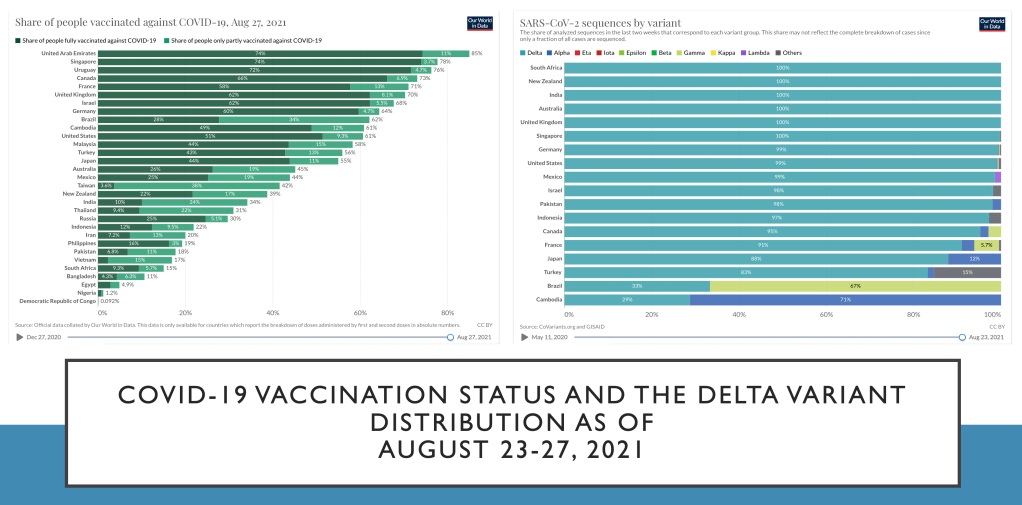
The state of vaccination in many parts of the world is provided in the final infographic. The delta variant has proven to be a formidable challenge, as many countries report this variant as the predominant circulating type for SARS-CoV-2. Undoubtedly, in the Philippines, delta has landed as well and is now in various communities.

Less than 1/3 of the world’s eligible population has received a single dose covid vaccine as of this report. It’s even lower (less than 1/4) when you take into consideration those that are now fully vaccinated.

The scarcity of vaccines, the gap between wealthier vs. poorer nations in access to the vaccines, the issue on waning immunity to previous vaccines, and finally the efficacy of some vaccine platforms versus delta variant has played a major role in the current surge.

Second highest new cases and deaths and the data of 08.21.2021

With a few less cases than yesterday, the Health Agency announces 16,694 new cases today. With less recoveries than new cases, the active cases are almost 124,000.

On August 19, more than 65,000 tests were done (one of the highest if not the highest number of tests done in a single day) still yielded more than 25% positivity rate. Or, one in every 4 tested would test positive.

Without a doubt, a more transmissible variant like Delta, is highly likely responsible for the increasing numbers in the community. And it’s the same story we are seeing in many parts of the world.

There were 398 new deaths announced today. This is the second highest number of deaths reported (highest was April 9, when the Health Agency announced 400 deaths) since the pandemic began. The case fatality ratio for outcomes is now at 1.86%. The 1.73% provided by the Health Agency presumes that all the new cases will have good outcome, which is not being realistic about the disease and the healthcare utilization which is now over 70% on the national level and the NCR.

NCR continued to report more than 4,000 cases today with close to 27% of the total cases for the country. CALABARZON, Central Luzon and Central Visayas continued to bring in quadruple digits and up with 44.4% of the cases (from 42% the previous day).

Cavite province, Cebu province and Laguna had the quadruple digits and ranked in the top three among provinces.

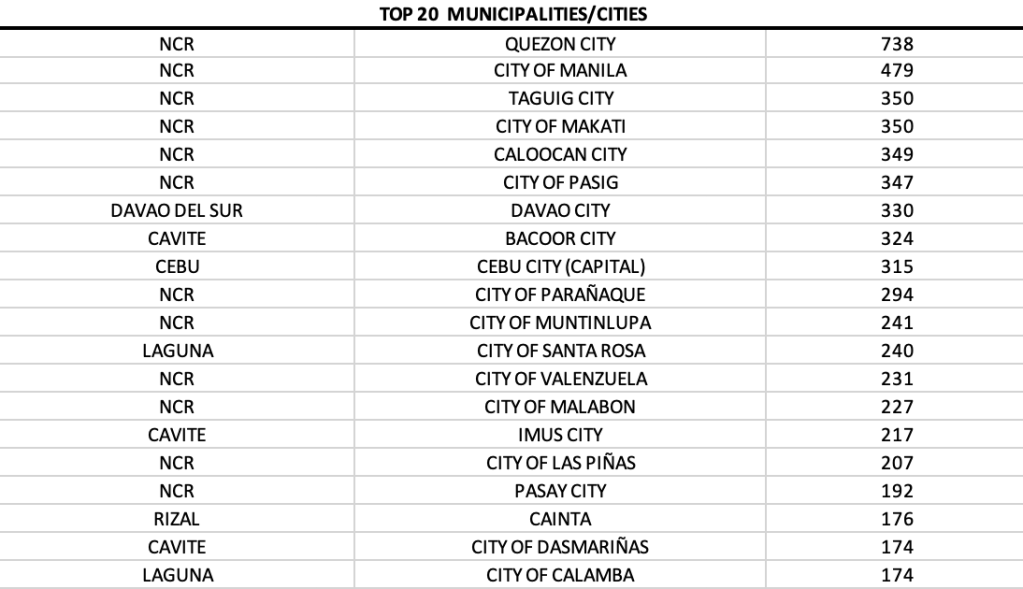
On a LGU level, six LGUs from NCR ranked first to sixth spot today – Quezon City, Manila, Taguig, Makati, Caloocan and Pasig. Twelve of 17 LGUs from NCR were among the top 20. In the top 20 LGUs for today were three cities in Cavite, 2 cities in Laguna and 1 city in Rizal.

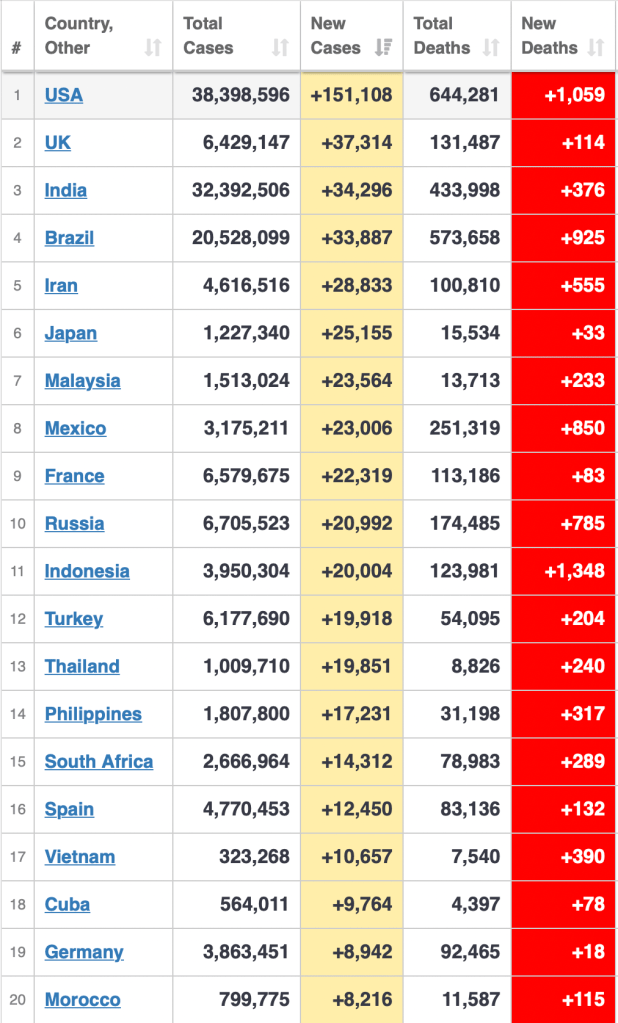
Many countries in Asia landed in the top twenty countries with most cases globally yesterday.

Japan led with more than 25,000 new cases. Malaysia landed in 7th rank and Indonesia continued to have declining cases but more deaths. Thailand, the Philippines and Vietnam are part of the top 20.

Record breaking Freaky Friday and the data of 08.20.2021

It’s a record breaking day!

Officially, the Philippines passes the 1.8M mark with 17,231 new cases announced today by the Health Agency – the highest one day tally of the country ever. This brings to more than 123,000 the active cases.

On August 18, we also recorded one of the highest number of tests done in a single day – close to 65,000. The positivity rate? 26.1%. Which means to bring it to an acceptable level for testing, the country should be doing 120,000-150,000 tests a day.

Then there are the deaths – 317 of which are reported today. This brings past 31,000 the total deaths. The case fatality ratio for outcomes is now at 1.852%. As the total number of active cases rise, it is not appropriate to use the total cases as the denominator when calculating for the case fatality ratio because we do not know the outcome of the active cases yet.

Hospital utilization is at critical levels both nationally and in Mega Manila.

This, as the major epicenter moves into MECQ beginning tomorrow.

While NCR still led the tally among regions, it accounted for a decent 27% of the cases in the country today. For a good news, the of course is the bad news. Where was the 73% coming from? CALABARZON, Central Luzon and Central Visayas report quadruple digits and these three regions outside of NCR were responsible for close to 42% of the total. Ten regions report more than 500 cases as the increasing cases are seen in every archipelago.

NOTE THAT ALL THE RECORDED CASES ARE CONFIRMED BY RT-PCR. Which means that those that test positive by rapid antigen alone but are symptomatic with COVID-19 are not included in the reported cases. We encourage those who need to get tested to get tested so that contact tracing can be done. In addition, the Health Agency and IATF use rapid antigen kits in order to screen and document cases more quickly during this surge.

On a provincial level, three provinces report quadruple digits – Cavite, Laguna and Cebu.

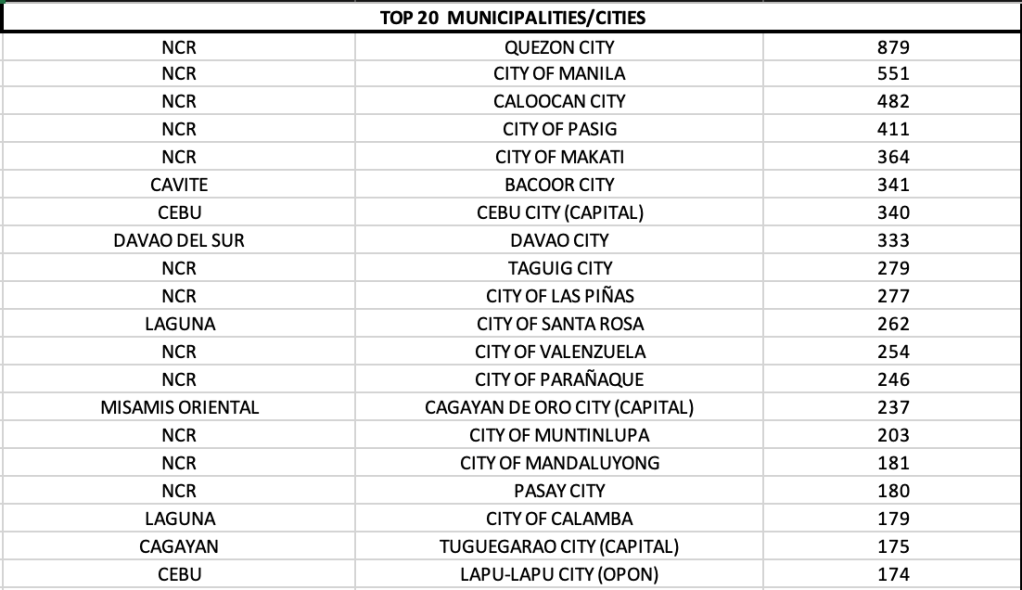
In the meantime, among LGUs, 12 or 17 LGUs in the NCR make it to the top twenty cities with most cases. The top five cities in the country for the day are all from NCR – Quezon City, Manila, Caloocan City, Pasig and Makati.

OCTA MONITORING REPORT

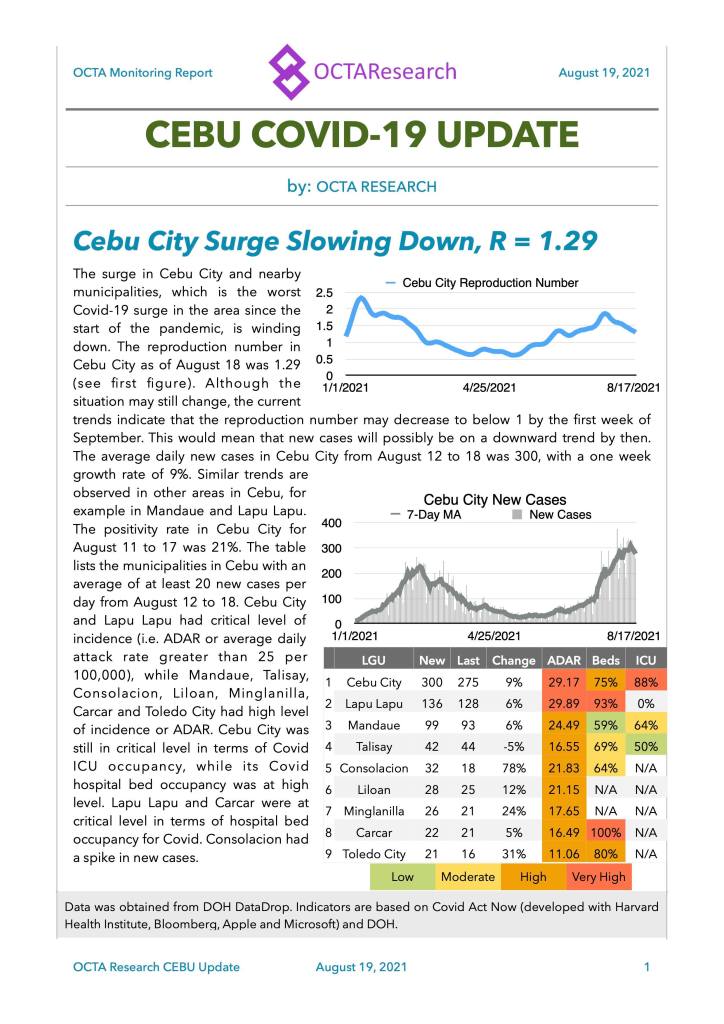
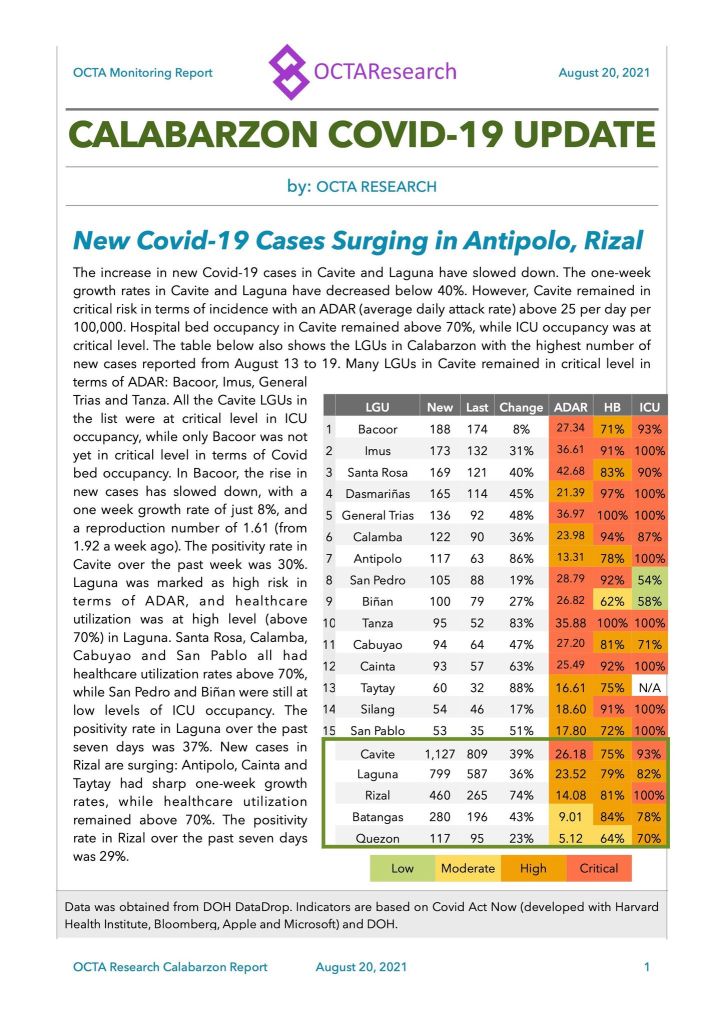
As the National Capital Region, CALABARZON and Central Luzon regions sees rising cases in the midst of the delta variant storm, the province of Cebu seems to see a slowing down in the reproduction numbers.

In yesterday’s OCTA Monitoring report, Cebu was the feature story. The surge seems to be winding down based on a slowing of cases are reflected in the reproduction number. Current trends show that R may dip to 1 by September and a downtrend would be a welcome respite for the region. While the incidence rate is still critical in Cebu City and Lapu Lapu City, hospital utilization is relatively better this week than the past weeks.

CALABARZON is a different story altogether. Annexed to the southern most portion of the National Capital Region are the provinces of Laguna and Cavite. While there is a slight slow down in cases in these provinces, Cavite province remains at critical risk in terms of incidence. Hospital capacity and ICU utilization, both at critical levels is also highest in many LGUs in this province.

Compared to Laguna, Cavite Province’s incidence rate is at critical level (>25/100,000 population) and over-all ICU utilization at 93%.

Because the borders of these provinces are a hairline from the epicenter Mega Manila, it is prudent that the quarantine requirements in the contiguous areas surrounding Mega Manila should implement the same quarantine classification in order to contain the surge and prevent spill overs. In addition, vaccines should also be poured into these provinces in equal tranches as the National Capital Region.

Almost 15K and 23.8% positivity on Thursday and the data for 08.19.2021

Will keep this short and simple.

The Health Agency reports 14,895 new cases today, and with a little more than 8K recoveries, the number of active cases are now over 110,000 (6.7% of the total cases and deaths with outcomes).

Close to 60,000 tests were done on August 17 with a positivity of 23.8%. At this rate 1 in every 4-5 people tested by PCR are testing positive.

Health care utilization suddenly jumped overnight from 61% to 73% ICU occupancy.

Newly reported deaths today are 258, bringing the case fatality ratio for outcomes at 1.84%.

NCR alone accounted for close to 30% of the total cases today. Other regions that reported quadruple digits were CALABARZON, Central Luzon and Northern Mindanao.

Cavite province has led among all provinces (and will continue to do so) the last week. This province accounts for the greater majority of cases among all the five provinces in the CALABARZON region. It is a wonder then, why it also has one of the most lax quarantine measures considering its contiguity to NCR. The challenge to addressing the pandemic response through using lockdown measures should take into consideration the neighboring areas of the epicenter of the pandemic. In this case, NCR. It will be more difficult and take a longer time to control the rising cases in NCR if Cavite Province has numbers that are surging as well.
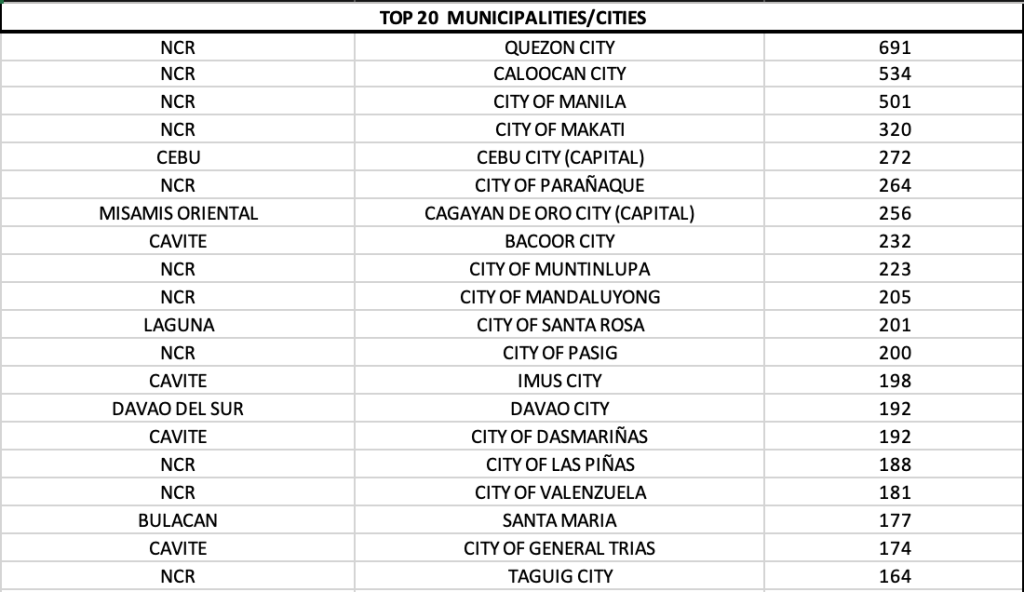
While Quezon City continues to lead for the day, 12 of 17 LGUs in NCR are in the top 20 cities with most cases. Four cities in Cavite are in the top twenty as well.

VACCINATION DATA

The Health Agency released last August 15 the vaccine statistics (which I failed to post, but am posting for the information of the readers). The provided data in the infographic of the agency is based on national tally and not by region. Based on the data, a little close to 11% have been fully vaccinated (most of them recently) from various vaccines available including the single dose Janssen vaccine. As vaccine supplies are scarce, it will still take awhile before we can achieve a greater majority to be fully vaccinated. The target is quite huge considering that the supplies are coming in in trickles.