The Health Agency reports 14,895 new cases today, and with a little more than 8K recoveries, the number of active cases are now over 110,000 (6.7% of the total cases and deaths with outcomes).
Close to 60,000 tests were done on August 17 with a positivity of 23.8%. At this rate 1 in every 4-5 people tested by PCR are testing positive.
Health care utilization suddenly jumped overnight from 61% to 73% ICU occupancy.
Newly reported deaths today are 258, bringing the case fatality ratio for outcomes at 1.84%.
NCR alone accounted for close to 30% of the total cases today. Other regions that reported quadruple digits were CALABARZON, Central Luzon and Northern Mindanao.
Cavite province has led among all provinces (and will continue to do so) the last week. This province accounts for the greater majority of cases among all the five provinces in the CALABARZON region. It is a wonder then, why it also has one of the most lax quarantine measures considering its contiguity to NCR. The challenge to addressing the pandemic response through using lockdown measures should take into consideration the neighboring areas of the epicenter of the pandemic. In this case, NCR. It will be more difficult and take a longer time to control the rising cases in NCR if Cavite Province has numbers that are surging as well.
While Quezon City continues to lead for the day, 12 of 17 LGUs in NCR are in the top 20 cities with most cases. Four cities in Cavite are in the top twenty as well.
VACCINATION DATA
The Health Agency released last August 15 the vaccine statistics (which I failed to post, but am posting for the information of the readers). The provided data in the infographic of the agency is based on national tally and not by region. Based on the data, a little close to 11% have been fully vaccinated (most of them recently) from various vaccines available including the single dose Janssen vaccine. As vaccine supplies are scarce, it will still take awhile before we can achieve a greater majority to be fully vaccinated. The target is quite huge considering that the supplies are coming in in trickles.
The typical Wednesday is seeing a few more hundred cases (or at least 10% more) than the day before.
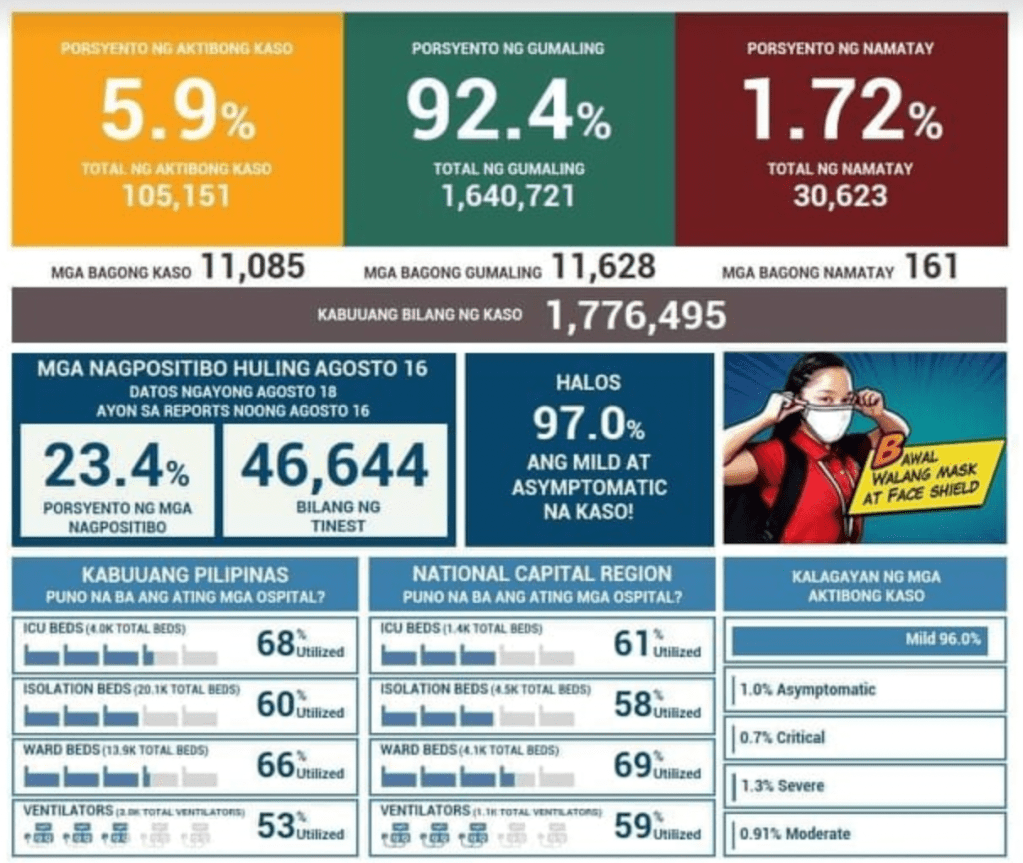
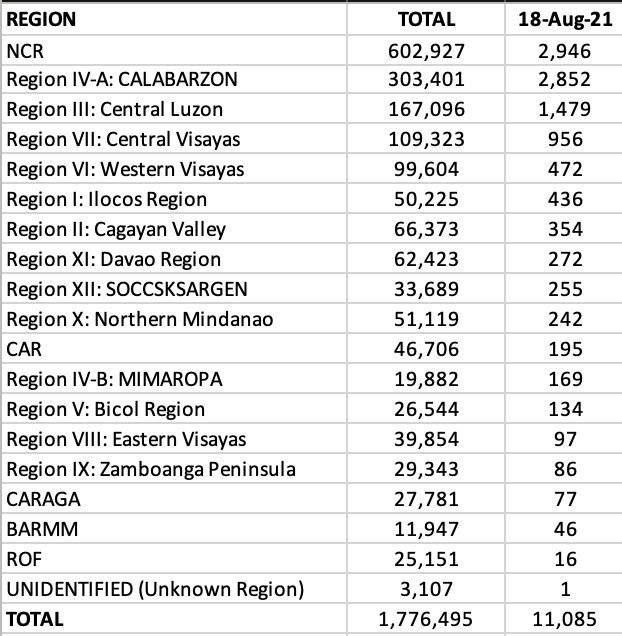
With 11,085 new cases reported today, the new cases brushed off the recoveries and the number of active cases continues to exceed 100,000.
Of more than 46,000 tests done last August 16, 23.4% were positive.
Total deaths today added was 161, placing the case fatality ratio for outcomes steady at 1.83% (not 1.72%). Reiterate the fact that we still do not know the outcome of the active cases, which account for close to 6% of the total cases in the country.
ICU utilization has gone down perhaps due to increase in ICU beds for some government and private hospitals or that most the cases being reported are mild or asymptomatic and will not require hospitalization for now.
NCR and CALABARZON accounted for more than half the cases in the Philippines today.
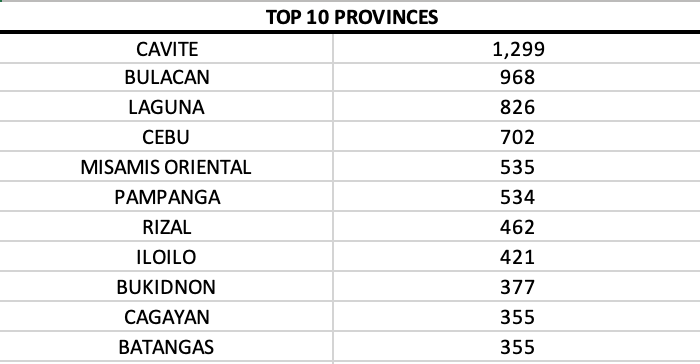
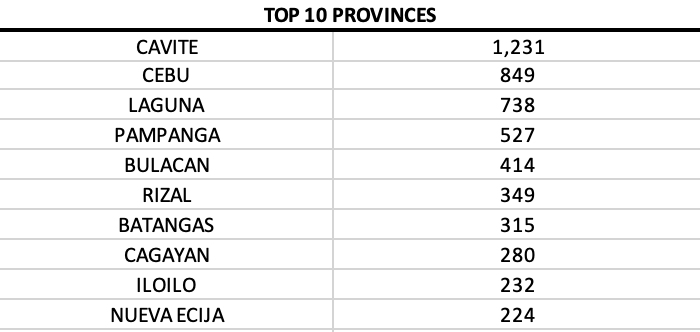
Cavite remains the top province on a provincial level with quadruple digits. Four provinces in Region IVA (CALABARZON) are among the top 10 provinces with most cases for the day.
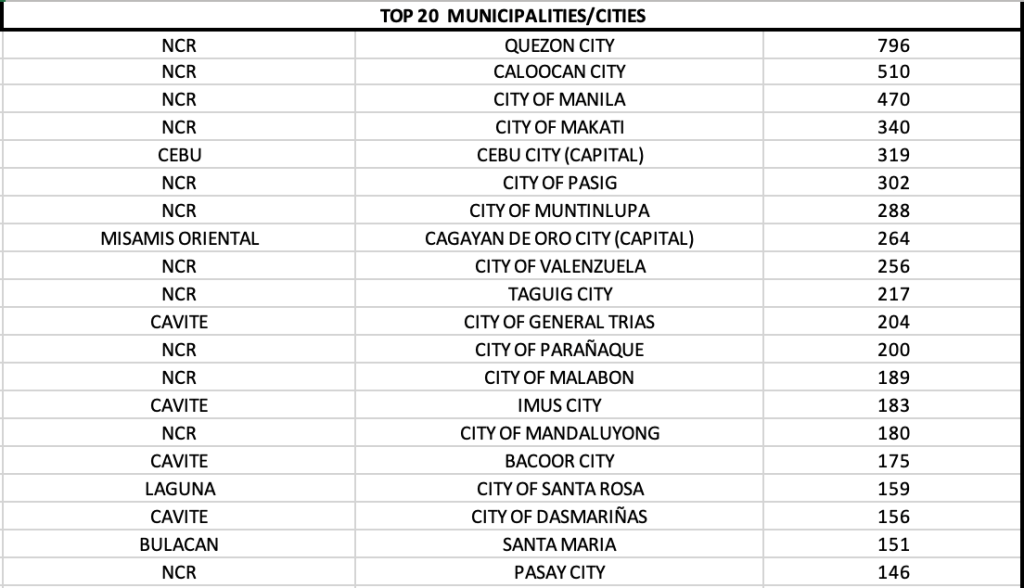
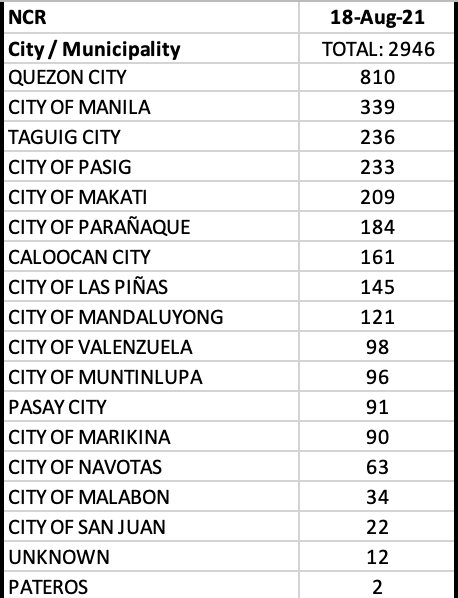
Quezon City remains as the top LGU in terms of new cases in the country. Eight of 17 LGUs in NCR are in the 20 LGUs with most cases. It is, however, cities in Cavite that have surprisingly joined the top 20 LGUs. Five LGUs in Cavite are in the top 20. Two LGUs are from Cebu province, and two LGUs are from Laguna.
OCTA MONITORING REPORT
From a handful to a bucketful.
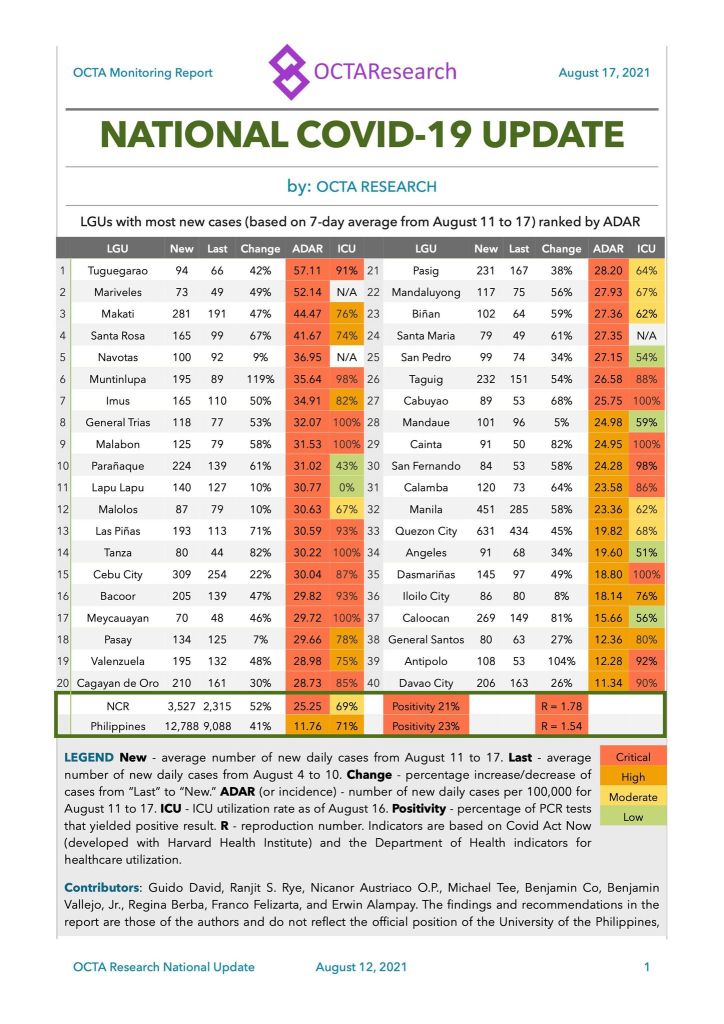
The national reproduction number is at 1.54, while it is higher at 1.78 in the NCR.
There was an overall increase of 41% in cases nationally, while an increase of 52% in Mega Manila.
Muntinlupa City in the NCR led all LGUs in the country with the highest increase in cases based on the 7-day average from August 11-17, 2021. Muntinlupa shot up 119% from 89 new daily cases to 195 new daily cases. Based on ADAR (incidence rate), Muntinlupa ranked 6th in the country with ICU utilization at 98%.
In today’s report, 27 of the top 40 LGUs have an ADAR (average daily attack rate or number of new daily cases per 100,000 population for this period) greater than 25!. The highest ADAR is Tuguegarao.
ICU utilization is also at critical levels in 18 of the 40 LGUs, This may be a case of under reporting for many cities in the list.
And yes, because it is a Tuesday, we have fewer cases today.
Nevertheless, these are high cases for any other Tuesday as the total cases reported today are still past 10,000.
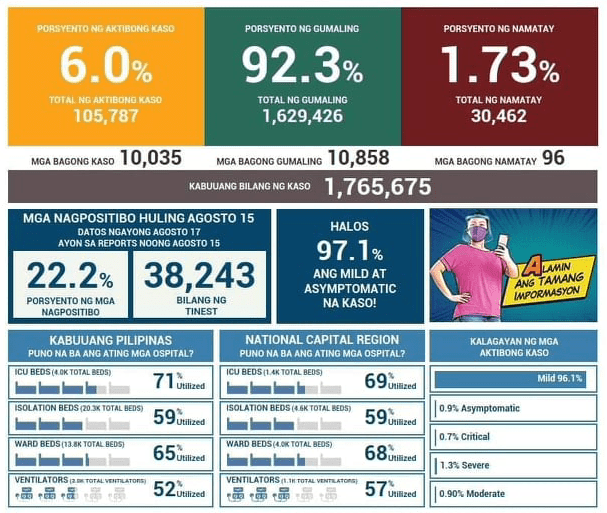
The Health Agency announces 10,035 new cases today and almost the same number of recoveries, making no change in the active cases which are still past the 100,000 mark.
Tests done last August 15 totaled more than 38,000. The positivity rate remains high at 22.2%.
With 96 new deaths, the case fatality ratio for outcomes is at 1.84%.
While it was the usual low Tuesday for the nation, this was the highest tally for a Tuesday since the pandemic. NCR, CALABARZON, and Central Luzon accounted for 57.9% of the total cases today.
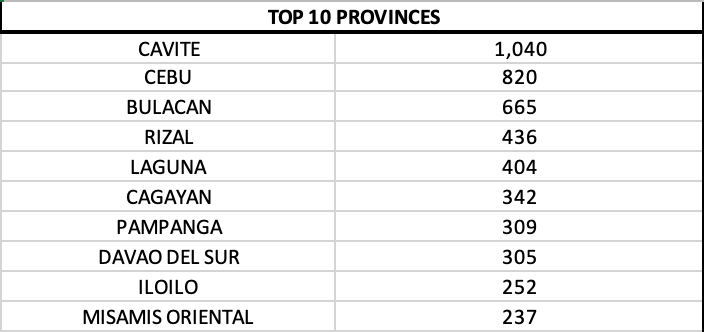
Cavite continued to lead among provinces. Laguna and Rizal, two other provinces in Region IVA joined Cavite in the top 10 provinces again today.
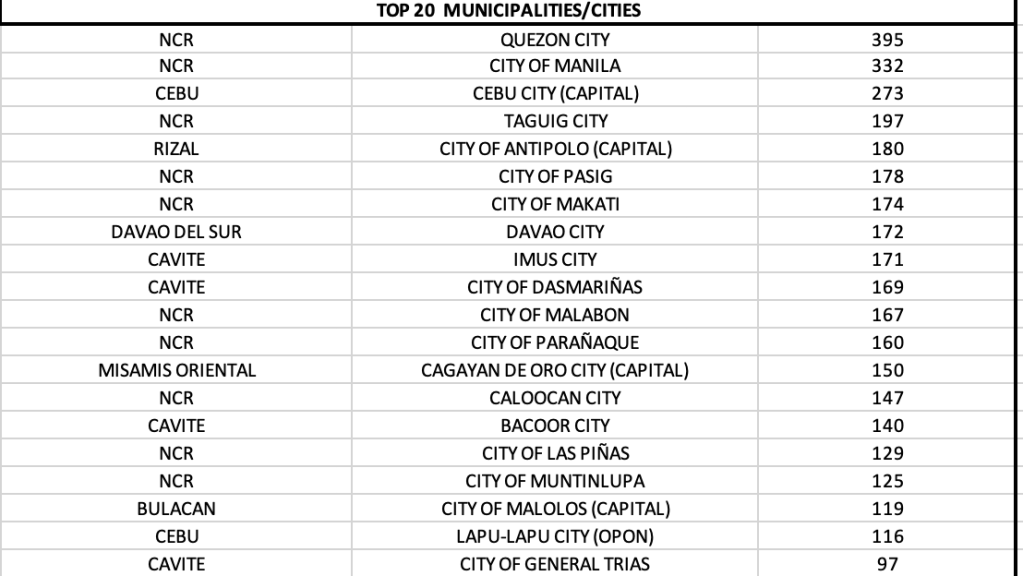
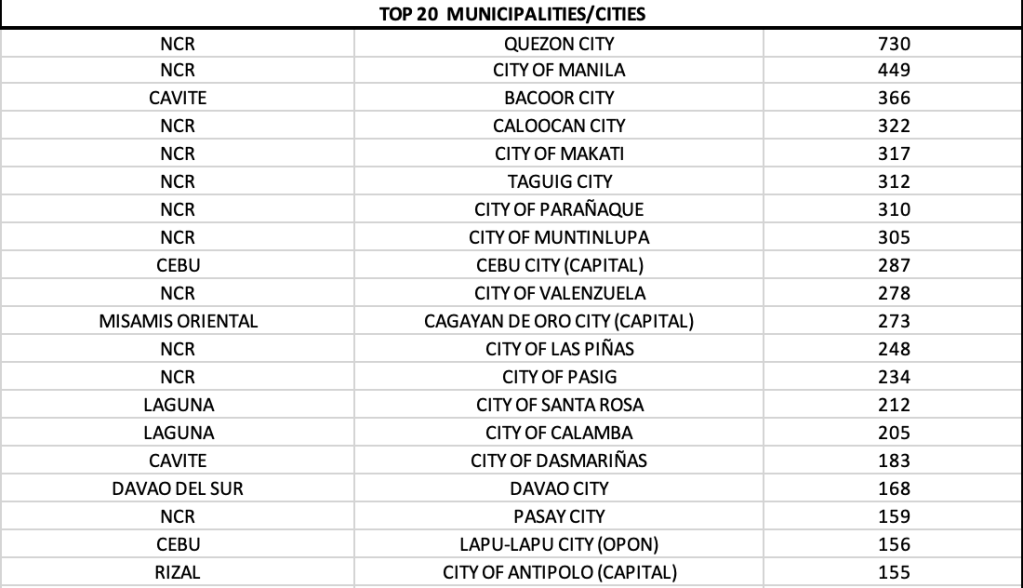
Quezon City remained the top LGU with most COVID-19 cases. Ten of 17 LGUs in NCR are among the top 20 LGUs with most cases in the country. Four cities in Cavite Province and two in Cebu Province are also in the top 20 cities/municipalities with most cases for the day.
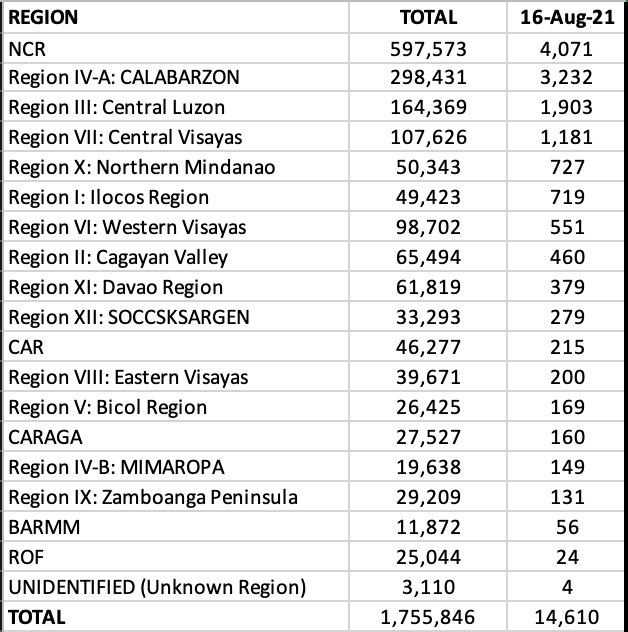
It’s the third straight day with more than 14,000 new cases reported in a single day. Are we plateauing? No.
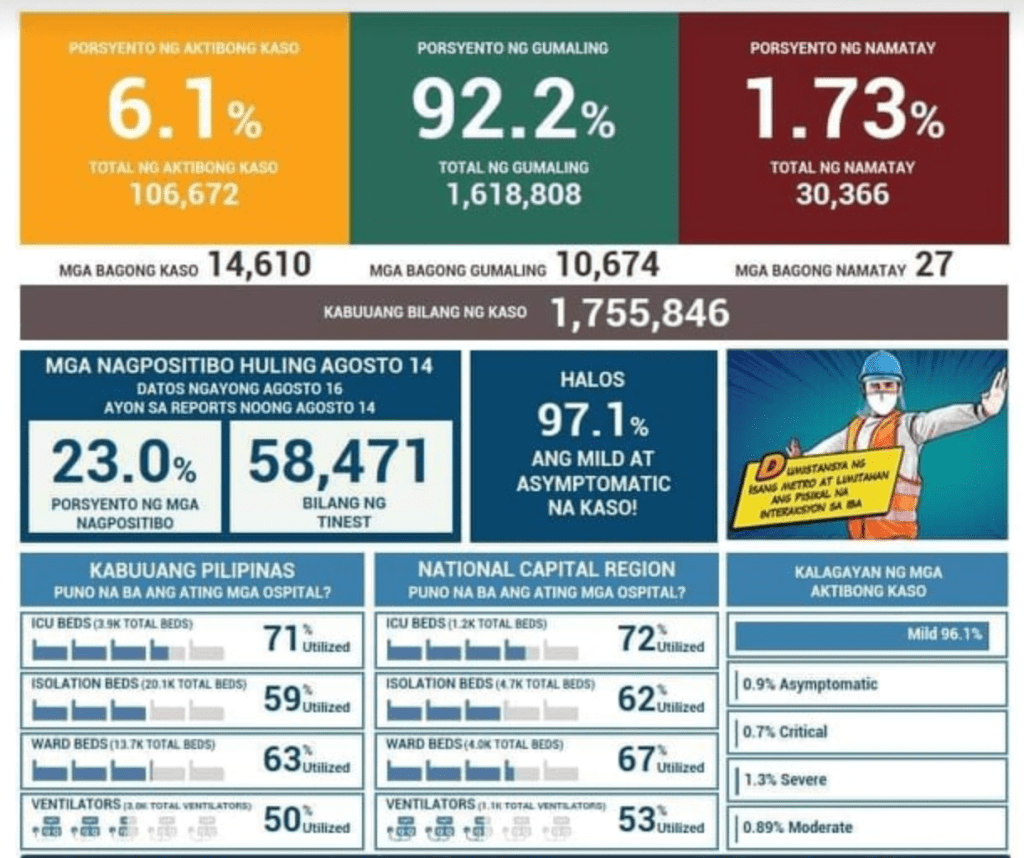
Based on the 14,610 new cases, notice that the active cases have now ballooned to 106,672. This will take time for a greater number to recover. Of course, the most important question is – are they tracing the contacts for these active cases? The larger the active cases, the wider the contact tracing must be.
Tests on August 14 showed more than 58,000 done, with still a large 23% positivity rate. Largely pointing to the fact we are not testing enough for now.
Even ICU beds are up in the NCR and nationally, although the numbers announced by the Health Agency may not necessarily reflect the reality on the ground, as most, if not all hospitals in major LGUs being inundated in this surge are now at full capacity.
Only 27 new deaths were reported. While it is a low number, it may not reflect the real situation again as deaths are late reports requiring validation and reconciliation of data.
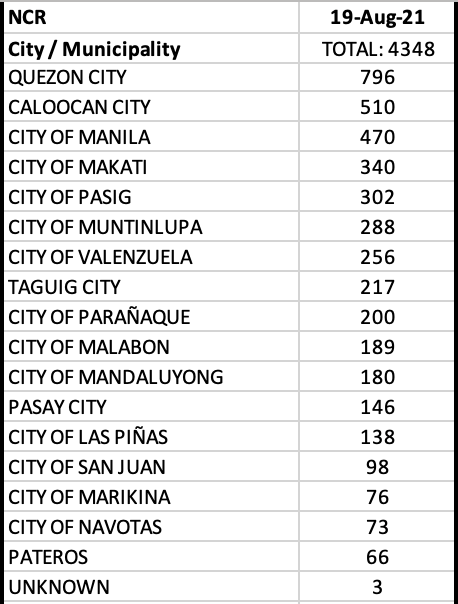
NCR logs in past 4,000 cases today with LGUs outside of Quezon City, Manila and Makati seeing doubling cases for many cities in Mega Manila. The smallest region in terms of land area accounted for 28% of the total cases in the country. CALABARZON and Central Luzon together with NCR was responsible for almost 2/3 of the cases today. And together with Central Visayas, that reported quadruple digits as well, all four regions contributed to more than 71% of today’s cases.
Cavite, Cebu province and Laguna reported quadruple digits today, with four provinces in CALABARZON making it to the top 10 provinces with most cases. They are: Cavite, Laguna, Rizal and Batangas.
While Quezon City still raked in the most number of cases on an LGU level, 11 of 17 LGUs from NCR were in the top 20 cities with most cases for the day. Two cities in Cavite, two in Laguna and two in Cebu are in the top twenty list.
OCTA MONITORING REPORT
The NCR COVID-19 update is provided in today’s report as Mega Manila sees a 7-day average rise in new cases to 3,262 from the period August 9-15. This is a 51% increase from the cases the week before. Arranged according to incidence rate or ADAR (average daily attack rate), twelve LGUs are in critical level. They are: Navotas, Makati, Pateros, San Juan, Pasay, Muntinlupa, Mandaluyong, Valenzuela, Parañaque, Malabon, Pasig and Las Piñas.
Bed capacity is 100% in Navotas, while ICU utilization is critical in Pateros, San Juan, Muntinlupa, Las Piñas, Taguig, and Marikina.
The detection of lambda variant in the middle of the storm of other variants circulating is disconcerting. For now, lambda is a VOI (variant of interest) and not considered a concern. We need to keep an eye on this as it evolves This, as the Health Agency reports 14,749 new cases, bringing the active cases past 100,000.
Tests done last August 13 racked up to close to 60,000 but the positivity rate for those were still at 23.5% high.
There were 270 new deaths added, bringing the case fatality ratio of outcomes to 1.851%.
ICU bed utilization is at 71% in the NCR while it is at 70% nationally.
While NCR continued to have more than 3000 cases, CALBARZON reaches a new high with 3,000 new cases followed by a new high also for Central Luzon with more than 2,000 cases. These three regions make up 58.8% of today’s cases, but it is CALABARZON and Central Luzon that are seeing a dramatic increase in cases.
On a provincial level, CAVITE has been on a streak with more than 1,000 cases for the past days. Cavite is one of the provinces under a more relaxed quarantine compared to Laguna, which is in its neighboring border. Both Cavite and Laguna are the top two provinces for the day,
On an LGU level, cases in NCR continue to rise in various LGUs but remain flat in others. Quezon City continued to lead on both the regional level and national level as the LGU with most cases. Eleven of 17 LGUs in NCR are in the top twenty list of most cases by city. Three of the top twenty are LGUs in the province of Cavite.
OCTA MONITORING REPORT
Of course, the first of the weekend report is from the OCTA Research group. For the week of August 8-14, 2021, the country now has a 7-day average of 11,000 cases/day. The Rt for this period is 1.46 and the growth rate in new cases up by 29% from the last week.
The top twenty provinces with most new cases is in the table below with Tarlac registering the highest jump of 139%, followed by Rizal, Cagayan and Nueva Ecija – all with more than 50% increase in cases.
Incidence rate (or ADAR) ic critical in Ilocos Norte despite the 24% decline in cases and Aklan which saw a 5% rise. NCR, Cebu, Cavite, Laguna, Bulacan and Pampanga all saw significant increase in cases from the past week (which is truly a wonder why these areas annexed to NCR are even considering going into a lighter quarantine status next week).
Bed capacity is critical in Misamis Oriental and Cagayan, while ICU capacity is at critical level in Cavite, Pampanga, Misamis Oriental, Cagayan and Tarlac.
THE WEEK IN REVIEW
Of course, the report will not be complete without an assessment of how we did as a nation for the whole week – 9 days after declaring various forms of lockdown measures in the Philippines.
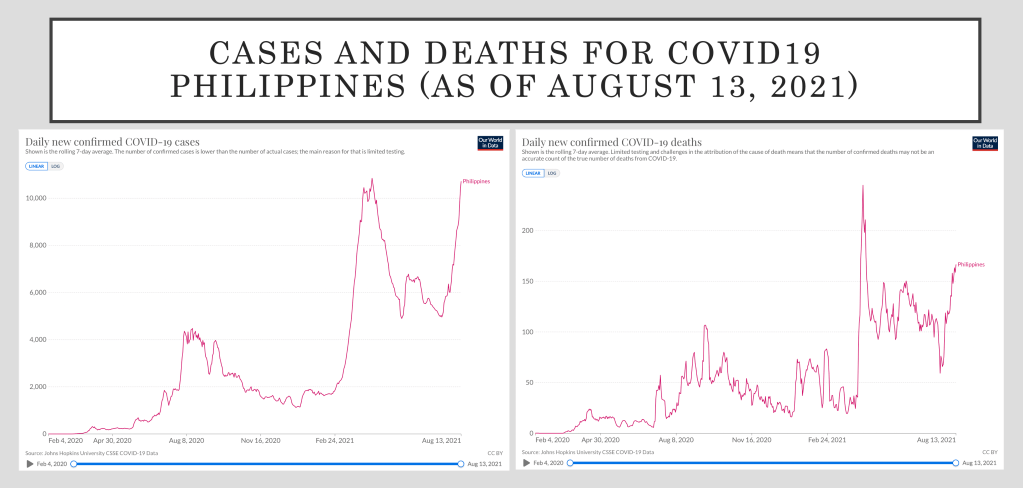
Without a doubt, the increase in cases has sent the hospitals to full capacity once more. On August 14, the Philippines recorded the second highest number of cases at more than 14,000 in a single day. Will we break the record set last April 2 where we posted 15,280 cases.
The death cases were also on an incline over the past week in spite of a few days of recording low cases. Death reports will always be late, and when validated may get lumped in a single report. Whatever reason is provided, it is evident that as the number of cases see a rise, so do deaths.
Testing during a surge is important. Unfortunately, over the same time period where lockdowns were imposed, there was no significant increase in testing done, driving up the positivity rate of the tests to an all time high. As of yesterday, the 7-day average was almost 25% or 1 in every 4 individuals tested, testing positive.
Among select Asian and ASEAN countries that are experiencing a surge in cases, the other countries are still seeing increasing numbers but have slowed down. Indonesia for example has seen a significant decline in number of cases. While Indonesia may have more daily and total cases, if we take the population of Indonesia vs. the Philippines into consideration and compute for the number of cases per million population (per capita), Indonesia has only 13,852 cases per million people, but the Philippines has 15,532 cases per million. Deaths on the other hand are lower in the Philippines with 270 deaths per million vs. Indonesia with 420 deaths per million.
The reproduction number is a reflection of how the countries have been able to bring down the new cases or slowed it down. A month ago, the Philippines was able to stay at the bottom of the rung where its R was less than 1.0. Among the select countries, our R is up while all other countries that have slowed down or brought down the number of cases are seeing a decline in the R. A major indicator on how we are doing is the ability to bring down the R and maintain this at a very low level forever. Anytime we see a steady rise in the R, is an indication that cases are up and that interventions at addressing the rise should be implemented immediately in order to abrogate a surge.
Finally, this is where many countries in the world stand with vaccination coverage and with the delta variant. We are not that far from some neighboring Asian countries, but there are some that are doing better are vaccination than us. Cambodia, with a population of around 16.5M has more than 52% of the population vaccinated (43% fully).
The second to the highest new cases announced in a day since April 2021 is today.
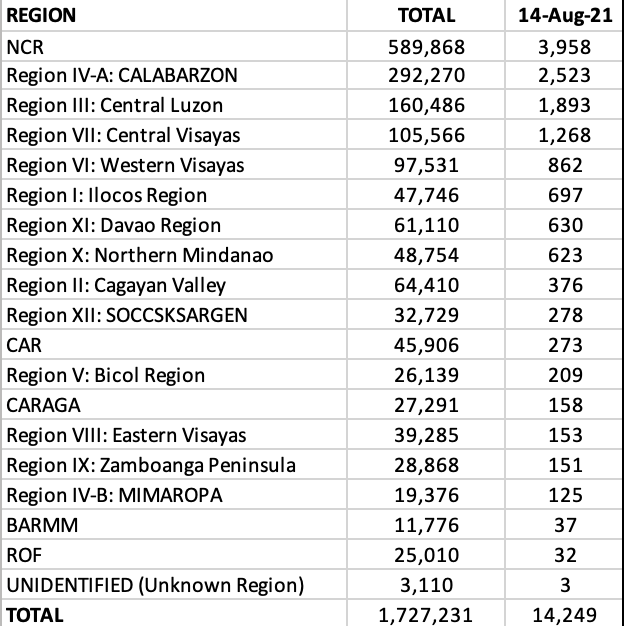
The Health Agency reports 14,249 new cases pushing the active cases a tad shy of 100,000 active cases. This apparently has put the healthcare system in various localities in critical zones as the ICU beds in the NCR fill up to 71% (and 70% nationally).
With more than 52,000 tests only done last August 12, almost 25% positivity rate was recorded. Meaning 1 in every 4 patients swabbed would likely test positive.
With 233 new deaths, we now pass the 30,000 number of people who have passed away from COVID-19. It would also be better if the Health Agency reported the case fatality ratio more realistically by using outcomes as the denominator. They compute the CFR using the total cases as the denominator, making the case fatality ratio look lower at 1.74%. In reality, the denominator is best represented by the total outcome (in this case, those that have recovered vs those that have died). We cannot presume the outcome of the active cases as good, considering that the ICU utilization has now crossed the 70% mark and that the active cases are almost 100,000. The corrected case fatality ratio based on outcomes stands higher at 1.85% today.
With today’s total cases, NCR accounts for 27.8% of the total cases nationally. Together with CALABARZON and Central Luzon, these three regions make up 58.8% of the country’s total for the day. Other regions are seeing rising numbers once more as all regions, except the BARMM report triple or more digits.
Cebu lands again on top as the province in most cases. Today, four provinces in Region IVA are in the top ten provinces – Cavite, Laguna, Rizal and Batangas. Two provinces in Central Luzon join the top ten as well – Bulacan and Pampanga.
At the level of the LGU, 13 of 17 LGUs in NCR are in the top 20 cities with most cases for the day, led by Quezon City, Manila, Caloocan City, and Makati. In fifth spot is Davao City, which is seeing a rise in cases once more.
OCTA MONITORING REPORT
With the current surge, the OCTA monitoring report for August 7-13, 2021, shows the top 40 LGUs ranked by incidence rate (or average daily attack rate) in the table below. Those highlighted are areas at critical risk. This is led by Navotas with a 215% increase in cases and an ADAR of 47.67 per 100,000 population. Tuguegarao, Mariveles (Bataan), Makati City, Santa Rosa (Laguna), Lapu Lapu City (Cebu), Pasay City, Imus (Cavite), Malolos (Bulacan), Cebu City, Cagayan de Oro, General Trias (Cavite) and Meycauayan (Bulacan) have ADAR of > 25 per 100,000 population.
The next 27 LGUs are all at high risk with ADAR > 10. Only Antipolo is at moderate risk with a 7.51 ADAR.
Positivity rate in the Philippines is at 22% (Rt = 1.45). The positivity rate in the NCR is lower at 19% but has a higher reproduction number at 1.85 than the national Rt.
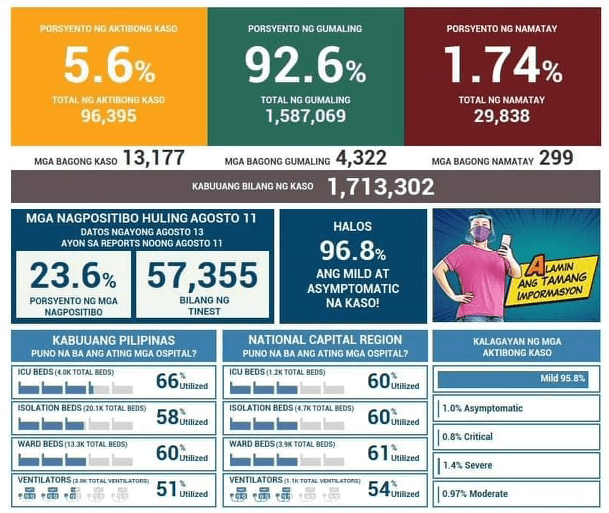
Friday the 13th ends with unsettling report of 13,177 newly announced cases. The additional bad news is that, of more than 57,000 tests done last August 11, 23.6% of them were positive. Which means that we brace ourselves for more cases in the upcoming days. Please remember that the new cases are not the same are the cases based on the tests done. They are two separate information – one on testing results and the other on newly verified cases.
The new cases now pushes the active cases closer to the 100,000 mark.
With 299 deaths announced today, the case fatality ratio for outcomes is at 1.84%.
While NCR stays on top, it is the CALBARZON area that is fazed with high cases especially Cavite and Laguna that are inundated as their hospitals see full occupancy. NCR now owns 27.3% of the total cases today. Together with CALABARZON and Central Luzon, these three regions account for two-thirds of the COVID-19 cases today.
Cavite is on a three-day streak of more than 1,000 new daily cases (not counting the backlogs of the Health Agency). The provinces of Cavite and Laguna alone were responsible for almost three-fourths of the cases in Region IVA.
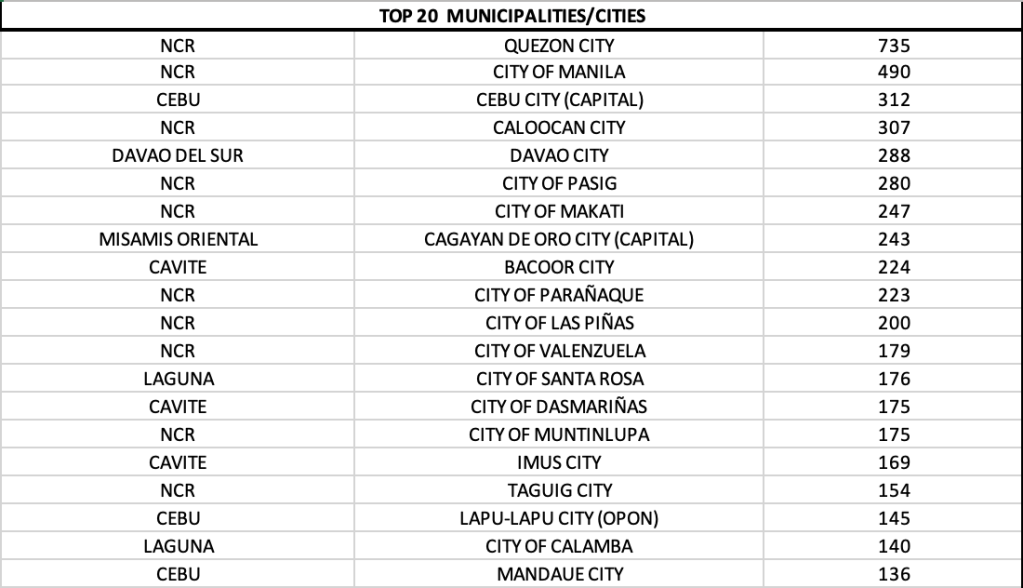
Quezon City had a whopping 735 new cases in a single day, with most the LGUs in the NCR seeing triple digit numbers. Ten of 17 LGUs in NCR were among the top twenty cities with most cases. Three cities from Cebu were also in the top twenty, while three cities in Cavite and two cities in Laguna made it to the list.
OCTA MONITORING REPORT
The immediate neighbors of NCR are on the top of the heap among provinces with most cases for several days now. Not withstanding the delayed reporting of actual cases from the Health Agency (with the thousands of backlogs in its data drop), it is worrisome that the IATF declares a less stringent in the CALABARZON area.
While it is the NCR that is and has remained the epicenter of any surge in the country, it is undeniable also that the provinces that annex to the NCR with a very thin line demarcating the borders would carry the same risk the closer that boundary is. After all, it is the enclave for homes and industrial parks and warehousing for the offices of businesses in Mega Manila, where labor, rent, and taxes are lower than parking them in the highly congested Mega Manila.
Which makes common sense that these areas would primarily be affected during a surge in NCR. It is also the same community that utilizes (and usurps) the limited healthcare system of the NCR as those that can afford to be hospitalized in Mega Manila tertiary hospitals will have their sick patients admitted here instead.
In today’s report, CALABARZON is the spotlight as the 16 LGUs enumerated show a marked increase in cases, including incidence rate, hospital beds and ICUs filled to the brim in the majority.
To consider them lowering their quarantine status at this point makes no sense.
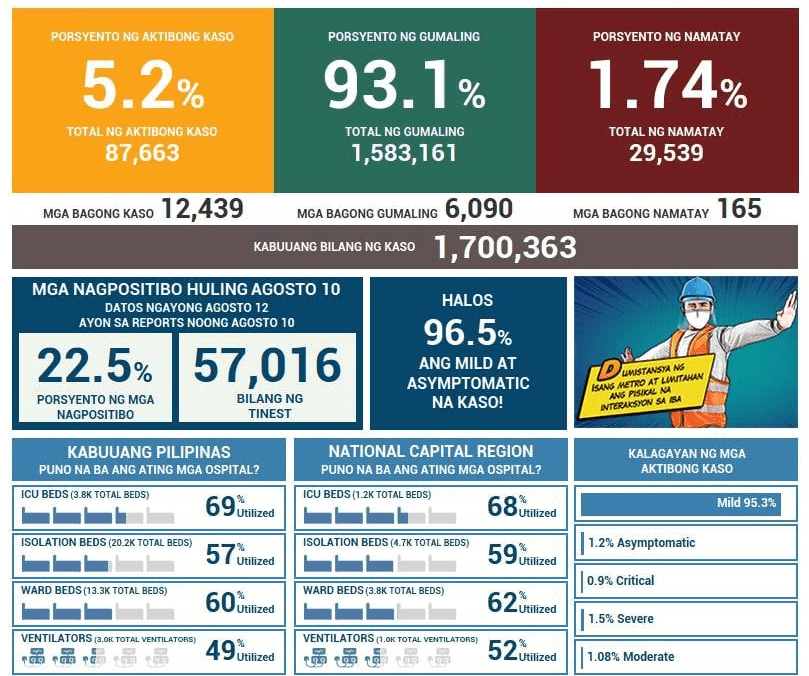
The Health Agency reports high of 12,439 new cases today pushing the active cases to an all time high of more than 87,000.
Tests done on August 10 were more than 57,000 but the positivity rate was at 22.5%. Meaning, of every 100 patients tested, more than 22 tested positive (or 1 positive for every 4-5 patients tested).
Total deaths reported today is 165. The case fatality ratio for outcomes is at 1.83%.
NCR now accounts for almost 30% of the total cases in the nation. Together with CALABARZON and Central Luzon, they make up more than 60% of the cases for the day. Four regions report quadruple digits as the country sees a continuing rise in COVID-19 cases.
Cavite continued to lead on a provincial level, accounting for almost 50% of the total cases for Region IVA alone.
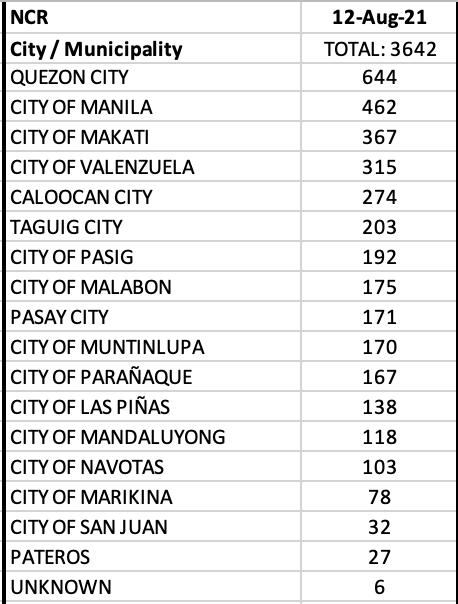
On an LGU level, Quezon City led the day to make 13 of 17 LGUs from NCR be included in the top 20 cities with most cases.
The country reports 177 new cases of the delta variant out of the 372 sequenced on August 11. It is important to remember that newly announced cases do not mean that they occurred today. It is only being reported today based on what was sequenced on the date announced. The delta variant now makes up 47.5% of the variants reported on August 11, 2021.
OCTA MONITORING REPORT
With increasing cases in various parts of the Philippines, the top 40 LGUs with most new cases based on the 7-day average from August 5-11 are in the graph below. The Philippines Rt is now at 1.41 while the NCR is up at 1.76. The positivity rate of the country is critical at 21%, while that of NCR is high at 17%.
Only 2 cities saw a decline in the 7-day average – General Santos and Laoag. All the rest had double digit increase in cases.
In terms of ADAR or incidence rate, those considered critical are: Cebu City, Makati, Lapu Lapu City, Imus (Cavite), Pasay City, Santa Rosa (Laguna), Navotas, Malolos (Bulacan), Tuguegarao, Mariveles (Bataan), Kalibo (Aklan), and Laoag (Ilocos Norte).
ICU utilization is at critical risk for Cebu City, Cagayan de Oro, Taguig, Las Piñas, Imus (Cavite), Dasmariñas (Cavite), Muntinlupa, Iloilo City, General Trias, Tuguegarao, Cabuyao (Laguna), San Fernando (Pampanga) and Meycauayan (Bulacan).
With only less than 40,000 tests done August 9, 2021, a positivity rate of 21.9% is very high. What’s worst is that the Health Agency announces 12,021 new cases today, pushing the active cases to more than 80,000.
Total new deaths announced is 154 today.
Health care facilities are once more being deluged with ICU bed occupancy at 69% in the NCR and 68% nationally.
The NCR continued to contribute heavily to the daily tally accounting for 26% of the total COVID-19 cases for the day. Together with CALABARZON and Central Luzon, these three regions brought in 60% of the cases for the day!!!
Cavite province had quadruple digits and led on a provincial level. This was followed by Cebu and Laguna, respectively.
On a LGU level, Quezon City led once more with close to 600 new cases. Nine of 17 LGUs in NCR were in the top twenty cities with most cases. All cases in the top twenty are triple digits and the fewest cases in the 20th spot was Lapu Lapu City with 142 cases for the day. Four cities in Cavite made it to the top 20 list – Imus, Dasmariñas, Bacoor and General Trias.
OCTA MONITORINGREPORT
The reproduction number in the NCR slowed down as of August 10, 2021 slowed down to 1.74. But the numbers are still high, and the situation remains volatile at the moment as the ICU occupancy in Mega Manila begins to build up. The ICUs in the NCR may breach the 70% critical level by the weekend.
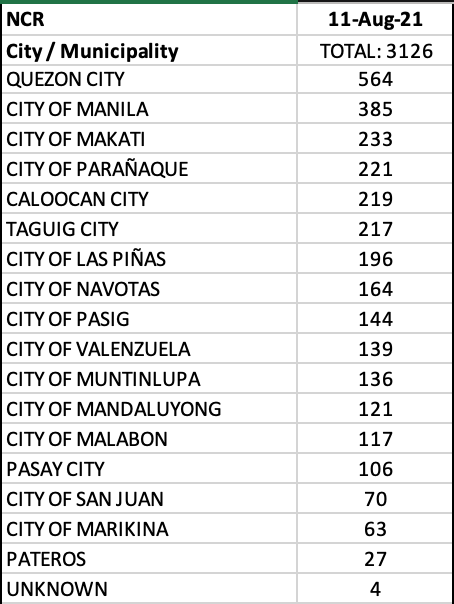
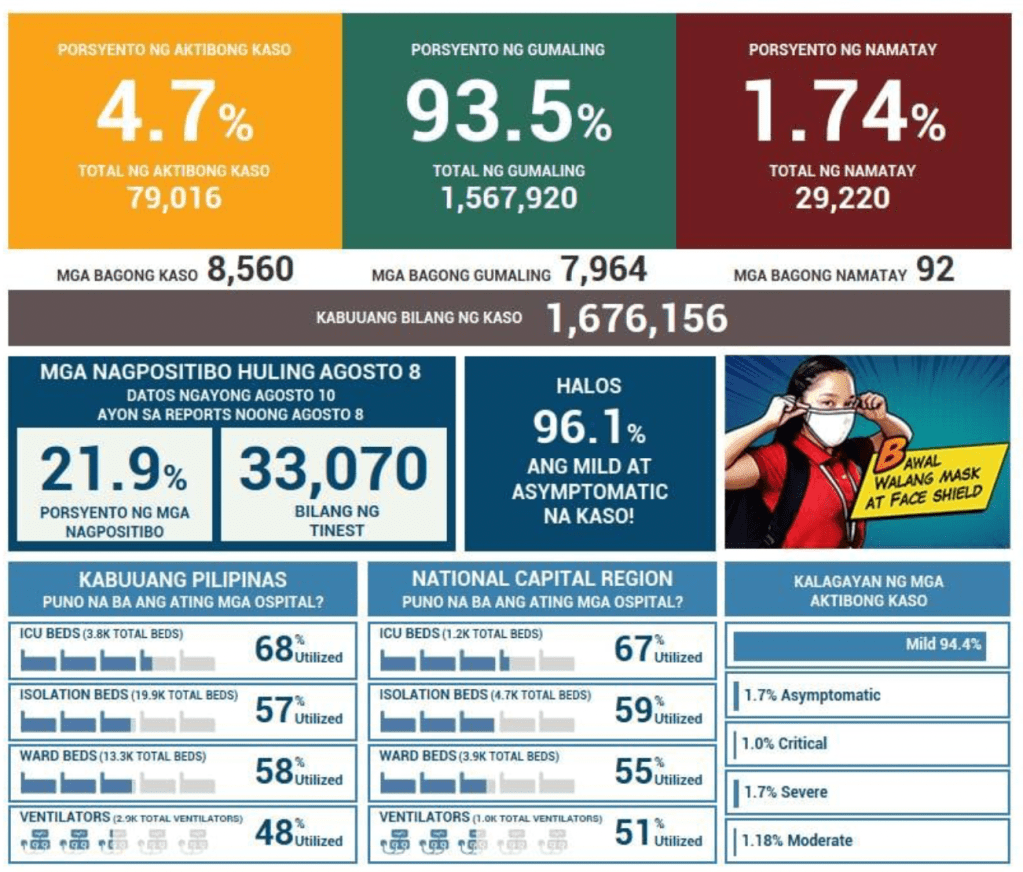
It used to be called low Tuesdays. That’s because the data announced on Tuesdays are from tests done on a Sunday. Last August 8, only 33,070 tests were done. Driving a whopping 21.9% positivity rate! That meant, more than 1 in every 5 people tested, tested positive.
The Philippines has 8,560 new cases today and 92 new deaths announced. At the rate of new cases, we will most likely exceed 1.7M total COVID-19 cases on or before the weekend.
Active cases are close to 80,000 and ICU utilization is now teetering at the boundary of the critical level with utilization up both nationally and in the National Capital Region. Several private hospitals have already declared their COVID-19 facilities (bed and ICU) full.
We expect more cases the coming days as it is only day 5 of the Enhanced Community Quarantine. Locking down early may have its benefits. After all, things get worse before it gets better.
Where are we with testing?
One of the critical indicators in addressing a pandemic is the number of tests being done to identify positive cases. The ability to test quickly is important, particularly in the face of a fitter and faster variant. The delta variant has changed the way we need to improve our testing capacity, including releasing results as efficiently as possible so that we are able to do the next important step – contact tracing.
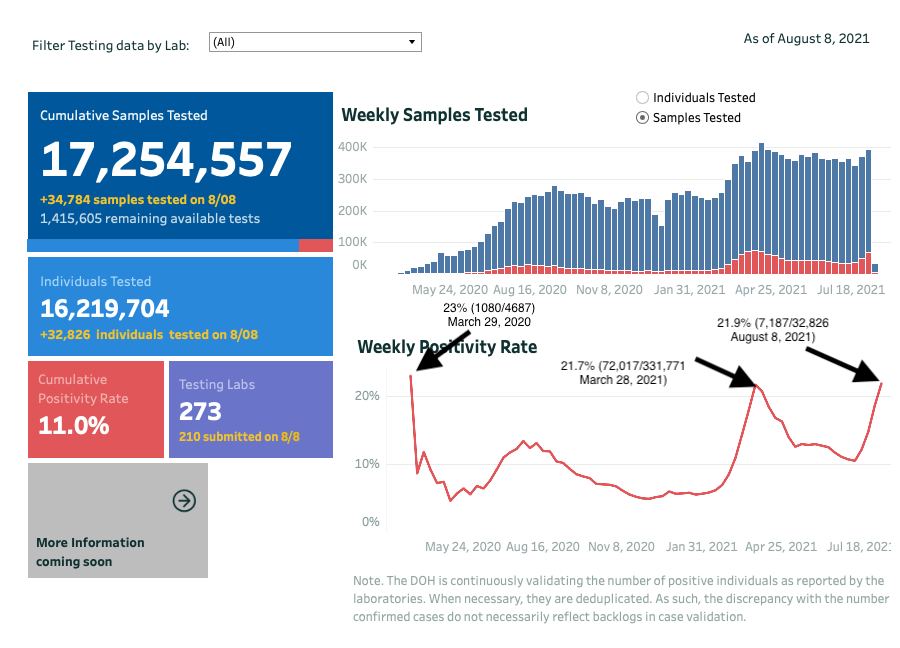
The infographic below (from the COVID-19 tracker website of the Department of Health), shows the positivity rate since the pandemic began in 2020. The highest positivity rate of the country was in March 29, 2020 with 1,080 testing positive from 4,687 samples tested. This was forgivable considering there were only a handful of testing centers then. With the commitment of the government, the number of testing laboratories are now more than 260.
The average testing daily in various waves the country has gone through has averaged 30K-50K daily. But the concern is the weekly positivity rate, which has significantly gone up in the last March surge with a peak on March 28, 2021 at 21.7%. While we were able to bring it down over the past months, notice how steep the rise in positivity rate is. This shows the direct correlation between the number of new cases daily with the positivity rate.
We need to bring the positivity rate down by testing more including those that we contact trace.
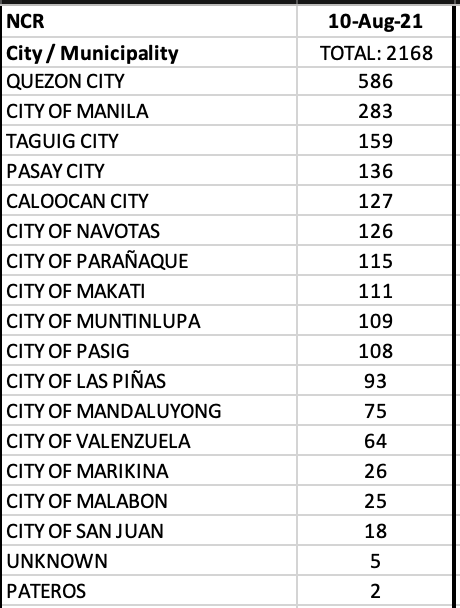
The NCR continued to record more than two thousand cases, while its annex regions CALABARZON and Central Luzon report quadruple digits as well. These three regions alone now own almost 60% of the total cases in the country today.
Cebu province has the most cases on a provincial level. Notice that the provinces annexed to NCR have high cases as well. Cavite and Bulacan came in second and third, respectively.
On a LGU level, Quezon City kept the lead with 586 cases. This city in NCR, accounted for more than 27% of the cases in Mega Manila for the day. It had more cases than the combined cases of Cebu City and the City of Manila. Eleven of 17 LGUs in NCR were in the top twenty today. For the first time, Cavite saw three of its provinces in the top twenty. They are: Bacoor, Dasmariñas, and Imus.
OCTA MONITORING REPORT
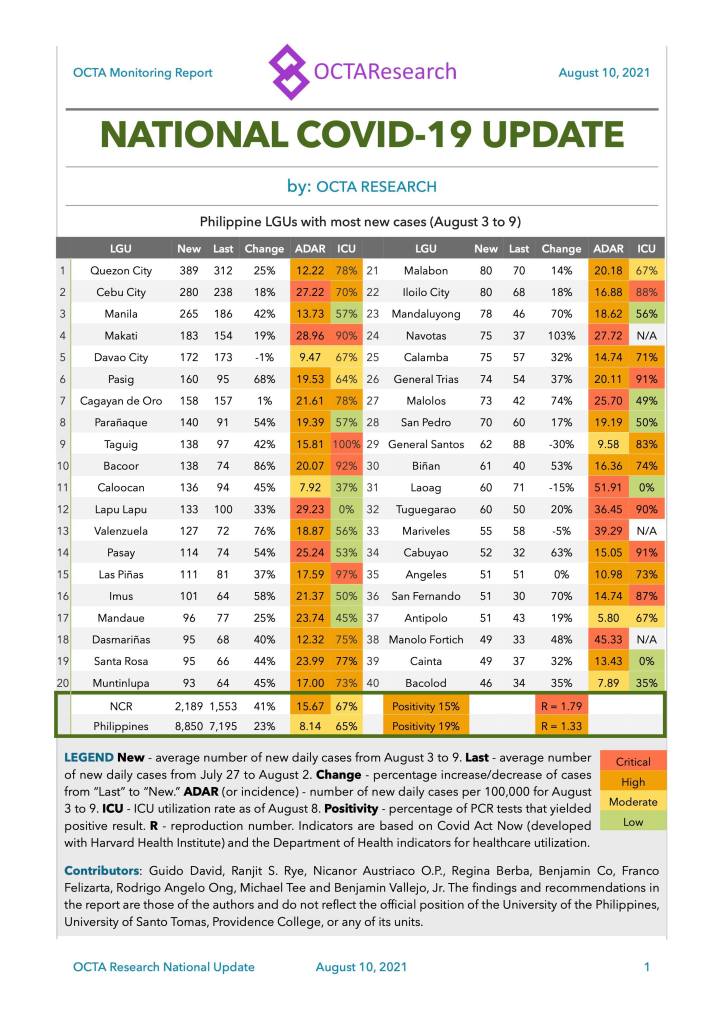
The data of August 3-9, 2021 shows that the current positivity rate is 19% (high) in the Philippines, with the positivity of NCR up at 15%. The reproduction numbers are also increased at 1.79 for NCR.
The top 40 LGUs are shown in the table below. Only 5 did not show an increase in cases for this period. All 35 LGUs showed increasing cases. The ADAR (average daily attack rate or incidence rate) is now critical in Cebu City, Makati City, Lapu Lapu City, Pasay City, Navotas, Malls, Laoag, Tuguegarao, Mariveles and Manolo Fortich (Bukidnon).
ICU capacity is critical in 9 LGUs, high in 10, and moderate in 4.
























 Relative Joy