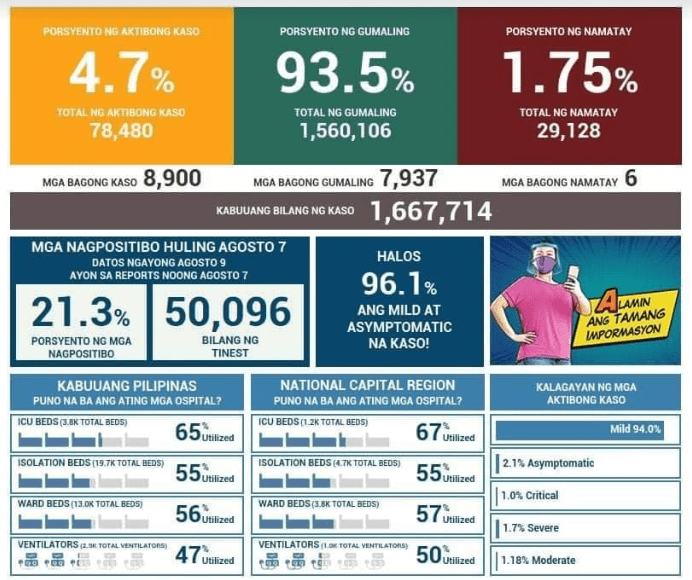
Shockingly high with more than 50,000 tests done on August 7, 2021 is the positivity rate of 21.3%.
The shock here is that the Health Agency reported only 8,900 new cases today and miraculously 6 new deaths. That pushes the active cases now close to 80,000. The major problem is the hospital utilization in the National Capital Region which is up, with the ICU utilization at 67% or a tad shy of the critical mark of 70%.
It is likely that the 8,900 new cases announced are those that have been validated for now. The health agency has been erratic in announcing the cases for the day. For example, yesterday’s data did not tally – the total announced by the government was 9,671 but during the data drop of the DoH, there were 9,753 actually recorded.
While the province of Cebu had 1,352 cases reported for 08.08.2021, the major cities Cebu City, Lapu Lapu and Mandaue had around 750 cases only. Where did the 600 cases come from? And that becomes a problem when we just rely on data without being able to scrutinize it. It makes the modeling and prediction bad.
How did the province of Cebu end up with this data? Well let’s start off with the fact that 903 of the reported cases on August 8 were from specimen collection dates August 4-6, 2021. Four hundred and forty five (445) were from August 1-3, one was from July 31 and 1 all the way back from February 11. The right question to ask is WHY is the data (and reporting) in such disarray? The Health Agency needs to provide more transparency on how it collects data and what it announces for the day, because all projections and modeling highly depend on the data the health agency gathers and reports.
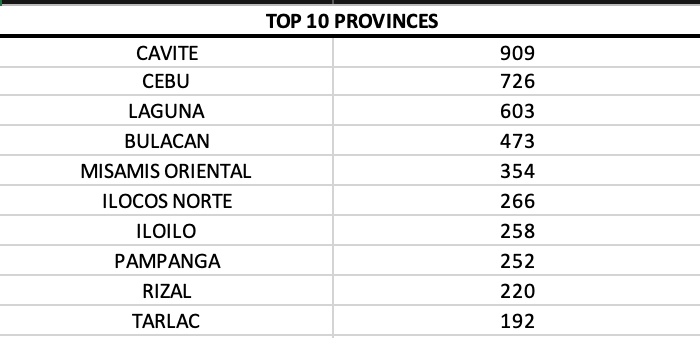
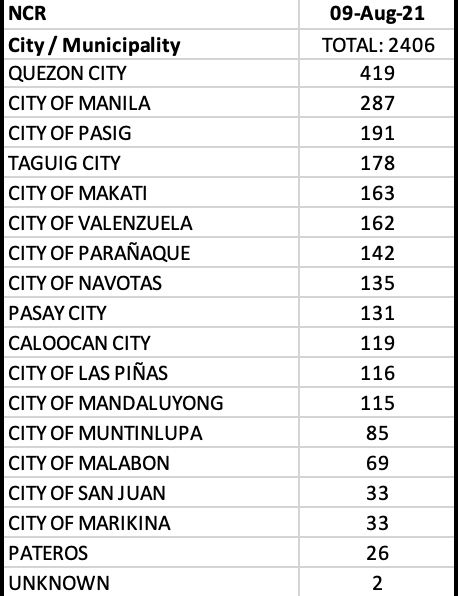
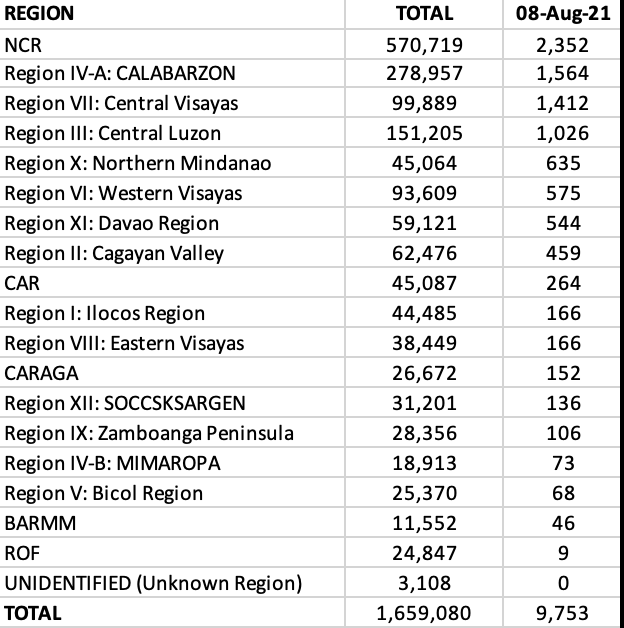
The NCR continued to dominate the day, followed by CALABARZON and Central Luzon. The share of Mega Manila for the total cases in the Philippines is up at 27% (and climbing).
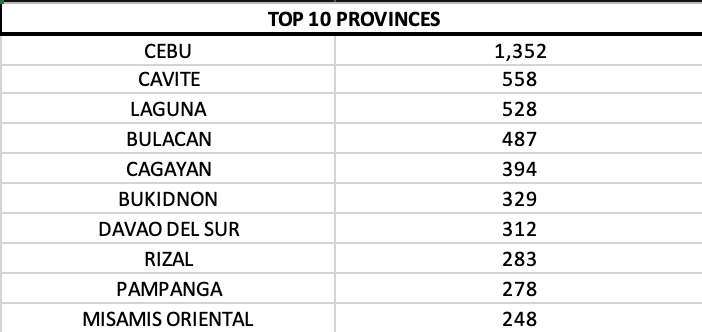
Cavite is back on top among provinces with most cases, followed by Cebu and Laguna.
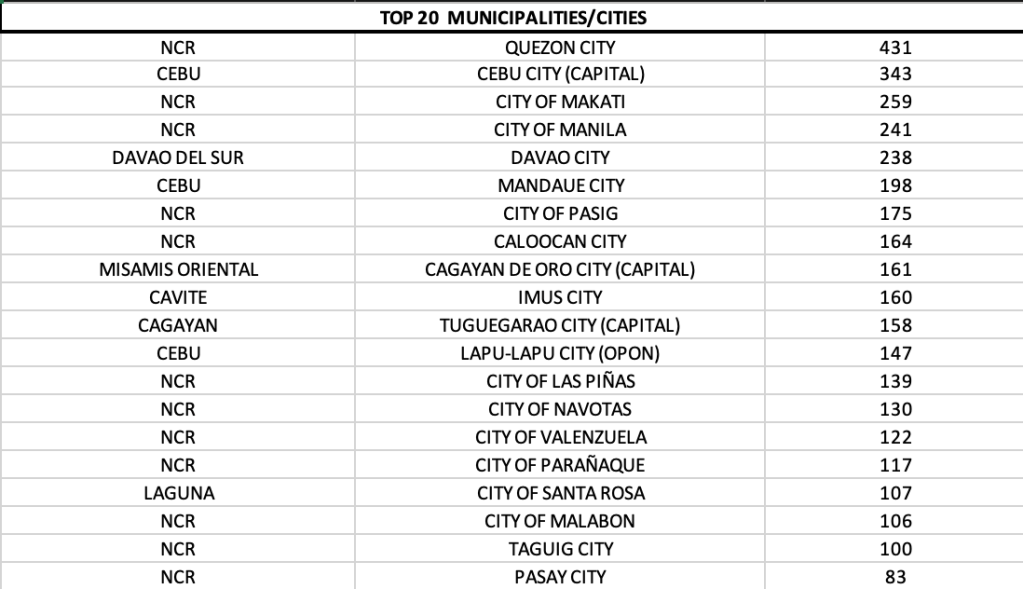
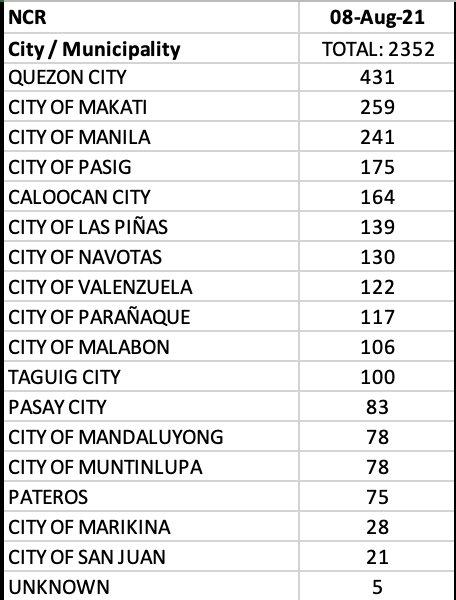
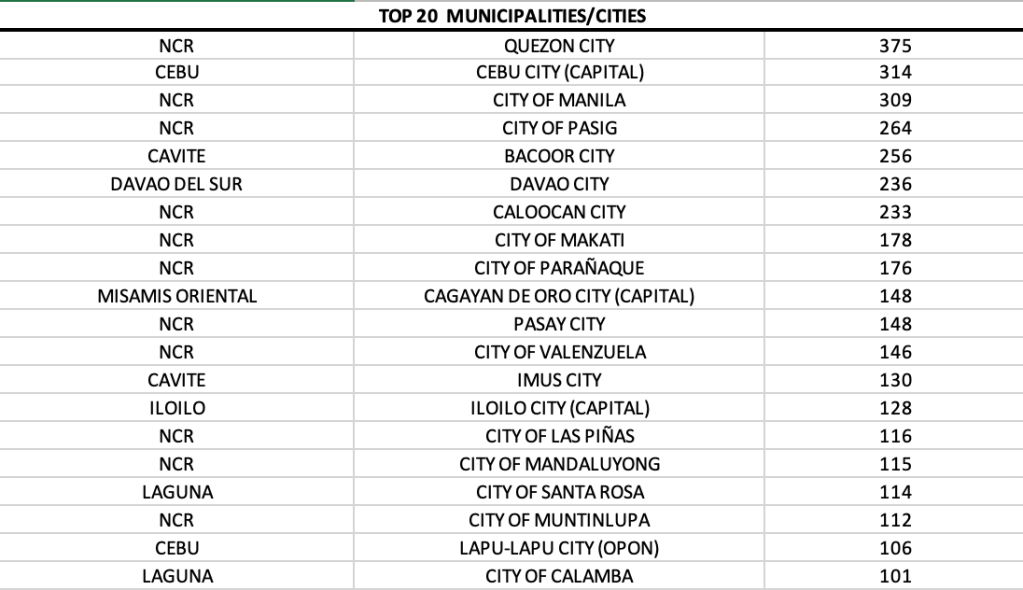
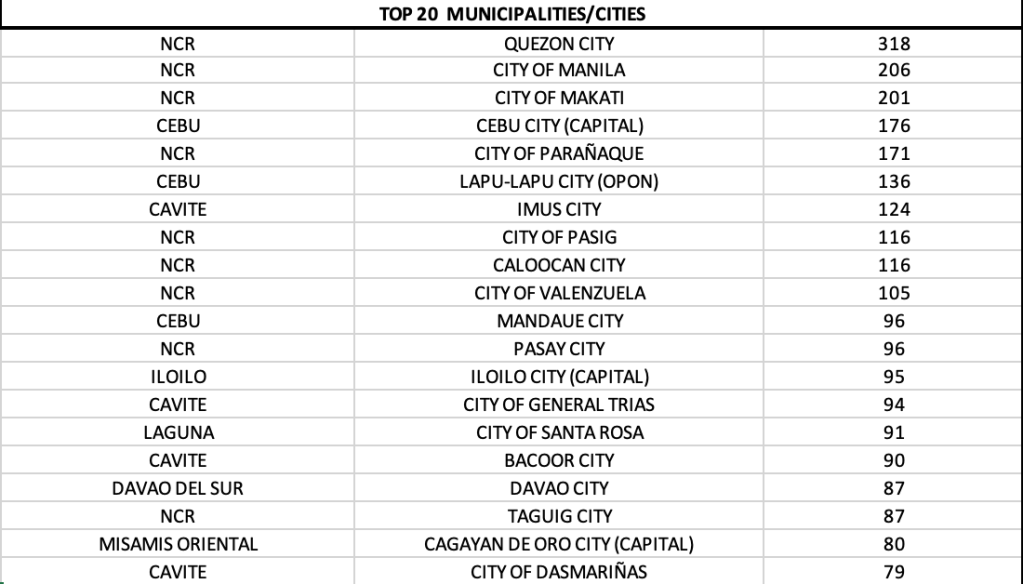
Among LGUs, Quezon City maintains its lead. The City of Manila, Cebu City, Cagayan de Oro and Dasmariñas (Cavite) are the others in the top five. Twelve of 17 LGUs in NCR are among the top twenty cities with most cases for the day.
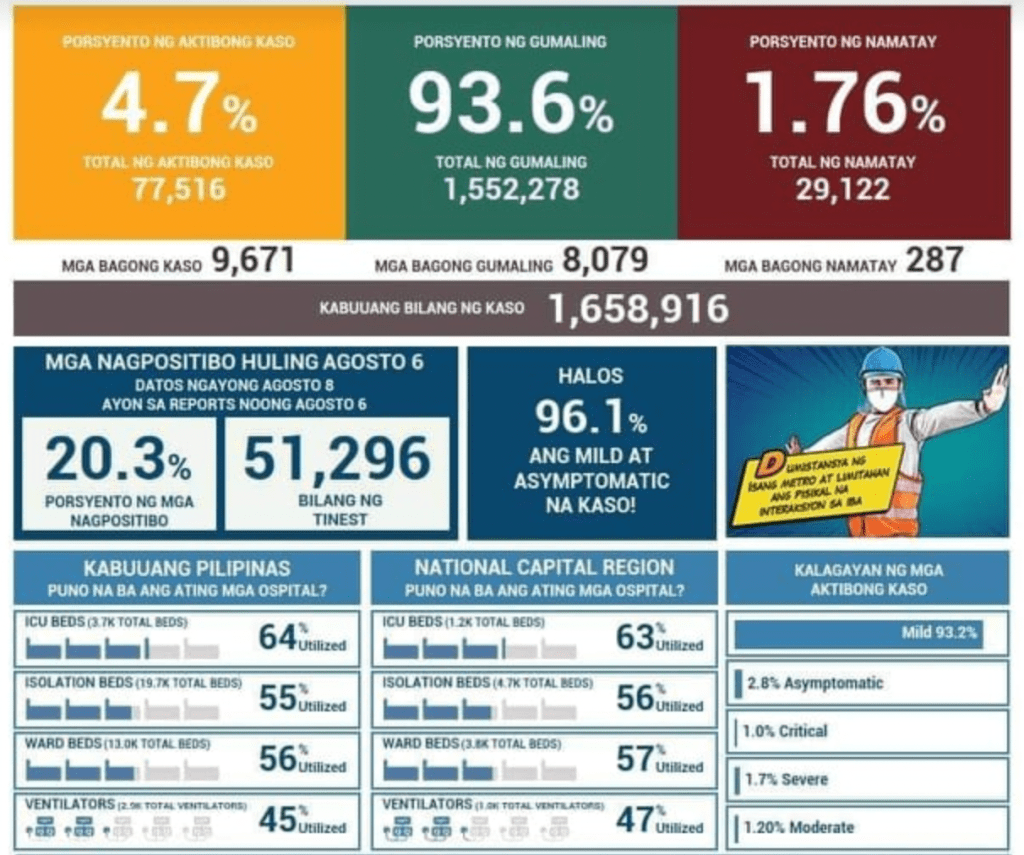
While there were relatively fewer cases reported today with 9,671 for more than 50,000 tests done on August 6m the whopping 20.3% positivity rate is definitely concerning. The number of active cases are up and climbing and are close to 80,000.
ICU bed utilization in the National Capital Region is at 63%, higher than the previous days and week.
Total new deaths at 287 puts the case fatality ratio for outcomes now to 1.84% (Note that the author uses the outcomes – recovery and deaths, and not total number of cases, as the denominator. This is a better reflection of the case fatality ratio because the total number of active cases have no outcomes yet. When the healthcare system becomes overwhelmed, this may tilt the balance in favor of poorer outcomes than recoveries).
Okay, so here’s where I cannot understand the discrepancy. While the Health Agency announced 9,671 new cases yesterday, the data drop reveals 9,753 cases. So much for addition and subtraction. I only wish that someone vetted all this information before releasing them.
NCR continued the lead with 2,352 (24%) of the total cases followed by CALABARZON and Central Visayas. Central Luzon came in fourth with quadruple digits as well. Northern Mindanao, Western Visayas and Davao Region had more than 500 cases.
Cebu province led the provinces, reporting more than 1,300 cases. They had more cases than the total cases of Cavite and Laguna combined.
On a LGU level, Quezon City continued to lead with 431 cases followed by Cebu City. Twelve of 17 LGUs in NCR were among the top 20 cities with most cases in the country. Three top cities in Cebu made it to the top 20 cities as well.
OCTA MONITORING REPORT
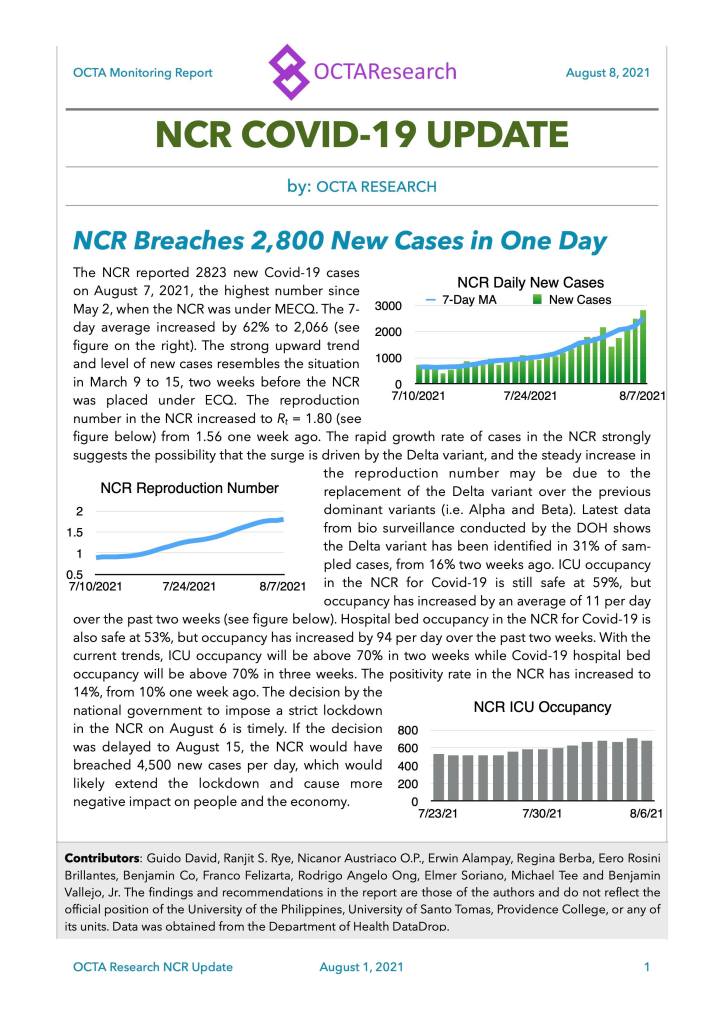
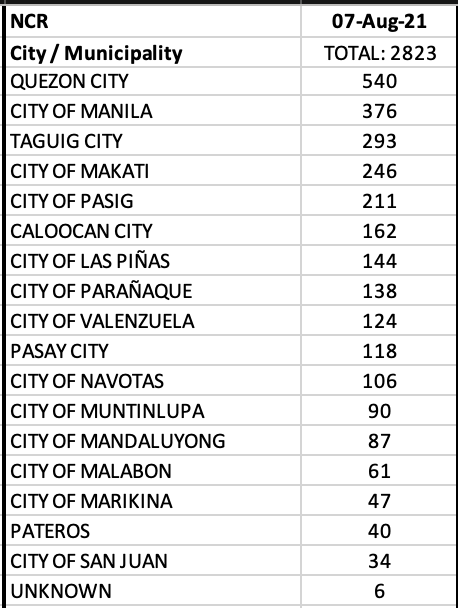
As Mega Manila breached 2,800 cases yesterday, the 7-day average is up at more than 2000 new cases daily. With this incline, the reproduction rate moves up to 1.8 from 1.56 a week ago.
Compared to the second surge last March, the quick increase in cases can be attributed to the rise in delta variant locally. This can only be extrapolated based on what data has been provided by the Health Agency as the Philippine Genome Center will certainly be unable to sequence all RT-PCR samples.
While the ICU occupancy is considered still “safe” at 59%, this is a tremendous rise over the past two weeks.
As NCR is back into its third ECQ since the start of the pandemic last year, we will still see a continued rise in cases in the next week (or so) as the number of active cases also rise disproportionately. The positivity rate is critical considering that more than 50K tests are done, yet we are yielding positivity between 16-19%.
Unlike the surge in March this year, hospital utilization and severe and critical cases requiring admission hopefully slows down as more people in NCR have been vaccinated over the period of March to August and that the number of patients who have had previous COVID-19 infections (more than 1.4M have recovered) may still have immune protection from the previous infection.
To appreciate better the OCTA data, see the week in summary below.
THE WEEK IN REVIEW
Without a doubt, we are back in our third major surge. When cases plateau, that is usually a precursor to a “surge” or increase in cases. As explained months ago when we saw the numbers fall, the country needs to maintain that momentum using the reproduction number as the primary indicator in continuing to bring down the cases, especially with the fact that the vaccination roll out is not as wide and as fast as expected.
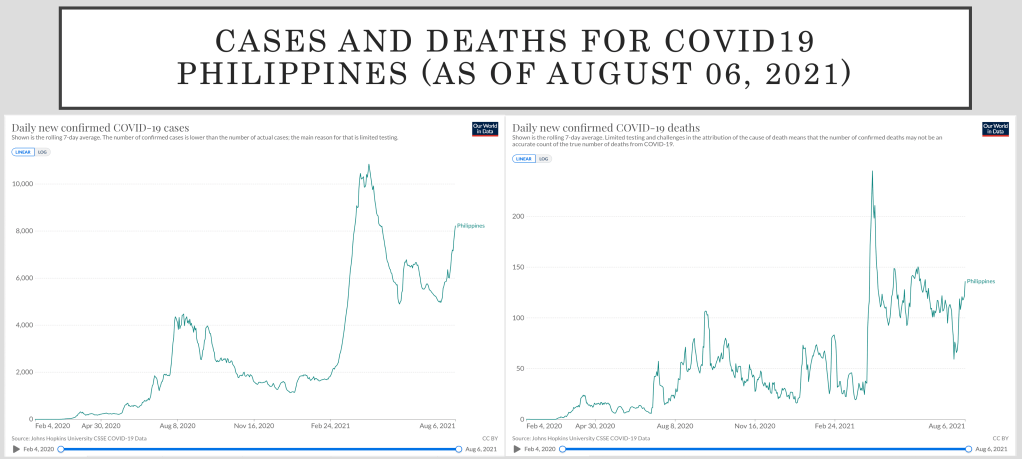
From the graph below, one can see the decrease in cases after April and a sudden hunchback rise in cases in May and June from regions outside NCR, particularly in the Visayas and Mindanao area. That pattern was also seen in the surge of August of 2020. After a stricter lockdown in the National Capital Region, the regions outside of Luzon accounted for the uptick in cases.
Unlike the first surge last year, however, this was more manageable and easier to bring down considering that we came from a lower baseline. The second surge in March of this year could have been averted had a stricter lockdown been called earlier by 2-4 weeks. The take home lesson from the recent surge was declaring a lockdown at the first sign of a surge. And a plateauing of cases will always be the forerunner for a surge.
The entry and rise of the delta variant is undoubtedly responsible for the current ‘exponential rise’ in cases. That is because we were unable to maintain the Rt. All eyes should be kept on that variable and any increasing trend is a foreshadow to a most likely future rise in cases. This was seen locally with the recent surges in Mindanao and Visayas. Rubbing salt to an open wound is the fact that our numbers have not gone down to levels we saw before the March surge. We were at 5000 daily cases before hitting this new high.
For the nth time, the government should use this time to increase testing capacity in the country. Antigen swabs test kits for patients that have one or a constellation of the 15 key symptoms of COVID-19 should be used as their sensitivity and positive predictive value in patients who are symptomatic are high. Rapid diagnostic tests during outbreaks help identify patients that need to be isolated/quarantined faster than RT-PCR results, the latter of which are overwhelmed and take days before the tests come out during surges. The Health Agency can opt to do RT-PCR in documented rapid swab positive patients later on or just include them in the daily statistics.
Testing is a key component at managing pandemics. Without testing, there will be no contact tracing done and patients who are sick will continue to infect other people.
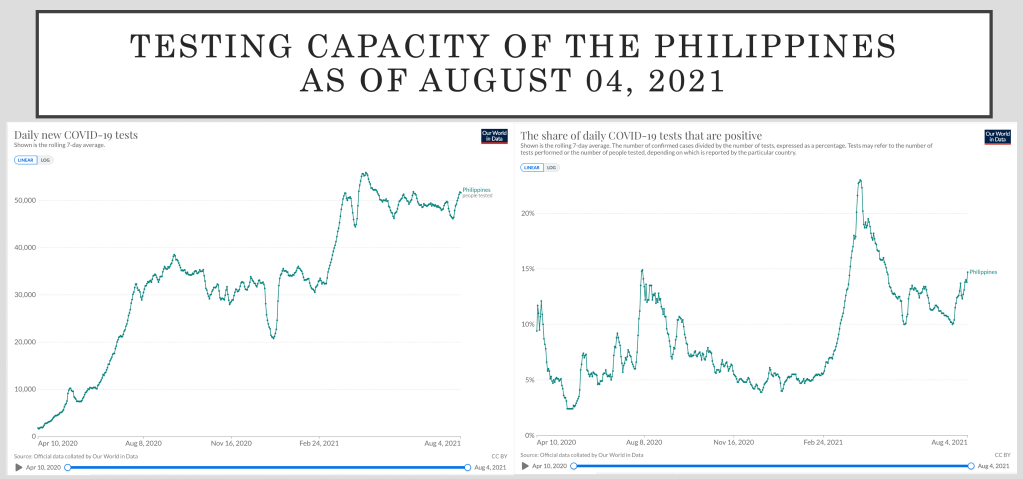
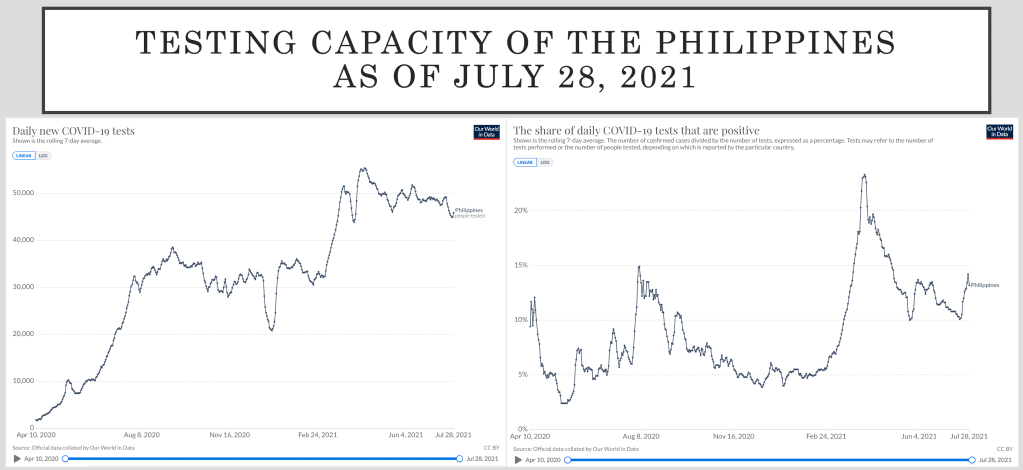
While the country has slightly more tests done this week, the positivity rate is also up. To bring the positivity rate to <5%, daily tests should average more than 120,000.
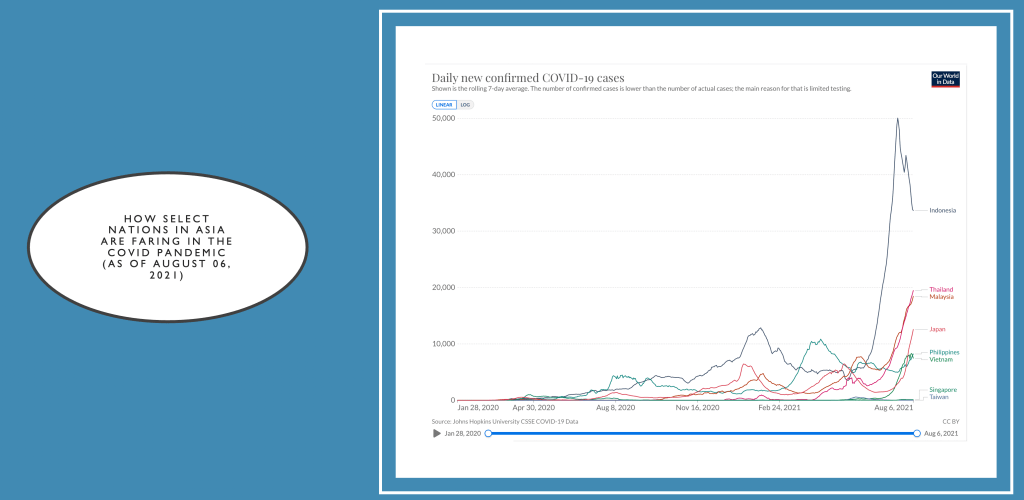
While it is true that many of our Asian neighbors (and other countries globally) are seeing a rise in cases, some are slowing down that increase and resorting to lockdowns as well, as they grapple between deciding on how to maintain the delicate balance of choosing an overwhelmed healthcare system or an economic downtrend.
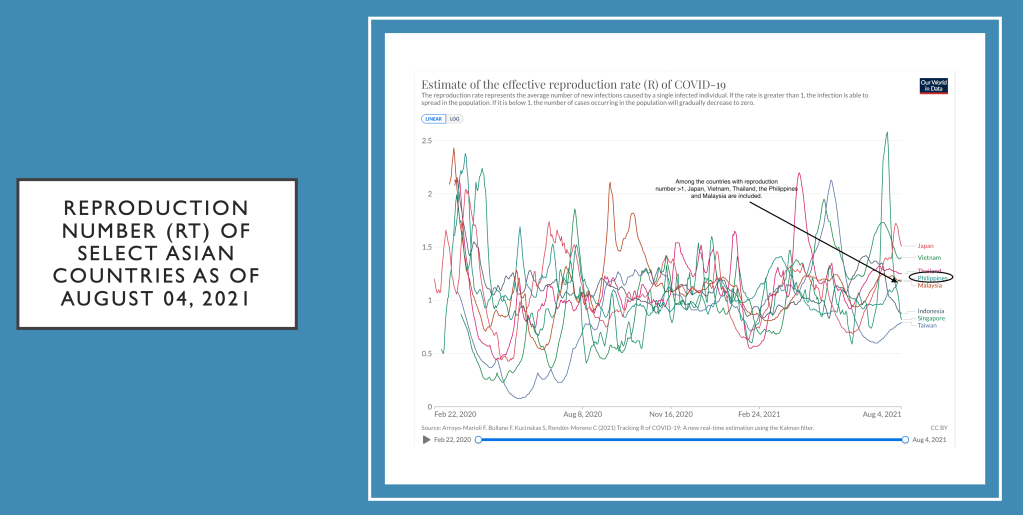
In the graph below are the same countries noted above with rising cases. Notice that while the cases continue to rise in almost all countries, the reproduction number has slowed down in many, with countries like Indonesia, Singapore and Taiwan maintaining their Rt <1.0. By bringing the reproduction numbers below 1, you don’t only slow down the rise but eventually see a decreasing trend in the daily cases, eventually falling to manageable levels over a period of time. The higher the number of daily new cases, the longer it will take to bring down the numbers to manageable levels enough to reopen the economy.
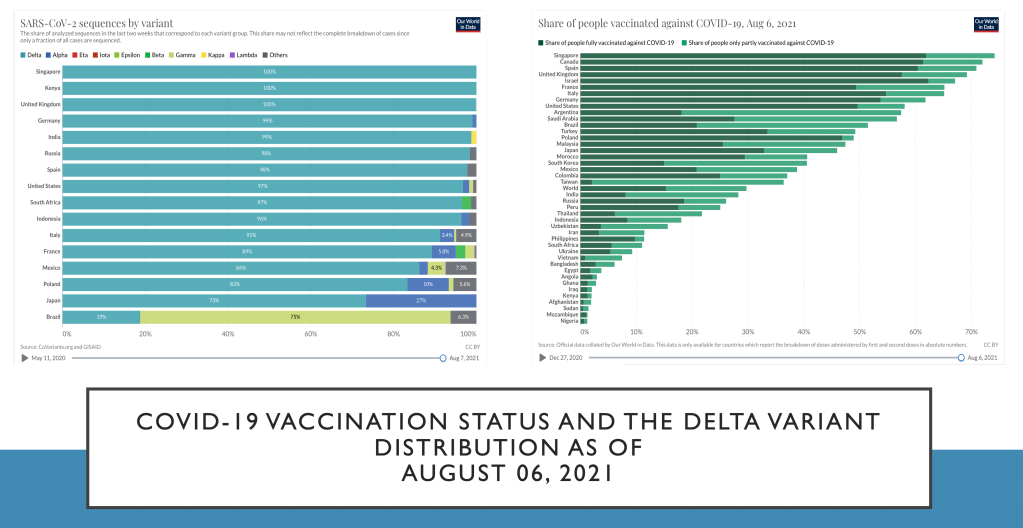
Vaccination and the delta variant has been the ultimate challenge at this time. The infographic below shows how the delta variant has taken over as the predominant variant of concern circulating in various countries and the share of people who have been vaccinated against COVID-19, regardless of vaccine brand.
More cases today as the Health Agency reports 11,021 new cases for more than 56,000 tests done August 5. The positivity rate is one of our highest at 19.1%! And the active cases are up at more than 76,000 or close to 5% of the total proportion of cases with COVID19. And these are just those that are reported and recorded from RT-PCR tests done in the country.
Number of new deaths today is 162 – bringing the case fatality ratio for outcomes to 1.83%.
On the second day of ECQ in Mega Manila, we will not expect the numbers to change until 2-4 weeks later. Hopefully, it does not last longer than expected.
The NCR is front and center in today’s numbers accounting for more than 25% of the total cases for the day. Followed by CALABARZON and Central Luzon, these three regions alone comprise 53.7% of the cases for the day in the country.
Cebu province returns with the highest cases on a provincial level. Cavite and Laguna report more than 600 cases apiece and Rizal has close to 300 cases.
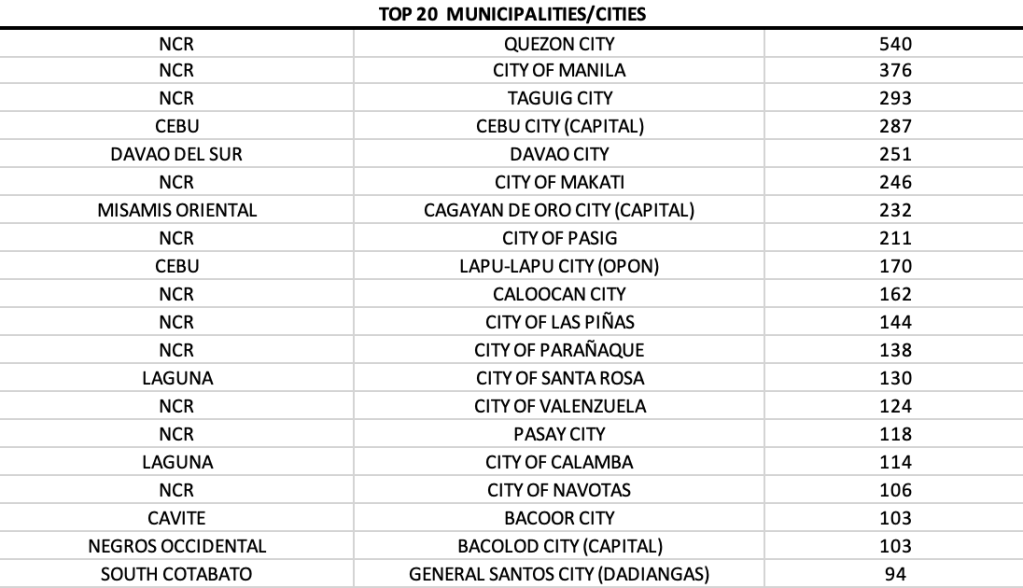
Among LGUs, Quezon City ran away with more than 540 cases. This city alone contributed to almost 5% of the total cases in the Philippines today. Eleven of 17 LGUs in NCR were in the top twenty, all of them having triple digits reported.
OCTA MONITORING REPORT
The weekend report for the period July 31-August 6 is not good news.
The sudden ‘surge’ in the reproduction number in the National Capital Region to 1.74 is quite disturbing. But it was expected, as the Health Agency reported the presence of the delta variant in every LGU in the region.
The top 40 LGUs in terms of 7-day average for new cases are provided in the infographic below. All data are obtained from the Data Drop of the Department of Health.
In terms of percent change, those that have seen significant (critical) rise in cases from the previous week are: Santa Maria (Bulacan), Cabuyao (Laguna), Parañaque, Pasay City, Mandaluyong, Valencia (Bukidnon), and Taguig at over 100%. Others in the critical zone include: Pasig, Imus, Muntinlupa, Dasmariñas (Cavite), Bacoor (Cavite), and Kalibo (Aklan).
The incidence rate or ADAR is critical in Cebu City, Makati, Laoag, Mariveles, Tuguegarao and Kalibo.
ICU utilization is critical in Makati, Iloilo City, San Pedro, Calamba, Tuguegarao, Cabuyao and Meycauayan. However, the ICU utilization is not real-time and does not reflect the actual situation on the ground where most of the private hospitals in the capital now filled up with sadly having to refer patients to other facilities outside of their LGU.
On the first day of ECQ, the Health Agency reports more than 10,000 cases today for tests done August 4 in close to 60,000 tests done with a positivity of 18.4%. This would be tantamount to having 1 in every 5 people testing positive in the country. Active cases are up at more than 74,000. This is the highest number of active cases recorded,
A total of 247 new deaths are reported today, which puts the case fatality ratio for outcomes to 1.82%.
Hospital utilization is also rapidly increasing, with the NCR rising 2-3% on a daily basis this week.
Both NCR and CALABARZON report more than 2,000 new cases each. Central Luzon and Central Visayas reported more than 1,000 but less than 2,000 cases apiece. Note that NCR, CALABARZON, and Central Luzon alone comprised almost 50% of the total cases in the country today. Unlike the previous surges, however, the current one is now scattered all over the country with four regions reporting quadruple digits and almost all the rest triple. Three regions report more than 500 cases today – Western Visayas, Davao Region and Ilocos Region.
In a day marred by more than 10,000 cases, Cavite province takes the lead on a provincial level. Three provinces in the CALABARZON area are among the top ten provinces for the day, which, aside from Cavite, includes Laguna and Rizal. All annexed closed to the border of NCR.
On a LGU level, 11 of 17 LGUs in NCR are among the top 20 cities/municipalities with most cases. All these 11 LGUs had more than 100 cases each today. Two LGUs in Cavite – Bacoor and Imus – make it to the top twenty cities with most cases in the Philippines.
The Health Agency releases an updated information in a single day. It has also announced that all 17 LGUs in the National Capital Region have cases of the delta variant. On August 5, the Philippine Genome Center Biosurveillance Report reported 119 additional delta variant cases. This means that the percentage of delta cases did not differ yesterday and today.
With 116 new cases of delta variant added today, and the Health Agency reporting that the variant has been located in nine regions in the country, the public is expected to practice minimum health standards professed by the Department of Health.
Reports on genome sequencing are not real-time. Reports are also random and not done in all RT-PCR swabs. With a rise in positivity rate over the past days, we really need to keep an eye on making sure that the delta variant is contained, and contained quickly.
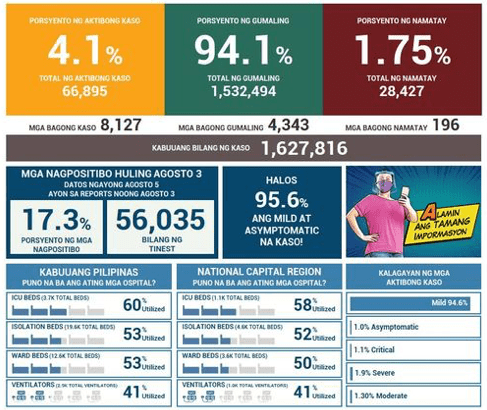
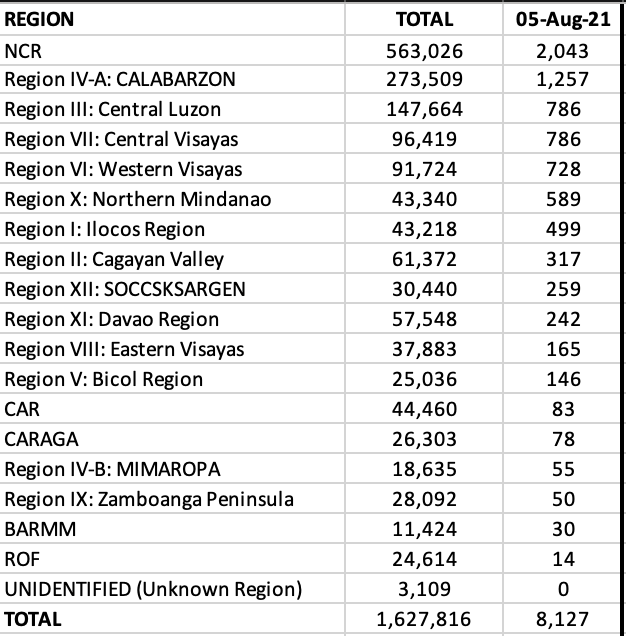
Today, the Health Agency reports 8,127 new cases for more than 56,000 tests done last August 3. Notice how the positivity rate continued to climb in spite of slightly more tests done. The active cases are also up at more than 66,000 (4.1%).
Healthcare capacity utilization is also up, both nationally and in the National Capital Region. And what a difference a week made in the number of new cases alone.
New deaths are at 196 today, with the case fatality ratio for outcomes now at 1.82%.
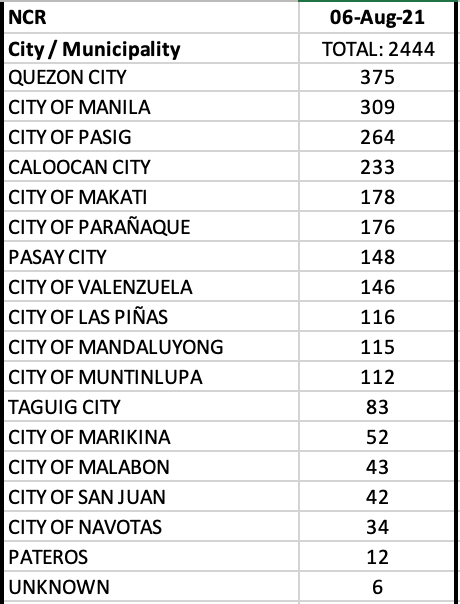
Today, the NCR claims 25% of the total cases for the day with more than 2,000 cases – its new high for this surge. Two regions saw quadruple digits while ten saw triple digit counts.
Cebu province had most cases on a provincial level, but oddly, Cavite, which has been in second spot for a week is is a less strict lockdown status.
Among LGUs, NCR has 12 of its 17 LGUs in the top 20 cities with most cases. Cebu City came in second among LGUs on a national scale. However, today’s numbers belong the Mega Manila. Four LGUs in NCR had more than 200 cases.
The Philippine Genome Center releases its bio surveillance report updating the previous report. This is as of August 4, 2021. Notice that of the 374 sequenced on this date, 116 (31%) were delta variant. This is an increase from the previous report on July 28 where 96 of 373 sequenced (25.7%) were delta.
Reminder in interpreting this report is that this is based on random sample collection as the center does not sequence all PCR swabs.
With 1 laboratory failing to submit data and 41,257 tests done on August 2, the positivity rate of 16.4% is staggeringly high.
The Health Agency reports 7,342 new cases today and with almost equal number of recoveries, the total active cases still exceed 63,000. Note however the healthcare capacities both nationally and in the National Capital Region, where the latter has numbers higher than the previous week alone. ICU is up at 59%, Isolation beds at 52%, ward beds at 48% and ventilators at 42%.
With 90 new deaths, the case fatality ratio for outcomes is at 1.81%.
As Mega Manila prepares to go back into ECQ, the data shows that the original triumvirate – NCR, CALABARZON, and Central Luzon are among the top three regions once more. These three regions alone totaled more than 3,900 cases, or more than 50% of today’s 7,342 total cases.
On a provincial level, while Cebu continued to lead, it was Cavite and Laguna that made up the chunk of cases in the CALABARZON area with close to 1,000 cases.
Four NCR cities were among the top five LGUs with most cases for the day – Quezon City, Manila, Makati and Parañaque. Cebu City came only a distant fourth. Nine of the 17 LGUs from NCR were among the top twenty LGUs for the day.
As the world passes 200,000,000 COVID19 cases, the Philippines also slips past Chile to move up the rankings from 24th to 23rd.
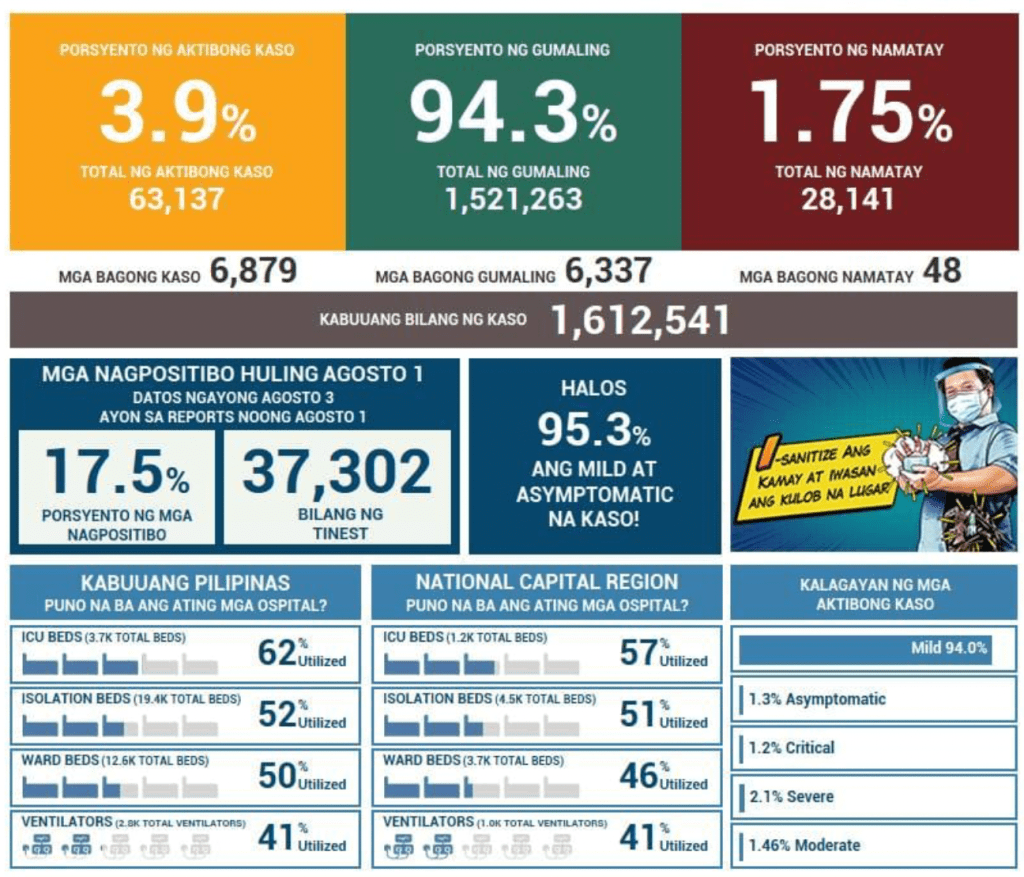
It’s a Tuesday, and with 17.5% positivity rate (the highest we’ve had since last year) for more than 37,000 tests done on August 1, the Health Agency reports 6,879 new cases today. Not only is this worrisome but is a sign of worst numbers in the days ahead, which could reach a record of 10,000 again towards the weekend.
Forty eight new deaths puts the case fatality ratio for outcomes at 1.82%.
The ICU bed utilization in both the NCR and the national level begin to significantly climb at 57% and 62%, respectively.
While the NCR continued to lead the daily numbers, the surprise of the day was Muntinlupa City, which came in THIRD among 17 LGUs in NCR and 7th in the country in one of the wildest jump of cases for the day. CALABARZON, Central Visayas, Central Luzon, Western Visayas were 2nd-5th, respectively.
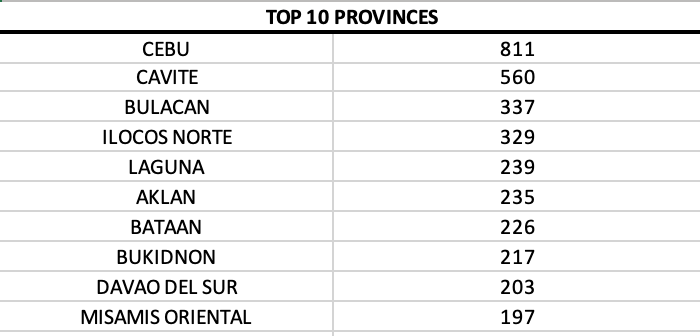
Cebu led among provinces on a provincial level, and yes, among LGUs, Cebu City took the lead today from Quezon City with more than 300 cases. Ten LGUs had triple digits in the country, while nine of 17 LGUs from NCR were among the top 20 cities/municipalities for the day.
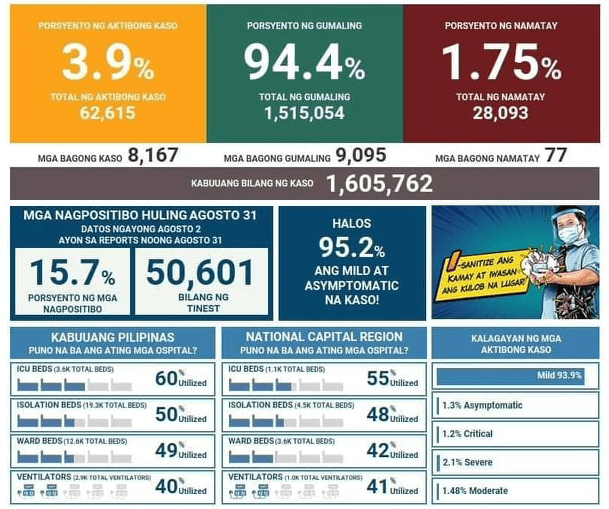
With 8,167 new cases reported today based on more than 50,000 tests done last July 31, (there is a typo error in the infographic of the Health Agency and that should read July not August 31), the positivity rate of 15.7% is worrisome. Not enough tests are being done, and not enough people are being contact traced. Todays new cases was enough to push the total COVID-19 cases to more than 1.6M.
There are 77 new deaths, bringing the case fatality ratio for outcomes to 1.82%.
In spite of more recoveries today, the active cases remain at more than 62,000.
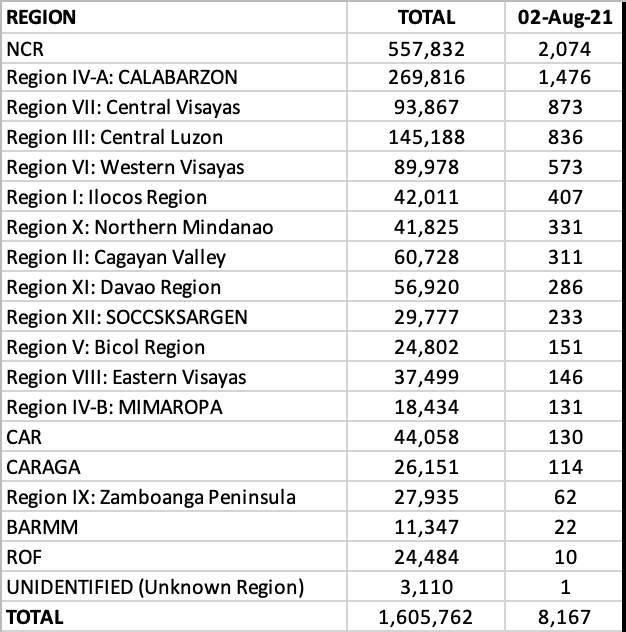
NCRs cases continued an upward trend and pulled away from all regions as almost 25% of the country’s total cases are from Mega Manila alone. Five regions had more than 500 new cases reported.
While Cebu province continued to dominate the provincial level, it was Cavite, Laguna and Rizal that raked in more than 1,200 new cases for the day, accounting for the most cases in Region IVA.
Among LGUs, Quezon City reported almost 400 new cases, followed by Cebu City, Manila, Cagayan de Oro and Makati City. We are back to that point where many LGUs in NCR are in the top 20. Today, 12 of 17 LGUs from NCR made it to the top twenty.
Eleven of 17 LGUs in NCR had triple digits.
OCTA MONITORING REPORT
In today’s report, OCTA presents the hotspots outside of NCR.
Cagayan de Oro remains to be at critical risk over-all. With the five indicators used, Mandaue has the highest infection rate, while Laoag has the highest incidence rate (ADAR). Both Cagayan de Oro and Lapu Lapu City are at critical levels on hospital bed use. ICU utilization is also critical in Iloilo City and Cagayan de Oro. Positive testing surpasses 20% in Laoag, Cagayan de Oro, General Santos and Iloilo City.
Three straight days of more than 8,000 new daily cases.
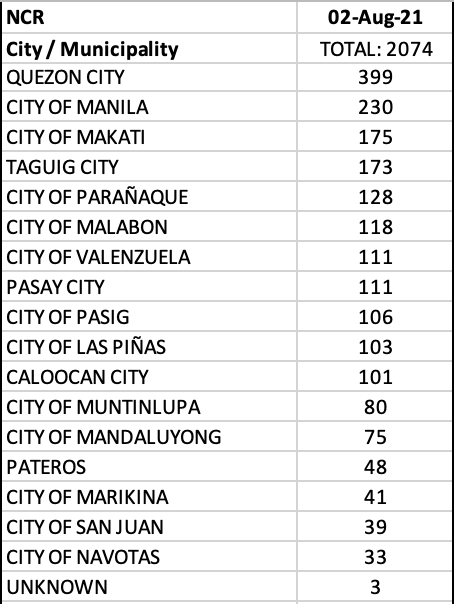
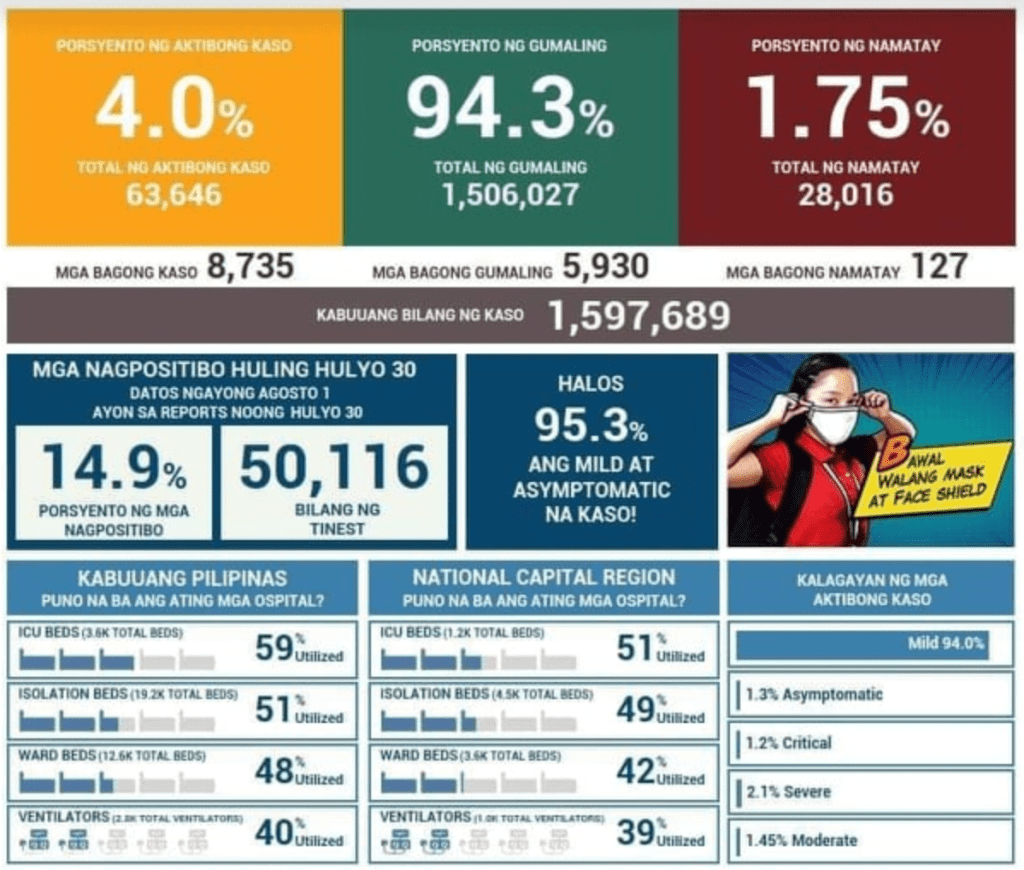
The Health Agency reports 8,735 new cases today for more than 50,000 tests done last July 30 with an almost 15% positivity rate. With fewer recoveries, the active cases now are up at 4% (more than 63,000 cases).
The 127 new deaths reported today are enough to push the total deaths now to more than 28,000. The case fatality ratio for outcomes (recoveries and deaths) are at 1.83%.
NCR continues to lead, with CALABARZON not very far behind and both regions reporting quadruple digits. Seven regions reported more than 500 new cases today.
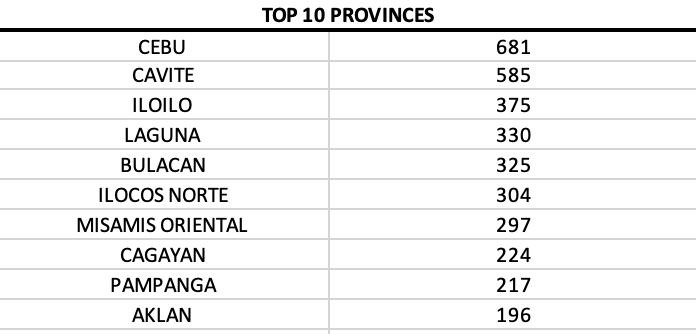
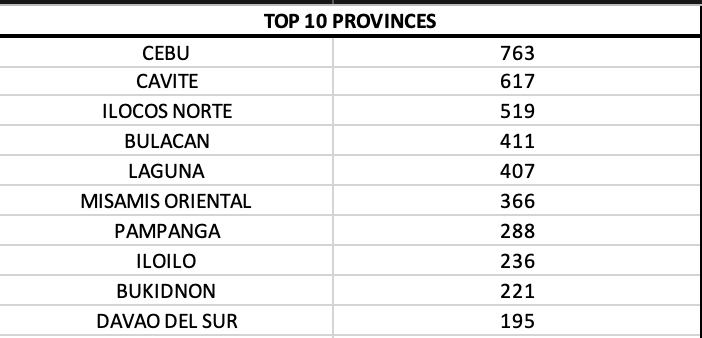
Cebu province remains the top province with most cases on a provincial level. However, Cavite saw a surge in numbers, followed by Ilocos Norte.
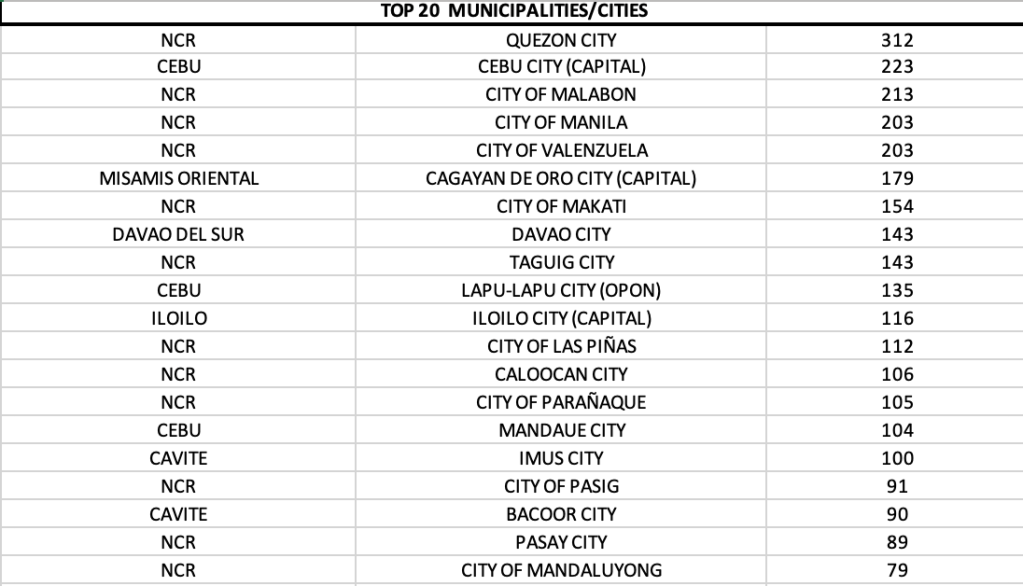
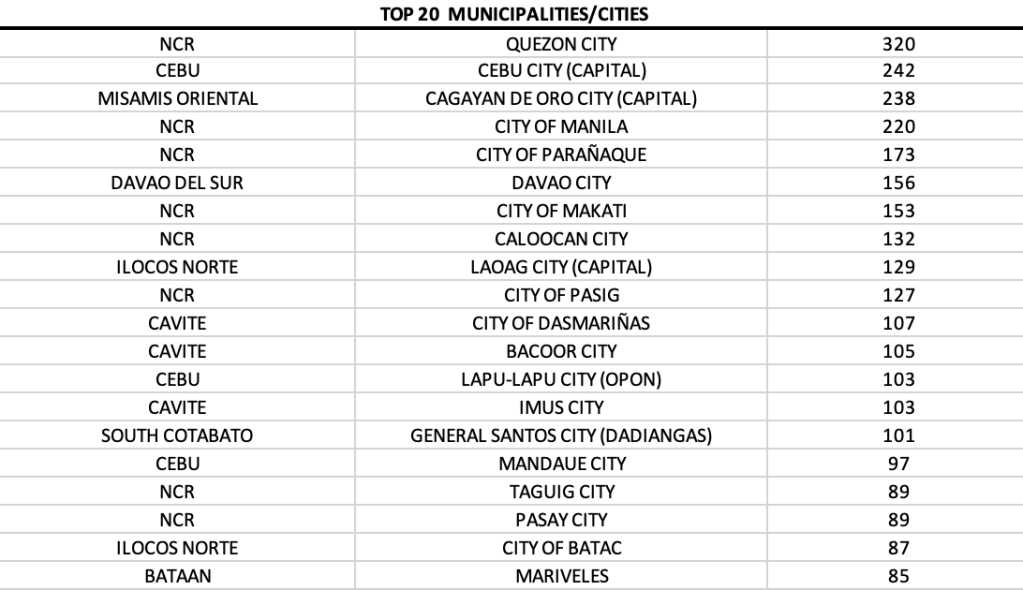
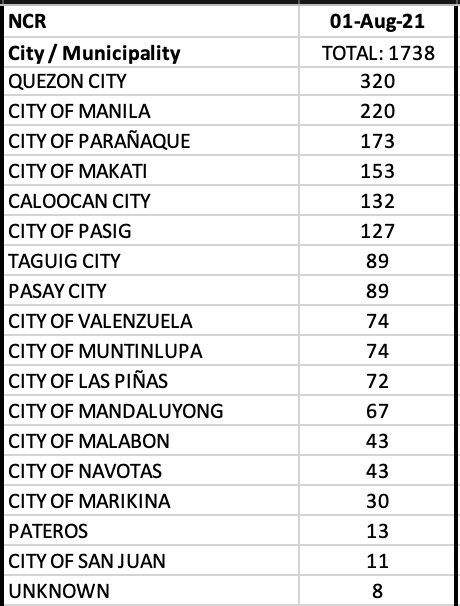
Among LGUs, it was a mixed bag. Quezon City led the LGUs in the country with 320 cases. Cebu City, Misamis Oriental, Makati and Paranaque were second to fifth in rank. Fifteen of the top 20 LGUs had triple digits.
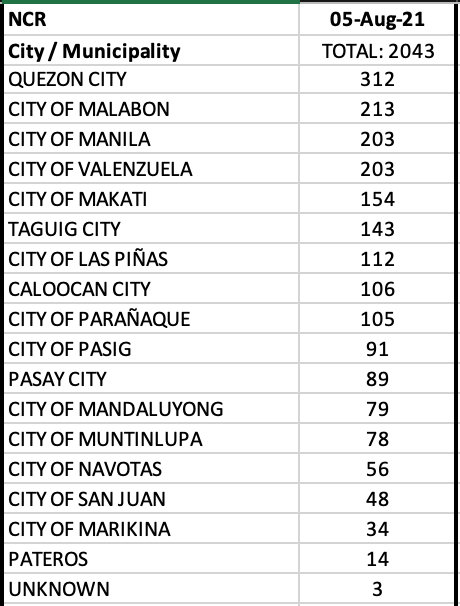
Eight of 17 LGUs from NCR were among the top twenty cities/municipalities with most cases for the day.
OCTA MONITORING REPORT
Without a doubt, the cases in the National Capital Region rose significantly in the past week. LGUs that never saw case with numbers that doubled, tripled and even quadrupled from the previous lows are now literally seeing surges.
Based on the five indicators: reproduction number, ADAR, beds, ICU capacity and positivity rate, only 4 of the 17 LGUs in NCR would be classified and moderate risk. The rest are at high risk.
Pateros, Malabon, Navotas have reproduction numbers more than 2, while the other cities with critical R are: Makati, San Juan, Muntinlupa, Valenzuela, Quezon City, Marikina and Caloocan.
The ADAR (average daily attack rate) is highest in Pateros at 26 per 100,000 population. This municipality that is known to have days where zero cases are being reported are seeing increasing cases.
Bed capacity is still good in most LGUs but already at moderate risk in Pateros, Pasay, Valenzuela and Quezon City.
ICU utilization is critical in Las Piñas, while it is moderate in Makati and Muntinlupa.
Finally, positivity is critical in Valenzuela at 23%, but is at high risk in Makati, Las Piñas, Pasig, Muntinlupa, Taguig, Parañaque and Caloocan.
Overall, the NCRs Rt is now at 1.52, with positivity rate at 10%.
THE WEEK IN REVIEW
It was a week that started with low cases. The surprise came when there was a reversal of numbers. The low Tuesdays took us aback. July 27 had an unusually high number of cases, considering that the data was coming from around 30,000 tests alone. Undoubtedly, the cases are now climbing, especially in the National Capital Region, CALABARZON, and Central Visayas.
But the reported glitches of the week could not overshadow the fact that the number of cases are up.
Sadly, this does not reflect the real situation on the ground as we see testing still averaging 45,000 a day (note on the word AVERAGING). The high positivity rate (which has actually shot up to more than 15% on certain days) is worrisome because that would point to only one fact – not enough people are tests are done because not enough people are traced.
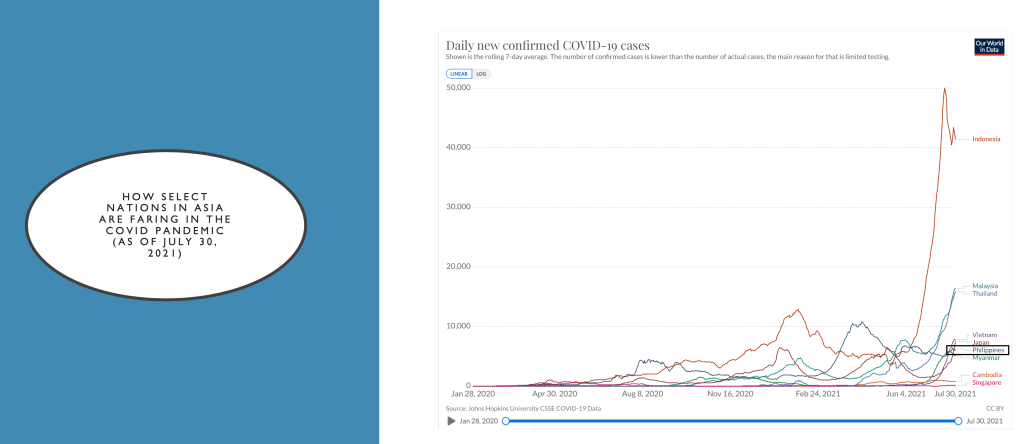
But the problem of rising cases is not only internal to the country. Many countries in the world are experiencing the fury of a fitter variant in the form of delta. In Asia and some ASEAN countries, the cases continue an upward trajectory with a steep slope for some nations.
Reproduction rates are up as well and Singapore has managed to bring down its reproduction number as it escalates more lockdown measures in this tiny country that has the most number of people in the world receiving a jab and where testing and contact tracing is most efficient. Except for Cambodia, all the countries below have Rt more than 1.0 as of July 28, 2021.
The delta variant continues to predominate in most countries, even among those that have more than 50% of its population fully vaccinated. As more people are now vaccinated, it is expected that the number of patients that will require hospitalization will be lower, but there will also be more people who have already been vaccinated that will require hospitalization as the proportion of number of patients who get vaccinated yet get COVID-19 infections shift.
Note that while there will be a shift in numbers to patients who receive a vaccine getting hospitalized, the over-all hospitalization rate will far be fewer. And all models suggest that those hospitalized but are vaccinated have a less severe course than the unvaccinated.
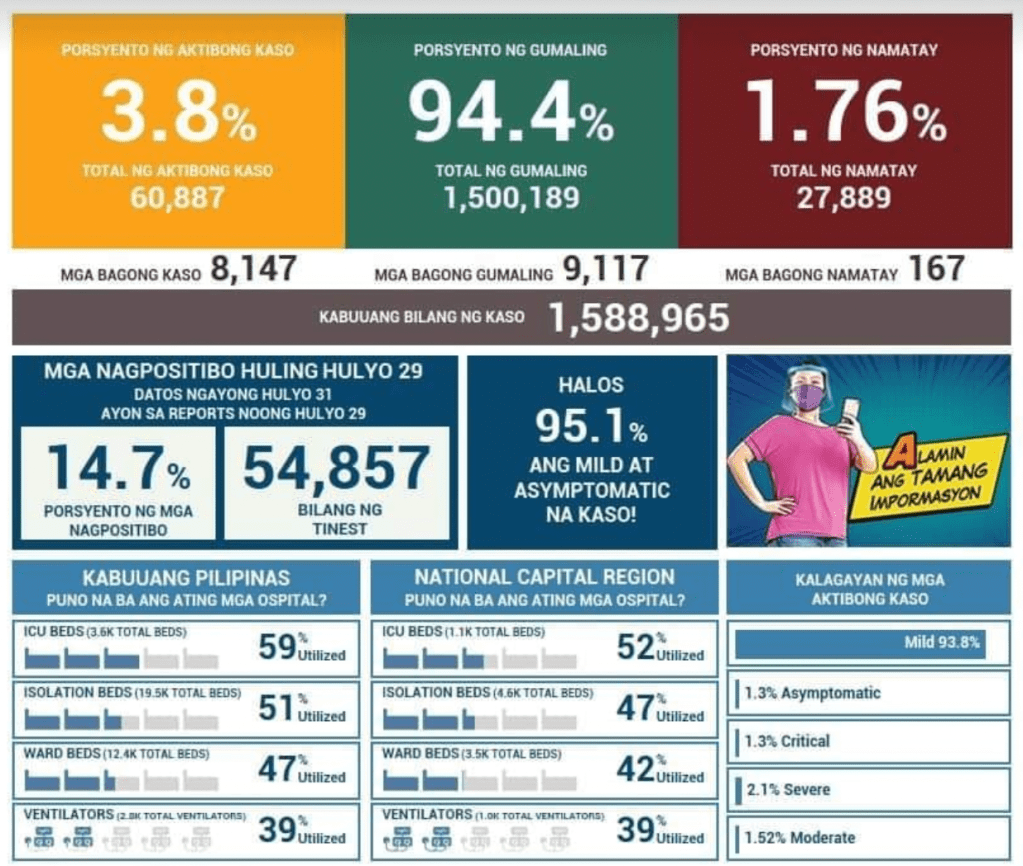
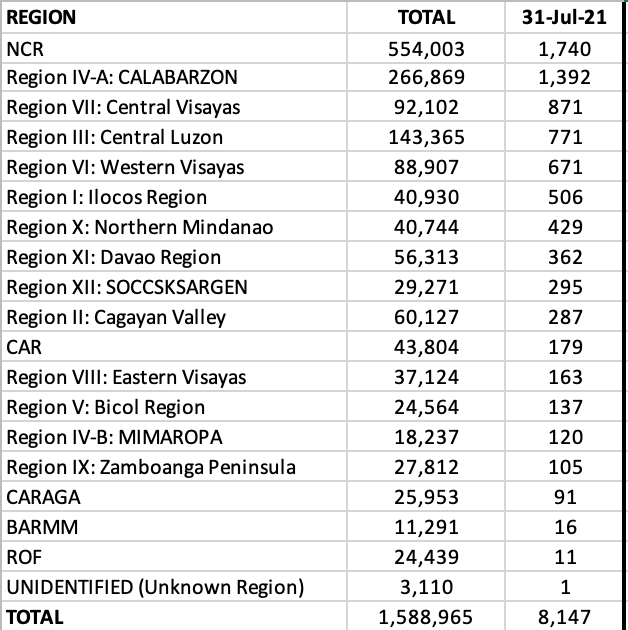
The last day of the July has the Health Agency reporting 8,147 new cases from a high of almost 55,000 tests done last July 29. Sadly, the positivity rate is still high at 14.7%. With a few more recoveries than new cases, the active cases are still more than 60,000 today.
In addition, 167 new deaths were announced, bringing the deaths from COVID-19 close to 28,000 or a case fatality ratio for outcomes at 1.82%.
So far, the Philippines has almost 1.6M total COVID-19 cases (reported and documented) since the start of the pandemic. This brings us to more than 14,000 cases/M population as of today.
And NCR adds more cases today as the new cases now mount to close to 1,750. CALABARZON and Central Visayas in second and third, respectively. Central Luzon, Western Visayas, and Ilocos Region had more than 500 new cases each region.
While Cebu province continued to dominate on a provincial level, Cavite, Laguna and Rizal, which make up the chunk of CALABARZON account for more than 1,100 of the 1,392 cases in that region alone.
On an LGU level, Quezon City, Cebu City, City of Manila, Davao City and Makati City are the top 5 cities with most cases for the day. Eleven of 17 LGUs in NCR are in the top 20. Three LGUs in Cebu province are also in the top 20.
All LGUs in the NCR are seeing rising cases. Even Pateros, Navotas and San Juan which has seen single or zero numbers are not spared from the increasing cases.
OCTA MONITORING REPORT
There were 1,533 new cases reported yesterday in Mega Manila. The table below summarizes the increase (or decrease) in the respective provinces. The country has a 7% increase in cases versus the past week. The positivity rate in the NCR also increased from 6% the past week to 9% this week alone.
Note that those highlighted in yellow in the report below show significant increasing cases over the week on week.
























 Relative Joy