With Rt at 1.35 for NCR, the increase in cases is worrisome. The data for 07.29.30

Let’s start off with answering the question – are the cases rising?

The answer, without a doubt is yes. The graph below alone will tell you the story of the pandemic in the Philippines.

While I usually show this graph on a weekend, let’s put things into the proper perspective. A week ago, our 7-day average was at 5,500 cases per day. Today, our 7-day average is at 6,032 new cases daily. That’s a 10% increase in cases over the week.

While NCR averaged around 600-700 new cases daily in the past weeks, it now averages almost 1,000 per day. An increase of almost 40%. Mega Manila has always been the major driver in the increase in cases in the country. A jump in this populous region brings the whole country to a halt. That’s because the healthcare system capacity is a finite one. We do not grow the healthcare industry overnight. And, while there may be more beds available, it is the health worker that needs to be augmented. When the health worker gets sick with COVID-19, those who have come in contact with that worker inevitably will not come to work as well. In a normal situation where COVID-19 is not a problem, when one health worker is sick, life in the hospitals do not come to a halt.

Arguably therefore, exhausting the health system before calling for a time out increases the burden and the demand in the health system.

This is why there is a need to prepare for the worst case scenario as our neighboring countries and the global data shows that increasing cases are being seen again in nations that have not only successfully vaccinated a greater percentage of its population but have reopened economies already only to have it tumble down once more because of the delta variant.

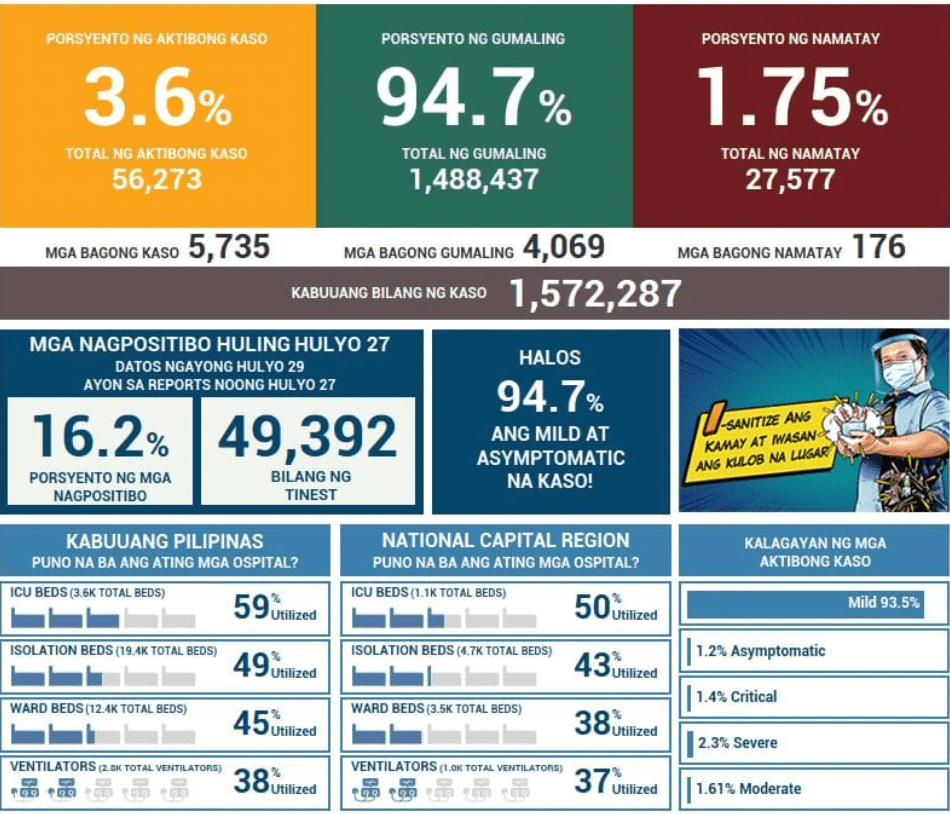
The Health Agency reports 5,742 new cases today for tests done last July 27 with a whopping 16.2% positivity rate in close to 50,000 tests done. Based on the infographics provided, there is a discrepancy in the number of new cases if we were to base it on the test results for the date indicated in the poster of the Department of Health.

There are higher number of cases compared to recoveries putting the active cases at more than 56,000.

The total new deaths is at 176. The case fatality ratio for outcomes is at 1.82%.

Notice however the ICU bed utilization which is up at 50% in the National Capital Region. This is up from a previous low ranging from 40-45%.

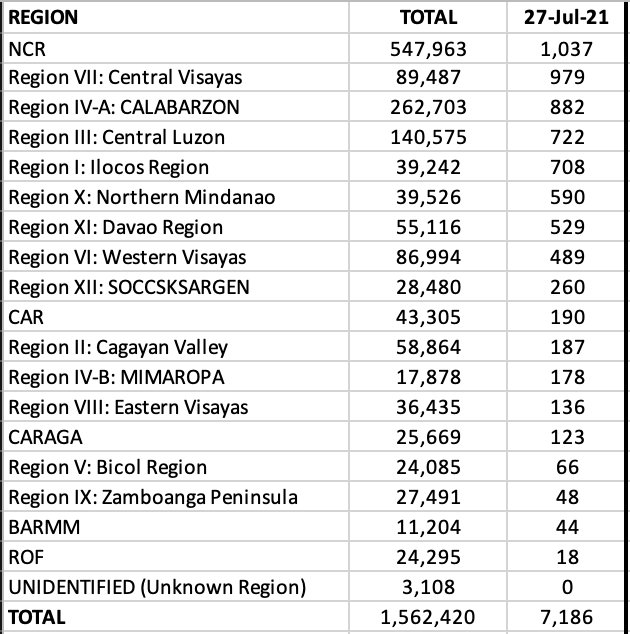
NCR continued to see increasing cases, accounting for close to 1/4 of the cases in the country today. And we’re back to the triumvirate of NCR + CALABARZON + Central Luzon as the top three regions with most cases. Both Central and Western Visayas reported more than 500 cases as well.

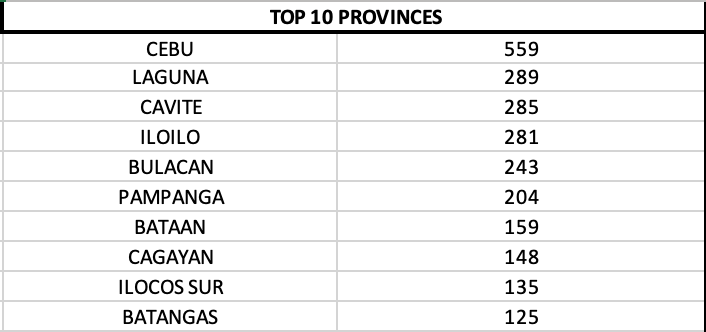
It was the province of Cebu that continued to lead on a provincial level with 559 new cases, followed by two provinces in Region IVA – Laguna and Cavite.

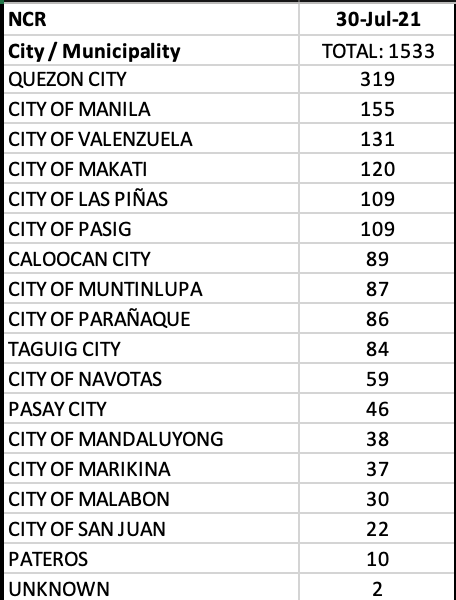
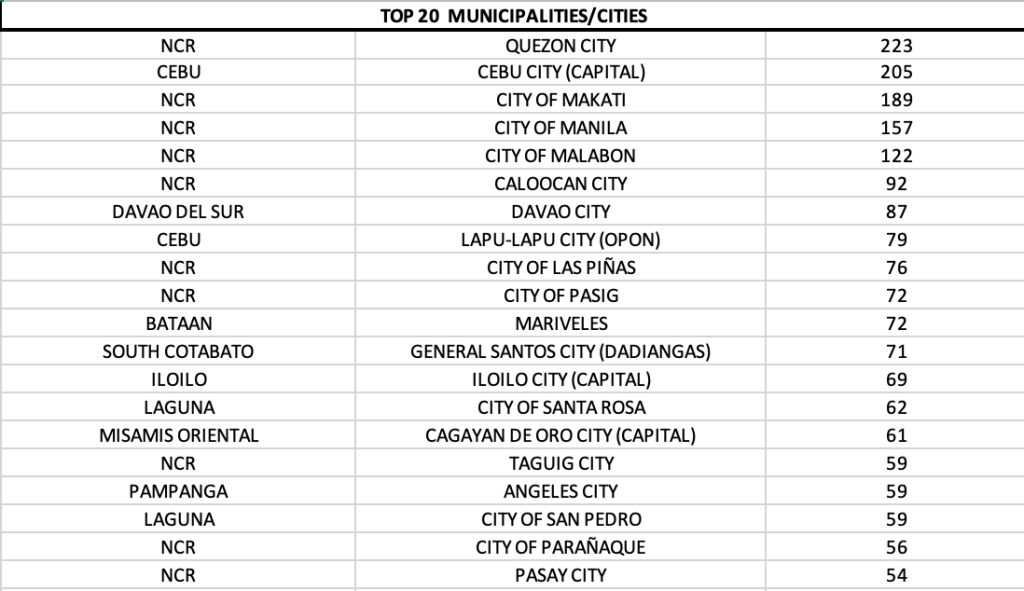
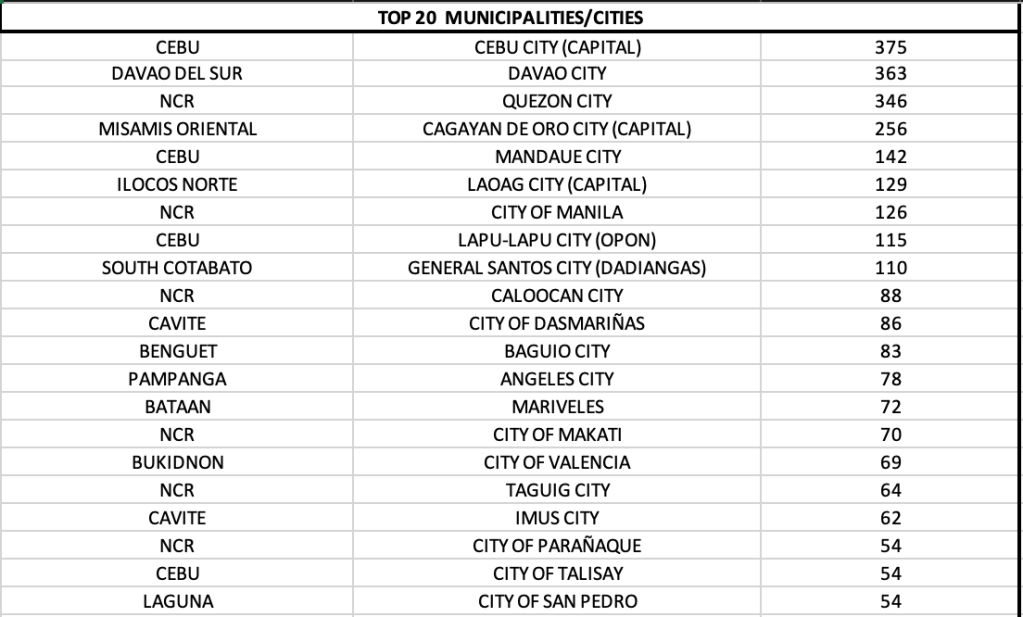
Among LGUs in the country, four of the top five LGUs with highest cases were from the NCR. Quezon City is back in first place, followed by Cebu City in second. In third to fifth are: Makati, Manila and Malabon. Eleven of 17 LGUs in the NCR are in the top twenty cities/municipalities with most cases today.

OCTA MONITORING REPORT

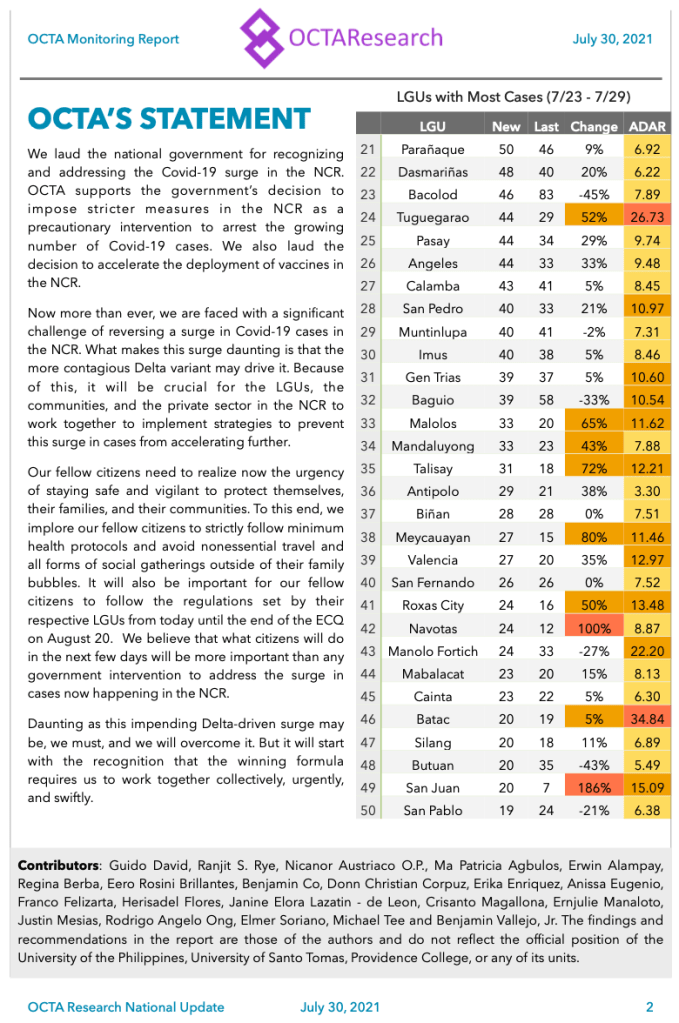
The July 29 National Update from OCTA shows that the national Rt is at 1.09. There is variability of the Rt (reproduction number) depending on the region or the LGU. The Rt in NCR is up from 1.33 a few days ago to 1.35.

Notice that based on the five indicators – infection (Rt), ADAR (incidence rate), HCUR (health care utilization rate), ICU (intensive care use) and testing (positivity rate) – Cagayan de Oro remains at critical risk. This is because it posted a 139% increase in new cases with 1.69 Rt, 88% usage of ICU and 25% positivity rate.

Key cities in Cebu are seeing higher Rt – Mandaue, Cebu City, and Lapu Lapu City.

Laoag has the highest incidence (Average Daily Attack Rate) at 60.56 per 100,000 population and the highest positivity rate in the country at 35%.

Healthcare utilization has exceeded 80% in Lapu Lapu City (Cebu province) and Mariveles (Bataan).

The rest of the report is seen below.

Circuit breaker lockdowns and the data on 07.28.2021

There is talk of a circuit breaker lockdown.

What is a circuit breaker ‘lockdown’?

A circuit breaker is short, temporary and time-bound. It is enacted with the intention of reducing the R0, briefly, hence, slowing down transmission and delaying peak in infections.

For those interested, there is a published article that is a good read on how ‘circuit breaker’ lockdowns can avert subsequent surges. The link is provided here https://www.ncbi.nlm.nih.gov/pmc/articles/PMC7750327/.

As the Delta Variant outbreak looms, and with rising cases seen in major cities in the country, instituting an early and short lockdown can avert surges similar to what is being seen in our neighboring countries and globally. As the SARS-CoV-2 evolves in variants, we need to be one step ahead of curtailing its transmission. And because man is the first and final host, averting transmission in the community is vital at addressing surges.

Doing it early and more impactful clearly allows economies to return to normal states earlier as well rather than implementing a lockdown much later when cases are high, hospitals and healthcare are overwhelmed, and majority of the people are scrambling for life. Whatever economy is salvaged will be futile when lockdowns are declared very late.

Clearly, a circuit breaker has an objective, and an endpoint. It also provides a guide to people on what to do.

It is divided into phases and has a timeline. The phases are meant for a country to move forward while knowing when to step back. It is a map of how the government intends to address the pandemic. It puts into the map when the ‘circuit breaker’ is reinstitute based on parameters or indicators of imminent outbreaks or surges. In short, it is a rational way of addressing how we contain surges in order to save lives and help the economy prosper at the same time.

It may not be a perfect model, but it is a rational one.

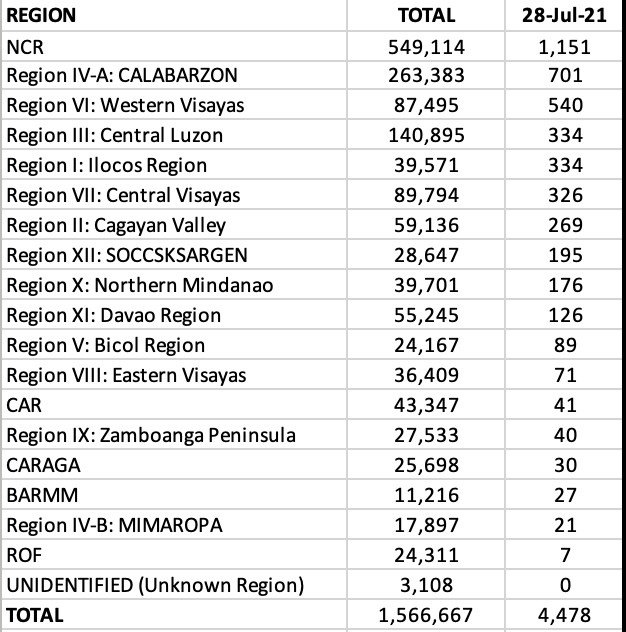
In the meantime, the Health Agency reports 4,478 new cases today. The shocker is that this is data for a little less than 35,000 tests done on July 26 (with 4 laboratories not reporting), the positivity rate is an astounding 15%! That means that for every 100 people tested, 15 end up as positive.

New deaths announced are 84 and the case fatality ratio for outcomes is at 1.81%.

Based on the Tuesday report and today’s report, the cases that were reported yesterday most likely included cases that were unreported over the weekend accounting for the over 7000 cases on a day where a little over 30K tests were done and a positivity rate of 13.2% only.

The NCR is back in the lead with 25% of the total cases for today. Most likely the other data from regions outside of NCR are late or have had less testing done as seen in the lower testing output for July 26.

Among provinces, Cebu continued to lead with lower cases, followed by Ilocos Norte and Laguna.

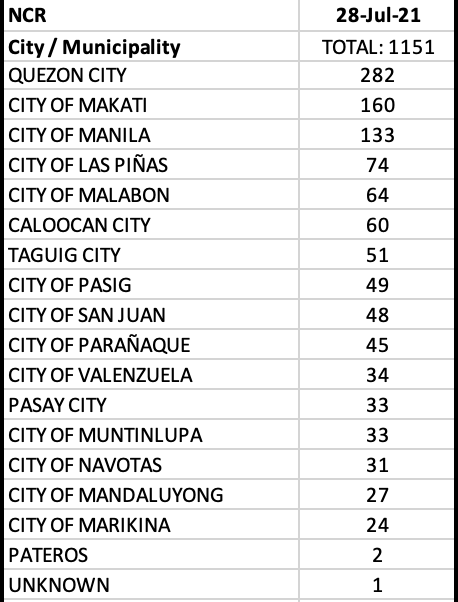
On an LGU level, ten of 17 LGUs in the NCR are among the top 20 cities with most cases, with Quezon City, Makati City and the City of Manila in first, second, and third, respectively.
We are f*cked Tuesday with more than 7K on 07.27.2021

Tuesdays will always deliver some good news – lower new cases.

Today was different, and one cannot help but think – did they hold back the data yesterday or the previous days because of the SONA of the President?

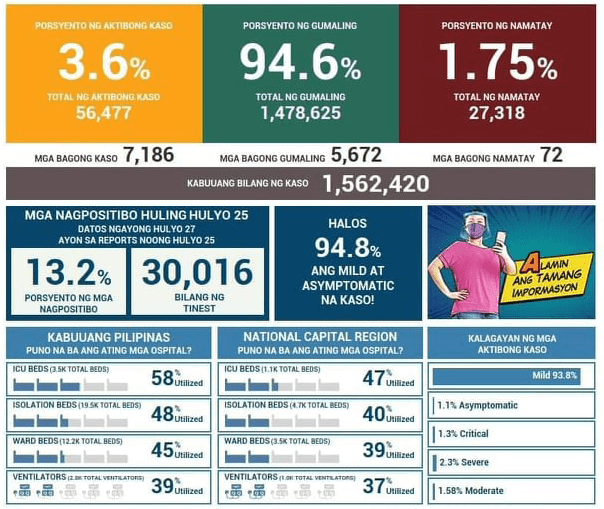
Let’s look at the data for July 25 where a little more than 30,000 tests were done. And where the positivity rate was 13.2%. With the few tests, how could you arrive at 7,186 new cases?

So yes, there are more than 7,000 new cases, the active cases are more than 56,000 and it will be interesting to find out if the Department of Health will upload the Data Drop tomorrow, because they did not do it today (as of this writing).

With 72 new deaths reported, the case fatality ratio for outcomes is at 1.81%.

While NCR continued the lead, regions outside of NCR, in particular Central Visayas, CALBARZON, Central Luzon, Ilocos Region, Northern Mindanao and Davao Region saw more than 500 cases today. As to whether the data are based on a single day test result, most likely not. It is highly likely that some of the cases were attributed to delayed reporting due to whatever reason.

The province of Cebu marched on with 904 new cases, with Ilocos Norte and Davao del Sur in second and third, respectively.

Among LGUs, it was a different story as Cebu City took the lead. Three key cities reported more than or close to 350 cases each – CEBU CITY, DAVAO CITY, AND QUEZON CITY. Nine LGUs in the top twenty had triple digits. Six of 17 LGUs in NCR were among the tope 20 cities with most cases for the day.

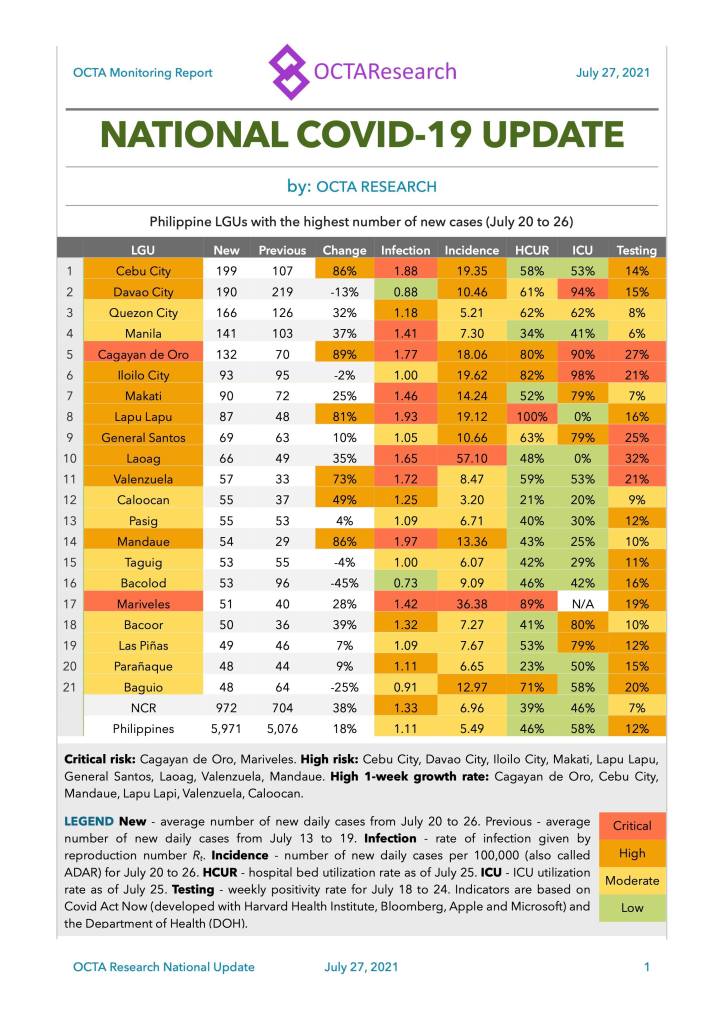
OCTA MONITORING REPORT

While the rise in cases due to the Delta Variant is not proprietary to the Philippines or Asian nations, we need to learn from the experience of countries that had this variant eventually dominate the serotype circulating in the community. It is understandable that the concern is on how badly hit the economic sector is with never ending lockdowns. We need to balance the health risks on healthcare with economy.

The Health Agency and IATF need to consider using self-test antigen kits as screening tools for exposures and contact tracing and government should financially support those who test positive with free PCR testing.

The Rt is up at 1.11 nationally and 1.33 in the NCR.

During the first and second surges, NCR was the main driver of the cases. As we see a rise in cases, short of calling it a possible surge, there are multiple LGUs driving the increasing numbers. Western Visayas has not seen a significant decline in cases for the past months and still remains as one of the biggest contributors to the daily cases. This, as Cebu province tops the list of provinces pouring in more cases.

And as cases are now on an upswing, from Aparri to Jolo, it’s anyone’s guess how this will play out with a country where its sprawling archipelago is the perfect picture for leaky borders and where mobility will be difficult to control.

NCR Rt at 1.31, while major cities in Central Visayas are seeing increasing cases on 07.26.2021

New cases are higher today at more than 6,600 with one laboratory not submitting report for July 24 and only 45,000 tests done. The positivity rate is up at 13.4%! As the delta variant unfolds in our midst, the numbers seem to point to one thing – that there should be more urgent sequencing of the samples sent to the Philippine Genome Center, more testing should be done and contact tracing should be instituted early.

People need to understand that the behavior of the delta variant is a bit different from the previous variant of concerns, the alpha and beta variants. The delta variant has a shorter infection period, which makes it spread quicker. Because of the higher viral load compared to the original Wuhan virus, it also has the propensity to spread in greater populations because of the shorter time from exposure to symptom development. And the virus has the propensity to have escape mechanisms that may affect response to vaccination and a previous infection.

There are 23 reported deaths today, moving the case fatality ratio for outcomes to 1.81%.

OCTA MONITORING REPORT

The update for the week July 19-25 still shows Cagayan de Oro and Mariveles as the LGUs in the critical zone based on the four indicators used for monitoring how the top LGUs are doing.

In the high risk are: Davao City, Cebu City, Makati City, Iloilo City, Lapu Lapu City, Laoag, General Santos, Mandaue, Baguio, Las Piñas, and Valenzuela.

Notice the uptick in the reproduction number in the NCR. It now stands at 1.31. The national Rt is at 1.08.

The vaccination status in the country is updated and provided below (as issued by the Department of Health). Based on the report that over 30M COVID vaccines have arrived, a little more than half had been administered. Obviously, with a little more than 6% fully vaccinated for now and the threat of the delta variant looming over us like the Damocles sword, it will take awhile before a larger segment of the population will get jabbed. In the meantime, people are still advised to spread the word that we need to be mindful of when and how we move about. Mobility should be restricted for essentials for now.

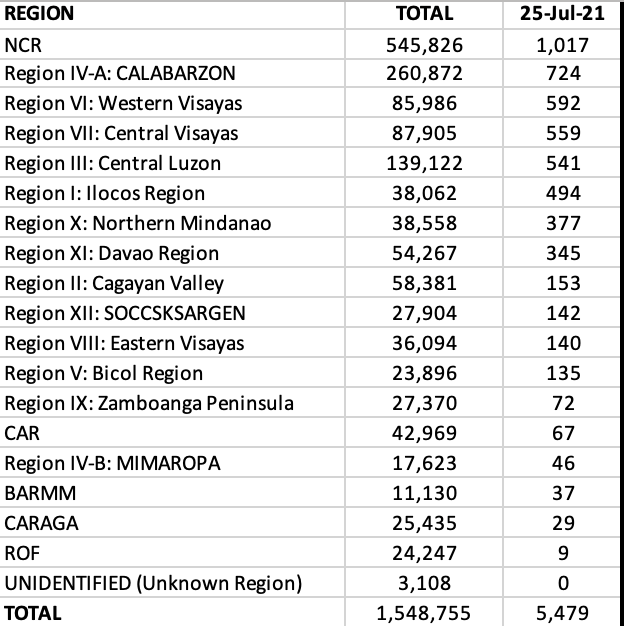
Lower cases on 07.25.2021, but an increasing trend over the past week

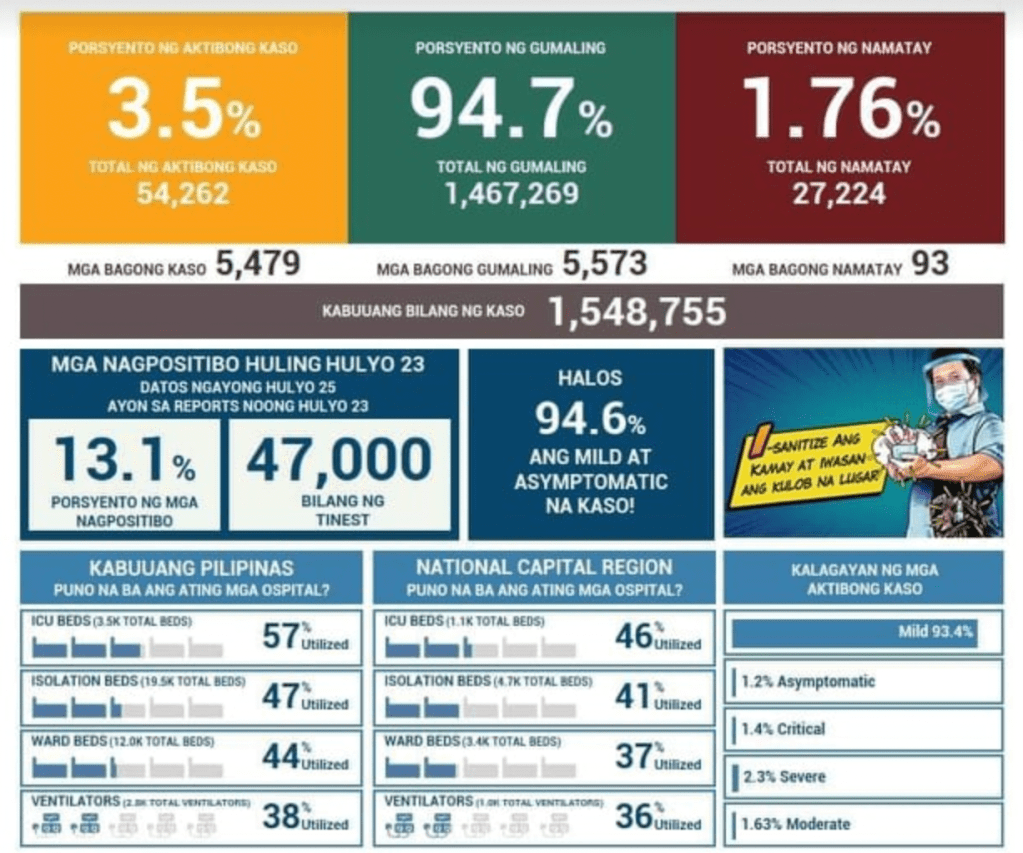
The Health Agency reports lower new cases today with close to 5,500. Since the recoveries and new cases are almost the same, the number of active cases remain high at over 54,000. Today’s report is based on 47,000 tests done on July 23, with a 13.1% positivity rate. Notice in the week in review summary below that the testing capacity for the week has been significantly lower with an over-all increase in the average positivity rate.

There are 93 new deaths and the case fatality ratio for outcomes remains at 1.82%.

While the cases may be fewer today, Mega Manila is on the rise as it accounts for almost 20% of the total cases for the day.

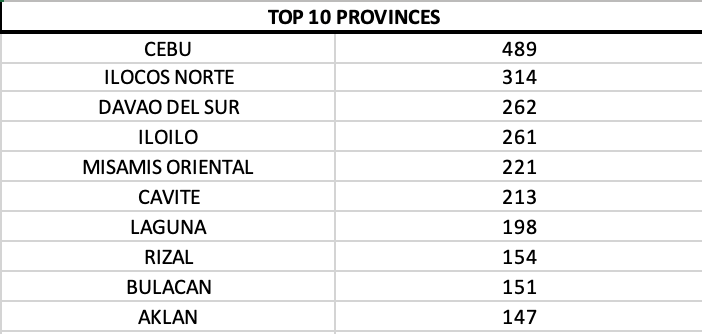
It is the province of Cebu that continued to lead today, with Ilocos Norte and Davao del Sur behind her.

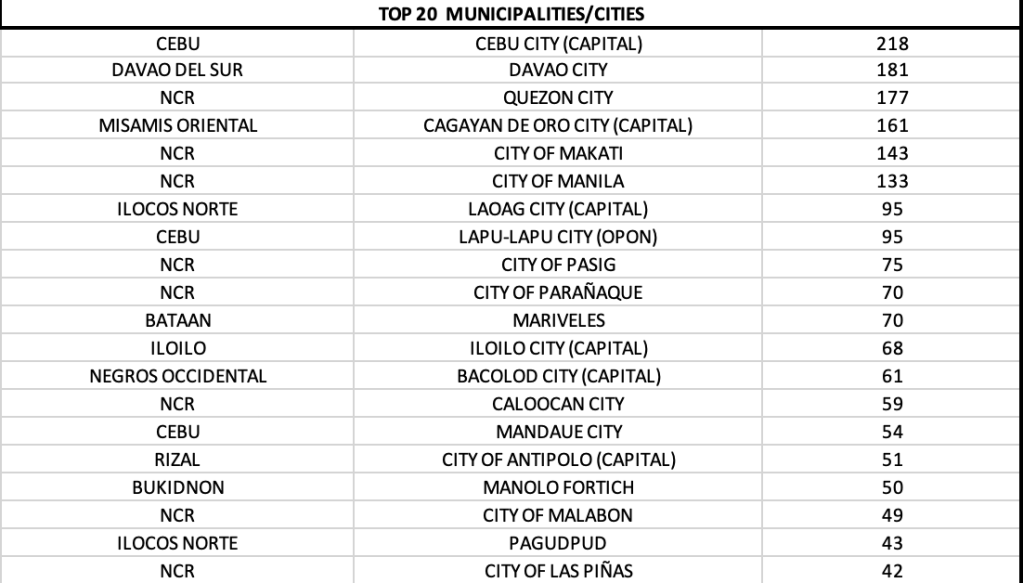
On the LGU level, Cebu City has overtaken Davao City to rank first and second place among the top twenty. There are eight of 17 LGUs in NCR that are back in the top 20 rankings as these LGUs see rising cases in the community.

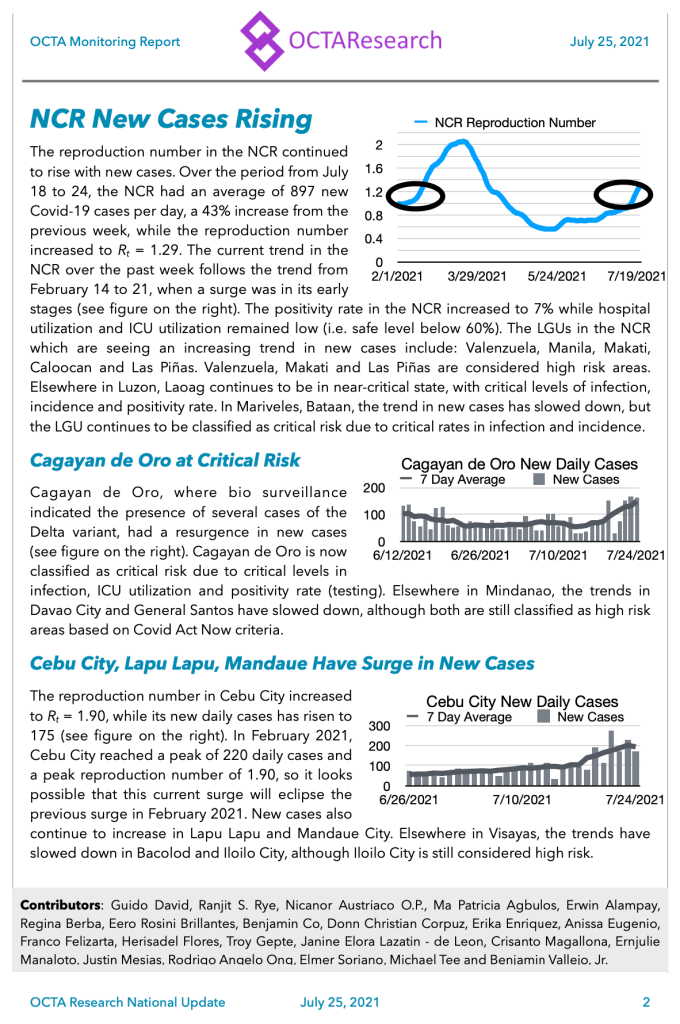
OCTA MONITORING REPORT

The updated OCTA report shows Cagayan de Oro in an over-all critical situation with a 109% increase in cases, and over indicators of infection , ICU utilization and positivity tests at the critical level. The other critical LGU is Mariveles. While it showed a decline in percentage of cases, its Rt = 1.45 and the ADAR is at 33.53/100,000 population. Other LGUs considered high risk are Davao City, Cebu City, Iloilo City, Makati, Lapu Lapu, General Santos, Baguio, Laoag, Mandaue, Las Piñas, and Valenzuela.

The full report in indicated below.

THE WEEK IN REVIEW

However you look at it, the average new daily cases from July 18-24 was on a rise in the Philippines. The 7-day average is up at close to 6,000 daily cases from a previous 5,000. And while the deaths may have taken a nose dive, this is attributable to a glitch in the system of the Health Agency, with a corrected report of piling up all 241 cases for July 23 and 24 on the 24th.

The above data on the uptick in cases is because of the rise in cases in the National Capital Region and Central Visayas. Testing capacity is down and there is a sudden rise in positivity rate. The perfect correlation to the increasing cases noted this week.

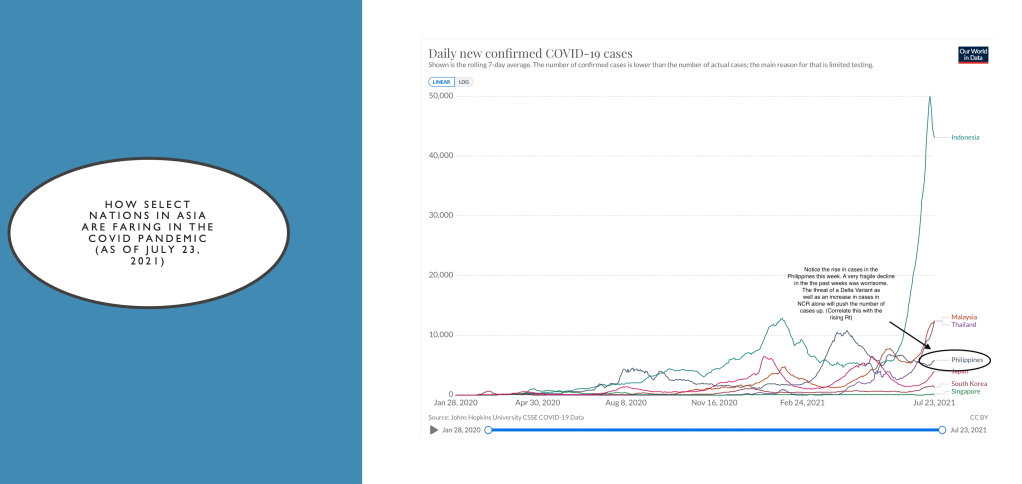
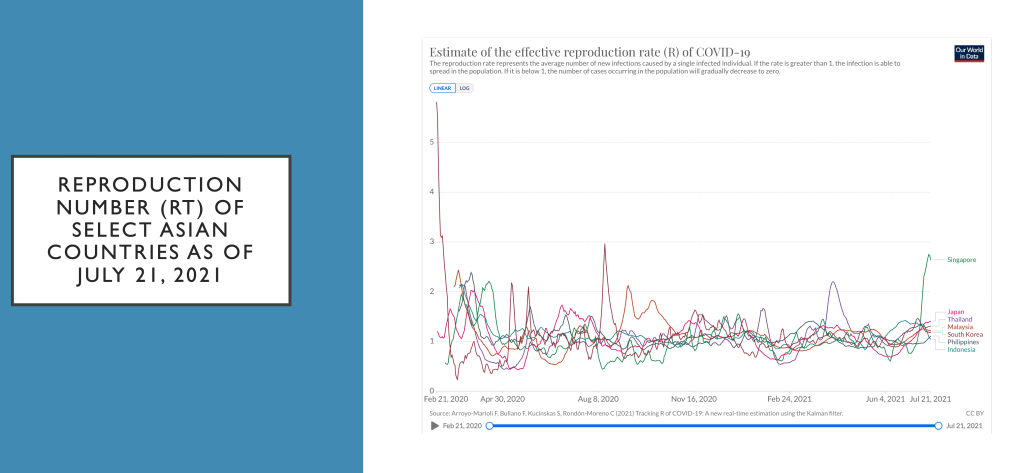
Elsewhere in select countries in Asia, many nations are seeing increasing reproduction rates (all are above 1.0) including the Philippines. Last week, I reported that we were the only country that had a Rt < 1.0. What a difference a week made. Indonesia is seeing a gradual decline in cases this week, while spotty outbreaks in Singapore and breakthrough infections among those who are fully vaccinated drive their Rt to almost 3.0, with the Delta Variant predominantly circulating in the community.

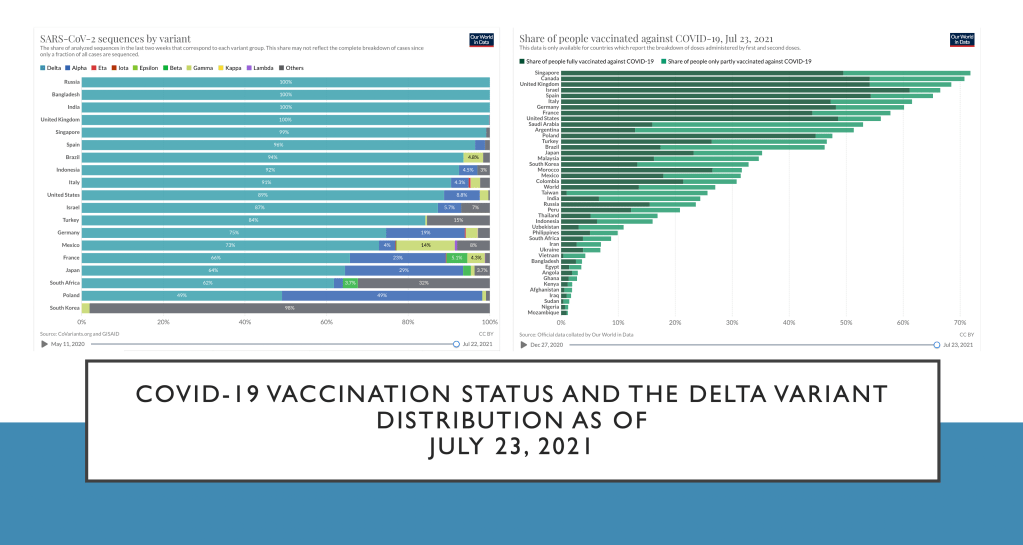
Most countries have begun their vaccination programs, with Singapore leading globally in having most people vaccinated. With a country of a little less than 6Million people, this isn’t quite a difficult job to jab. But here’s a quick look at the variants circulating in these countries where vaccination has also ramped up significantly. The main difference is in the outcome of deaths, where those with less vaccinated populations have higher mortalities among the unvaccinated compared to those who are vaccinated.

The more difficult challenge is how to roll out those vaccines, achieve an immune response (takes 2-4 weeks after 2 doses or 1 dose if you’re getting the J&J vaccine) and reopen the economy. For now, the economic sector will have to take a back seat and wait till we get to the point where the greater majority have been vaccinated, before we can even resort to easing lockdowns. The only way to accelerate this is to get the jabs into the arms as quickly as possible.

With 17 new Delta variant cases and the return of the unknowns on 07.24.2021

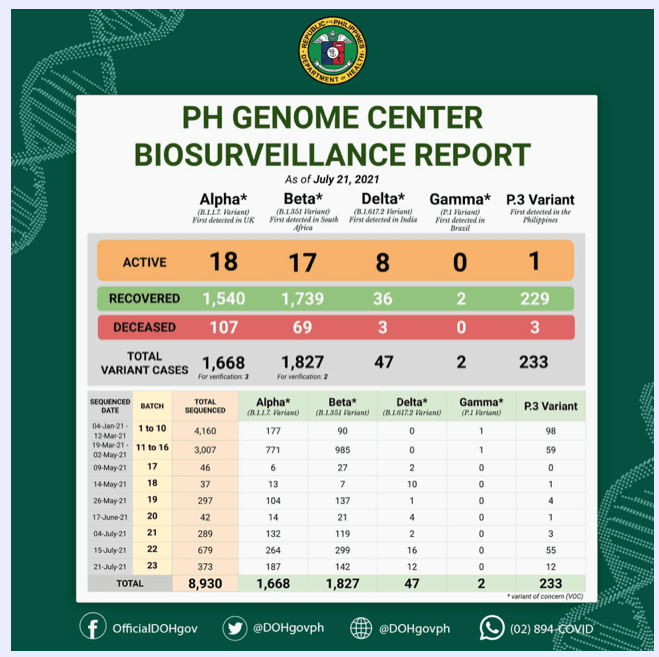
Suddenly, the total Delta Variant cases are up at 64 with 17 new additional cases announced by the Health Agency today.

The breakdown of the 17 are: 12 local, 1 OFW and 4 for verification.

Of the 12 local cases: 9 listed addresses in Mega Manila while 3 are from CALABARZON. Most disappointing is the fact that the habit of reporting UNKNOWNS by the DoH is back. And not just as single digits, but as the top number of cases that have no locality. Which is highly unacceptable. You cannot contact trace what you cannot find. Besides, it is basic that the address of the person tested needs to be written down in the information sheet that is filled up prior to testing. The Health Agency is obligated to provide an explanation for these unknowns because it is bad data collection and sloppy data reporting.

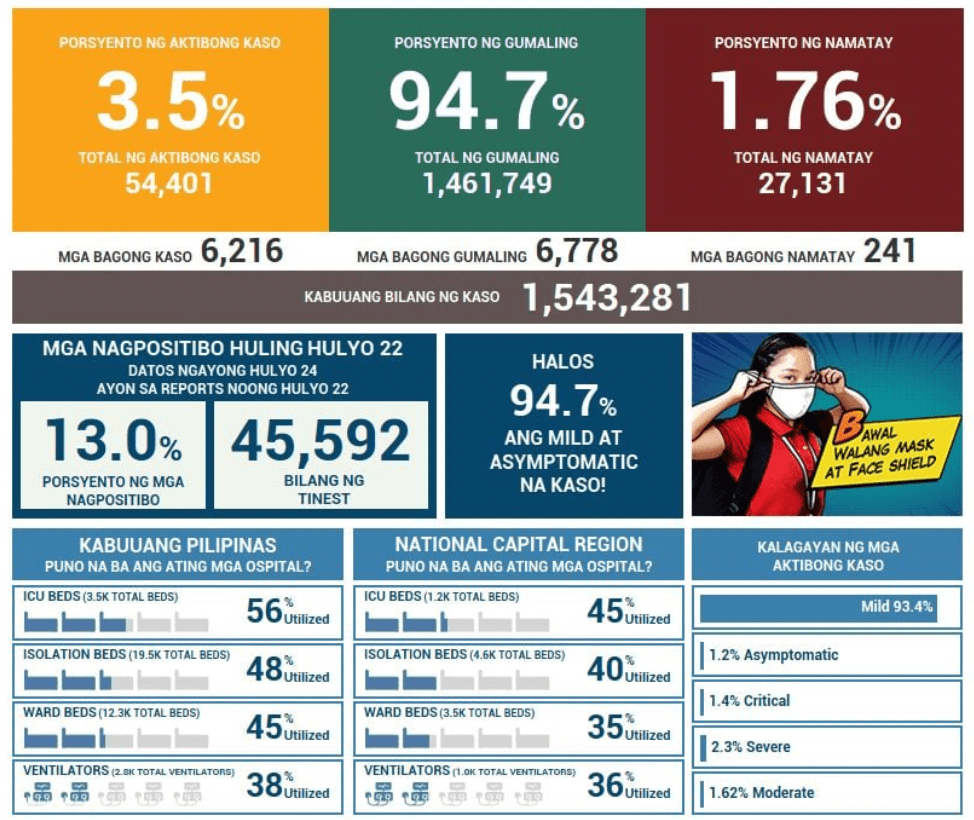
There are 6,216 new cases reported for those tested last July 22 with 13% positivity rate. The number of tests done actually has declined over the past week, sending the positivity rate up. Active cases are back up to more than 50,000.

And the ‘technical glitch’ yesterday of ZERO deaths, comes back today with 241 new deaths reported. This pushes the total deaths past 27,000 and the case fatality ratio for outcomes stays at 1.82%.

And while NCR continued to lead among regions, it had less than 1,000 cases. All top five regions, including Central Visayas, CALABARZON, Central Luzon and Western Visayas had more than 600 cases apiece.

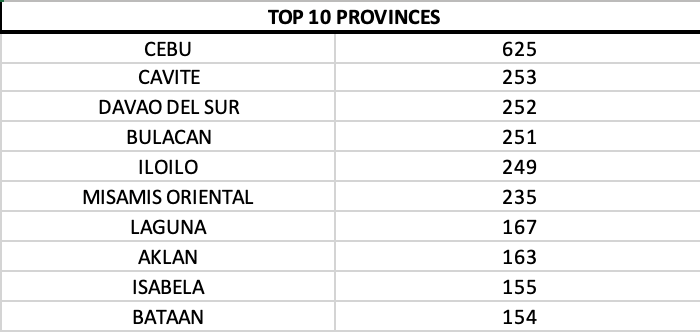
Cebu province led among all provinces with 625 new cases. Sadly, FOUR cities in the province made it to the top 20 cities with Cebu City, Lapu Lapu City, Mandaue and newcomer Talisay City in the list. The province of Cebu had cases almost equivalent to the total cases of all the provinces in ranks 2-4.

On a LGU level, Davao City continued to lead among all LGUs in the country. One second municipality, Odiongan in Romblon was among the top 20. And 7 of 17 LGUs in NCR were in the top 20 as well.

As the Delta Variant of concern spins out of control worldwide, the US is back in the lead among all countries with most new cases. In the top twenty countries in the world with most cases for the day July 23, 2021, were ASEAN nations: Indonesia, Malaysia, Thailand, Vietnam and the Philippines.

A day with no reported deaths on 07.23.2021

Perhaps we should take the Health Agency report the way it is reported. Of course, one cannot cast some skepticism on whether the data is true or false but we give it the benefit of the doubt – THERE ARE ZERO reported deaths today.

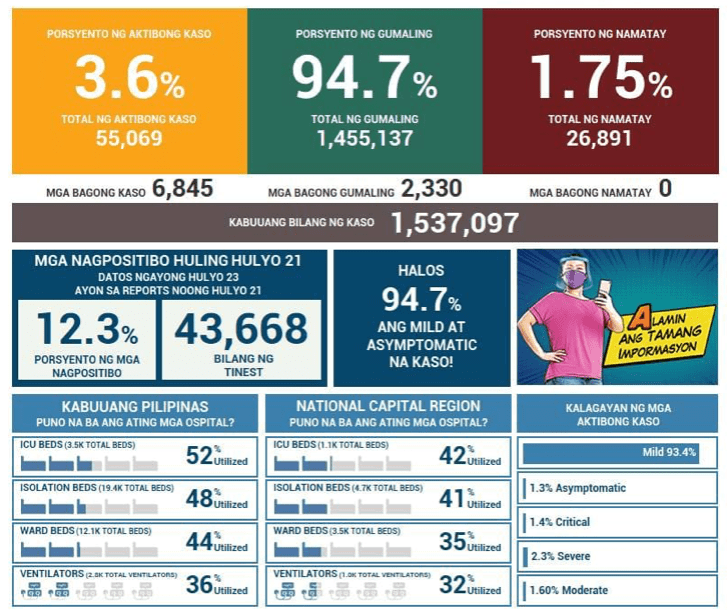
With close to 7,000 cases, the ‘good’ news is that in spite of more new cases than recoveries, there were no new deaths reported. The 6,845 new cases are based on reports from July 21 where a positivity rate of 12.3% was recorded.

So early this morning, the Health Agency reports a glitch in their system. That is why there were ZERO deaths yesterday. They’ve been either having glitches or have had a bad system in reporting because the unknowns are back.

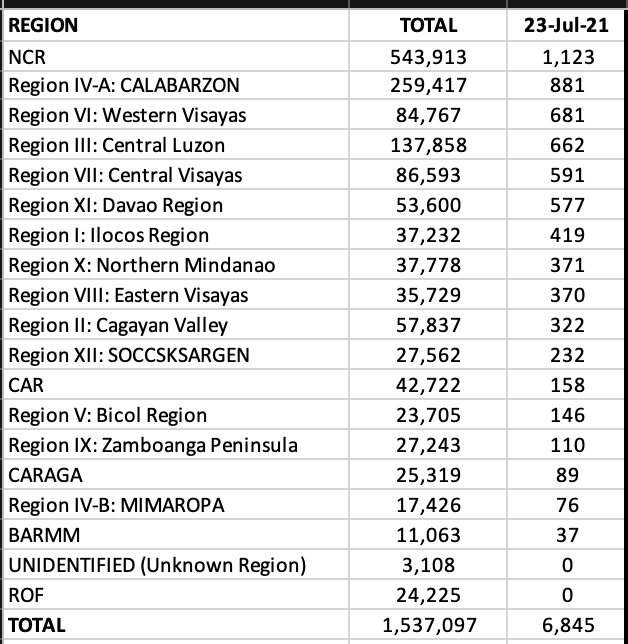
NCR is on top with 1,123 new cases, but the unknowns have been plaguing us for the week. Six regions are seeing more than 500 cases today.

The province of Cebu and Davao del Sur are on the top of the list among provinces with most cases.

On a LGU level, Davao City and Cebu City lead the pack.

In the NCR, it is the unknown that is again in the lead with 211 cases. Among those known, it is the city of Makati, Manila and Quezon City that are lead the pack today.

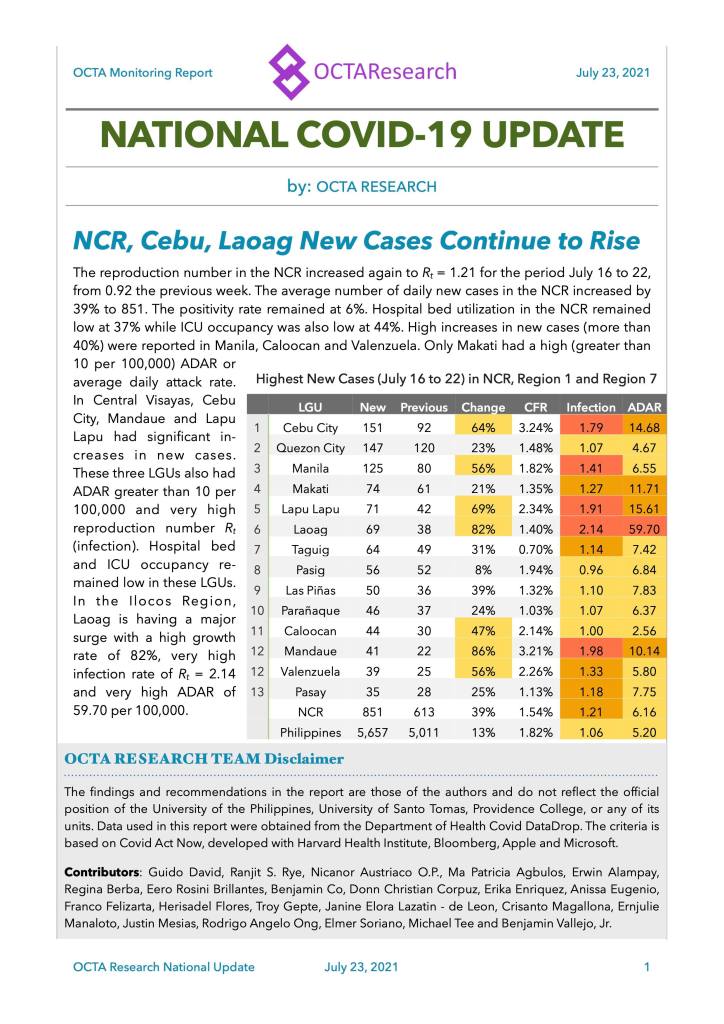
OCTA MONITORING REPORT

While the number of cases yesterday was slightly down from a previous Wednesday high, there are several key cities in the country that are seeing increasing cases.

Based on the July 16-22 data, Rt in NCR is up at 1.21 from 0.92 the week before. This is driven by the fact that the average daily new cases in the NCR increased by almost 40%, while the positivity rate remained at 6%.

In NCR, it is the City of Manila and Valenzuela that had the highest increase in cases. It was, however, Manila that had the highest infection rate (Rt = 1.41).

Cebu Province is back in the eye of the storm with Cebu City, Lapu Lapu City and Mandate City seeing infection rates more than 1.79.

Laoag has the highest infection rate at 2.14, with an ADAR (average daily attack rate) of close to 60 per 100,000 individuals.

The Rt nationally, has passed 1.0 and is at 1.06.

The good news and the bad news on 07.22.2021

The good news first.

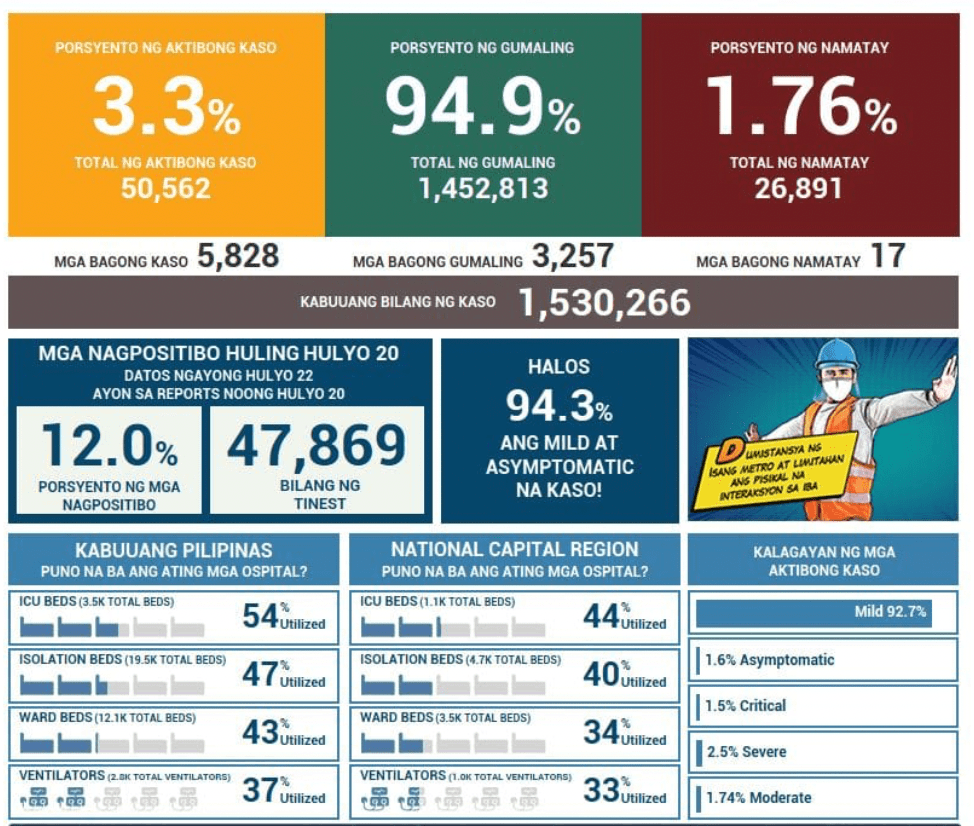
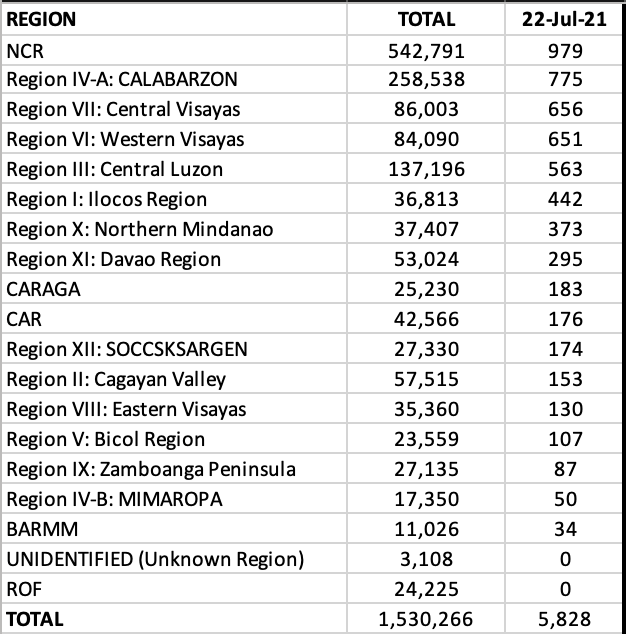
Remarkably, the Health Agency reported fewer cases today compared to yesterday with 5,828 new cases for more than 47,000 tests done on July 20 and 12% positivity.

The other good news is that they reported only 17 deaths. Bringing the case fatality ratio for outcomes down to 1.82%.

Of course, there will be some bad news.

As the new cases are more than the recoveries, active cases are back at more than 50,000.

There is an increase in ICU bed utilization in the NCR (up from a previous 42%) at 44%. Yesterday, Mega Manila is back on top with quadruple digits.

Let’s remember that these are data for a single day. The 7-days moving average is up at more than 5,500 per day compared to a previous week low of less than 5,000 new daily cases. As more delta variant cases are reported (retroactively), the data this week and next week will be crucial in determining how the variant is unfolding in the country.

It an unusual day yesterday (maybe because Tuesday was a holiday? or perhaps we had really lesser cases), Mega Manila continued to lead among regions with close to 1,000 cases. But the Health Agency is back with the reporting system where it is raining unknowns.

In the National Capital Region, the unknowns led by a mile with 227. If we do not know which locality they belong to – then that would mean we have 227 index cases where contact tracing would not even be possible. Go figure!

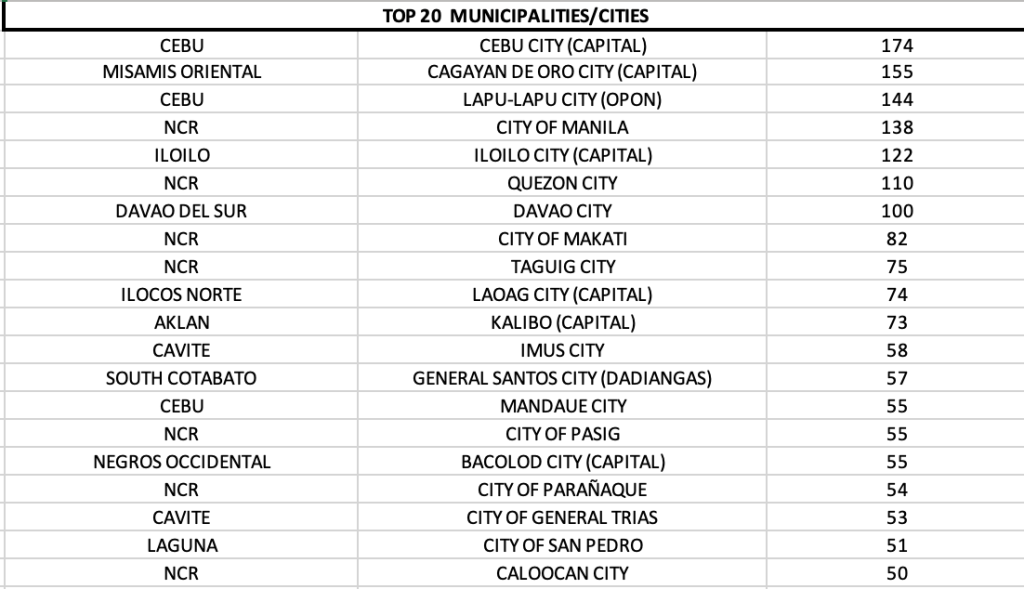
On a provincial level, it is Cebu that continued to lead, explaining also why they top the list of LGUs among cities/municipalities with most cases. Seven of 17 LGUs in NCR are in the top twenty with most cases, and while three of Cebu cities are in the top twenty, it is Cebu City and Lapu Lapu city that sit pat on first and third rank for the day. Of course, this data is biased by the fact that 227 individuals reported to have positive COVID-19 tests belong to NCR.

OCTA MONITORING REPORT

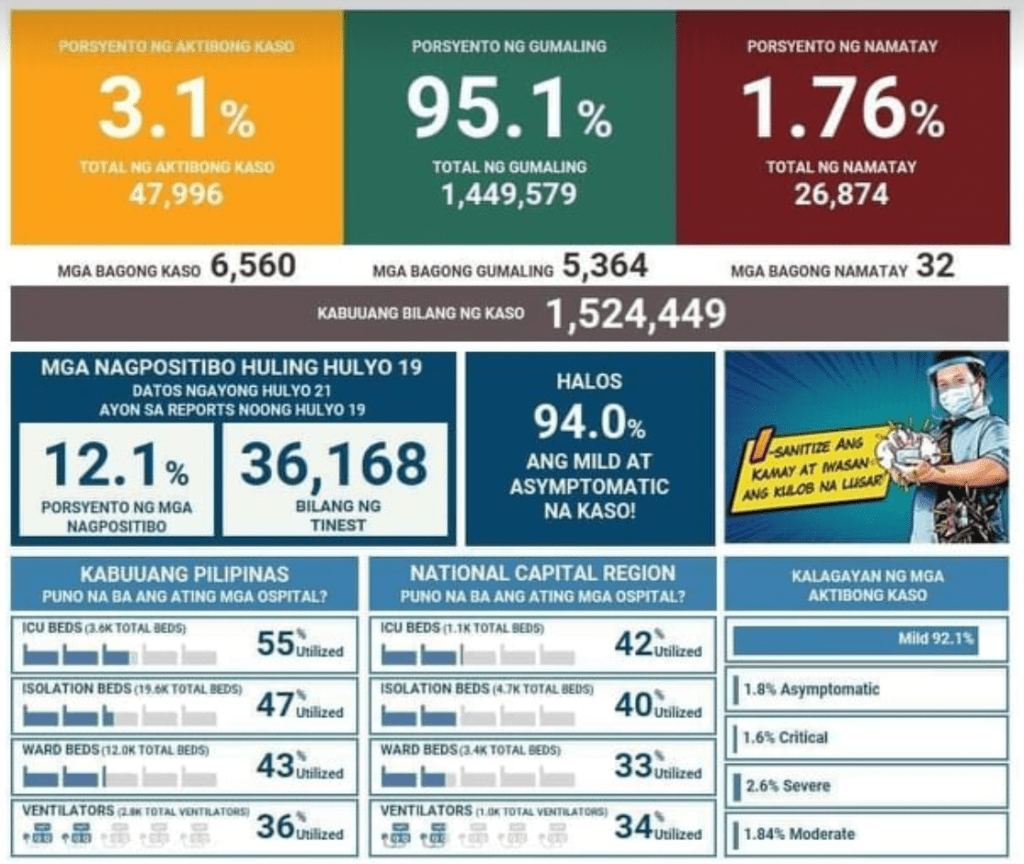
The 6,560 cases yesterday was disturbing. Of course, with disturbing news is bad news.

The NCR reproduction number has increased to 1.15 for the period July 15-21, 2021. This rise was the same pattern seen at the beginning of the second surge last February 12-19, 2021 when the Rt jumped from 1.06 to 1.31.

This is a serious concern and should be taken seriously, considering that the Department of Health has been reporting and changing reports regarding the presence of Delta variant in the country. They cannot keep backtracking on data because contact tracing based on late information is an exercise in futility and potentially disastrous. It is the anatomy of another surge.

Are we on an upward swing with 6,560 new cases on 07.21.2021?

The usual trend for Wednesdays is slightly a fewer hundred cases from the Tuesday.

Today took a different turn. And that’s not a good sign. While the deaths are a low 32, they are not accurate as deaths are always reported late. The bothersome data is that the Health Agency announces 6,560 new cases for a Wednesday. This is based on 36,168 tests done last July 19 and a positivity rate up at more than 12%.

This is considering that 4 laboratories failed to submit data for July 19.

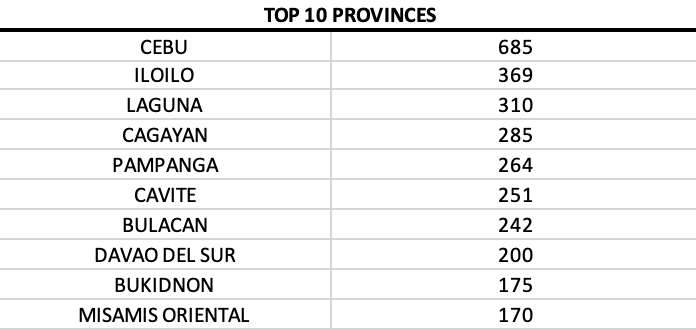
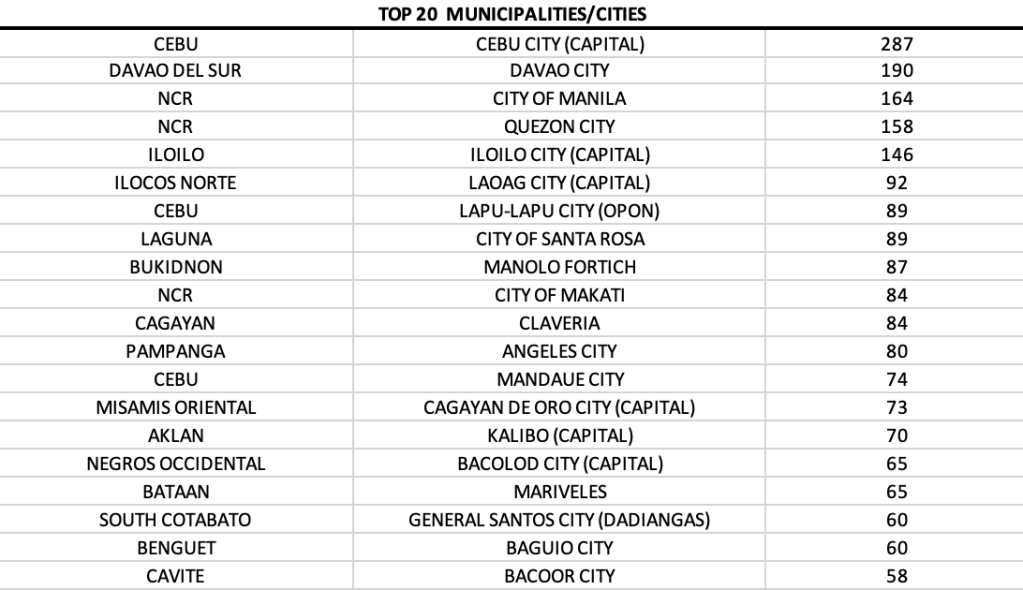
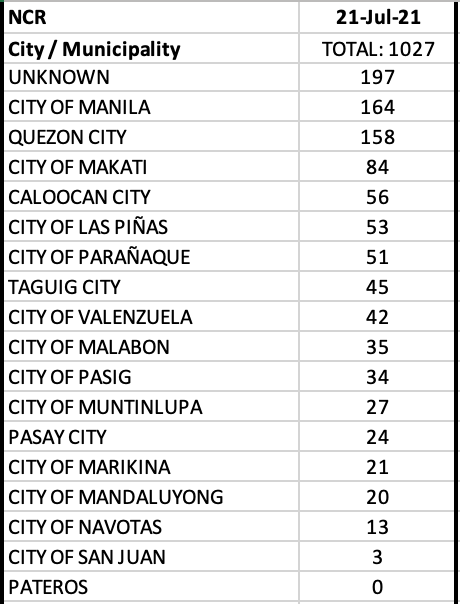
The NCR has breached the 1,000 mark again. But the sad part is that it’s a Wednesday, when cases are lower. And the reproduction rate is now at 1.15! But that’s not the story alone. There are 197 recorded cases but from unknown LGU in NCR. This time, the city of Manila led all cities in NCR followed by Quezon City. And only 3 of 17 LGUs in Mega Manila were in the top 20 LGUs with most cases in the country. Which means that the cases are increasing in many key areas.

CALABARZON, Central and Western Visayas and Central Luzon reported more than 700 cases!

On a provincial level, Cebu topped the list with 685 new cases. This was higher than the combined cases of Iloilo province and Laguna, that came in second and third today.

And the city of Cebu has the most cases among all LGUs in the country for the day.

OCTA MONITORING REPORT

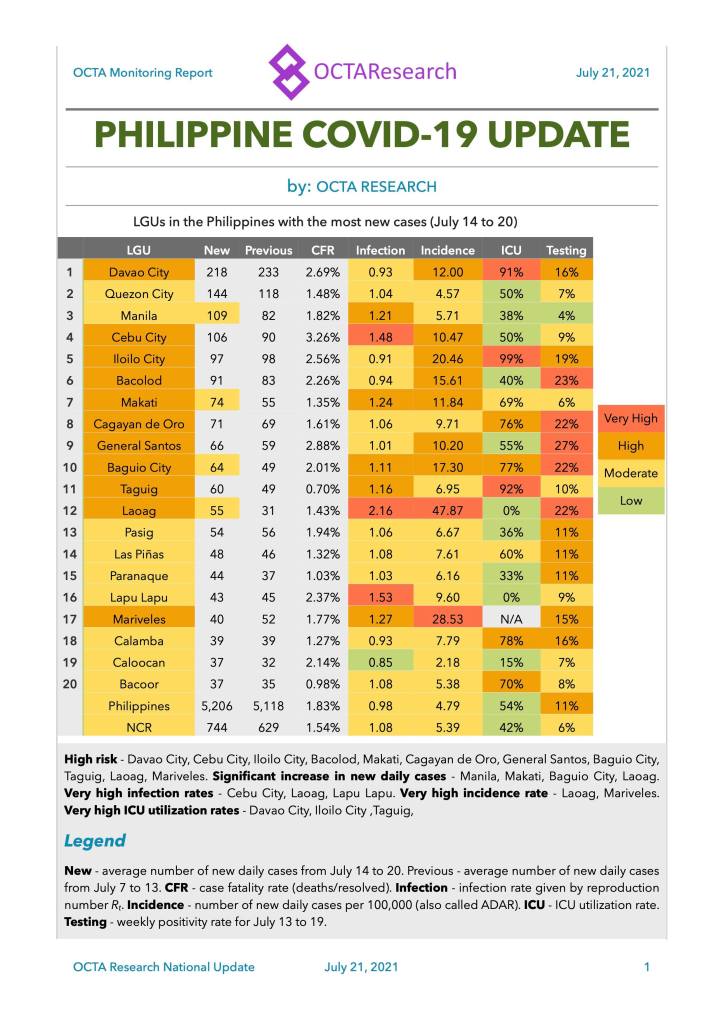
Notice the sudden rise in Rt nationally and the NCR. Rt in the Philippines is up at 0.98, while in Mega Manila, the Rt is up from 1.06 to 1.08 as of the data for July 14-20.

The following LGUs are considered high risk using the four indicators of infection (Rt), incidence (ADAR), ICU utilization rate, and positivity tests: Davao City, Cebu City, Iloilo City, Bacolod, Makati, Cagayan de Oro, General Santos, Baguio City, Taguig, Laoag, and Mariveles.

Based on the indicator for Rt, Laoag, Lapu Lapu City and Cebu City have very high infection rates.

Incidence is highest in Laoag at 47.87 per 100,000 population, followed by Mariveles with 28.53.

ICU occupancy is heaviest in Iloilo City at 99%, while it is at 92% in Taguig and 91% in Davao.

Finally, positivity rate is highest in General Santos at 27%, while the following LGUs have positivity rates that are more than 20% (1 out of 5 tested will likely test positive) – Bacolod, Cagayan de Oro, General Santos, Baguio City and Laoag.

Cases in the NCR are up and Rt=1.06 on 07.20.2021

You know that the reported cases are disturbing considering that the Health Agency is scrambling with how to deal on ‘gently’ breaking the news of the delta variant to the public. When the messaging is inconsistent over a 24 hour period, you cannot expect the public not be anxious.

But yes, Delta has landed. Even the Health Secretary has declared that we must act as if the variant is now in town.

Over the payday weekend, the business community recently enjoyed the brisk gains in Mega Manila with the shift to regular General Community Quarantine as observers noted open air malls filled up with children’s laughter and restaurants full of customer who wined and dined with gusto.

The last time we saw this scenario was Valentine’s Day this year. NCR was in regular GCQ. The vaccines had not yet arrived. But celebrations of love and romance permeated the tired citizens.

Two weeks later, the surge crept in. It took another two weeks to send the healthcare system in Mega Manila out of control.

A round of quarantines returned.

This time, however, the government decided to open up businesses while total new cases averaged 5000 daily in the country. In the NCR, children 5 years old and up are now allowed to enjoy open air activities.

In the midst of the Delta variant threatening a new surge, how will government balance this difficult act?

Businesses cannot afford another lockdown. Vaccines are arriving in trickles and we’re not jabbing them quick enough.

The Health Agency reports 4,516 new cases today. While it may seem lower than yesterday (because today is a Tuesday), this is relatively higher than the previous Tuesday. A little more than 34,000 tests with 10.9% positivity rate last July 18 are reported today.

An additional 58 new deaths were recorded, keeping the case fatality ratio steady at 1.83%.

On a low day, NCR is on top owning more than 15% of the total cases. While CALABARZON is in third, it is because Laguna seemed to not have submitted test results for the day as they suddenly disappear from the top ten provinces for the day. This accounts for Central Visayas being in second rank today.

Cebu province led the day among provinces, followed by Cavite and Davao del Sur.

And Quezon City is back in the lead as the LGU with highest cases as it breaches the 200 mark once more. Seven of 17 LGUs in NCR are among the top 20 cities with most cases. Three key cities in Cebu are in the top ten as well.

As of July 18, 2021, more than 15M doses of COVID vaccine have been administered. There are less than 5% of the population fully vaccinated. The infographic of the health agency below is inaccurate because it does not actually reveal the total population that should be vaccinated. It simply states how many frontline healthcare workers or A2 or A3 and so on down the line have been vaccinated with one or two doses. Which really does not provide the actual picture of how many in these sectors have been covered.

Example, there may be 2,700,000 health care workers that are front liners. Which means if only 1.3M are fully vaccinated, then less than 50% of the HCWs have been jabbed.

It also does not expound on how many percent in the various LGUs have been vaccinated. There are numerous complaints from citizens that there are no vaccines reaching their LGU when in fact they belong the to the bubble that needs to receive the vaccines first.

Hopefully, the agency should be able to address these issues because a storm is brewing.

And everyone needs to stay on top of the situation because the storm that is threatening us, will affect those that are also vaccinated.

OCTA MONITORING REPORT

NCR climbs back to top spot with a reproduction number higher than the national Rt (1.06 vs 0.95). And this is the first time it inches back above 1 since 3 months ago when the region was under the strictest quarantine.

Two cities in NCR are a cause of cancer – Makati and Manila. Manila had a growth rate of 35%, while Makati increased by 29%. Valenzuela, Pasay, Marikina and Parañaque had increases in new daily cases as well and Tagged has ICU utilization at 100%.

Based on the four indicators (Rt, ADAR, ICU and positive tests), the LGU with very high risk is Mariveles in Bataan. Those at high risk are: Davao City, Cebu City, Bacolod, Iloilo City, Makati, Cagayan de Oro, Baguio City, General Santos, Laoag, Lapu Lapu City and Butuan.

Note the jump in Rt of NCR to 1.06, higher than the national average and ADAR has breached 5. Positive tests are also up from <5% to 6%. The NCR is now classified as MODERATE risk. With a population of close to 14M and the most dense region in the country, it will only take two weeks to see a surge happen once more, particularly in the unvaccinated group.

Hopefully, the government does not wait for that to happen. Prior to the second surge, the warning bells were sounded off early. Someone listened to the economic managers first. The rest was history.

The question is – will history repeat itself?