Silence

“Silence does not mean that a person quits. It simply means that one doesn’t want to argue with people who just don’t want to understand.”

I don’t know how many have heard of the Simon and Garfunkel song “The Sound of Silence”. It’s lyrics start off with:

Hello darkness, my old friend

I’ve come to talk with you again

Because a vision softly creeping

Left it’s seed while I was sleeping

And the vision that was planted in my brain

Still remains

Within the sound of silence.

The lyrics of the whole song are disturbing and yet relevant at the same time. It’s about the inability of people to communicate emotionally. Written by Paul Simon almost the same time as the assassination of JFK in 1964, the song was a dismal failure in the initial debut, which became a hit after the second and third versions were released.

Silence is a haunting and eerie emotion because one cannot understand its meaning. Similar to the music of Simon and Garfunkel, silence is a confusing state.

Silence is at times attributed to weakness. There are those who prefer to stay silent in order to avoid problems. But their silence should be taken with apprehension because it’s the shallow water that plans big moves. Remember, the noisy ones are always predictable.

“…my silence means I have adapted to the changes in my life and I don’t want to complain. My silence means I’m on a self-healing process and I’m trying to forget everything that has hurt me. My silence means I am just trying to move on gracefully with all my dignity…”

The parable of the hollow blocks

There were three workers in a construction site who were busy putting up hollow blocks in the middle of a hot sunny day. The foreman passed by and noticed that they were working at different paces. While they were all placing the blocks one on top of another, their energy levels differed.

The first worker was slowly putting one block on top of another at a slow pace and grumpily cursed as he went along his chores. The second worker worked slightly a bit faster and was doing it quietly, while the third worker was placing the blocks at an amazingly timely motion and was humming a tune the whole time he was working.

The foreman asked the first worker why he was working at that pace and sans energy. He replied, “because I have to work on a hot humid day”. When the second worker was asked why he was working at that pace, but slightly faster than the first worker, he replied, “because I need to finish my work early and earn my pay.” When the third worker was asked where he gets the impetus to work harder with a happy disposition, he replied, “because I am working to finish building a school which many children can use when it is finished early”.

There are many versions to this story, with the kind of building (a church, home, or hospital) being built in the end, depending on the story teller.

Today’s blog post is inspired by Fr. James McTavish during his talk at the recently concluded Philippine Pediatric Society’s Annual Convention held at the PICC. Fr James talked on the topic “Wounded Healers”.

As a people, we are wounded in various ways. From relationships to the workplace or school, we’re broken in some form.

I’m taking the cue from Fr. James (who happens to be a pediatric plastic surgeon) on the healthcare professionals to share my thoughts on being wounded healers.

Taking care of patients in general is not an easy task. There’s the patient and his/her family we need to understand. People think that as doctors we are infallible. I’d like to believe that we all remember why we became healers in the first place. While a few of us (like me) took this road out of serendipity, we are all bound by a Hippocratic Oath of first doing NO HARM.

Most of us in the profession take the higher moral ground of being true healers rather than doing this because of the financial remuneration or the prestige of being called a doctor.

Not all of us took the road of private practice. There are the unsung heroes who serve communities and the government because they know that their roles would make a difference and impact by serving the less fortunate and the needy.

It does not, however, mean that those of us in private practice, the academe or in research look at the practice of medicine in a different light. We create our own passion at addressing the wounds of healing. The academician labours at his/her dedication to teaching and creating better doctors for our future generation and the researcher engages in doing studies aimed at advancing medical science and information. Those in private practice create programs in hospitals and organizations for improving their specialties and health programs in the community.

We are ALL Health Warriors. Every patient is not just a statistic or a case report. We feel the pain and misery of patients whose lives we care for. We are patients as well and we know what it’s like to be sick and what it’s like to face death as well.

Albert Einstein aptly puts it well when he said that we should “strive not to be a success but to be of value”.

And touching other people’s lives through healing and serving with love and dedication with passion like the third construction worker in the parable is the key to healing all wounds.

Healing our wounds will always be our source of joy.

Negative people

So you didn’t get the promotion. Or someone broke your heart. Wait, let me guess, you didn’t pass the exam. Sh*t, no way…the holiday was cancelled because the government shut down the island! What? You totally smashed dad’s car?!?

They’re but a few conversations we have with people and friends. How we react to the situation is a reflection of the kind of people or friend we are. Which means, you’d rather be talking to someone who’d share positive vibes rather than someone who looks at the glass of water half empty.

So here’s my ten cents worth of thoughts on people and friends;

1. Stay away from negative people. They have a problem for every solution.

You know the saying that “misery loves company”? Well, that in a nutshell are what negative people are. They’re miserable blokes. Their mission in life is to destroy other people’s happiness. Their mantra is “if I can’t be happy, so can’t you”! During a situation, instead of offering a solution, they present more problems. Stay clear from them, because you’ll end up feeling anxious and depressed after a conversation with them.

The key to identifying this kind of scum is that they are backstabbers. Like vultures that just circle around a dying carcass, once you have your back turned, they’re ready to pounce on your meat.

2. The best revenge is just moving on and getting over it.

I get it. No one deserves to be treated unjustly. And standing (or sitting) there and watching your world fall apart because the evil king has destroyed your goals and dreams with lies and false accusations isn’t going to change your life. Let me say it and say it candidly. Don’t give someone the satisfaction of watching you suffer ! Ever! It’s the worst kind of humiliation.

Karma will find their way with injustice. Remember that. And even if in your lifetime it doesn’t, don’t worry…it will.

3. Get busy loving your life

Okay. So, life’s not fair. You get thrown a watermelon your way. In the back of your mind, you want to throw a hundred durians at your opponent. But is retaliation the solution at rudeness? If you love your life, learn to walk away at the battles that don’t need to get fought. Be busy loving your life that you have no time for hate, regret or fear.

4. Declutter your “friends” list on social media. It will be the best thing you can do to yourself today.

So you have 5,000+ followers on Facebook. Who gives a f*ck?! The people in your life and your social media platforms should be a source of reducing stress, and not causing more of it. It doesn’t matter if you have one or two “likes”. Social media has become a great source of negativity. “Unfriend” if you must, to stay happy. Remember, some people can’t function without negativity because bringing down others makes them feel better.

5. Rude is the rule with negative people.

When people are rude to you, they reveal who they are, not who you are. Obviously, it’s painful because you end up asking yourself WHY. Learn not to take everything personally. Walk away.

If you surround yourself with people who don’t suck the positivity out of you, you’d have a better life! Remember, you’re only going to be as good as the people you surround yourself with. Be brave enough to let go of those who keep weighing you down. They’re not worth the keep.

The last day

If you want a happy ending, that depends, of course, on where you stop your story.

– Orson Welles

In the book by Daniel Pink entitled “When: The Scientific Secrets of Perfect Timing”, chapter 5 talks about ENDINGS.

It’s one of the most interesting discussions of the book particularly when it talks about the core of meaningful endings, poignancy. Poignancy is a mix of happiness and sadness. For many, “the most powerful endings deliver poignancy because poignancy delivers significance…adding a small component of sadness to an otherwise happy moment elevates that moment rather than diminishes it.”

I’m not very good at goodbyes. Or endings, for that matter. After all, the best endings don’t leave us happy. “Instead, they produce something richer – a rush of unexpected insight. A fleeting moment of transcendence, the possibility that by discarding what we wanted we’ve gotten what we need.”

I’d like to believe that decisions have both good and bad news. The bad news is that the I feel sad leaving a new found “family” behind. But closings, conclusions, and culminations reveal something essential about the human condition: in the end, we seek meaning.

When I was writing this blog entry, I did not know how to end the story. Pink points out the “when’s” of our lives in such scientific relevance that I understood better why I decided what I decided.

(The following is lifted from his book entitled “When”, and is available currently at Fully Booked).
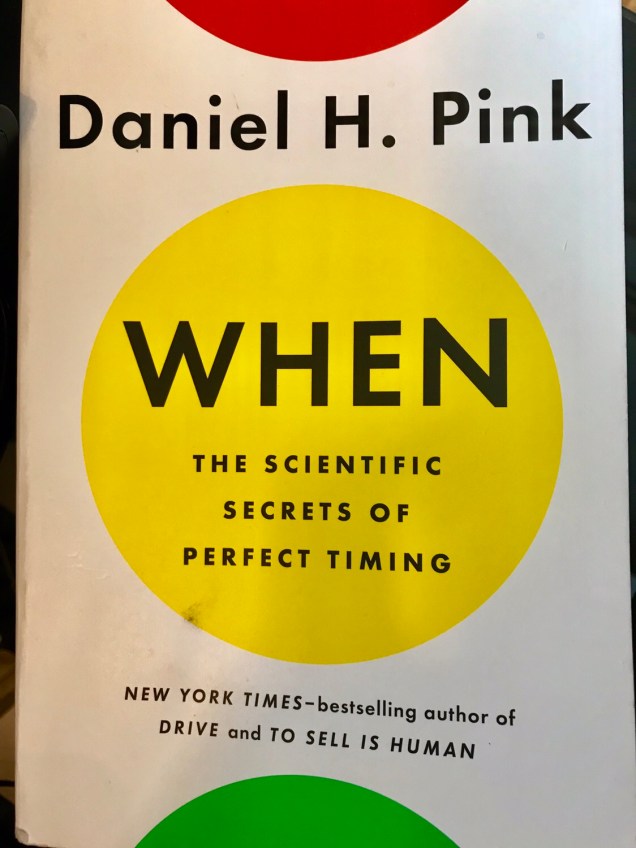
Many “when” decisions involve endings. There are five questions to help us decide. If your answer to two or more of these is no, it might be time to craft an end.

1. Do you want to be in this job on your next work anniversary?

People are most likely to leave a job on their one-year work anniversary. The second most likely time? Their two-year anniversary. The third? Their three-year anniversary. You get the idea. If you dream the thought of being at your job on your next work anniversary; start looking now. You’ll be better prepared when the time comes.

2. Is your current job both demanding and in your control?

The most fulfilling jobs share a common trait: They prod us to work at our highest level but in a way that we, not someone else, control. Jobs that are demanding but don’t offer autonomy burn us out. Jobs that offer autonomy but little challenge bore us. (And jobs that are neither demanding nor in our control are the worst of all.) If your job doesn’t provide both challenge and autonomy, and there’s nothing you can do to make things better, consider a move.

3. Does your boss allow you to do your best work?

In his excellent book Good Boss, Bad Boss: How to be the best…and learn from the worst, Stanford Graduate School of Business professor Robert Sutton explains the qualities that make someone worth working for. If your boss has your back, takes responsibility instead of blaming others, encourages your efforts but also gets out of your way, and displays a sense of humor rather than a raging temper, you’re probably in a good place. If your boss is the opposite, watch out – and maybe get out.

4. Are you outside the three- to five-year salary bump window?

One of the best ways to boost your pay is to switch organizations. And the best time to do that is often three to five years after you’ve started. This period represents the sweet spot for pay increases. Less than three years might be too little time to develop the most marketable skills. More than five years is when employees start becoming tied to their company and moving up its leadership ranks, which makes it more difficult to start somewhere else.

(While this was lifted straight from Pink’s book, my work experience has proven that this is the average time frame for “making it” or not, at the work force. If, after three years you’re not in a better place at work, it’s time to either re-examine yourself or leave the company.)

5. Does your daily work align with your long-term goals?

Ample research from many countries shows that when your individual goals align with those of your organization, you’re happier and more productive. So take a moment and list your top two goals for the next five years and ten years. If your current employer can help you reach them, great! If not, think about an ending.

The story of the blind boy

On a busy street, a blind boy was waiting for someone to drop a coin in his can. He had a board beside him with a note written: “I am blind, please feel pity on me.”

A man came and dropped a coin and erased what was on the board. Soon, the boy heard a lot of coins being dropped in his can. The boy wondered and asked someone to read what was on the board.

“Today is a beautiful day, too bad I can’t see it”.

I shared this story 5 years ago and up to today, I find it most relevant for stories on relative joy.

The story here reminds us on various ways to see life’s challenges – wallowing in self-pity or celebrating our Calvary.

We always have choices. But the decision is always left to us to make. Comfort zones are so easy to settle in. And like the blind boy in the story, it’s what we’re used to – self-pity. Like many of us, we feel it’s a safe place to be, afraid of change, waiting for the miracles that would change the situation – instead of taking on how happiness can be achieved if we only changed our paradigm.

Aging gracefully

There’s a saying that some people mellow with time. Or that as you age, you become wiser beyond your years. Some call it experience. Others call it reconciliation with life.

Growing older should slap us with more sense of responsibility in our lives. These petty dramas must come to a halt. And we need to make sense of learning to grow up instead of being pinned in so much petty squabbles. It’s sad to see some adults still lacking the maturity that comes with age.
David Bowie says it bluntly when he points out that

Aging is an extraordinary process where you become the person you always should have been.

Sometimes life isn’t fair. And there are lemons thrown our way. There are situations that make it difficult for some of us to realize that we mature with the damage, not with the years.

Through our life journey, we need to remember that it is important to do your best, place your best foot forward, and try to be an honest person.

As they say,

Change is inevitable. But personal growth is a choice.

We all need to age gracefully. Time, after all, has been our faithful companion.

Judgemental

A little girl was holding two apples. Her mom asked for one. The little girl quickly bit one apple, and then the other. Her mom held back her disappointment. Then the girl handed one to her, saying, “here, this is the sweeter one”.

Often times in our lives we’re quick to draw judgement at people or their actions without fully understanding the circumstances at all.

Sometimes all these harsh and rash judgement isn’t even real. It’s picked up from gossip that are spread by envious detractors and the sad part here is that some people are just too gullible to believe them. In short, we have problems when it comes to giving the other person a chance to prove herself.

Like the child in the story, the mom was quick to judge at the action taken by the child. She forgot that it was a well meaning gesture because the little girl cared.

There are people that circle our lives like vultures waiting for the kill. And these are the dangerous kind of acquaintances we meet. Discerning them and dissociating with them is difficult especially when you rely on rumors from the vultures at bay. Gossip is like listening to the devil whispering in our ears. The story is juicy but the intent is evil. Being judgemental is treating people unfairly.

No one likes feeling judged. We need to back off and let people live because we’re all in our personal journeys – evolving and growing.

Discernment is a gift we need to harness because only through discernment can good come from the wise.

Four agreements

Don Miguel Ángel Ruiz, a Mexican author, summarizes four agreements we need to consider in our lives.

Entitled “The Four Agreements: A Practical Guide to Personal Freedom”, the book published in 1997, reveals the source of self-limiting beliefs that rob us of joy and create needless suffering.

Here’s a summary and hope it serves as a daily reminder on life’s relative joy. It is self explanatory.

1. Be impeccable with your word.

Speak with integrity. Say only what you mean. Avoid using the word to speak against yourself or gossip about others. Use the power of your word in the direction of truth and love.

2. Don’t take anything personally.

Nothing others do is because of you. What others say and do is a projection of their own reality, their own dream. When you are immune to the opinions and actions of others, you won’t be the victim of needless sufferings.

3. Don’t make assumptions.

Find the courage to ask questions and to express what you really want. Communicate with others as clearly as you can to avoid misunderstandings, sadness and drama. With just this one agreement, you can completely transform your life.

4. Always do your best.

Your best is going to change from moment to moment; it will be different when you are healthy as opposed to sick. Under any circumstance, simply do your best, and you will avoid self-judgment, self-abuse, and regret.

Life can be as complicated or simplified as we make it. Only we decide for ourselves.

Quitting now

There’s quitting on drugs, caffeine, nicotine, alcohol, or sex. But no, they’re not the most difficult things to quit from. Here’s the top five:

1. Trying to please everyone

So someone wants to be Miss Congeniality. There’s always someone in the group that wants to be a people pleaser to the point that they rumor monger just to be popular. Then there’s also the one that thinks that playing goody will get all the sympathy votes. Both are wrong. There is no Miss Friendship or Mr Sympathy in the real world.

2. Fearing change

As they say, the only thing that is permanent in this world is change. And there’s really nothing wrong with change because when we are afforded multiple chances in life, we become better people!

One of the hardest decisions in life is letting go. Whether it’s guilt, anger, love, betrayal or loss – change is never easy. We fight to hold on. And we fight to let go.

3. Living in the past

Trauma makes it difficult for people to move on. Staying stuck in the past creates an atmosphere of bitterness and anger. Truth is, the past cannot be changed, forgotten, edited or erased. Once we learn to accept it, we can move on.

Let the past die. Kill it if you have to.

4. Putting yourself down

Often times we underestimate ourselves. Not because we think we’re not good enough but because people have pushed you into believing you’re not good enough. But f*ck them! People who attack your confidence and self-esteem are aware of your potential and feel you’re a threat. Don’t give in to their insecurities.

5. Overthinking

We are laden with anxiety day in and day out. The mind is a dirty playground. We anticipate a problem even when the problem does not present itself. There are various signs of overthinking: we second guess, analyze things to death, suffer from insomnia, let someone decide for you, refuse to let things go, criticize yourself a lot, feel tense, unable to turn off your brain, expect the worse…to name a few. However it appears as, overthinking is hazardous to your health.

We all need to quit on the things that are burdens of daily living.

Everyday is an opportunity to change our lives. Another chance. A new beginning.

Quatervois

(n.) a crossroad; a critical decision or turning point in one’s life

We all have a quatervois.

Some look for signs. Others leave it to chance. And there will always be misgivings on making life decisions. Sometimes it’s the search for happiness or job satisfaction. More often than not, it’s the financial stability. But even when the job sucks and all the wrong are written all over the walls, the longer you tolerate the wrong, the more difficult it is to let go and get mired in all that shit.

Seriously, it’s called being an accomplice to it. And even just watching from a distance within the same bureaucratic mumbo jumbo is tantamount to dancing with evil.

I get it when you come face to face with a quatervois. It’s probably like looking at desperation straight in the eyes. A million things run through your mind. You want to fight it but you’re inclined to look the other way because of personal reasons. We all have that critical turning point in life. And the most difficult decision will always be made when you feel like giving up.

That point comes when you begin to solicit advice from others instead of deciding on your own. Why solicit the advice? It’s because you want to hear people stop you from leaving a job or perhaps someone you love reassuring you that the relationship is worth salvaging. Whatever it is, you want reassurance on uncertainty.

Sometimes you have to do what’s best for you and your life, not what’s best for everybody else.

Remember: indecision will never move you forward. It’s a sign you don’t trust your intuition.