The gospel according to Thomas Sowell

My post on “Credit Where Credit is Due”, drew inspiration from Thomas Sowell.  I know most (if not all) of my readers are unfamiliar with him.  I stumbled upon him at Pinterest and began reading up on many of his publications.  His biography entitled “A Personal Odyssey” published in 2002 is a recommended read.

Who is Thomas Sowell?

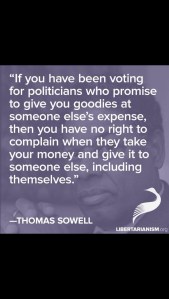
It is hard to imagine a more stupid or more dangerous way of making decisions than by putting those decisions in the hands of people who pay no price for being wrong.

Influential American economist and social theorist Thomas Sowell was born in 1930 in Gastonia, North Carolina but grew up in Harlem, New York.  Although Thomas showed signs of academic promise, his father who was a construction worker did not encourage him to pursue higher education. Thomas dropped out of high school, worked odd jobs, but his penchant for pursuing academic achievement saw him obtain a high school degree in an evening program.  After serving the marines, he entered Howard University and later moved to Harvard graduating Magna Cum Laude. He later earned his master’s from Columbia University and PhD from the University of Chicago. His mentor at the University of Chicago was the Nobel Prize winning conservative economist Milton Friedman.

His teaching career would take him to Rutgers, Howard, Cornell, Brandeis, and UCLA. Today, at 88 years old, he is currently a Rose and Milton Friedman Senior Fellow at the Hoover Institution at Stanford University in California.

A prolific scholar (he has written over 25 books), his earliest work Economics: Issues and Analysis was published in 1971. His latest work was published in 2007, entitled A Conflict of Visions. 

His position with government and the private sector included the US Department of Labor, the Urban Institute, and the Hoover Institution.  In 1990, Sowell won the Francis Boyer Award from the American Enterprise Institute.  In 2002, he was awarded the National Humanities Medal for innovative scholarship and incorporated history, economics and political science.

Sowell tells things the way it is and the way it should be told.  Often times too real and painful for the onion-skinned, his opinions speak volumes of experience.

His political rants are spot on:

No one will really understand politics until they understand that politicians are not trying to solve our problems.  They are trying to solve their own – of which getting elected and re-elected are number one and number two.  Whatever is number three is far behind.

He has this to say when politics takes on a personal agenda:

Politics is the art of making your selfish desires seem like the national interest.

His thoughts on entitlement are point blank:

  • When people get used to preferential treatment, equal treatment seems like discrimination.
  • It is usually futile to try to talk facts and analysis to people who are enjoying a sense of moral superiority in their ignorance.

His views on education:

The problem is not people being uneducated.  The problem is that they are educated just enough to believe what they’ve been taught.  And not educated enough to question what they’ve been taught.

His thoughts on the current social situation:

  • One of the sad signs of our times is that we have demonised those who produce, subsidised those who refuse to produce, and canonised those who complain.
  • The real danger to us all is when government not only exercises the powers that we have voted to give it, but exercises additional powers that we have never voted to give it.  That is when “public servants” become public masters.  That is when government itself has stepped over the line.
  • What is ominous is the case with which some people go from saying that they don’t like something, to saying that the government should forbid it.  When you go down that road, don’t expect freedom to survive very long.

On the relation of economy, taxes and the government:

I have never understood why it is “greed” to want to keep the money you’ve earned, but not greed to want to take somebody else’s money.

Or simply placing real life scenarios in perspective:

People who enjoy meetings should not be in charge of anything.

And harping at media bias:

If people in the media cannot decide whether they are in the business of reporting news or manufacturing propaganda, it is all the more important that the public understand that difference, and choose their news sources accordingly.

‘he sleeps in a storm’

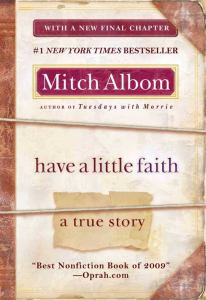
Eight years ago, I wrote a book review for “Have a Little Faith” by Mitch Albom.

Albom is renowned author to “Tuesdays With Morrie”, “Five People You Meet in Heaven”,  “For One More Day”, “The Magic Strings of Frankie Presto”, “The Time Keeper”, “The First Phone Call From Heaven”.  On October 9, his new book entitled “The Next Person You Meet in Heaven” will hit the bookstands.

So far, “Have a Little Faith” was his best.

While the book was published in 2010, its message is as timely as when I wrote it’s review eight years ago.

Perhaps, it has come at no better time when we come to grips with our faith.  The conversation between Albom and the dying rabbi is an awakening  to what inner faith many of us lack or what many of us lost.

Timely and moving are the two words that best describe the 254 pages that drove me to a deeper understanding of my humanity.

The book begins with a task.  The 82 year old rabbi has asked Mitch to deliver an eulogy for him when he passes on. Here, Albom seeks out to find not only the story of the life of the rabbi, but his life and many of those whose lives he crossed path with in his search for the “right words” to say to fittingly describe one of the greatest eulogies.

The story spans eight years between two men – Rabbi Albert Lewis and Pastor Henry Covington. In Alboms’ search for the right words to put together, their stories would cross paths in the search for the meaning to life and happiness.

On page 93 is a short excerpt of how beautifully written the sermon of Rabbi Lewis (Reb) is:

From a sermon by the Reb, 1975:

“A man seeks employment on a farm.  He hands his letter of recommendation to his new employer. It reads simply – ‘he sleeps in a storm’.

The owner is desperate for help, so he hires the man.  

Several weeks pass, and suddenly in the middle of the night, a powerful storm rips through the valley.

Awakened by the swirling rain and howling wind, the owner leaps out of bed. He calls for the new hired hand, but the man is sleeping soundly.

So he dashes off to the barn. He sees to his amazement, that animals are secure with plenty of feed. 

He runs out to the field.  He sees the bales of wheat have been bound and wrapped in tarpaulins.

He races to the silo.  The doors are latched, and the grain is dry.

And then he understands, “HE SLEEPS IN A STORM”.

“My friends, if we tend to the things that are important in our life, if we are right with those we love and behave in line with our faith, our lives will not be cursed with the aching throb of unfulfilled business. Our words will always be sincere, our embraces will be tight.  We will never wallow in the agony of  ‘I could have, I should have’. We can sleep in a storm.”

And when it’s time, our goodbyes will be complete”.

There will always be stories of despair. Or of inspiration. Albom puts reality into perspective by engaging us in a story of finding meaning in our faith.

As the story draws to a close, Album finds that the lives of two men from two different religions profoundly find something bigger than oneself.

images

Have a Little Faith is a book about life’s purpose. About losing belief.  And finding it again. About the divine spark inside each of us.

You will smile.

Shed a tear or cry.

Because this one man’s journey, is everyone’s story.

Credit where credit is due

I have no political inclinations. Like many Filipinos, when it comes to political affiliations, I have no conflict of interest.

I do not like it when people call each other “dilawan” or “ka-DDS”.  We are Filipinos.  One nation.  Whether you are an oligarch or a pauper, whether you are a drug lord or a communist rebel, whether you are an OFW or a farmer in Benguet – the Philippines is our motherland. Patriotism should never be territorial.  Just because the president or other government officials hail from a province or region does not mean you have to die for them. No other agenda should be put on the forefront of politics except the greater good of the people.

When you want to help people, you tell them the truth.

When you want to help yourself, you tell them what they want to hear.

I am writing this for everyone, regardless of political stand, who use social media in the dissemination of information, to think and do a bit of research before they share. To share the full story and not pick up bits and pieces to fit an agenda. If there is nothing good to share or when you doubt on the information that you are sharing, DO NOT PRESS CLICK AND SHARE. Sharing wrong information is perpetuating evil.  It is wrong to think that it does no harm passing around twisted lies.  Peddling lies is being in connivance with the devil. The last I recall was that we are citizens of this nation and not a cult for some government officials.

I have friends and colleagues who have lost all critical thinking because of political affiliation.  And that makes me sad.  They were intelligent people who got washed away with the tide.  We need to respect each other’s political beliefs.  But a spade must be called a spade when it is.  Credit should be given where credit is due.

Of all ignorance, the ignorance of the educated is the most dangerous.  Not only are educated people more likely to have more influence, they are the last people to suspect that they don’t know what they are talking about when they go outside their narrow fields.

We all know that it takes more than the six (6) years of an administration to see the fruits of its labor.  There are projects of every administration that has either a sordid history laden with graft and corruption or one where we all look back and recognise the visionary in them.  Most of that, however, can only be appreciated after the term of the administration is over. It takes years to build infrastructure – skyways, road, airports, subways, etc.  The layers of governmental approval – from bidding to construction – is a logistic nightmare in itself.  By the time any sitting president will see his or her flagship projects, MANY OF THEM will be seen in the next administration.

I am writing to the people who share posts about infrastructure projects being credited to the current administration, when the projects were started by the previous administration and completed only in this administration OR were completed in the final year of the previous administration and were not given due credit.

I am writing to the people who use fake pictures to promote success when that success story never happened in our country.

I am not a fan of PNoy. He had his own lapses in governance.  And I can name many. But whatever credit is due him, let’s not subvert the incontrovertible truth of the achievements of the previous administration, particularly when it comes to infrastructure or disaster preparedness.  Every administration could have used the lessons the previous administrations had in building and rebuilding a country. There is no perfect leader.  There has been no one that has endeared the people. Using these lessons will chart us in more concrete directions.

Social media is being misused for the gullible plenty.  What the current administration can do is focus on short term goals – the economy.  That, my friends, is tangible success.

Since this is an era when many people are concerned about “fairness” and “social justice”, what is your ‘fair share’ of what someone else worked for?

Let the real infrastructure progress of the current administration be reflected when the projects have been completed.  When Boracay is finally open and cleared of all that stench and filth, then kudos to those responsible for the clean up drive.

The pressing issue is the economy hitting the shitty ceiling.  The major bravado of the current administration should be to work at what are tangible solutions to the economic woes of the country now.  When corruption and incompetence are in collusion with governance, we are all headed for a collision course with an economic meltdown because we were all focused on issues that were personal and formed background noise.

Let’s face it, you cannot turn your head away from issues hounding appointees who have been accused of corruption and stay silent about it.

You cannot look the other way with appointees who disappoint and drag the president down because of their feeling of entitlement and expect the public to love them. The president was elected to govern for the greater good of its people – friend or foe, rich or poor.  The allegiance of every Filipino is to its country.

One of the consequences of such notions as “entitlements” is that people who have contributed nothing to society feel that society owes them something, apparently just for being nice enough to grace us with their presence.

Let’s put some sensibility and civility back on the table.  There is no shame in recognising our faults and short comings.  Our disillusions and misplaced sense of allegiance.  Let us give credit to where credit is due.  And respect where respect should be.

Enough with peddling these lies, make believe stories and half-truths. Accountability is mandatory for all actions – no exceptions to the rule. If you have nothing better to say, or share, don’t.

Remember: Right is right even when no one is doing it.  Wrong is wrong even if everyone is doing it.

(All quotations are from the Politics of Thomas Sowell).

The story of truth and lie

In 1896, French artist, Jean-Léon Gérôme painted La Vérité sorta time du puits armée de son martinet pour châtier l’humanité.

(Truth coming from the well armed with her whip to chastise mankind).

The painting was suggested to be an expression of Gérôme’s hostility to impressionist movement, to which he was violently opposed. The expression is a translation of the aphorism of the philosopher Democritus, “of truth we know nothing, for truth is in an abyss”. The nude model refers to the naked truth.

In the 19th century, there was a legend created based on the painting.

Truth and Lie meet one day. Lie tells truth that “it’s a beautiful day today”. Truth looks up to the skies and sighs. For truly, it was a beautiful day.

Truth and Lie spent the whole day together, exchanging stories and having fun. During their stroll, they reach a well. Lie tells Truth, “the water looks very nice. Let’s take a dip together.” Truth, once again suspicious, tests the water and discovers that indeed, it was very nice. They undress and start bathing.

Suddenly, Lie jumps out of the well and puts on the clothes of Truth and runs away. The furious Truth comes out of the well and runs everywhere to find Lie so she could get her clothes back.

The World, seeing Truth all naked, turns it’s gaze away, with contempt and rage.

The poor Truth returns to the well and disappears forever, hiding therein, it’s shame.

Since then, Lie has traveled the world dressed as Truth, satisfying the needs of society, because the World, in any case, harbors no wish at all to meet the Naked Truth.

According to Gérôme’s biographer, Charles Moreau-Vauthier, Gérôme slept with this painting above his bed and was found after his death with his arm stretched towards it, in a gesture of farewell.

Since 1978, it has been part of a permanent exhibition at the Museé Anne de Beaujeu in Moulins, France.

(Thank you to my classmate Noel Tanglao for posting this story in our Viber group. This is a modified version.)

The opportunities

Change is always in our midst.

The choice on when to change our attitude is a personal one. When we’ve made that choice, there are five “opportunities” that Maxwell points out around us, that make this decision a success.

I will rewrite parts of it for easy recall.

1. The friend

We need one another.  Few people are successful unless a lot of people want them to be.  Change has a tendency to intimidate us.  Add to that intimidation the realisation that we have a long way to go before proper attitudes are established.

To help overcome this feeling of inadequacy, you need the help of a friend.

The real friend is the one who does not take advantage of that relationship.  Remember, we can never do anything for others that will not have some eventual benefits for ourselves.  There is a law of life that will, in time, return good for good.  Therefore, enlisting someone’s help will not only assist you, but it will also give a friend a blessing in return.

2. The associate

There are two keys to determine who we are: (1) who we perceive ourselves to be and (2) who we associate with.

Birds of a feather do flock together.  From friends, we acquire many of our thoughts, mannerisms, and characteristics.  Changing an attitude from negative to positive often requires changing friendships.  It is no accident that kids with good grades run around with other kids with good grades.

Many times people blame circumstances for their problems.  But usually it is the crowd we run with, not the circumstances we encounter, that makes the difference in our lives.  Good circumstances with bad friends result in defeat.  Bad circumstances with good friends result in victory.

When people who you “trust” pull you down because they have their own agenda or their own ghosts of the past to live with in order to survive, they are not good associates. They are bad people who will let you hang yourselves to dry when they don’t need you anymore.

3. The model

Communicators say that 90% of what we learn is visual, 9% is audio, and 1% comes through the other senses.  Our dependence on the eyes to learn, no doubt, is at least partially a result of television in our culture.  Visual messages last longer than those we just hear.  You could select someone to follow who would give you a constant visualisation of what you want to become.  Making a single decision to alter an attitude is not enough.  To achieve the kind of life you want, you must act, walk, talk, and conduct yourself as the ideal person that you visualise yourself to be.

Our children and the youth, more often than not, have parents as their role model.  We start them young – as the posters say it.  The apple, after all, does not fall far from the tree.  What we become, what our children become, what the nation becomes – is a reflection of who leads and how we influence our children as well.  The future started yesterday.

4. The mistake

The first instant an idea is conceived is a moment of decision.  When an opportunity of growth is opened to you, what do you tell yourself? In that moment, you choose between success and failure.

You cannot control all circumstances.  You cannot always make right decisions that bring right results.  But you can always learn from your mistakes.

We are all human and mistakes will always be the best teacher. Acknowledging that we are wrong is the lesson learned. And there is no shame in that. Pride, after all, can be swallowed without loss.

5. The experience

It takes five positive experiences to overcome one negative situation.  When faced with the possibility of failure, our tendency is to sit back and be anxious.  Fear is nature’s warning signal to get busy.  We overcome it by a successful action.

Nothing intimidates us more than constant exposure to failure.  Nothing motivates us more than constant exposure to success.  People change more quickly if they are continually given situations in which they can be successful.

We need to value other people’s worth. No one wants to work in a continuously negative environment. It is not only inhumane but tiring as well. No one wins a war. We are all losers.

The storm

The perfect storm is when everything in the universe conspires to align.

When natural disasters occur, we can only prepare for survival.  It is humanly impossible to challenge nature. This blog is not about the force of nature. The intangible is difficult to foresee.

Let’s talk about the tangible. Man made disasters can be averted when calculated risks are taken before decisions – whether life changing or minor ones – are made.

The Philippine economy has seen a dramatic free fall in the last few months.  As in my previous blog on WHY THE NUMBERS MATTER, the political environment has lately borne the brunt of the initial salvo of a storm.  The short discourse on my previous blog made mathematical sense, with no additional confounding factors needed, to arrive at the conclusion that if policy makers and economists running the country don’t get their shit together, we’re headed for that perfect storm.

I was telling a friend of mine, that in a country like the Philippines, where the poor and marginalised make up 3/4 of the total population – productivity, savings and consumption  – take a big hit during an economic tailspin that is politically driven.  These three factors affects the most vulnerable in society because they now have to spend more for basic necessities, when they have the least to spend. These factors are present regardless of who the sitting president is.  

The peso now teeters at P54.15 for every USD$1.  The domino effect results in increase cost of fuel at almost P60 per litre. Delivery of goods and services are driven by fuel, which indirectly raises the cost of goods, commodities, and services.  Coupled with inflation is the demand for higher wages and compensation. While some economists claim that the region is widely affected, it is without doubt that the greatest free fall currently is in the Philippines.

In a perfect storm, the casualties are high.  At what price will we pay for not heeding the signals early on?

The country and its people are the casualties of any political storm. There is no yellow or red army when the lives and livelihood of people are at stake. As a nation, we’re all in this together. The greater good should be what we all work for. And the president is correct when he says that corruption must be stopped. It is without doubt that the political noise must address this storm. And like the storm that nature brings, it is the periphery that brings most havoc.

When the people around him is the storm, the greatest destruction is only felt when the trail of the typhoon has left. The damage has been done. And the people will have a more difficult time rebuilding their lives.

Like a thief in the night…

The recent deaths of popular personalities – fashion designer Kate Spade and celebrity chef Anthony Bourdain – have triggered a media frenzy on the topic of depression and suicide.

Many of us may not really know what depression is. Take it from me, I’m writing from experience. Let me point out the reality that the consecutive untimely demise of famous personalities should not be the basis for reaching out to people who encounter depression.

Depression is a sensitive topic to discuss. Some people prefer to sweep this under the rug when the issue is raised. Until of course, it hits home.

What does depression feel like?

You don’t want to live but you don’t want to die. You don’t want to talk to anyone but you feel very lonely. You wake up in the morning and simply wait for the night to come.

Everyone comes to a point in their life where depression comes to us like a thief in the night. Whether it is from abuse or loss of a loved one or financial difficulties, drug dependence or at the throngs of death because of a disease impossible to treat, depression is a slow mortifying event of the mind. It robs us of our happiness, sanity, then dignity.

What drives one to depression?

No one exactly knows. But 10-15% of us will be depressed in our lifetime. Several factors lead to depression, namely:

1. Genetic predisposition

2. Brain chemistry (neurotransmitters) imbalance

3. Female sex hormones (probably explaining why more women suffer from depression more than men)

4. Circadian rhythm disturbance (seasonal affective disorder)

5. Poor nutrition

6. Physical health problems

7. Drugs and alcohol

8. Stressful life events

9. Grief and loss

Why certain people are more predisposed than others may be a combination of the above factors. Suffice it to say, those that have multiple factors above are most likely to be depressed than others.

Dealing with depression

Seek help when you need.

It’s usually denial at first signs.

Recognising the little things that distract you or make your daily routine unusually difficult to bear eventually accumulate over time. We wake up one day, not only denying these, only to find out that those physiologic symptoms (heartburn, abdominal pain, headaches, easy fatigability, frequent urination) are not anatomical problems. It’s probably psychosomatic. The mind controls our whole physiologic function.

Changing lifestyle may be a good option.

The best medicine is seeking for help.

Easier said than done

The problem with depression is that it is filled with so much guilt feelings.

You know you’ll be fine but still feel awful.

You know there are people who love and care for you but doesn’t feel like they do.

You know you want to get better, but don’t know how to get there.

Like a thief in the night…

The only way depression ends is to end it all.

And standing in the sidelines when a loved one is battling with depression can be frustrating and a helpless, overwhelming experience.  Depression is an isolating illness.  The major mood is that of a sad, hopeless, discouraged, let down world. Many have persistent anger.  Social withdrawal and lack of interest is common among people with depression.  Joy is not found here anymore.

How can you help? (adapted from Psycom.net)

  1. Learn about depression

People with depression can have very good days, even a few good days in a row, only to experience depressed mood once again.  There is an ebb and flow to depression that always isn’t understood by loved ones. From feelings of sadness and hopelessness to loss of interest or pleasure in normal activities, to anxiety and agitation, to trouble thinking and making decision, or to ending it all.

Because symptoms of depression can vary and change over time, the best way to understand depression in your loved one is to ask open-ended questions and use empathic listening.

2. Be there

Sometimes we feel that putting our loved ones with people who have the same problems or a support group may be the solution to the problem.  More often than not, the solution is just around the corner.  The best thing you can do is to show up when they need you.

You don’t have all the answers.  That’s fine.  Just sit and listen.  Ask the right questions – how can I help? and provide the assurances they expect to hear – I will be here for you and we can get through this together.

3. Encourage treatment

Depression seldom improves without treatment.  Some people may think that it’s just a phase and they can shake themselves free from that state.  Of course, it may be painful to point out what you notice with your loved ones.  But they will want to hear what you have to say.  After all, their symptoms are noticeable to them as well.  And they are subtle signs asking you if you’ve noticed them.  Express your concern.  Your willingness  to help.  What you’ve read about depression.  Treatment options.  And even if you have to accompany them to the doctor so that you get a clearer picture of what is happening.

4. Create a supportive home environment

Why your loved one is depressed is no ones fault. You can’t fix this.  But your just being their for the long haul means a lot through this difficult time. Lifestyle changes can make a big difference during the treatment process.

Healthy eating.  Low stress environment.  Helping with the appointments with the doctor. Making plans together. Positive reinforcement. In short, you may need to change your lifestyle as well in order to adapt to your loved ones. But isn’t that what love is all about?

5. Focus on the small goals

Depression feels overwhelming.  Even the act of getting out of bed can feel like a monumental task. Help your loved one set smaller achievable and realistic goals and tasks.  Patience and understanding when working through a depressive episode is of monumental help.

6. Know the warning signs of suicide

They’ll never let you know that it’s time.

The risk of suicide is highest during the major depressive episode.  There are red flags that we should be aware of: They talk about suicide, dying or death. They find means to attempt at suicide. The extreme mood swings – one day fine, the next day at the lowest ebb. Social withdrawal. Overwhelmed and hopeless. Engaging in risky and destructive behaviour. Saying goodbye.  Giving away belongings. Getting affairs in order. Personality changes.

We may not live in the same mental environment as those that go through depression, but we can help them live better lives.

One day at a time.

Paranoia

That irrational and persistent feeling that people are ‘out to get you’.

That instinct or thought process believed to be heavily influenced by anxiety or fear, often to the point of delusion.

That feeling of of intense anxiety, or thoughts related to persecution, threat or conspiracy.

People who are paranoid mistrust others and remain in a state of suspicion.

Remember – it is NORMAL to have minor feelings of paranoia.  When paranoia causes significant fear and anxiety and results in a pronounced effect on social functioning, the person may have underlying mental issues and will need to seek professional help.

Is paranoia a psychiatric problem alone?  While schizophrenia may be an underlying disorder for paranoia, other medical diseases like Alzheimer’s, multiple sclerosis, alcohol intoxication and drug abuse may lead to feelings of paranoia.  The elderly population is at highest risk because an underlying disease may be synergistic with the drugs the patient is taking. The perfect storm is when all these are present.

In 1906 Auguste Deter, a 50 year old woman was the first person diagnosed with Alzheimer’s, a form of dementia. The disease was named after Alois Alzheimer, the doctor that first described it.  When Deter died, Alzheimer performed a brain autopsy and discovered that the brain of Deter shrunk dramatically and had abnormal deposits around the nerve cells.

Alzheimer’s disease is characterised by agitation, odd behaviour, paranoia, memory problems, disorientations, and delusions.

Dementia is not a specific disease and can be a presentation among patients with Alzheimer’s or due to other disorders that can affect the brain.  In short, dementia is a composite of symptoms that may be due to different disorders of the brain.

Patients with dementia have impaired intellectual function that interfere with the activities of daily living, including personal relationships.  This impairment includes memory loss, language difficulty, decreased perception, and impaired reasoning. Sometimes, people with dementia go through personality changes or develop delusions. Among the ageing population, dementia is often mistaken for senility or a mental decline as part of the ageing process.

The discourse on paranoia, dementia, Alzheimer’s disease and other mental health problems should be arrived at with proper professional help.

Paranoia is a symptom that is of grave concern that requires medical attention.

The key to true paranoia is when the person exhibits an unreasonable and/or exaggerated mistrust and suspicion of others. The suspicion is not based on facts.  Usually based on hearsay from friends and enemies, the paranoid person builds a world of fantasy and lives in that world, creating a delusion.  Untrue.  Unreal.  Unlikely.

To reiterate, paranoia is a symptom of some mental health problem and is not a diagnosis in itself.  It’s like saying that fever is a symptom of some other underlying disease like an infection, dehydration or metabolic disorder.  Paranoid thoughts can be anything from very mild to very severe.  The crux will depend on how much:

  • you believe the paranoid thoughts
  • you think about the paranoid thoughts
  • the paranoid thoughts upset you
  • the paranoid thoughts interfere with your everyday life

We all experience mild paranoia at some point in our lives.  They change over time.  It’s called reconciling with our past.  Moving on.  It does not mean we forget the events.  It just means that we’ve made peace with the issues that have dragged us to a corner and cower for awhile.

And then there’s the one that’s really bad.  Those delusions which are persecutory in nature.  They stay in your mind forever.  Destroying not only you, but your relationships with people around you because of the obsession of believing fantasy.

Believing in the paranoid is being duped of your principles of rational thoughts.  It’s like following a herd of swine where in the beginning, only one is afflicted with a disease.  When the disease spreads to the heard they either throw themselves off a cliff or the master slaughters all of them, afraid that the healthy herd would die as well.

Mr. Stupid and the Emperor’s New Clothes

There’s nothing like growing old and remaining an idiot.

Being an idiot is bad enough.  But to grow old and stay an idiot, that tops the list of being the greatest imbecile of the world.

Miriam Defensor-Santiago, God rest her soul, was right – “stupid is forever“. We don’t need to compare our country with other nations.  We’ve got the numbers and the data in ours alone.  Hell, we’re doing a heck of a good job advertising stupidity. And we have media as the main driver for pushing stupid up the pedestal and them to blame come election time when these idiots get voted into office.

That’s because as long as it is news – good or bad – it made the headlines! And people will always remember Mr. Stupid. That’s media mileage for them.

Idiots are not born.

They are man made.

Some say they are mentally retarded.  I beg to disagree.  Mental retardation is not something that people wilfully want to be.  It’s a natural disease.  And it’s an insult to call people who are mentally retarded idiots.

An idiot is a fool. An ass. A dunce. Ignoramus. Cretin. Moron. Dolt. A halfwit.  Imbecile.  The simpleton. In short, an idiot is stupid. To be called an idiot is never a compliment. It illustrates how menial your mental processing capacity is. But the idiot is also a scheming whore.  He sells his soul to the highest bidder – never mind his moral compass or his allegiance to the constitution.  He has no capacity to think on matters of justice and being upright.  Most, if not all, lack a conscience.  For lack of it, they have no remorse.  It’s because stupid is as stupid gets.

Name calling does not hurt them.  They are the epitome of what I would call the persons-with-disability (PWD) of entitled people.  Worse than the entitled, they are the first in line.  They demand that everyone else be a quarter wit. What can be lower than a moron? Whatever it is, they demand everyone to be that.

But stupid is seen in every nook and cranny.  From government to the private sector, there will always be Mr. Stupid blabbering away and trying to run the show. Mr. Stupid thinks he is intelligent or people adore him.  On the contrary, he is like the King in the story “The Emperor’s New Clothes“. In that short story by Hans Christian Anderson, the emperor who was fond of new clothes was duped by two strangers who came to town.

The swindlers said they could weave the most magnificent fabrics imaginable. Not only were their colours and patterns uncommonly fine, but clothes made of this cloth had a wonderful way of becoming invisible to anyone who was unfit for his office, or who was unusually stupid.

The story goes on with the gullible emperor being deceived, paying the swindlers a large sum of money.  But the swindlers were just weaving at air.  They stole all the silk and fine thread and placed them in their bags.  The emperor asked his honest minister to go to the room where these two men were working at empty looms. The minister saw nothing being weaved, but became afraid to tell the truth because he thought that if he said he saw nothing and would tell the king that there was nothing there (which was the truth), he would be called unfit and stupid.  So he lied.  The old minister just went on with the stupidity by saying it was beautiful!

The swindlers knew that they now had the emperor and the old minister’s trust.  They asked for more money and more silk and thread.  The emperor went on sending more trustworthy officials to look at the dress that was being made for him.  And the same officials landed in the same predicament as the honest old minister.  And this went on and on until the whole retinue looked at the same empty loom.  Because no one wanted to be called a fool, they all praised the empty loom as some beautiful craftsmanship from the two swindlers.  Even the emperor who saw NOTHING, did not want to look stupid.  He believed the swindlers.

On the day of the procession, the swindlers as the Emperor to strip and pretended to put on the invisible clothes.  During the procession, while riding the splendid canopy (naked), and through the crowd, he heard a voice of a child shout, “look Ma, the emperor has no clothes”!

That was when everyone started agreeing that indeed, the Emperor had no clothes and was naked in public.

The truth hurts when the gullible realise their stupidity.  They will never accept it and will fight tooth and nail to rationalise their stupidity as a sign of loyalty.  I beg to disagree.

Some people will only love you as much as they can use you.

Their loyalty ends where their benefits stop.

The losing attitude

We’ve all had horrible days.

I know we all want the sun to shine, moon to glow, stars to twinkle…but we don’t live in paradise.  And nothing in this world is perfect.  Not every day is your day.  Even if you think you woke up on the right side of the bed. And the attitude compass moves quickly from one pole to the next. Suddenly, we become Dr. Jekyll and Mr. Hyde.

Maxwell points out a few rules to remember when we’re having one of those “terrible, horrible, no good, very bad days”.  And our attitude starts to dive.

RULE 1: Maintain the right attitude when the “going gets tough”.

RULE 2: Realise that the “rough weather” will not last forever.

RULE 3: Try to make major decisions before the storm.

RULE 4: Keep in contact with the control tower.

But crashes happen.  It is either internal or external.  As Maxwell puts it, either from within or without.

“There are certain storms within a person’s life that contribute to an attitude crash…They are part of us and must be constructively dealt with to bring inner peace and a wholesome attitude.”

THE FEAR OF FAILURE

This is the first inward storm.  Failure – we hide it, deny it, fear it, ignore it, and hate it.  We do everything but accept it.  Not the resignation or apathy.  But the understanding that failure is a necessary step to success.  The person who never makes a mistake never does anything.

Very little comes out right the first time.  Failures, repeated failures, are fingerprints on the road to achievement. Accepting failure in the positive sense becomes effective when you believe that the right to fail is as important as the right to succeed.  And it is impossible to succeed without suffering.  If you are successful and have not suffered, someone has suffered for you, and if you are suffering without succeeding, perhaps someone may succeed after you.  But there is not success without suffering.

Take a risk.  Climb out on a limb where the fruit is.  Too many people are still hugging the tree trunk, wondering why they are not receiving the fruit of life. Risks must be taken.  The greatest hazard in life is to risk nothing.  The person who risks nothing does nothing, has nothing, and is nothing.  He may avoid suffering and sorrows, but he simply cannot learn, grow, feel, change, love, or live.

Attitude is the determining factor of whether our failures make us or break us.  Winners don’t quit! Failure becomes devastating and causes our attitude to crash when we quit.  To accept failure as final is to be finally a failure.

THE DREAD OF DISCOURAGEMENT

Discouragement causes us to see ourselves as less than we really are.  This fact becomes even more important when we realise that we cannot consistently perform in a manner that is inconsistent with the way we see ourselves.

Discourage comes when we:

  1. feel that opportunity for success is gone
  2. become selfish
  3. are not immediately successful in our attempts to do something
  4. lack purpose and a plan

THE STRUGGLE OF SIN

Your attitude begins to falter when sin enters your life.  A withdrawal, a hardness, and a fleshy nature begin to invade us, all caused by sin.  It is first appealing, then appalling; first alluring, then alienating; first deceiving, then damning; it promises life and produces death; it is the most disappointing thing in the world.

Everything starts within us.  It’s easier to recognise the internal factors first because we have the ability to control these.  They are within our will power.  Within our grasp.  And only we, have the ability to steer our attitude in the right direction when we’re losing the altitude.