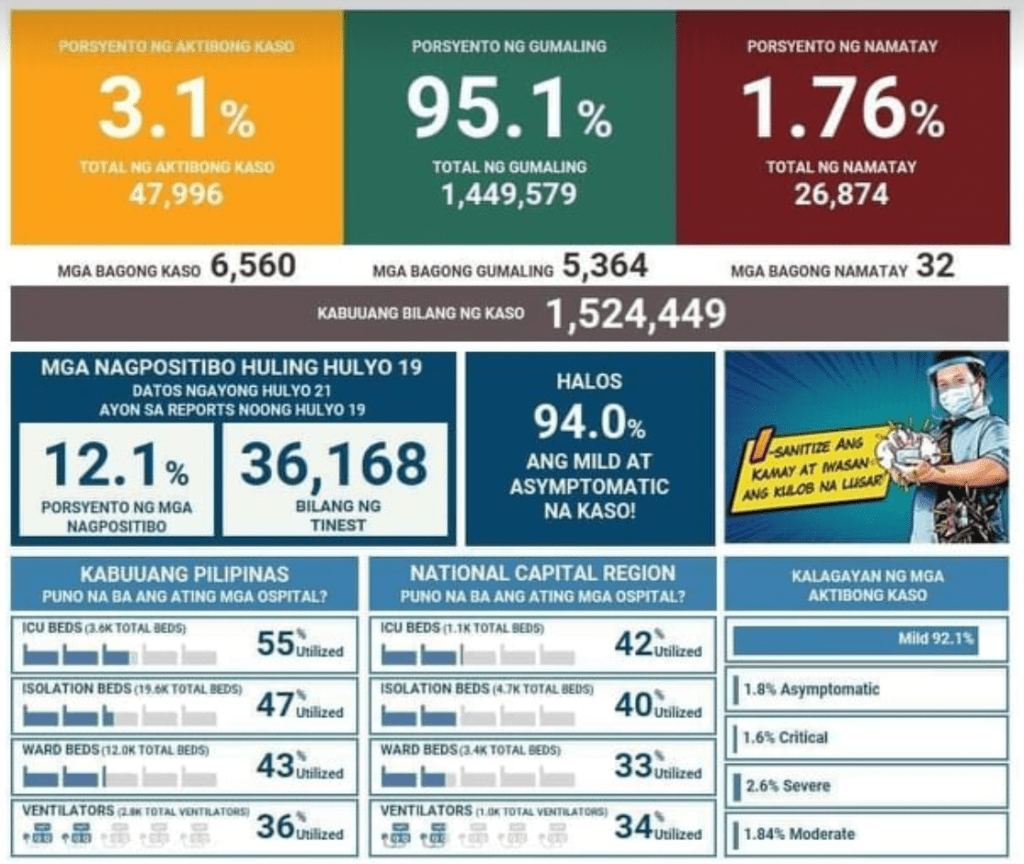
Are we on an upward swing with 6,560 new cases on 07.21.2021?

The usual trend for Wednesdays is slightly a fewer hundred cases from the Tuesday.

Today took a different turn. And that’s not a good sign. While the deaths are a low 32, they are not accurate as deaths are always reported late. The bothersome data is that the Health Agency announces 6,560 new cases for a Wednesday. This is based on 36,168 tests done last July 19 and a positivity rate up at more than 12%.

This is considering that 4 laboratories failed to submit data for July 19.

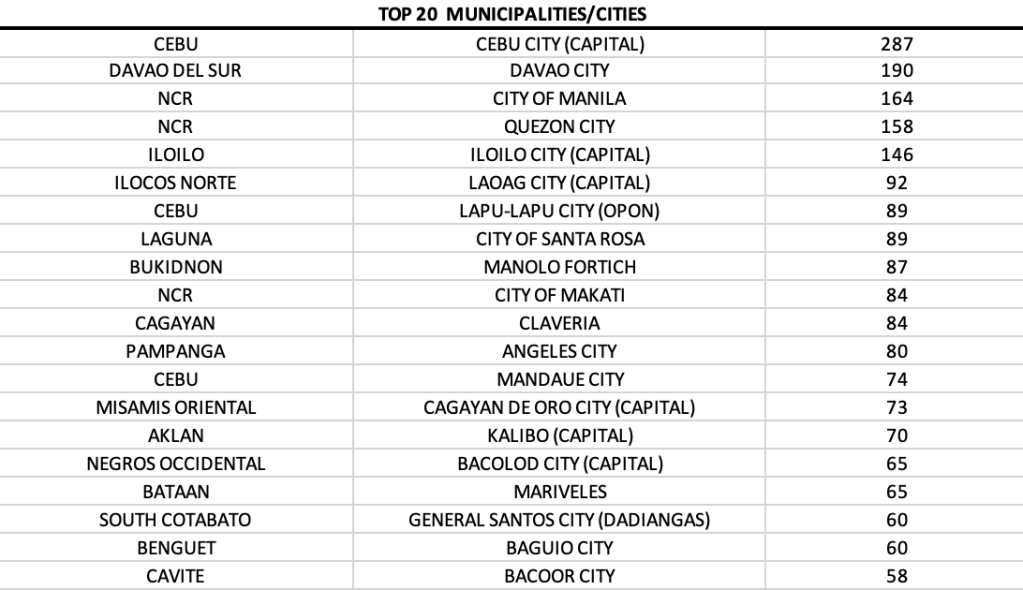
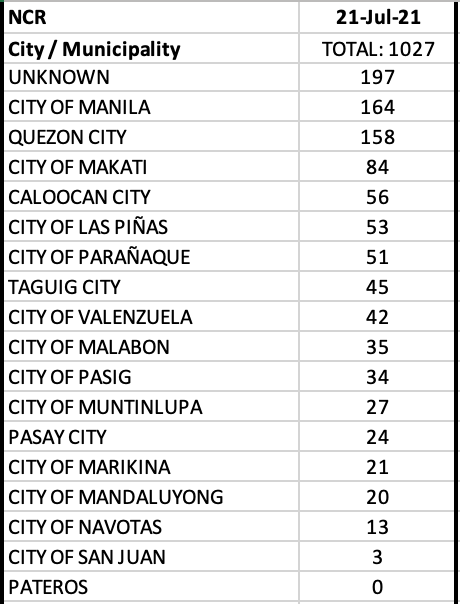
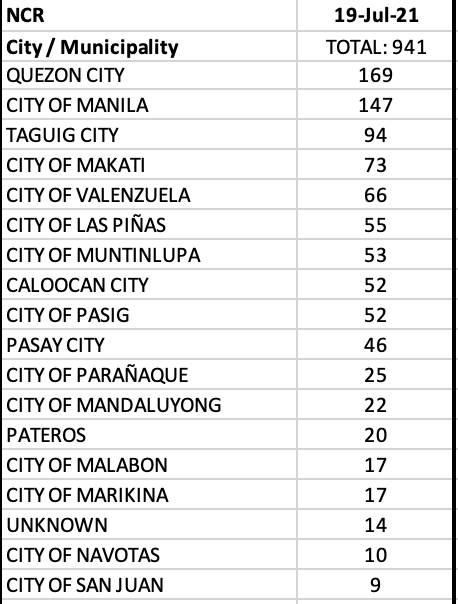
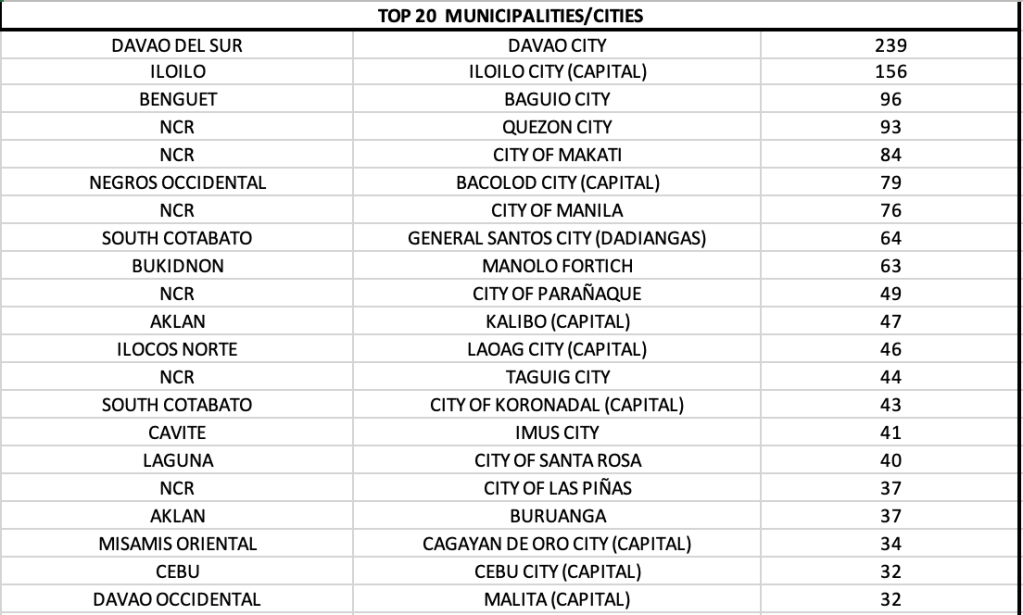
The NCR has breached the 1,000 mark again. But the sad part is that it’s a Wednesday, when cases are lower. And the reproduction rate is now at 1.15! But that’s not the story alone. There are 197 recorded cases but from unknown LGU in NCR. This time, the city of Manila led all cities in NCR followed by Quezon City. And only 3 of 17 LGUs in Mega Manila were in the top 20 LGUs with most cases in the country. Which means that the cases are increasing in many key areas.

CALABARZON, Central and Western Visayas and Central Luzon reported more than 700 cases!

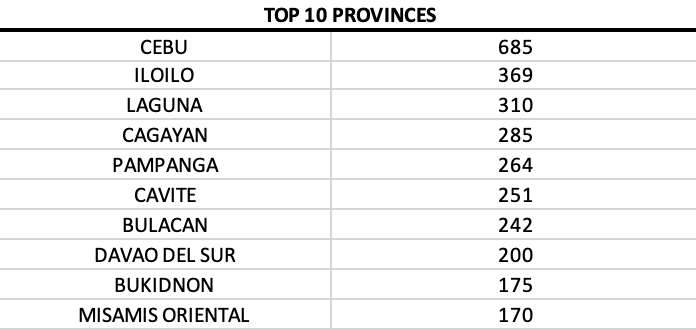
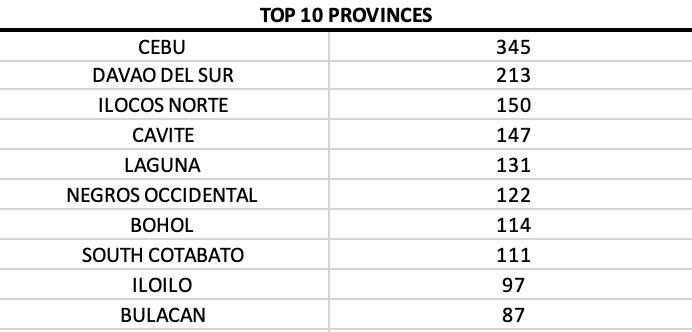
On a provincial level, Cebu topped the list with 685 new cases. This was higher than the combined cases of Iloilo province and Laguna, that came in second and third today.

And the city of Cebu has the most cases among all LGUs in the country for the day.

OCTA MONITORING REPORT

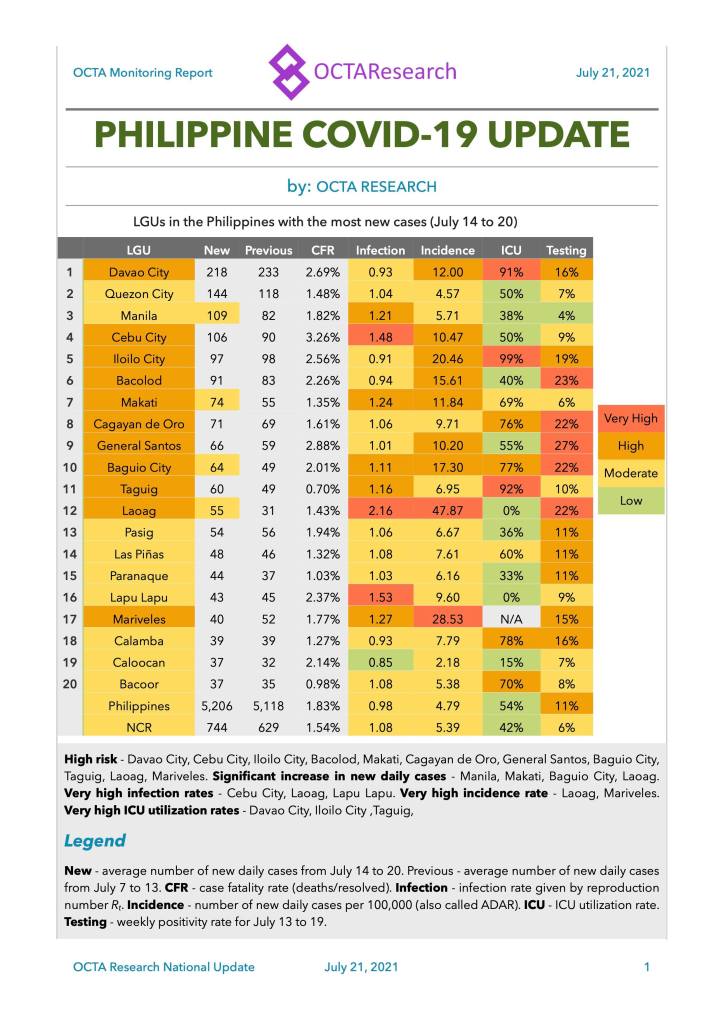
Notice the sudden rise in Rt nationally and the NCR. Rt in the Philippines is up at 0.98, while in Mega Manila, the Rt is up from 1.06 to 1.08 as of the data for July 14-20.

The following LGUs are considered high risk using the four indicators of infection (Rt), incidence (ADAR), ICU utilization rate, and positivity tests: Davao City, Cebu City, Iloilo City, Bacolod, Makati, Cagayan de Oro, General Santos, Baguio City, Taguig, Laoag, and Mariveles.

Based on the indicator for Rt, Laoag, Lapu Lapu City and Cebu City have very high infection rates.

Incidence is highest in Laoag at 47.87 per 100,000 population, followed by Mariveles with 28.53.

ICU occupancy is heaviest in Iloilo City at 99%, while it is at 92% in Taguig and 91% in Davao.

Finally, positivity rate is highest in General Santos at 27%, while the following LGUs have positivity rates that are more than 20% (1 out of 5 tested will likely test positive) – Bacolod, Cagayan de Oro, General Santos, Baguio City and Laoag.

Cases in the NCR are up and Rt=1.06 on 07.20.2021

You know that the reported cases are disturbing considering that the Health Agency is scrambling with how to deal on ‘gently’ breaking the news of the delta variant to the public. When the messaging is inconsistent over a 24 hour period, you cannot expect the public not be anxious.

But yes, Delta has landed. Even the Health Secretary has declared that we must act as if the variant is now in town.

Over the payday weekend, the business community recently enjoyed the brisk gains in Mega Manila with the shift to regular General Community Quarantine as observers noted open air malls filled up with children’s laughter and restaurants full of customer who wined and dined with gusto.

The last time we saw this scenario was Valentine’s Day this year. NCR was in regular GCQ. The vaccines had not yet arrived. But celebrations of love and romance permeated the tired citizens.

Two weeks later, the surge crept in. It took another two weeks to send the healthcare system in Mega Manila out of control.

A round of quarantines returned.

This time, however, the government decided to open up businesses while total new cases averaged 5000 daily in the country. In the NCR, children 5 years old and up are now allowed to enjoy open air activities.

In the midst of the Delta variant threatening a new surge, how will government balance this difficult act?

Businesses cannot afford another lockdown. Vaccines are arriving in trickles and we’re not jabbing them quick enough.

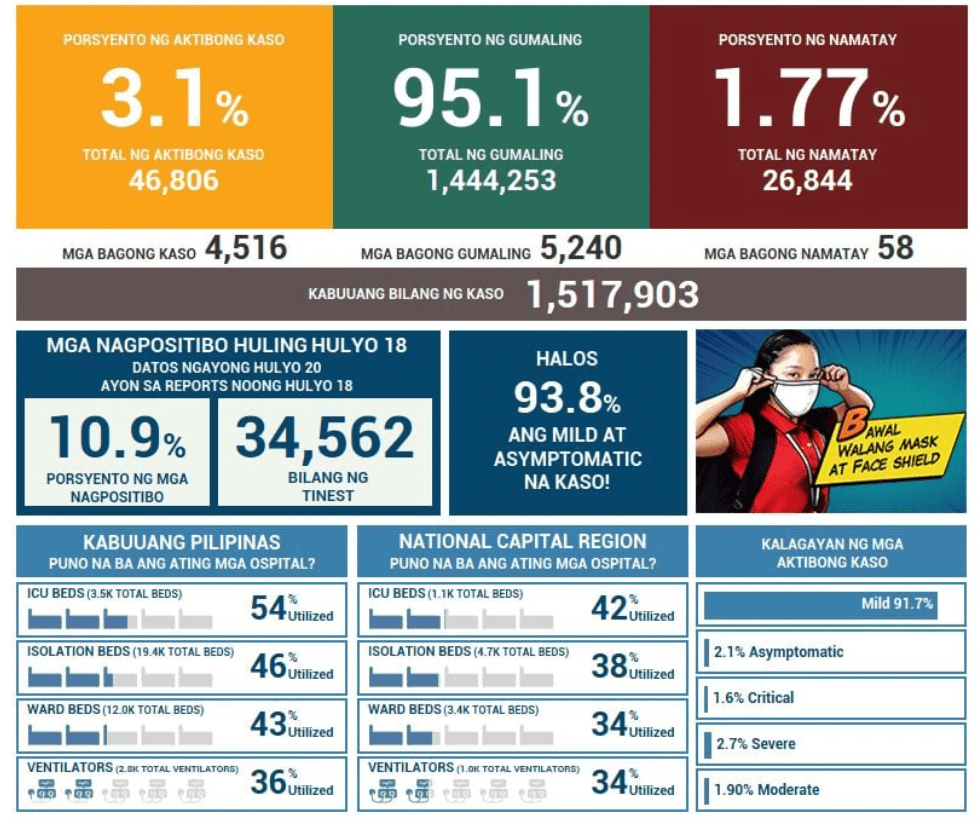
The Health Agency reports 4,516 new cases today. While it may seem lower than yesterday (because today is a Tuesday), this is relatively higher than the previous Tuesday. A little more than 34,000 tests with 10.9% positivity rate last July 18 are reported today.

An additional 58 new deaths were recorded, keeping the case fatality ratio steady at 1.83%.

On a low day, NCR is on top owning more than 15% of the total cases. While CALABARZON is in third, it is because Laguna seemed to not have submitted test results for the day as they suddenly disappear from the top ten provinces for the day. This accounts for Central Visayas being in second rank today.

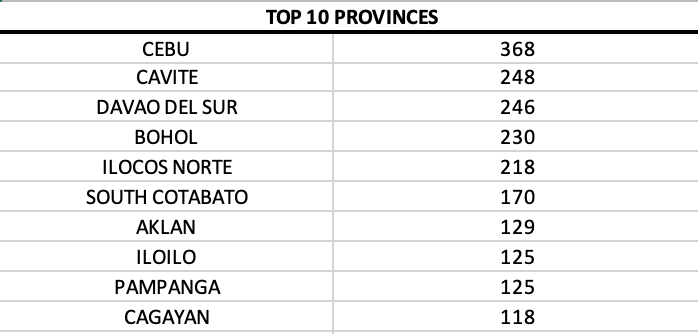
Cebu province led the day among provinces, followed by Cavite and Davao del Sur.

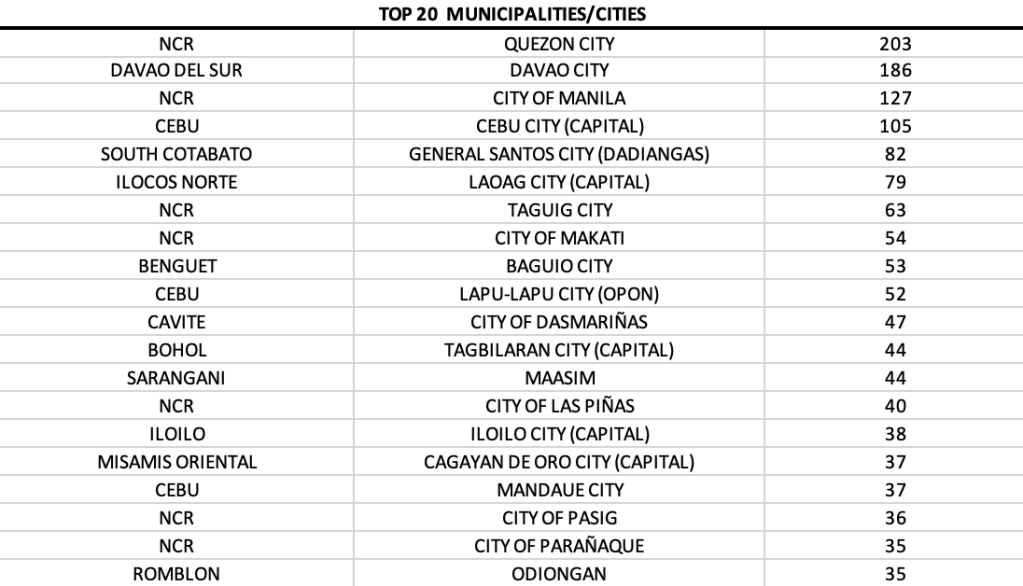
And Quezon City is back in the lead as the LGU with highest cases as it breaches the 200 mark once more. Seven of 17 LGUs in NCR are among the top 20 cities with most cases. Three key cities in Cebu are in the top ten as well.

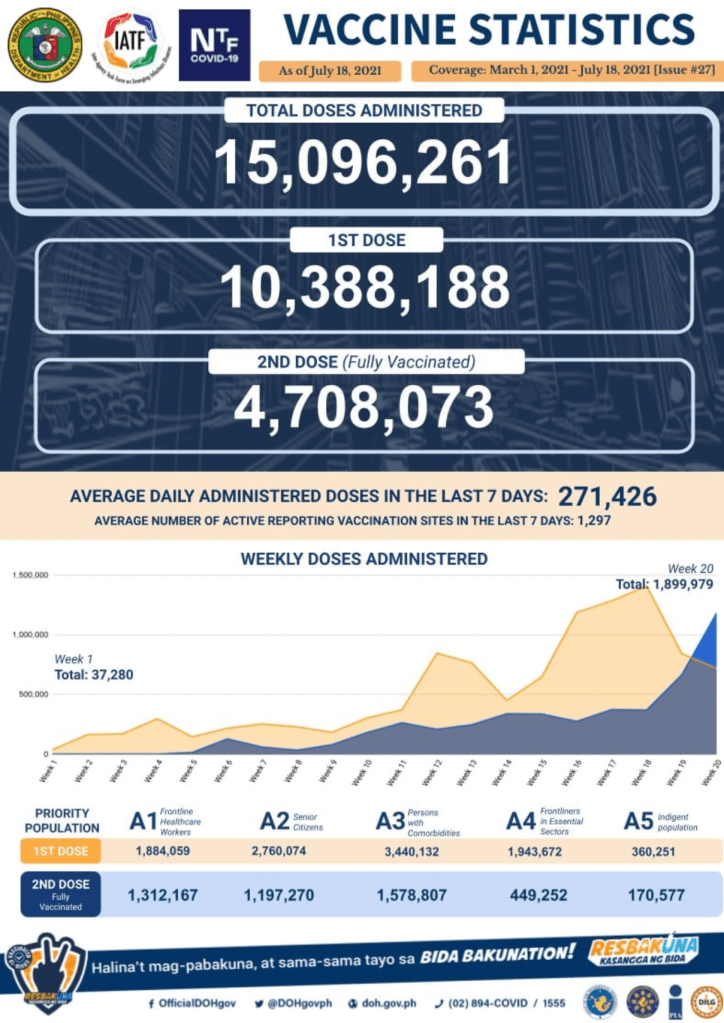
As of July 18, 2021, more than 15M doses of COVID vaccine have been administered. There are less than 5% of the population fully vaccinated. The infographic of the health agency below is inaccurate because it does not actually reveal the total population that should be vaccinated. It simply states how many frontline healthcare workers or A2 or A3 and so on down the line have been vaccinated with one or two doses. Which really does not provide the actual picture of how many in these sectors have been covered.

Example, there may be 2,700,000 health care workers that are front liners. Which means if only 1.3M are fully vaccinated, then less than 50% of the HCWs have been jabbed.

It also does not expound on how many percent in the various LGUs have been vaccinated. There are numerous complaints from citizens that there are no vaccines reaching their LGU when in fact they belong the to the bubble that needs to receive the vaccines first.

Hopefully, the agency should be able to address these issues because a storm is brewing.

And everyone needs to stay on top of the situation because the storm that is threatening us, will affect those that are also vaccinated.

OCTA MONITORING REPORT

NCR climbs back to top spot with a reproduction number higher than the national Rt (1.06 vs 0.95). And this is the first time it inches back above 1 since 3 months ago when the region was under the strictest quarantine.

Two cities in NCR are a cause of cancer – Makati and Manila. Manila had a growth rate of 35%, while Makati increased by 29%. Valenzuela, Pasay, Marikina and Parañaque had increases in new daily cases as well and Tagged has ICU utilization at 100%.

Based on the four indicators (Rt, ADAR, ICU and positive tests), the LGU with very high risk is Mariveles in Bataan. Those at high risk are: Davao City, Cebu City, Bacolod, Iloilo City, Makati, Cagayan de Oro, Baguio City, General Santos, Laoag, Lapu Lapu City and Butuan.

Note the jump in Rt of NCR to 1.06, higher than the national average and ADAR has breached 5. Positive tests are also up from <5% to 6%. The NCR is now classified as MODERATE risk. With a population of close to 14M and the most dense region in the country, it will only take two weeks to see a surge happen once more, particularly in the unvaccinated group.

Hopefully, the government does not wait for that to happen. Prior to the second surge, the warning bells were sounded off early. Someone listened to the economic managers first. The rest was history.

The question is – will history repeat itself?
Slight uptick in cases for 07.19.2021, but tomorrow is a Tuesday

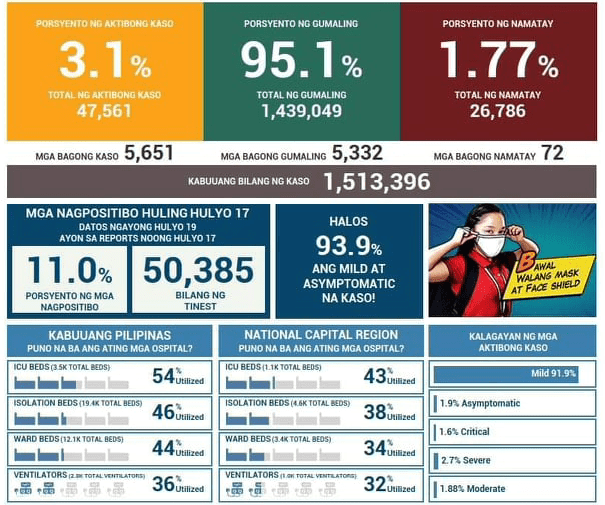
The 7 day average remains at around 5000 new cases/day. This, as the Health Agency announces 5,651 new cases for more than 50,000 tests done on July 17 and 6 laboratories failing to submit data. Positivity rate is at 11%. And active cases remain above 47,000.

With 72 new deaths, the case fatality ratio on outcomes stands at 1.83%.

The fluctuation in daily data and plateauing at this average for the past 2 months is troubling because it means that whatever measures are being instituted now may not be enough to bring the actual number of cases down. With increasing mobility and the government opening up the economy quicker than the new cases cases being reported sends mixed signals. For the nth time, these cases reported daily are based only on PCR tests. They do not include patients who test positive for swab antigen OR patients who do not get tested at all.

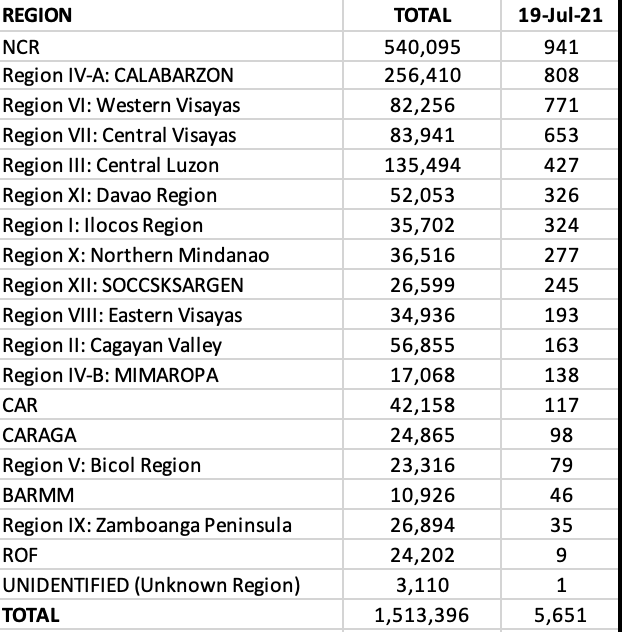
The NCR saw almost 1,000 new cases as the Rt moves quickly up to 1.02 from a previous of 0.94. The daily average in NCR tips at more than 700 cases a day compared to the previous 600 plus cases. And while it is CALBARZON that now trails NCR, Western and Central Visayas are third and fourth, respectively.

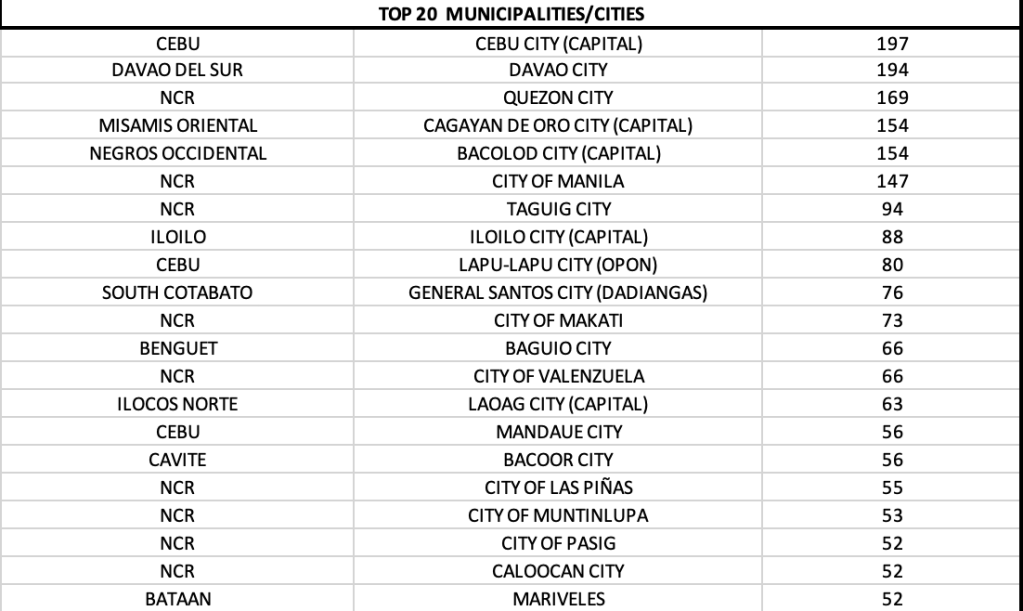
Cebu province tops the provincial tally with Cebu City topping the LGUs nationally. Davao City continues its decline and is now in second spot.

Nine of 17 LGUs in NCR are back in the top 20 cities with most cases. Three cities in Cebu were among the top twenty cities with most cases as well.

OCTA MONITORING REPORT

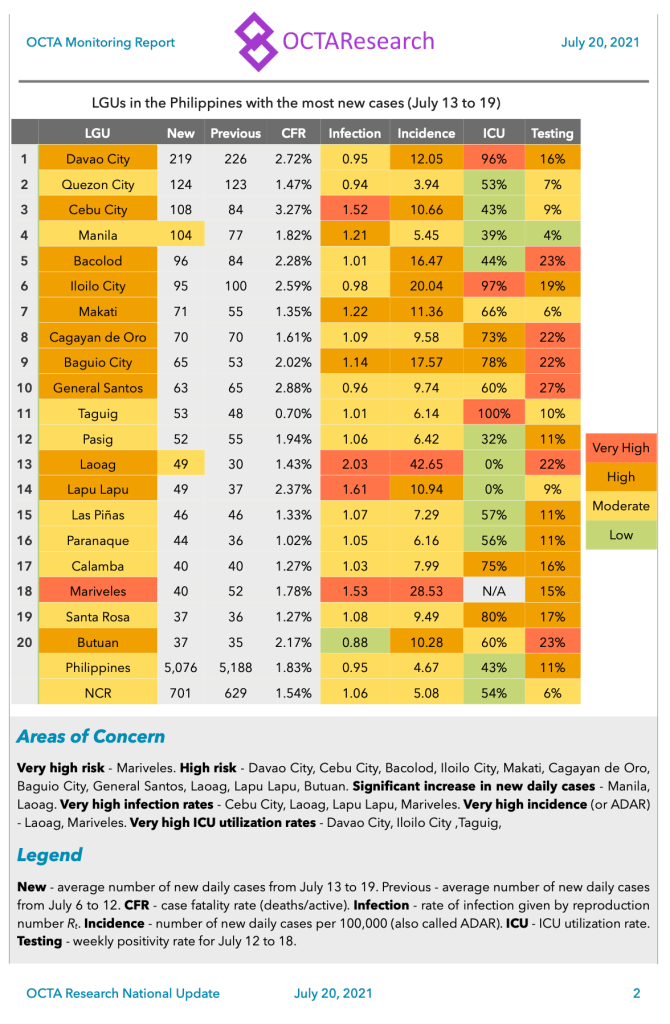
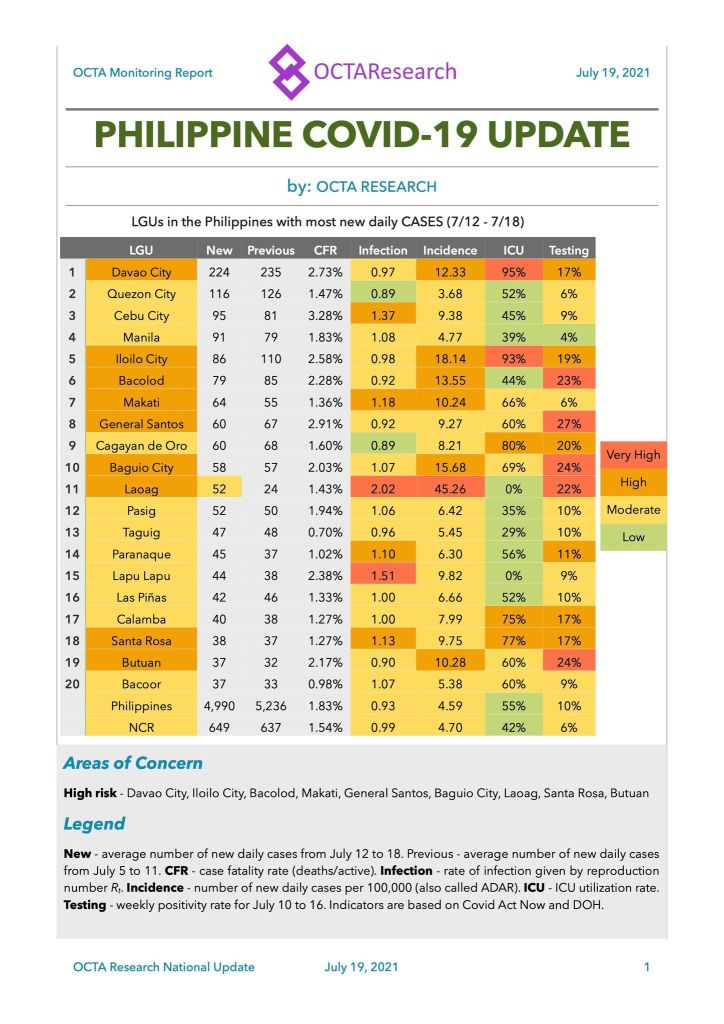
The update for July 12-18, 2021 is shown in the table below. Those in dark orange are areas of high risk based on the 4 indicators – infection (Rt), incidence (ADAR), ICU utilization rate, and positivity tests.

They are: Davao City, Iloilo City, Bacolod, Makati, General Santos, Baguio City, Laoag, Santa Rosa, and Butuan.

Among all the LGUs, Cebu City still owns the highest case fatality ratio based on outcomes, followed by General Santos City, and Davao City.

PH holds steady at 5K/day for 7-day average on 07.18.2021

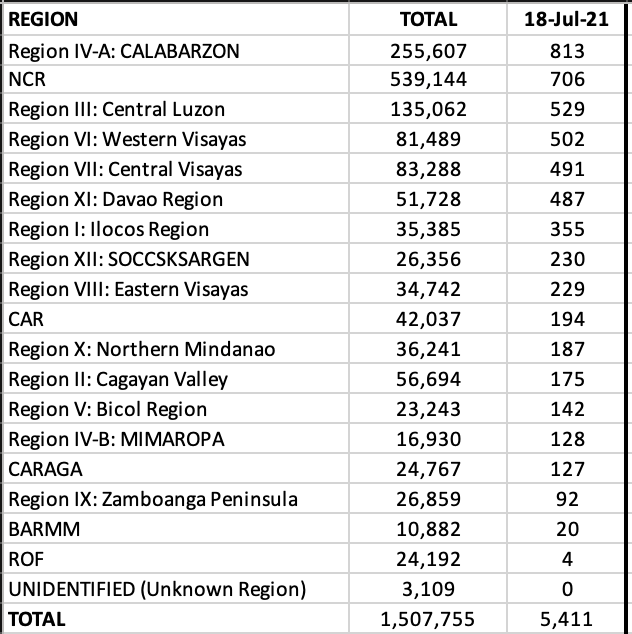
The Health Agency reports 5,411 new cases with 4 laboratories not submitting data on July 16 with more than 53,000 tests for a positivity rate of 10.2%. Active cases remain at more than 47,000.

New deaths reported at 117 for a case fatality ratio on outcomes steady at 1.83%.

CALABARZON, NCR, and Central Luzon are back in the top three today.

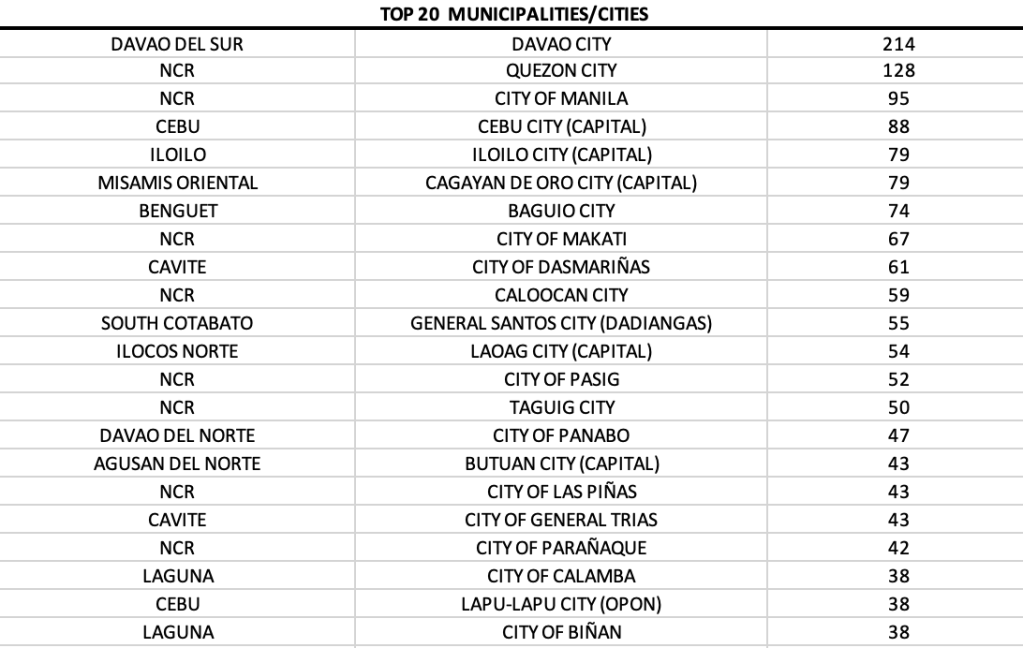
Laguna led the pack on a provincial level, while Davao City continued to have the most cases among all LGUs in the country.

Quezon City continued to lead all LGUs in NCR, while 8 of 17 LGUs from Mega Manila are among the top twenty cities with most cases for the day.

WEEK IN REVIEW

So how did we actually do from July 9-16, 2021?
On cases and deaths, the Philippines is taking a slow decline in cases with a 7-day average down to a tad less than 5,000 new cases daily. The deaths on the other hand are reported erratically, but average 108 new deaths/day during this period.

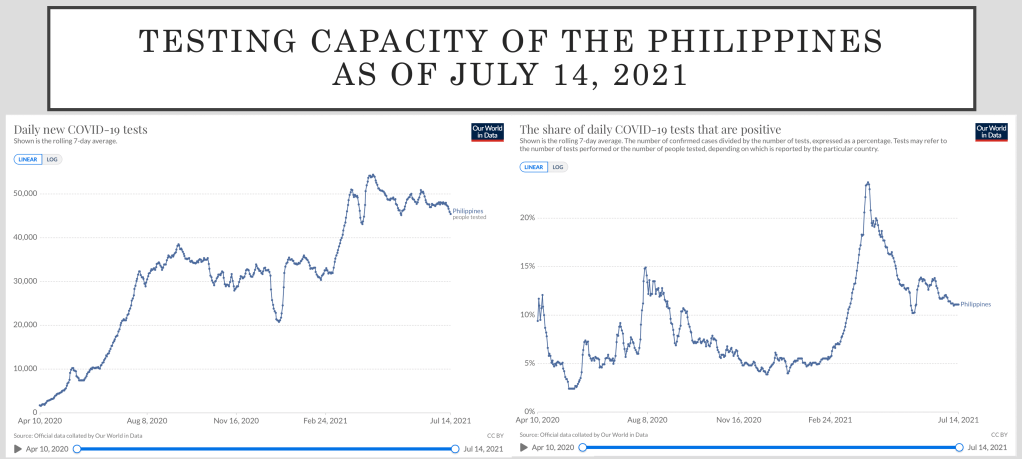
Testing capacity relatively dips (notice that is the 7-day average) as the positivity rate sees a slight decline to an average of 11%. This is still high as other provinces and LGUs outside of NCR plus are unable to test, trace and isolate properly. I cannot overemphasize that the five pillars of Testing, Tracing, Isolating, Quarantining, and Vaccinating (TTIQV) should remain the solid foundation of resilience during the pandemic.

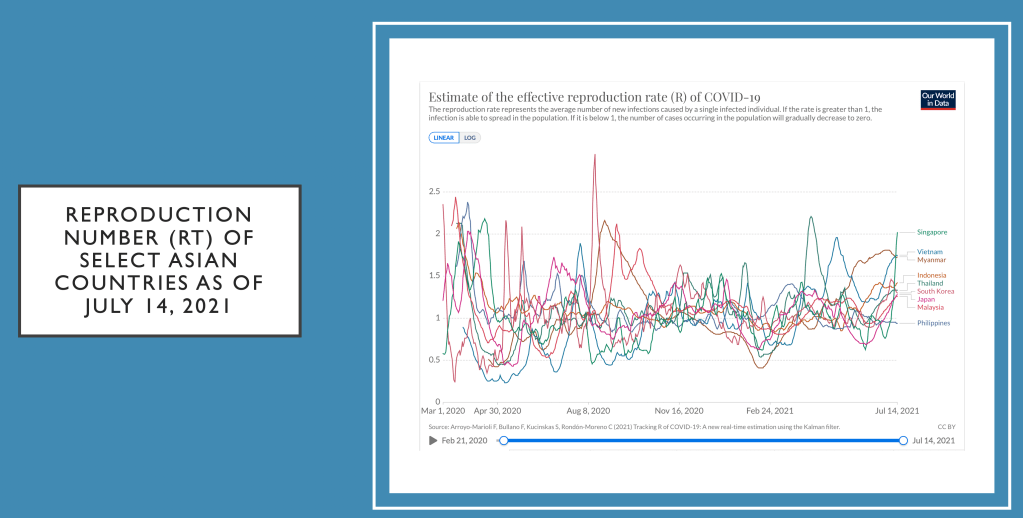
The rest of Asia (let’s not get to the world for now) is suffering a beating in this surge. Reproduction rate is highest in Singapore at 2.0 among the ASEAN nations. While they may have lower cases, they have fewer people as well, with a population barely 1/2 that of Mega Manila. As seen in the graph below, the Philippines has the lowest reproduction rate at 0.94. But this should be interpreted as both good and bad.

It is good that our Rt is less than 1.0, but we need to work on bringing this lower to 0.5. Yes, 0.5. For 4 consecutive weeks in all regions. That’s the only way we will bring the numbers back to pre-surge levels. The bad news is that with new cases still averaging at least 5,000 per day, any slight upward movement of the reproduction number will be devastating to our healthcare system.

So here is where select Asian countries stand as of July 16, 2021. We’re the only nation in the list below seeing a downward trend. Taiwan, incidentally has done an excellent job at bringing their Rt dramatically to 0.5 in less than 6 weeks. Our problem will always be the discrepancy on how we test and trace depending on the capacity of the LGU.

OCTA MONITORING REPORT

Updated as of July 18, 2021 (for the period July 11-17), Mariveles (Bataan) is the LGU at highest risk in the country based on the 4 indicators of infection (Rt), incidence (average daily attack rate or ADAR), ICUUR (intensive care unit utility rate) and positive tests.

Those that are high risk are: Davao City, Iloilo City, Bacolod City, General Santos City, Baguio City, Lapu Lapu City, Laoag City and Santa Rosa (Laguna).

That third dose

While first world nations are talking about the third dose or ‘booster’ shots for COVID-19, the sobering truth is a painful one. As of July 16, while 1/4 of the citizens of the world have received at least a dose of COVID-19 vaccine, only 1% of people in low-income countries have received at least a dose.

Based on the data of the Department of Health, as of July 11, the Philippines has more than 3.6M people who are fully vaccinated. That’s roughly around 3.6% of the population or more than 5% of the eligible people who can get vaccinated so far.

It’s not that we’re primarily hesitant at getting vaccinated. While initial surveys before the arrival of vaccines and the second surge showed a larger majority being hesitant to getting a jab, the tides have significantly turned. Many are now willing to get vaccinated but remain wary about side effects. Given the opportunity though, there are more people willing to get their COVID-19 shots than those who don’t. The problem is a matter of supply. We really don’t have enough to go around for now. Hence, the strategy is to address areas that are at highest risk, and then cascade downwards to LGUs that have very few (if at all) COVID-19 cases. With 7,641 islands in this archipelago, rolling out a vaccination program of this magnitude is truly a logistically challenging one.

The great divide in a third world nation like ours is not the availability of the vaccine alone. Equity in access to vaccines is highlighted in the global stage. Poorer nations scramble at vaccines while the richer ones talk about boosters and those extra jabs, as nations that have begun reopening after vaccinating a large majority of their population begin to feel the pinch of having to go back to lockdowns because of variants of concern washing up on their shores.

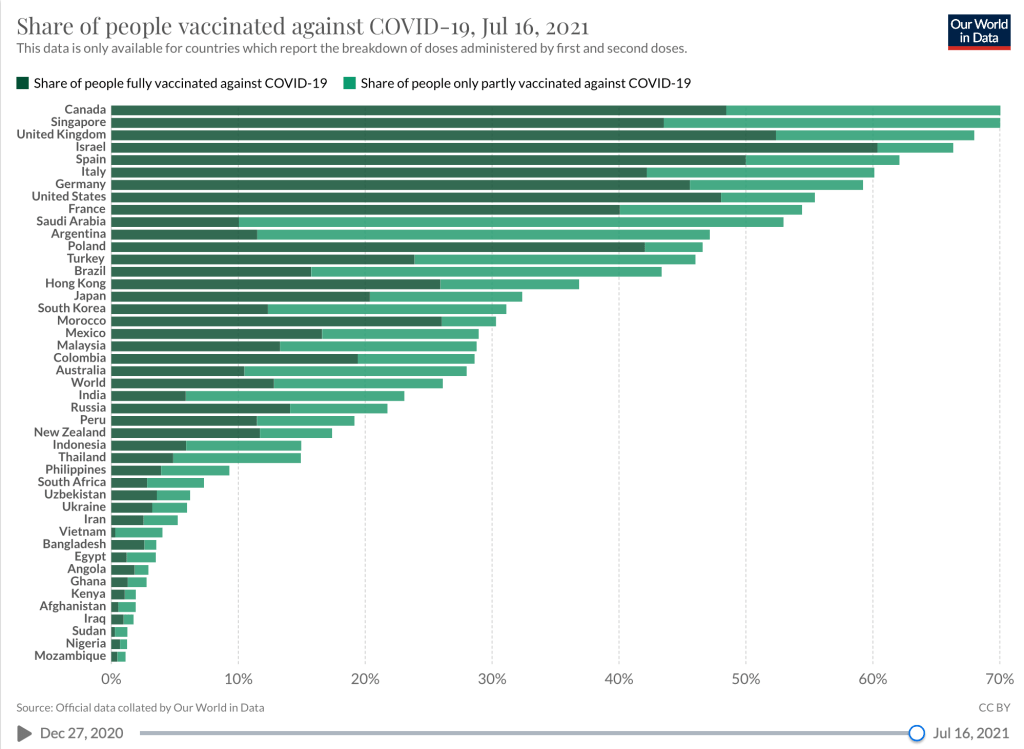
Our World in Data https://ourworldindata.org/covid-vaccinations tracks the vaccine roll out in most of the countries that have been able to vaccinate against COVID-19. The graph below elaborates how wealthier nations are able to jump start way ahead of the rest of the other countries when it comes to vaccine access. Some countries are able to achieve higher vaccination rates because they happen to have smaller populations. Singapore for example has a population of less than 6M – barely 40% of the total population of Mega Manila. Combining the populations of both Singapore and Israel is barely 80% of the population of NCR plus CALABARZON. Aside from the fact therefore, that most of these countries are awash with cash, they have a smaller population to care for during the pandemic.

As the variants evolve, every nation becomes vulnerable to getting reinfections or infections because no vaccine really affords 100% protection. Nevertheless, not all vaccines are created equal and because of that, some nations will need to settle for whatever vaccine is available to them.

Every country is a microcosm of the global picture. While third world nations like ours have more poor people, there is also the elite class comprised of entrepreneurs, businessmen, moguls and a hefty bunch of politicians. A large proportion of the elite are able to access everything better – from the food on the table, to the shot in the arm.

As the pandemic moves closer to the end of the second year since it began in December 2019, some nations that have been able to stave off the impact of this crisis on their economies at the start are now feeling the brunt of surges that disable the healthcare system of nations. With a collapse in the healthcare is a concomitant crumbling of their economies. Resiliency at a time of crisis is tested in how prepared a nation is when they face the worst during a disaster.

With vaccines against SARS-CoV-2 now available, access to it is the challenge. And talk about getting booster doses or a better vaccine as an extra jab are the tattle in social media, mostly prompted by vaccine manufacturers as they sadly take advantage of the pandemic in order to gain headway for profit.

The bottomline is – as of this writing, the jury is still out on whether we will need boosters and whether that third jab will work at addressing additional surges and the variants of concern.

What science does tell us, is that variants evolve during outbreaks and the major driver is a surge. The answer for now is to provide the rest of the world equal access to vaccines, so that the greater majority of their population can be protected. Doing that will minimize the evolution of mutations and variants of interest or concern in the future.

At the end of the day, we realize one thing. It is difficult and arduous to be poor.

Because beggars can’t be choosers.

Passed the 1.5M mark for reported COVID-19 cases on 07.17.2021

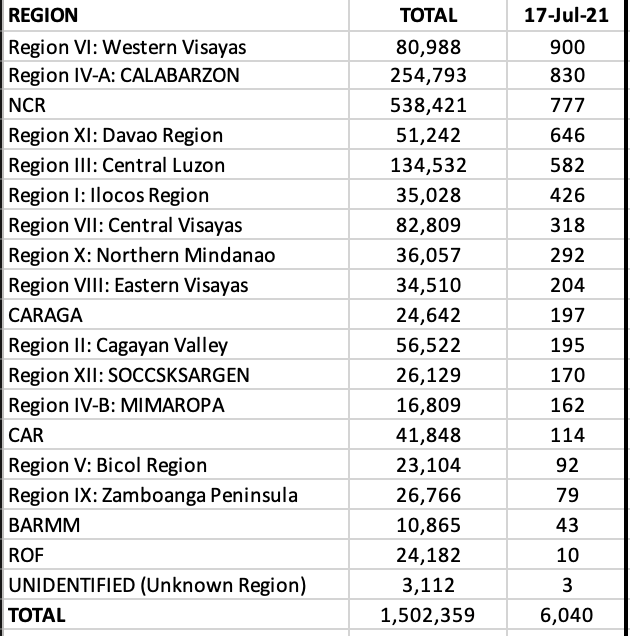
With 6,040 new cases, the Philippines officially passes the 1.5M mark for reported COVID-19 cases. Today’s data is based on more than 52,000 tests done with 10.7% positivity rate for July 15. Note that these are only the reported cases where RT-PCR testing is performed, hence documented.

The active cases remain high at more than 47,000.

Total deaths reported today is 122, placing the case fatality ratio for outcomes steady at 1.83%.

While we may be performing a tad better than many of our Asian neighbors, we need to make sure that we keep the numbers really lower. Vaccine roll out is not fast and broad enough. In addition, heavily congested cities are more than eager to allow economic revival roll sooner than later. Finally, the presence of the Delta variant in the ASEAN region and in the country is threatening to disrupt both the healthcare system and the economy (again) if we become too complacent.

Western Visayas is back on top with 900 new cases today, followed by CALABARZON and NCR.

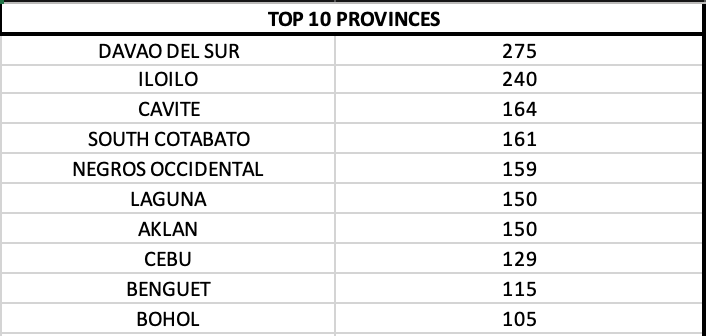
In a provincial level, it is Davao del Sur that ranked first with two provinces in Western Visayas rounding up the second and third spots – Iloilo Province and Negros Occidental.

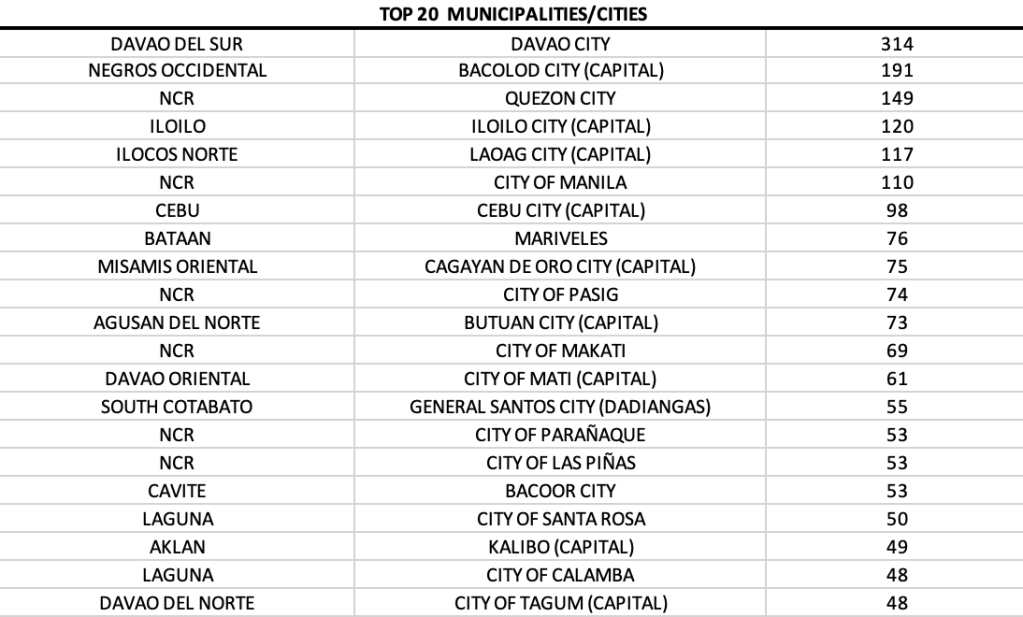
It is no surprise that Davao City came on top among LGUs with 314 new cases. In the top five LGUs with most cases for the day were: Bacolod City, Quezon City, Iloilo City and Laoag City. Nine capital cities in the country were among the top twenty cities with most cases. Six of 17 LGUs in NCR were in the top twenty as well.

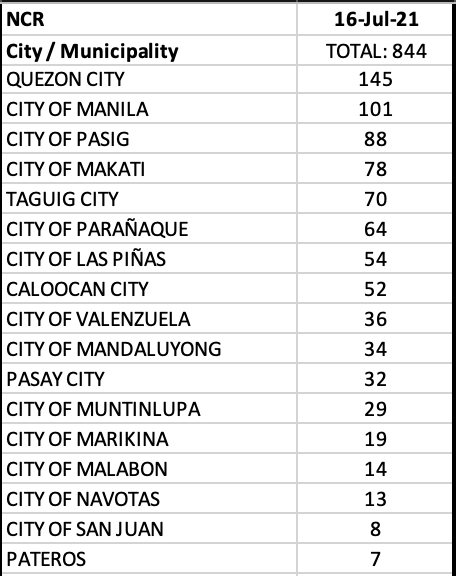
In Mega Manila, both Quezon City and Manila reported triple digits for the day.

OCTA MONITORING REPORT

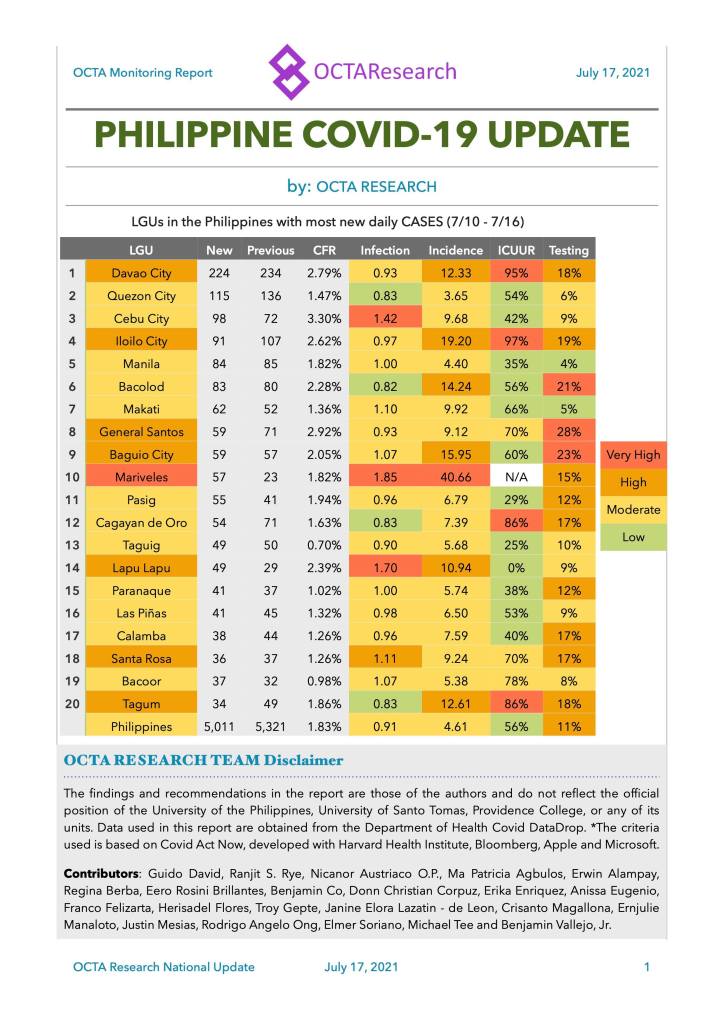
From the latest update of the OCTA Research, for the week of July 10-16, below are the top twenty LGUs with the highest cases. Mariveles, Bataan is classified very high risk over-all. Davao City, Iloilo City, General Santos, Baguio City, Lapu Lapu City, Santa Rosa (Laguna), and Tagum are high risk LGUs.

Based on the 4 indicators of infection, incidence, ICU utilization rate and testing, Mariveles, Lapu-Lapu and Cebu City have the highest Rt. The ADAR or incidence rate is highest also in Mariveles, while ICUUR is highest in Iloilo City, Davao City, Cagayan de Oro and Tagum.

Positivity rate from testing is extremely high in General Santos (28%), Baguio City (23%), and Bacolod (21%). Testing in these areas in insufficient and means that 1 out of every 4 to 5 people tested in this locality will most likely test positive.

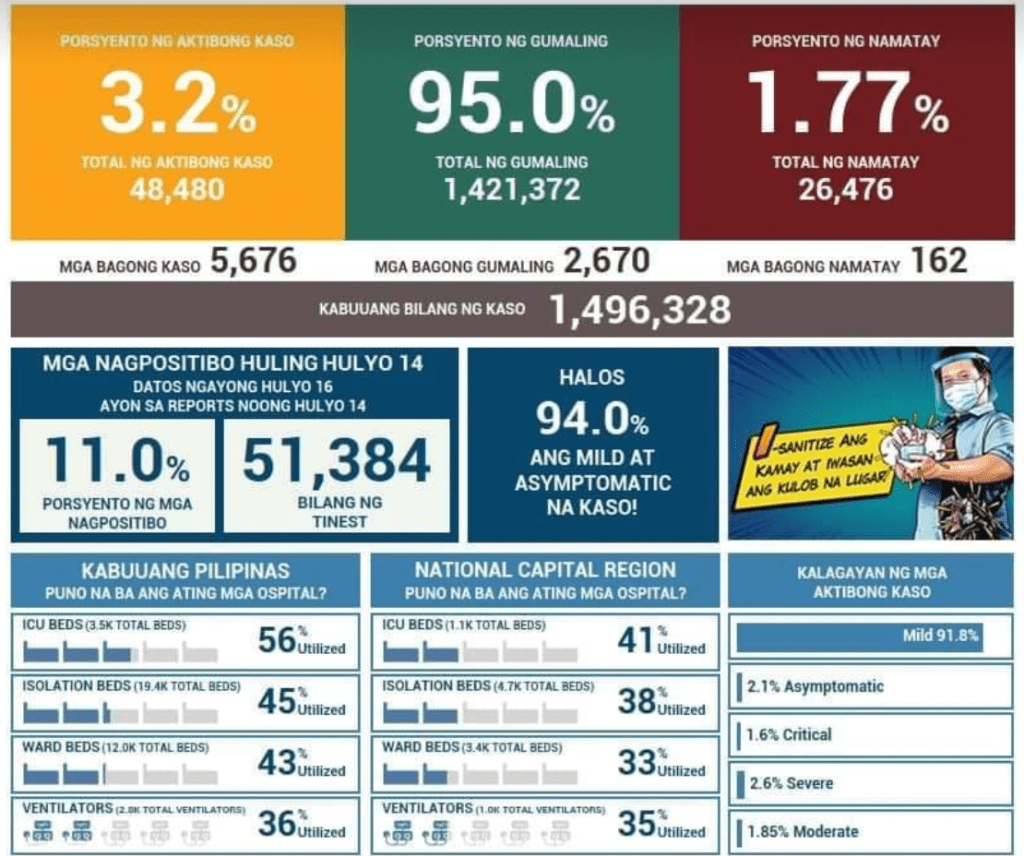
With Delta Virus now spotted in the PH and a local transmission, the data on 07.16.2021 is unsettling

The Health Agency reports 5,676 new cases from the over 51,000 tests done last July 14 with 11% positivity rate. With less recoveries today (it’s a Friday so you will see less recoveries), the active cases are up at near 50K again. The total number of cases are a shy away from the next 1.5M mark, which we will surely surpass tomorrow.

There were 162 deaths reported as well. This brings the case fatality ratio for outcomes to 1.83% today.

The original triumvirate CALABARZON, NCR and Central Luzon are back in the lead, with NCR raking in close to 15% of the total new cases for the day.

Among provinces, Cebu province ranked first, followed by Laguna and Davao del Sur.

Davao City continued to lead on an LGU level. This is followed by Quezon City, Cebu City, City of Manila and Iloilo City in sequence. Eight of 17 LGUs in NCR landed in the top twenty cities with most cases.

In Mega Manila, Quezon City and Manila reported triple digits, while the rest saw a slight increase in cases per LGU.

Back to more than 5K on 07.15.2021

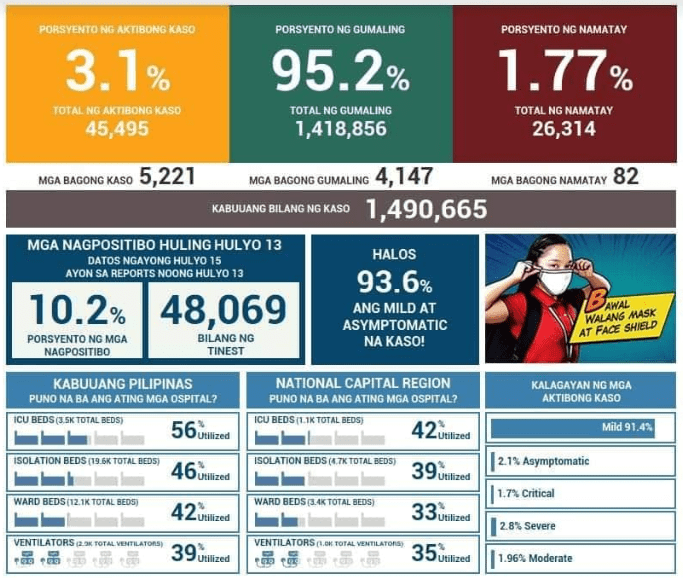
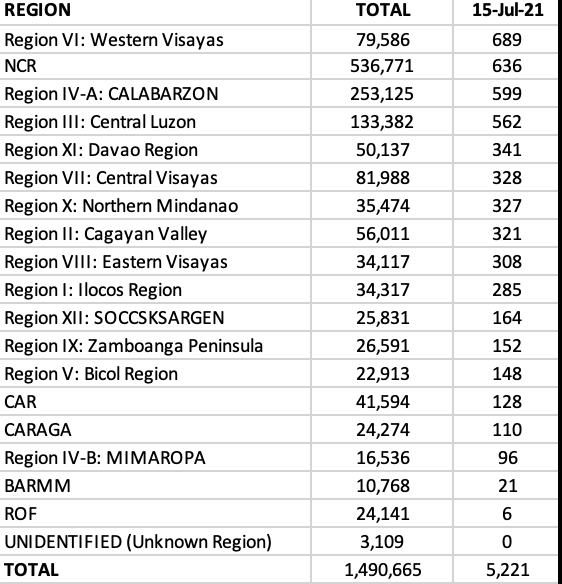
After the Tuesday and Wednesday reprieve where we enjoyed lower daily cases, the Health Agency reports 5,221 new cases today based on over 48K tests done last July 13 with a 10.2% positivity rate. The active cases exceeds 45,000 today, as more new cases than recoveries are announced.

With 82 new deaths, the case fatality ratio for outcomes is steady at 1.82%.

Western Visayas and NCR take the lead once more, as the cases in Davao Region see a significant decline. Except for MIMAROPA and BARMM, all the other regions continue to report triple digits.

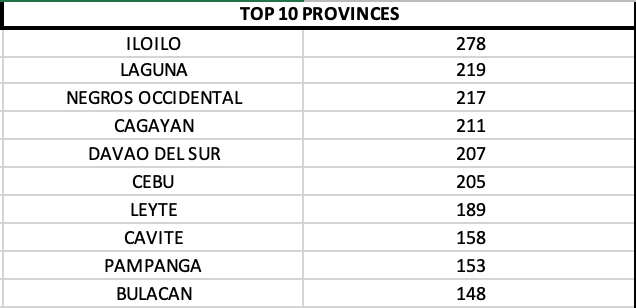
Iloilo province, Laguna and Negros Occidental are the provinces with most new cases.

While Davao City remains the LGU to beat, its declining cases will most likely have Quezon City back in saddle as the city to beat in the country. All major cities in the country are among the top five LGUs with most cases. In third to fifth are: Cebu City, Bacolod City and Iloilo City.

Quezon City remains the city with most new cases in NCR and is the only one with triple digits for the day. Six of 17 LGUs in Mega Manila are among the top 20 cities with most cases in the country.

OCTA Monitoring Report

Based on data from July 8-July 14, there are red flags among the four indicators for seeing how well select LGUs seeing high number of cases in the country are doing. For example, Mariveles in Bataan is flagged for having the highest Rt = 2.23, ADAR of 37.09 (per 100,000 population) and a positive testing rate of 15%.

Baguio City has a positivity rate of 23% and General Santos’ positive rate is the highest in the country at 27%.

ICU utilization rate is highest in Santa Rosa Laguna at 97%, followed by Iloilo City at 94%. Davao City is doing fairly better this week compared the past months.

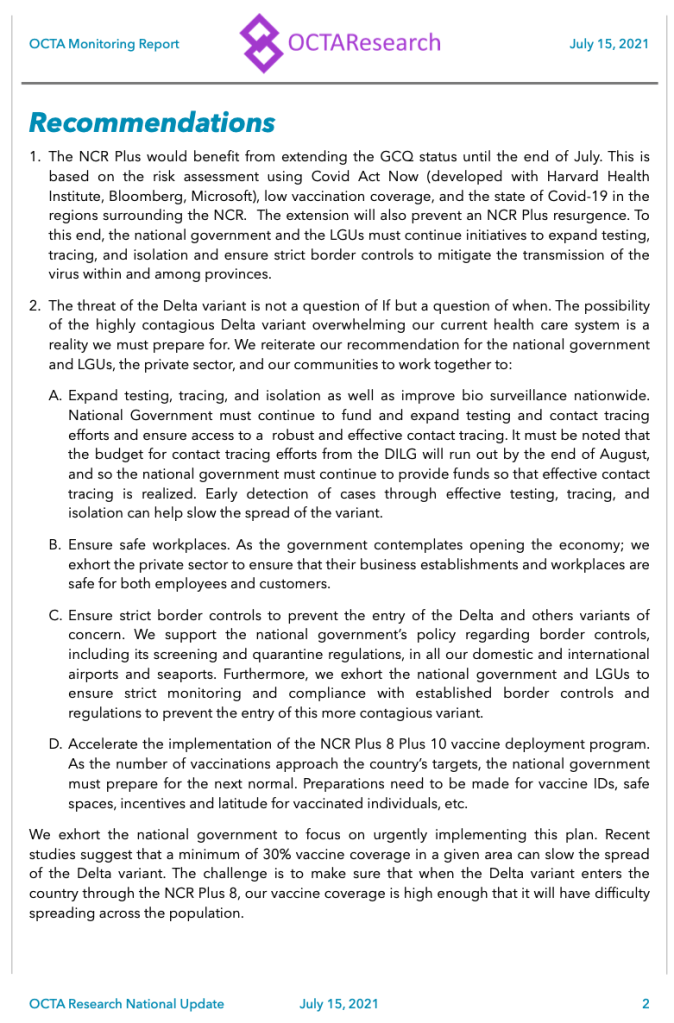
The full report and recommendations below:

As our Asian neighbors see a rise in cases, how are we doing? On 07.14.2021

Because it is a Wednesday, we are a few cases more than the Tuesdays.

The Health Agency announces 3,806 new cases based on close to 32,000 tests done on July 12 with a positivity rate of 11%, still high by any standard. In the NCR, the positivity rate is at 6%, but the national positivity rate is being pulled up because of other provinces and regions.

With more recoveries than new cases, the number of active cases is down to less than 45,000.

New deaths announced today is 140, placing the case fatality ratio for outcomes steady at 1.82%. With a 7-day average of 5,000/day, will we reach the 1.5M milestone by the weekend?

Suddenly Central Visayas has a significant drop in cases. NCR accounted for more than 14% of the total cases.

The daily data is not a true reflection of what is happening on a day to day basis as this reflects the testing and submission of tests within the region (or province or LGU).

Davao del Sur, Iloilo province and Cavite were the top contributors on a provincial level.

Davao City stayed on top with less cases among top twenty LGUs for the day.

And in NCR, Quezon City continued to lead. However, the cases in the NCR were in the double digit and single digit margin.

OCTA MONITORING REPORT

In yesterday’s blog, it was pointed out that in spite of the low number of cases (because it was a Tuesday), Central Visayas suddenly found itself in the top spot. Whether this is because of improved testing and contact tracing, some perspective should be taken with the increase of cases in this region.

To recapitulate yesterday’s data, Central Visayas was the top region, Cebu province was the top province and three cities in Cebu were in the top ten – Cebu City, Lapu Lapu City and Mandate City. These three cities accounted for close to 250 of the new cases in the province alone.

The OCTA report today shows the sudden increase in infection rate for Cebu City (Rt=1.49) and Lapu Lapu City (Rt=1.96). Mariveles is seeing the highest Rt at 2.26 (remember it was number 1 among LGUs a few days ago). In spite of the higher infection rates in Cebu, their ICU utilization rates remain relative low and positivity test is less than the national positivity rate of 11%. As the DOH-Region VII office notes a ‘third wave’, we continue to monitor closely the situation in Cebu and leave to the local government there on how to utilize the information provided here.

The full report below:

Elsewhere in the world, are our next door neighbors. Indonesia suddenly has the most cases in a day yesterday and passes other countries seeing higher cases like Spain and the UK. Not in the table below are the others who made it to the top twenty – Malaysia and Thailand. And as our neighboring ASEAN nations are experiencing the difficult surges, how do we treat our border entries for those coming from these countries?

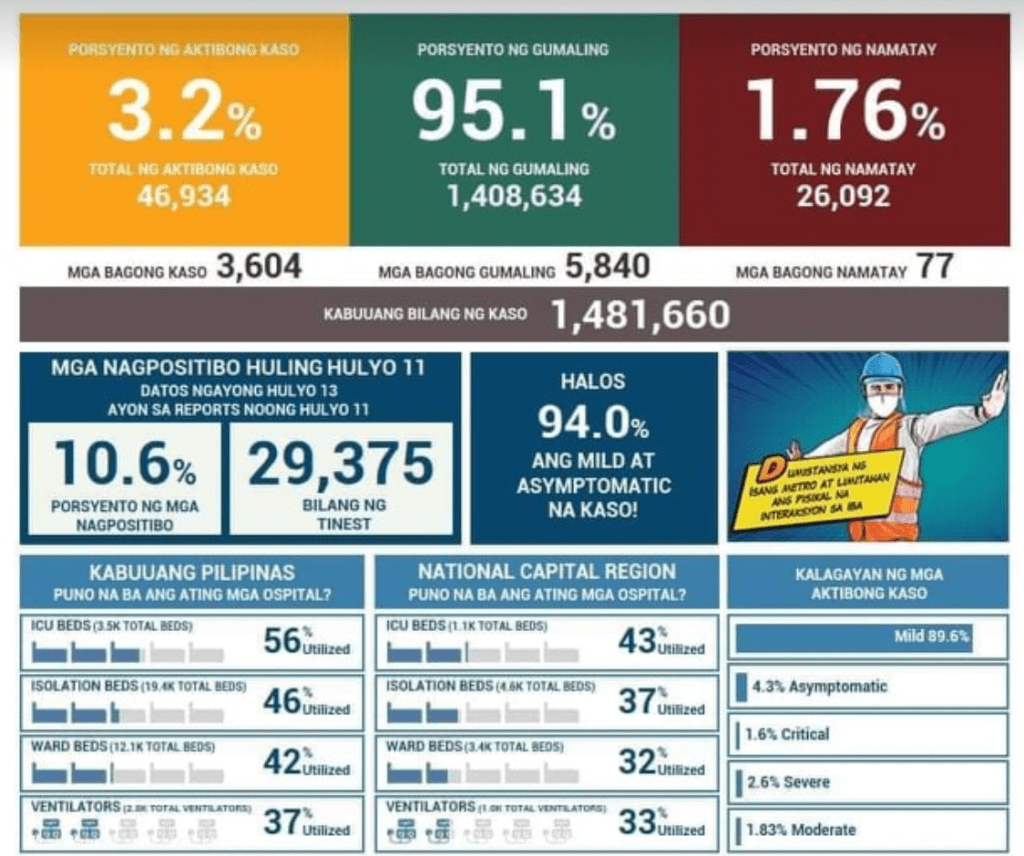
Lower new cases at 3,604 for 07.13.2021

Based on the Health Agency report for the day, the Philippines records lower cases based on close to 30,000 tests done last July 11, a Sunday. Positivity rate is still above 10%. With more new recoveries than new cases, the active cases are now at close to 47,000.

Seventy seven new deaths announced today make the case fatality ratio for outcomes remain at 1.82%.

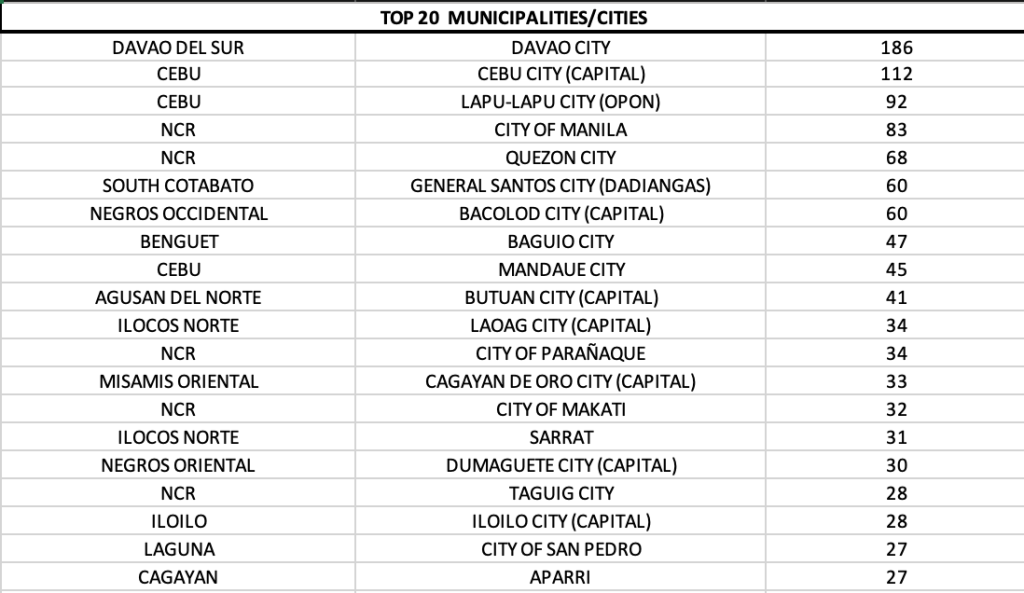
The low cases on a Tuesday came as a shocker for one region – Central Visayas – taking the lead away from NCR plus. It led not only by region, but Cebu province was number one among the top ten provinces. Cebu City, the crown jewel in the south came in second among all LGUs in the country.

The province of Cebu had three cities in the top ten – Cebu City, Lapu-Lapu City and Mandaue City.

Davao City remained in the lead among LGUs, while NCR saw all it’s LGUs reporting double digit cases. The City of Manila had the highest number of cases in Mega Manila for the day. Five of 17 LGUs in NCR were among the top twenty cities today.

The region to watch is Ilocos Region, which saw a significant rise in cases and in ranking among regions.

OCTA MONITORING REPORT UPDATE

The OCTA Monitoring Report for July 13 spotlights on the cases in the National Capital Region. With a steady trend of 634 new cases per day for the period July 6-12, this is a tiny bit lower than the previous week’s average. The Rt is at 0.93 and inches up a bit as well.. Using the ADAR (average daily attack rate or incidence rate), NCR overall has 4.59 per 100,000 daily. Positivity rate is still at 6%.

Cities that are seeing more than 5 per 100,000 daily are Parañaque, Taguig, Pasay, Mandaluyong, Muntinlupa, Pasig, Las Piñas, San Juan and Makati.