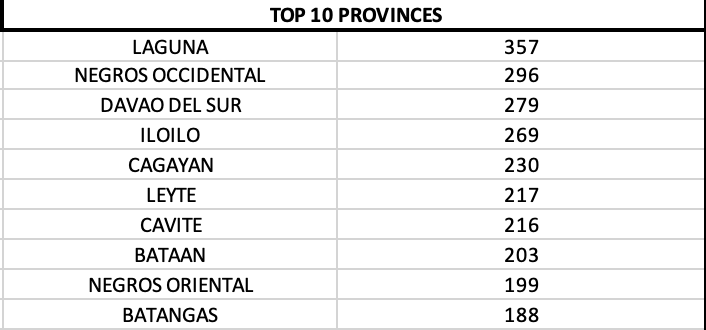
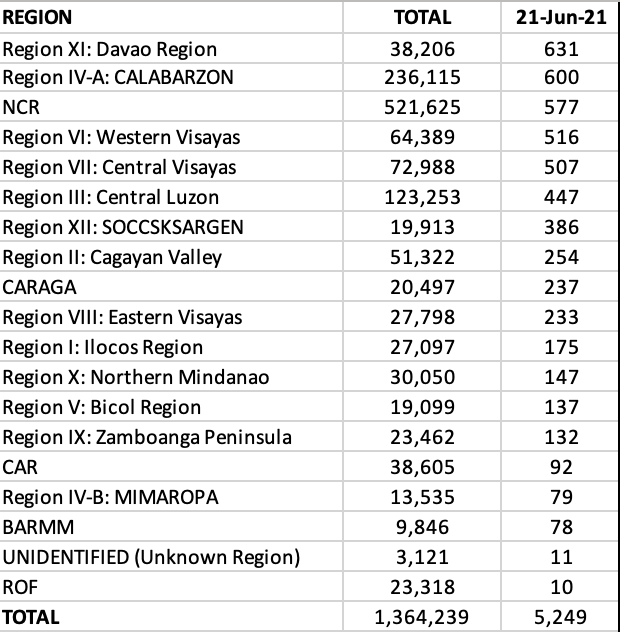
With 3 laboratories not submitting reports for June 25 with almost 48,000 tests and 12% positivity rate, the Health Agency reports 6,096 new cases. In spite of more recoveries, the number of active cases are still above 50,000. We are a little more than 2,000 cases to breach 14M total COVID-19 cases.
There were 128 new deaths reported today and the case fatality ratio is still 1.81%.
While CALABARZON is back in the lead, NCR’s numbers are up from a previous of 10% to 12.3%. Does the vaccine rollout make people more complacent? Western Visayas and Davao Region continue to report high numbers in their respective regions.
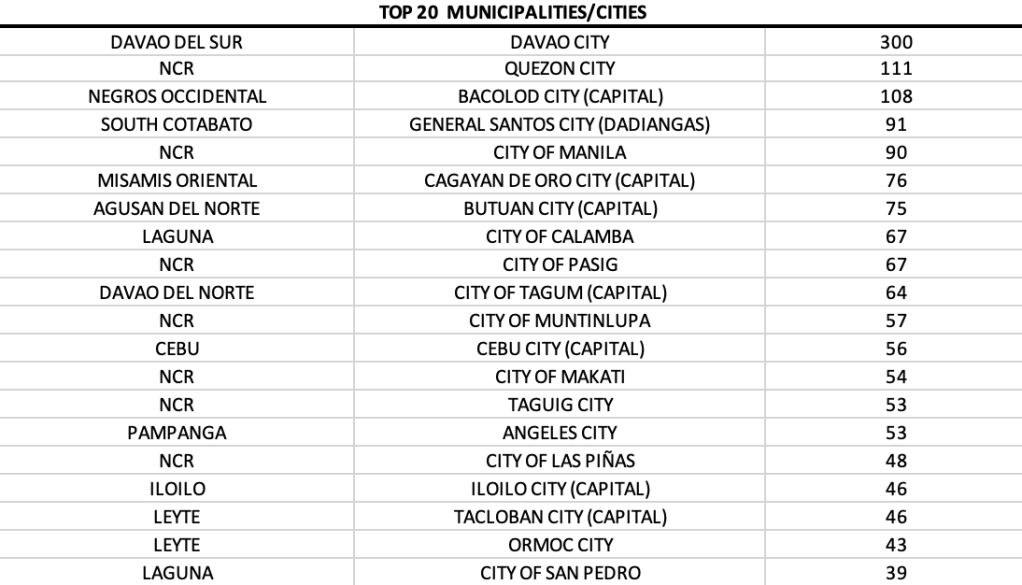
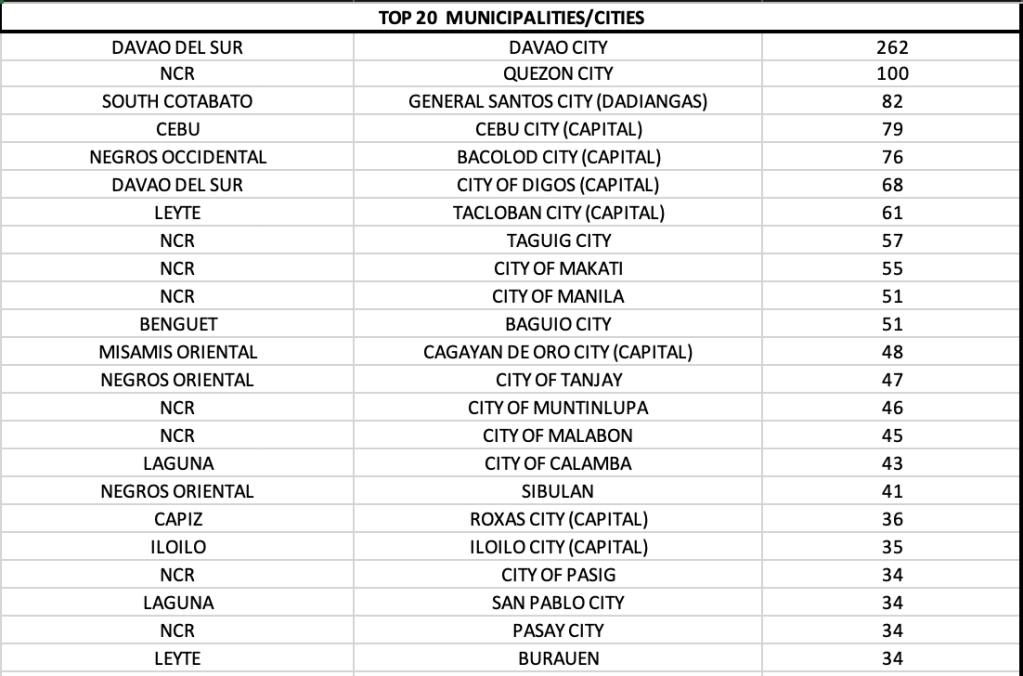
In NCR, Quezon City continues to lead and among 17 LGUs in Mega Manila, the region manages to land 7 of the 20 cities in the top. Three of these 7 cities are among the top five – Quezon City, Makati, Manila.
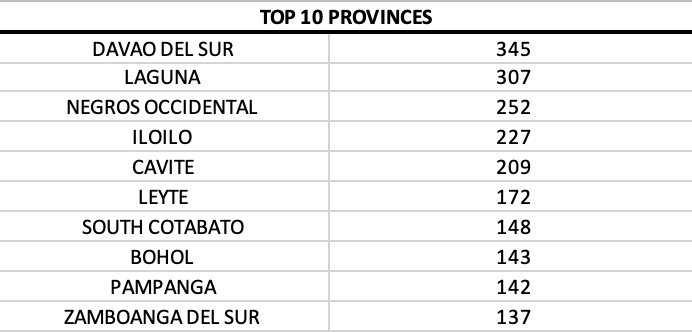
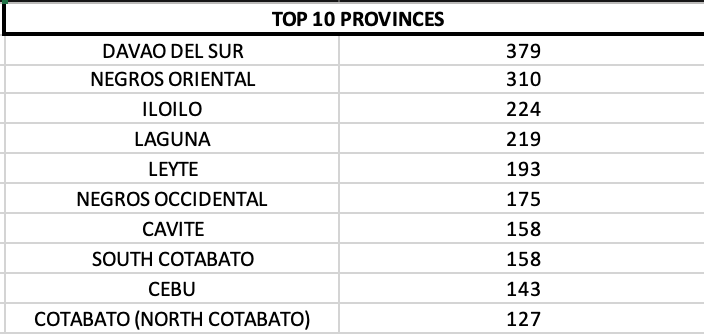
On a provincial level, it is Davao del Sur, Iloilo Province and Laguna that continue the lead.
And Davao City remains on top among all LGUs with 301 cases today. Much more than combining the total new cases from Quezon City and Makati City.
With slower decline in reproduction number and a relatively slow roll-out of vaccines, we really won’t expect a dramatic drop in the cases for COVID-19 in the country. Even when vaccines are fully rolled out, people will need remember that it will take 4 weeks before the full dose (2 doses) before a surmountable immune response can be expected. Even with the roll-out today, the most likely benefits should be seen after 6-8 weeks.
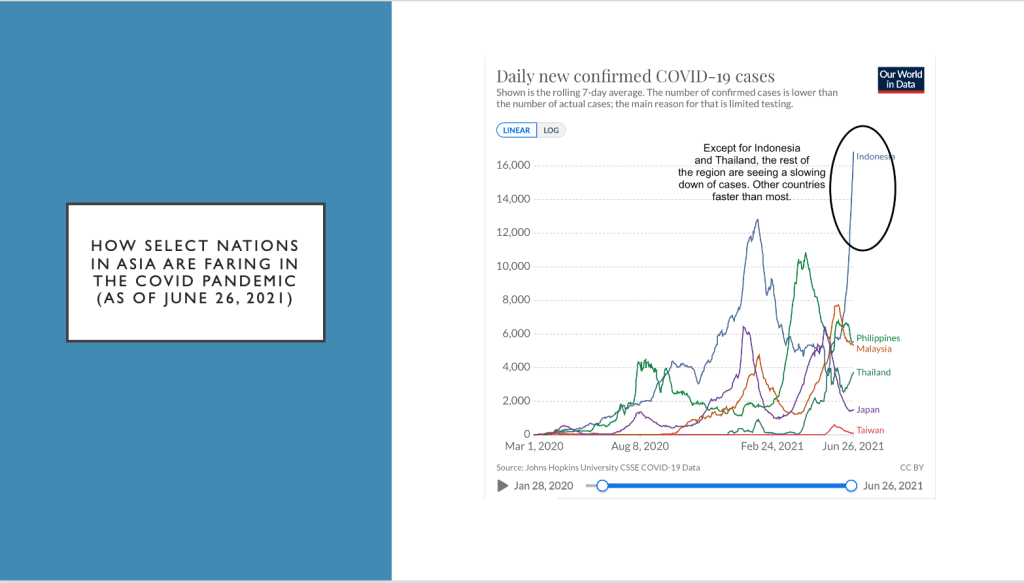
In the meantime, the other countries in select Asian countries who saw a rise in cases are seeing a quicker dip while others remain to struggle. The question is, how long will our economic and educational struggle take us as the government continues to utilize lockdowns as the main strategic solution in addressing the pandemic?
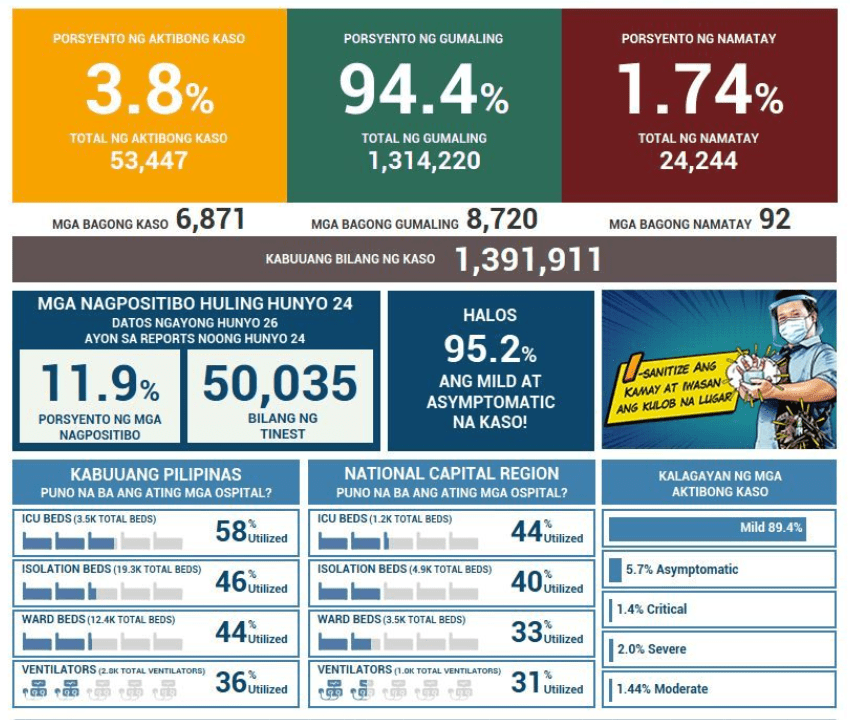
There were 50 more cases today than yesterday. That, with 3 laboratories not submitting results for June 24. With that, the Health Agency announced 6,871 new cases today, with more than 50,000 tests done and an 11.9% positivity rate two days ago. The number of active cases is still more than 50K (3.8%).
The country is seeing a slow decline in cases as the national reproduction number is now at 0.90 (as of June 22.
WIth 92 new deaths today, the case fatality ratio for outcomes remains steady at 1.81%. The Philippines still has the highest mortality rate among ASEAN nations at 218 per million population followed by Indonesia at 204 per million and Malaysia at 147 per million as of June 25.
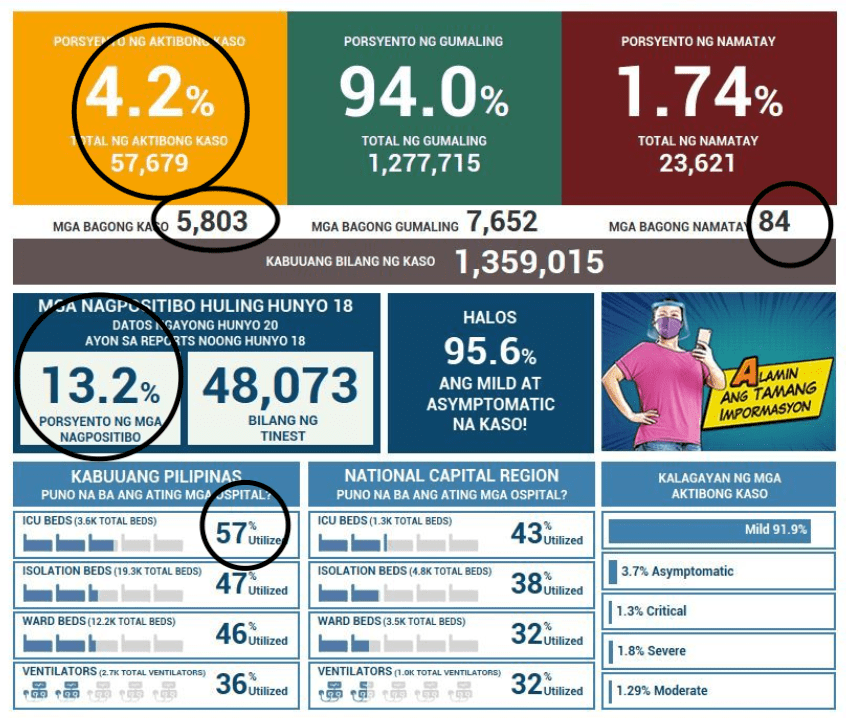
Health utilization rate is higher nationally compared to the National Capital Region.
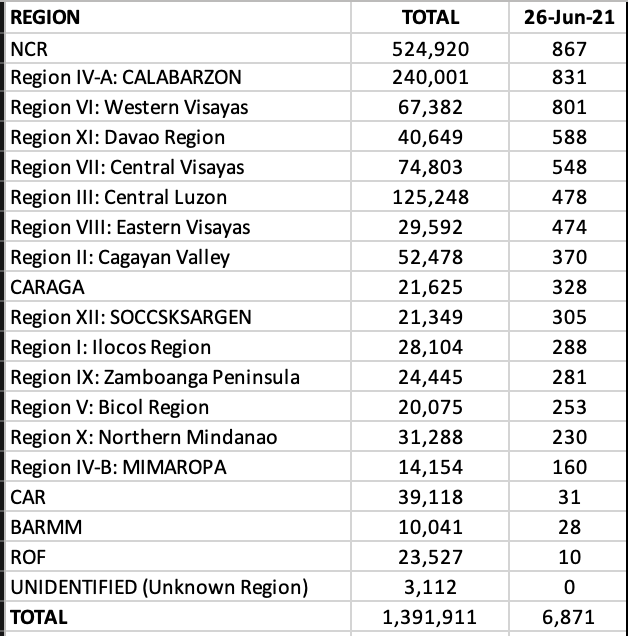
NCR takes back the lead with most cases by region. As the cases slowly go down in the country, will NCR be the lone region that leads in cases? CALABARZON, Western Visayas, Davao Region and Central Visayas round up the top five by region.
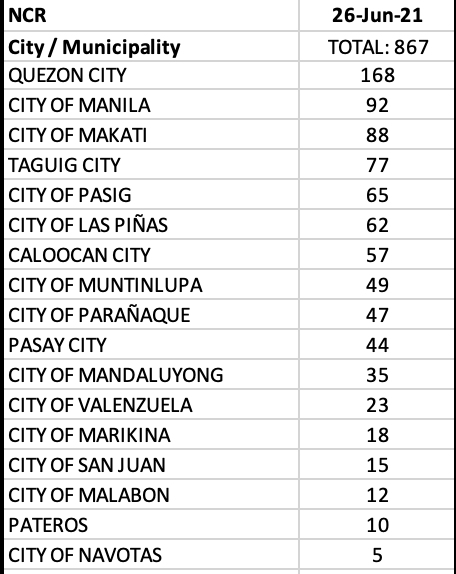
In Mega Manila, it is Quezon City that continued to lead with triple digits and most of the cities had higher cases reported overnight.
On a provincial level, Davao del Sur, Laguna and Negros Occidental led in tally among the provinces.
The highest number of cases by LGU was Davao City for several consecutive days. It actually had more cases than Quezon City (2nd rank) and Bacolod City (3rd) combined.
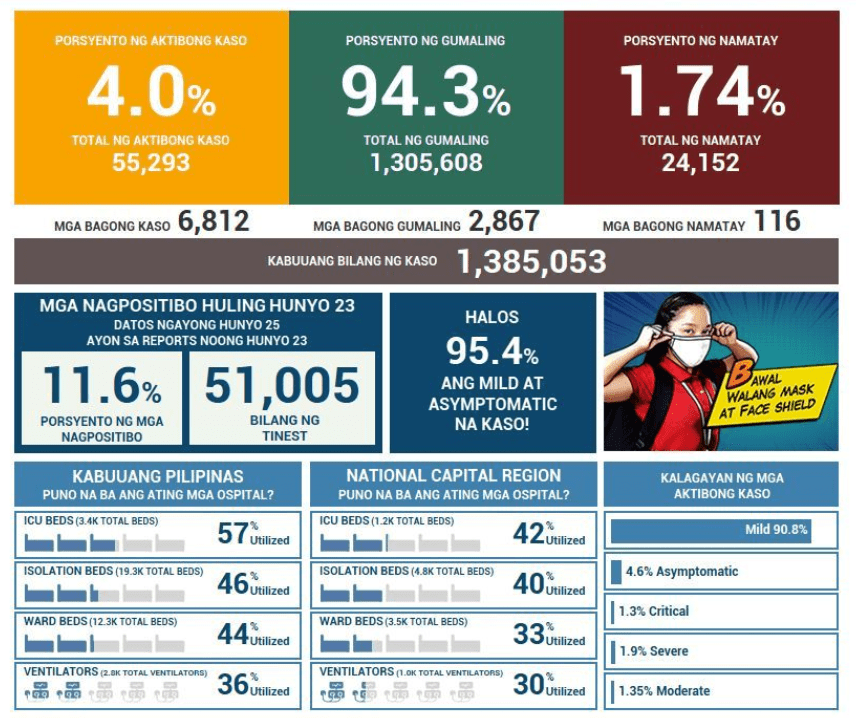
With 6,812 new cases today based on more than 51,000 tests done June 23 and a positivity rate of 11.6%. With more new cases today than recoveries, the active cases are up again at more than 55,000 (4%). Total cases are now past 1.385Million.
There are 116 new deaths reported today, which brings the case fatality ratio for outcomes steady at 1.81%.
Note at the lower health care utilization at the NCR compared to the national data. This correlates with the lower cases now being seen in Mega Manila.
While CALABARZON registered close to 1,000 cases today, NCR and Western Visayas continued to trail Region IVA. Central Luzon saw a decline in cases as it moved down to 7th rank.
Back in NCR, Quezon City continued to report triple digits and three LGUs reported single digits. Nevertheless, 8 of 17 LGUs in NCR made it to the top twenty cities with most cases in the country.
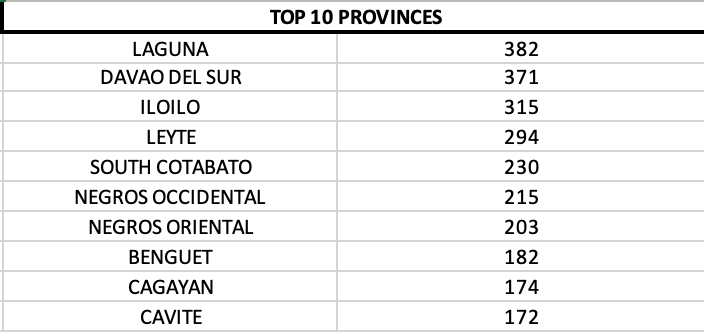
On a provincial level, Laguna took back the lead followed by Davao del Sur and Iloilo Province.
Davao City continued to post the highest cases among the LGUs in the country. The other four LGUs that rounded up the top five were: Quezon City, Baguio City, Iloilo City and General Santos City.
With 6,043 new cases announced today, the total COVID-19 cases inches closer to 1.38M as the week comes to an end. The cases today are based on close to 47,000 tests done last June 22, with a 12% positivity rate. Because of fewer recoveries compared to active cases, the active cases are up at more than 50,000 once more.
While the bulk of the cases are coming from Visayas and Mindanao, it is good news that the NCR has kept a steady decline. Otherwise the major epicenter of cases in Metro Manila would push the total numbers much higher than what is reported daily.
With 108 new deaths, the total deaths now exceed 24,000, and the case fatality ratio for outcomes is steady at 1.81%.
CALABARZON and Western Visayas dominated the regional haul but NCR, Davao Region and Central Luzon continued to contribute to the most cases for the day.
Among LGUs in NCR, Quezon City and Manila reported triple digits, while Navotas was the lone LGU that had a single digit. Despite the lower cases in NCR, 6 of 17 LGUs in Mega Manila still managed to be among the top 20 cities with most cases.
On a provincial level, Davao del Sur topped the list with Negros Occidental and Iloilo province in second and third, respectively. It was no surprise to see Davao City continue to lead the LGUs among the top five cities with most cases in the country. Quezon City, Bacolod City, Manila and Iloilo City rounded up the rest.
The Wednesday data will always be the second highest number of cases for the week. Tuesday is notably the day with lowest new cases.
The Health Agency reports 4353 new cases today based on a little over 33k tests done with 11.4% positivity rate last June 21. Sundays and Mondays will always have the lowest tests done. Understandably the Sundays will have lower tests are some testing facilities are closed.
With 119 new deaths today, the case fatality ratio for outcomes is steady at 1.81%.
With more recoveries than new cases, the active cases are now less than 50,000 (3.6%).
CALABARZON and NCR took back the lead for regions with most new cases for the day as Davao comes in third. Visayas and Mindanao continue to contribute to the new cases for the day.
In the NCR, Quezon City reports triple digits once again, with 4 cities/municipalities reporting single digits. Seven of 17 LGUs in NCR were among the top twenty cities with most cases.
On a provincial level, it is Davao del Sur, South Cotabato and Laguna that led the pack.
Among all LGUs, Davao City led the pack with more than twice the cases of Quezon City. Joining them to round up the top five were: City of Tagum, Butuan and Koronadal. Unknown municipalities New Washington in Aklan and Polanco in Zamboanga del Norte were among the top twenty LGUs today.
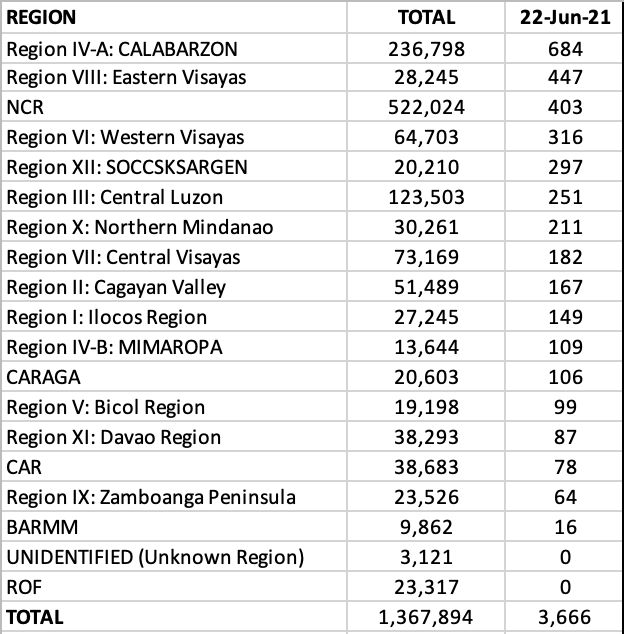
Because it is a Tuesday, the 3,666 new cases came as good news with more than 31K tests done on a Sunday – June 20. The positivity rate is still up close to 12%. With more than 6810 recoveries, the active cases now decrease to a little more than 52,000 (3.9%).
There are 60 new deaths reported today, putting the case fatality ratio for outcomes at 1.81%. The Tuesday data is lower than the past Tuesday reports. Hopefully, we continue the decline in cases for the whole country as the vaccines continue to roll out.
Of course it came as a surprise that Davao Region suddenly dropped from 600 plus cases to just 87 cases today. But NCR has managed to stay clear of the lead as CALABARZON and Eastern Visayas took the first and second place today.
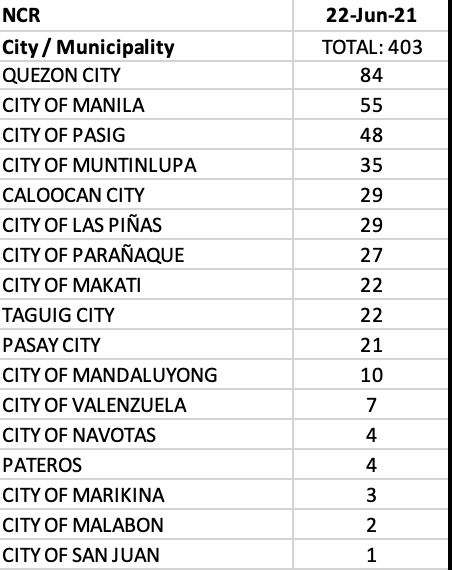
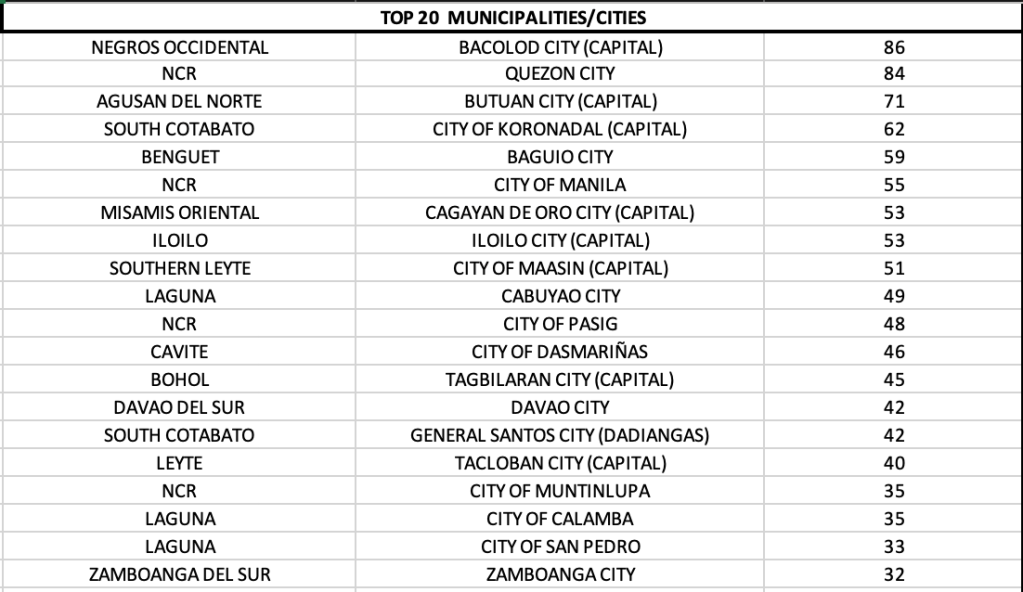
For the first time, Quezon City reported only double digits. The following cities in NCR, joined QC among the top five – Manila, Pasig, Muntinlupa and Caloocan City. Seven LGUs in NCR reported single digits today. Only 4 of the 17 LGUs were among the top 20 cities with most cases.
Laguna took back the lead on a provincial level, while Bacolod City led among all LGUs in the country in a day that saw fewer cases.
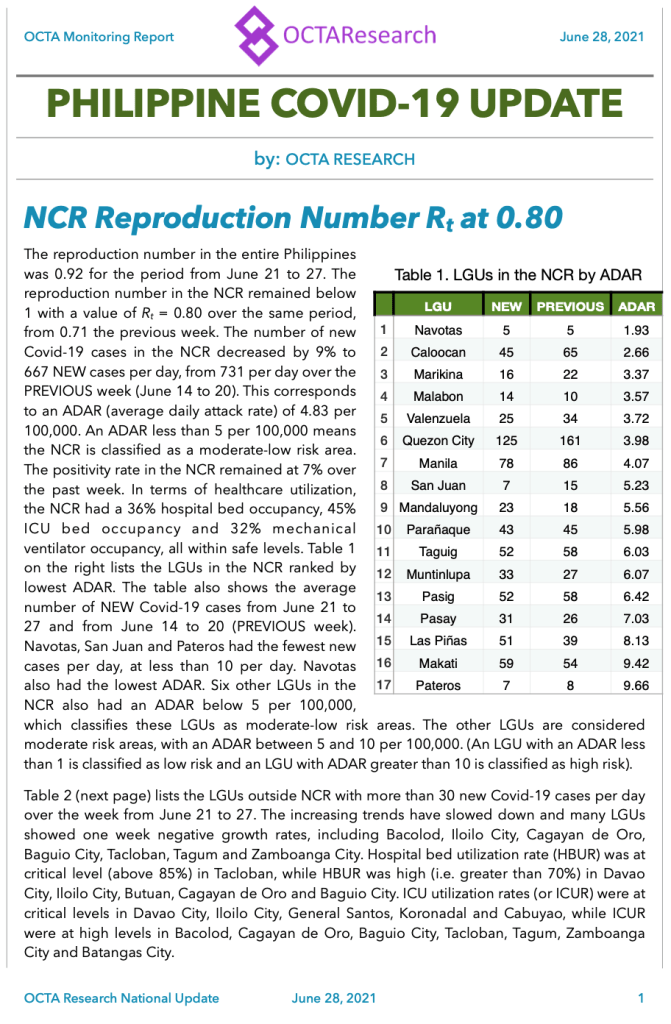
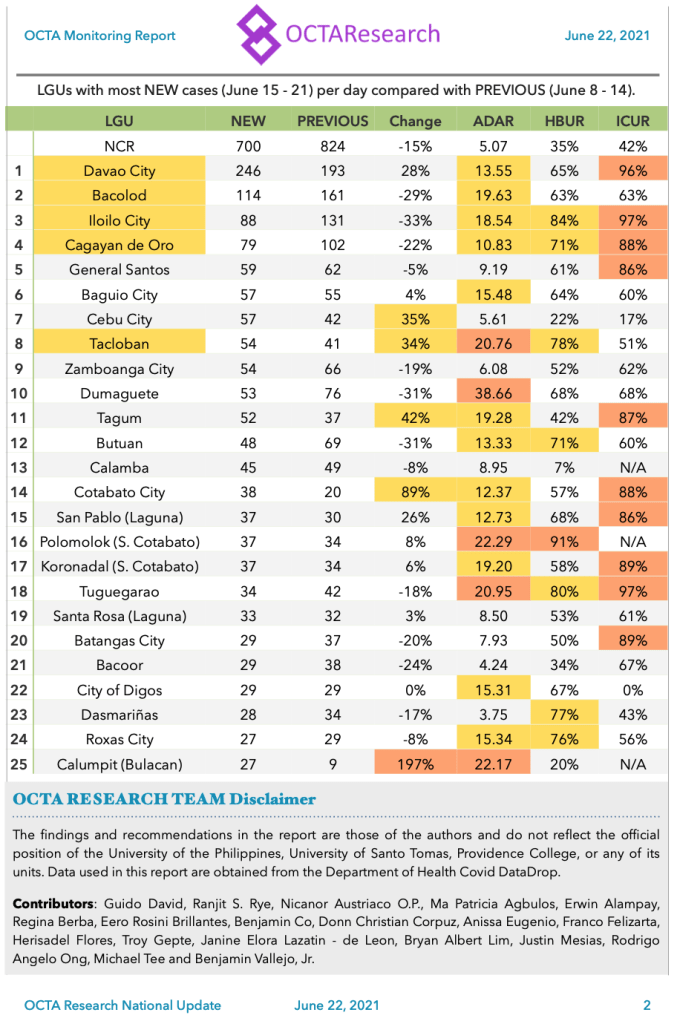
The OCTA Monitoring Report released today notes that the number of cases in the country declined by 8% (averaging 6,027 daily) from June 15-21 and the reproduction number dipping a tad lower at 0.95. The NCR continued to have decreasing cases with a 15% decline from the previous week. Its average daily attack rate is now at 5.07/100,000 population and the Rt = 0.73. Positivity rate for tests is at 7% compared to the national positivity rate of >13%. That is because the bulk of the testing facilities are in Mega Manila, where extensive testing can and is being done .
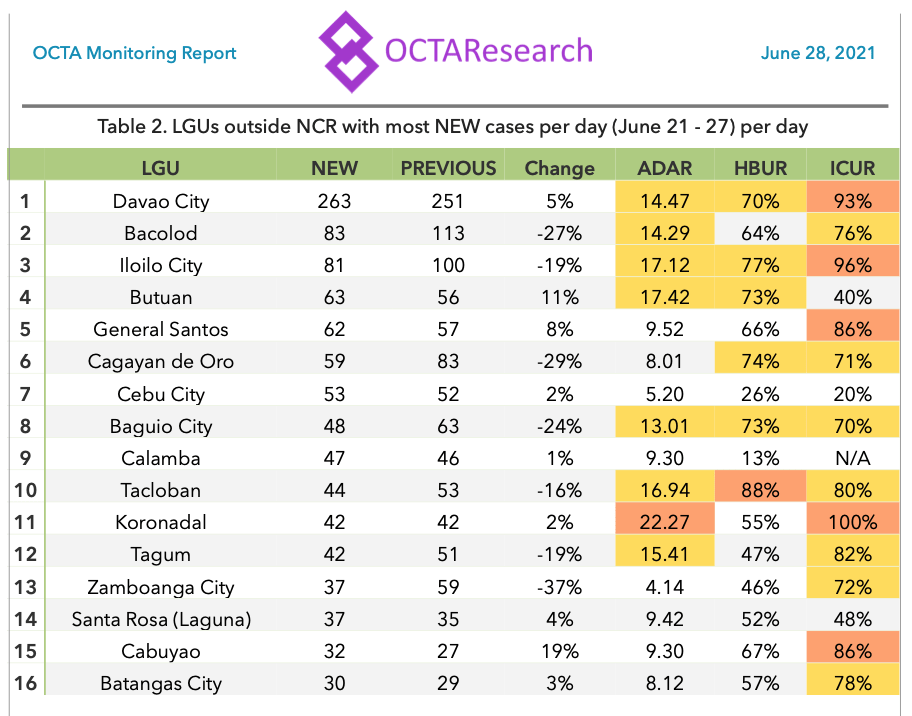
The data in the LGUs outside of NCR is not good news. Davao City, Bacolod, Iloilo City, Cagayan de Oro and Tacloban remain areas of concern. The variability in the increase of cases in these LGUs, ADAR, hospital bed occupancy rate and ICU rate are parameters that should be monitored rather than just the number of new cases. Hospital utilization is a reflection of how the healthcare system of the LGU is doing and mirrors how the situation of the outbreak in the community.
With close to 5,300 cases today for reports on June 19 in over 43,000 cases and a positivity rate of 13%, the Philippines now has over 1.36M COVID-19 cases. The active cases remain above 4% (55,847).
There are 128 new deaths today, putting the case fatality ratio for outcomes is steady at 1.82%.
Davao, for the first time, officially took the lead in number of new cases by region, province (Davao del Sur) and City (Davao City) as the outbreak continued to spread across Visayas and Mindanao.
CALABARZON and NCR are in ranks 2nd and 3rd, with NCR owning 11% of the total cases. Western, Central and Eastern Visayas had more cases than NCR and Region IVA combined.
Among LGUs in NCR, Quezon City was the lone city with triple digits and Pateros had a glorious day with ZERO cases.
But it was a day where other LGUs also reported lower cases, which put the NCR LGUs in a precarious position with 8 of 17 cities landing in the top twenty cities with most cases for the day.
As of this post, the Health Agency has announced that around 2% of the Philippine population have been fully vaccinated. At least 6% have received a single dose with the breakdown provided in their graph below.
It would be more interesting to find out how many (in percentage) in the various categories have actually received their vaccines. For example, if there are 1,000,000 HCWs (healthcare workers) in the country and 990,000 have been fully immunized, then that means that 99% of the HCWs have been immunized. This is important as the numbers below do not mean anything if you’re just counting the numbers.
In addition, here is the latest Biosurveillance Report from the Philippine Genome Center on the status of the variants circulating in the country. Alpha and Beta variants remain the predominant variants we are seeing in their random genome sequencing of swabs taken from positive patients in the sequenced date.
With 2 laboratories not submitting reports for June 18, the Health Agency announces 5,803 new cases today. The positivity rate is still high at 13.2% because testing is insufficient at less than 50,000 test two days ago. The active cases dip a little less than the 60,000 average.
With 84 new deaths, the case fatality ratio for outcomes is at 1.81%.
CALABARZON, NCR, and Western Visayas continued to lead the regions with most cases for the day. The Visayas and Mindanao Regions continue to account for majority of the cases in the country.
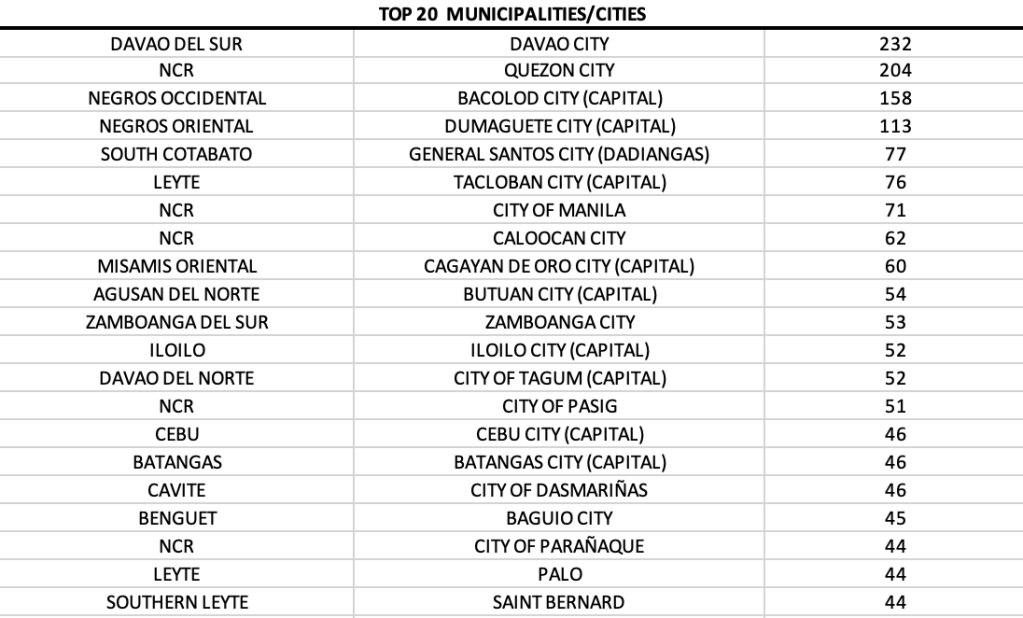
In NCR, Quezon City has difficulty in controlling its cases, as the city contributes to almost 1/3 of the total cases for Mega Manila alone. Five of 17 LGUs in NCR were among the top twenty cities with most cases.
On a provincial level, Negros Occidental, Davao del Sur and Leyte reported more than 300 cases apiece.
Davao City continued to lead as the city with most cases. Other cities rounding up the top five LGUs for the day are – Quezon City, Bacolod City, Dumaguete City and General Santos City.
The OCTA Research Monitoring Report updated for June 20, shows how the various LGUs in the country are performing week-on-week and contributing to the cases of COVID-19 in the country. NCR, the erstwhile epicenter of the country is currently seeing an average of 750 new cases/day. A drop of 11%. It’s ADAR (average daily attack rate) is lower at 5.43/100,000 population as a region.
LGUs seeing significant rises include Davao City (up at 42%), Cebu City (up at 45%), Polomok (up at 32%), and Valencia (Bukidnon, up at 80%). Notice that while Cebu City is seeing higher cases, their health care utilization (beds and ICU) remain significantly low. This is because the cases are from extensive contact tracing done and patients who are positive being isolated early. This, however, is not true for other LGUs where the rise in cases are from symptomatically ill patients.
Health bed utilization is highest in Iloilo City and Polomok (South Cotabato). ICU rates are up in Davao City, Iloilo City, General Santos, Tagum, Polomok (South Cotabato), San Pablo (Laguna), Tuguegarao, Cotabato City, Bacoor (Cavite) and Naga City. As the virus continues to spread throughout the archipelago, it is important for the government to concentrate all efforts on testing – both symptomatic and asymptomatic close contact cases. Vital in the TTIQ-V (Test, Trace, Isolate, Quarantine, Vaccination) algorithm, is the ability to test early (and release results early) so that tracing, isolating and quarantine can be done within a 48-72 hour span. Anything less that this will result in a continued increase in cases. Of course, there are only two ways to bring down the positivity rates – do more testing (100,000/day) or do not test at all. Doing the latter would result in chaos and a breakdown of the healthcare standards of the nation. At this point, as many provinces have very few testing facilities, which result in a very late release of reports, the Health Agency must accept the option of doing rapid antigen tests in patients who are symptomatic as basis for counting and including these patients in the daily data count. When patients are rapid antigen positive, PCR tests should be immediately done, and while waiting for confirmatory results, all contacts of patients who were antigen positive should be quarantined and closely monitored pending the release of the PCR results. Isolation of patients who are antigen positive should also be imposed, similar to patients who are RT-PCR positive. We lose nothing at this point by using these tests because of the outbreak.
The week in review showed how the country continued to plateau in numbers. As of June 19, the Philippines added 44,884 new cases and 889 new deaths for the week of June 13-19. This, as the new cases bounced around the 7,000 average per day for the week and deaths stayed more than 100/day (and considered an underreport).
Testing became challenging as many of the provinces/regions that are seeing rise in cases have limited testing facilities. The Health Agency only counts PCR tested individuals in the daily data. In spite of the 265 accredited testing facilities in the country [https://doh.gov.ph/licensed-covid-19-testing-laboratories], the testing facilities are not enough in areas outside of the NCR and highly urbanized centers (Cebu and Davao, CALABARZON and Central Luzon).
NCR owned 112 of 265 (42.3%) accredited centers in the country but is now seeing only less than 800 new cases per day. Together with the 22 centers in CALABARZON, half the testing centers in the nation are found in these two regions alone.
Compare that with say, Polomok in South Cotabato, Region XII with only 7 testing center – 4 of which are private and 3 public. Two of the testing centers are in Cotabato City, one in Koronadal, two in General Santos City, and two in Sultan Kudarat (both found in Tacurong City). The apparent disequilibrium in testing capacity in the country should be addressed by the government (particularly the IATF and testing czar) as COVID-19 is not a propriety of the urbanized areas alone.
For now, this is how we stand in some select countries in Asia. Many who saw surges have been able to bring down the cases for now. Sadly, our country is still debating the role of face shields in the pandemic.
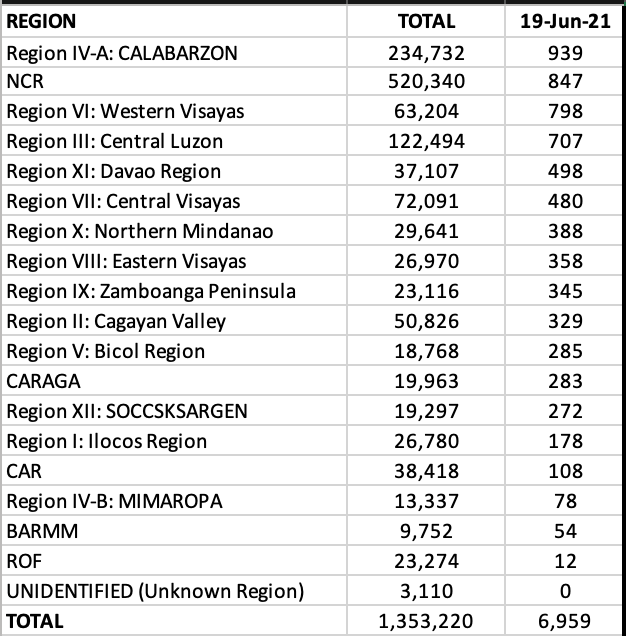
The Health Agency continued to report higher cases for today with 6,959 new cases (6 laboratories failing to submit reports so that’s clearly more than 7K) for more than 50,000 tests done on June 17 with a nationwide positivity rate of 11.5%. The active cases continue to hover around 60,000 per day.
There were 153 new deaths reported today places the case fatality ratio steady at 1.82%.
While CALABARZON remains to lead among regions with NCR in second, Western Visayas is turning up a storm as it reports close to 800 new cases.
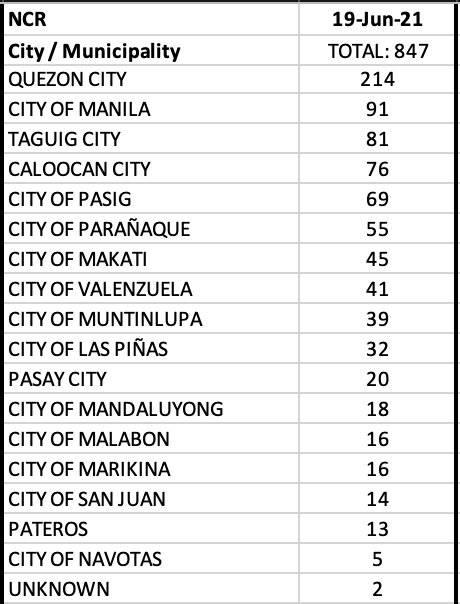
Among the LGUs in NCR, Quezon City marks more than 200 cases again while the other cities continue to report double digits only, with Navotas reporting only 5 cases. In spite of this, 7 of 17 LGUs in NCR still managed to land in the top twenty cities with most cases.
On a provincial level, it is Laguna that continued to pour in the cases and lead the provinces with most cases for the day, followed by Negros Occidental and Davao Region.
Among all LGUs in the country, Davao City continued to lead in number of cases, followed by Quezon City, Cagayan de Oro, Iloilo City, and Bacolod City to close the top five.
Close to 7,000 new cases, with 5 laboratories not reporting today, with almost 44K tests on June 16 still had a positivity rate of 12.6%. The active cases continue to average around 60,000 cases daily. And the provinces continue to rake in the new cases.
There are 110 new deaths reported today putting the case fatality ratio for outcomes is steady at 1.82% ICU bed utilization is also up in the regions outside of the NCR. Note that this is the average, and includes other regions that are seeing lower cases.
CALABARZON takes back the lead from NCR with close to 1,000 cases. Except for BARMM, all other regions reported triple digit numbers. It was the Visayas that saw a horrible day with Western, Central and Eastern Visayas capping the top five regions from 3rd to 5th ranks.
Back in the NCR, it is not surprising that Quezon City continued to lead with triple digit cases. The good news is that four cities/municipality had only single digits – Malabon, San Juan, Navotas and Pateros. Six of 17 LGUs in NCR are among the top twenty cities with highest cases.
On a provincial level, Iloilo grabbed the lead followed by Laguna and Davao del Sur.
Overall LGUs showed Davao City continuing to lead among the top twenty cities in the country. Aside from Quezon City (which will most likely never be out of the top five cities with most cases), Cagayan de Oro, Zamboanga City and Iloilo City cap the top five.
The OCTA Research Monitoring for June 18, 2021 shows that among LGUs outside of NCR, Davao City is seeing an increase in new COVID-19 cases. Yesterday, June 17, the Health Agency data drop showed Davao City reporting 482 new cases, its highest ever since the pandemic began last year. This is an increase of 26% from the daily average of 184 new cases daily last June 4-10. The ICU rate is over 90%.
This phenomenon is not an isolated one among LGUs outside of NCR. Bacolod City, Iloilo City, Cagayan de Oro and Dumaguete are also among the top five cities with highest cases. Baguio City saw a 49% increase in cases. Polomok in South Cotabato had the highest increase in cases at 63% for the week of June 11-17. Dumaguete had the highest ADAR (average daily attack rate at 52.21 per 100,000 population) while Iloilo City had the highest Hospital Bed Utilization Rate (HBUR).
ICUR was highest for Koronadal and Bacoor (Cavite) at 100%. Those near or above 90% ICUR included Davao City, Iloilo City, Tagum, Batangas City, and Tuguegarao.