Of beginnings and endings

C.S. Lewis once said, “you can’t go back and change the beginning, but you can start where you are and change the ending.

Oftentimes we get into a glut and pray for a rewind in life. You know what I mean. These are the “what if” and “if only” moments we’re in.

Every action or choice has its consequence. And we end up where we are because of the choice we make. A business that was unsustainable, a love story that did not end happily ever after, a career that went south, an affair that didn’t last – whatever it is, where we are are because of the choices we make.

All of us, yep, and there’s no exception to that rule, end up making that momentous choice. Even the trivial things like choosing which clothes to wear, or food to eat, or going for a swim, or having your armpits waxed – they’re choices we end up making. Whether you end up looking like an upholstery, or end up with a cholesterol laden dish, or decide to swim in a beach, or get a disastrous skin reaction from the armpit peel – they’re consequences we end up with. You see, there is no crystal ball after our choices. We live with it.

Get a grip! Life’s like that. Wherever we end up with our choices, it should not stifle our growth. Decisions are free. Making mistakes is human nature. If we keep revisiting our past and keep staying stuck in the “what if” and “if only” moments of our lives, we will remain prisoners of our past. Remember the rule – time has no rewind. Let go. The universe will always catch you even when you fall.

Confusions

Not everything is meant to be understood. Sometimes people send mixed signals. Other times you’re not part of the equation in their lives so you’re caught unaware. In a relationship, you get confused when your boyfriend is hot one day and emotionless the next. It’s like, is he or isn’t he into you? Even among friends, if you’re not in the “inner circle”, or part of the clique, you’re probably the last to know that there was a grand get together last night but you weren’t invited.

Confusion is a state of uncertainty. Baffled. Bewildered. Puzzled. Perplexed. They’re all nouns to describe that mystified state where you try to understand the discombobulation in front of you.

You can either focus on what’s tearing you apart, or what’s holding you together.”

I get it when people tell me that when things get “confusing”, they can’t think straight and make decisions based on the situation at hand. Sometimes they may be right, other times, wrong.

There’s really no answer on how to handle a confusing situation. Discernment is a key consideration. And oftentimes we get too engrossed in that state of bewilderment that we lose track of the road we travel.

Never give up on faith and hope in the midst of confusion. God will always be on our side and will never let you down when you need Him most. Trust me. I’ve been there.

The Push

“Can we be manipulated through the familiar forces of pressure to commit murder?”

Social compliance is the main theme in Derren Brown’s: The Push, available in Netflix this week. In this bold experiment, mentalist Brown uses social pressure to convince an ordinary decent person to cast aside moral codes and commit murder.

The audacious social experiment is fast paced and plotted well. The unknowing victim is enthralled in a psychological game where he is first pre-selected through a dubious plot to determine who is most gullible to social compliance.

This interesting show is a psychological masterpiece as it delves into the deep recesses of our subconscious on what we, as humans, are capable of becoming.

How readily we hand over the shit of ourselves everyday. And how easily we get controlled by social media is the main tenor of “The Push”.

I highly recommend this short movie to all.

Ransom Patterson puts it well when he points out in “How people manipulate you: The 6 principles or influence” on how and why social compliance matters.

1. Consistency

2. Reciprocation

3. Social Proof

4. Authority

5. Liking

6. Scarcity

These principles allow us to act automatically and efficiently in a way that benefits you.

People with knowledge of these principles tend to exploit them to lure us to make purchases, donations, bully or torture others, and yes, even kill.

I highly recommend this film on Netflix and you’ll understand why we dish out the shit we’re pushed to do and why we do it.

Patience and time

Leo Tolstoy once said that the two most important warriors are patience and time.

Time is never on our side though. What is past has occurred. Tomorrow is always fraught with uncertainty. Today is always what we deal with. All the unpredictability leaves us anxious and desolate rewinding and overthinking. Let’s face it. Anything occurring at the moment is hardly remembered after the day is over.

Often times we procrastinate making decisions because even though we’re in a bad place, the sliver of hope keeps us doing what we used to. Hoping and praying that things get better. Or miracles happen. A piece of advice:

If you wait for the perfect time, it will never happen.

So we just sit back and wait and wait and wait for a sign to show us the path to making “right” decisions.

Patience is a virtue. We harness this virtue in order to rationalize making life changing steps. Taking a break from a relationship, quitting a job, venturing into a business, going back to school – whatever it is, time and patience will lead us to those crucial decisions.

The thing here is that time and patience can pose opposing discomfort. Patience makes you wait to the point of procrastinating a decision. Because we think we have time on our side.

I’m not saying that we make impulsive decisions here. I’m talking about crossroads that make you stop and ponder when to make a life changing decision. It goes without saying that we shouldn’t be making rash decisions at the spur of the moment.

When the events during the “patient moments” are intolerable anymore, we need to remember that waiting will not matter.

We need to grow through what we go through. Let go. Move on.

Chapter 3 – Stories of faith and hope

Life will always find us come full circle of our beginnings. Our journeys will always be a test of resilience and how we survive life’s biggest tests. After all, let’s put it this way, life is like a big exam. Every once in a while, there are tests given to find out how we are able to hurdle them and continue with the next challenges.

This month marks another chapter to what I’m writing for you. It’s two of the most inspiring and heart crunching words in the dictionary – FAITH and HOPE.

We all need a little healing in our lives. I get it when people say that some of the things that happen, happen for a reason.

“Sometimes when you’re in a dark place, you think you’ve been buried, but actually you’ve been planted.”

Being in that dark place leaves a sick feeling and you can’t help question the universe why it’s happening to you. Whether it’s love betrayed or professional jealousy or family feuds, problems that crop up in our lives add to our stress of daily survival.

The best support group will always be true friends who are there for you when you’re at your worst.

So here’s the rub, whatever it is we’re all going through, faith and hope will always be our best companions. After all, no one else will look out for you except yourself. One day, you will look back at all these and write your stories, as I do mine.

Everyday will always be a new chapter. A new beginning. A fresh start. Because we all deserve some miracles in life.

Stages

There are five stages for grief.

Anger

Denial

Bargaining

Depression

Acceptance

It’s otherwise called in psychology the Kübler-Ross model and “postulates a progression of emotional states experienced by terminally patients after diagnosis and by loved ones after death.”

It is natural for all of us to go through a grieving process. Letting go is not as simple as it seems. When the circumstances leading to grief is a sudden one, it usually takes a longer time to reconcile the stages.

The element that makes us feel grief is love.

“Sometimes you can’t let go of what’s making you sad, because it was the only thing that made you happy.”

Denial is a defense mechanism that buffers the immediate shock of loss. More often than not, when people are unprepared for a tragedy, the denial stage is prolonged because we need to figure out the overwhelming emotions of the loss.

Anger comes when the numbness of denial wears off. There is blame, intense guilt, and various forms of anger.

Bargaining is the “what if” stage of grief. It provides temporary escape from pain, provides hope, and serves as the adjustment period to reality.

Depression is an appropriate response to the loss. There is intense sadness, inability to sleep well, feel demotivated, have poor appetite and experience nausea, and poor concentration.

When the stage of depression is too prolonged, mental and eventually physical health becomes compromised.

Then the final stage is acceptance. It means accepting the reality of the loss. And nothing can change that reality. And will move on from the loss. But not necessarily mean the person is “okay” with the loss.

The last blog for the month is a reminder that “grief is just love with no place to go”. And some good things come to an end. And whether they are happy endings or not, letting go and moving on will always be the stories of our lives.

Let the past die

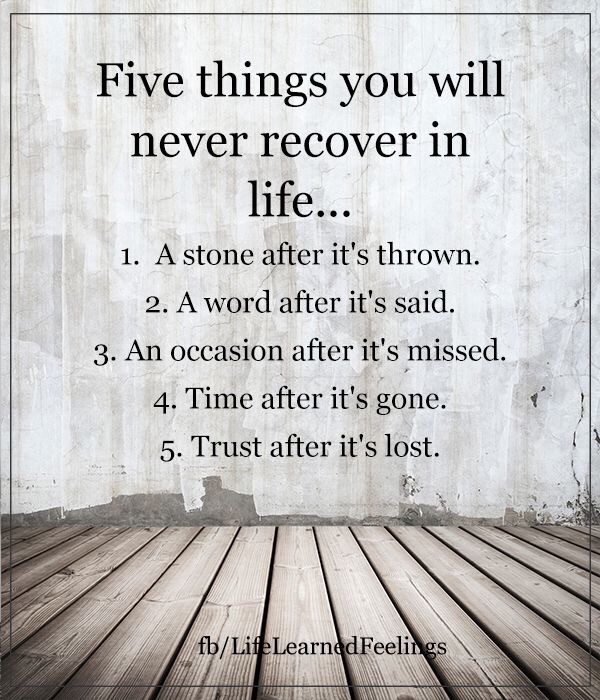
There’s an interesting poster regarding things one will never recover in life.

Life gives us over a billion lessons to learn from but only a few should be remembered well.

These opportunities are difficult if not impossible to recover at all. The most important of them to me is trust.

Whether it is love, professional or political scenarios, the deal breaker of trust is the most impactful.

When truth has been distorted and trust is lost, that’s the deal breaker. Nothing will ever be the same again. Ever.

People

Once upon a time in a kingdom far away lived a king who was loved by his people.

The kind king was an inspiration to many of his servants. While he was loved my most, there were a few who wanted the king to abdicate his throne.

As the kingdom grew larger, the king appointed two jesters. One who would provide wisdom, the other would foment dissent. It was natural that because the kingdom was a large one, the king had to listen to both jesters, as he divided which part of the kingdom each jester would oversee.

The jester that provided wisdom was well respected and appreciated. The other jester that created division was full of greed and vile. Over the years, the kingdom became divided. Soon, only intrigue and rumor mongering governed the land. And more people began to dislike the once wise king. Even the jesters became at odds with one another.

A small tribe on the south of the king was watching patiently. Waiting for the moment when people in the kingdom would be disgruntled on how the king ruled. The small tribe took the opportunity one day to use the weakened morale of the people to conquer the kingdom. The king had to eventually abdicate his thrown after an uprising led by a small tribe.

What is the moral of the story?

It takes people to build a kingdom and the same people to take advantage of its weakness and destroy the same kingdom.

People are what make a kingdom rise to great heights. Treat them right and justly. Because it is also the same people that can bring the kingdom down.

The strength and weakness of every organization or city or country lies not in leading with an iron fist but with a kind and understanding heart.

The devil’s challenge

I am writing this for myself.

It’s been one helluva rough month. You know, the kind that one problem seems to pour like a humongous storm. I appreciate all the love that’s being shared by my friends, family, colleagues, the academic, business and political community. As I always say, when you’re at your lowest in life, that’s when you find out who your true friends are. It’s also when you know who supports you or not.

It’s painful when people stab you in the back or f*cks around with your mind. Anxiety builds up and the days are difficult to bear. You can’t focus on your work, you tend to be irritable, and your appetite is weirdly erratic. And yes, it’s not okay to feel emotionally and mentally assaulted.

After a few weeks of questioning myself, reflecting in prayers, and finding hope and support with friends from all walks of life, the humiliation on how unfair things turn out has brought me on my knees to God.

I’m calling this blog “The Devil’s Challenge”. When your dignity and humanity is challenged, maligned and crossed, what do you do? Natural instinct for survival is called self preservation. And self preservation isn’t all that bad. It demonstrates love of self first.

After love of self comes love of neighbor. Loving those who do us good comes natural. It is doing the impossible – loving someone who has humiliated you, spread false stories, destroy your name – that’s difficult to love. To love God is to follow His example. That we treat all with kindness and compassion. Even those who have wronged me. And I can live with the fact that whatever is happening is probably my Lenten sacrifice. It’s the cross I am meant to bear for myself and for others.

For the words of enlightenment and encouragement of my friends, thank you from the bottom of my heart. My gratitude is overflowing. Thank you for reaching out and offering your help especially during the storms of my life.

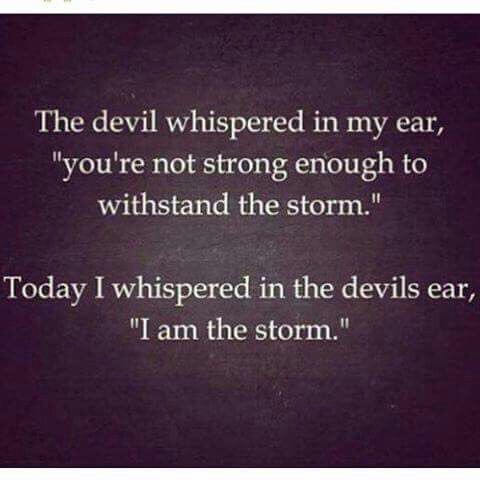
The devil has not yet seen me as the storm that will put him down. I will weather this storm because I love myself too much to let any evil destroy me. And I will let love and kindness and compassion and understanding destroy the devil’s challenge.

Because God is on my side.

Wrong before right

Once upon a time in a land of make believe, there’s the story about a Princess who thought that all the decisions she made were the right ones because it pleased her.

She was never a princess. Her childhood years were difficult because growing up years proved to be rough. She struggled hard, but life threw tomatoes at her. Everything she touched was peachy at first. When people knew the real her they had second thoughts. She had beauty and charm and over time her life had improved. As she worked her way up the ladder of success, fame and fortune, she began to carry more baggages in the journey because she trampled on peoples feet during the climb.

One day, she met her prince in shining armour. She was showered with travels, jewels and the promise of a queenly life. She thought her life was to be a fairytale promise. But the fancy life in the palace was an illusion. Soon the money began to dwindle. Then the family problems of the prince started to grow into her. And the glass tower began to crack. The princess found herself no sooner than where she was back to – a life plagued with emotional and worldly problems. Her bitterness at the world became dimmer. Her paranoia and distrust worsened. Her once closest friends were now her biggest enemies. You see, the baggage she carried on her shoulders were always with her throughout her journey because she thought that she would use those excess baggages to get back at the people who she thought had wronged her in life. The princess had never let go of misery.

What is the moral of the fairy tale story?

Things don’t turn out the way we want for a reason. We sometimes live in a dark place or experience the worst of our times not because it’s a punishment but a cross we carry. Of course, not everyone deserves a cross to carry. But these crosses in life are meant to make us stronger, not bitter. Scarred, but survived. Better human beings, not monsters.

We need to carry on in life no matter how difficult it gets but sans the excess baggages. These heavy burdens of guilt, fear, pride, anger and hate should be left behind during our challenging journey. As we move on in life the less burden we carry, the less heavy our load. The less heavy the load, the kinder we treat people. Humility has its way of bringing back the good aura in our lives.

Sometimes we just need to do the right thing or trust the right people, and keep our hopes up that someday, all the wrongs done will eventually turn out right, and we get the happy endings we dream of.

As for the princess in the story, despite the many second chances she has had in life, she will have third and fourth chances over time.

That is true of our lives. We all have a princess in our life. Leave the baggages of hate behind. The journey is lighter that way. It’s also a happier one.