Lowest since August 10 and the data of 10.11.2021

So the 12,000 plus cases yesterday was depressing. But as I explained, it had to be the backlogs which were unaccounted for during the glitches with COVIDKaya. Hopefully, that has been resolved.

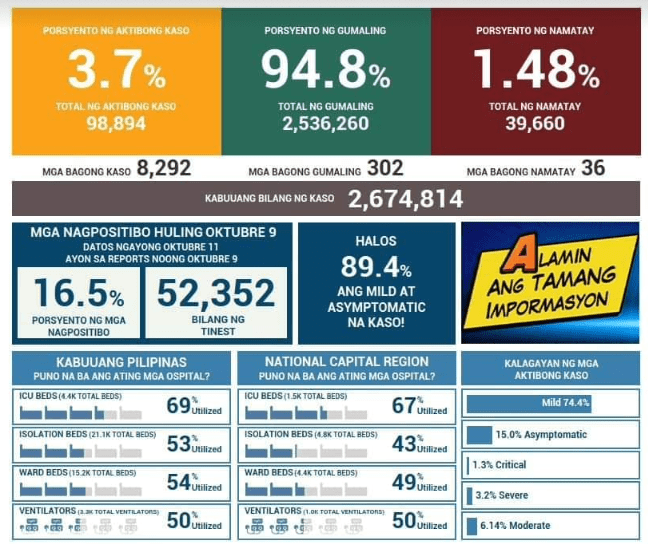
The Health Agency announces 8,292 new cases today, its lowest since the last time we touched 8,423 cases last August 10, 2021. According to the infographic, todays data is based on over 52,000 tests done October 9, with a positivity rate of 16.5%.

With only 306 recoveries, the active case are up at close to 99,000.

Health care utilization seems to be doing well both nationally (69%) and the National Capital Region (67%). The HCUR is a good reflection on how well correlated the cases are with the trend in the pandemic.

There were 36 new deaths reported today.

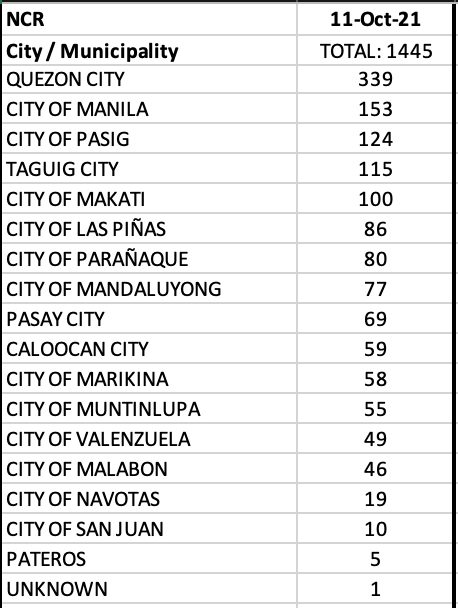
While the NCR still recorded the highest cases among the regions, it reported 1,445 (17%) cases, and was the only region to report quadruple digits. Cagayan Valley, Ilocos Region and CAR accounted for around 30% of today’s total cases.

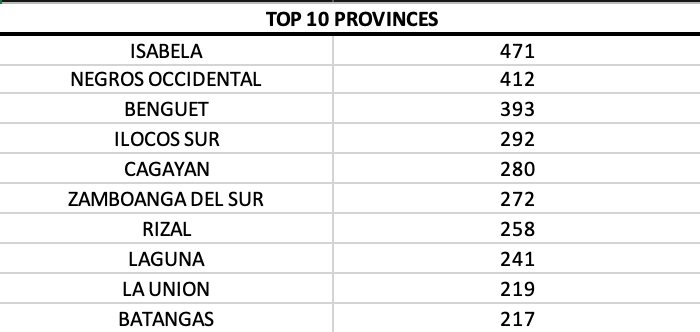
On a provincial level, 5 provinces in Northern Luzon are in the top ten – Isabela, Benguet, Ilocos Sur, Cagayan, and La Union.

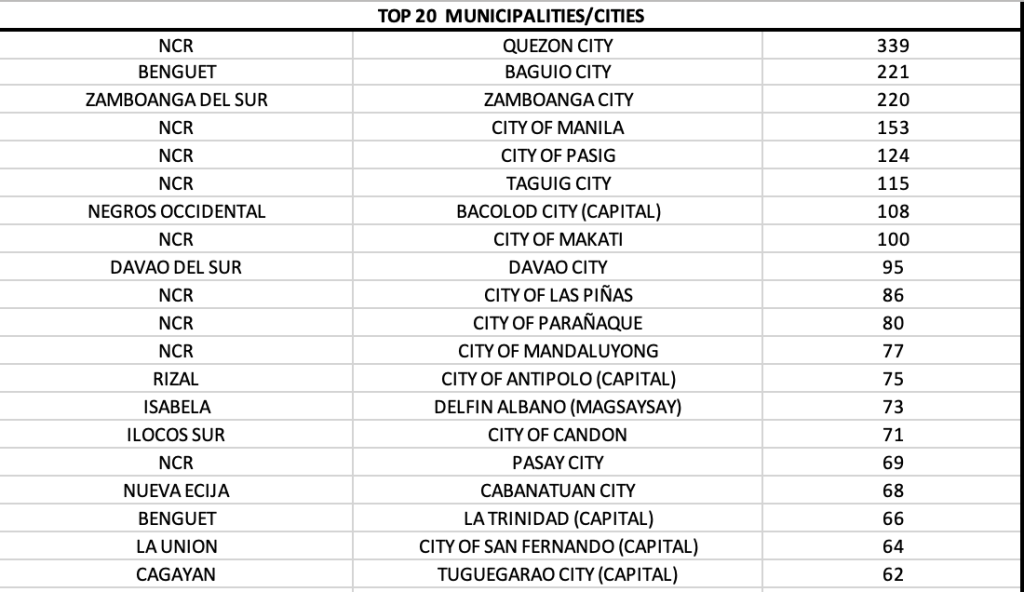
Nine of 17 LGUs in Mega Manila are in the top twenty cities/municipalities with most cases for the day. Several LGUs in Northern Luzon are in the top 20 – Baguio City, Delfin Albano (Magsaysay in Isabela), City of Candon (Ilocos Sur), La Trinidad (Benguet), San Fernando City (La Union), and Tuguegarao City (Cagayan).

With more than 12,000 new cases and the data for 10.10.2021

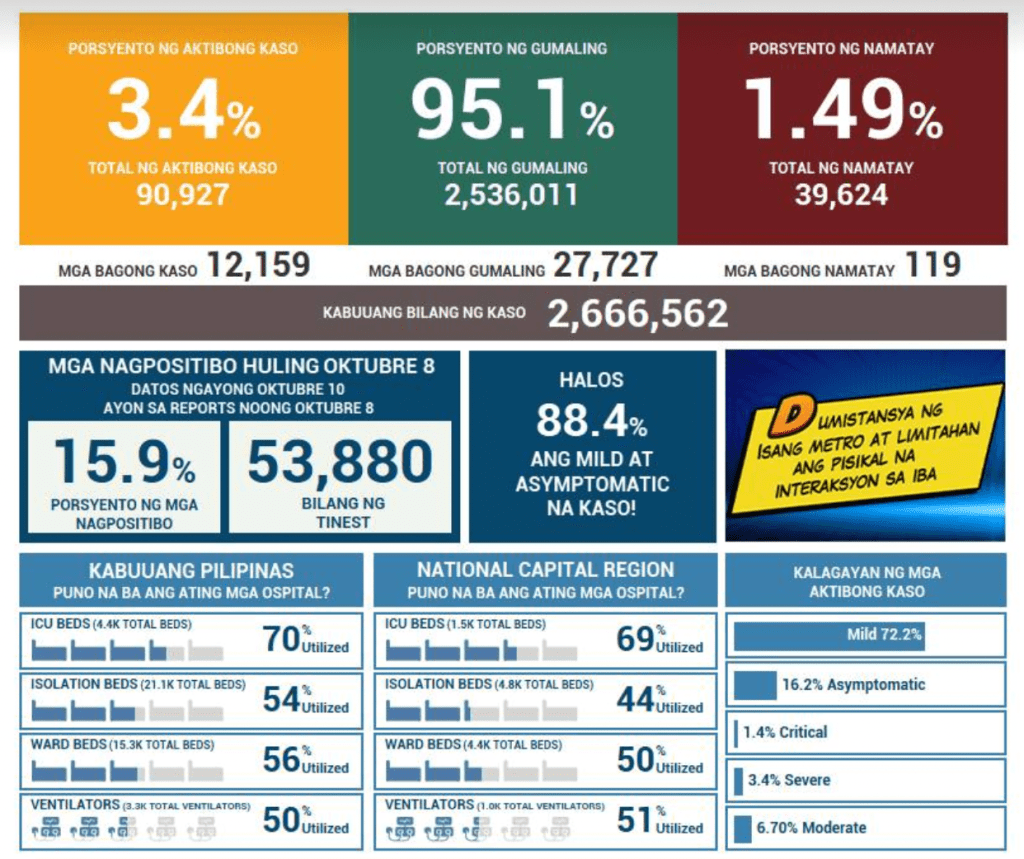
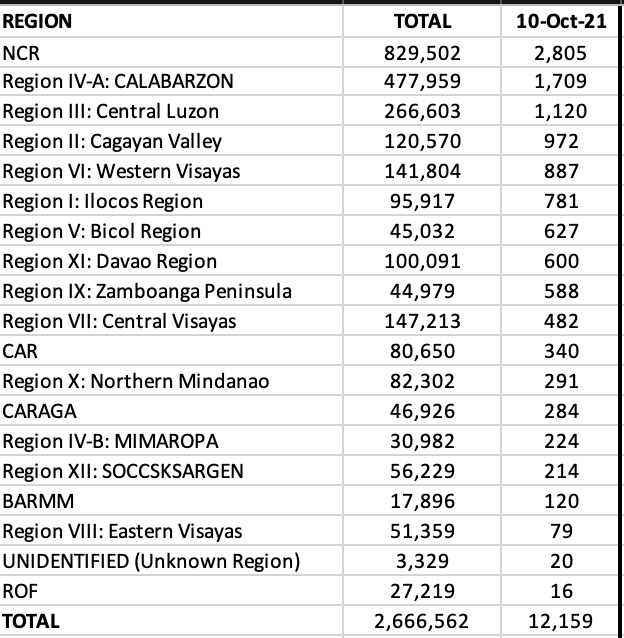
The Health Agency reports 12,159 new cases today. Of course, this will not match their infographics where they point out that the data today is based on reports last October 8 where 53,880 were tested with 15.9% positivity. If this were the case, then we would mathematically have 8500 or so cases in actuality.

But people don’t count the backlog and if you did, you’d notice that the backlogs were mounting the past days. I can only surmise that these were due to the COVIDKaya glitches, which needs to get addressed ASAP. It is difficult to model inaccurate data.

With more than 27,000 recoveries, the active cases are now at 90,927.

There are 119 new deaths reported today.

NCR recorded a high 23% of the total cases today (from previous < 20% daily shares), and CALABARZON and Central Luzon back in the 1-2-3 rankings. Cagayan Valley came in fourth and the other regions in Northern Luzon (Ilocos Region and CAR) take a respite from the daily high numbers (most likely delayed reports again).

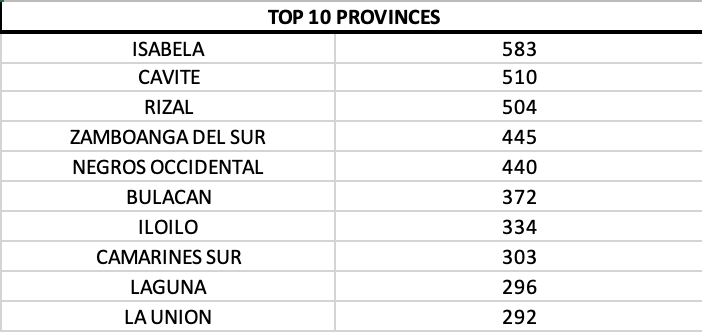
However, on a provincial level, Isabela continued to lead, followed by Cavite and Rizal.

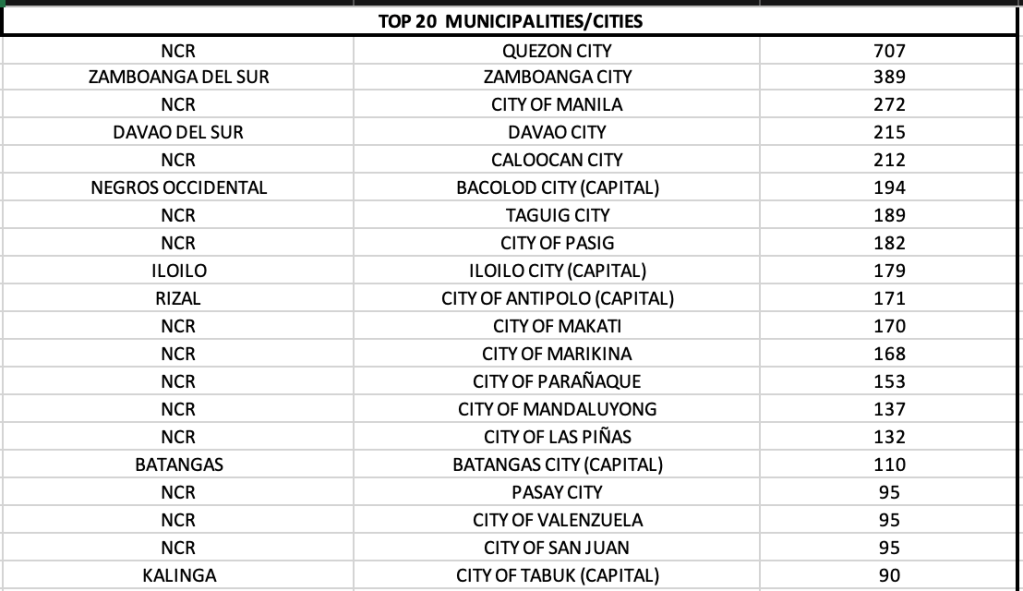
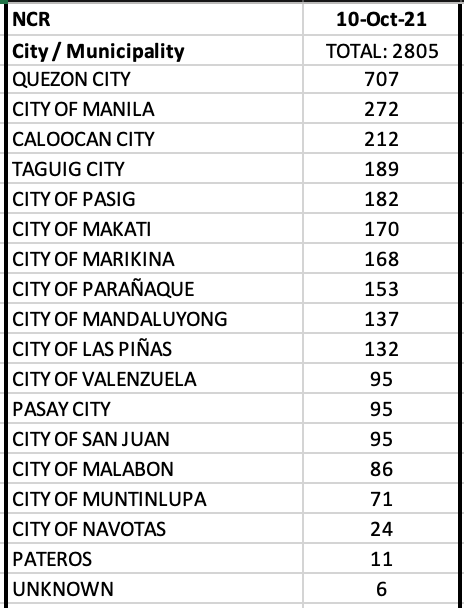
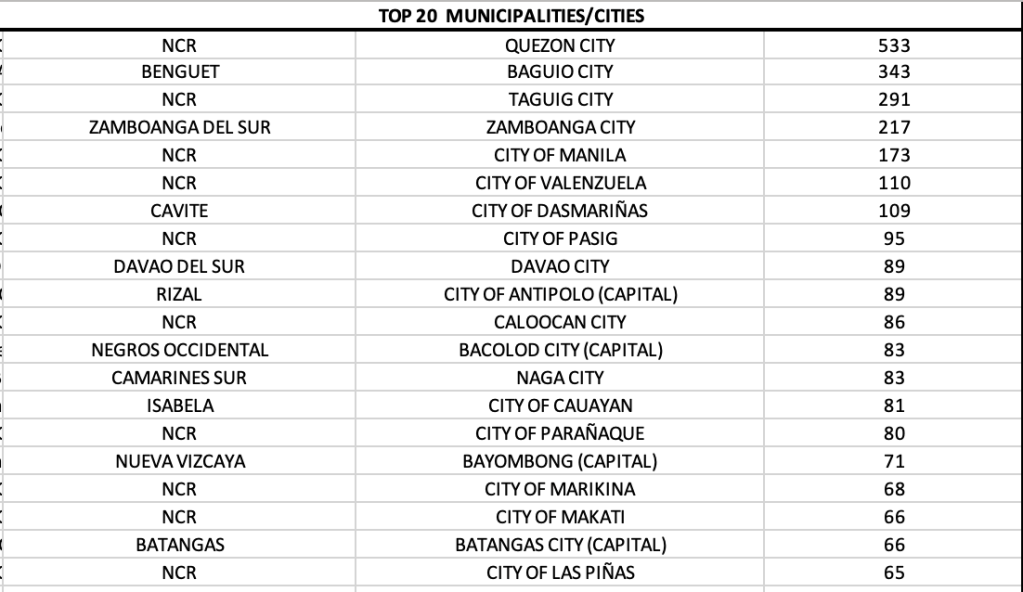
And among cities/municipalities, 13 of 17 LGUs in NCR are among the top ten. The surprise of the day is Zamboanga City that zipped into second spot. Davao City, Bacolod City, Iloilo City and Antipolo (Rizal) are in the top ten list.

THE WEEK IN REVIEW

The number of cases (and deaths) continued to decrease in the Philippines, in spite of remaining anywhere between 7th-11th place (depending on which day you were looking at). The 7-day average is down to a little more than 11,000 and should likely trend in the four digits this coming week, as the R is seen declining as well.

The average deaths seen is also low, but may not be accurate as the many glitches in COVIDKaya became challenging in reporting mortalities.

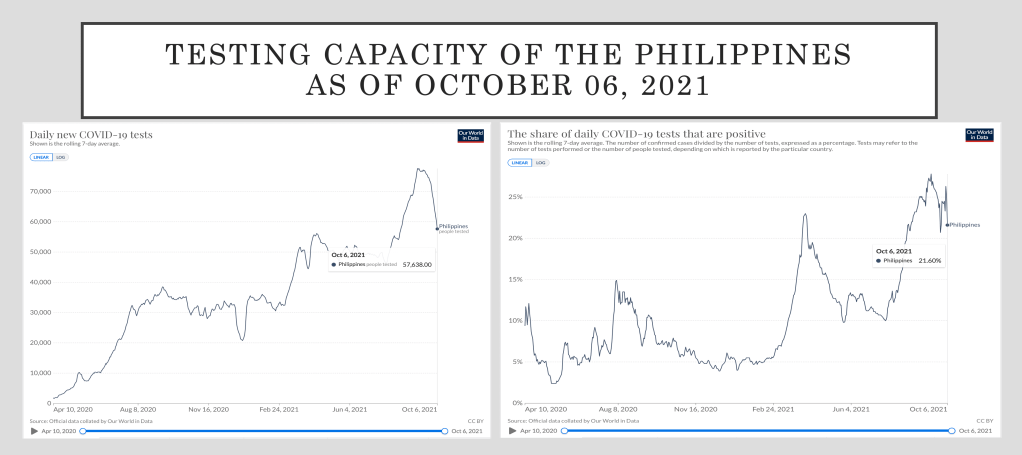
Testing has also considerably declined, but the positivity rate has decreased as well. The decrease in testing can be attributed to the decreasing cases, particularly in the National Capital Region. Why is this so? The NCR (plus CALABARZON and Central Luzon) account for more than 50% of the almost 280 testing facilities in the country. Notice that the positivity rate posted here is still at 21%, but the Department of Health pegs our 7 day average at 16.3% as of yesterday, October 9, 2021.

If you scrutinize the data drop, the NCR, the largest contributor to the daily COVID-19 cases has a positivity rate of 13%. Quite a distance from the national average. It’s because more people get tested where there are facilities. Where there is lack of laboratories for testing, there is delay in testing and obtaining results.

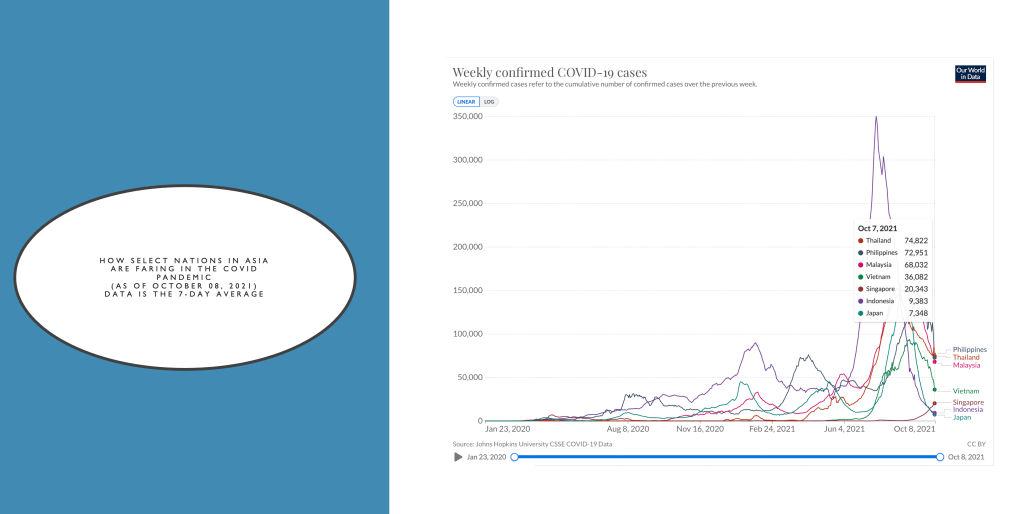
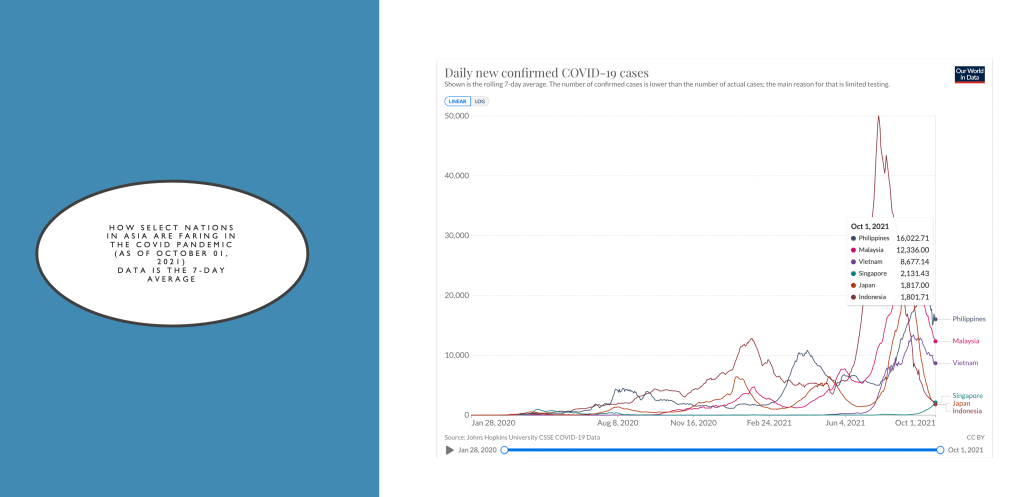
In the ASEAN region and select Asian continent, the total number of weekly confirmed COVID-19 cases as of October 8 was highest for Thailand, followed by the Philippines. Surprisingly, Singapore had more cases this past week with 20,343 cases, than Indonesia that reported only 9,383 cases over the whole week.

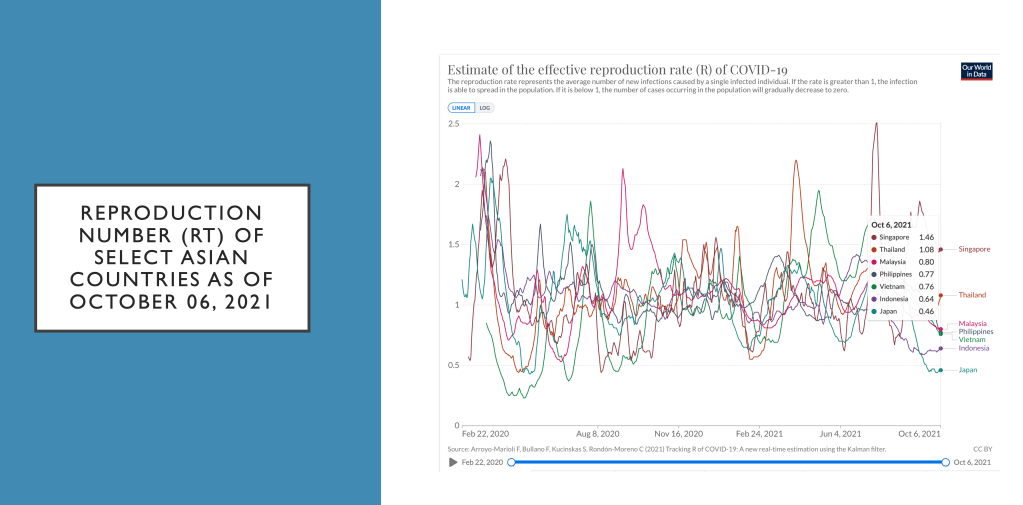
The number of cases can be correlated with the effective reproduction number among the same countries. Singapore is seeing a rise in R at 1.46, while Thailand is cruising at 1.08. All other ASEAN nations are down to <1.0, while Japan is seeing a R<0.5. If Japan is able to maintain the R <0.5 for a whole month, it will likely see double to low triple digit cases in a day next month.
A tad higher but plateauing and the data of 10.09.2021

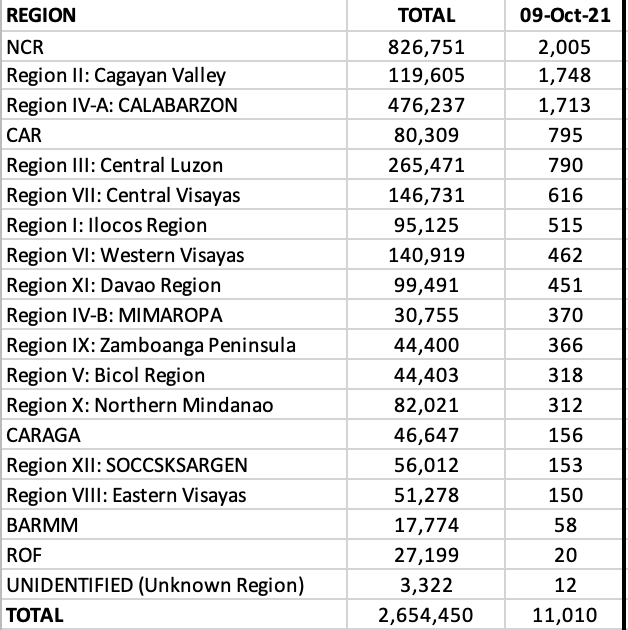
The Health Agency reported 500 additional cases today announcing 11,010 new cases today. With more than 22,500 recoveries, there are a bit more than 100,000 active cases with 90.2% being asymptomatic and mild at the time of testing.

Total tests done last October 7 was 56,475 with 16.3% positivity.

There were 273 new deaths reported today putting the total deaths closer to 40,000.

Notice that there is now a lowering of health care utilization, including ICU utilization.

NCR saw a slight bump up in the share of the total cases with 18.2% or 2,005 new cases. Nevertheless, it was Northern Luzon that accounted for 28% of the country’s cases with Cagayan Valley in second spot.

On a provincial level, four provinces located in Northern Luzon are among the top ten – Isabela and Benguet (first and third), and Cagayan and Nueva Vizcaya.

Nine of 17 LGUs continued to be in the top 20 cities/municipalities with most cases. The shift is in the LGUs outside of Mega Manila, where 6 of those in the top ten are from outside of the National Capital Region. Those in the top ten are: Baguio City, Davao City, Zamboanga City, Dasmariñas (Cavite), Cauayan (Isabela) and Bacolod City.

Flattening at 10K plus and the data on 10.08.2021

The COVIDKaya remains challenging as noted in the very very late upload of the data drop for yesterday, October 7, 2021.

I have updated the previous post with the granular data so that the readers can access it.

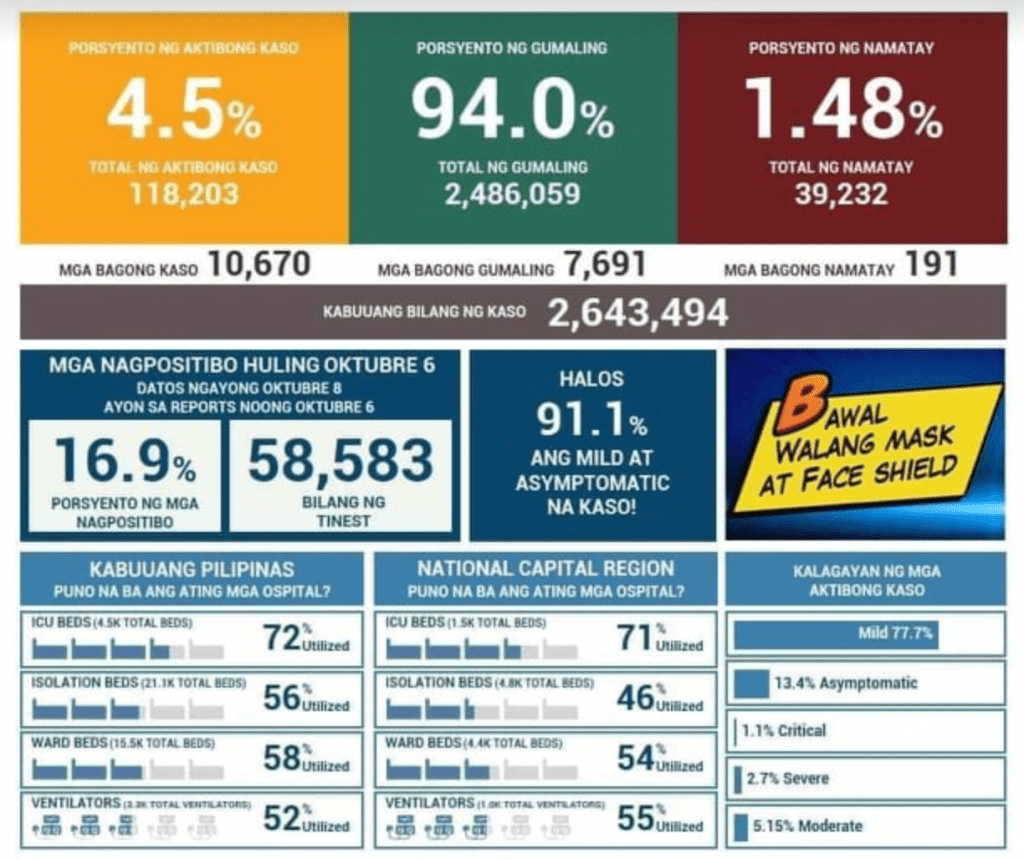
Today, the Health Agency reports 500 more cases than yesterday and announced 10,670 new cases. With 7,691 recoveries, the active cases are up at more than 118,000.

Total tests done on October 6 was 58,583, with a positivity rate of 16.9% (a new low).

Total deaths reported today was at 191.

NCR continues to lead, albeit flat, accounting for 17.1% of the total cases today. Aside from CALABARZON that came in third, the other regions with quadruple digits were all from Northern Luzon – Cordillera Administrative Regions, Ilocos Region and Cagayan Valley. Northern Luzon accounted for one-third of the total cases in the country.

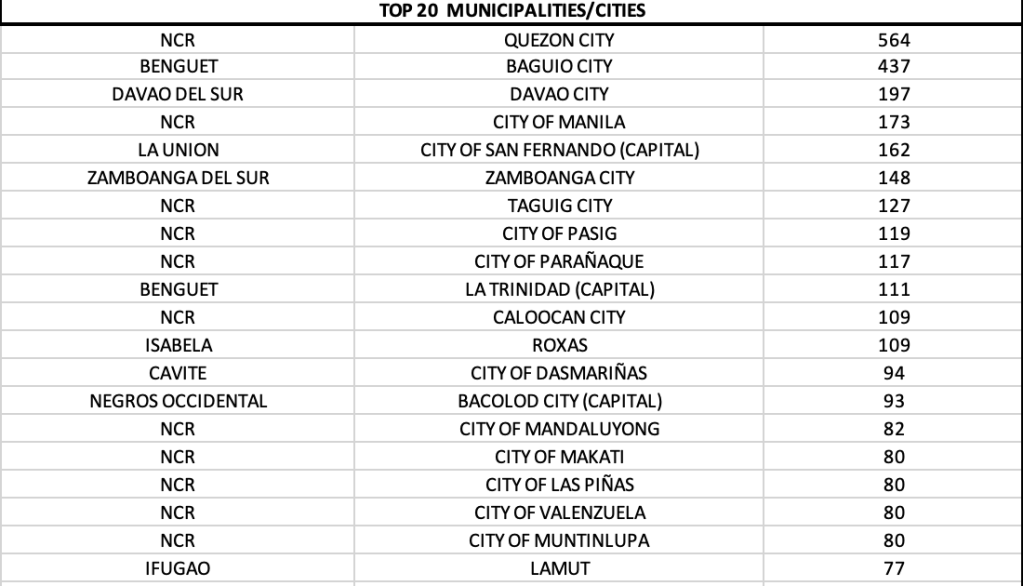
This is reflected in the fact that on a provincial level, 6 of the top ten provinces were all from the North: Benguet, Isabela, La Union, Pangasinan, Cagayan and Ifugao.

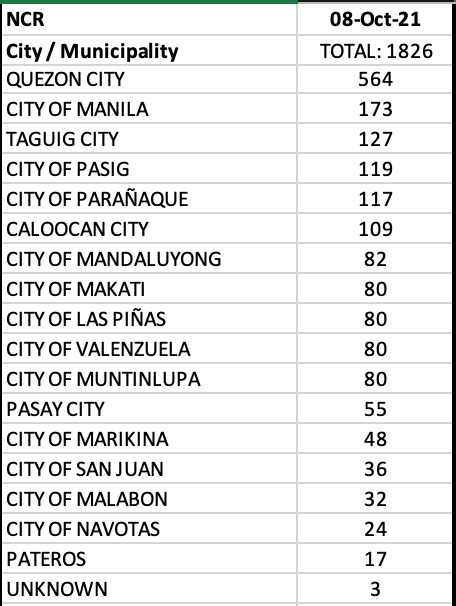
On a LGU level, 11 of 17 LGUs in NCR were among the top twenty cities/municipalities with most cases. However, five LGUs outside NCR were among the top ten, with Baguio City in second and Davao City in third. The others were: San Fernando (La Union), Zamboanga City, and La Trinidad (Benguet).

At >10,000 cases and R=0.85 and the data for 10.07.2021

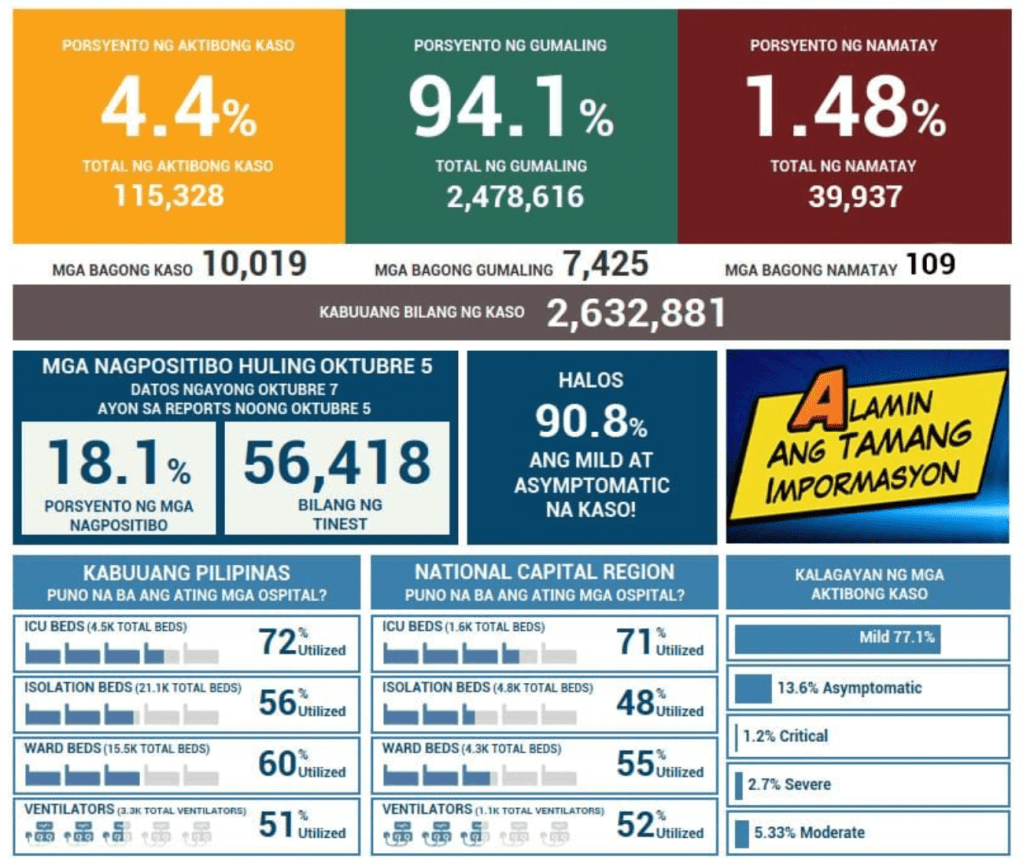
With declining cases, the reproduction number of the Philippines as of October 3 stood at 0.85 (+/- 0.05). Which is good news, as NCR’s reproduction number slips further to 0.64 and a positivity rate around 16%.

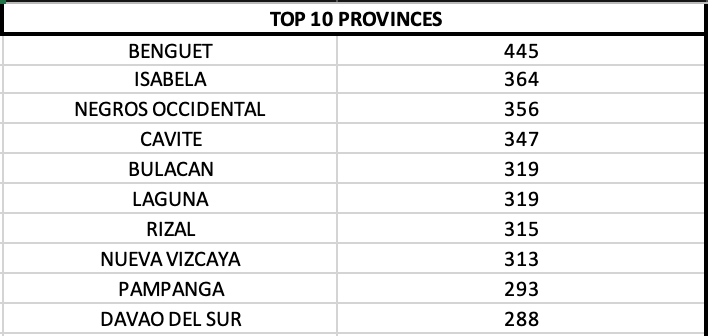
Today, the Health Agency reports 10,019 new cases. With more than 7000 recoveries, the active cases is up at 115,328. Total tests done last October 5 was 56,418, with a positivity rate of 18.1% (higher nationally than Mega Manila).

New deaths reported were 109.

The very late post for the granular data is due to the glitches in uploading of COVIDKaya.

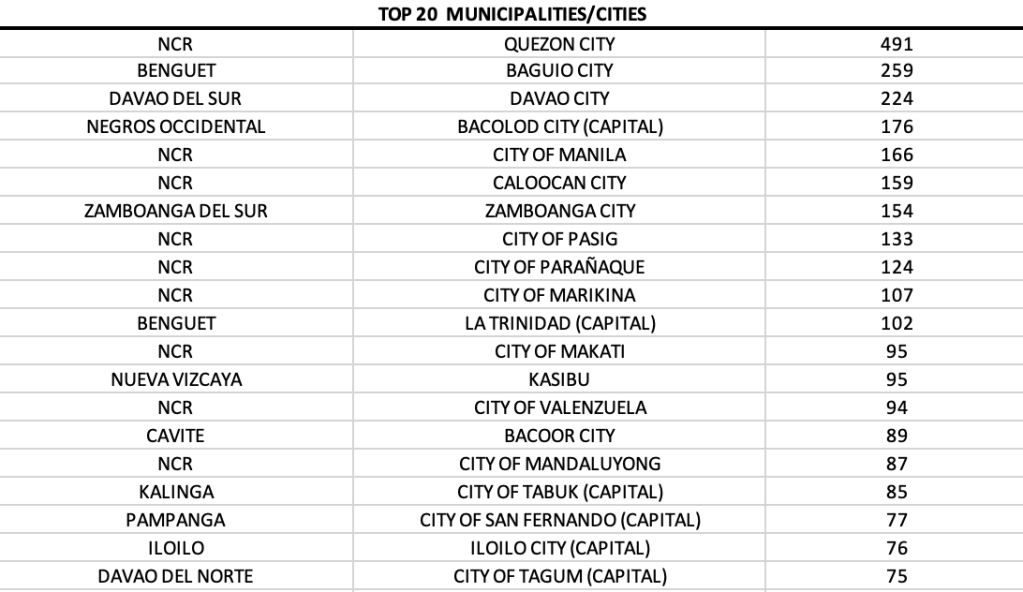
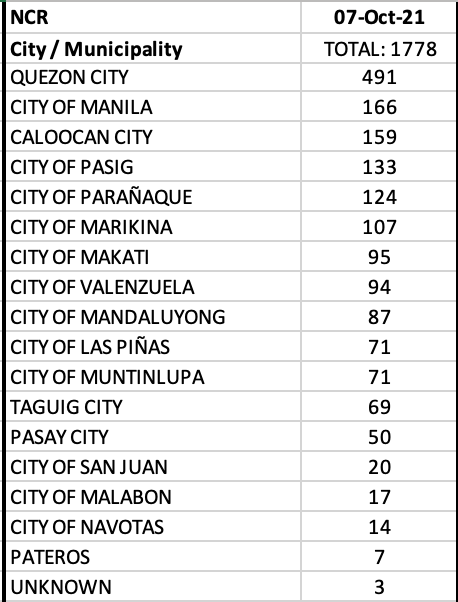
While NCR had 1,778 new cases, this was down to 17.7% of the total cases in the country. CALABARZON and Central Luzon are back in second and third place, while Cagayan Valley had 1,015 new cases. Again, all the remaining regions reported triple digits.

This data is well correlated with the top provinces Benguet and Isabela which continued to lead on a provincial level.

On the LGU level, 9 of 17 LGUs in NCR were in the top twenty cities with most cases. Baguio City, Davao City, Bacolod City and Zamboanga City made it to the top ten list.

A four digit Wednesday and the data of 10.06.2021

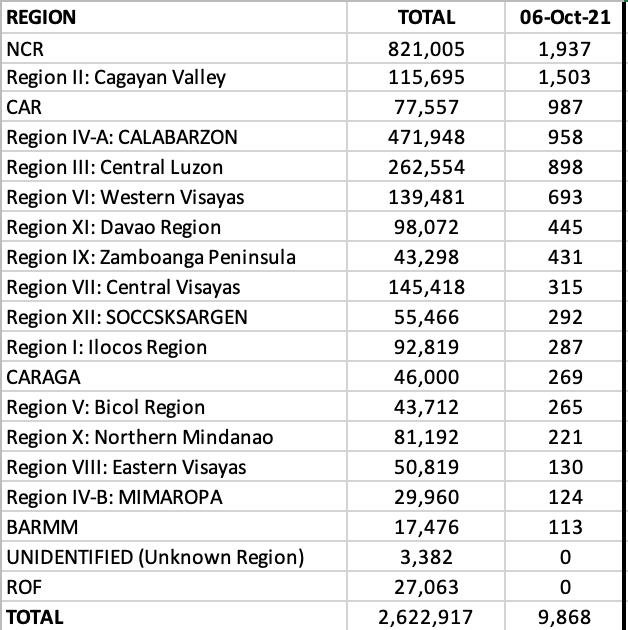
Well, we all know that Tuesdays and Wednesdays will yield lower numbers. And we’re seeing this consistent trend as the Health Agency reports 9,868 new cases. And with only 133 new recoveries counted, the active cases are up at past 112,000.

There were 43,759 tests done last October 4, bringing the positivity rate to 18.2%.

With the glitches hounding COVIDKaya, no deaths were reported again for the second consecutive day.

The good news (well let’s just call it good) is the decline in healthcare utilization in both the NCR and nationally. The NCR’s HCUR has dropped considerably, with ICU utilization now < 70% (critical mark).

The NCR continued to see less than 2,000 cases today and surprisingly, CALBARZON and Central Luzon now report three digits! However, Cagayan Valley is seeing a continued rise in cases as it comes second to NCR with more than 1,500 today. The bad news is that ALL regions reported three digits today.

On a provincial level, it was surprising that Cavite and Laguna did not land in the top ten. Three provinces in the north ranked 1-3. They are: Isabela, Nueva Vizcaya and Benguet.

Only 9 of 17 LGUs in NCR are among the top twenty cities with most cases today. Davao City, Baguio City, Zamboanga City and Solano (in Nueva Vizcaya) were among the top 10.

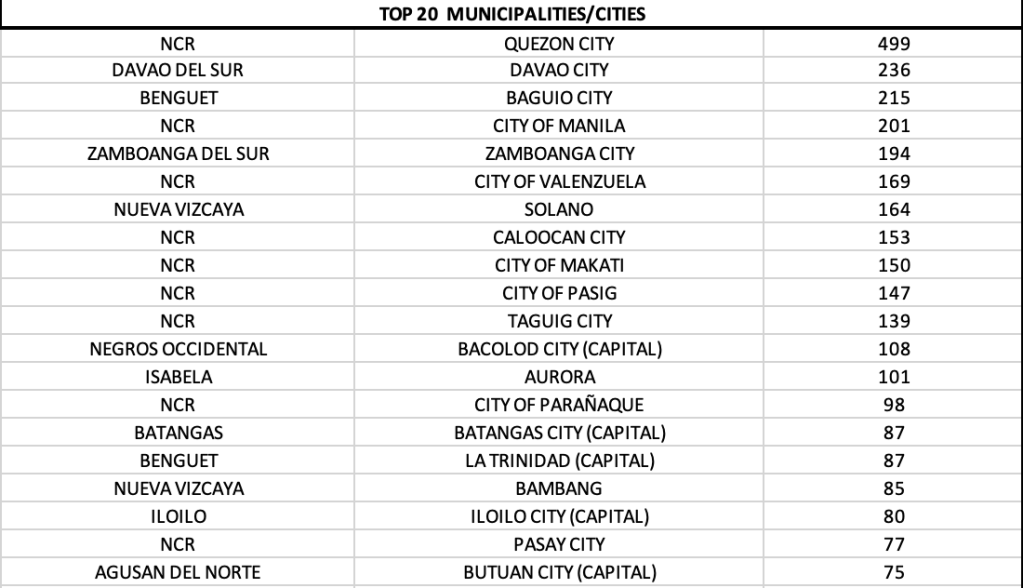
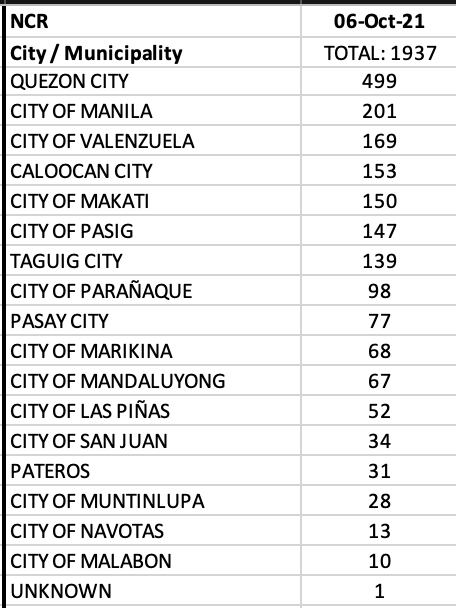
The day we tipped four digits and the data for 10.05.2021

Because it’s a Tuesday, we expected lower cases. Well, not that low, considering that we had 10K cases yesterday.

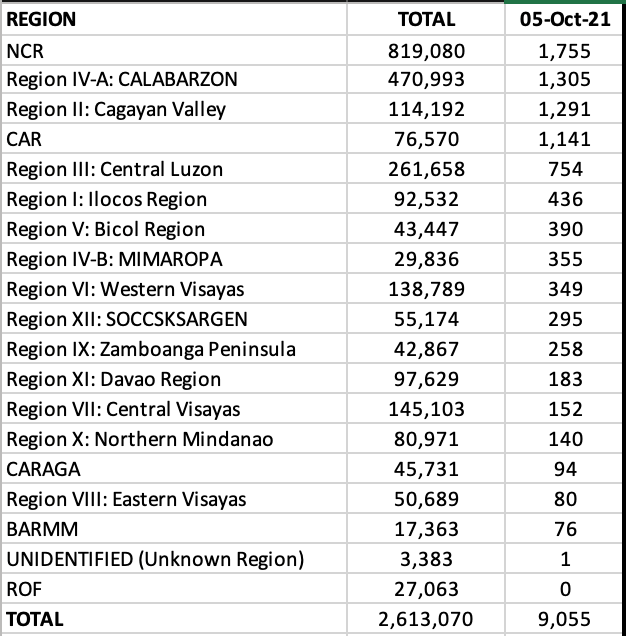
The Health Agency announces 9,055 new cases today. It’s been quite a long while since we tipped four digit numbers. Even the positivity rate is now below the 20% margin, in spite of only 41,673 tests being done last October 3. With more than 12,000 recoveries, the active cases are down to 103,077.

Unfortunately, with the glitches on the COVIDKaya system, no deaths were announced today.

Healthcare utilization is also lower in both the national level and NCR.

While NCR and CALABARZON continue to lead among regions with most cases, generally, the number of cases are lower today. It is, however, the regions in Northern Luzon that continue to see increasing cases in spite of the lower cases nationally.

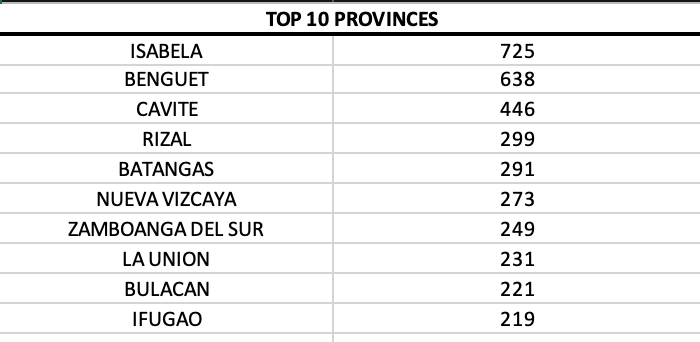
The regional data is reflected also in the provincial level as the provinces of Isabela and Benguet continue the 1-2 lead, and three other provinces in the north, namely, Nueva Vizcaya, La Union and Ifugao are among the top ten provinces with most cases for the day.

It was a half and half scenario in the LGU level, where 10 of 17 LGUs in NCR were in the top 20 list, while the remaining 10 were from outside of NCR.

A good shock, and the data for 10.04.2021

Unexpected. After all, today is a Monday. Yet the lowest number of cases reported on a Monday since the July surge was reported today.

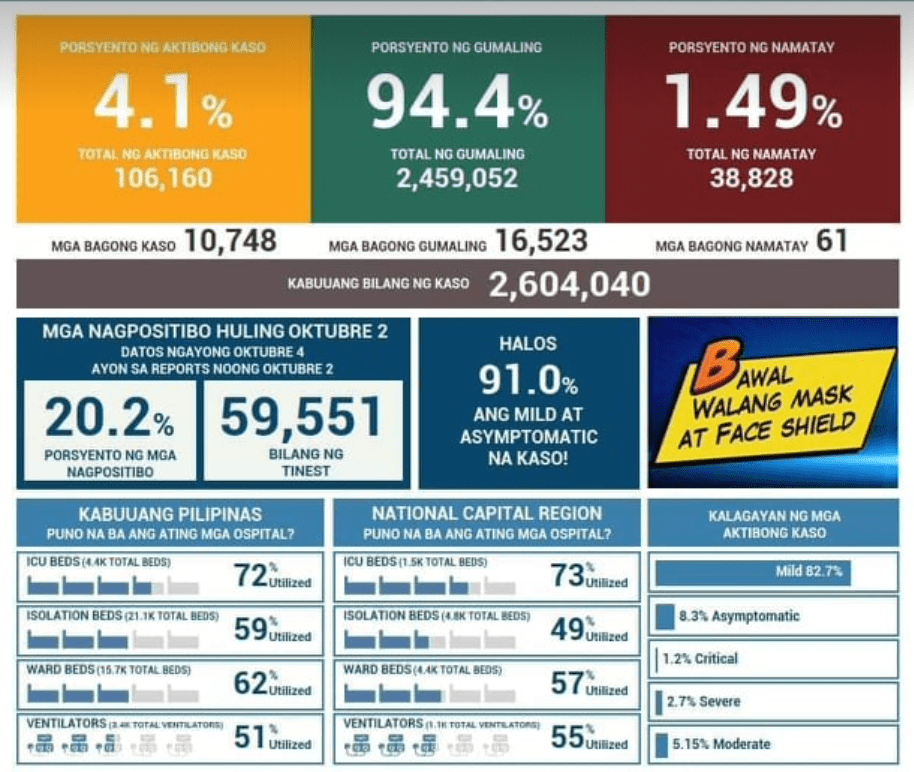
The Health Agency reports 10,748 new cases today and with over 16,000 recoveries, the active cases are down to a little more than 100,000. Another good news. Nevertheless, in spite of the lower cases today, it was enough to push the total of the Philippines past 2.6M. A new milestone. Hopefully, it slows down as it targets the next milestone of 2.7M.

There were close to 60,000 tests done last October 2, a Saturday, with a 20.2% positivity rate (which is still considerably high).

There were 61 new deaths announced today.

The final good news, is that the hospital utilization rate in the National Capital Region is declining slowly as well. ICU utilization rate will always be a late parameter because recovery of severe and critically ill patients will always be delayed.

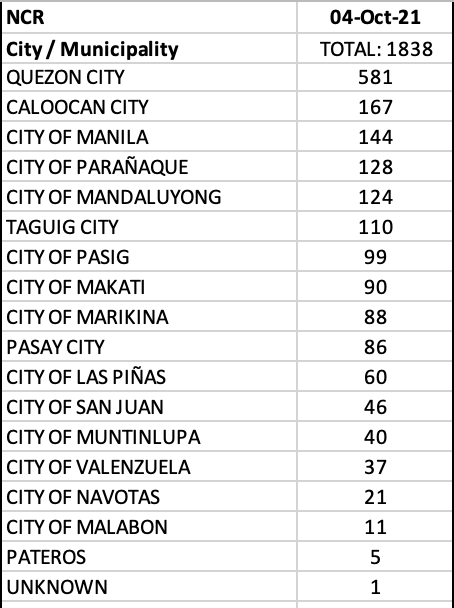
NCR had a pleasant surprise as well, owning 17% of the total cases in the country today. It was way below the range of percentage of the share of COVID-19 cases. On the flip side of the good news is Northern Luzon, where Regions I, II and CAR are seeing higher cases. NCR plus (CALABARZON and Central Luzon) accounted for 40% of the total cases (a large drop from the usual 50-55%), but Northern Luzon saw a rapid rise to 35% (from 18-25% the previous week) of the share of total cases for the day.

This is reflected in the provincial count where the provinces of Ilocos Sur, Benguet and Nueva Vizcaya have dominated the top provinces for the day.

Even on an LGU level (cities and municipalities), while 9 of 17 LGUs in NCR were among the top 20 cities with most cases, 8 of the LGUs from Regions I, II and CAR were in the list. Baguio City continued to be in number 2 for cities with most cases in the country.

The downtrend with 13,273 cases and the data for 010.03.2021

The late report of the Health Agency due to glitches in COVIDKaya is back.

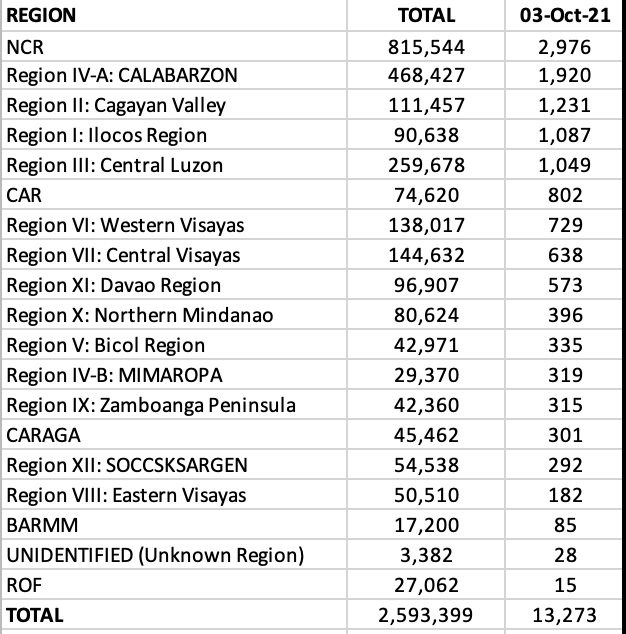
There are 13,273 new cases reported today but with a whopping over 45,000 recoveries, the active cases are down to a tad above 112,000. Tomorrow, the Philippines will surpass the next milestone with more than 2.6M cases.

Close to 65,000 tests were done last October 1, giving a positive rate of 20.2%. Hopefully, if we do more tests, we should be able to bring this down to less than 20% next week.

New deaths announced is 112 today.

NCR accounted for a moderate number of the total cases, up from a previous day of 19% to 22% today. First place Quezon City alone accounted for almost the same number of cases of four cities that ranked 2nd to 5th – Davao City, City of Manila, Zamboanga City, and Caloocan City.

On a regional level, Regions I, II and CAR continued to report high number of cases and made up for almost 24% of the total national cases.

The province of Isabela topped the provincial level.

Eleven of 17 LGUs in NCR were among the top twenty cities/municipalities with most cases for the day, while the rest were from LGUs outside of Mega Manila.

THE WEEK IN REVIEW

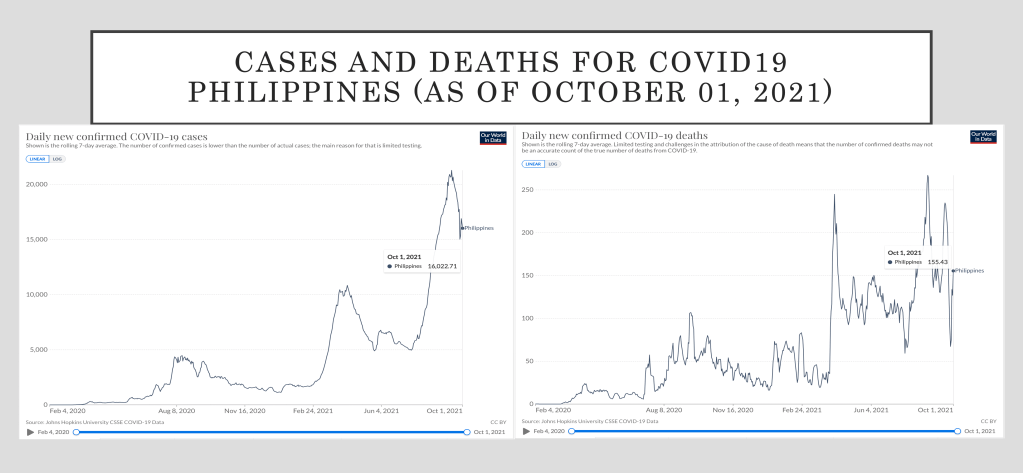
It was a rollercoaster week as the Philippines saw a slight decline in its average daily cases. In spite of the lower 7-day average, it remained in the top 10 among countries with most cases in the world over the past week. The glitches in the data system added to the daily anxiety as the cases (and deaths) were announced late (or not at all).

So the good news is that we are seeing a decline in cases. The bad news is that it’s still considerably high compared to the March/April surge.

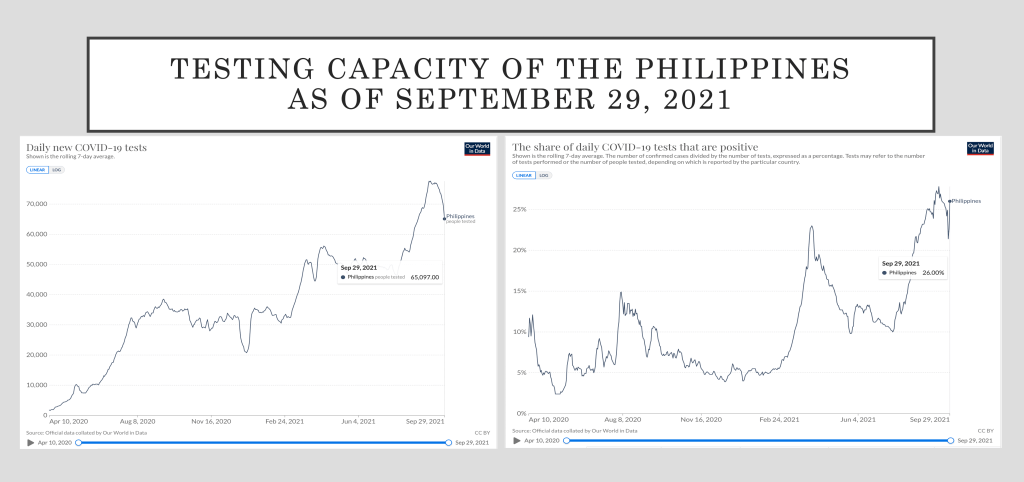
The disturbing part of the pandemic response in the country is the variability in testing capacity. We are second to Mexico, among countries that have low testing and therefore announce a high positivity rate. Tests are important because it helps identify those that are sick or asymptomatic. Patients positive for the virus are infective – where they are symptomatic or not. If you look at the daily data of the Department of Health, the asymptomatic account for an average of 15% of the active cases. A situation that is alarming because we are under estimating the numbers considering that testing capacity is low.

We cannot solely lie on vaccines to control the surge. We already know for a fact that people who are vaccinated have the potential to develop breakthrough infections and that patients who are vaccinated, get infected with delta variant, have the same viral load as non vaccinated individuals. The difference lies in the unvaccinated ending up sicker and more serious than non vaccinated people.

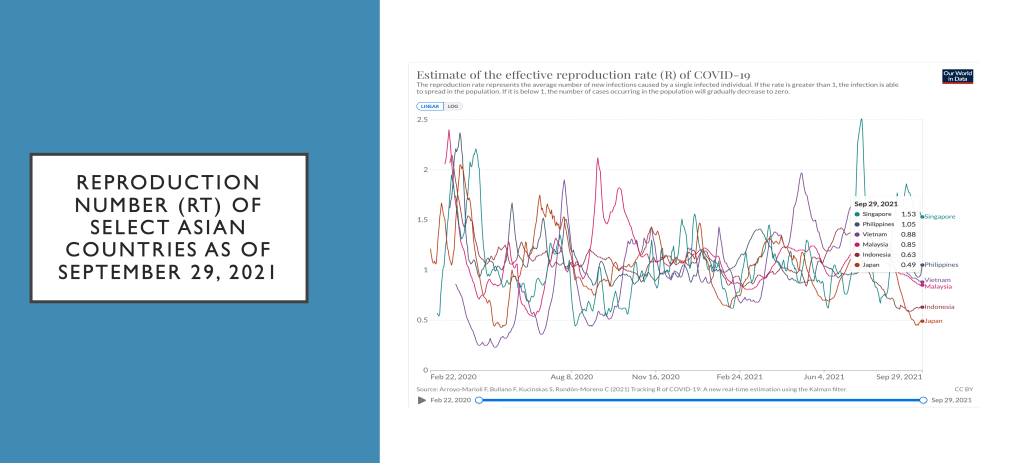
As the cases slow down, the reproduction number nationally is stable at 1.05 (+/- 0.05). Which isn’t too bad but isn’t declining more rapidly. The R in the NCR is lower than the national R. That is because the cases in other regions, especially Northern Luzon have dragged the R up.

Among select Asian nations, Singapore is currently dealing with their own problems of a surge that is spiraling as well. It is now in a more strict mode for mobility for its citizens. Note, however, that the other ASEAN countries have dropped their R much faster and consistently than the Philippines. And that is why testing counts a lot.

The same Asian countries above, it is the Philippines that leads in the most number for 7-day average. ALL ASEAN nations show a downward trend in cases, except for Singapore that is in an upward trajectory.

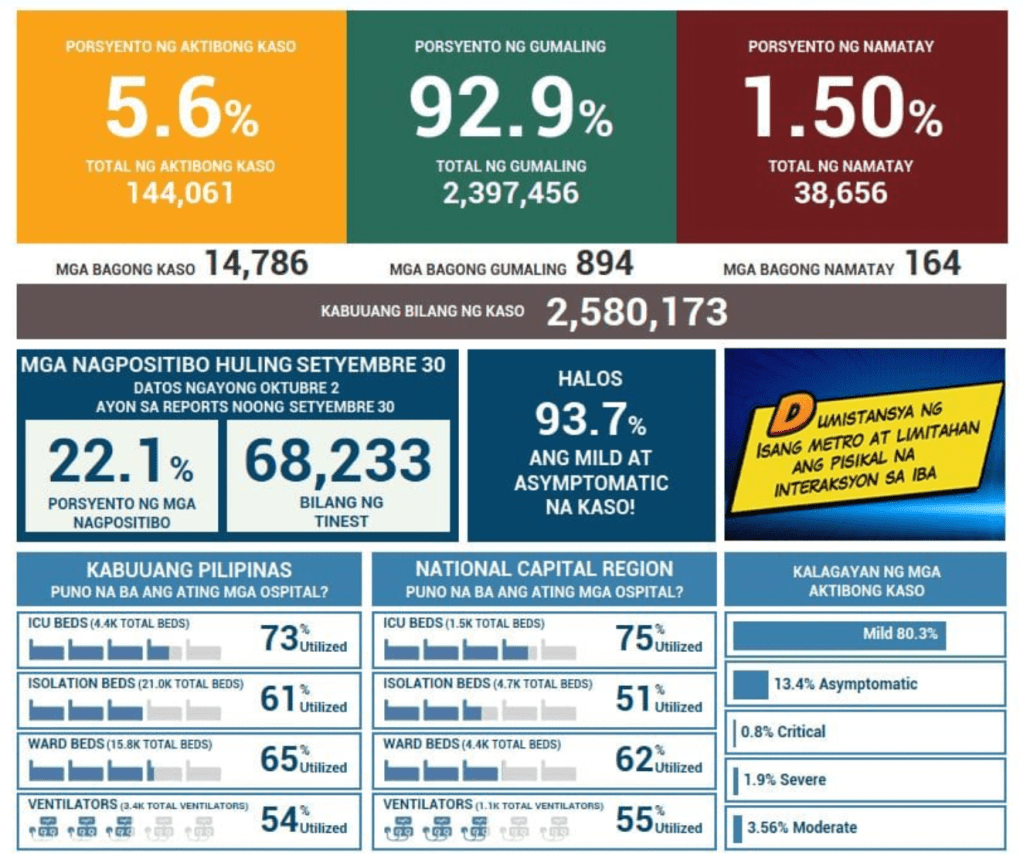
As the cases decline, we are still not testing enough and the data for 10.02.2021

The good news is that we seem to have plateaued.

The Health Agency reports 14,786 new cases today and with only 894 recoveries, the active cases jump close to 145,000.

While this is good news, the unsettling issue is the testing. There were only 68,233 tests run on September 30, with a positivity rate of 22.1%. While there are more testing done in NCR and in other HUCs (e.g., Cebu), it is not the same across all provinces particularly in areas where there are few testing facilities. It cannot be overemphasized that the government needs to invest in more testing in order to see the true picture of the cases in the country. With more than 22% positivity, we are definitely under testing and under estimating the real number of cases of COVID19. You cannot control a pandemic properly if you do not see the enemy. You cannot rely on vaccination as the only exit strategy in this pandemic.

There are 164 new deaths recorded today.

Notice that of the 144,000 plus active COVID19 cases, over 13% are asymptomatic, while 2.7% (or 3,900) are severe and critical and 2.56% (5,130) are moderate. Remember, the classification is based on the clinical presentation of the patient at the time the test was done. It is possible that patients who are asymptomatic become mild or even die later on. I doubt that the agency follows up each and every patient.

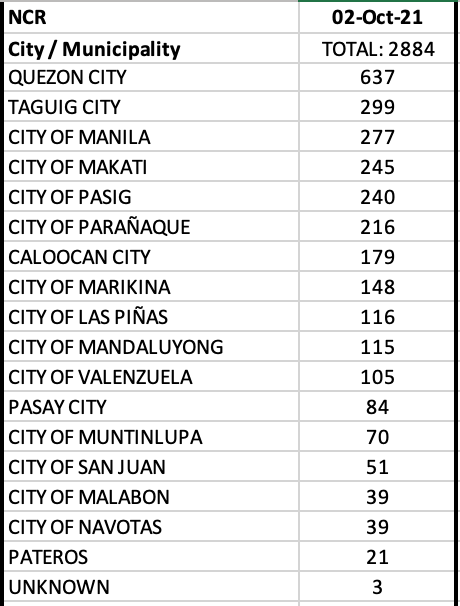
The NCR posted less than 3,000 cases today, accounting for 19.5% of the total cases. Other regions with four digits were: CALABARZON, Ilocos Region, Central Luzon, CAR and Cagayan Valley. The cases in Northern Luzon are disturbingly high as Regions I, II, and CAR account for close to 27% of the total cases in the country today.

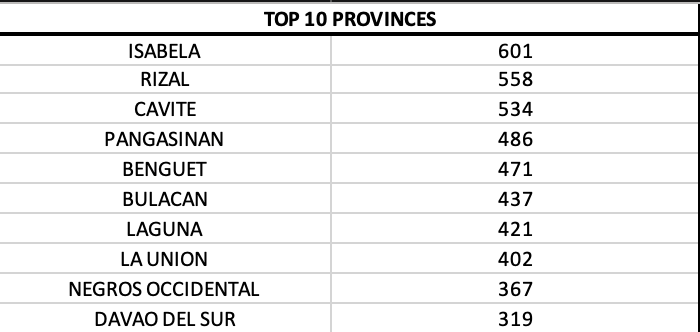
While Cavite topped the provinces, it was four provinces in Northern Luzon that were in the top five: Ilocos Sur, Isabela, Benguet, and La Union.

On a city/municipality level, Quezon City will always be the city to beat in terms of number of cases. Baguio City remains a solid second behind Quezon City. Eleven of 17 LGUs in NCR are in the top twenty, while the remaining are from LGUs in the provinces.