The downtrend with 13,273 cases and the data for 010.03.2021

The late report of the Health Agency due to glitches in COVIDKaya is back.

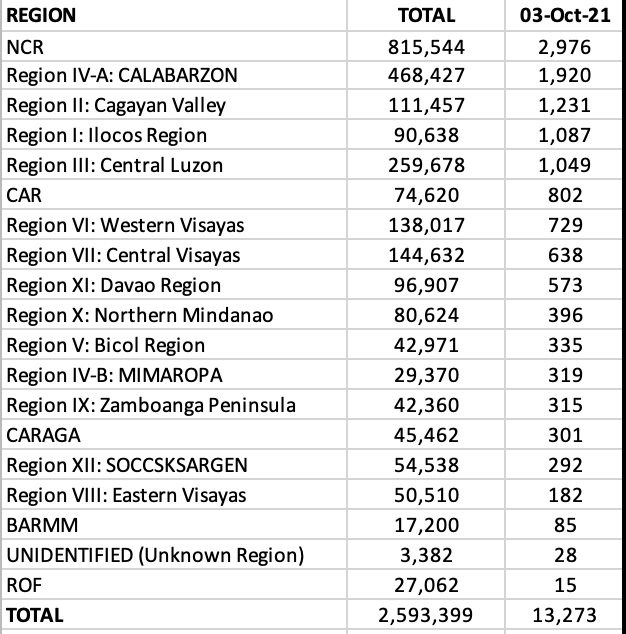
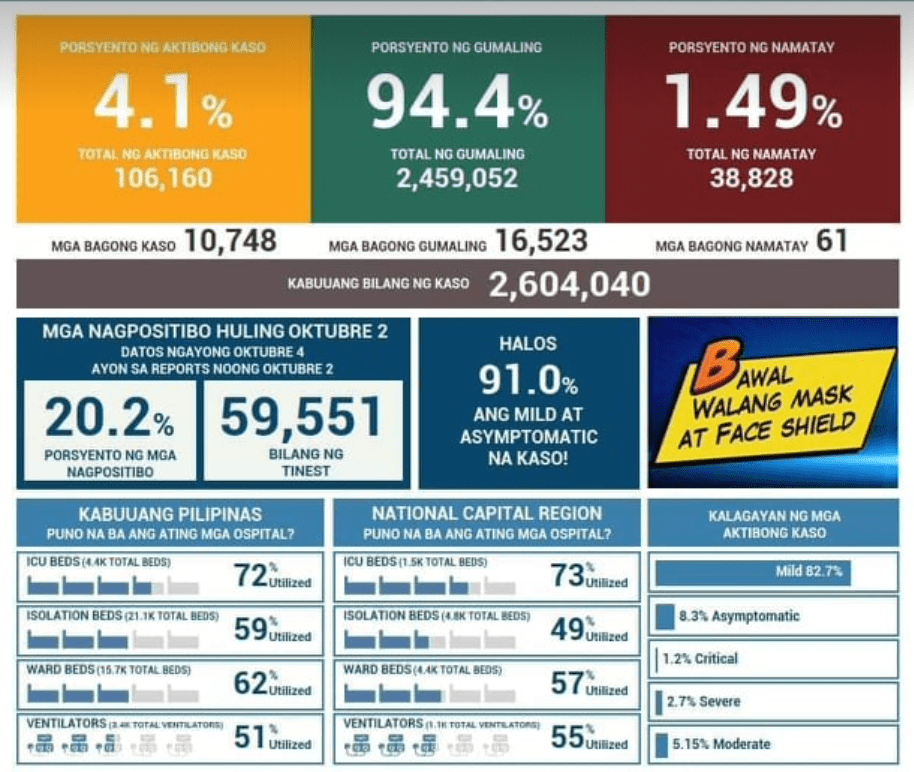
There are 13,273 new cases reported today but with a whopping over 45,000 recoveries, the active cases are down to a tad above 112,000. Tomorrow, the Philippines will surpass the next milestone with more than 2.6M cases.

Close to 65,000 tests were done last October 1, giving a positive rate of 20.2%. Hopefully, if we do more tests, we should be able to bring this down to less than 20% next week.

New deaths announced is 112 today.

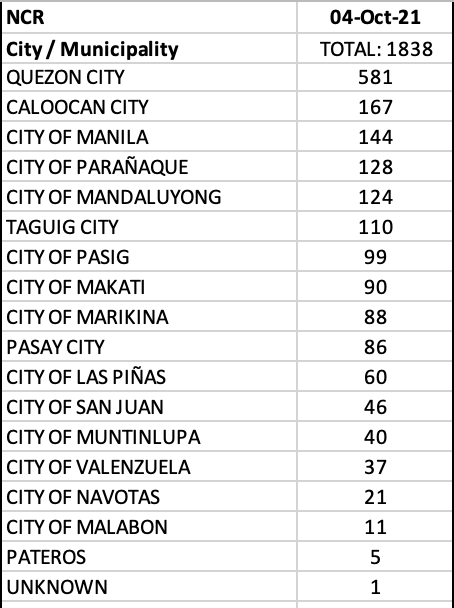
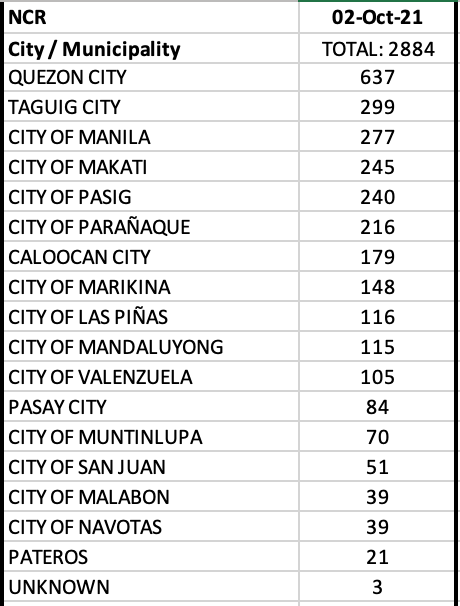
NCR accounted for a moderate number of the total cases, up from a previous day of 19% to 22% today. First place Quezon City alone accounted for almost the same number of cases of four cities that ranked 2nd to 5th – Davao City, City of Manila, Zamboanga City, and Caloocan City.

On a regional level, Regions I, II and CAR continued to report high number of cases and made up for almost 24% of the total national cases.

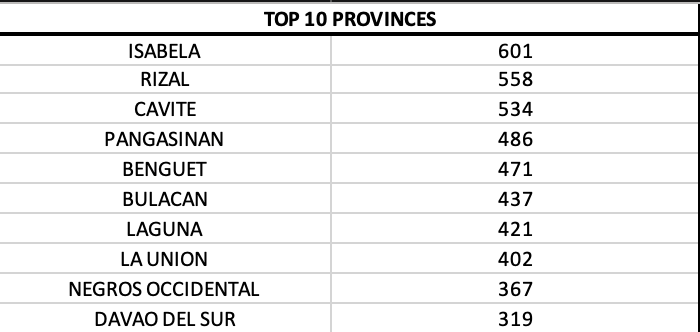
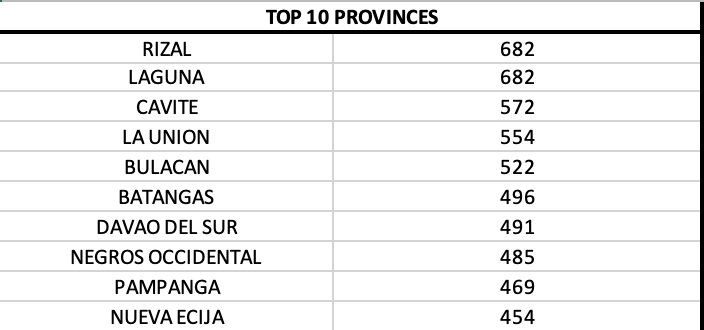
The province of Isabela topped the provincial level.

Eleven of 17 LGUs in NCR were among the top twenty cities/municipalities with most cases for the day, while the rest were from LGUs outside of Mega Manila.

THE WEEK IN REVIEW

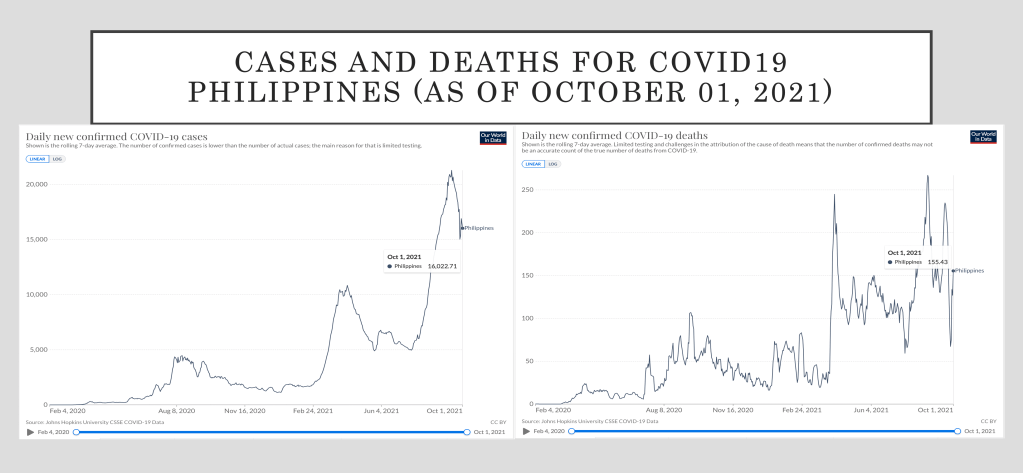
It was a rollercoaster week as the Philippines saw a slight decline in its average daily cases. In spite of the lower 7-day average, it remained in the top 10 among countries with most cases in the world over the past week. The glitches in the data system added to the daily anxiety as the cases (and deaths) were announced late (or not at all).

So the good news is that we are seeing a decline in cases. The bad news is that it’s still considerably high compared to the March/April surge.

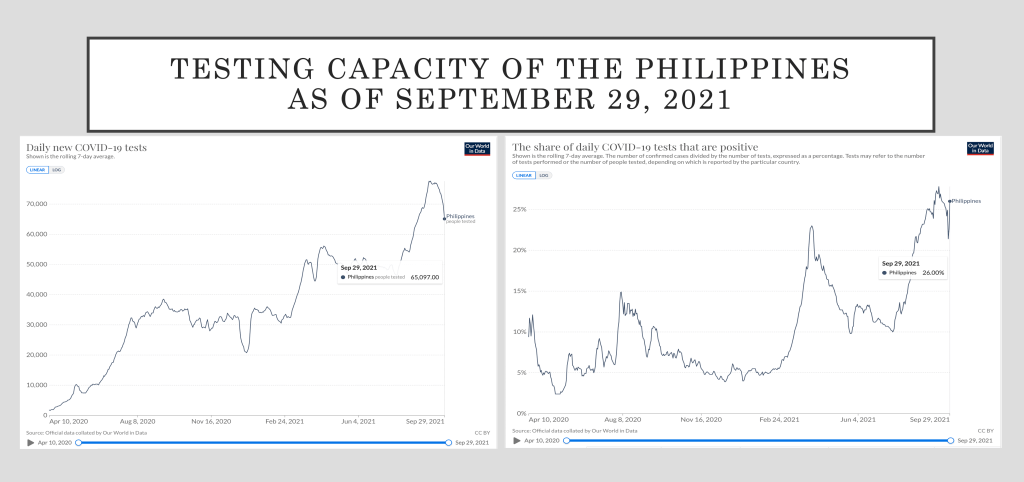
The disturbing part of the pandemic response in the country is the variability in testing capacity. We are second to Mexico, among countries that have low testing and therefore announce a high positivity rate. Tests are important because it helps identify those that are sick or asymptomatic. Patients positive for the virus are infective – where they are symptomatic or not. If you look at the daily data of the Department of Health, the asymptomatic account for an average of 15% of the active cases. A situation that is alarming because we are under estimating the numbers considering that testing capacity is low.

We cannot solely lie on vaccines to control the surge. We already know for a fact that people who are vaccinated have the potential to develop breakthrough infections and that patients who are vaccinated, get infected with delta variant, have the same viral load as non vaccinated individuals. The difference lies in the unvaccinated ending up sicker and more serious than non vaccinated people.

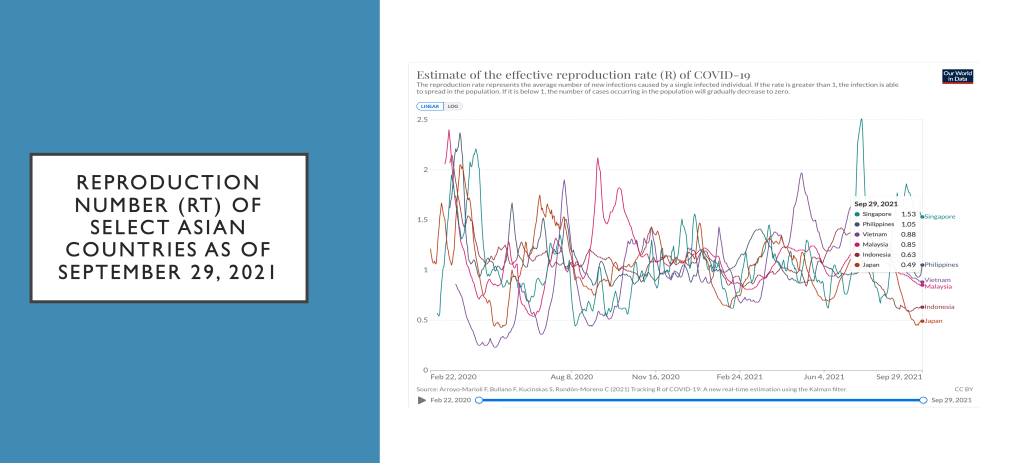
As the cases slow down, the reproduction number nationally is stable at 1.05 (+/- 0.05). Which isn’t too bad but isn’t declining more rapidly. The R in the NCR is lower than the national R. That is because the cases in other regions, especially Northern Luzon have dragged the R up.

Among select Asian nations, Singapore is currently dealing with their own problems of a surge that is spiraling as well. It is now in a more strict mode for mobility for its citizens. Note, however, that the other ASEAN countries have dropped their R much faster and consistently than the Philippines. And that is why testing counts a lot.

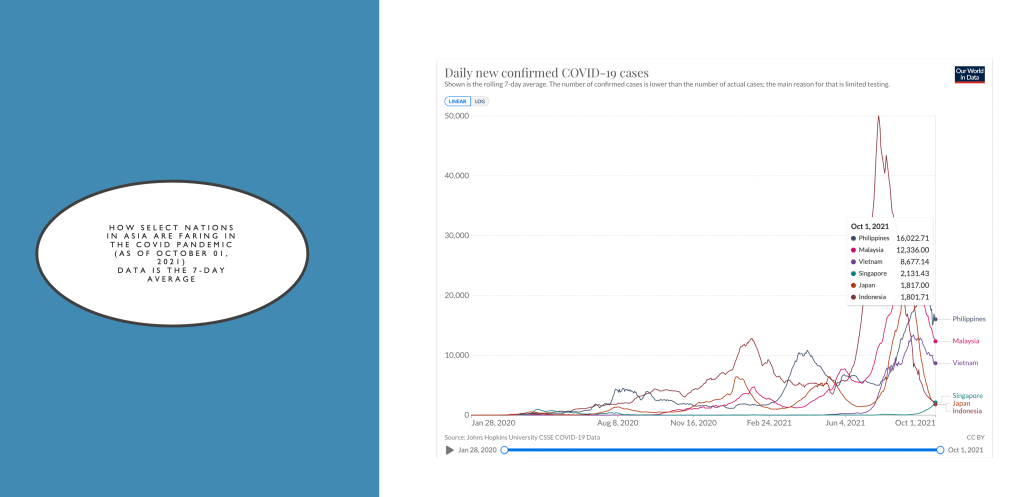
The same Asian countries above, it is the Philippines that leads in the most number for 7-day average. ALL ASEAN nations show a downward trend in cases, except for Singapore that is in an upward trajectory.

As the cases decline, we are still not testing enough and the data for 10.02.2021

The good news is that we seem to have plateaued.

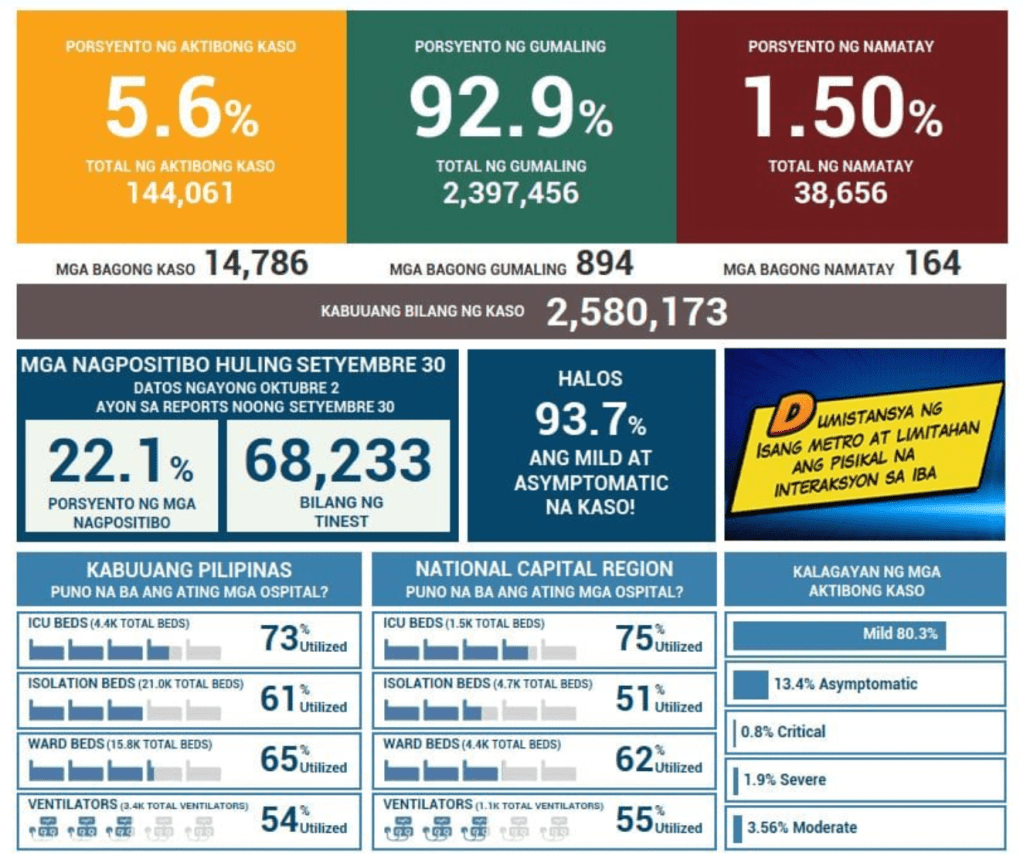
The Health Agency reports 14,786 new cases today and with only 894 recoveries, the active cases jump close to 145,000.

While this is good news, the unsettling issue is the testing. There were only 68,233 tests run on September 30, with a positivity rate of 22.1%. While there are more testing done in NCR and in other HUCs (e.g., Cebu), it is not the same across all provinces particularly in areas where there are few testing facilities. It cannot be overemphasized that the government needs to invest in more testing in order to see the true picture of the cases in the country. With more than 22% positivity, we are definitely under testing and under estimating the real number of cases of COVID19. You cannot control a pandemic properly if you do not see the enemy. You cannot rely on vaccination as the only exit strategy in this pandemic.

There are 164 new deaths recorded today.

Notice that of the 144,000 plus active COVID19 cases, over 13% are asymptomatic, while 2.7% (or 3,900) are severe and critical and 2.56% (5,130) are moderate. Remember, the classification is based on the clinical presentation of the patient at the time the test was done. It is possible that patients who are asymptomatic become mild or even die later on. I doubt that the agency follows up each and every patient.

The NCR posted less than 3,000 cases today, accounting for 19.5% of the total cases. Other regions with four digits were: CALABARZON, Ilocos Region, Central Luzon, CAR and Cagayan Valley. The cases in Northern Luzon are disturbingly high as Regions I, II, and CAR account for close to 27% of the total cases in the country today.

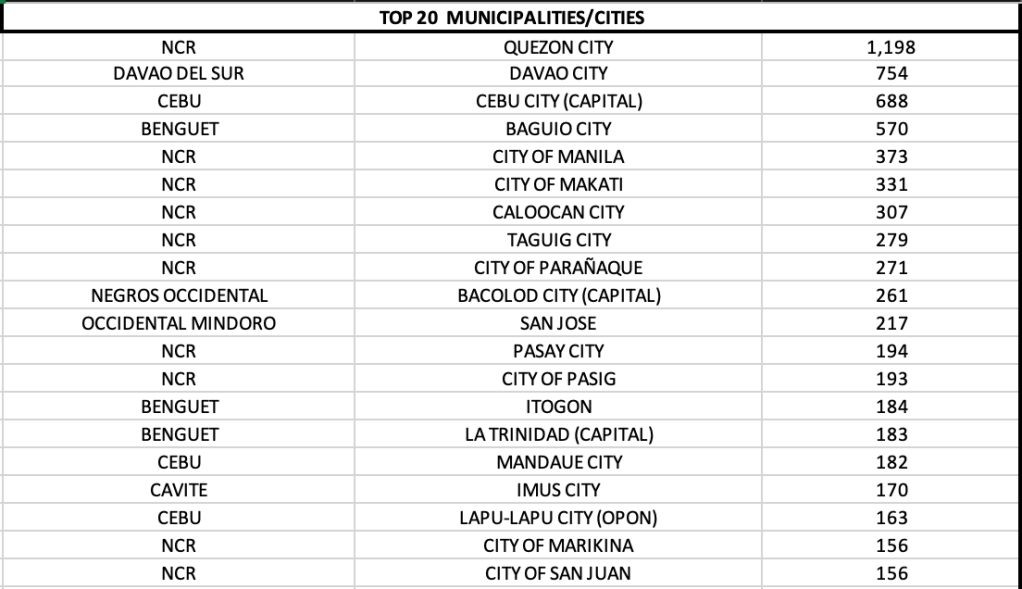
While Cavite topped the provinces, it was four provinces in Northern Luzon that were in the top five: Ilocos Sur, Isabela, Benguet, and La Union.

On a city/municipality level, Quezon City will always be the city to beat in terms of number of cases. Baguio City remains a solid second behind Quezon City. Eleven of 17 LGUs in NCR are in the top twenty, while the remaining are from LGUs in the provinces.

With 15,566 cases on 01.10.2021, we are seeing a downward trend. Can we sustain this?

With a little more than 15,000 cases announced by the Health Agency today, and the more than 23,000 recoveries, the active cases are now down to 130,000.

With more than 63,000 tests done last September 29 (not October as in the infographic), the percent positive is at 21.3% (lower than the past days but still high).

The Health Agency reports 199 new deaths today.

The NCR accounted for almost 4,000 new cases today (25% of national total), with Quezon City leading the haul. Quezon City alone was responsible for more than 28% of the cases in Mega Manila. As a matter of fact, today’s total was almost equivalent to the total of the cities in 2nd to 4th rank for the day.

Other regions with quadruple digits include the annexed regions to NCR – CALABARZON and Central Luzon – and Ilocos Region. NCR plus had close to 54% of the total cases today. All other regions reported triple digits. From the data, it will be awhile before the whole country sees four digit numbers UNLESS the three key regions in NCR plus bring their cases down and account for less than 25% of the total daily cases in the country. A feat that will take quite sometime to achieve.

Rizal, Laguna, Cavite – provinces in Region IVA led the haul for the day.

Eleven of 17 LGUs in NCR were among the top 20 cities/municipalities, while the rest were from major HUCs in the country.

OCTA MONITORING REPORT

Featured today are the two regions that are annexed to Mega Manila. It is important that the cases in these two contiguous areas drop, together with NCR. That is because they share a very thin border and a very wide base for leisure, recreation and home. Many of those that work in the national capital have established homes outside of their work area.

Managing the pandemic is not about concentrating all responses to the epicenter alone. Notice that when NCR has increasing numbers, CALABARZON and Central Luzon see a concomitant rise in cases, and vice-versa.

While CALABARZON shows a high positivity rate compared to the NCR, it is showing a gradual (and hopefully sustained) decline in cases. Many of the ICUs in the hospitals in these areas are the reason for the spill over of cases in the region into the National Capital Region, hence, overwhelming the healthcare resources of NCR. Hopefully, with the declining trend, we should be able to also ease the burden of the NCR sooner than later.

With 14,286 new cases on 09.30.2021, are we finally seeing a decline in COVID-19 cases?

We end the month of September on a high note. There were less cases today than expected, which is actually a good sign that we most likely will not see the 20K mark anytime soon.

More than 60,000 tests done last September 28 showed 22% positivity. While the positivity rate is still high, it is lower than the previous positivity rates of close to 30%. In addition, the positivity rate is also much lower in the NCR, the epicenter of the pandemic.

There are 130 new deaths announced today.

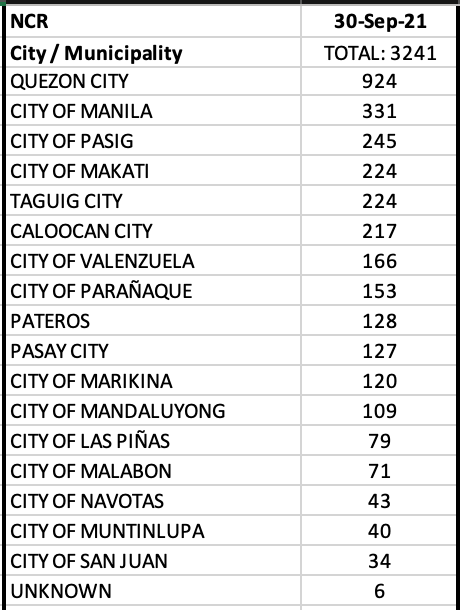
NCR accounted for 23% of today’s cases with 3,241 reported. Four regions report four digit numbers: CALABARZON, Central Luzon, Cagayan Valley and Ilocos Region. All the rest, except for the BARMM report triple digits, on a day when many regions report lower cases which may not necessarily reflect the real number of cases but a delay in reporting.

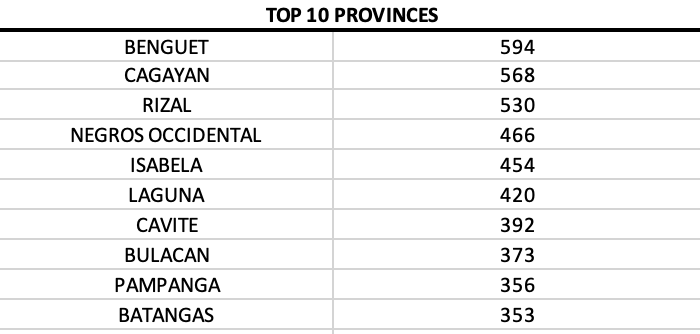
The provinces of Benguet and Cagayan top the provincial level.

Among cities and municipalities, 12 of 17 LGUs in NCR remain the haulers for the top 20 list. Baguio City, Davao City and Zamboanga City are among the top 10 cities with most cases for the day.

OCTA MONITORING REPORT

The last week saw a continuous downtrend of COVID-19 cases in NCR, with average cases ranging from 20-23% of the total cases in the country. This meant that there was a general decline of 17% from the previous week. The reproduction number (R) moves down to 0.87 from 0.94-0.99. The positivity rate in the capital has also decreased to 18% (from a previous 21%).

While NCR remains at high risk, six LGUs are considered moderate risk based on the indicators used by OCTA – Incidence rate, R, hospital bed utilization and ICU utilization.

The new low for the week and the data of 09.29.2021

It’s always good to hear better news. So instead of the low Tuesdays, we’ve had lower cases on Wednesdays. And this time, it’s not only the cases that are a bit lower, but it’s also the positivity rate.

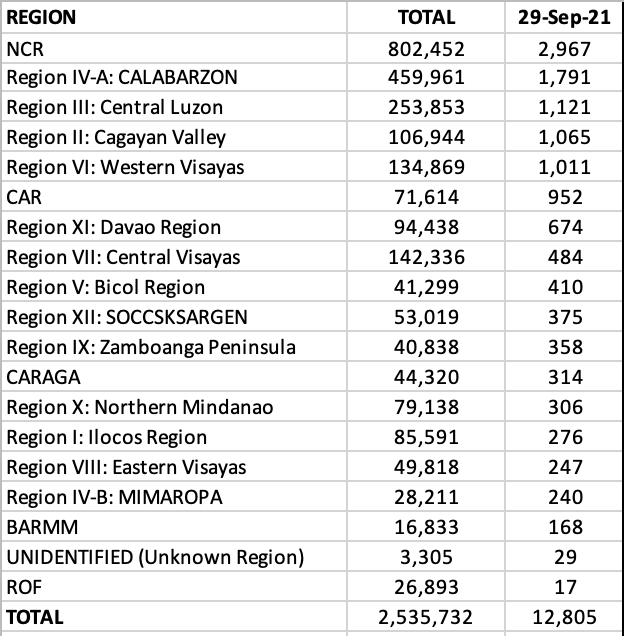
The Health Agency announces 12,805 new cases for today. With less recoveries, the active cases are slightly up.

There were more than 51,000 tests done last September 27, for a positivity rate of 22.9%. The lower positivity rate is good news if we are able to sustain this and we do more testing so that we can do appropriate contact tracing.

The deaths are a different matter altogether. The Health Agency this morning announced 292 additional deaths, which did not include the 190 deaths in the 4PM report. The aliquot reporting on deaths was likely due to glitches the system has been experiencing in the past week. Note that 212 cases that were previously tagged as recoveries were reclassified as deaths after final validation. One hundred seventy five of these recoveries to deaths are part of the 292 deaths added this morning. This brings the total deaths due to COVID19 past the 38,000 mark. [Note that the DoH corrected the deaths an hour after posting and the total deaths reported in the 4PM report were down to 186, making the total deaths of the day 448.]

The NCR accounted for 23% of the total cases for the day with 2,967. Other regions with four digits were: CALABARZON, Central Luzon, Cagayan Valley and Western Visayas. None of the regions reported less than triple digits.

On a provincial level, Rizal and Cavite led the provinces.

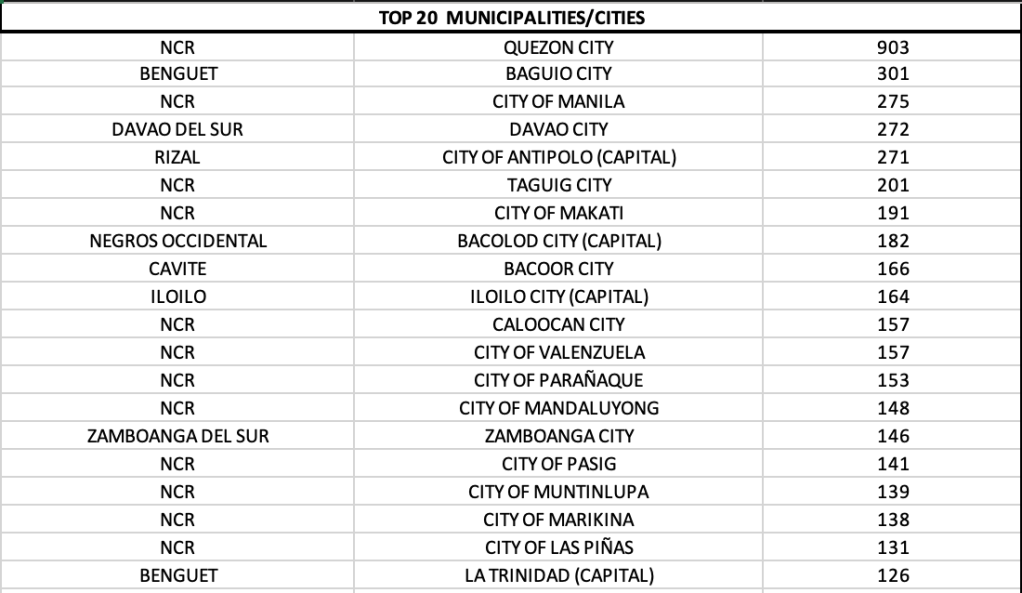
And on a LGU level, 12 of 17 LGUs in NCR were among the top 20 cities/municipalities with most cases. Included in the top ten LGUs were: Baguio (2nd), Davao City (4th), Antipolo (5th), Bacolod City (8th), Bacoor City (Cavite, 9th) and Iloilo City (10th), as many LGUs in the provinces are in the top 10.

The low Tuesday is back and the data of 09.28.2021

After the glitches left and right from the Health Agency, and the very late night report for yesterday’s cases, the Department of Health reports 13,846 new cases today. With close to 40,000 that have recovered, the active cases are also down to a little more than 130,000.

On September 26, there were 47,430 tests with a high 24.1% positivity rate.

New deaths reported today were 91. This puts the case fatality ratio for outcomes at 1.57%.

Notice also in the active cases, the very large asymptomatic cases – 16.4!

For the second straight day, NCR accounted for a low 20% of the total cases in the country. While there are four other regions with quadruple digits, it is Cagayan Valley and the Cordillera Administrative Regions that is seeing a large rise in cases.

Benguet and Cagayan now lead on a provincial level, with Benguet for the first time reporting four digit numbers.

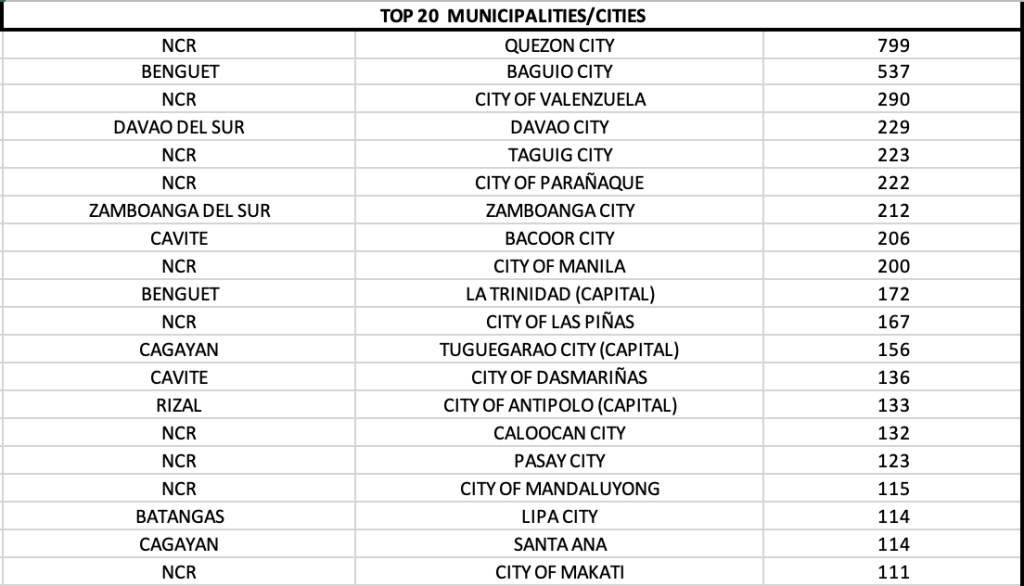
Even on a local level, Baguio City shot up to number 2, next to Quezon City, with 537 cases for the day. Ten of 17 LGUs in NCR were among the top 20 cities/municipalities for the day, while Davao City, Zamboanga City, Bacoor City (Cavite) and La Trinidad (Benguet) joined the top ten list.

Past 2.5M cases and the very late data for 09.27.2021

I was a nail biter to the very end. The 4PM daily report came in at 930PM. Drum roll please…

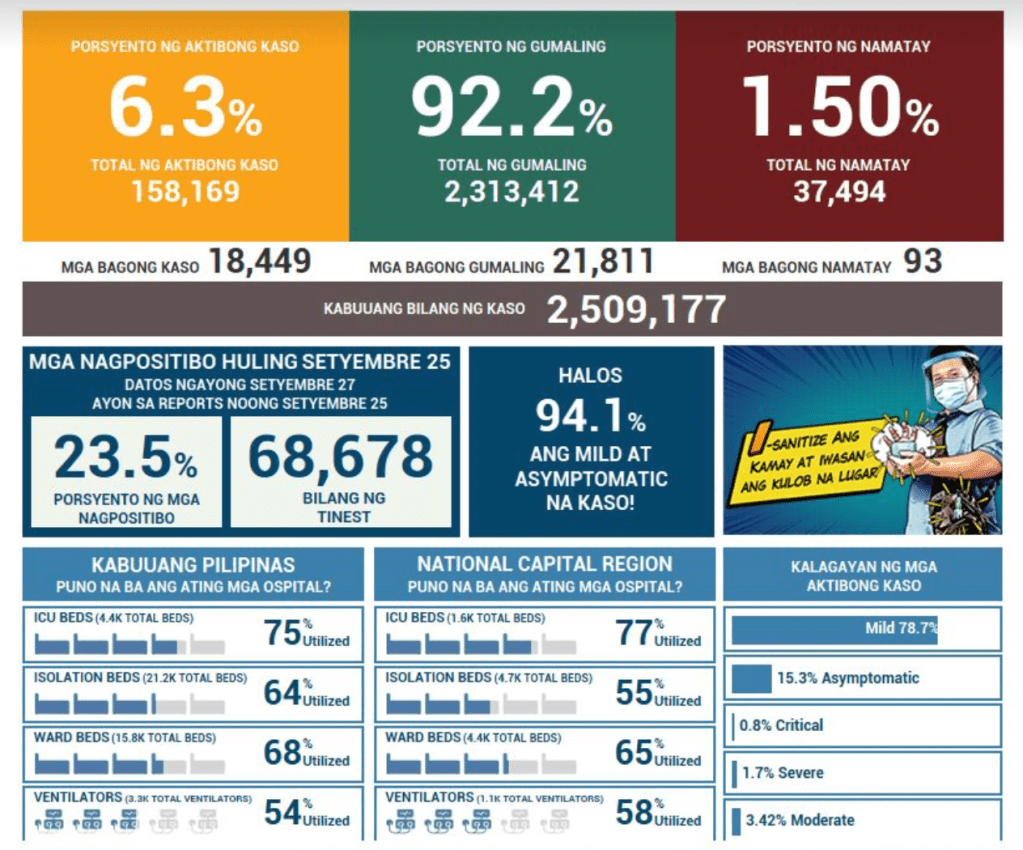
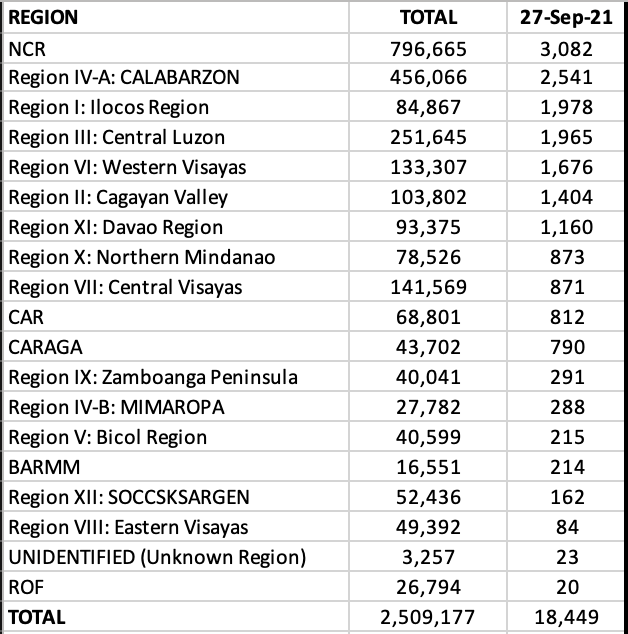
The Health Agency reports 18,449 new cases today and with more than 21,000 that recovered, the total active cases are now a little above 158,000. But that was enough to push the country’s total past the 2.5M mark.

The more than 68,000 tests done on September 25, the positivity rate is at 23.5% and expected to bump up a bit with a Sunday report for Tuesday.

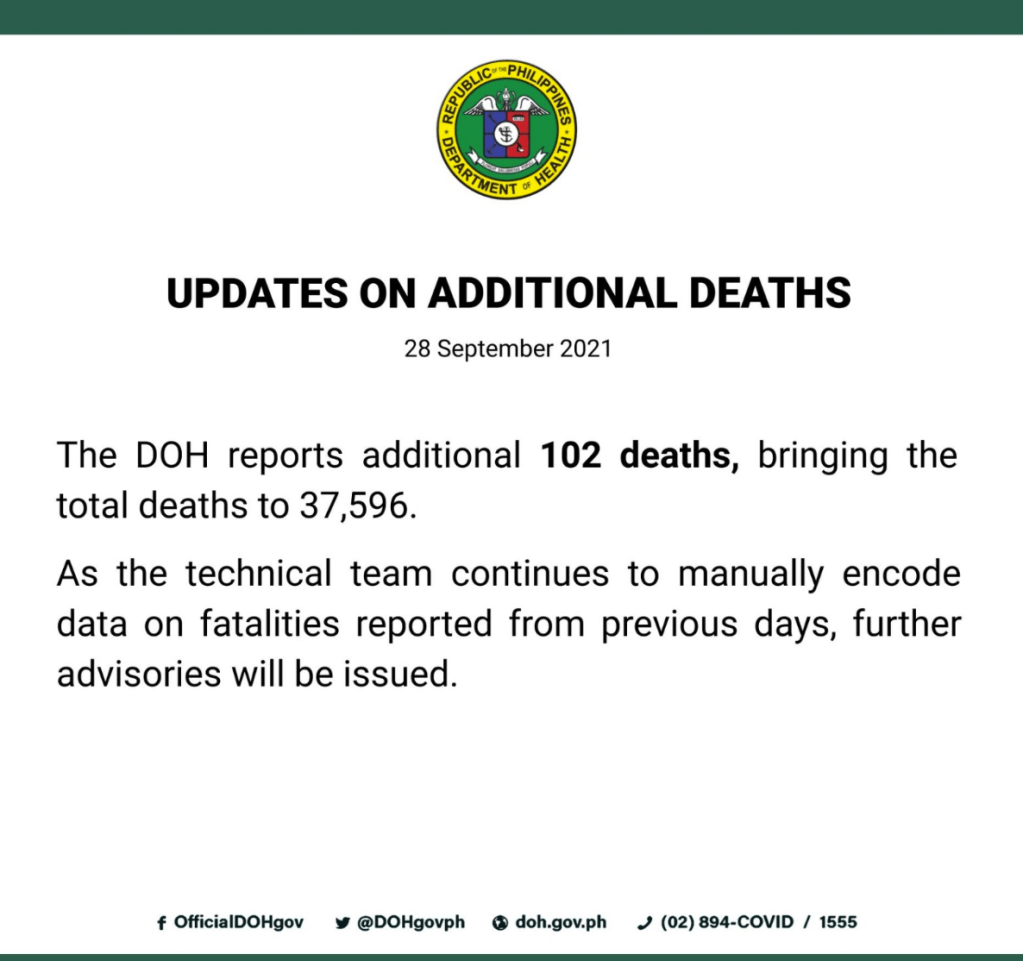
There were 93 deaths reported today. This lowers the case fatality ratio for outcomes to 1.60 percent.

With the numerous glitches occurring with the COVIDKaya of the Department of Health, they are trying to address the several issues where the negatives were counted as positive cases, as well as the death cases. With the 102 additional deaths reported this morning, the deaths recorded on 09.27.2021 are actually 202. But this is again an undercount considering that the number of deaths reported for the last three days were ZERO (or not applicable).

The very very late granular data just came in this afternoon.

The NCR continued to lead, however, it accounted for only 16.7% of the total cases. The other regions with four digits were: CALABARZON, Ilocos Region, Central Luzon, Western Visayas, Cagayan Valley, and Davao Region.

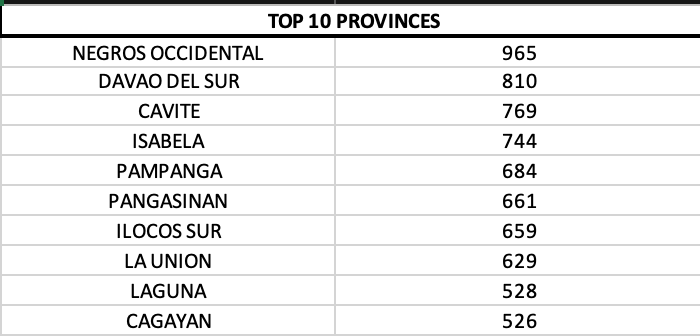
On a provincial level Negros Occidental and Davao del Sur topped the provinces.

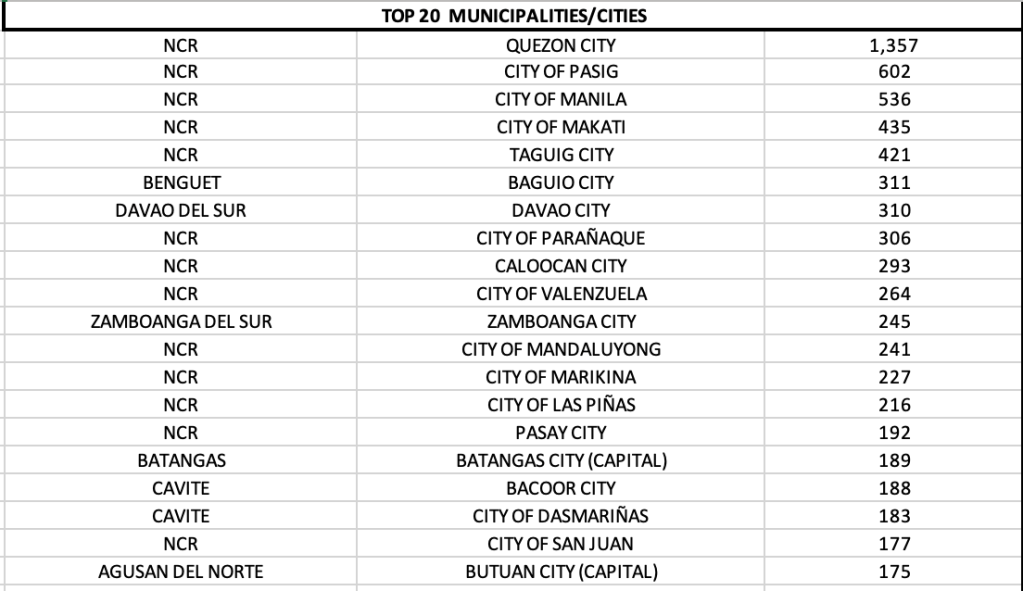
Ten of 17 LGUs in NCR were among the top 20 cities/municipalities with most cases. Other major cities in the top 20 were: Davao City (2nd), Bacolod (5th), Baguio City (8th) and San Fernando, La Union (10th).

Back to 20K with 21.6% positivity on 09.26.2021

They’re not really saying why. But the reports have come in late lately.

Only two scenarios why there are 20,755 new cases reported by the Health Agency today. Either they are counting antigen swabs and/or there’s a lot of backlog being reported.

With close to 75,000 tests on September 24, the positivity rate drops to 21.9%. What we do not know is if these represent only PCR tests or do they include antigen tests as well.

This is also the third straight day where NO deaths have been reported due to system glitches. It is, after all, statistically impossible to have no deaths for the last three straight days on a day where you see five digit cases. No country in the world has even managed to be that lucky.

Tomorrow, we will break the 2.5M mark. And most likely rank in the top five countries with most cases for the day.

The NCR recorded a high 27.5% of the total cases today with more than 5,600 new cases. Other regions with 4 digits were: CALABARZON, Central Luzon, Ilocos Region, Cagayan Valley and Western Visayas. The rest of the regions report triple digits. There were 53 unknowns on this category.

The provinces of Cavite, Rizal, Laguna and Batangas were on the top five list among provinces with most cases.

And 13 of 17 LGUs in NCR were among the top 20 cities/municipalities in the country with most cases for the day. Baguio City and Davao City remain in the top ten as well.

OCTA MONITORING REPORT

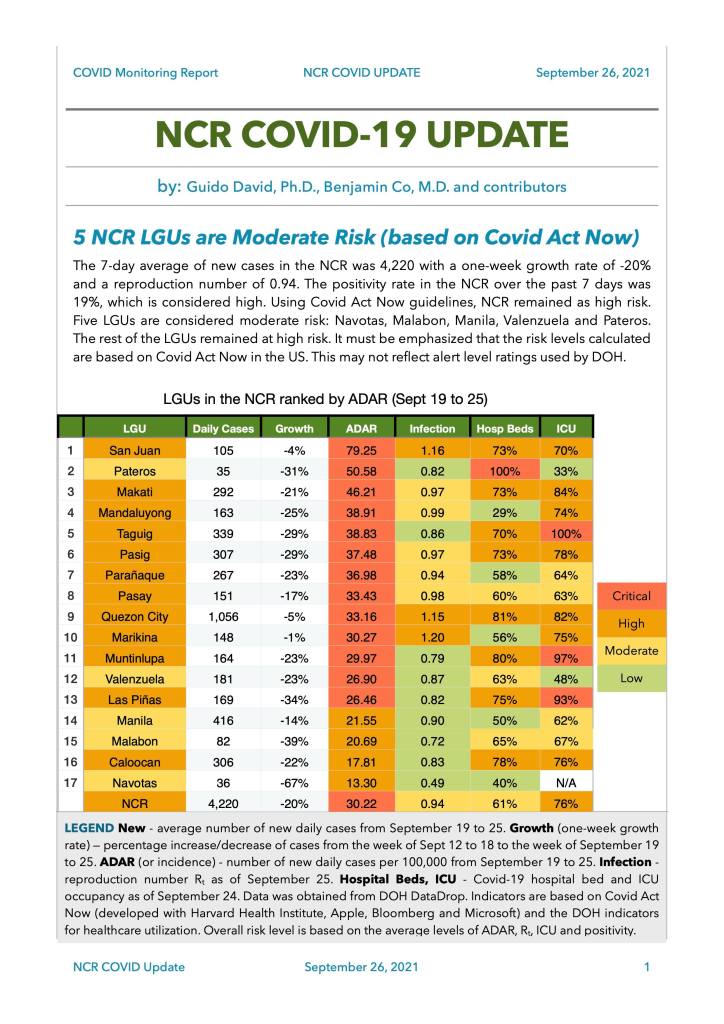
The data drop from the DoH was used in calculating for the four indicators on the situation in the National Capital Region. The indicators are ADAR (incidence rate), R (infection), Hospital Bed utilization and ICU utilization rate.

The average R for NCR is down to 0.94 (moderate risk) not including the data today. Ranked according to ADAR, five NCR LGUs are at moderate risk. They are: City of Manila, Malabon, Valenzuela and Pateros. Based on R, the cities of San Juan, Quezon City, and Marikina have R> 1.0. The cities with R<0.9 are: Pateros, Taguig, Muntinlupa, Valenzuela, Las Piñas, Manila, Malabon, Caloocan and Navotas.

The indicators used in the monitoring update do not reflect the alert level rating used by the Department of Health.

THE WEEK IN REVIEW

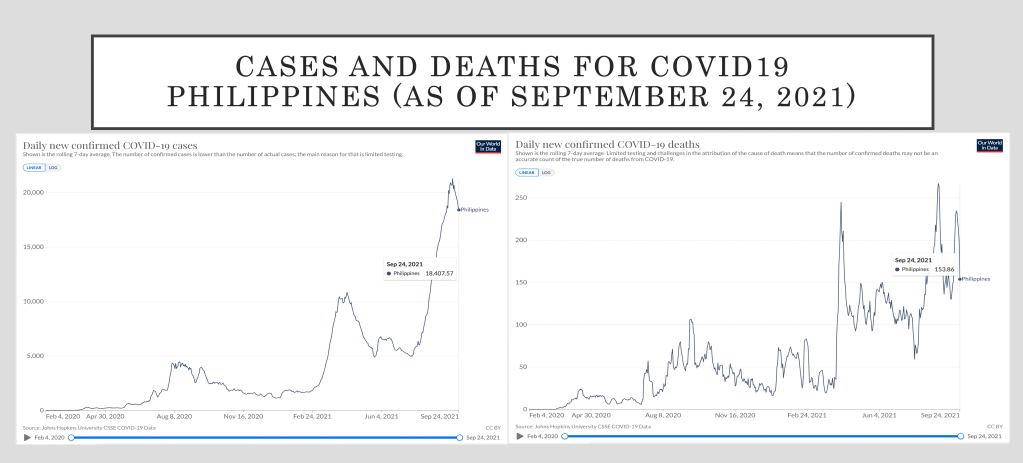
The Philippines is now seeing a declining trend in cases as seen in the infographic data below. While the deaths are also lower now, this is erratic as there has been some problem with the recording of the deaths in the national database system and should be able to reconcile this soon.

Note that based on testing data for the week before, while the testing capacity has declined, the positivity rate has considerably increased. However, this is a summary of the previous week. The positivity rate in the past days has been lower than 25%. Hopefully, this is sustained in the weeks to come.

When compared to select Asian and ASEAN countries, the Philippines remains on top with a 7-day average of 18K+ daly cases. However, all nations are seeing a decline in cases except Singapore that is seeing a significant rise based on their population size.

As a matter of fact, comparing the effective R of the same Asian countries above, it is Singapore whose R has increased, while all the other ASEAN nations are seeing R<1.0. Japan’s R is at 0.46, a feat that all the other ASEAN countries must follow in order to bring the five digit cases down to four digits. As mentioned previously, it will take at least 4 weeks of R<0.7 to bring the five digit cases to 4 digit numbers.

Vaccination is still less than 25% of the total population (whether as a single dose or complete dose) in the Philippines, and here is where we stand compared to other countries in the world.

In many of these countries, the predominant variant of concern that is circulating is the delta variant. This VOC is responsible for the many resurgences seen in various countries, particularly those who have very low vaccination rates and those with breakthrough infections.
The slow decline with R < 1.00 and the data for 09.25.2021

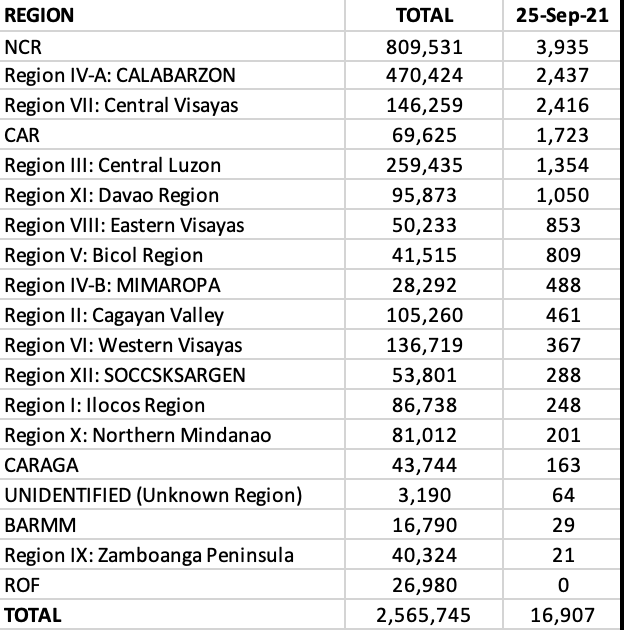
The cases continued on the downward trend as the Health Agency reports 16,907 new cases today. With more than 27,000 recoveries, the active cases remain a high 165,000.

Close to 75,000 tests were done on September 23, with a positivity rate that has dropped 1% to 23.6% overnight.

At this rate, the Philippines should exceed 2.5M cases anytime next week.

Again there are no deaths reported for the second consecutive day because of problems with CovidKaya system.

NCR continued to enjoy a decent share of numbers with 23% of the total cases in the country today. While CALABARZON remained in steady second place, as its cases gradually decline and is in pace with the gradual decline of NCR, there are regions outside of NCR that are seeing increasing cases.

Central Visayas saw a sudden spike in cases with 2,416. Unusual coming from a previous day of triple digits and may most likely be due to previous backlog reports. Other regions that saw increased cases was CAR and Davao Region, whose numbers follow an actual trend.

On the other hand it was also unusual for the Zamboanga Peninsula to record only 21 cases. This time, most likely due to delayed reporting or under testing in the region.

There were 65 unknowns from a regional category.

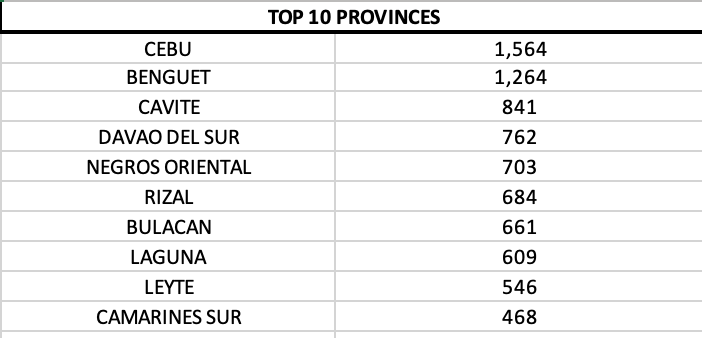
On a provincial level, the surge in cases in Central Visayas put the province of Cebu in front to top the provinces with most cases, followed by Benguet province.

The increased cases is reflected in the LGU level. 10 of 17 LGUs in the NCR are among the top 20 cities/municipalities with most cases. Three LGUs in Cebu were in the list today – Cebu City (3rd), Mandaue and Lapu-Lapu City. Three LGUs in Benguet province were also in the top 20 – Baguio City (4th), Itogon, and La Trinidad.

No deaths (?!?!) and the data of 09.24.2021

The Health Agency reports 18,659 new cases as the active cases are up at more than 175,000 again.

There were more than 76,000 tests done on September 22 with much lower positivity at 24.2%.

There were no deaths reported today as the Health Agency reports another technical glitch in the CovidKaya program of the agency. Of course, we expect the deaths to pour in when CovidKaya is up and running.

The data from Prof. Guido David is shown in the table below, where all the 17 LGUs in the NCR’s average cases, growth rate, reproduction rate and incidence rate. The cities of Quezon City, Mandaluyong and San Juan have Rt >1.0. The overall Rt of the region is at 0.97 with a general negative growth rate.

The NCR reported a decent 24% of the total share of new COVID19 cases in the country today. Five other regions continued to report four digits: CALABARZON, Central Luzon, Cagayan Valley, Ilocos Region, and Davao Region.

On a provincial level, Cavite maintained its lead, while three other provinces in CALABARZON were among the top ten. They were: Laguna, Rizal and Batangas.

Twelve of 17 LGUs in NCR were among the top twenty cities/municipalities with most cases for the day. Four LGUs from Region IVA were in the list, together with Davao City, Baguio City, Zamboanga City and Iloilo City.