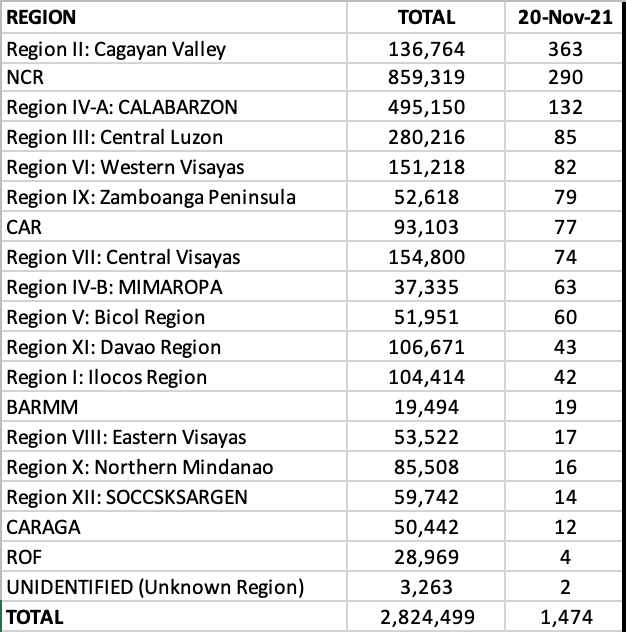
The Philippines is on track for the 1000-1500/day range of cases for the week as the Health Agency reports 1,474 new cases today. And with more recoveries, the active cases drops to 22,000. The data is based on more than 38,000 tests done last November 18 with a 3.2% positivity rate. The 7-day average is ~1,470 cases/day.
The share of moderate to critical cases is close to 40% of the active cases, which means that more than 8,000 of the active cases fall in this category.
Another 205 deaths were added today.
With late posts coming in, it was not surprising that Cagayan Valley overtook the NCR in new cases reported for the day with 25% of the total cases today. This means that one in four cases reported today was from Cagayan Valley.
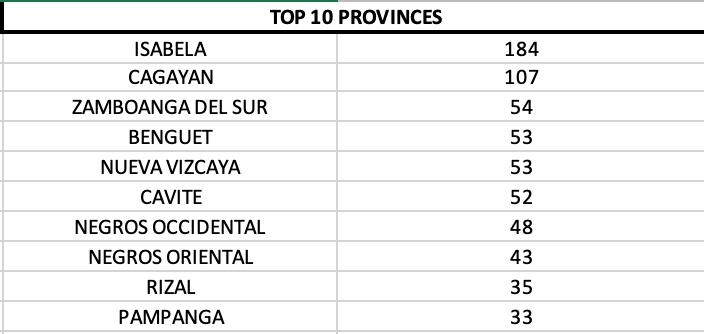
This is reflected in the provincial listing where Isabela and Cagayan reported triple digits – 184 and 107, respectively.
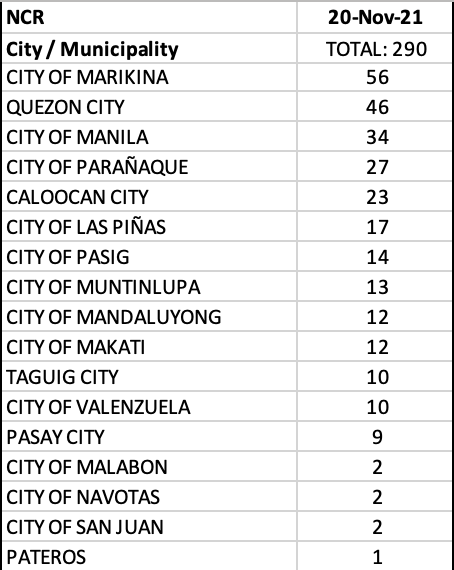
On an LGU level (cities and municipalities), Marikina took the top stop in the country (and in Mega Manila) with 56 new cases (~20%). Seven of 17 LGUs in NCR were in the top 20 list as five LGUs in Isabela province joined the top 20 list. The city of Baguio is third in the list today.
There is no winter season in the Philippines, but as December draws near, the areas in the north have much colder temperature and is the hideaway for many Filipinos who want to experience the ‘winter’ feeling. The COVID-19 seasonal trend globally may be problematic for these areas in the Philippines in the coming holiday season.
While the cases are slightly up today, it is to be expected as we plateau between 1,000-1,500 new daily cases.
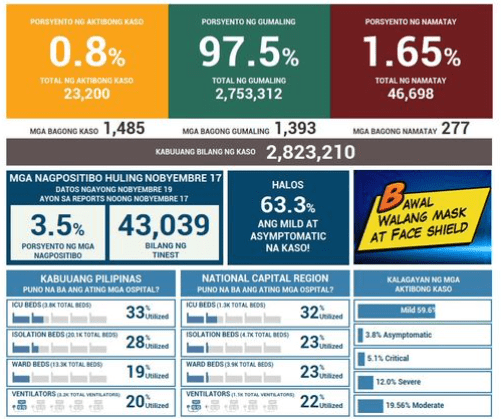
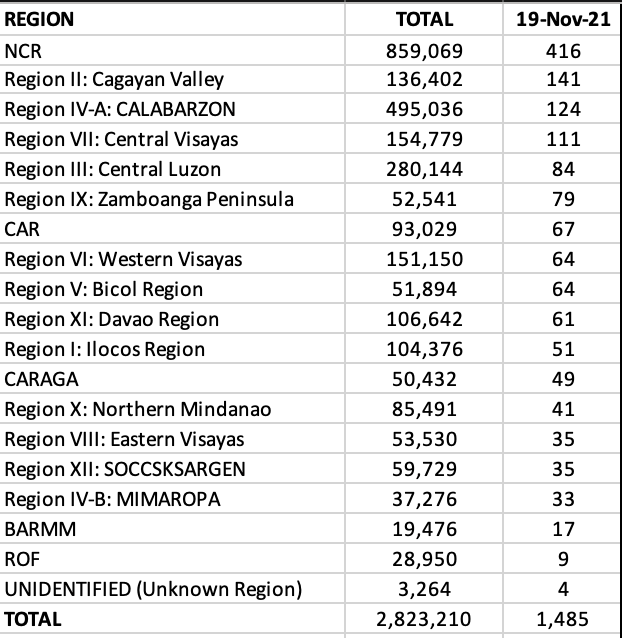
The Health Agency announces 1,485 new cases and with less recoveries, the active cases remain in the 23,000 mark. This is based on over 43,000 tests done last November 17 with a 3.5% positivity rate.
Additional 277 deaths were reported today.
NCR accounted for close to 30% of the total share of COVID-19 cases in the country today with 416 new cases. It had more cases than combined total cases of Cagayan Valley, CALABARZON and Central Visayas.
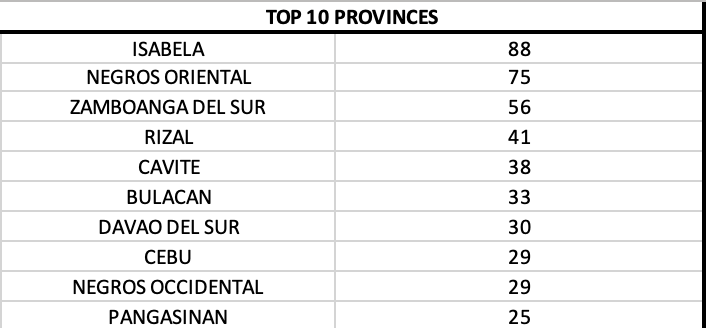
All the provinces among the top 10 had less than 100 cases.
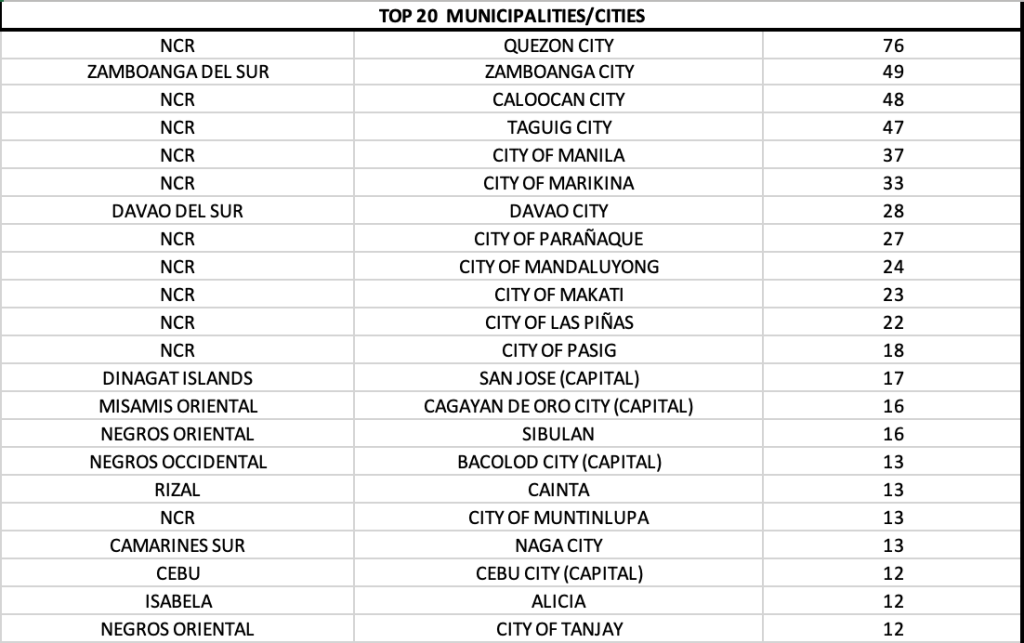
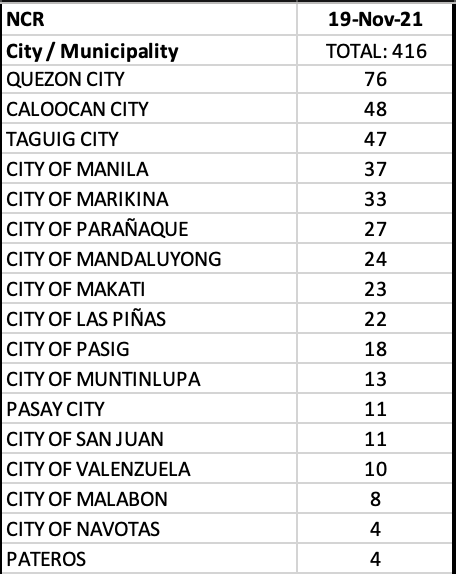
Among cities and municipalities, it was Quezon City once more that dominated the numbers with 76 new cases, or 18.3% of the total in Mega Manila. Many LGUs in NCR saw higher numbers as well, with almost all LGUs in Mega Manila reporting double digits except for Malabon, Navotas and Pateros. Eleven of 17 LGUs in NCR were among the top 20 for the day.
OCTA RESEARCH MONITORING REPORT
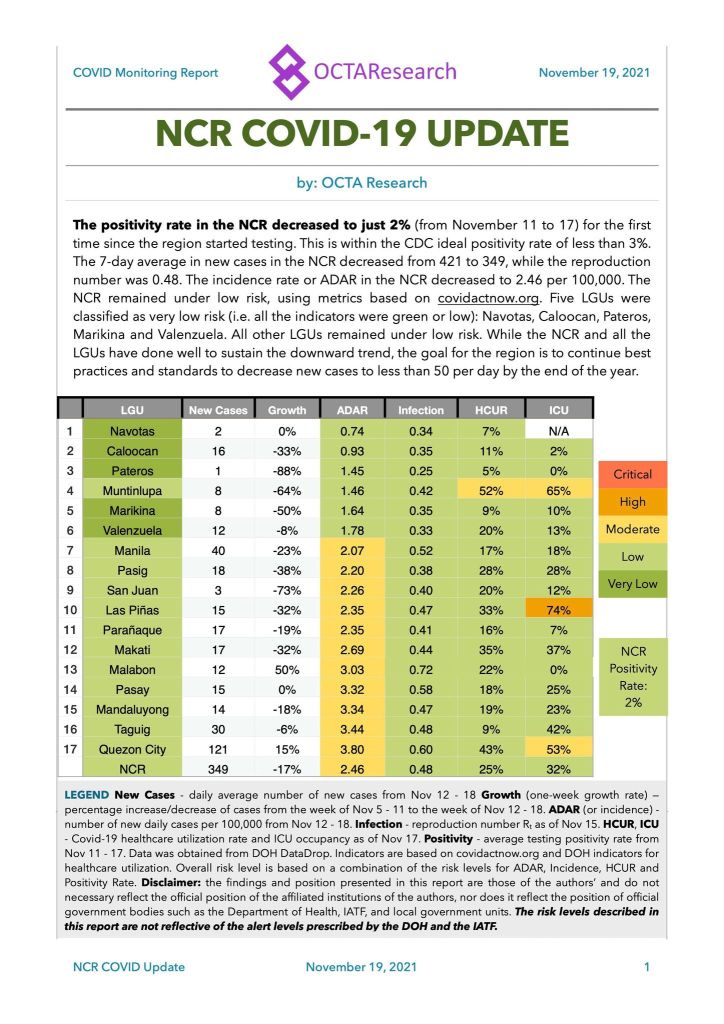
The positivity rate in the National Capital Region has dropped to ~ 2% for the week November 11-17. This falls now within the acceptable positivity rate of the Center for Disease Control (<3%). Reproduction number is < 0.5 and in the ADAR is at an average of 2.46/100,000 population. Navotas and Caloocan are < 1.0/100,000.
With the current numbers, five of the 17 LGUs are at very low risk category, while the rest are at low risk. Eleven of the 17 LGUs have ADAR at moderate risk. Only Muntinlupa City and Quezon City have high ICU utilization rate.
Among the 17 LGUs in NCR, only Quezon City and Malabon had a positive increase this week compared to the past week. Five of the 17 LGUs reported single digit daily new cases. Only Quezon City continued to report triple digits.
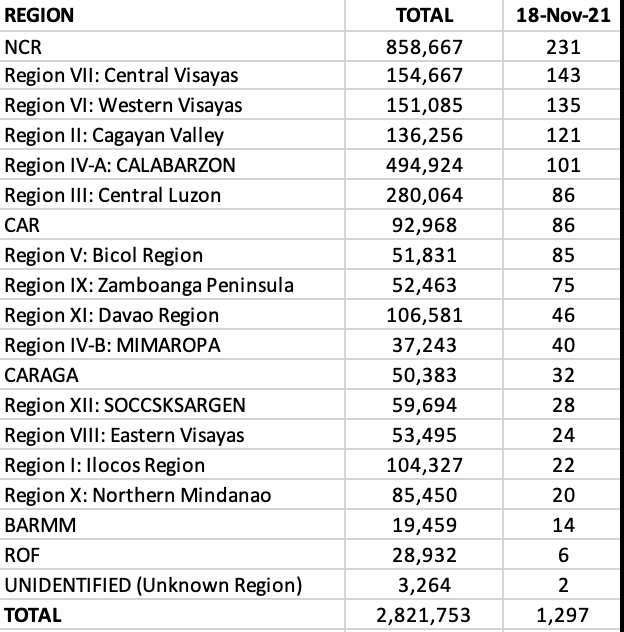
The Health Agency reported 1,297 new cases today, from the over 42,000 tests done last November 16 with a 3.4% positivity. Active cases are down to 23,158.
The number of moderate to critical cases are almost 40% of the active cases.
An additional 305 deaths were announced today.
The NCR contributed to lesser share for today’s cases – 17.8% – compared to the previous days where 22-25% of the daily numbers belonged to Mega Manila. Central Visayas and Western Visayas were second and third, respectively.
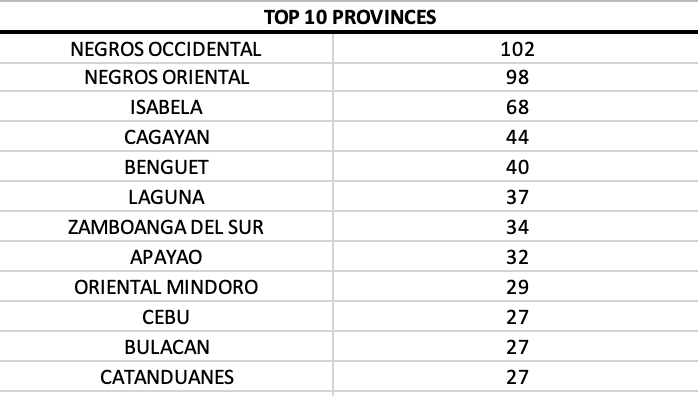
The ranking in the Visayas was primarily led by the provinces of Negros Oriental and Occidental, with Negros Occidental reporting triple digit cases.
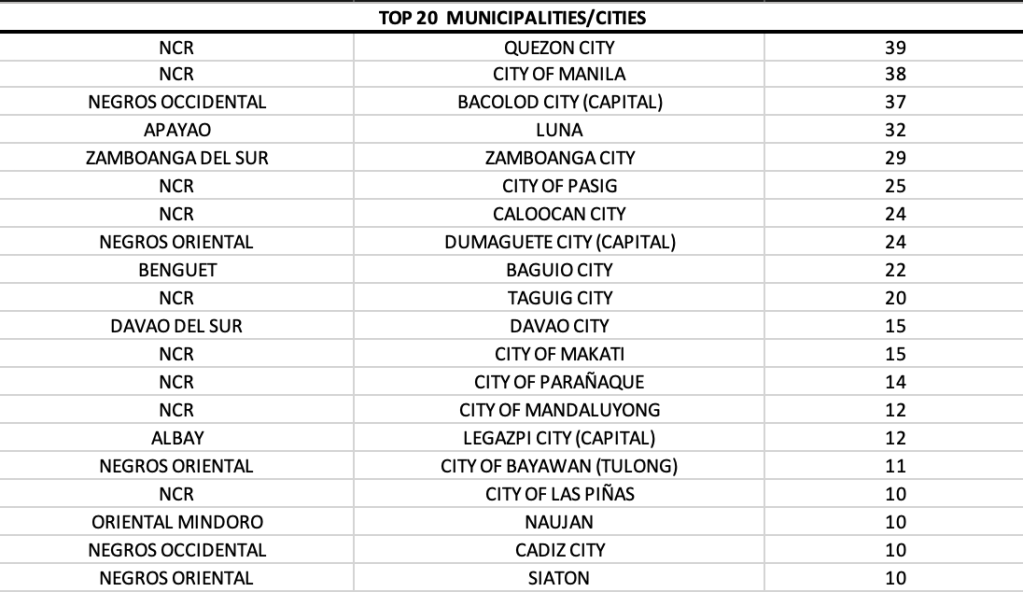
On an LGU level, while Quezon City continued to lead, it reported only 39 cases today (or 17%) of the share for NCR followed by the City of Manila with 38. All LGUs nationwide had less than 40 new cases today. Nine of 17 LGUs in NCR were in the top 20, as the least number of cases in the list drops down to 10. The remaining 8 LGUs in NCR report single digit numbers today.
OCTA RESEARCH MONITORING REPORT
As more areas move into lower alert levels, here’s the rundown on the top 20 provinces with most cases in the country for the week of November 11-17, 2021.
NCR continued to lead other provinces (considering of course that it is the densest, most populous and tiniest land area in the country). All, and that means ALL, the top 20 provinces (including NCR) saw a negative one-week growth rate, with ADARs falling significantly as 6 provinces now are categorized as very low risk. Most of these provinces are in the CALABARZON region, with Rizal, Cavite and Laguna joining the very low risk category. The other provinces classified as very low risk include Bulacan, Davao del Sur, and Cebu.
Eight provinces are at low risk including NCR, while the remaining are at moderate risk.
Positivity testing is lowest in Cavite and Cebu at 1%. And remains critical in Negros Oriental, Isabela, Cagayan and Palawan. While the latter areas may have lower ADAR, the low testing output is concerning because not enough testing is being done in these provinces. The true picture of the condition in these areas cannot be extrapolated from the ADAR or healthcare system use alone.
The Health Agency reports 1,190 new cases today with a little more than 33,000 tests done last November 15, with 3.5% positivity rate. Active cases are at less than 24,000, with more than 36% being tagged as anywhere from moderate to critical. And this is an area that will need to get dissected well because there seems to be a large backlog in identifying whether this group of patients tagged as moderate, severe, or critical have had outcomes or not. And this lag in resolution of outcomes in this group may explain the discrepancy in ICU utilization which is not congruent with the 17% severe and critical cases.
There are 309 new deaths announced today, resulting in over 46,000 deaths already or an overall case fatality ratio for outcomes at 1.65%.
Based on the data drop of the DoH, it was interesting to dissect why the number of moderate to critical cases were so high at close to 37%. Was this because there are still a lot of moderate to critically ill cases? But the ICU and ward beds and ventilators in use were unusually low. In short, the data did not match.
Among the current 23,846 active cases, there were 7,794 cases that remained open in outcomes (no mention if they have recovered or died). Of the 7,794 cases that remained unresolved, 6,146 were moderate to critical.
Breakdown based on month of diagnosis is as follows:
To elucidate the above the table, there were 15 patients categorized as critical last January 2021 with NO outcomes yet. And the DoH is still counting these outstanding cases. Most of the cases from August to September have had no resolution as of now – that’s 2-3 months after their being diagnosed. Which most likely should not be the case especially for moderate patients who may have resolved already and the more severe and critical ones, that may have passed on.
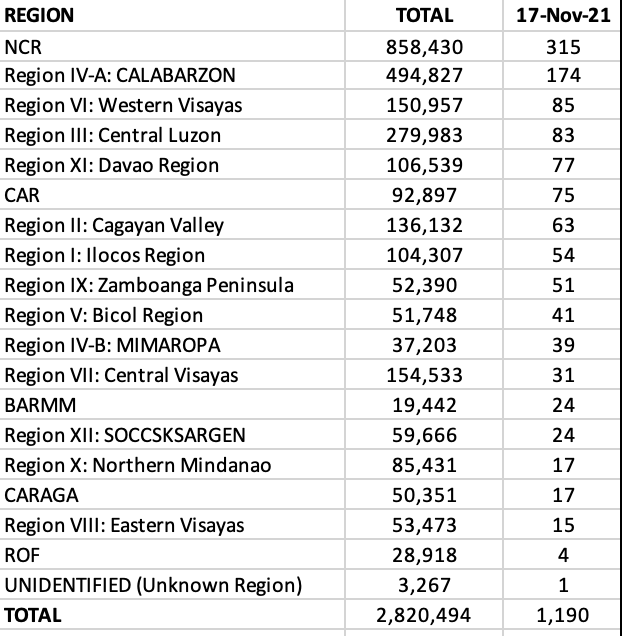
The NCR accounted for a higher share for todays cases with 315 or 26.5% new cases. Notice the rapid decline in other regions lately, with NCR plateauing at the 300-500 daily mark, an increase of 8% from the previous weeks.
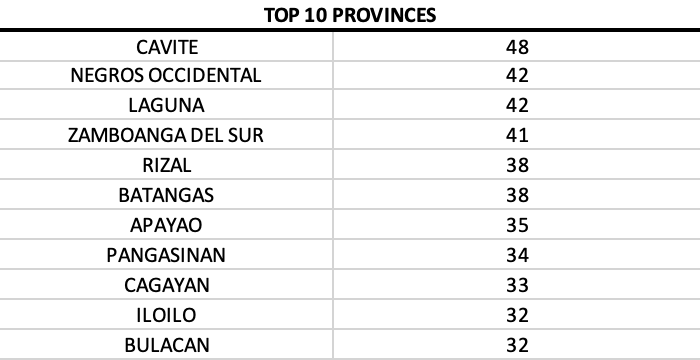
It is good news that we are seeing provinces report less cases as well with Cavite leading but with less than 50 cases. None of the provinces in the top 10 list had more than 50 cases.
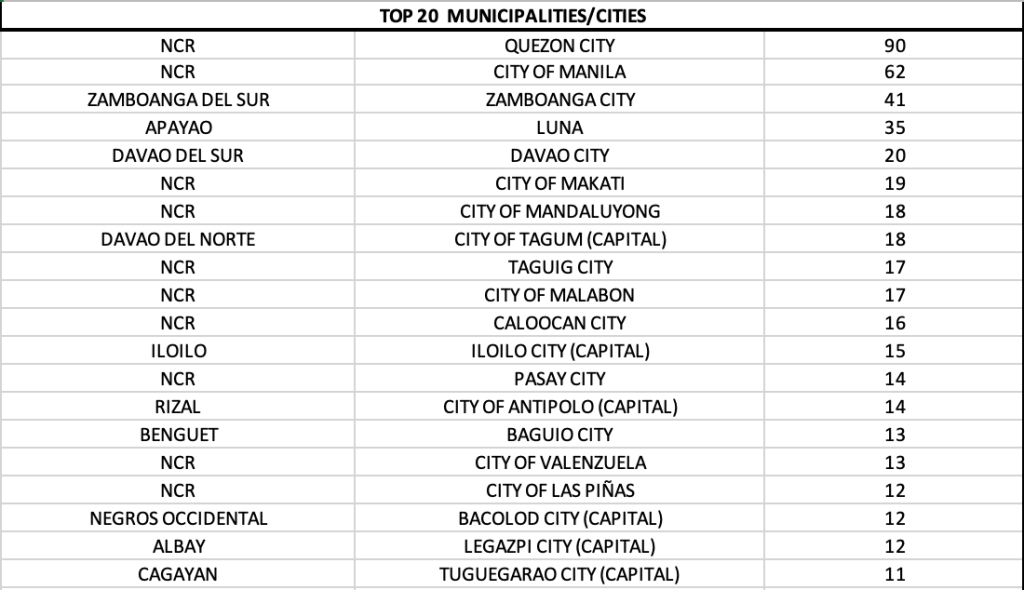
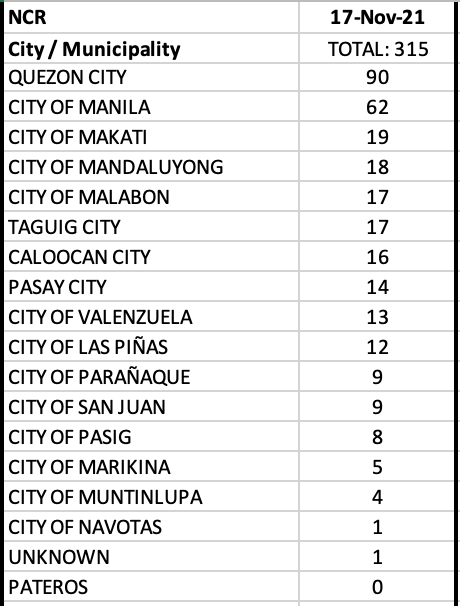
Among cities and municipalities, Quezon City continues to take the lead with 90 of the 315 cases in NCR – that’s almost 30% of the total share of Mega Manila. The City of Manila came in second with 62 cases while the rest of NCR reported less than 20 cases per LGU. Seven of the 17 LGUs reported single digits.
It’s been awhile since we have seen triple digits. The last time we reported cases in triple digits was December 2020. The lowest recorded for the month of December 2020 was 756 on December 28.
The Health Agency announces 849 new cases today, as there are more recoveries, only a little more than 25,000 active cases are left in the tally. The cases today are based on a little more than 28,000 tests done on Sunday, November 14. Positivity rate was 3.2%.
Among the active cases, 35% are moderate to critical. That’s more than 8,900 individuals. Critical and severe cases are at 16.4%.
There are 99 new deaths added today.
While the total COVID-19 cases in the country slowed down (because it is a Tuesday), it was the NCR that accounted for almost 1/4 of the total cases today. This may be due to the fact that NCR is the densest, smallest, yet most populous region. It also has most of the testing facilities in the country (almost 50%), meaning more testing is done.
The continuing saga of Quezon City is the story of the data today. While NCR reported 207 (of the 849) cases today, it was Quezon City that went far and beyond with owning 114 (55%) of the cases in NCR. The LGU in the NCR that came in second was the City of Manila, with 14 cases. For today alone, more than 13% of the cases came from one LGU – Quezon City.
The fewest cases among cities/municipalities in the top 20 list today was 7. Meaning if your LGU had 7 cases, it would be in the list.
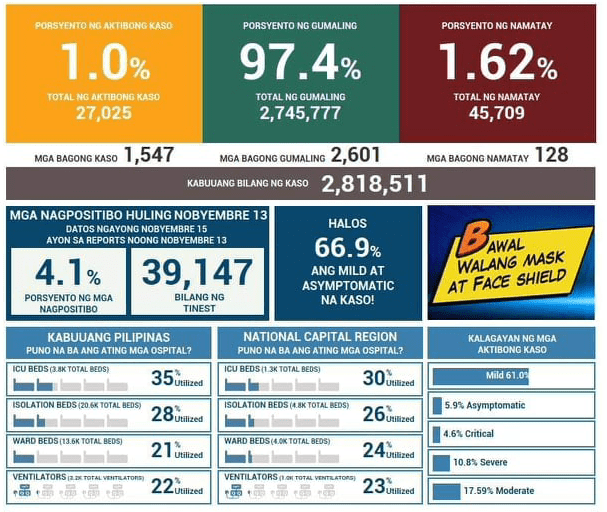
The week begins with 1,547 new cases based on reports last November 13 or close to just 40,000 tests and a positivity rate of 4.1%. The active cases drop to 27,000 but so do the mild and asymptomatic, which now comprise only 2/3 of the total active cases. That means that 1/3 of all the active cases are moderate to critical. That’s still close to 9,000 patients.
Another 128 new deaths are added today.
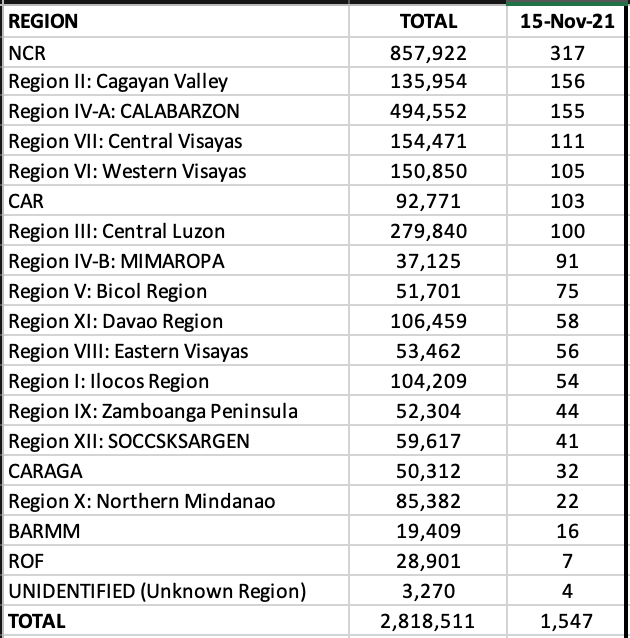
NCR continued to lead among all regions with more than 20% of the total share for today with 317 cases. It had more cases than the combined cases of Cagayan Valley and CALABARZON. Fewer regions are now reporting triple digits.
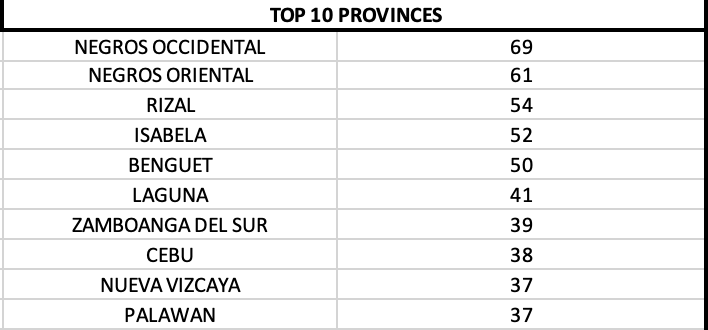
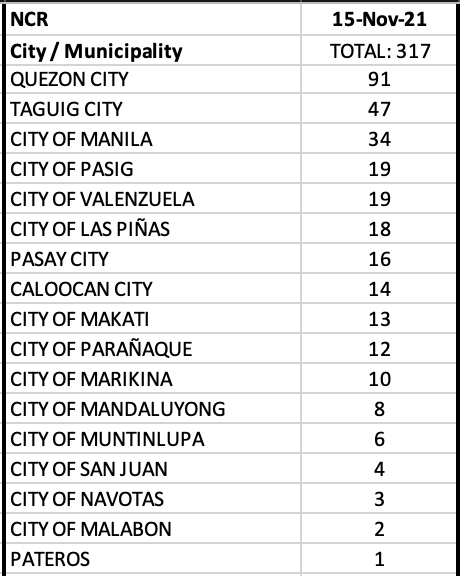
Quezon City has continued to lead among LGUs in new cases reported. Today, it reported 91 cases or almost 30% of the total cases in Mega Manila. Without Quezon City’s numbers, the number of cases in the NCR would have been significantly lower. This LGU had higher cases than any of the provinces in the top 10 list for the day.
The good news is that 9 of 17 LGUs in NCR were in the top 20 LGUs with most cases for the day. The fewest cases for today is 13. Meaning if your LGU recorded 13 cases, it would be in the list.
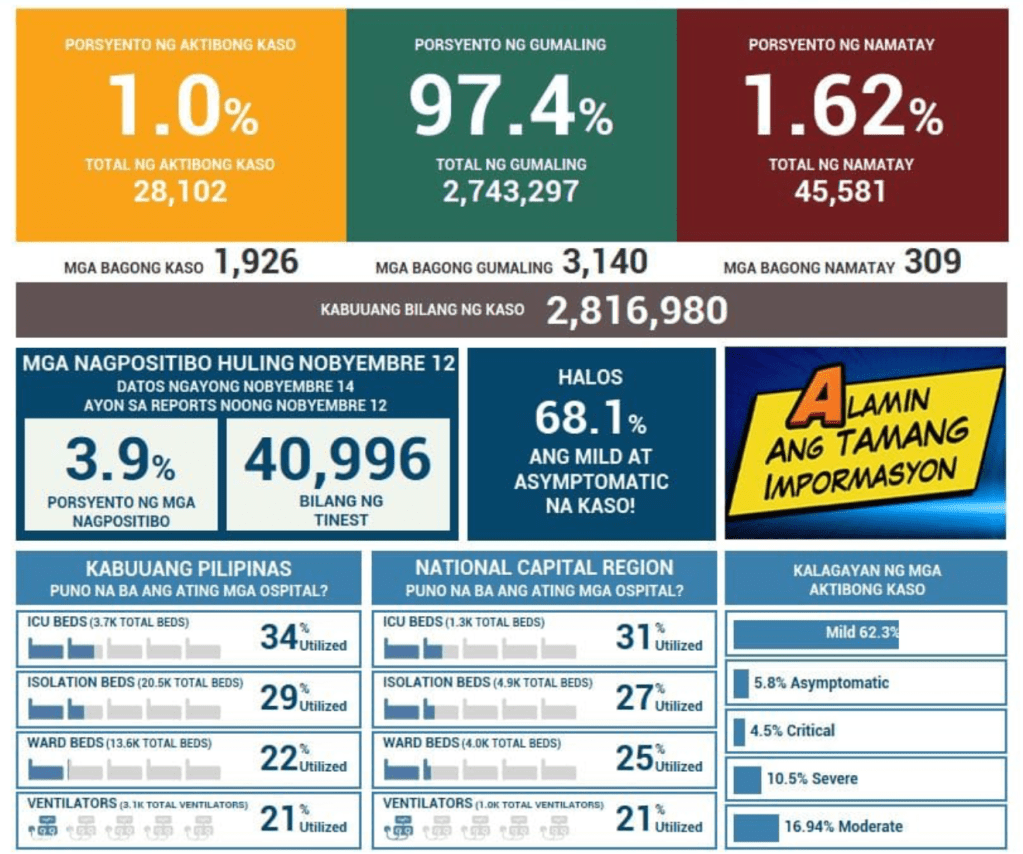
While the Health Agency reports a tad lower cases with 1,926 new cases, the number of active cases fall to a few notches above 28,000. This is based on reports from November 12 where close to 41,000 tests with 3.9% positivity rate was registered.
As the total active cases dip, the moderate to critically ill continue to contribute to close to 32% of the total share. That means that 8,964 cases fall in this class. Critical and severe comprise 15% of the total active – 4,215 to be exact.
A record week high in number of deaths with 309 newly announced deaths today.
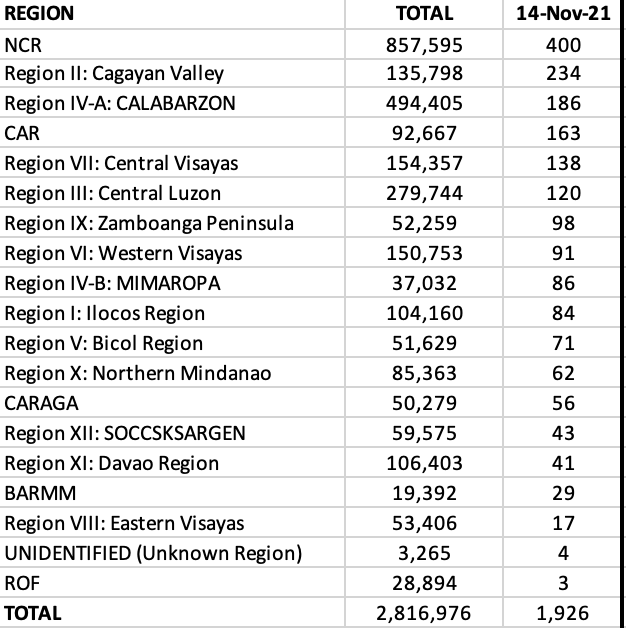
NCR has been owning a greater share of the cases in the country the past week. With R up at 0.54 (+/- 0.05), it now averages about 20% of the total cases (1 in 5) in the country daily. Cagayan Valley came in second and CALABARZON in third.
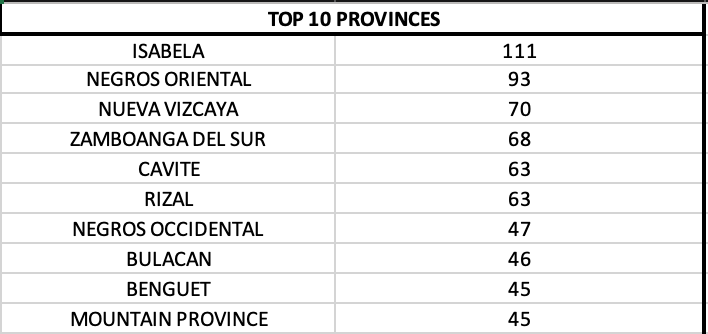
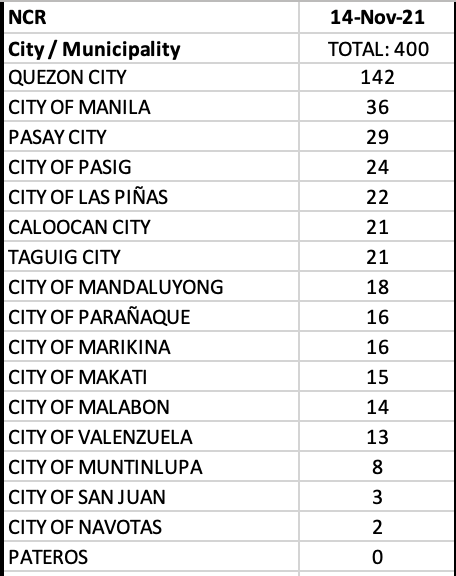
It was Quezon City that continued to pour in cases for the National Capital Region with almost 36% (142) of the cases today. As a matter of fact, only Quezon City had numbers that equaled the total cases of Zamboanga City, Solano (Nueva Vizcaya) and the City of Manila combined. Quezon City also had almost 4x the total cases of the City of Manila, second among the LGUs in NCR with most cases.
The fewest cases in the top twenty LGUs in the country today was 16. Which meant that if the LGU had 16 or more cases, it would be in the list.
THE WEEK IN REVIEW
With the sudden downgrading to alert level 2 in most places in the Philippines, the decline in cases slows down as the economy attempts to recover during the last quarter of the year. And while the cases are lower now, one should take into context that testing has also decreased in the country. When mild and asymptomatic cases do not get tested, there is a rise in the more moderate to severe (and critical) disease. And that’s not good because contact tracing is affected. Which means that we may most likely be seeing an artificial drop in cases because only those that have more severe clinical presentations get tested.
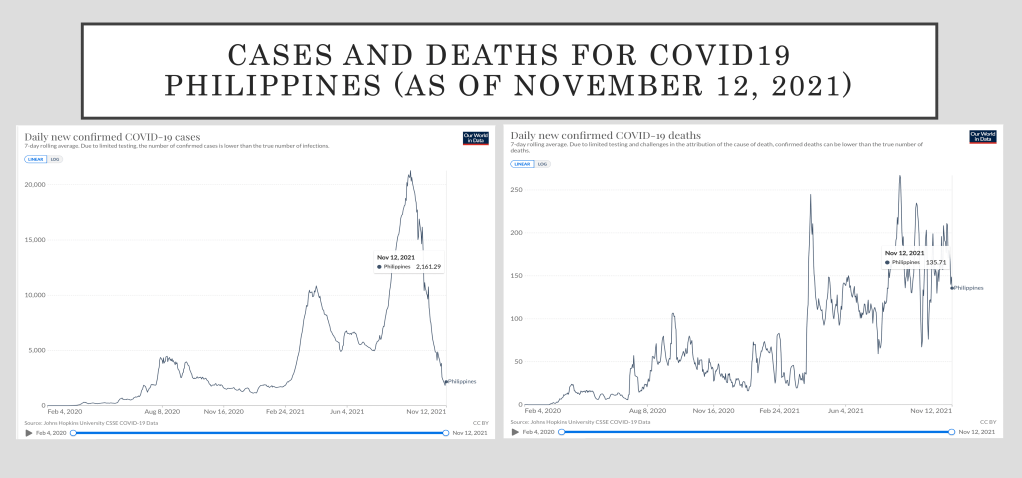
The 7-day average of cases drops to a little above 2,000 cases/day, while deaths continue to fluctuate.
Which isn’t too shabby when compared to the other countries in select Asian region. Singapore and Malaysia continue to lead with triple digits per million population, while the Philippines is now lower at 19 cases/M. The major envy of course is with Indonesia and Japan – two more populous countries than the Philippines – and yet seeing single digit per capita cases per million. Indonesia now reports 1.47 and Japan 1.48 case/million population!
When put together side by side, notice how cases, tests, positive rate and reproduction rates are lower in the Philippines currently. There is significant decline in all these parameters.
And when compared to the same select Asian countries described above, other countries are still grappling with existing conditions. Singapore for example has not only the highest cases per capita but also has the highest positivity rate at 17.1% in the region. It has also decreased testing capacity compared to Malaysia. Reproduction rate is highest now in Vietnam (it was highest with South Korea last week), as other countries see a decline in R and the Philippines recording the lowest R for the week as of November 10.
Note, however, that the Philippines has the fewest number of people tested in this region with 3-4 tests done per 10,000 people. And that can provide an artificial look at gains, especially when more of the people being tested are only those who end up being hospitalized. It would have been a great story for the Philippines had the positive test rate been the way it is (or even lower) with higher number of people getting tested. This would mean that contact tracing is robust.
In the meantime, this is how the numbers end for the week.
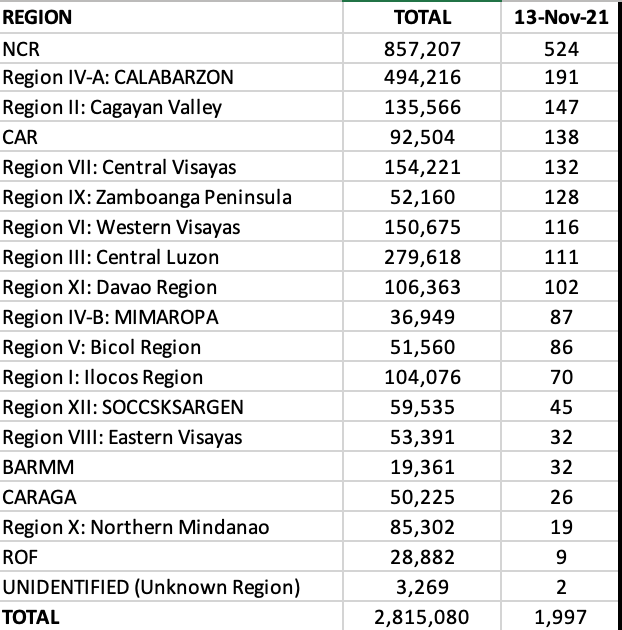
The Health Agency reports 1,997 new cases today based on close to 46,000 tests done last November 11 with a 4.5% positivity rate. Active cases are less than 30,000.
The puzzle in the infographic data is that more than 30% are moderate to critical among the active cases. That means more than 9,000 patients fall in this category. But even taking the severe and critical patients alone – that would mean 14.4% of the total cases fall in this category. That’s 4,231 cases among the active cases. Based on the infographic, there are 3,800 ICU beds in the country and only 36% are utilized or 1,368 of it is occupied. Where are the 2,863 patients in the severe and critical category?
The agency needs to provide an answer to the apparent discrepancy in health care utilization in the country as more moderate to critical cases are being recorded.
Additional 238 new deaths were reported today.
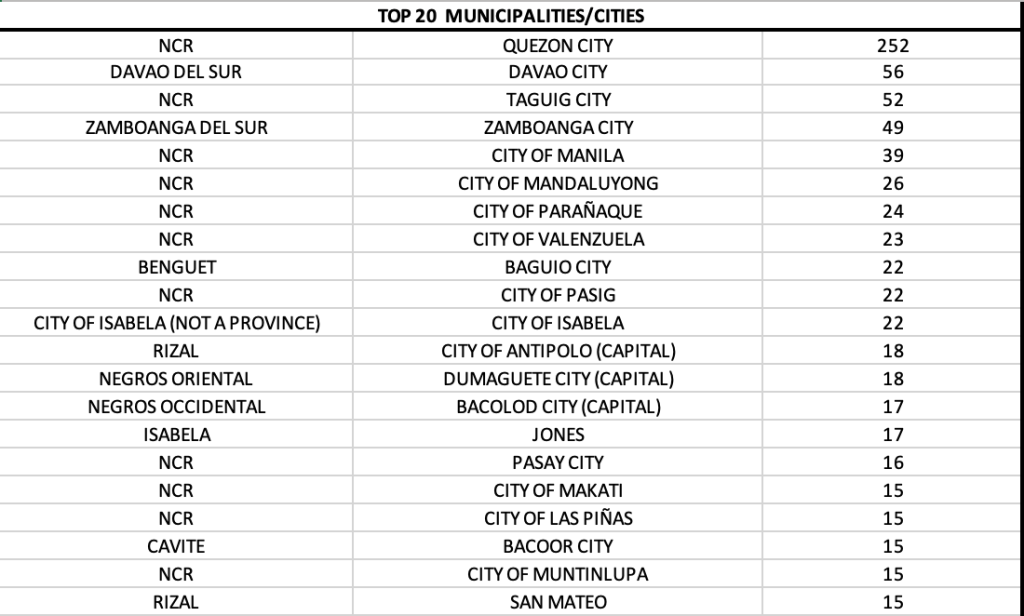
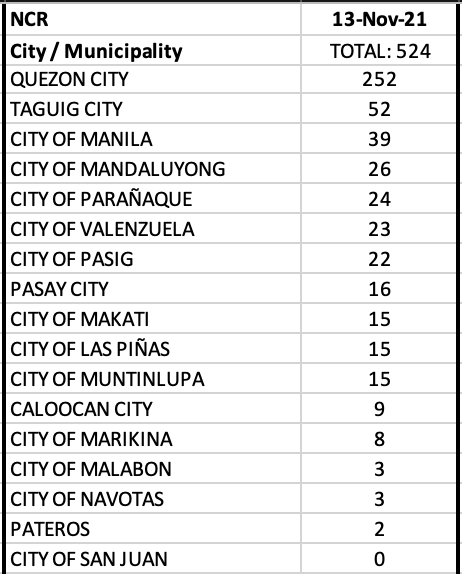
NCR outnumbered all other regions accounting for more than 26% of the total cases in the Philippines today. That means that more than 1 out of 4 cases in the country were from NCR alone. The shocker of the day? Almost half the reported cases were from Quezon City. It outstripped regions and provinces with an astounding record high of 252 reported cases. One in 8 cases in the country reported today was from Quezon City alone.
OCTA RESEARCH MONITORING
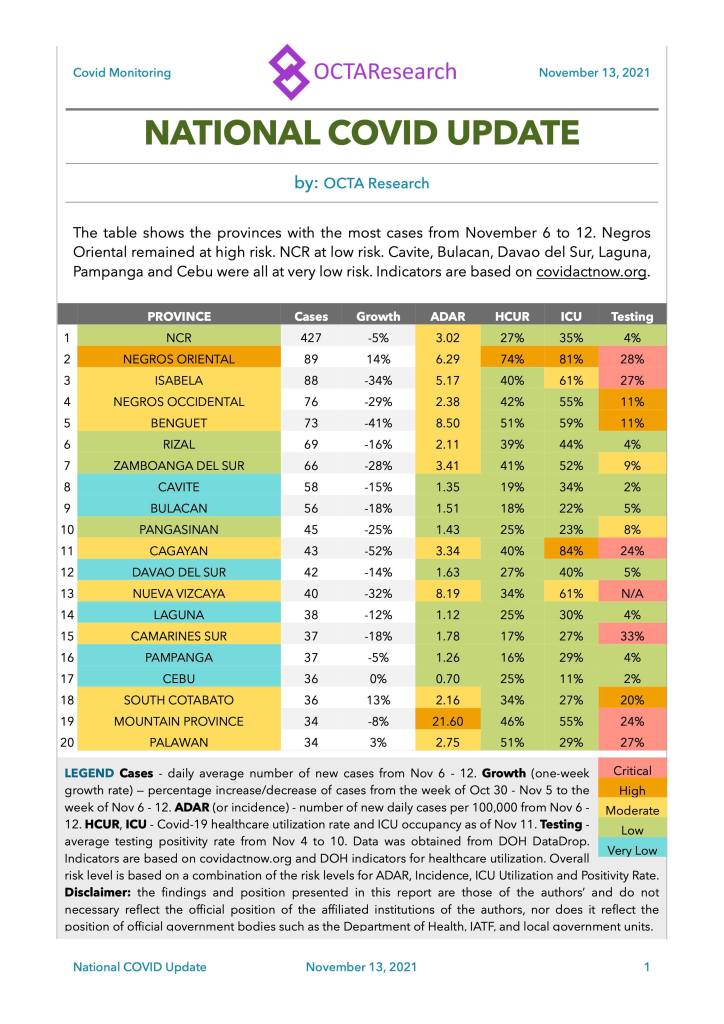
Update from the OCTA Research Group for COVID Monitoring is provided today. The top twenty provinces (including NCR) are mostly seeing a decline in growth rate, but the growth rate of NCR had significantly slowed down this week to -5% only. Several provinces like Cavite, Bulacan, Davao del Sur, Laguna, Pampanga and Cebu have very low risk based on the average sum of indicators used to classify risk – ADAR, Health care utilization, ICU rate (according to government data), and positivity testing. Notice that there are many provinces that still have critical and high risk rating in the positivity rates. Among all the provinces, Negros Oriental remains at high risk in all major indicators.
While the total new patients were slightly lower today than yesterday, the positivity rate for 43,591 tests done on November 10 was up at 5.5%. There is a lack of around 500 patients from the data of November 10.
The Health Agency reports 1,894 new cases today. The active cases remain less than 30,000.
ICU utilization rate and healthcare utilization is lower, both nationally and the National Capital Region.
Another 170 deaths were reported, pushing the deaths now past 45,000 with a case fatality rate for outcomes at 1.61%.
The NCR accounted for 22.4% of the total cases in the country. For the second consecutive day, it reported for than 20% of the total national cases or 1 in every 4-5 new cases in the Philippines was from Mega Manila. NCR had more cases than Cagayan Valley and Central Visayas combined.
Negros Oriental remained the only province to report triple digits on a provincial level.
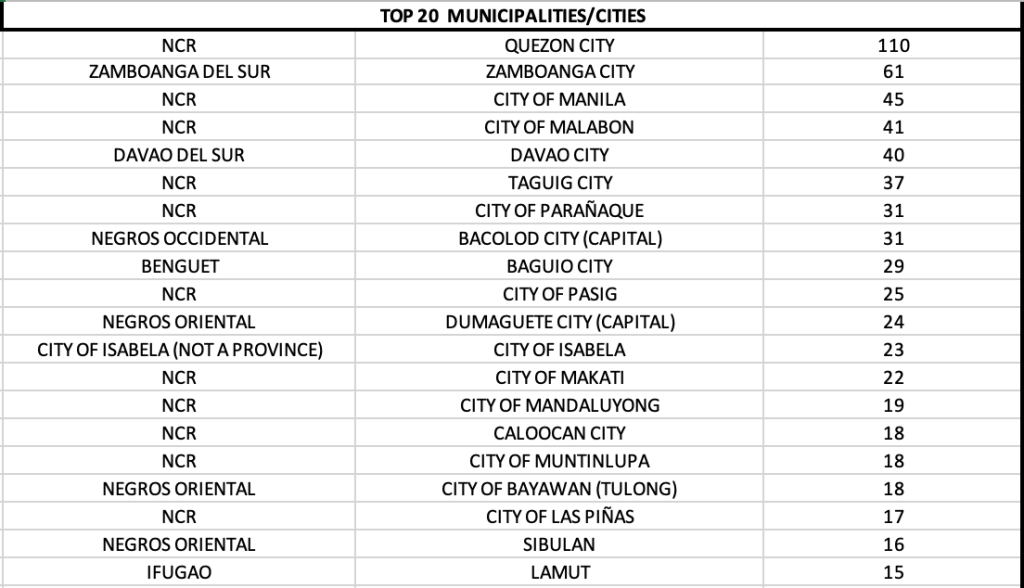
While among LGUs, Quezon City was on top with 110 cases and accounted for more than 25% of the total cases in Mega Manila. Which meant that for every case in NCR, one was from QC. Eleven of 17 LGUs in the NCR were in the top 20 list as the fewest number of cases today was 15. Which meant that if you LGU had 15 cases, it would be in the list.
There were fewer cases today than yesterday as backlogs were included in the tally.
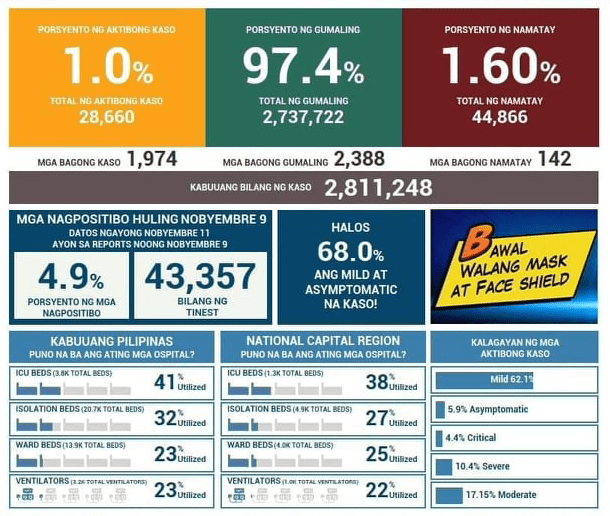
Today, the Health Agency reports 1,974 new cases based on more than 43.000 tests done last November 9 with a 4.9% positivity rate. This is the second straight day with positivity rates < 5%.
With more recoveries, the active cases are now down to a little more than 28,000. Around 9,000 plus active cases are anywhere from moderate to critical.
A total of 142 new deaths were announced today.
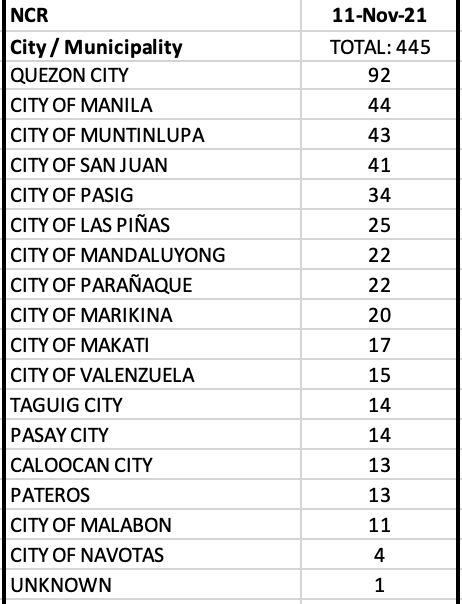
The NCR continued to lead with 445 new cases today and a share of 22.5% of the total cases in the country. As the cases in other regions continue to decline, more than 1 in 4-5 cases in the country are from Mega Manila. While 8 regions reported triple digits, they were less than 200 cases apiece.
Negros Oriental was the only province that reported triple digits.
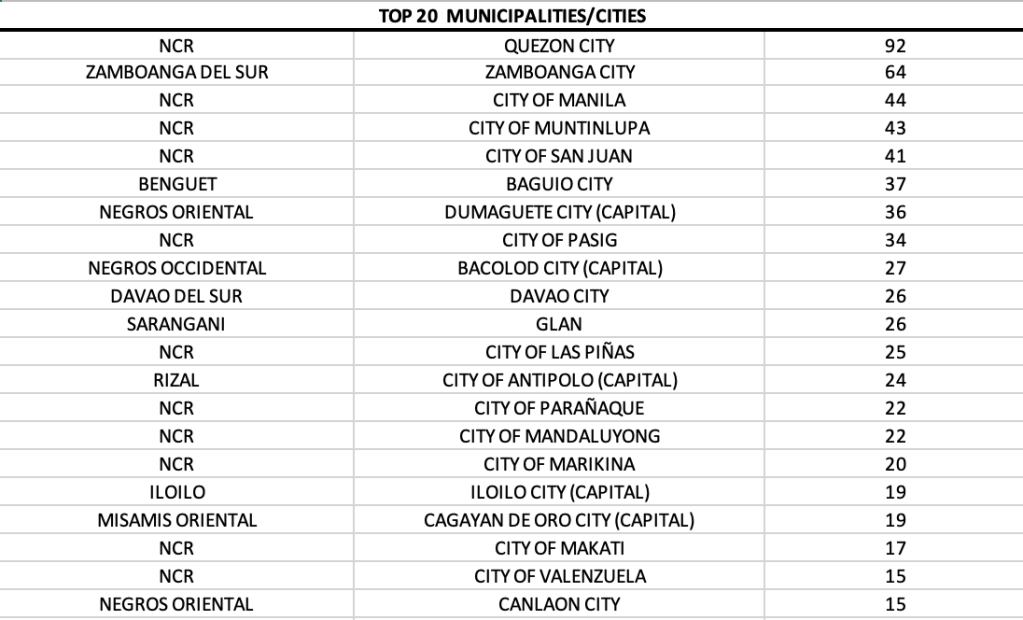
On an LGU level, 11 of 17 LGUs from NCR were among the top 20, with the small city of Muntinlupa jumping to fourth spot in the country. Fewest number of cases for the day was 15. Which meant that if your LGU had 15 cases, it would be part of the top 20 list.

















 Relative Joy