Infection vs. injection: The light at the end of whose tunnel?

The world changed overnight with the COVID-19 pandemic.

So did our lives.

Masks became part of the new normal. Travel – whether by land, air or sea – unless essential for work was parked. Borders both locally and internationally were closed. The economy broke its back as mobility became compromised. What stood out was how the pandemic served as the great divide between rich and poor countries, rich and poor people. Inequity became more glaring during the past one and half years.

The world needed to live differently. At an age of technological, digital and economic advances, the new normal was mentally and emotionally challenging.

In the Philippines, schools never reopened face-to-face. The irony here is that while many other municipalities and cities in the 7,641 islands in the archipelago had very few COVID-19 cases, the whole education system had a one strike policy – shut it down. And for a country whose internet speed and regular stream of energy supply is wanting, this was a misguided decision of government. The disruption in our normal daily lives was more apparent among the frontline healthcare workers and the daily wage earners in society. Lockdowns became the primary measures at curtailing the spread of the virus.

The year 2020 was traumatic to everyone. When the first surge came, the health workers were overwhelmed. It was a time when we scrambled searching for a cure while some friends, families and colleagues who got infected died. Several drugs were repurposed as we waited on the sidelines for vaccines. Using new and old platforms, science was on a mad dash to developing vaccines to stem the pandemic’s growth.

Towards the end of 2020, some manufacturers were ready to roll out vaccines. The COVID-19 vaccines were approved for Emergency Use Authorization (EUA) in less than a year. The quickest ever. The entry of a new platform using mRNA technology provided the first ray of light at the end of the deep dark tunnel. Other vaccine platforms – non-replicating viral vector (Astra-Zeneca Oxford, Sputnik V, Janssen), inactivated virus (Sinovac, Sinopharm), and subunit protein (Novavax) – rolled out their clinical trial results one after the other. To date, there are more than 80 vaccines in development at various phases of clinical trials. A testimony of humanity working together towards that light.

While vaccines are now available, the glaring prejudice for countries or continents that have more resources compared to poor nations has become more apparent than ever. Israel, the UK, the US are examples of model and wealthy nations that have managed to address the pandemic with the abundance of vaccines available to them. The saying “beggars can’t be choosers” is strikingly more vivid now, with developing and third world countries like ours having to literally beg for that shot of hope.

With vaccines coming in dribbles for now, how the available COVID-19 vaccines at our disposal are being rolled out, is even a challenging one.

The first challenge is the war against vaccine hesitancy.

Vaccine acceptance was never a problem in the Philippines. Until the political story behind Dengvaxia came along. After the Dengvaxia fiasco – with theatrics and drama at the level of congress and the senate – rebuilding vaccine confidence became an uphill battle. Social media and reckless sensational journalism heightened the misinformation and false information campaign. While it is true that Dengvaxia was prematurely rolled out as a public health program by the past administration, the vaccine was vilified and stripped of its potential use among those who may benefit from a vaccine against dengue. During the deliberations in congress and the senate, science was thrown under the bus. At the end of the Dengvaxia debacle, science and research were lost in translation. The wrong people were crucified. And public trust in vaccines were lost overnight.

The Dengvaxia story would be one that would be the first straw to severely affect preventive healthcare in the country. Parents refused to have their children immunized. An outbreak of measles ensued. Followed by polio. Then dengue. Sadly, the more vulnerable sectors of society – classes C, D and E – were the most affected.

Then came the COVID-19 pandemic. And while the world was not prepared for a pandemic of this magnitude, the ghost of Dengvaxia past was still fresh in the minds of the Filipino people. Deeply ingrained even as vaccines against COVID-19 started to arrive and roll out, that ghost would haunt our vaccination efforts.

In several early surveys done by independent organizations (SWS, OCTA RESEARCH, Pulse Asia), vaccine acceptance against COVID-19 was initially very low. The brand also mattered. There was distrust from those made in China and Russia. The tragedy created by the Dengvaxia story created a wedge so deep with fear that many people were more than willing to risk infections rather than getting injections.

As the title in a Nature article would say, “six months and 1.7 billion doses later“, where are we in the effort to address the pandemic?

That leads us to second challenge – restoring vaccine confidence.

On December 8, 2020, at 630AM, Margaret Keenan, a 90 year old British woman became the first person in the world to receive a COVID-19 vaccine (Pfizer-BioNTech) as a mass vaccination effort at University Hospital in Coventry. On April 22, 2021, Maggie was interviewed once more, and called the global mass vaccination rollout as “incredible”. She has turned 91 since, and continues to be the poster woman who took the first jab during the pandemic.

Without a doubt, the vaccines work. Their efficacies vary from clinical trial settings and since their roll out in the real world, much of the news continues to be positive on how well the vaccines perform in general settings.

As a general rule, the ideal time to roll out a vaccine program is when the cases are low. If you wait to do this when the cases are running through the roof then one will need to combine this with extensive limitation of mobility (e.g., lockdowns) to give time for the vaccines to provide immunologic responses to those that get the shot. Starving the virus entails stemming the transmission from person to person either by limiting movement of individuals in society or having them vaccinated.

Restoring vaccine confidence will entail a lot more work than just providing lip service. The communication strategy should be one that appeals to the concerns (safety and suitability) of the masses. The major question that is asked – IS IT SAFE?

We will need more than just one Keenan out there to show the world that the vaccines work and are safe. With an unparalleled speed in the roll out of a vaccine, surveillance systems must be put in place to watch out for adverse events, record them, and identify if there is a link between the vaccine and that reported side effect. So far, the concerns include clotting syndrome with vaccines from an adenovirus platform, anaphylactic reactions after immunization, and lately, the possible link of myocarditis (heart inflammation) among those 16-19 years old who received Pfizer-BioNTech vaccine. The debate on the safety of these vaccines was enough to dampen public confidence in them.

What level of safety is acceptable?

Even the food we eat, or the air we breath or the water we drink have potential risks. Over the counter multivitamins or supplements have different manufacturing standards and can pose harm even to those who perceive that they are absolutely safe.

There is no answer that will guarantee with absolute certainty that the vaccines are 100% safe. Some side effects will occur. Whether it is local or systemic, majority will be mild, tolerable, and inconsequential. To date, the number of people who have developed adverse events to the COVID-19 vaccines available as EUA are far fewer than the 1.7 billion doses that have been administered. Definitely, a case where the benefits far outweigh the risks.

The final challenge is equity at a time of scarcity.

When the COVID-19 vaccines began its initial roll out in the Philippines, the healthcare workers were the priority. Not many wanted to get the first jab. It was a disappointment that instead of an mRNA that arrived, a vaccine made in China came. But we rolled up our sleeves and took the jab anyway.

A study published in the American Journal of Preventive Medicine on “The Benefits of Vaccinating With the First Available COVID-19 Coronavirus Vaccine” by Bartsch et al. last January 18, 2021 argues why “during a pandemic, there are many situations in which the first available vaccines that may not have as high effectiveness as vaccines that are still under development or vaccines that are not yet ready for distribution” raise the question of whether it is better to go with what is available now or wait. After all, it is a valid concern by all.

The authors of that study developed a computational model representing the spread of COVID-19 and vaccines with different efficacies (either to prevent infection or reduce severity of disease), vaccination timing and the clinical and economic value of vaccination.

That study showed that, using the United States of America population as computational model, “if a vaccine with 50% efficacy in preventing infection becomes available when 10% of the population has already been infected, waiting until 40% of the population are infected for a vaccine with 80% efficacy in preventing infection results in 15.6 million additional cases and 1.5 million additional infections, costing $20.6 billion more in direct medical costs and $12.4 billion more in productivity loses.”

Clearly, there are few situations where it is even worth foregoing the first available COVID-19 vaccine in favor of one that becomes available later on during an ongoing pandemic, even if the one we are waiting for has a substantially higher efficacy.

At at time when the vaccines that are arriving are coming in trickles, let us remember that the ultimate aim of vaccination is creating herd protection. This can only be achieved when majority of us are immunized, regardless of the vaccine platform. There are many factors that affect response to a vaccine. We need to keep in mind that the best one is the one in our arm. And when we get more arms getting the shot, then it becomes more difficult for the virus to transfer from a person who is protected to an unprotected individual.

But there is a need to equitably distribute the available vaccines across all classes of society.

The systems that allow people to get vaccinated should not rely on technology alone because people in classes C, D and E will most likely not have the same means and resources as those in class A and B. Being able to register for vaccination using technology is unjust and inequitable. It is prejudicial to the poor who will always be left behind. As a consequence, the effect of being noninclusive in a society that treats them differently, pandemic or not, is a challenge for every local government.

In spite of the vaccine roll out, every nation cannot fully depend on lockdown measures and vaccines as the only strategy at addressing the pandemic. Economies will suffer and those who have the least will have a longer journey through the tunnel. Unless a feasible exit plan is laid out.

At the end of the day, the impact of the pandemic will continue to be felt until every eligible person from high-, middle- or low-income countries can be immunized.
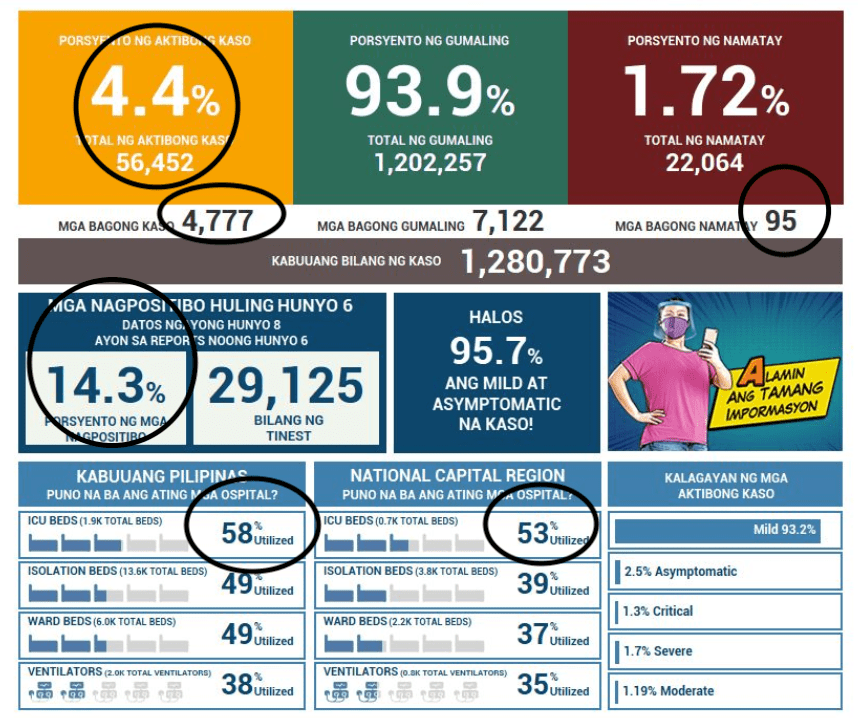
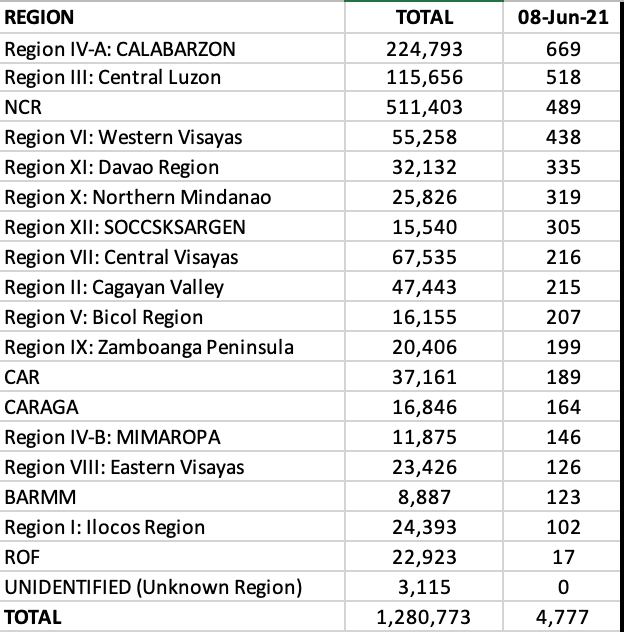
4,777 new cases on 06.08.2021…because it’s a Tuesday

Because it is a Tuesday, the 4,777 new cases announced today by the Health Agency were from tests done on June 6, 2021 with a very high 14.3% positivity rate (because less than 30,000 tests were done. This tells us that the high positivity rate is due to the low testing being done in the country.). With lower new cases, the active cases are now at 4.4% (56,452). And while they may be lower, they are indicative of the actual number of cases (only the reported ones) in the country.

Number of deaths today are at 95. The case fatality ratio for outcomes is steady at 1.80%.

Note, however, that in spite of the lower cases in the NCR in the past weeks, the utilization for ICU beds is up at 53% from 49% yesterday. An increase of 4%.

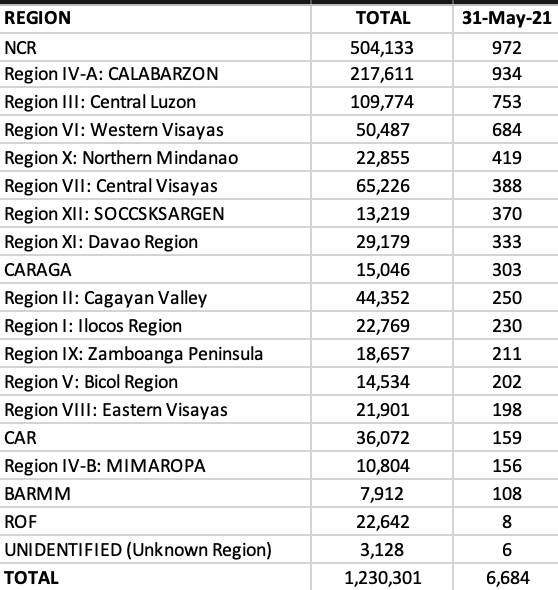
While the news came in really really really late, the update for cases by region, provinces and LGUs show that CALABARZON continued to lead on a regional level. This time, Central Luzon overtook NCR for second spot. Western Visayas comes in fourth with a little more than 50 cases separating it from Mega Manila. Ironically, even on a day that reported less cases, ALL regions in the Philippines continued to report triple digits.

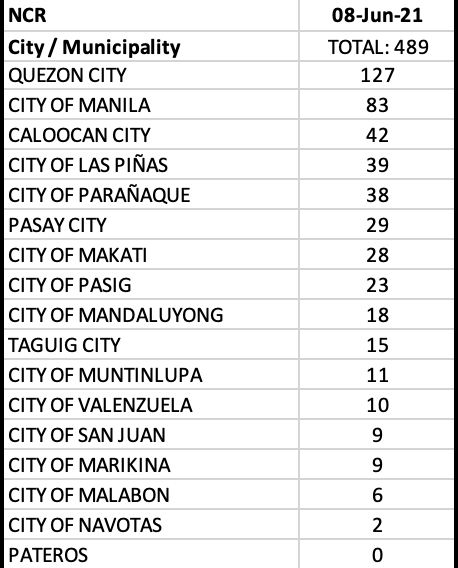
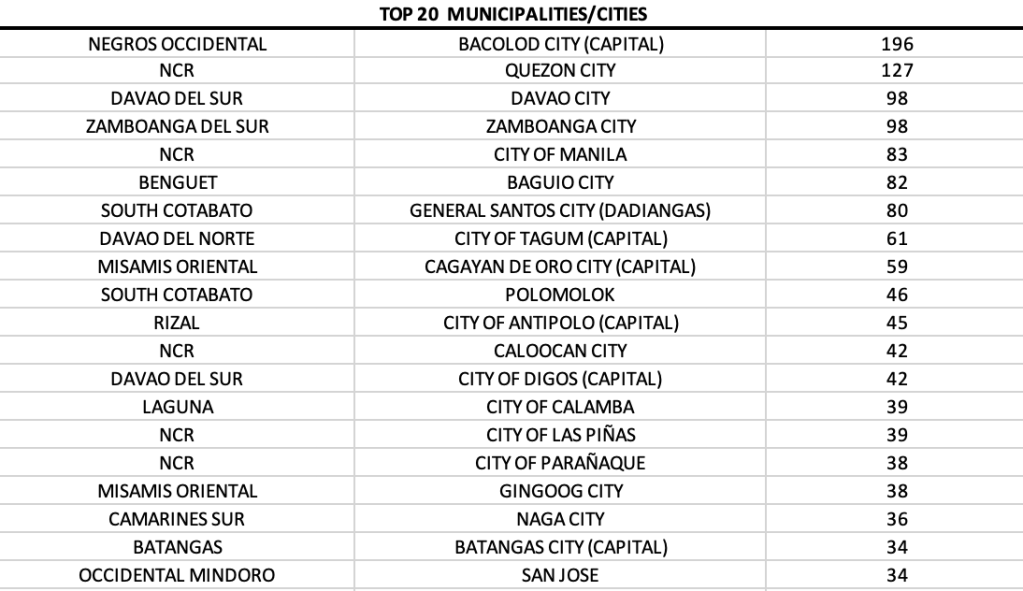
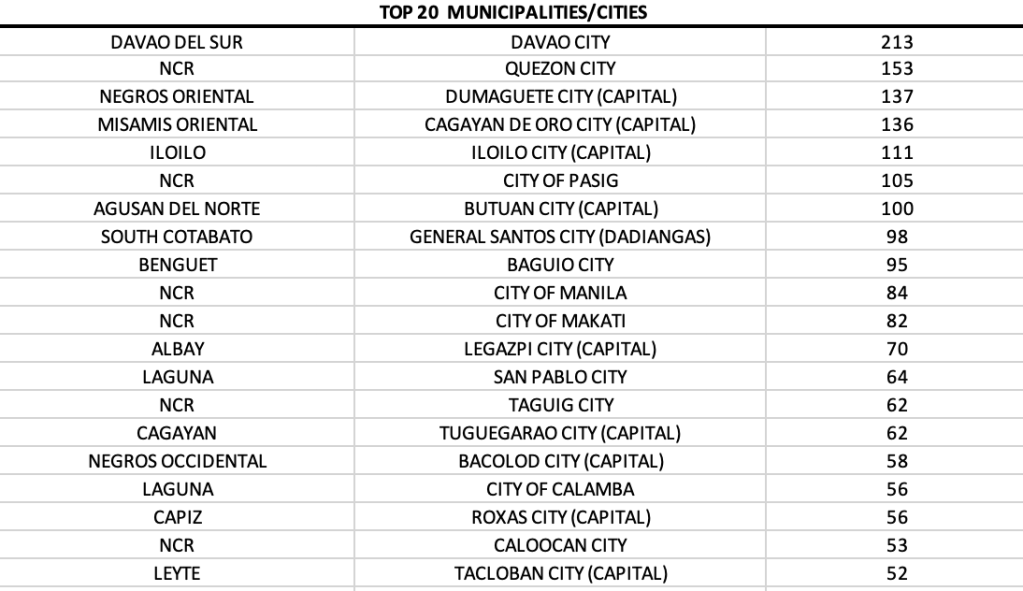
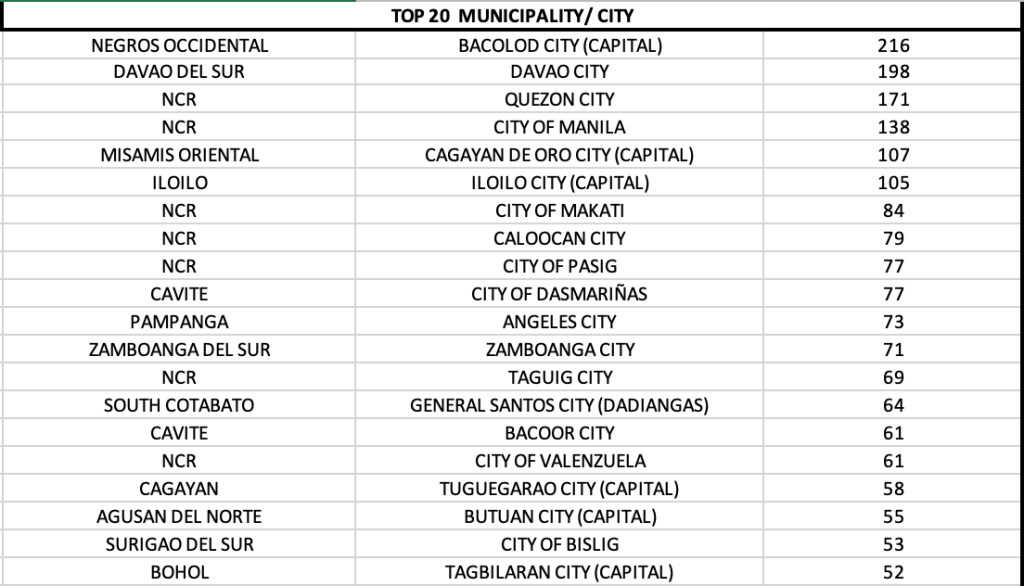
In NCR, only Quezon City reported triple digits with 127 new cases. Five of 17 LGUs in NCR landed among the top twenty cities with most cases for the day.

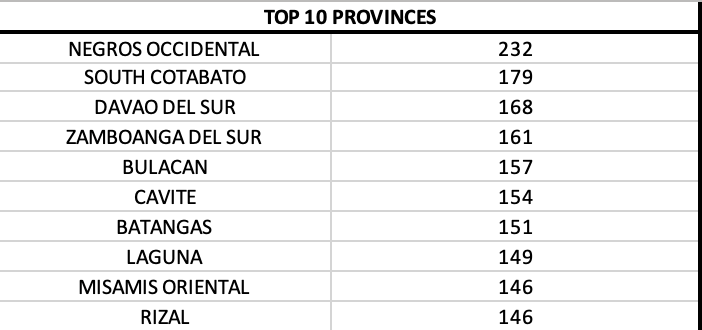
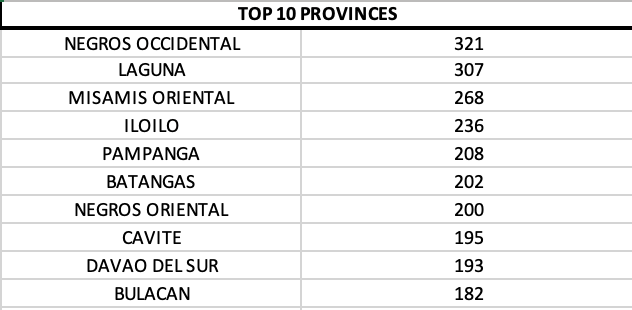
On a provincial level, Negros Occidental and South Cotabato took the lead.

On a city/municipality level, Bacolod City grabbed the lead with 196 cases, followed by Quezon City and Davao City.

The OCTA Research Monitoring provides an update for LGUs with most new cases per day (from June 1-7, 2021). Davao City shows a growth of 44% putting it in the lead among cities with most cases. Quezon City is the only LGU from NCR that is among the top five cities with most cases. The other cities in the top five are: Cagayan de Oro, Bacolod and Iloilo City.

Koronadal and Dumaguete City are reporting growths over 100% with average daily attack rates in the high risk zone.

With >6.5K new cases & 13.3% positivity rate on 06.07.2021, stricter lockdowns in regions outside NCR should be imposed

The Health Agency reports 6,539 new cases based on more than 45,000 tests done last June 5, with a positivity rate of 13.3%. However, there were 7 laboratories that failed to submit reports for this day. If all labs most likely submitted test reports, the new cases would be closer to 7K. There are still close to 60K active cases (4.6%).

An additional 71 new deaths were reported as well, bringing the case fatality ratio for outcomes is at 1.80% for today. Healthcare utilization is higher nationally compared to the NCR. However, the granular breakdown on how specific cities in the country are doing during this second surge is better delineated in the updated OCTA Research Monitoring report.

CALABARZON continued its four digit tally with 1,049 new cases. NCR was in second (12.4% of the total cases in the PH) and Western Visayas in third spot. All regions continued to report triple digits for the day.

In NCR, only Quezon City and Pasig reported triple digits, and at a little more than 100 cases for the day. Six of 17 LGUs in NCR stay in the top twenty cities with most cases in the country.

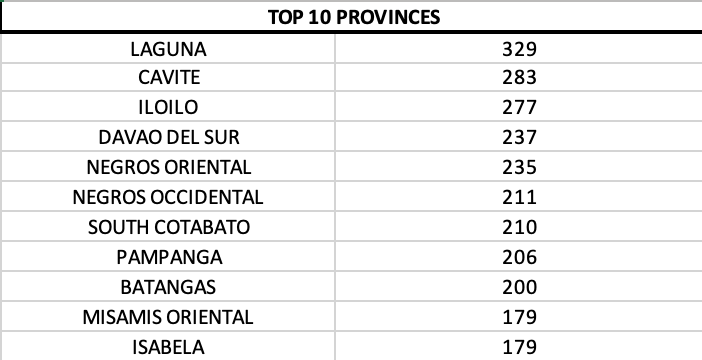
On a provincial level, Laguna and Cavite, two major provinces in Region IVA, continued to dominate the rest of the provinces in number of cases for the day. These two provinces, together with Batangas, remain the major drivers of cases in CALABARZON.

The shift in tide of cases to the regions outside of NCR among the various LGU cities and municipalities is glaringly seen today as Davao City continued to stay on top among cities with most cases for the day. There are now 7 cities outside of NCR that are in the top ten. Aside from Davao City, they include: Dumaguete City, Cagayan de Oro, Iloilo City, Butuan City, General Santos City, and Baguio City.

The OCTA Research Monitoring Report on June 7 shows that the NCR plus bubble continued the decline of 11% after a week of uncertain trends. Positivity rate in Mega Manila is 9%.

However, the major cities of concern have shifted to Mindanao and some areas in Visayas. The provinces of concern are Iloilo, Negros Occidental, Davao del Sur, South Cotabato, Negros Oriental, Leyte and Bukidnon, that are seeing rising cases. Health Care Utilization Rate more than 70% is noted in the provinces of Iloilo, Misamis Oriental and Cagayan.

Among LGUs with most new cases per day, Dumaguete saw 206% increase in the period May 31 – June 6. Davao City, Cagayan de Oro, Bacolod City and Iloilo City ranked 2nd to 5th for the first time. The average daily attack rate is highest for Bacolod, Iloilo City, Tuguegarao, Koronadal and Dumaguete. ICU health utilization rate is deadliest in Iloilo City, General Santos, Tuguegarao, Koronadal, Bacoor (Cavite), Cotabato City, and Dumaguete City.

Another day with >7K on 06.06.2021

So we’ve been treading the 7,000 mark over the past few days. Today, the Health Agency reports 7,228 new cases for close to 44,000 tests done last June 4 with a 13.2% positivity rate. In the weekly summary update, one will see the U turn the Philippines took in the past two weeks. In spite of the more than 7,372 recoveries for the day, the total number of active cases is at 4.7% (almost 60K).

New deaths reported were 166 today putting the case fatality ratio fixed at 1.81 percent.

As of yesterday, there were 45,703 new cases reported this week and an uptick in death count at 1,008 new deaths for the week May 30 – June 5, 2021.

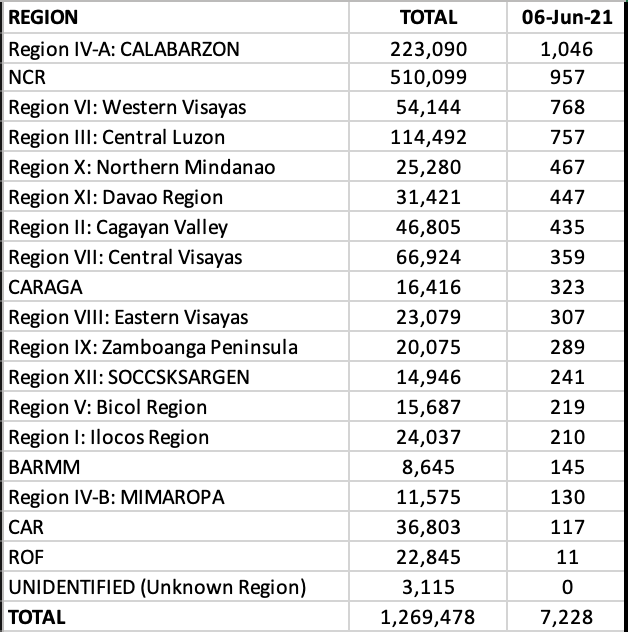
CALABARZON took over the regional lead today as the only region reporting four digits with 1,046 new cases. NCR came in second and had one of its lowest percentage over-all total contribution at 13% (957) to total cases for today. The surprise? Western Visayas – which had moved to third place with 768 new cases. All regions continued to report triple digit numbers.

Every city in the NCR had less than 200 cases, with only Quezon City and Manila reporting triple digits. Two cities and one municipality even reported single digit cases. Seven of 17 LGUs in NCR were among the top twenty cities with most cases in the Philippines for the day.

The province of Negros Occidental took over the lead among the top provinces, while Iloilo province came in fourth.

Bacolod City had the most cases among all cities, followed by Davao City, for the day. Other cities outside of NCR that were among the top ten included: Iloilo City, Cagayan de Oro and Dasmariñas City (Cavite).

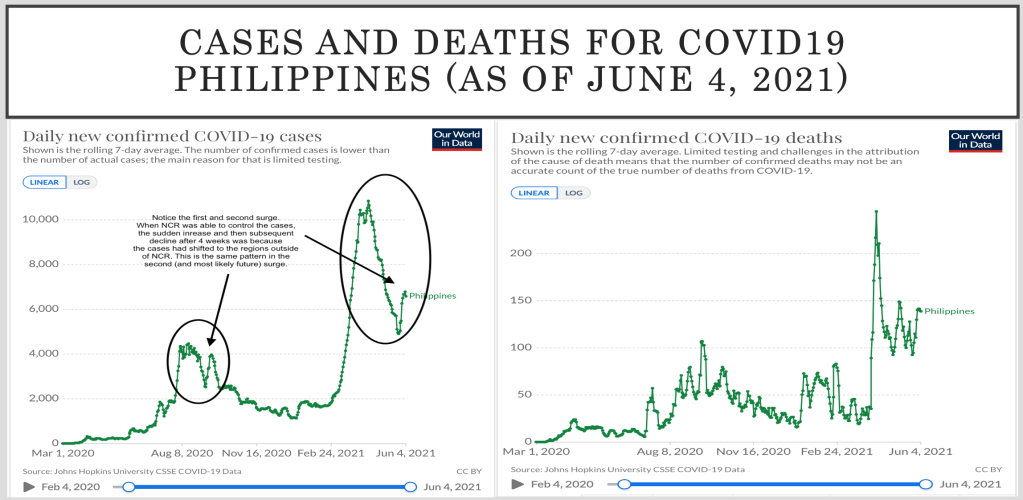
The week in review now shows the U turn the country took the past two weeks. Notice how the deaths also took an upward trajectory. It is interesting to note the parallelism for the uptick in cases during the first and second surge. The first surge last August 2020 lasted more more than 2 months. The NCR and areas around NCR were the primary contributors to these cases. When the cases began to decline by end of September, there was an increase in cases that lasted close to a month. That second rise was from the regions outside of NCR. The second surge which began the last week of February 2021 was again attributed to the NCR plus bubble. Another lockdown (ECQ followed by MECQ and heightened GCQ) for 4 months now pushed the cases down. Similar to the first surge, we were never able to bring the cases low enough as mobility allowed the cases to migrate to the regions. The U turn, is attributed to the rise of cases outside of NCR plus bubble.

Testing capacity remained a paltry around 40-50K per day. It is lowest during Sundays and Mondays. Because most of the testing centers are located in the NCR plus bubble and in major urban areas of the country, it is understandable that we have lower tests conducted because the regions are not that capacitated. This is why the positivity rate takes the same U turn as the cases. We are not testing enough in the regions outside of NCR because of lack of testing centers in these regions.
TTIQ – Testing, Tracing, Isolating and Quarantining – remain the four important cornerstones for addressing the pandemic. Including variants and surges. We need to maximize at strengthening these four pillars. While the government emphasizes the duty of each citizen to mask up, keep a distance, observe hand washing, improve ventilation and keep away from crowded venues, it is a good reminder for government to observe that it is their duty to ensure TTIQ is sustained and consistent across all LGUs in the country. The vaccines are only ONE PART of the solution. We cannot keep waiting for the donations and purchases to arrive. TTIQ is the obligation of government to its people.

Close to 7K and a stubborn positivity rate hovers at 13% on 06.05.2021

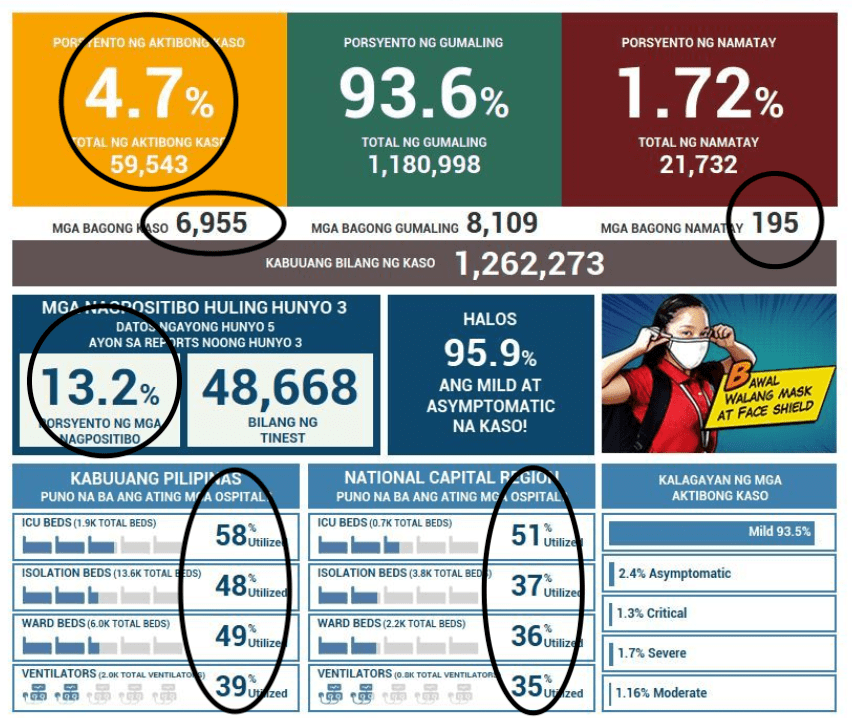
While today’s new cases test the 6000 margin, it’s like a fire sale. No, we are not testing the 6K mark. We’re still at the 7K lane as the Health Agency announces 6,955 new cases today based on reports of close to 50K tests last June 3. Two labs did not submit reports to be included in todays cases, hence, the actual numbers today would put us most likely along the 7K margin. Again. The positivity rate remains stubborn at over 13%. I cannot reiterate that we are not testing and tracing enough, particularly in regions outside of the NCR where there is an obvious lack in testing, tracing, isolation and quarantine.

The active cases fall around 60K as the total cases rapidly move to more than 1.26M cases.

New deaths today were 195 which brings the case fatality ratio a notch higher at 1.81%.

Healthcare utilization is still higher nationally compared to the NCR as the number of cases in NCR are flat (around 15-18% per day).

Only NCR recorded quadruple digits, but the southern provinces continued to see increasing cases for the day. Mega Manila continued to report 15.6% of the total cases. Central Luzon came in second, while CALABARZON in third.
Among the LGUs in NCR, the top four cities continue to be Quezon City, Manila, Pasig and Caloocan City.
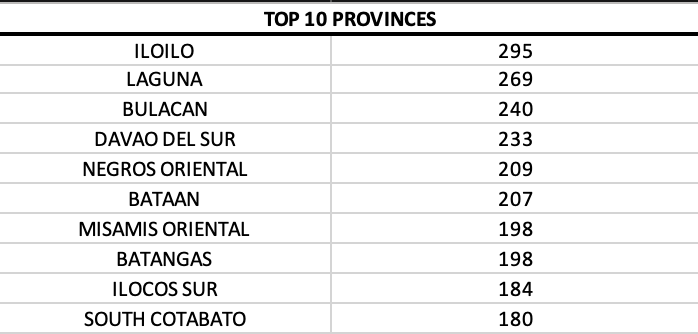
On a provincial level, Iloilo province took the forceful lead for the day, followed by Laguna, then Bulacan.

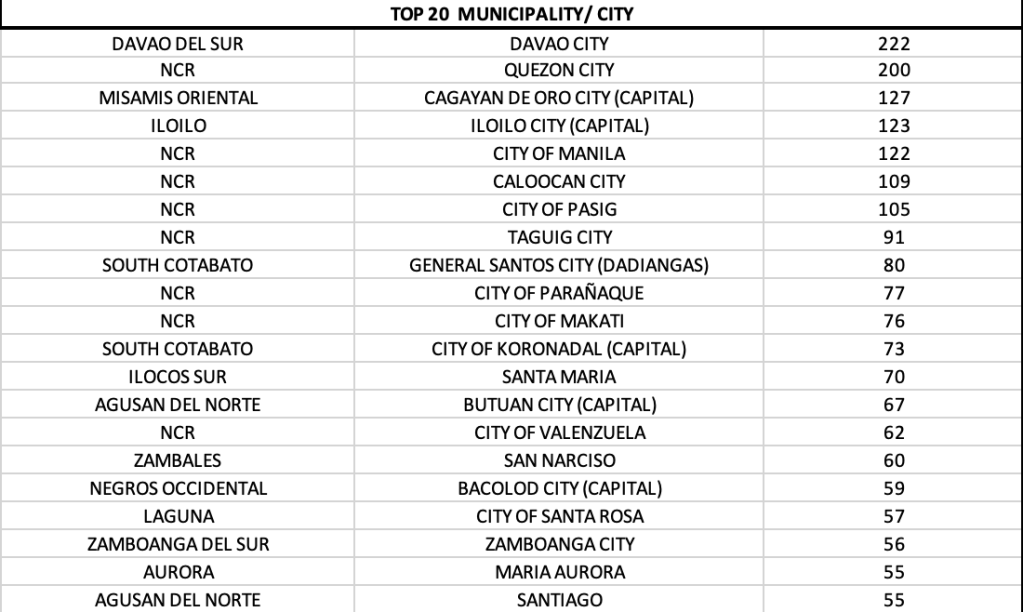
Among the top cities with most cases, it was Davao City that continued to lead in cases followed by Quezon City, Cagayan de Oro and Iloilo City. Three of five cities in the top twenty for the day are cities outside of NCR. Eight of 20 cities from NCR were in the top twenty. Oddly, cities/municipalities that were NEVER in the top twenty have appeared today: Santa Maria (Ilocos Sur), San Narciso (Zambales), Maria Aurora (Aurora), and Santiago (Agusan del Norte).

Up at almost 7.5K on 06.04.2021 as more provinces outside of NCR go into stricter lockdowns

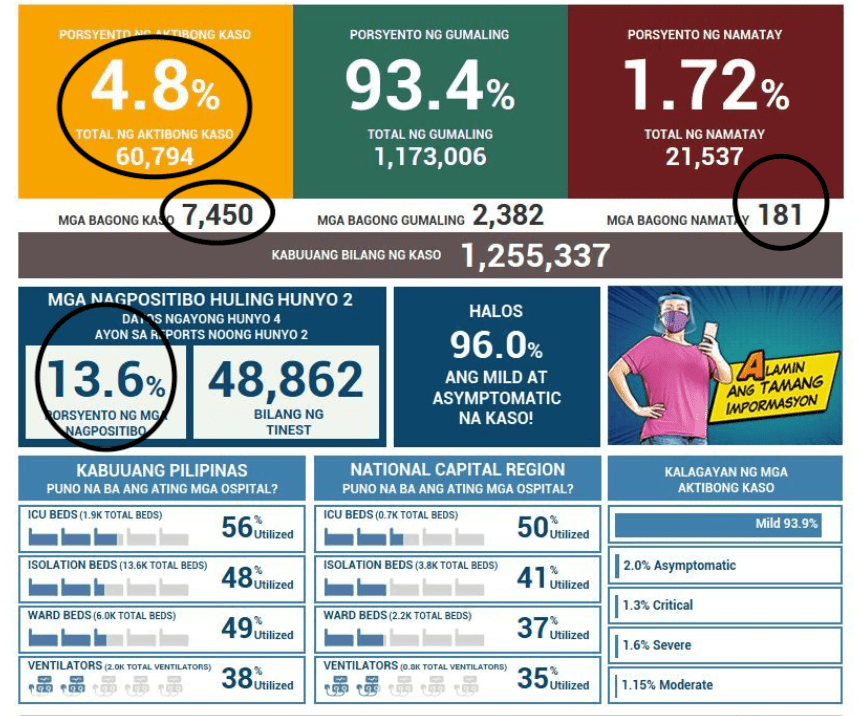
The Health Agency reported 7,450 new cases today based on reports last June 2 where close to 50,000 tests were conducted, with a positivity rate of 13.6%. Notice that the positivity rate has remained stable at a high of 12.5-14% over the past weeks. This means that we are likely plateauing and increasing slowly in new cases. The active cases are up at more than 60,000 (4.8%) today as only 2,382 new recoveries were recorded.

New deaths continued to be in the triple digits with 181 reported today. This brings the case fatality ratio for outcomes up at 1.8%.

Healthcare utilization is still higher nationally than the NCR as Visayas and Mindanao are reporting higher new cases than the NCR plus bubble.

CALABARZON takes back the top spot for most cases on a regional level. NCR is in second, owning 15% of the total cases and Central Luzon in third. These three regions continue to account for 40% of the total new cases for the Philippines.

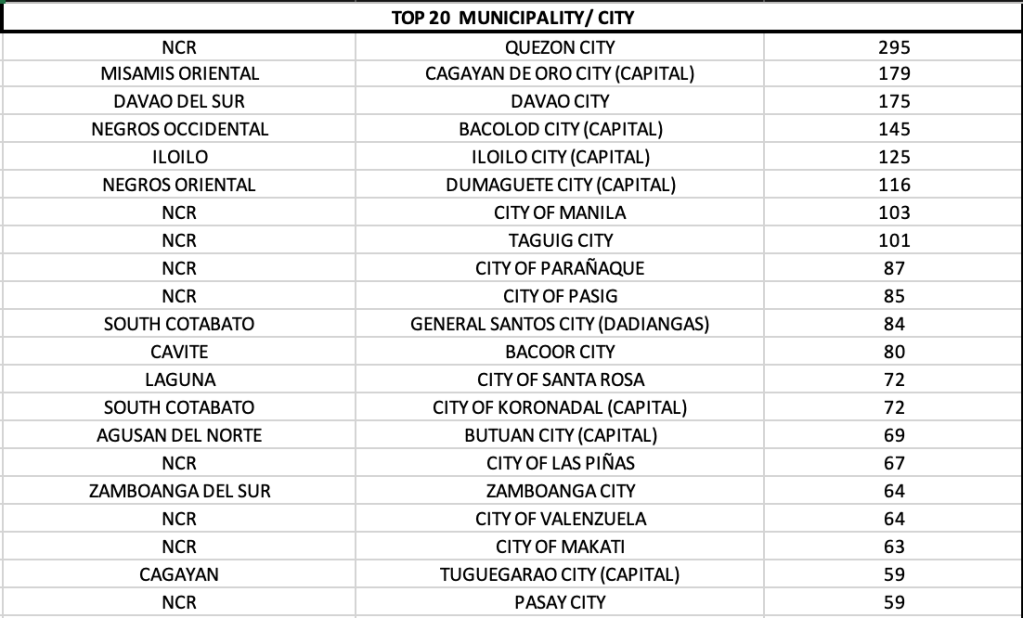
Among LGUs in NCR, Quezon City continued to lead with close to 300 cases today. Two other cities reported triple digits – Manila and Pasig. Nine of 17 LGUs are in the top twenty cities/municipalities in the country with most cases.

On a provincial level, Laguna is back on top, followed by Cavite and then the provinces in Visayas and Mindanao dominate the haul for the day.

On a city level, five cities in NCR are among the top ten. The remaining five cities came from outside of NCR. They are: Cagayan de Oro, Davao City, Bacolod City, Iloilo City and Dumaguete City – which ranked 2nd to 6th consecutively.

Up at 7K+ the PH sees more cases on 06.03.2021

With 7,217 new cases today, based on close to 45,000 tests done on June 1 with a positivity rate up at 14%, the Philippines is close to 1.25M total COVID-19 cases. There are more new cases than recoveries, placing the active cases at more than 55,000.

New deaths reported were 199. This means that the case fatality ratio for recoveries is up at 1.79%.

The healthcare utilization is higher nationally than the National Capital Region on all parameters (ICU occupancy, isolation beds, wards, and ventilator use).

The NCR is back on top as the region with most cases, and while understandably so (it has the largest population with the smallest area), it added 1,218 new cases (16.8% of total) today. Central Luzon came in second with 954 cases but Western Visayas sees a rapid rise with 847 cases to snatch third spot. CALABARZON moves down to fourth and Davao Region is now in fifth.

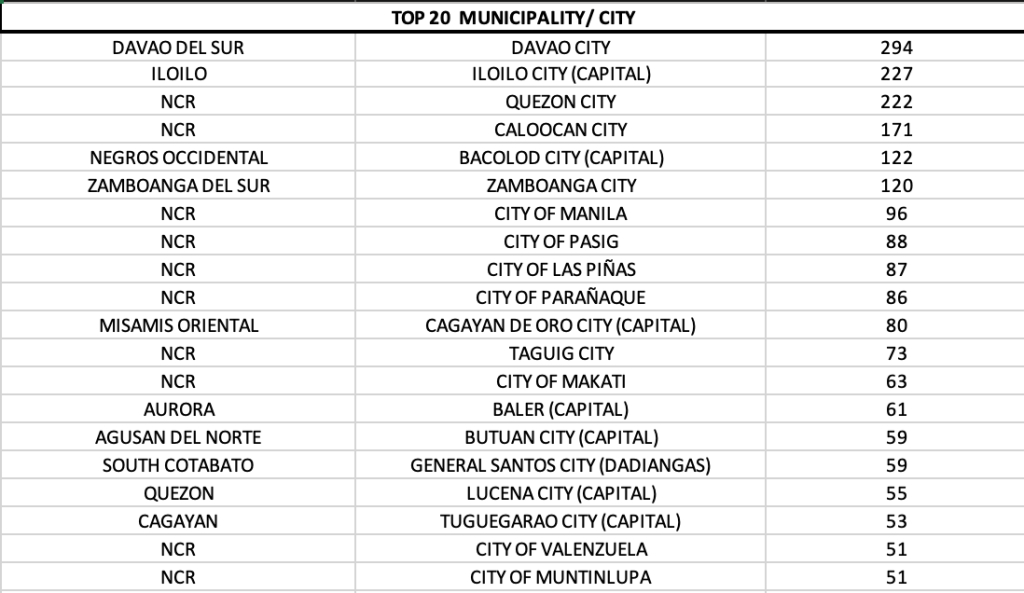
Among LGUs in NCR, Quezon City and Caloocan City provide triple digits and 11 of 17 cities are among the top 20 cities with most cases for the day.

On a provincial level, Iloilo, Davao del Sur, and Negros Occidental are the top three.

Davao City maintains its lead as the city the most cases for the day, followed by Iloilo City in second spot, upstaging erstwhile top leader Quezon City.

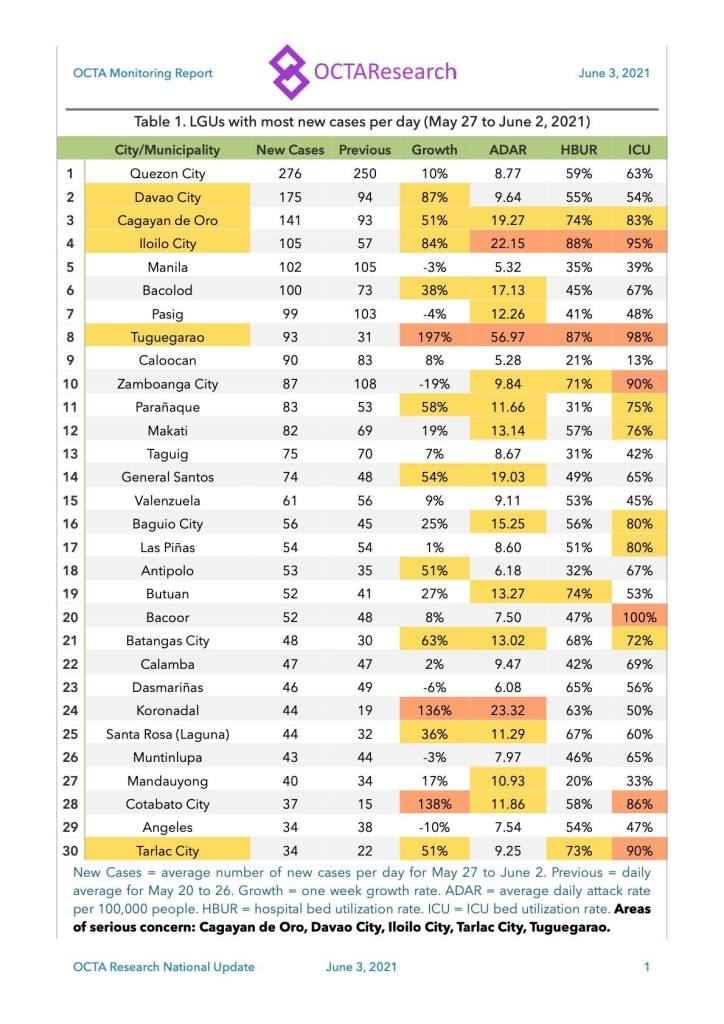
The OCTA Research provides an updated (June 3, 2021) monitoring report for LGUs with most new cases per day (from the period May 27 – June 2, 2021). The table below shows the percentage growth of new cases from the previous week, the Average Daily Attack Rate (>10 is high risk), the Hospital Bed Utilization Rate (HBUR) and the ICU occupancy per city/municipality. Among the top 30, areas of serious concern are: Cagayan de Oro, Davao City, Iloilo City, Tarlac City and Tuguegarao. Some of these areas of concern are either in GCQ or MGCQ status.

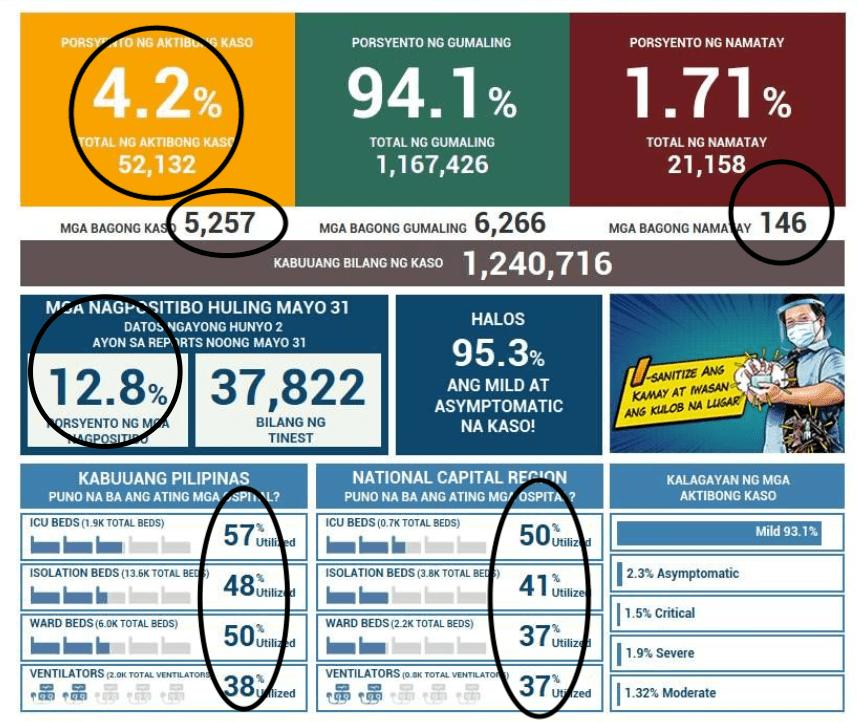
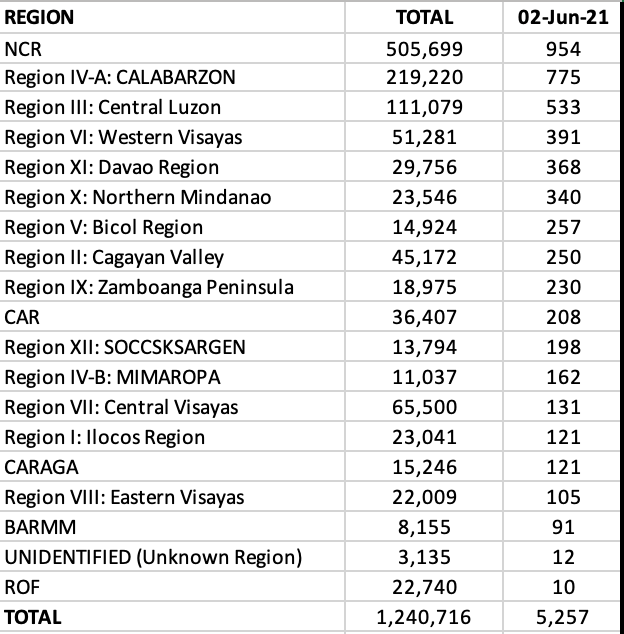
The U turn and 5,257 new cases on 06.02.2021

The typical Wednesday is a few cases more than the day before. The Health Agency announces 5,257 new cases today based on close to 40,000 tests done for May 31, with a positivity rate of 12.8%.

With 146 new deaths announced today, the case fatality ratio for outcomes is steady at 1.78%.

Healthcare utilization is higher nationally than the NCR.

The NCR takes back the lead with a little less than 1,000 new cases or 18.2% of the total cases for the day, followed by CALABARZON and Central Luzon. The irony is, that even on a day like Wednesday where the new cases are lower than the rest of the days of the week (except Tuesdays), all but one region (BARMM) report triple digits.

In NCR, Quezon City continued to report more than 200 new cases, but it was the city of Parañaque that snuck into second spot. Six of the 17 LGUs in Mega Manila were among the top twenty cities with most cases for the day.

Cavite kept its lead on a provincial level, but Davao del Sur took second rank. Cases in Davao del Sur were driven by Davao City with 226 cases. That was enough to wrest the lead among cities with highest cases for the day.

The OCTA Research Monitoring report for today June 2, 2021 provides an update on the COVID-19 data in the country.

Notice that the reproduction number in both NCR and nationally are up at 0.68 (from 0.57 last week) and 1.09, respectively. This increase in the Rt for the NCR was due to an increase of 8% growth rate. The Average Daily Attack Rate (ADAR) for NCR remains in moderate risk at 8.22 per 100,000. While NCR saw a slight uptick in Rt (due to increase in cases for the week), the rise in Rt nationally to 1.09 was driven by two factors: the rise in cases outside of NCR and NCR’s cases losing the momentum in decline.

Based on the top LGUs with most cases for the week, Davao City has a growth rate up by 70% and sits in second place. It is, however, Cagayan de Oro (which is in 3rd spot) that is more problematic. Its growth rate is more than 50% but its ADAR is at high risk (18.78%) and its health care utilization rate is at 75%.

The major driver of new cases have now shifted to the regions outside of NCR. As to whether this will return with a vengeance in the NCR because of less tighter quarantine status in areas with high cases outside of Mega Manila and the highly porous borders and the various LGUs requiring testing only when traveling out of NCR but not on the return to the capital city will be something we need to monitor closely in the coming weeks.

More than 5K on a Tuesday for 06.01.2021 is not a good sign

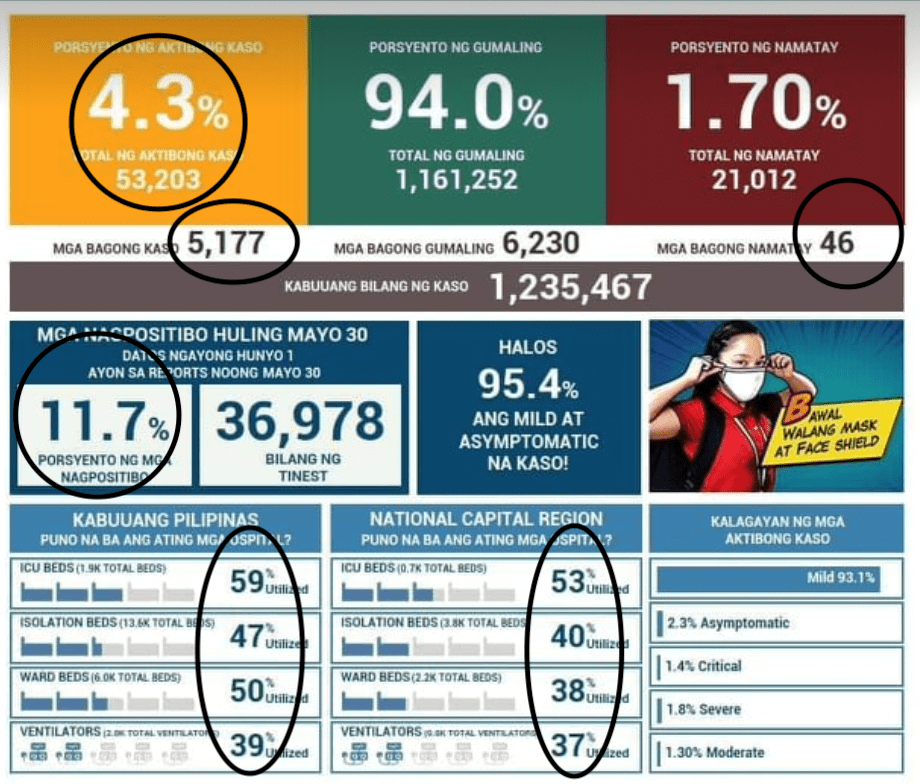
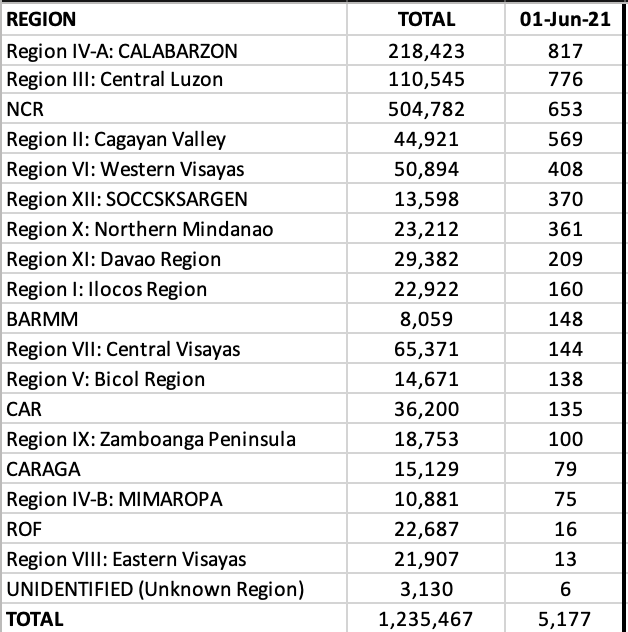
The first day of June is a Tuesday. The number of cases on Tuesdays and Wednesdays are usually 25-30% lower than the average cases from Thursday to Monday. The fact that the Health Agency reports 5,1777 new cases for reports of May 30, Sunday, with 11.7% positivity is quite unsettling. The active cases are still at more than 50,000. The regions outside of NCR are now accounting for around 85% of the total cases in the country. This is reflected in the healthcare utilization nationally vs the NCR. The driving force in increased hospital care on a national level are regions outside of Mega Manila.

With 46 new deaths, the case fatality ratio for outcomes remains steady at 1.78%. Total deaths has now breached 21,000.

Suddenly, the NCR slips to third place (which is good for the NCR region) as CALABARZON and Central Luzon take the lead in new cases by region. Mega Manila accounted for 12.6% of the cases. Together with regions IVA and III, these three regions accounted for 43% of the total cases in the country today.

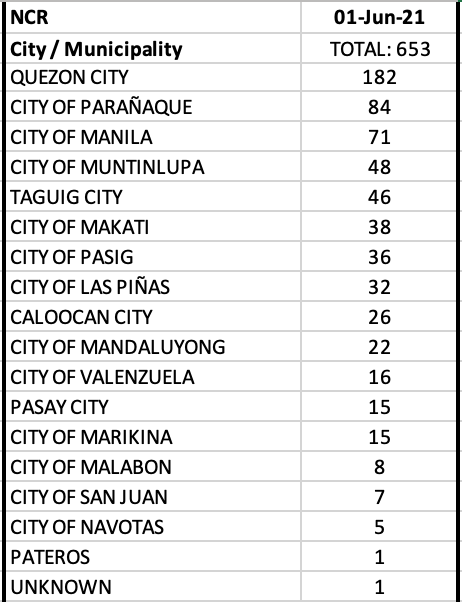
Of the 17 LGUs in NCR, Quezon City continued the lead with 182 cases, with Muntinlupa moving up to 4th rank for the day. Six of 17 LGUs were among the top 20 cities with most cases for the day.

On a provincial level, Cavite took the lead, with Isabela, Cagayan and Nueva Ecija in second to fourth spot today.

Cities outside of the NCR with the most cases were mostly from Mindanao – Davao City, Cagayan de Oro, and General Santos.

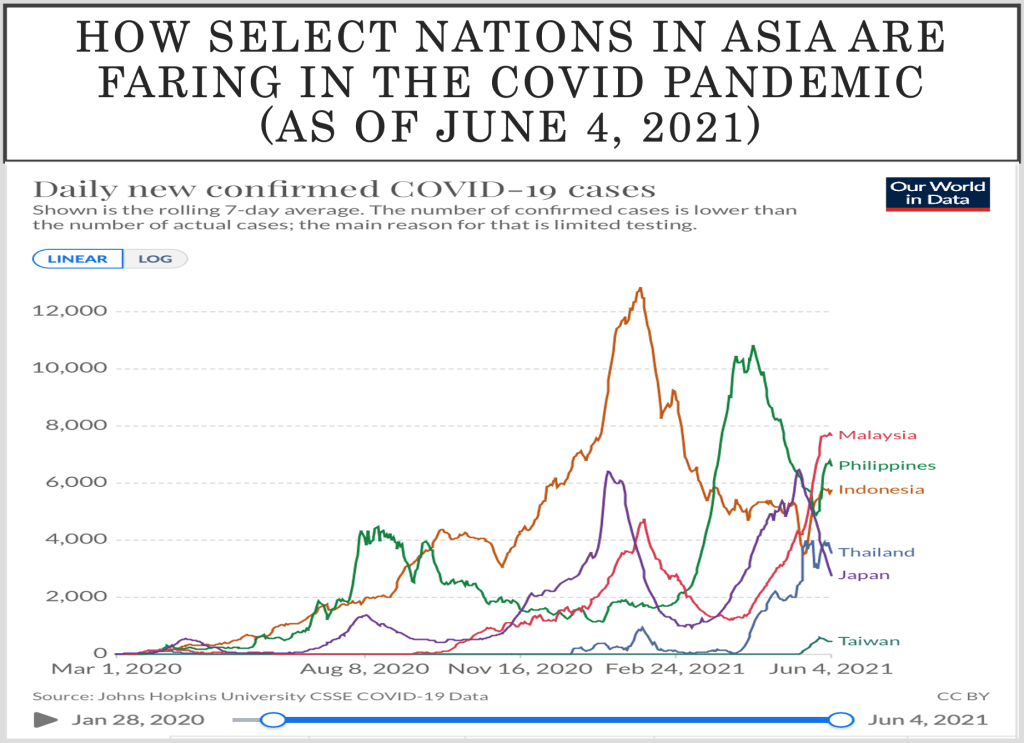
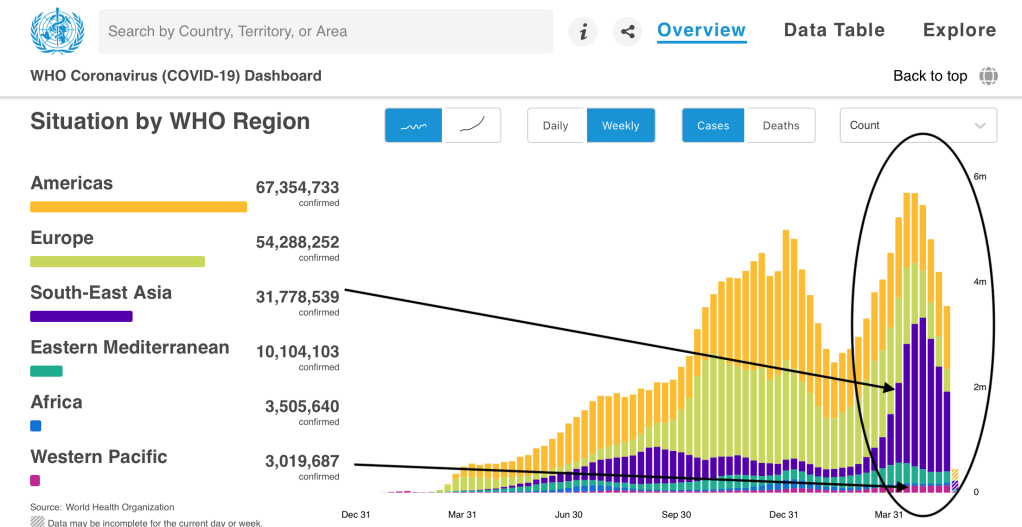
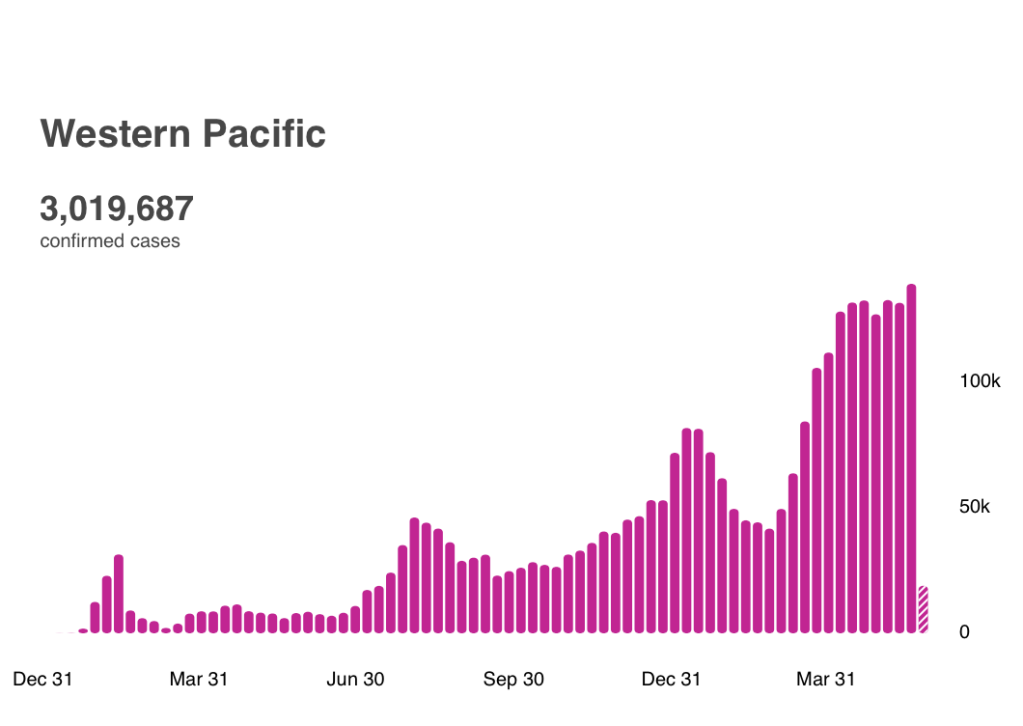
The World Health Organization COVID-19 dashboard (https://covid19.who.int) provides us an overview of the over-all situation of the pandemic globally. As of May 30, 2021, notice the data provided below where the surge in cases is now concentrated in South-East Asia and the Western Pacific region (where the Philippines belongs).

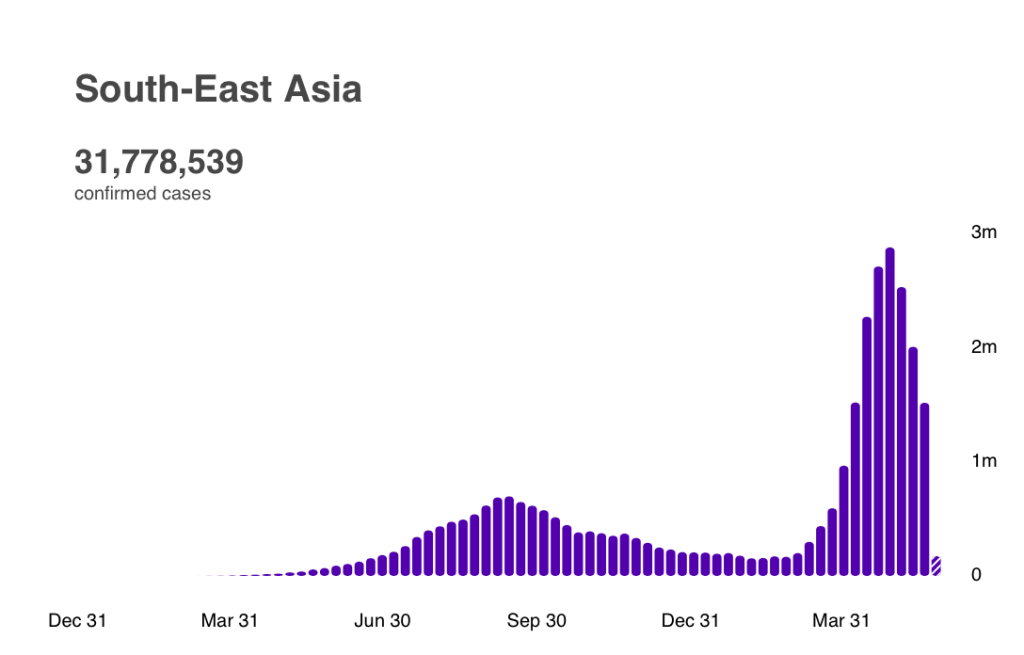
The graph provided is a weekly summary of the cases. The Western Pacific cases continue to increase and while there are only over 3M cases in this region (of which the Philippines belongs), the Philippines contributes to more than 40% of the cases in this region alone.

The graphs below isolate now the data of South-East Asia and that of the Western Pacific.

With close to 7K cases on 05.31.2021, will we land in the top ten again?

The bad is news is that we landed tenth among all countries in the world with MOST new cases, yesterday. The number of cases today and yesterday were just a few hundred cases, as the Health Agency announces 6,684 new cases today. This is based on reports from May 29, where 13.7% of the close to 45,000 individuals tested were positive. The positivity rate has really not gone down and is unsettling in the sense that the only way we will be seeing lower cases is when the positivity rate drops. (See the analysis of positivity rate per province or region below as reported by OCTA Research).

With more cases than recoveries, the active cases now approach 55,000.

And with 107 new deaths, the case fatality ratio for outcomes remains steady at 1.78% as the Philippines ends the month of May 2021 with 1.23M total cases since the start of the pandemic.

NCR swapped with CALABARZON for the lead today but both regions reported less than 1,000 cases each. NCR owned less than 15% of the total cases. NCR + CALABARZBON + Central Luzon accounted for only 39% of the total cases for the day. Again, ALL regions in the country continued to report triple digits.

Quezon City continues to lead Mega Manila and nationally with more than 200 new cases. Nine of the 17 LGUs in NCR were among the top twenty cities with most cases.

On a provincial level, Negros Occidental took the lead over Laguna.

Other cities outside of NCR among the top ten cities with most cases were: Cagayan de Oro, Bacolod City, Davao City, Iloilo City and Zamboanga City.

The updated OCTA Research Monitoring report for May 31, 2021, shows that while the downward trend in NCR plus bubble continues, it has actually slowed down. The national reproduction number is up at 1.02.

In the NCR, the numbers took a dramatic decline over the past weeks. Last week, the decline was only 1%. Other areas like Cavite and Laguna saw increases. This pushes the reproduction number of NCR up at 0.69 from a previous low os 0.54.

The full report of OCTA Research is provided below. Notice the tremendous increases in certain regions/provinces. While the cases may have decreased in Palawan, the decrease is not reflective of the actual nature of the positive cases as the positivity rate there is 53%. Or 1 in every 2 people tested, being positive. Camarines Sur has the highest positivity rate and up at 90% increase in cases. Isabela and Cagayan have more than 100% rise in cases and positivity rates that are more than 25%.