Reality check Thursday as the PH breaches 900,000 on 04.15.2021

We were headed to break 900,000 cases today. It was inevitable. With 11,429 new cases reported (yes, we’re back to the real numbers as more samples are tested). This pushes the active cases past 20 percent (183,527). As the reproduction number is still > 1.0 the average daily cases will continue to increase (albeit slightly slower than the steep trajectory seen last month). The positivity rate still hovers close to 20 percent in spite of more tests being done. The healthcare capacity in the National Capital Region continues to rise. Note that more cases will also mean a troubling increase in the number of deaths eventually, as critical care units become inundated with the increase in numbers.

The case fatality ratio is NOT 1.72 percent. While the Health Agency arrives at this number by computing the number of deaths divided by the number of cases. A better way to compute for CFR is to use the formula [deaths/(deaths + recoveries)] x 100 = CFR. This latter formula mitigates the bias due to delays in case resolution during an ongoing outbreak by restricting the analysis to resolved cases. This is particularly important at this time because the number of active cases is now more than 20 percent. Hence the denominator cannot be the total number of cases as it is presumptuous that the active cases will all recover. The denominator that should be used should be the deaths plus the cases that have recovered. These are the resolved cases. While this method does not eliminate all biases related to delayed reporting, it is a better formula for computing deaths due to COVID-19, as we still do not know the outcome of the active cases. [For further information on this, kindly refer to the link https://www.who.int/news-room/commentaries/detail/estimating-mortality-from-covid-19 .]

With the 148 new deaths reported today, the actual national CFR is 2.16 percent.
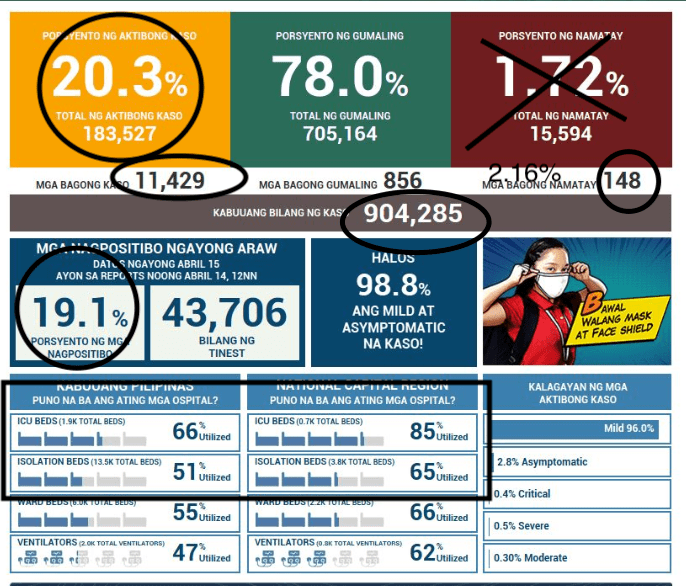
The National Capital Region accounted for 5,317 or 46.5 percent of the total cases today. CALABARZON and Central Luzon complete the triumvirate, where these three regions account for 76 percent of the cases in the country. CAR, Western Visayas and Cagayan Valley are the other three regions with more than 400 cases today. There are 82 cases with no known location on a regional level.

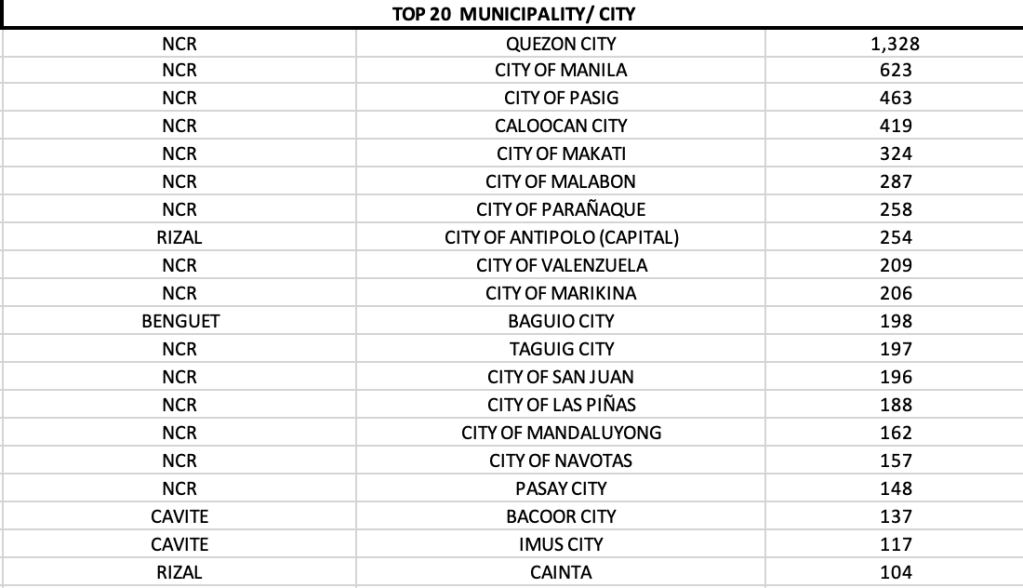
In Mega Manila, Quezon City accounted for the majority of the haul with almost 1/4 of the total cases. Manila was second with 623 cases. Pasig and Caloocan had more than 400 but less than 500 cases. Only Muntinlupa and Pateros reported double digits for new cases. Fifteen of 17 LGUs in NCR were among the top 20 cities with most cases for the day.

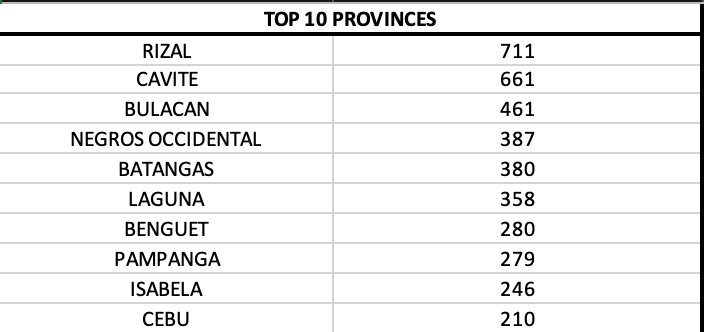
On a provincial level, Rizal overtook Cavite for the top spot. Bulacan was in third with 461 cases. All top ten reported more than 200 cases.
On a lighter note, the DOH has reported that as of April 13, 2021, more than 1.25 million doses of a COVID-19 vaccine has been administered. The 7-day average of vaccinated individuals is close to 50,000. Of the vaccines that have been distributed, 64 percent (1,093,651) have received at least the first dose, while 162,065 individuals are fully vaccinated (have completed the second dose). In the infographic below is the information from the Health Agency.

The table should be interpreted cautiously as people may think that more than three million doses have been given. Of the over 3 million doses of the vaccines the Philippines has, 93 percent have been distribution and less than half of the total doses at hand have been administered.

In the table one will see the number of doses received. This indicated the number of doses appropriated for that particular region. Beside the region are the number of first and second doses administered from that appropriated number. While the National Capital Region received the chunk of the vaccines (1,158,470), less than 500,00 have been given a first dose, while around 56,000 have been used for second doses.

a

Casualties of Covid19 and the data for 04.14.2021

The Health Agency reports 8,122 new cases and 162 new deaths for today. We will most likely breach the 900,000 mark tomorrow as there are more tests done and the positivity rate is at 19.5 percent. The unfortunate news are the ICU bed capacity in both the national level and in the National Capital Region. For the national level, it is now close to the critical level of 70 percent, while in Mega Manila, it is alarmingly high at 88 percent.

The increasing death reports over the past week is expected as the cases have averaged more than 10,000 daily in the country. In the National Capital Region alone, where close to 50 percent of the cases in the country is recorded, the OCTA Monitoring Report showed that “the CFR due to COVID-19 in the NCR from March 28 to April 13, 2021 is 5.36%, nearly three times higher compared to the CFR of 1.82% from March 1, 2020 to March 27, 2021. While the more recent CFR is based on a much smaller sample size of 284 deaths, and the CFR may still decrease as more data comes in, the possibility of an increase in CFR should not be ignored. The reasons for the increase in CFR may be due to an overwhelmed hospital care system, the presence of SARS-COV2 variants which may be more lethal, or both. Comparing the CFR before and after March 28, 2021, there was an increase from 11.8% to 28.6% for the 65 and up age group, an increase from 5.7% to 16.4% for the 60-64 age group, and an increase from 2.7% to 8.7% for the 50-59 age group.”

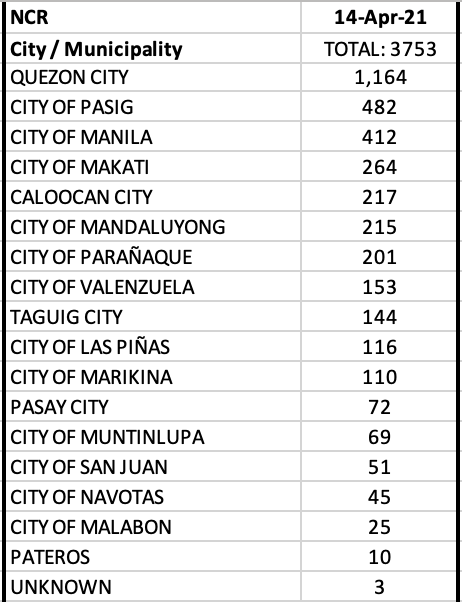
In todays data drop, NCR owned 3,753 or 46.2% of the total cases. CALABARZON was in second with 1,831 cases followed by Central Luzon with 811.

In the National Capital Region, Quezon City led the haul with close to 1/3 of the cases in the NCR. One can see the significantly decline in cases in the various cities in Mega Manila, but this is not reflective of the actual numbers as the reports are from lower testing on a Monday. Thirteen of 17 LGUs in NCR were among the top twenty cities with highest cases.
On a provincial level, Cavite continued to lead. This was followed by the province of Rizal and Pampanga.

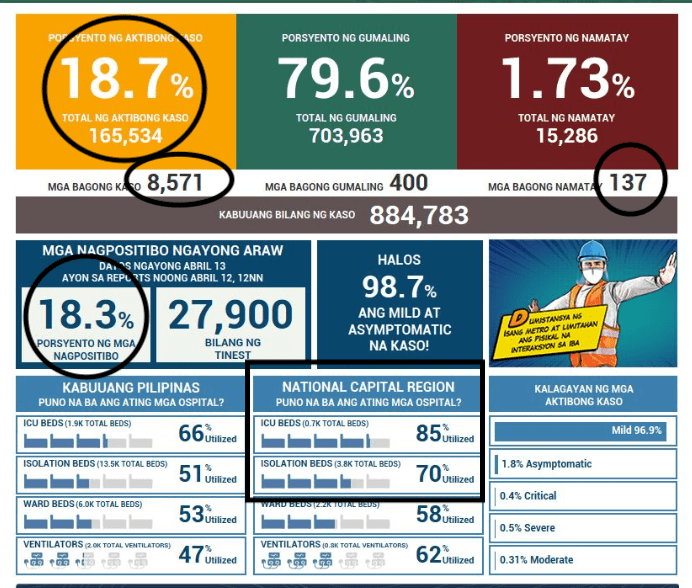
Slow down Tuesday with 8,571 new cases on 04.13.2021

You know that the data of the Health Agency is consistent (although not necessarily accurate) when they report lower numbers on Tuesdays and Wednesdays. The data for Tuesday are collated from tests done on a Sunday. As we all know, not all testing facilities are open daily or 24/7 and are usually closed on Sundays and holidays. This is true as well in other parts of the world. Because the data in other countries in the world are mostly real time, you will notice that the global cases are always lower on Mondays and Tuesdays (because most of the European and North American countries are a day back with respect to Philippine time). The bottomline is – COVID19 testing is not a medical emergency.
The DOH reports 8,571 new cases or almost a 25 percent drop from the cases in the previous days. This is the usual trend prior to the surge. Tuesdays and Wednesdays would see around 20-25 percent less cases than the average high days from Thursday to Monday. There is a slowing down in the increase of cases but we need to work at bringing down the reproduction rate to not only 1.0 but less than 0.7 (and even lower) in order to provide some order to the chaos we are current experiencing.

There were 137 new deaths reported. Positivity rate is at 18.3 percent (appreciably lower than the previous days) but the hospitals are inundated with patients where ICUs are now filled to the brim in many public and private hospitals in the National Capital Region. Isolation facilities have been added in some cities, but not enough for the rising cases in those localities.

The distribution of the “ayudas” and reports of some disorganized vaccination sites should be addressed by the individual local government units because these propagate super spreader events. While the intention to provide assistance and immunization is vital, it should be a well thought of plan (I thought that there was enough time to practice this while they were all waiting for the arrival of the vaccines), ironically is such a mess in some areas with people jockeying to get vaccine slots or hoping to be part of the QSL (quick substitution list). These two super spreader events need to get addressed promptly in order not to affect the gains of the current quarantine status.

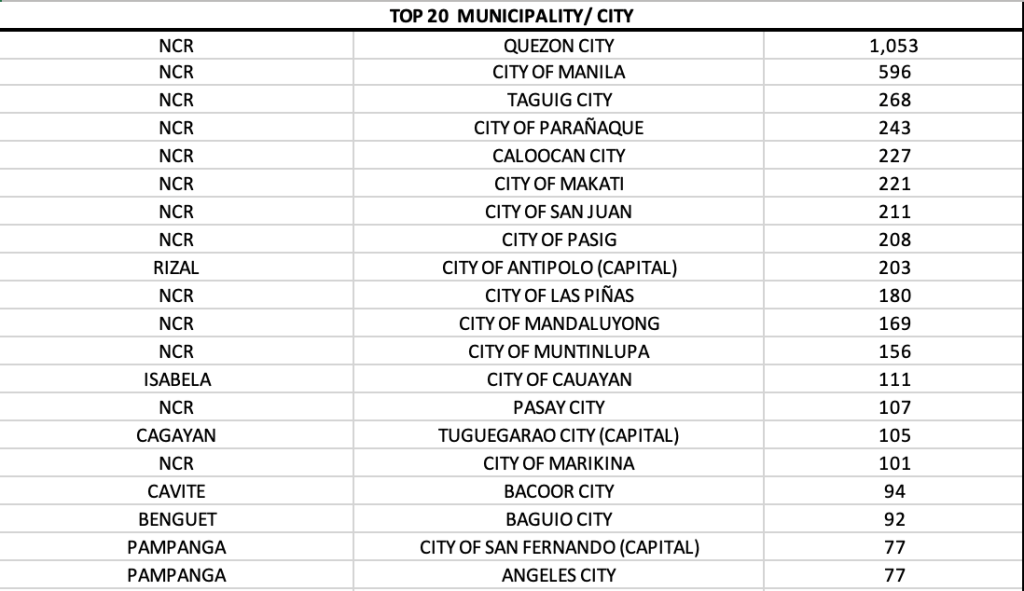
In todays data drop, NCR reported 3,949 new cases or 46 percent of the total cases in the country. Region IVA has 1562 cases and Central Luzon with 1,116 cases. These three regions alone account for 77 percent of the total cases in the country. Cagayan Valley hauled 556 new cases, while CAR contributed 282.

Quezon City owned 1,053 of the 3,949 cases in NCR or 27 percent of the total cases today. The City of Manila was in second with 596 cases. Pasay City, Marikina, Valenzuela, Malabon, Pateros, and Navotas reported fewer cases today than the previous days. Thirteen of 17 LGUs are among the top twenty cities with most cases.

On a provincial level, Cavite continued to lead with 539 cases followed by Rizal with 511. Pampanga, which is in GCQ status has 462 cases today, higher than erstwhile leader Bulacan that reported 397 cases which is in MECQ status.

With daily cases at 10,000/day, deaths based on CFR are at > 200/day. The data for 04.12.2021

There is good news and there is bad.

Let’s start with the good. With a reproduction rate of 1.2, it means that the growth of cases has slowed down significantly. Slowing down does not mean declining cases. It means, that instead of multiplying to more than twice the number in the previous week, there will still be minor increases and seems to be headed to plateauing. The positivity rate has also declined from a week high of 25 percent to 19.5 percent today.

The bad news is that while the case fatality rate nationally is 1.73 percent, it is much higher in the National Capital Region at 2.1 percent. This finding is not unexpected. Note that the NCR + bubble, which is current riddled with an overload of critical patients is a reflection of what happens when the healthcare facilities are overwhelmed. Medical care is compromised, better healthcare access is limited, patient care is delayed, and patient outcome is poorer. The total number of deaths has passed the 15,000 mark.

The Health Agency reports 11,378 new cases but 204 new deaths. Healthcare facilities continue to be burdened with the rising cases. The active cases have continued to rise and is now almost 160,000.

Based on the yesterdays data from the Department of Health, the following top 5 regions account for close to 80 percent of the total cases of the Philippines. So far, these are the total cases based on regional breakdown with NCR, CALABARZON, Central Luzon, Central Visayas and Western Visayas having the most cases in the country.

Todays data drop showed that NCR, CALABARZON, and Central Luzon continue to bring the haul for the day with 76 percent of the total cases. Cagayan Valley, Western Visayas, CAR, Ilocos Region, Central Visayas and Bicol Region report triple digits. There were 67 cases with no known location on a regional level.

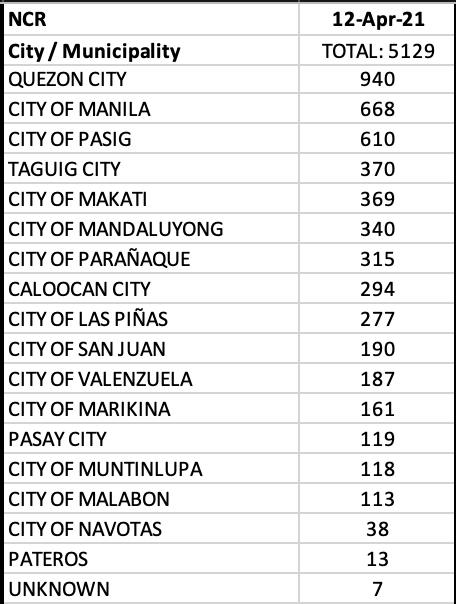
In the NCR, 15 of the 17 LGUs reported triple digits with Quezon City reporting 940 new cases. Manila and Pasig reported more than 600 but less than 700 cases. Thirteen of the 17 LGUs in Mega Manila were among the top 20 cities with most cases, with rank 1-12 all from NCR.

At a provincial level, Cavite, Bulacan, Rizal and Laguna report more than 500 cases today.

The weekend summary and data for 04.11.2021

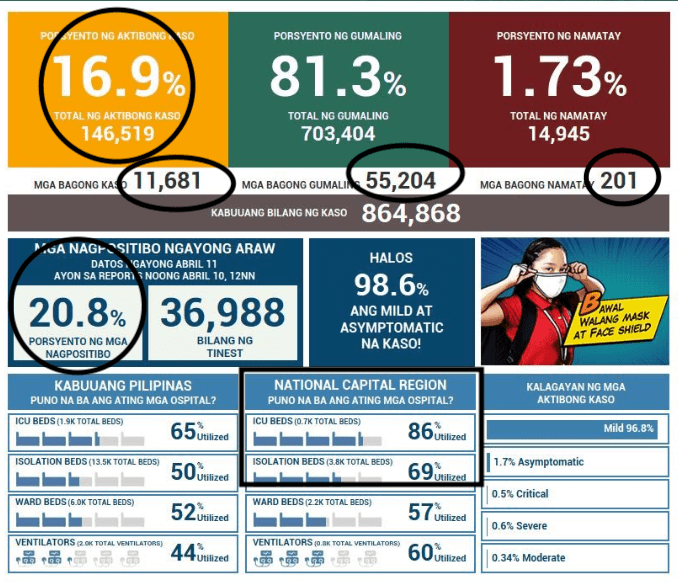
The Health Agency reports 11,681 new cases today pushing the total cases of the Philippines to 864,868. Sunday serves as the day when the recovery haul is reported, with 55,204 recoveries reported today. While this brought the total active cases to 16.9 percent, the number of reported active cases are still high at close to 150,000.

New deaths were reported at 201 for today.

Positivity rates for tests are still past 20 percent and ICU beds and isolation beds based on reports by the DOH is at past critical levels. Reports, however, from respective hospitals are more grim where many private and government hospitals in the LGUs in Mega Manila have passed the brink of despair.

While the reproductive number of the NCR is now lower at 1.24, this should not make the government and the people complacent as the IATF now lowers the quarantine restrictions to MECQ in spite of the high numbers we are still recording. For the week of April 4-10, 2021 alone, the Philippines had almost 70,000 new cases and 1,323 new deaths.

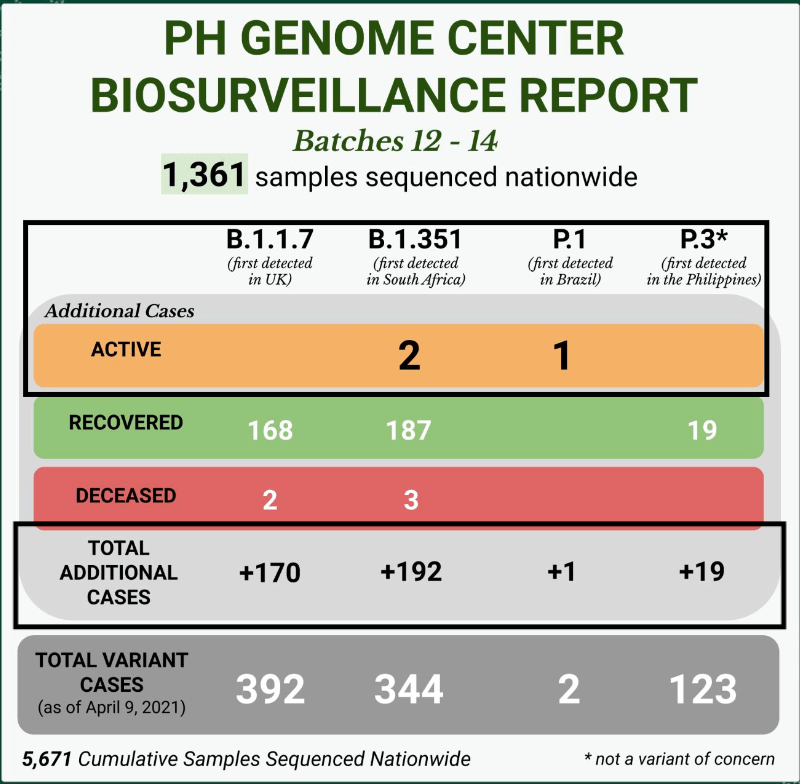
The Health Agency releases the report of the Philippine Genome Center Biosurveillance Report (batches 12-14) based on 1,361 samples sequenced nationally. While most the variants are B.1.1.1.7 (UK variant), it is quite alarming that there are more B.1.351 (South African variant) as additional cases in the latest batches. Data as of April 9, 2021 showed both the UK and SA variants dominating the type of variants that are present. Note, that not all samples swabbed undergo genomic sequencing.

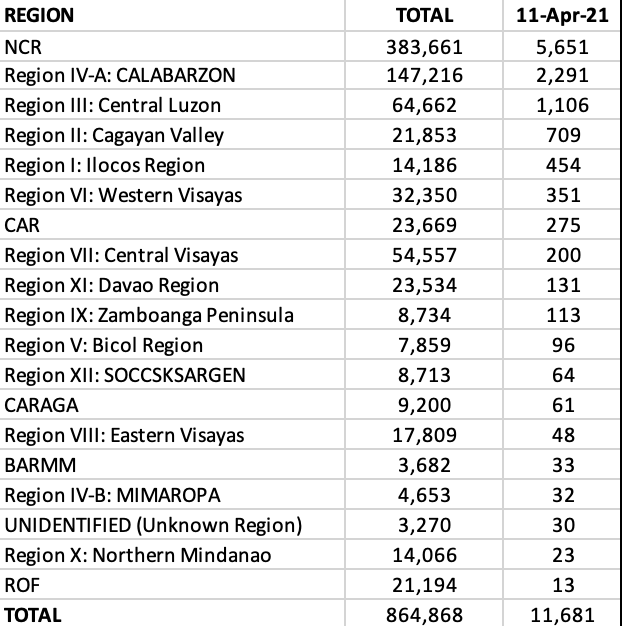
The following regions continued the daily haul today: NCR, CALABARZON, Central Luzon, and Cagayan Valley. NCR owned 48 percent of the cases in the country. But these four regions accounted for 84 percent of the total cases for the day. Six other regions reported triple digits.

Fourteen of 17 LGUs in the NCR were in the top 20 cities with most cases.

Quezon City continues to dominate among the cities with most cases, Muntinlupa City is seeing a rise in its new cases. This is in relation to the population size of Muntinlupa compared to other LGUs. One must look at the numbers based on a per capita (or population size) and not simply the number of cases alone.

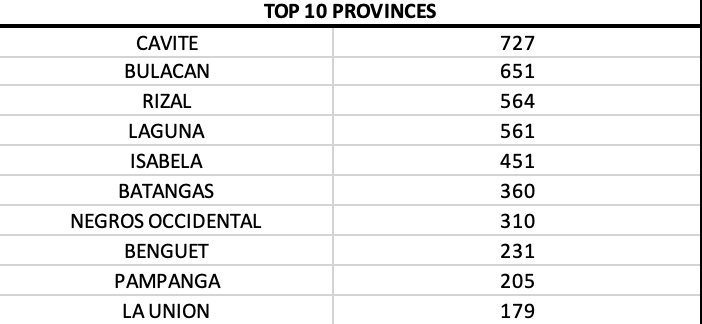
On a provincial level, Cavite continues to lead followed by Rizal and Bulacan. All the provinces in the top 10 report triple digits.


With cases averaging 10,000 daily in the country, the Philippines displaces Sweden and is behind Iraq, which is experiencing a difficult second surge as well but has an average of 7,000 new cases daily. Lower than the 7-day average of the Philippines.

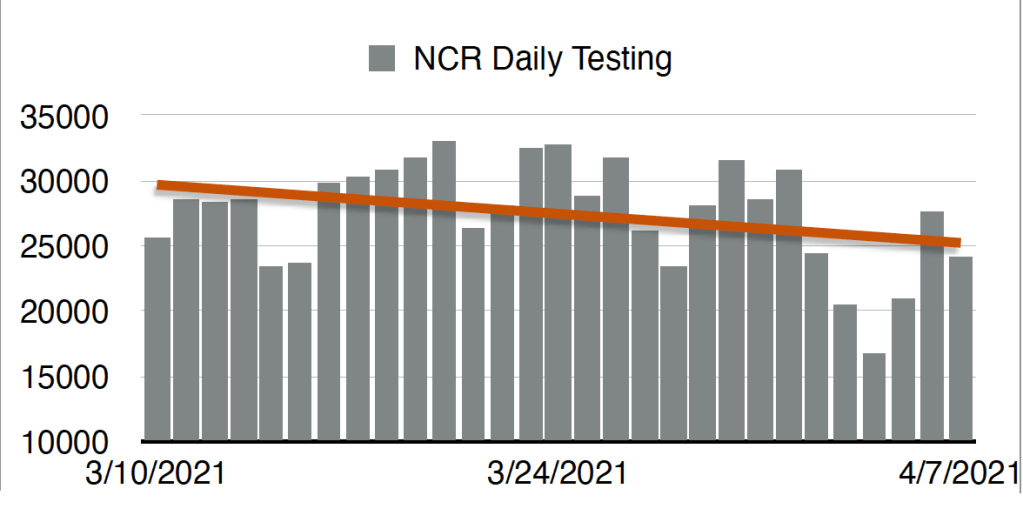
The weekend summary shows the current testing capacity of the Philippines. Note the fewer daily COVID-19 tests conducted within the week interval because of the Holy Week holiday and the share of COVID-19 tests that are positive has skyrocketed past the 5 percent acceptable mark.

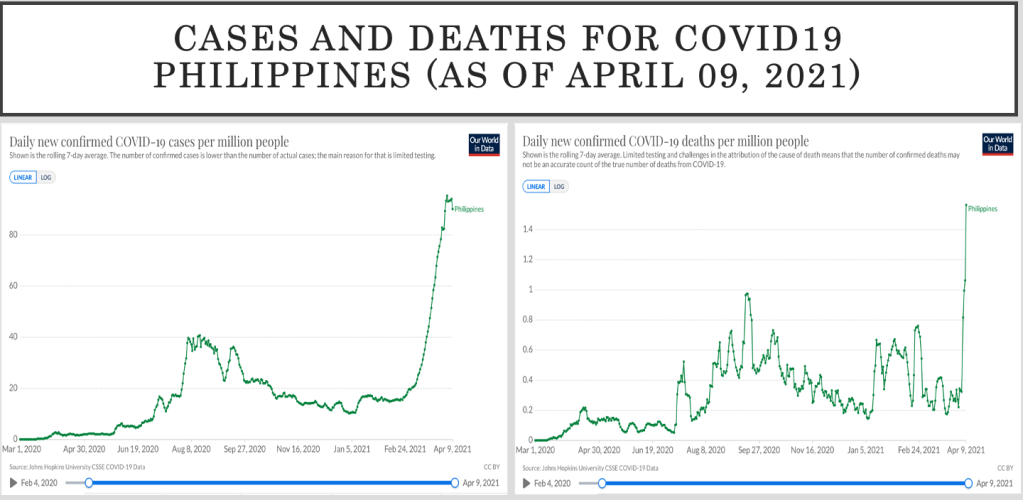
On cases and deaths from COVID-19, the Philippines also sees a large sudden peak for deaths and cases. Cases, however, see a tinge of decline, again due to the fewer reports due to the fewer testing done during the Holy Week holiday.

The graph below provides an overview on how select Asian neighbors are faring compared to the Philippines in the COVID19 pandemic.

The PH now ranks 28th globally with 12,674 new cases on 04.10.2021

With 12,674 new cases announced today, this is actually the highest number of cases recorded for a single day in the second surge of the pandemic in the Philippines. The 15,280 cases on April 02, included carry over of more than 3,700 backlog cases from the previous days, making the actual total cases recorded for April 02, 2021 at 11,601. This pushes the total active cases now to more than 190,000 and the total number of cases in the country to 853,209. With a positivity rate of still more than 20 percent (with more than 50,000 samples tested daily in the past several days), we will most likely see more than 10,000 cases daily in the upcoming week.

New deaths reported was 225 today. Healthcare capacity is at alarming capacity with 86 percent of ICU beds and 69 percent of isolation beds now occupied.

As the world shoots past 135 million COVID-19 cases and close to 3 M deaths from COVID-19, the Philippines moves up another rank to number 28, displacing Israel. As the numbers rack up, we will most likely displace Sweden for 27th spot tomorrow.

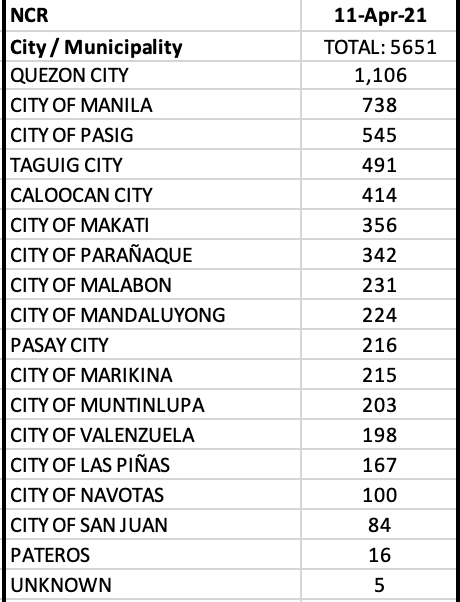
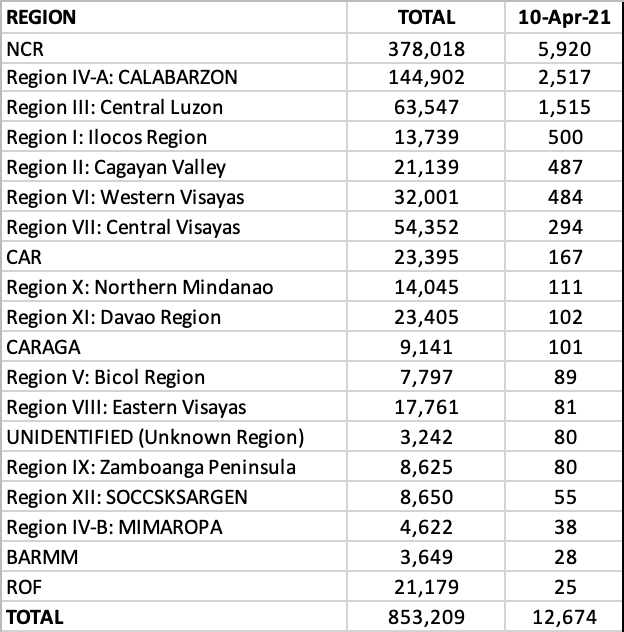
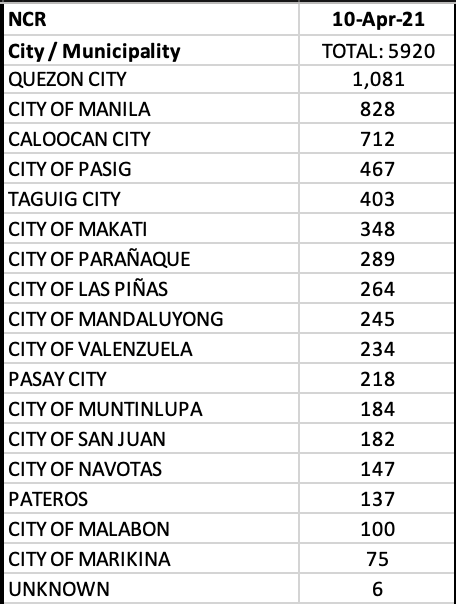
While NCR continued to lead with 5,920 (46.7 percent) of the total cases in the country, CALABARZON (2,517), Central Luzon (1,515), Ilocos Region (500), Cagayan Valley (487) and Western Visayas (484) accounted for more than 90 percent of the total cases today. There were 80 cases with no known location on a regional level, while there were 25 ROFs.

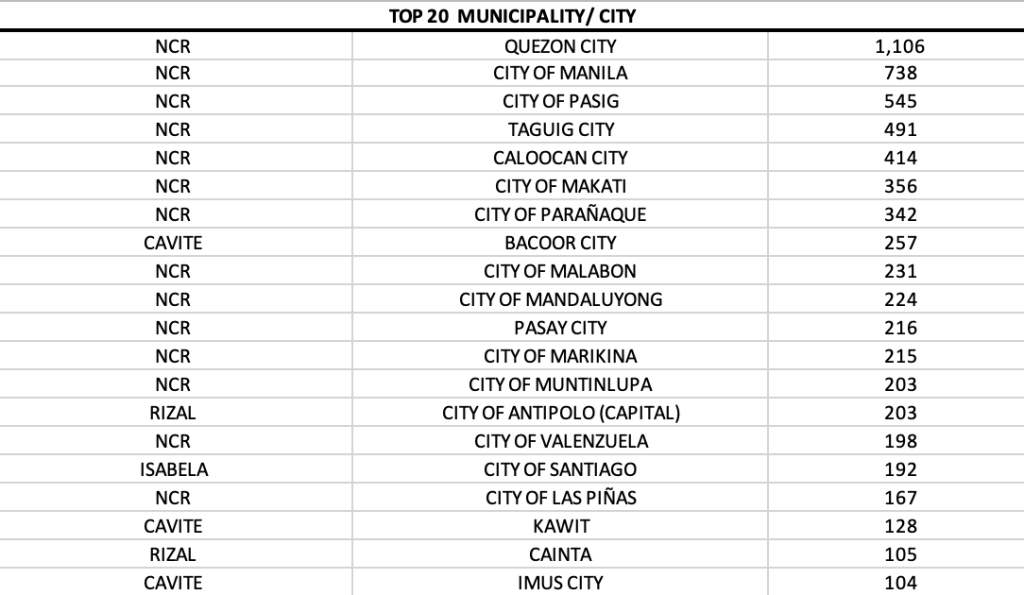
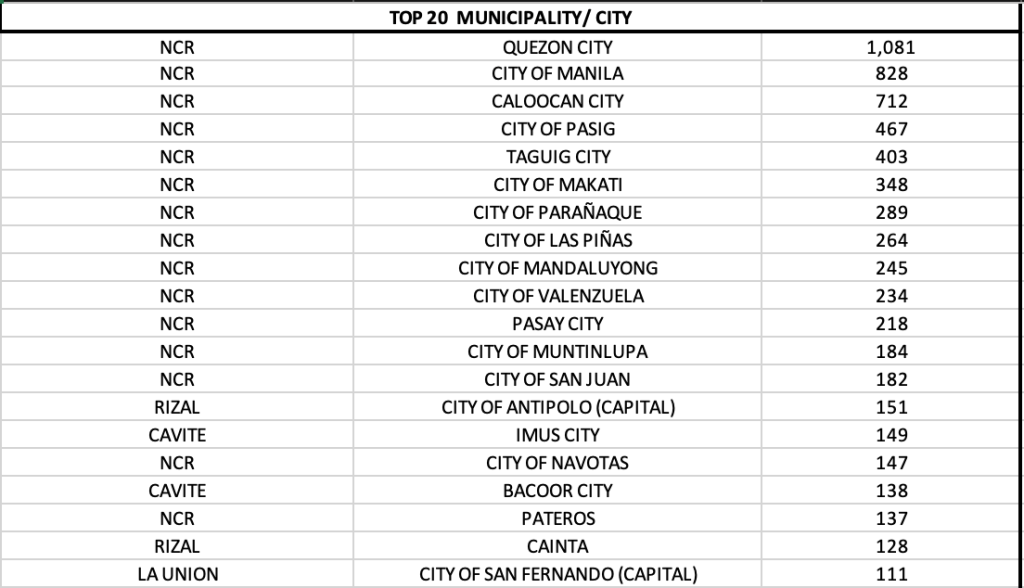
In the National Capital Region, Quezon City, Manila and Caloocan City were the top contributors responsible for over 44 percent of the cases in Mega Manila. Only the city of Marikina posted double digit cases. Fifteen of 17 cities in the NCR were in the top 20 cities with most cases for the day.

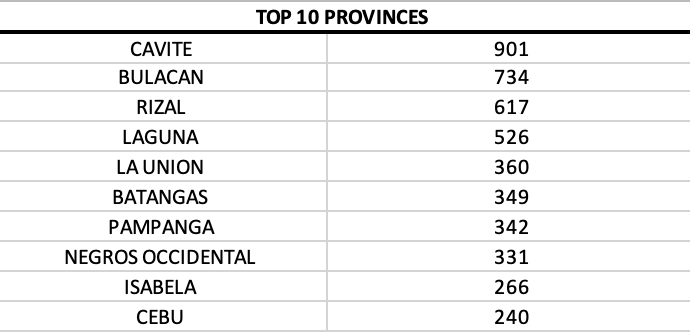
On a provincial level, Cavite, Bulacan, Rizal and Laguna had more than 500 new cases for the day. The fewest number of cases among the top ten provinces was Cebu, with 240 new cases.

401 deaths, 12,225 cases as the PH records a grim day on 04.09.2021

One of the grimmest day came ironically on Valor Day, otherwise called the fall of Bataan in the past, as the Philippine records the highest number of deaths in a single day with 401 and 12,225 new cases. Majority of the cases come from NCR, followed by CALABARZON, Central Luzon, Cagayan Valley and CAR. While the reproduction rates are lower this week at 1.24, the total number of new daily cases are plateauing only at the higher boundaries. Which means that if I have for example 12,500 daily cases but a Rt of 1.0, I will still have 12,500 daily cases in subsequent days. And it will take time for the number of cases to significantly drop because the reproduction rate is still above 1.0.

The number of active cases are now close to 180,000 as the Philippines passes more than 840,000 total cases. The positivity rate is still above 20 percent and the hospital ICU beds and isolation beds are past the critical level.

The OCTA Research Monitoring Update report gives the public an overview on the current situation in the Philippines after 2 weeks of ECQ. The reproduction rate has decreased, but it simply means that the new cases have simply slowed down in the increase and not decreased in actual numbers.

During this period, the NCR was averaging lower tests per day (19 percent less than the average over the week before ECQ). This means that we may not be seeing the complete picture of the ongoing pandemic.

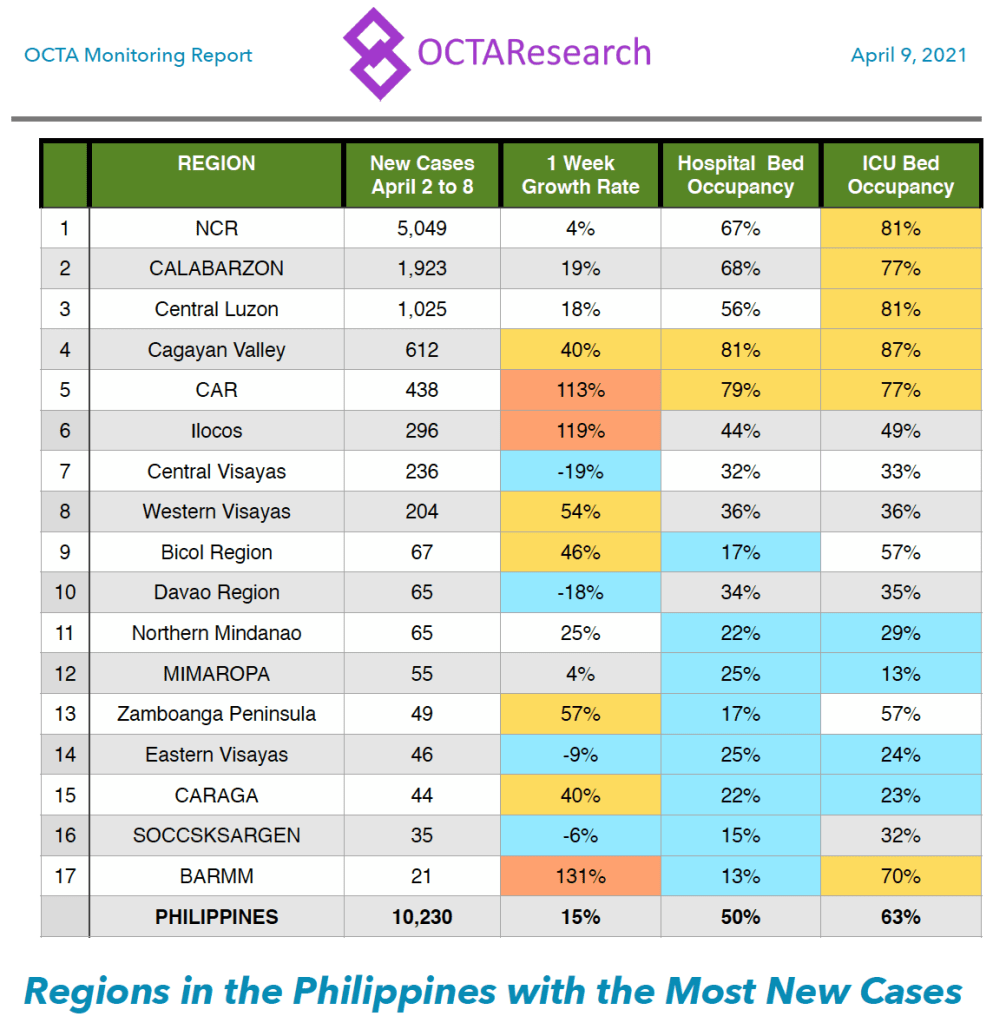
The table below shows the regions in the Philippines with the most new cases for the week April 2-8, 2021, the growth rate of cases in the week, hospital bed occupancy and ICU bed occupancy.

The regions with the highest single week growth rate are BARMM (133 percent), Ilocos (119 percent), and CAR (113 percent). Moderate growth is seen in Cagayan Valley, Western Visayas, Bicol Region, Zamboanga Peninsula and CARAGA. The greatest impact of the surge is on the ICU bed occupancy in the NCR, CALABARZON, Central Luzon, Cagayan Valley and CAR – the top 5 regions in the country with most cases.

The top twenty cities with most cases are tabulated below and show that only Muntinlupa City in Mega Manila is seeing the highest growth rate at 68 percent, while many of the LGUs have shown a large decline in growth rate (note in blue the negative decline). ICU occupancy is already filled up to 80-100 percent in 15 of the 20 top LGUs.

In the meantime, the breakdown of the 12,225 cases for today were as follows:

  1. NCR, CALABARZON, and Central Luzon accounted for 77.5 percent of the total cases today with 9,489 cases. Nine other regions reported triple digits.
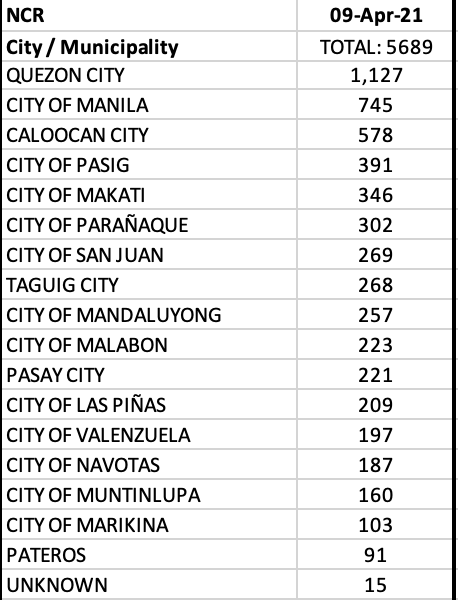
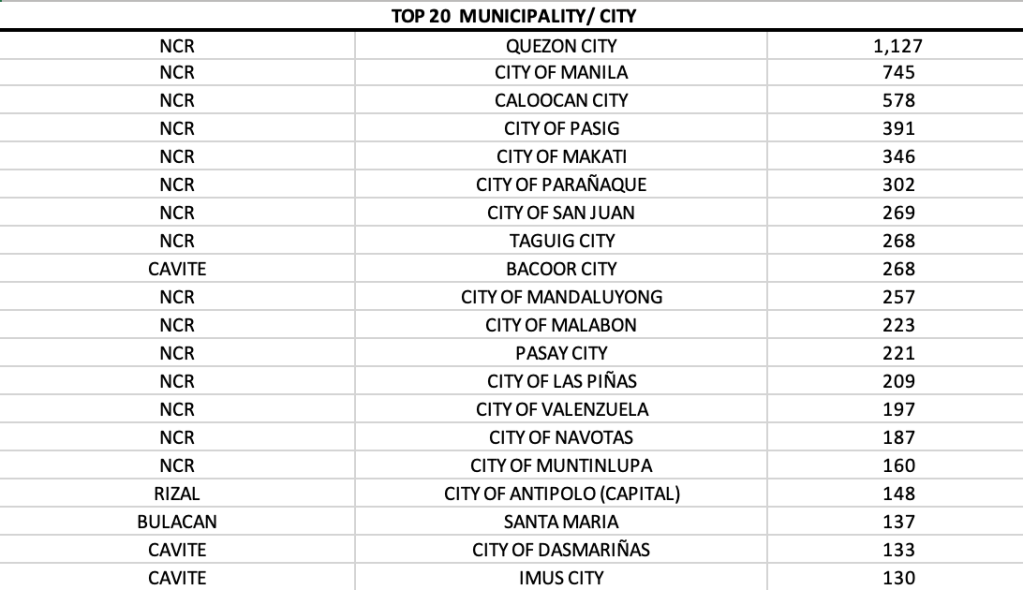
  2. Quezon City led with 1,127 new cases followed by Manila with 745 cases and Caloocan with 578. 16 of 17 LGUs had all triple digits. Fifteen of 17 LGUs were in the top 20 cities with the most cases. Muntinlupa Cities, while reporting only 160 cases had the highest growth of cases among all LGUs in the NCR.
  3. Cavite for the first time saw quadruple digits with 1,005 new cases followed by Bulacan (632) and Rizal (541).
  4. All top ten provinces reported triple digits.

PH has more than 20% active cases, the data for 04.08.2021

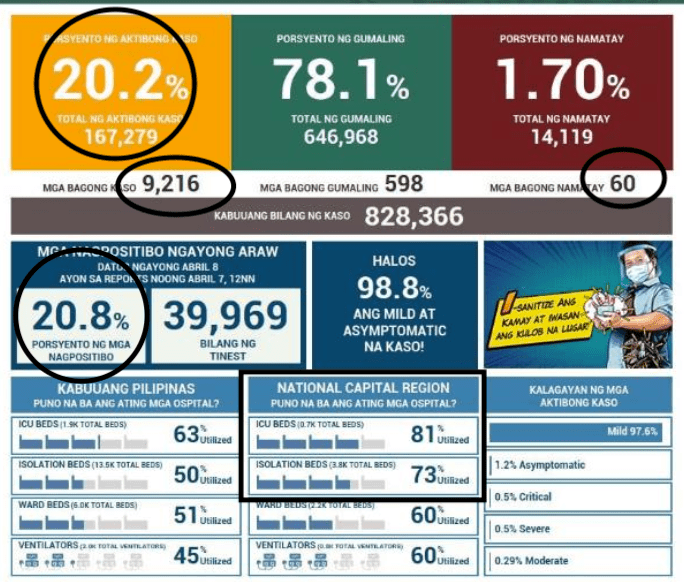
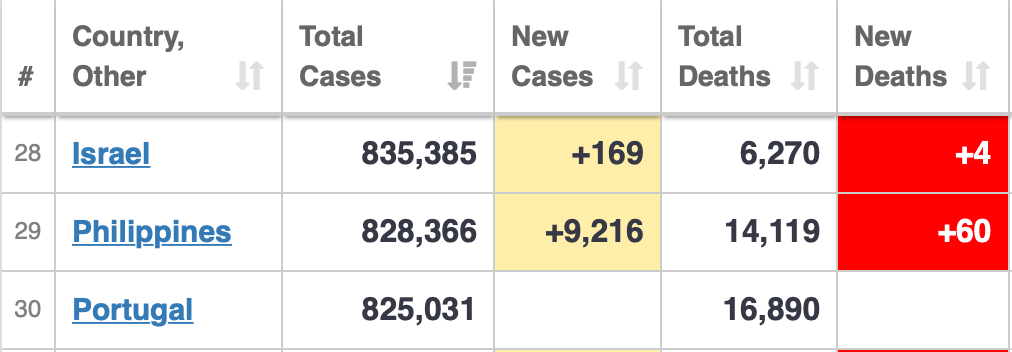
With 9,216 new cases announced by the Health Agency today, the total number of active cases are closing in to 170,000 (or 20.2 percent). The highest on record. There are now 828,366 total cases as the Philippines quickly overtakes Portugal for 29th rank in the world. Will we most likely overtake Israel tomorrow and move up to rank 28? Highly likely.

Positivity rate remains above 20 percent and ICU beds are at 81 percent utilization rate and isolation beds at 73 percent utilization rate as well.

There are 60 new deaths announced today.

Todays data drop showed NCR (4326), CALABARZON (1824), Central Luzon (995) and Cagayan Valley (586) account for 84 percent of the total cases for today.

In the National Capital Region, Quezon City and Manila continue to lead among the LGUs with 740 and 685 cases, respectively. Fourteen of the 17 LGUs in NCR were among the top 20 cities with the most cases.

On a provincial level, Cavite continued to lead with Rizal and Bulacan having more than 400 cases. All the top 10 provinces had triple digits.

242 new deaths for 04.07.2021

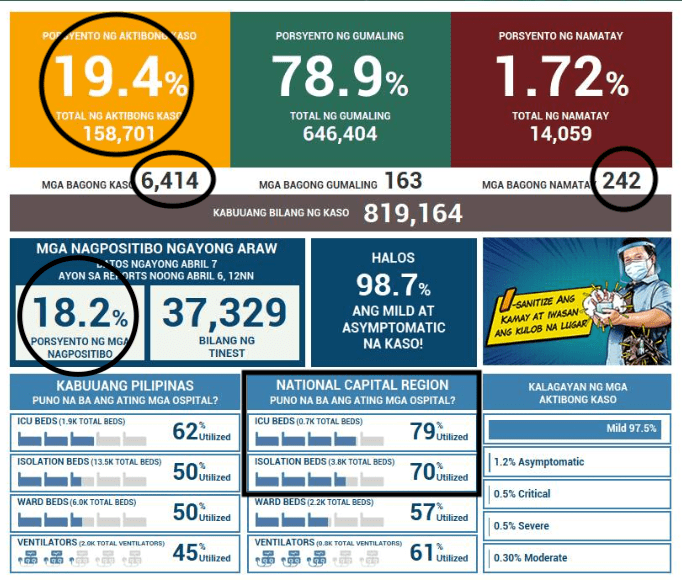
Tuesdays and Wednesdays regularly report lower cases. As mentioned before, there is a 2 days lag in the announcement of the Health Agency on new cases. Today they announced 6,414 new cases. However, the DOH also states that the reason why the numbers are low, is that the number of samples submitted for testing was also fewer last April 5, 2021.

The bad news is the announcement of deaths. From 1.7 percent case fatality rate, we now jump to 1.72 percent as 242 new deaths were reported today, bringing the total deaths past 14,000.

While the positivity rate is a bit lower at 18.2 percent, this is still relatively high for the country.

The healthcare capacity remains overwhelmed with ICU beds at 79 percent and isolation beds at 70 percent – both past the critical mark.

The growth in number of cases considerably declined in the National Capital Region, as reported by the OCTA group in their weekly Monitoring Update.

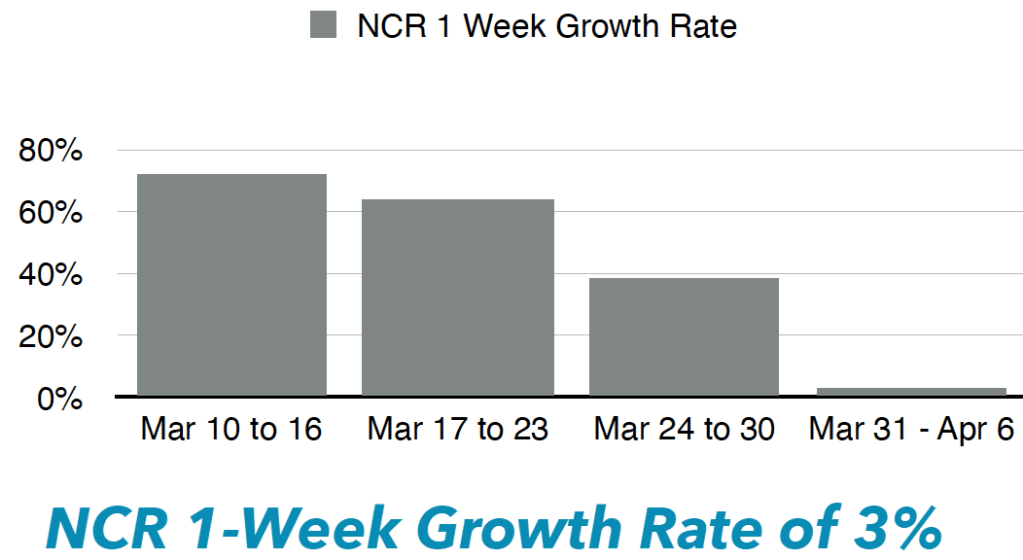
The reproduction number in the NCR decreased to 1.43 for the week of March 31 – April 6, while the reproduction number in the Philippines was up at 1.45. The average number of new COVID-19 cases reported per day in the NCR was 5,146 over the past week, with a one week growth rate of just 3 percent. During this period, the NCR is averaging 24,000 tests per day, 17 percent lower than the previous weeks average. This means that we are not seeing the complete picture with respect to growth rate and trends, and once data come in this week, there will be corrections in the findings.

OCTA Research, Philippine COVID-19 Update, April 7, 2021

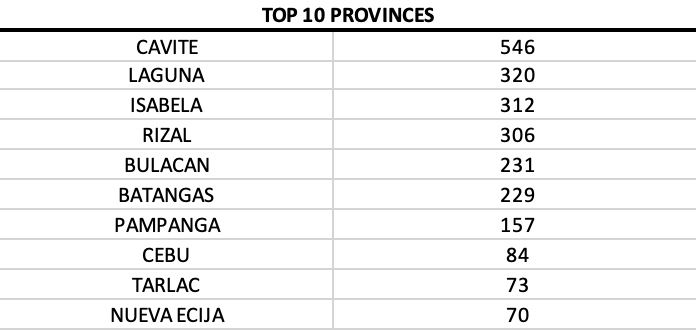
The top ten regions/provinces in the country with new cases are provided in the table below. While new cases have decreased significantly in Cebu, cases in Isabela and Benguet have increased significantly. The ICU capacity in various regions and provinces in the top 10 have breached the critical level capacity (70 percent) set by the Health Agency.

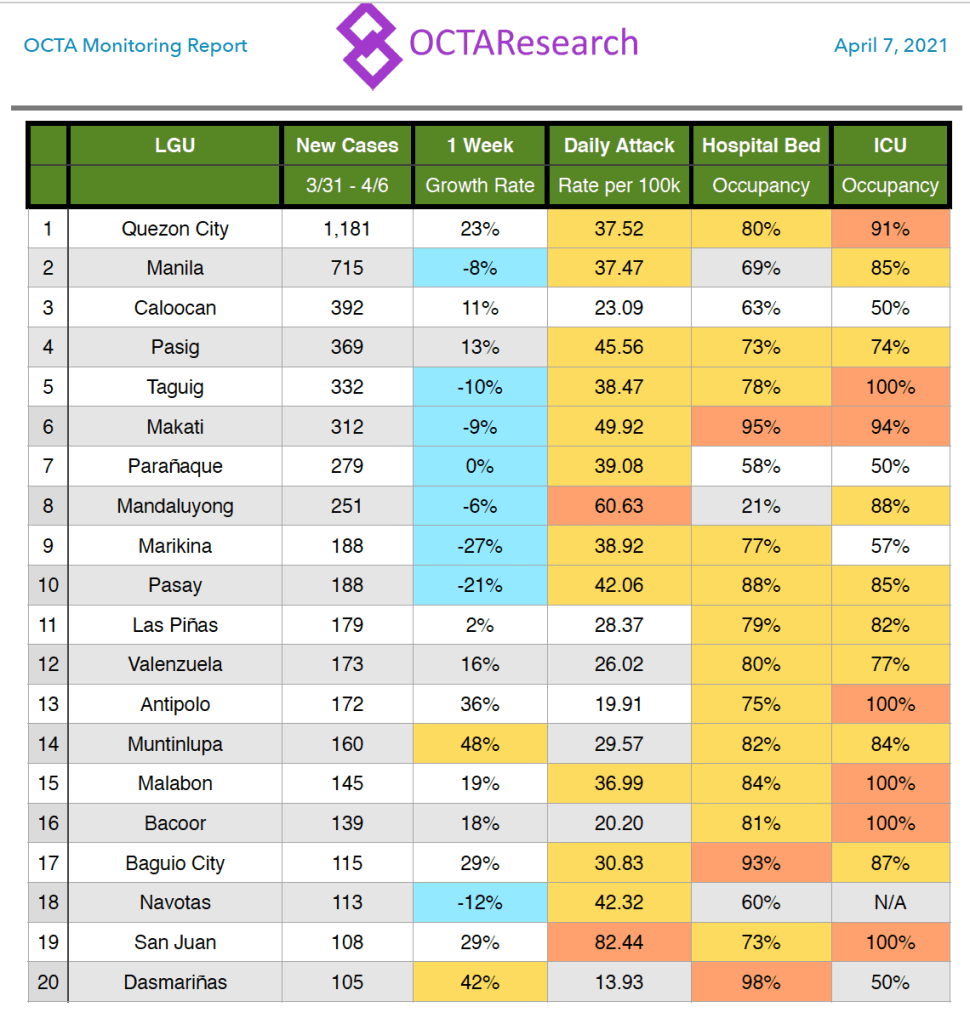
Among the top 20 cities with highest cases in the Philippines, notice that many LGUs are seeing a slowing down in the growth rate. The highest growth rate in cases has shifted to some LGUs which have never seen significant rise of cases. These are: Muntinlupa City (48 percent) with the highest growth rate in all LGUs in the country followed by Dasmariñas City in Cavite (42 percent). ICU and bed occupancy are mostly past 80 percent in 13 of the 20 top cities.

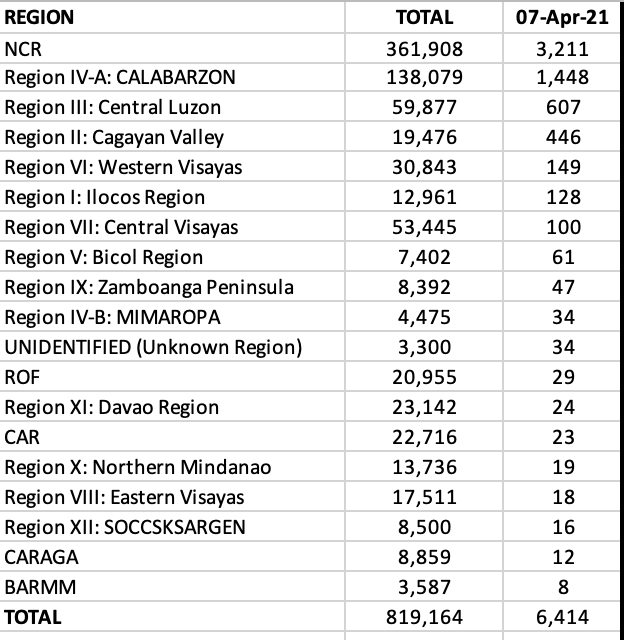
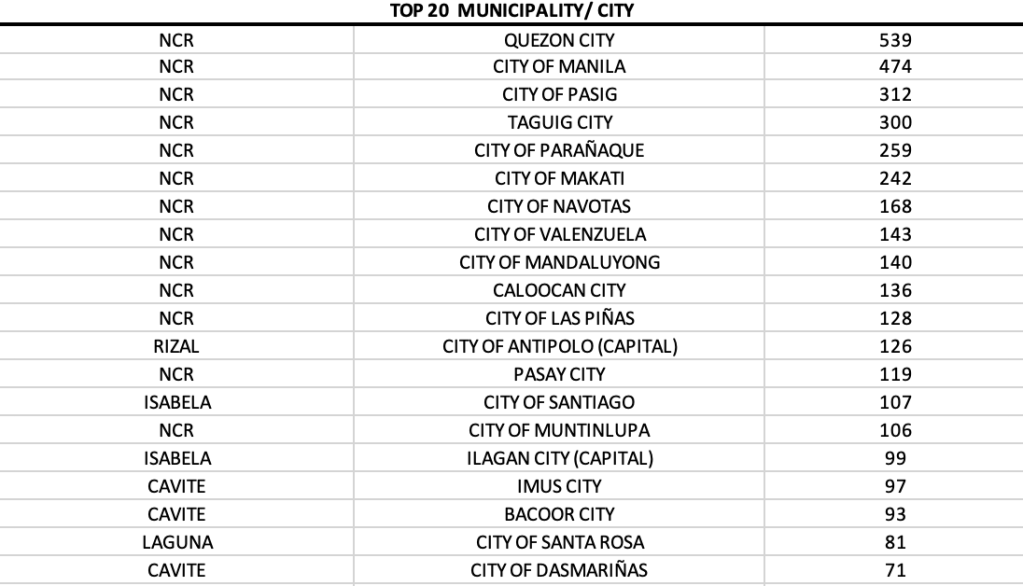
NCR accounted for half the total cases for today with 3,211 cases. Together with CALABARZON (1,448), Central Luzon (607), and Cagayan Valley (446), these four regions hauled 84.4 percent of the cases for the day. There were 34 cases with unknown locations on a regional level, while 29 were ROFs.

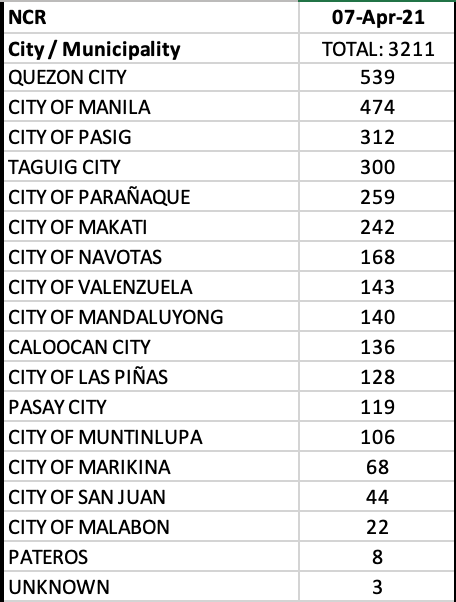
In the National Capital Region, some of the LGUs were seeing lower cases today because of the lower samples tested in the country in general and in Mega Manila in particular. Thirteen of 17 LGUs in NCR were among the top twenty cities with most cases for the day.

On a provincial level, Cavite is back on top, with Laguna, Isabela, and Rizal with more than 300 but less than 400 cases.

382 new deaths reported on 04.06.2021

Today marks the highest number of deaths reported in a single day in the Philippines as the Health Agency announces 382 new deaths (of which 341 occurred prior to April 2021). The highest deaths recorded in the country were on two occasions – September 14, 2020 (258 deaths) and February 20, 2021 (239 deaths). As mentioned in past posts, deaths may take quite some time to occur because of the long duration of illness among those that are severe or critical. In addition, reported deaths are validated thoroughly and may take quite some time to report as due to COVID-19 as the cause of death or other co-morbid diseases.

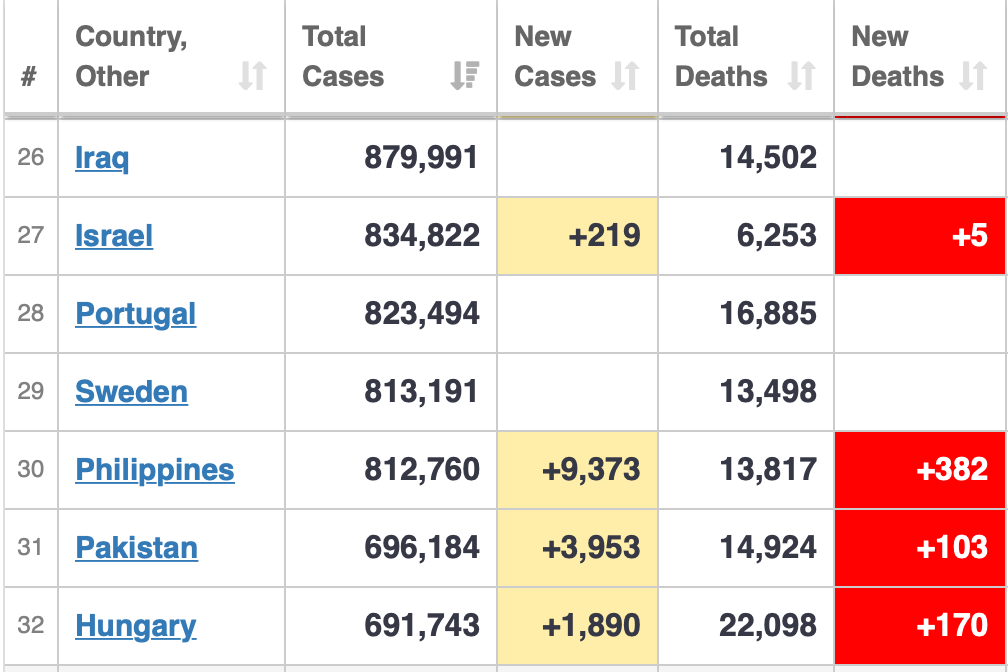
Tuesdays and Wednesdays usually report lower cases. There were 9,373 new cases reported today, pushing the total cases now to 812,760. Note, however, that the positivity rate is still at 20 percent and the healthcare capacity is at an alarmingly high level. ICU beds are 82 percent occupied in the National Capital Region, while isolation beds are at 71 percent. On a national scale, the ICU beds are at 63 percent capacity already.

We will most likely overtake Sweden and settle for 29th spot after the 4PM count tomorrow. In the global tally below, at the rate the number of new cases are being reported daily, we will most likely overtake Portugal and Israel before this week ends.

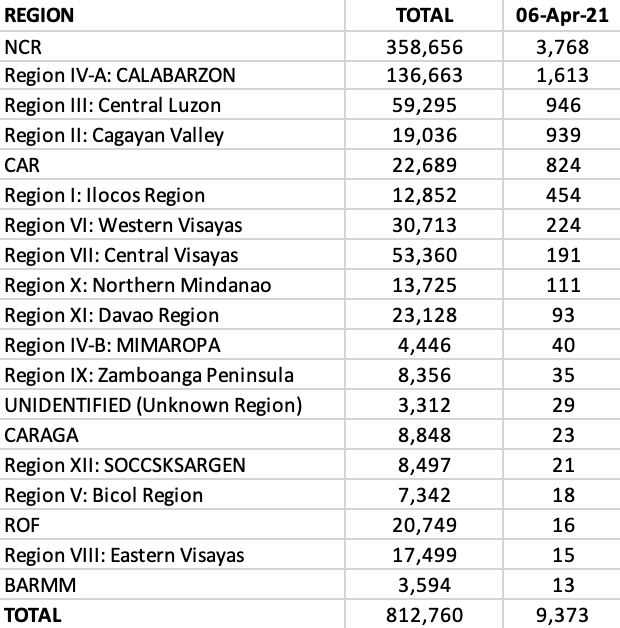
NCR as usual posted the highest number of cases for the day with 3,768 new cases (or only 40.2 percent) for the day. CALABARZON had 1,613 (17.2 percent) and Central Luzon 946 (10.1 percent). It was Cagayan Valley (939 new cases) and CAR (824 new cases) that contributed to the haul for the day. These five regions in Luzon accounted for 86.4 percent of the total cases of the day.

In NCR, it was Quezon City that continued the lead with 906 cases followed by Manila (629). The surprise of the day? Muntinlupa City which reported 216 cases and shot up to 6th place among all cities in the Philippines including all LGUs in the Mega Manila. Thirteen of 17 LGUs were among the top 20 cities with most cases.

Isabela was the overall leader on a provincial level with 601 new cases, overtaking Cavite. Notice that the rankings on a provincial had significantly shifted to the northern part of Luzon, extending to Benguet, La Union, Cagayan and Mountain Province.