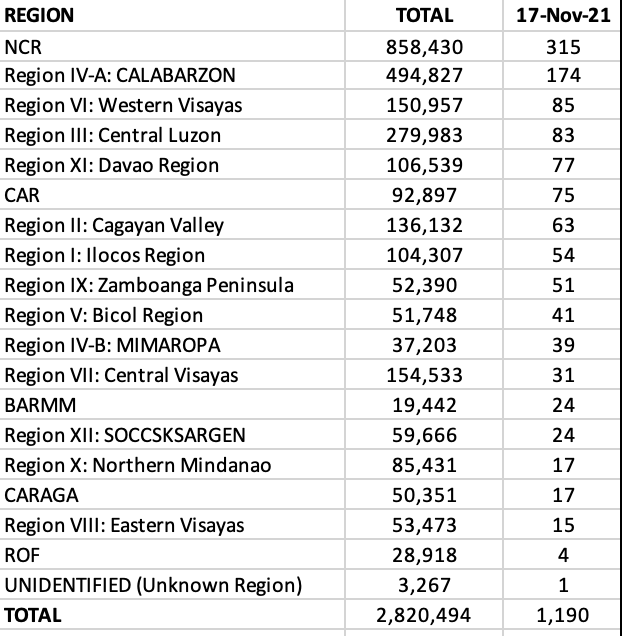
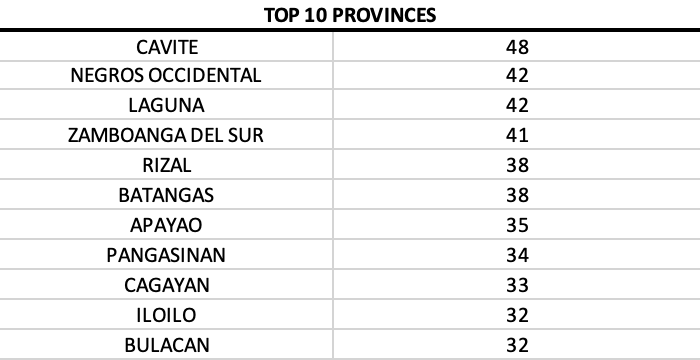
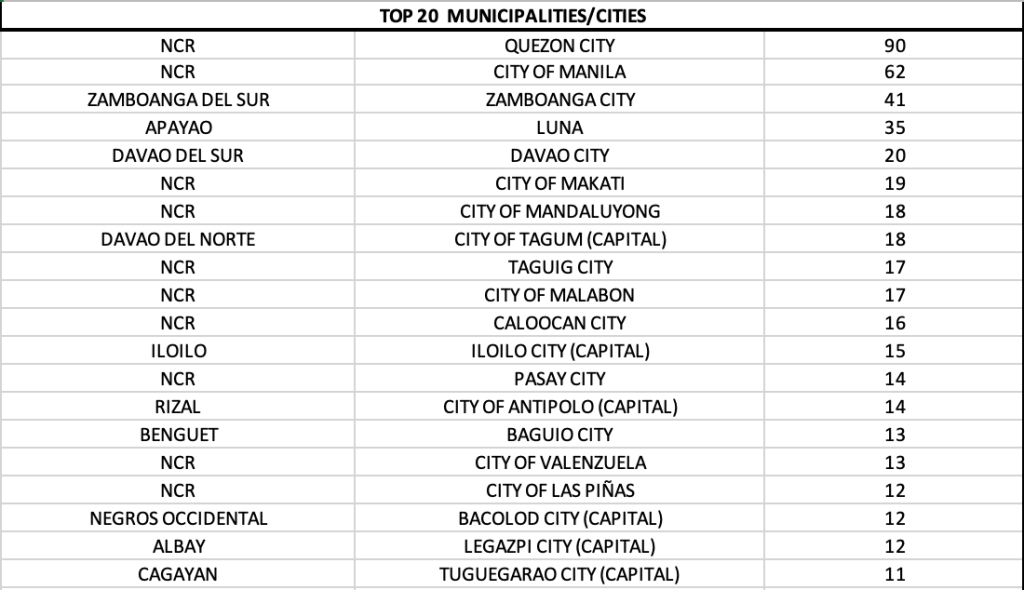
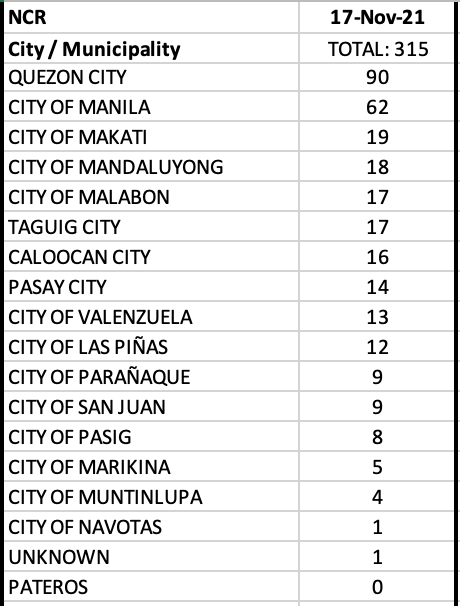
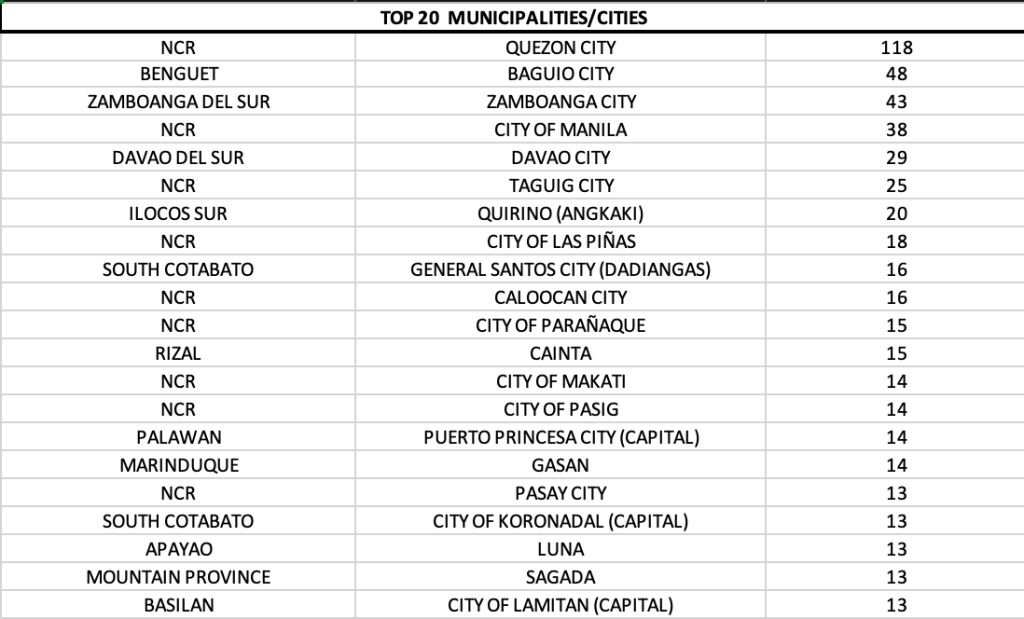
It’s been awhile since we have seen triple digits. The last time we reported cases in triple digits was December 2020. The lowest recorded for the month of December 2020 was 756 on December 28.
The Health Agency announces 849 new cases today, as there are more recoveries, only a little more than 25,000 active cases are left in the tally. The cases today are based on a little more than 28,000 tests done on Sunday, November 14. Positivity rate was 3.2%.
Among the active cases, 35% are moderate to critical. That’s more than 8,900 individuals. Critical and severe cases are at 16.4%.
There are 99 new deaths added today.
While the total COVID-19 cases in the country slowed down (because it is a Tuesday), it was the NCR that accounted for almost 1/4 of the total cases today. This may be due to the fact that NCR is the densest, smallest, yet most populous region. It also has most of the testing facilities in the country (almost 50%), meaning more testing is done.
The continuing saga of Quezon City is the story of the data today. While NCR reported 207 (of the 849) cases today, it was Quezon City that went far and beyond with owning 114 (55%) of the cases in NCR. The LGU in the NCR that came in second was the City of Manila, with 14 cases. For today alone, more than 13% of the cases came from one LGU – Quezon City.
The fewest cases among cities/municipalities in the top 20 list today was 7. Meaning if your LGU had 7 cases, it would be in the list.
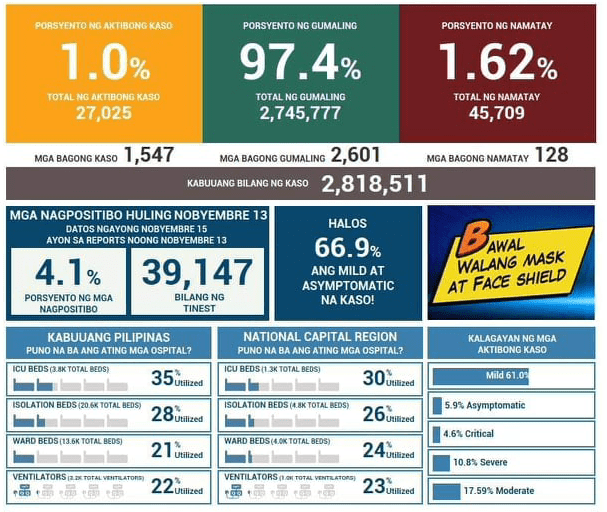
The week begins with 1,547 new cases based on reports last November 13 or close to just 40,000 tests and a positivity rate of 4.1%. The active cases drop to 27,000 but so do the mild and asymptomatic, which now comprise only 2/3 of the total active cases. That means that 1/3 of all the active cases are moderate to critical. That’s still close to 9,000 patients.
Another 128 new deaths are added today.
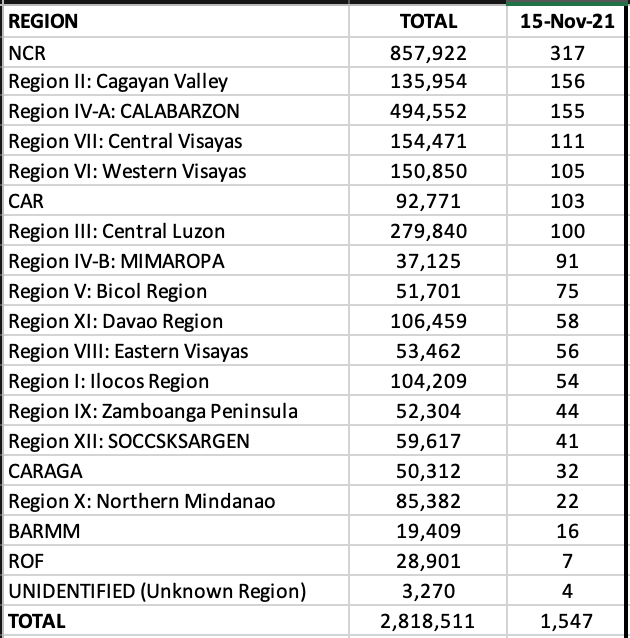
NCR continued to lead among all regions with more than 20% of the total share for today with 317 cases. It had more cases than the combined cases of Cagayan Valley and CALABARZON. Fewer regions are now reporting triple digits.
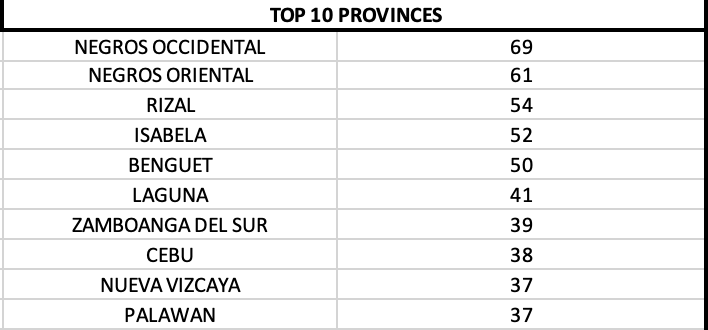
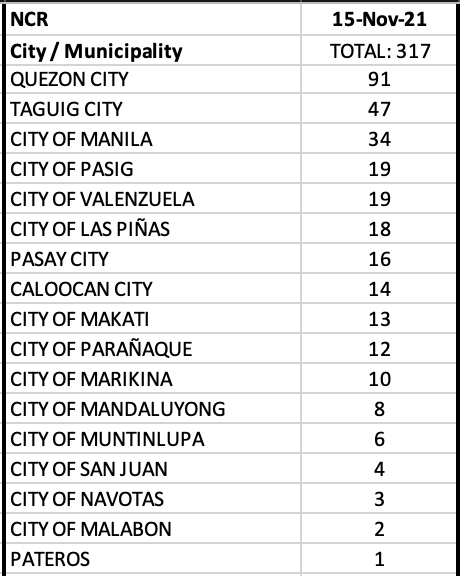
Quezon City has continued to lead among LGUs in new cases reported. Today, it reported 91 cases or almost 30% of the total cases in Mega Manila. Without Quezon City’s numbers, the number of cases in the NCR would have been significantly lower. This LGU had higher cases than any of the provinces in the top 10 list for the day.
The good news is that 9 of 17 LGUs in NCR were in the top 20 LGUs with most cases for the day. The fewest cases for today is 13. Meaning if your LGU recorded 13 cases, it would be in the list.
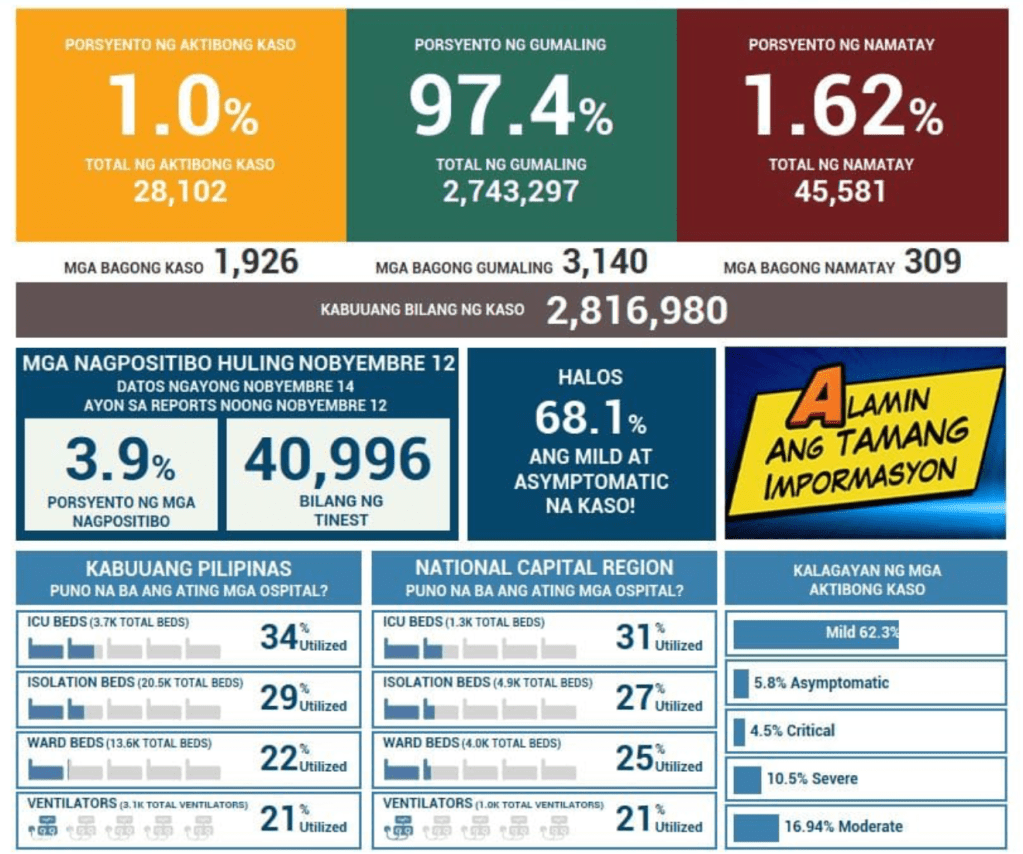
While the Health Agency reports a tad lower cases with 1,926 new cases, the number of active cases fall to a few notches above 28,000. This is based on reports from November 12 where close to 41,000 tests with 3.9% positivity rate was registered.
As the total active cases dip, the moderate to critically ill continue to contribute to close to 32% of the total share. That means that 8,964 cases fall in this class. Critical and severe comprise 15% of the total active – 4,215 to be exact.
A record week high in number of deaths with 309 newly announced deaths today.
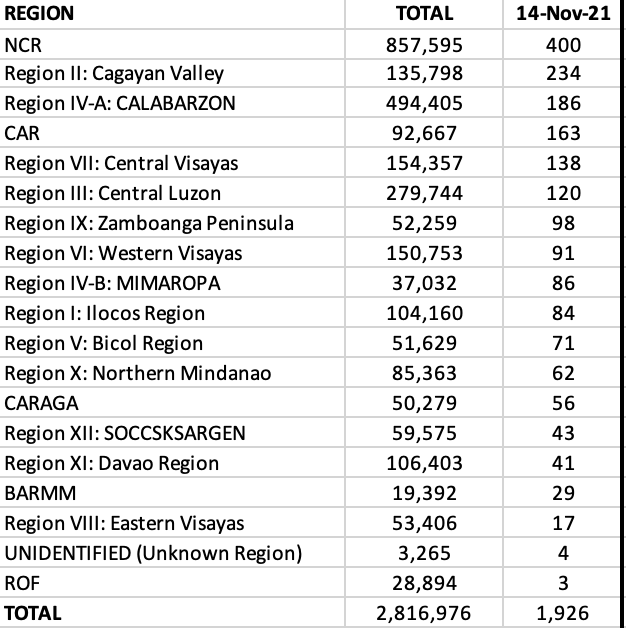
NCR has been owning a greater share of the cases in the country the past week. With R up at 0.54 (+/- 0.05), it now averages about 20% of the total cases (1 in 5) in the country daily. Cagayan Valley came in second and CALABARZON in third.
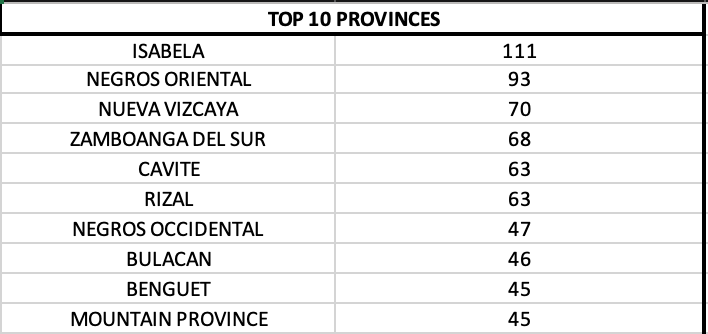
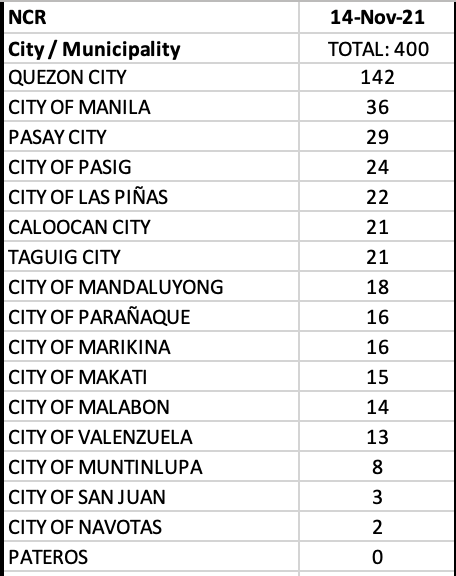
It was Quezon City that continued to pour in cases for the National Capital Region with almost 36% (142) of the cases today. As a matter of fact, only Quezon City had numbers that equaled the total cases of Zamboanga City, Solano (Nueva Vizcaya) and the City of Manila combined. Quezon City also had almost 4x the total cases of the City of Manila, second among the LGUs in NCR with most cases.
The fewest cases in the top twenty LGUs in the country today was 16. Which meant that if the LGU had 16 or more cases, it would be in the list.
THE WEEK IN REVIEW
With the sudden downgrading to alert level 2 in most places in the Philippines, the decline in cases slows down as the economy attempts to recover during the last quarter of the year. And while the cases are lower now, one should take into context that testing has also decreased in the country. When mild and asymptomatic cases do not get tested, there is a rise in the more moderate to severe (and critical) disease. And that’s not good because contact tracing is affected. Which means that we may most likely be seeing an artificial drop in cases because only those that have more severe clinical presentations get tested.
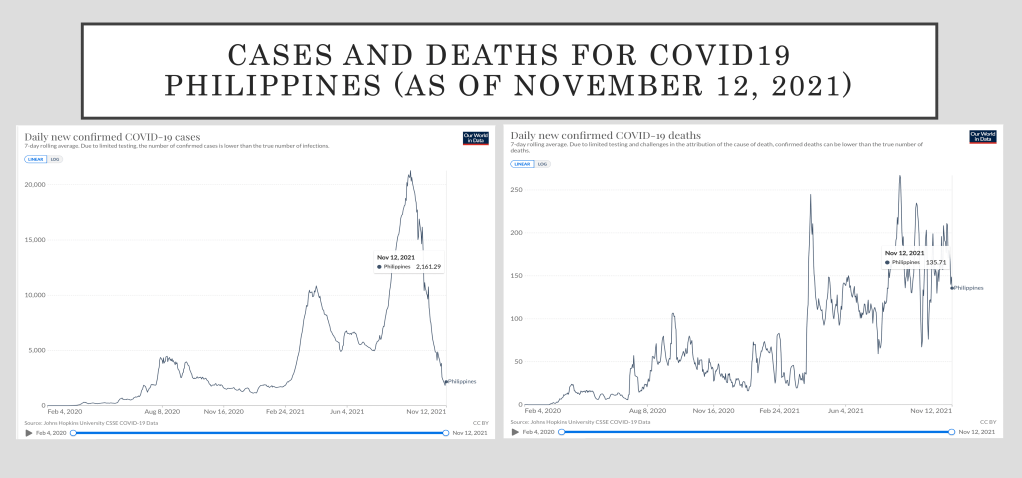
The 7-day average of cases drops to a little above 2,000 cases/day, while deaths continue to fluctuate.
Which isn’t too shabby when compared to the other countries in select Asian region. Singapore and Malaysia continue to lead with triple digits per million population, while the Philippines is now lower at 19 cases/M. The major envy of course is with Indonesia and Japan – two more populous countries than the Philippines – and yet seeing single digit per capita cases per million. Indonesia now reports 1.47 and Japan 1.48 case/million population!
When put together side by side, notice how cases, tests, positive rate and reproduction rates are lower in the Philippines currently. There is significant decline in all these parameters.
And when compared to the same select Asian countries described above, other countries are still grappling with existing conditions. Singapore for example has not only the highest cases per capita but also has the highest positivity rate at 17.1% in the region. It has also decreased testing capacity compared to Malaysia. Reproduction rate is highest now in Vietnam (it was highest with South Korea last week), as other countries see a decline in R and the Philippines recording the lowest R for the week as of November 10.
Note, however, that the Philippines has the fewest number of people tested in this region with 3-4 tests done per 10,000 people. And that can provide an artificial look at gains, especially when more of the people being tested are only those who end up being hospitalized. It would have been a great story for the Philippines had the positive test rate been the way it is (or even lower) with higher number of people getting tested. This would mean that contact tracing is robust.
In the meantime, this is how the numbers end for the week.
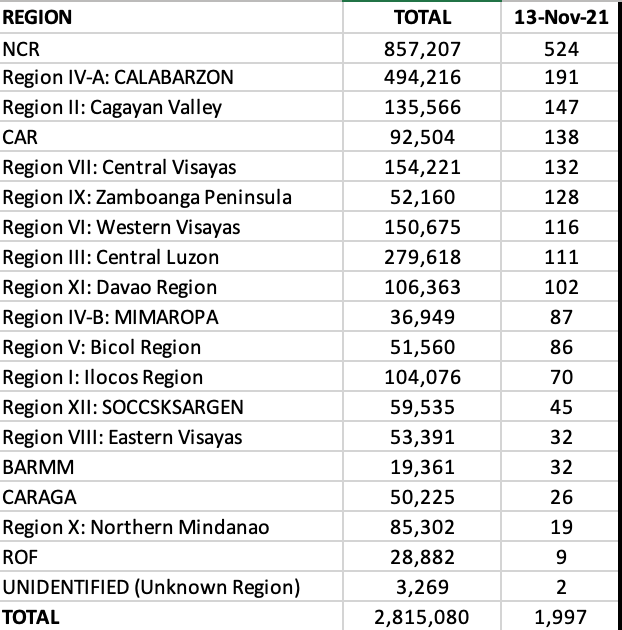
The Health Agency reports 1,997 new cases today based on close to 46,000 tests done last November 11 with a 4.5% positivity rate. Active cases are less than 30,000.
The puzzle in the infographic data is that more than 30% are moderate to critical among the active cases. That means more than 9,000 patients fall in this category. But even taking the severe and critical patients alone – that would mean 14.4% of the total cases fall in this category. That’s 4,231 cases among the active cases. Based on the infographic, there are 3,800 ICU beds in the country and only 36% are utilized or 1,368 of it is occupied. Where are the 2,863 patients in the severe and critical category?
The agency needs to provide an answer to the apparent discrepancy in health care utilization in the country as more moderate to critical cases are being recorded.
Additional 238 new deaths were reported today.
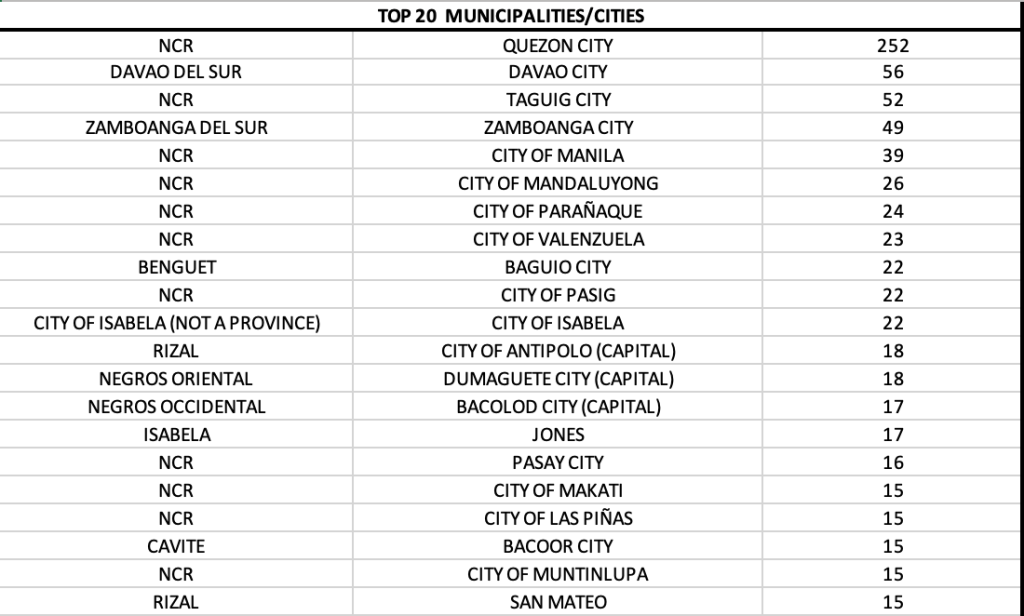
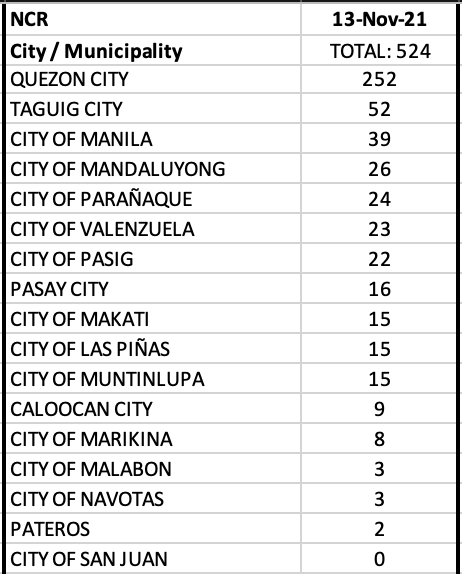
NCR outnumbered all other regions accounting for more than 26% of the total cases in the Philippines today. That means that more than 1 out of 4 cases in the country were from NCR alone. The shocker of the day? Almost half the reported cases were from Quezon City. It outstripped regions and provinces with an astounding record high of 252 reported cases. One in 8 cases in the country reported today was from Quezon City alone.
OCTA RESEARCH MONITORING
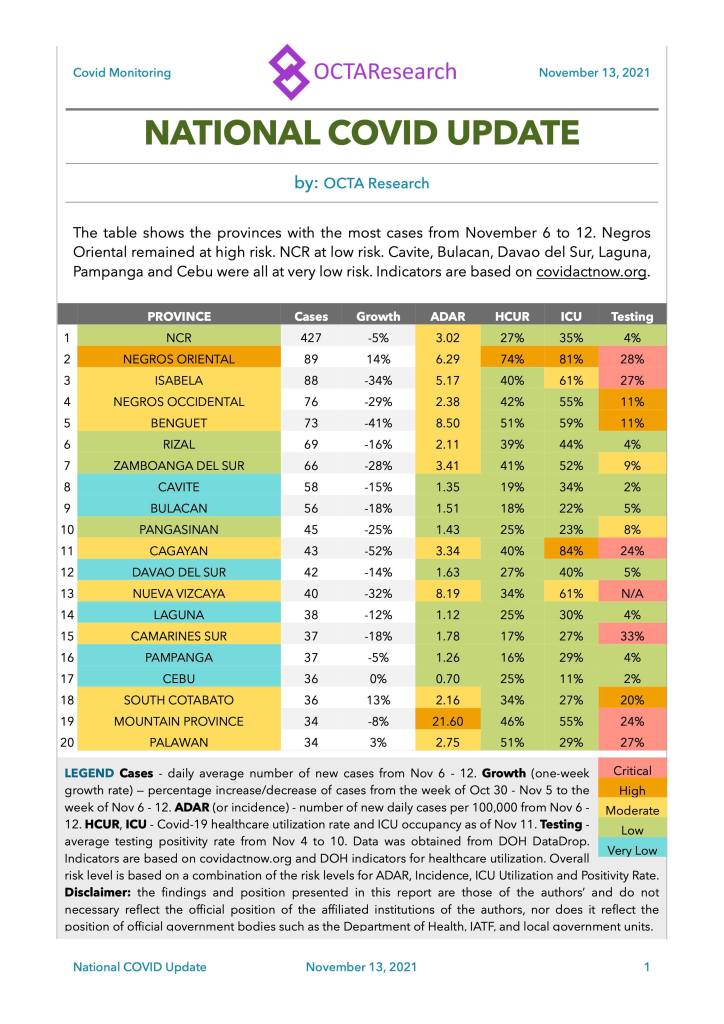
Update from the OCTA Research Group for COVID Monitoring is provided today. The top twenty provinces (including NCR) are mostly seeing a decline in growth rate, but the growth rate of NCR had significantly slowed down this week to -5% only. Several provinces like Cavite, Bulacan, Davao del Sur, Laguna, Pampanga and Cebu have very low risk based on the average sum of indicators used to classify risk – ADAR, Health care utilization, ICU rate (according to government data), and positivity testing. Notice that there are many provinces that still have critical and high risk rating in the positivity rates. Among all the provinces, Negros Oriental remains at high risk in all major indicators.
While the total new patients were slightly lower today than yesterday, the positivity rate for 43,591 tests done on November 10 was up at 5.5%. There is a lack of around 500 patients from the data of November 10.
The Health Agency reports 1,894 new cases today. The active cases remain less than 30,000.
ICU utilization rate and healthcare utilization is lower, both nationally and the National Capital Region.
Another 170 deaths were reported, pushing the deaths now past 45,000 with a case fatality rate for outcomes at 1.61%.
The NCR accounted for 22.4% of the total cases in the country. For the second consecutive day, it reported for than 20% of the total national cases or 1 in every 4-5 new cases in the Philippines was from Mega Manila. NCR had more cases than Cagayan Valley and Central Visayas combined.
Negros Oriental remained the only province to report triple digits on a provincial level.
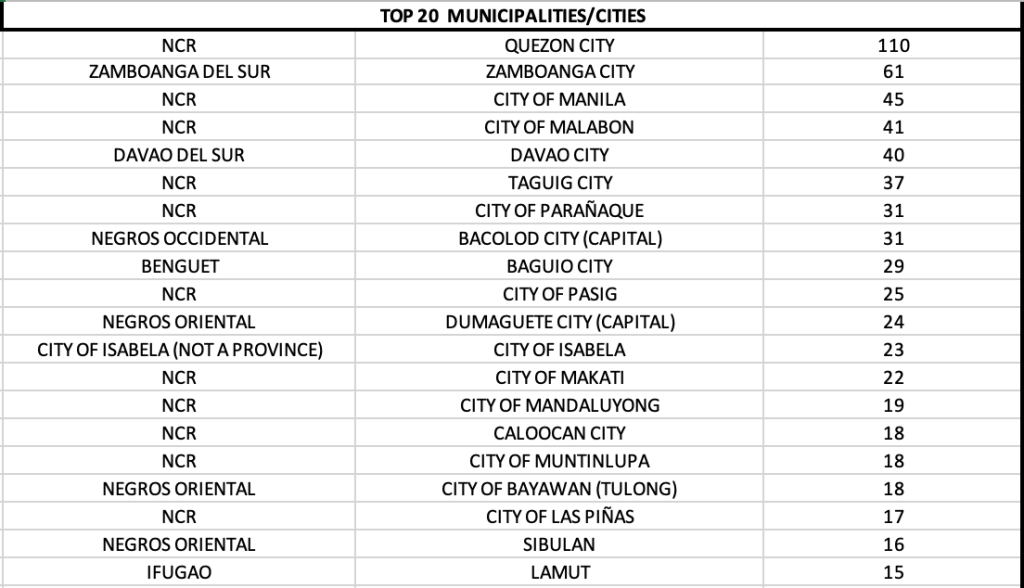
While among LGUs, Quezon City was on top with 110 cases and accounted for more than 25% of the total cases in Mega Manila. Which meant that for every case in NCR, one was from QC. Eleven of 17 LGUs in the NCR were in the top 20 list as the fewest number of cases today was 15. Which meant that if you LGU had 15 cases, it would be in the list.
There were fewer cases today than yesterday as backlogs were included in the tally.
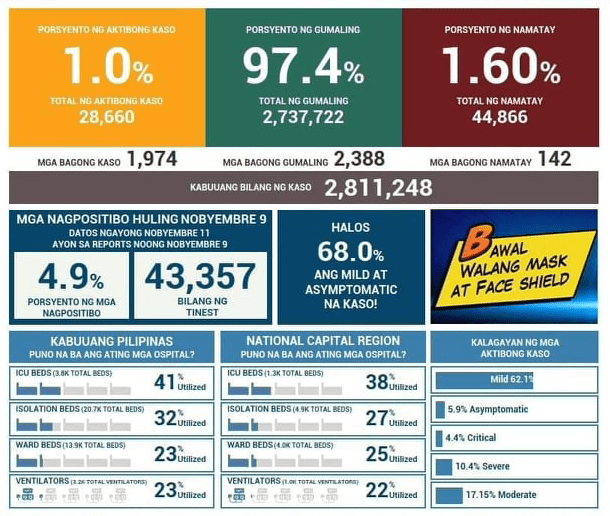
Today, the Health Agency reports 1,974 new cases based on more than 43.000 tests done last November 9 with a 4.9% positivity rate. This is the second straight day with positivity rates < 5%.
With more recoveries, the active cases are now down to a little more than 28,000. Around 9,000 plus active cases are anywhere from moderate to critical.
A total of 142 new deaths were announced today.
The NCR continued to lead with 445 new cases today and a share of 22.5% of the total cases in the country. As the cases in other regions continue to decline, more than 1 in 4-5 cases in the country are from Mega Manila. While 8 regions reported triple digits, they were less than 200 cases apiece.
Negros Oriental was the only province that reported triple digits.
On an LGU level, 11 of 17 LGUs from NCR were among the top 20, with the small city of Muntinlupa jumping to fourth spot in the country. Fewest number of cases for the day was 15. Which meant that if your LGU had 15 cases, it would be part of the top 20 list.
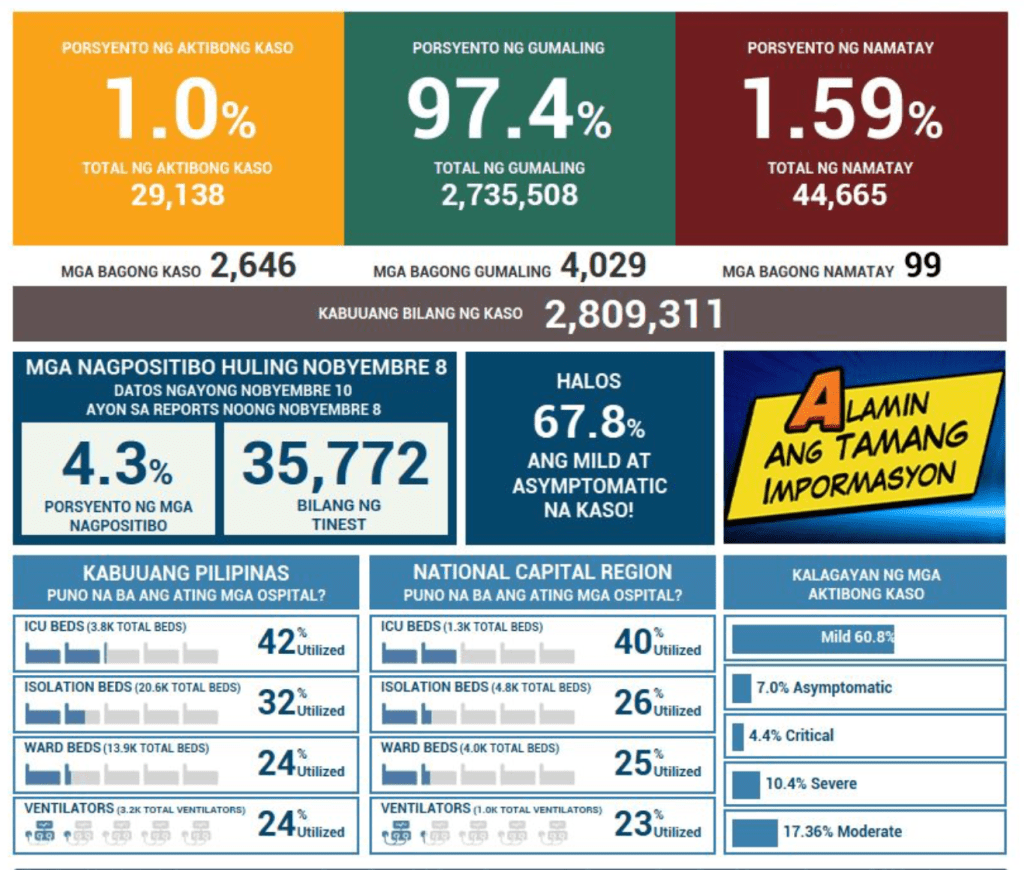
At first you’d get surprised at the sudden leap in numbers as the Health Agency reports 2,646 new cases today. The increase in numbers today most likely included backlogs form the past week and days.
For the first time, the Philippines records a positivity rate less than 5% (4.3%) with 35,772 tests done on November 8, 2021.
With more recoveries than cases, the active cases now dip below 30,000. However, one-third of the remaining active cases are moderate to critical as the mild and asymptomatic are at 67.8%. That means almost 10,000 of the active cases are moderate to critical.
As expected, the numbers will always be lower on Tuesdays. Today, the Health Agency reports 1,409 new cases from reports last November 7 where more than 30,000 tests yielded 5.4% positivity rate. This also brings down the 7-day average to less than 2,000 cases/day.
The slowing down of the cases is reflected also in the lower active cases which is not at a tad above 30,000.
Another 46 deaths was reported today.
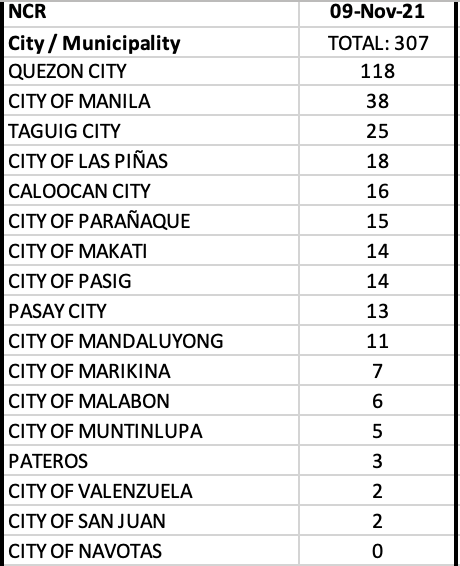
NCR had a very bad day today. With only 1,409 new cases in the country, NCR contributed to 22% of the total cases with 307 cases. Four other regions reported triple digits but had a little more than 100 cases only.
On a provincial level, all provinces continued to report double digits but at low numbers.
It was Quezon City that continued to report triple digits with 118 new cases or almost 40% of the cases in NCR alone. Nine of 17 LGUs in NCR were in the top 20 list with the least number of cases in the top 20 at 13 for today. Which means that if your LGU saw 13 cases, that LGU would be among the top 20 cities/municipalities with most cases.
It is a good start for the week considering that more than 43,000 tests were done last November 6 with a positivity of 5.2%.
The Health Agency announces 2,087 new cases with a decrease in active cases to a little more than 32,000.
The ICU utilization rate, however, is up in the National Capital Region from a previous of 37% to 40% currently as more unvaccinated individuals continue to fill the critical care facilities. Notice that as the active cases decline, there are less mild and asymptomatic individuals (70%). The remaining 30% of the 32,077 cases are either moderate, severe or critical. That’s almost 10,000 people in this category.
There were 91 new deaths added today.
NCR owned almost 19% of the total cases today with 388 recorded. Cagayan Valley came in second with 232 cases, while six regions reported more than 100 cases but less than 200.
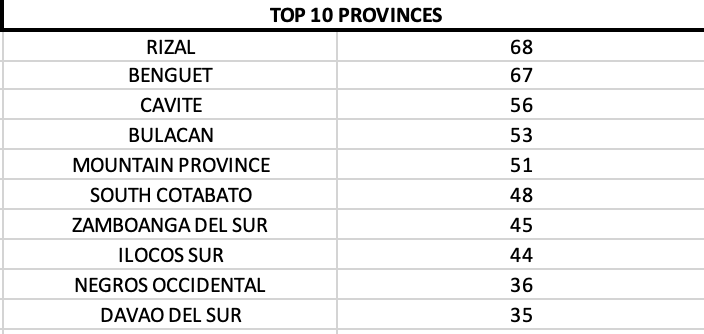
While Negros Oriental continued to lead on a provincial level, the cases are lower today with ALL provinces in the top 10 reporting only double digits.
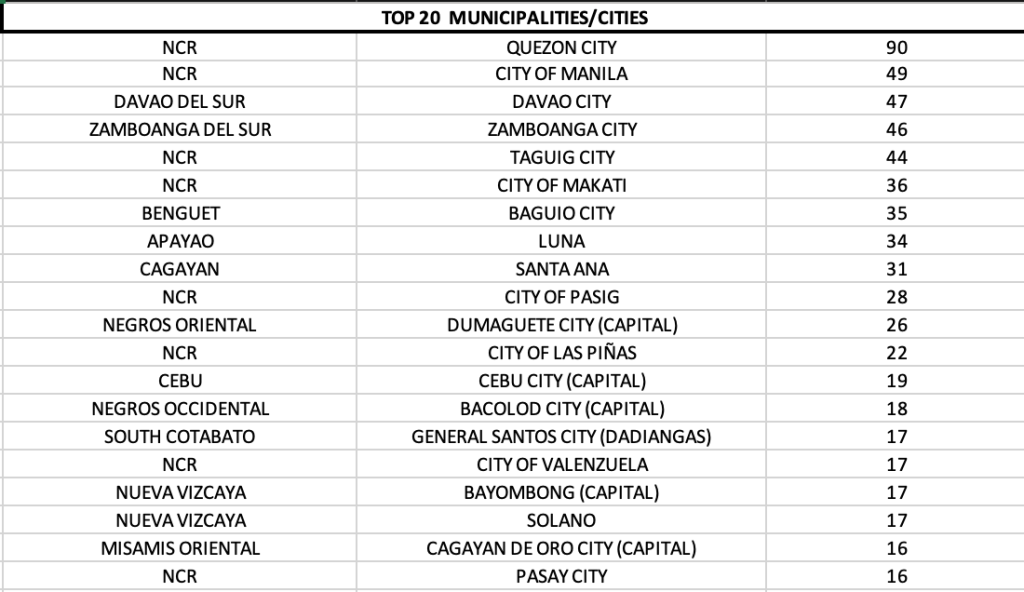
Quezon City reported 90 cases, accounting for 23% of the total cases in NCR. Again, none of the LGUs reported triple digit cases. All other LGUs, except for Quezon City, reported less than 50 cases. Eight of 17 LGUs in NCR were in the top 20 list. The lowest number of cases among LGUs was 16 for today (much lower than the 19 yesterday). Which meant that if your LGU had 16 cases, it would be included in the top 20 list.
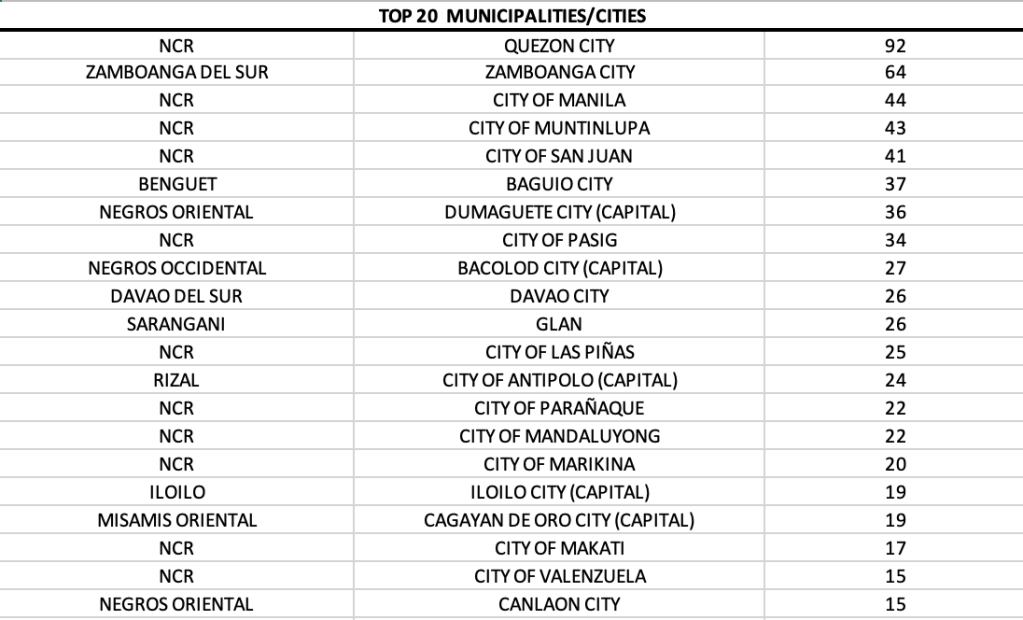
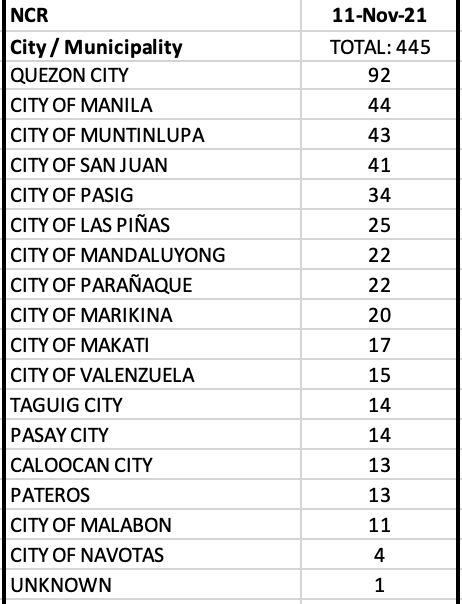
The weekend ends with 2,605 new cases announced by the Health Agency based on 48.450 tests done last November 5 with a 5.2% positivity rate. This puts us a few cases lower than the previous day. With slightly more recoveries than cases, the active cases are down to a little more than 33,000.
There were 191 new deaths announced today, pushing the 7-day average deaths to still greater than 200/day and the case fatality rate for outcomes at 1.59%.
The NCR logged 409 new cases today, accounting for 15.7% of the total cases in the country. Three regions reported more than 200 but less than 300 cases. They are: Cagayan Valley, CALABARZON, and CAR.
Isabela had the highest cases on a provincial level. Three other provinces reported triple digits – Negros Oriental, Davao del Sur, and Negros Occidental.
Zamboanga City took back the lead from Quezon City and was the only LGU that registered triple digits with 106 cases today. Ten of 17 LGUs in NCR were in the top 20 LGUs with most cases. The fewest cases in the top 20 list was 18 cases. This meant that if your LGU had 18 or more cases, your city/municipality would be part of the top 20. Six LGUs in Northern Luzon were in the top 20 list.
THE WEEK IN REVIEW
It’s been awhile since we’ve seen number of cases hit the 1,500 mark. Of course, majority of the cases are still from the National Capital Region. And yes, the positivity rate is still moderately high considering that we’re still not testing enough. But the week that ended relatively well and while the number of deaths average more than 200/day, the new cases dipped to less than 2,500 for the 7-days average as of November 6, 2021. There’s still more work to be done at bringing the cases even lower to triple digits, but the trend shows that we can.
It is, without a doubt, impossible to achieve ZERO COVID-19. But we can bring the cases as low as possible. In select Asian countries, Singapore took the weekly lead with 560 cases/M (per capita). The Philippines fell lowest among these select Asian nations to 34 cases/M population. Only Indonesia and Japan had single digit. It was a different story for deaths, however. Based again on a per capita (size of the population), Singapore led with 2.3 deaths/M, while the Philippines came in second with 1.9 deaths/M. While other countries like Indonesia may have numerically more deaths, this is not the case if you based it on the population size of the country. And the excess deaths have not even been factored in.
The infographic below shows the over-all status of the Philippines in the Delta surge. Cases have dropped and while testing has declined, so has positivity test rate. Even the reproduction rate is at an all time low at 0.63 (+/- 0.05).
Using the same parameters above in the same select Asian nations, the graph below shows how we stand compared to these countries.
Reproduction rate is highest now in South Korea as its R hits 1.24 and is seeing a rise in cases, followed by Vietnam and Singapore. The Philippines has the lowest R in the ASEAN community while it plays second fiddle to Japan, that is enjoying triple digits with R<0.5 (0.37). If the Philippines an keep an R<0.5 for 4 straight weeks, we will see numbers falls significantly. The problem is that in order to achieve this, two things must happen: (1) we must vaccinate a greater majority of the ADULT population (especially the working class), and (2) stay in Alert Level 3 even if we can be considered low risk in various indicators (ADAR, Rt, ICU utilization, and positivity tests). With the last quarter of the year at hand, it would be painful to remain at a strict lockdown because the economy will suffer. If we can get people to just even do number (1), then the metrics will turn in favor of opening the economy with less reservations.